Tag Archives: Outsourced Hedge Fund Analytics

The hedge fund industry is undergoing a series of transformations, and hedge fund managers are being forced to improve their performance in terms of alpha generation, as well as address operational complexities. All these factors have increased over the past few years, and as a result, the idea of outsourced hedge fund operations has picked up a lot of momentum. Rather than investing heavily in building an in-house team to manage operations, hedge fund managers are opting to work with outsourced hedge funds service providers to manage middle and back-office operations.

This has also been supported by a survey conducted by Deloitte, where they have released their alternative investment outlook 2024, stating that more than 70 percent of hedge funds currently outsource at least one operational function, thereby indicating a fundamental change in the way hedge funds operate.

Outsourced hedge fund models are reshaping the industry

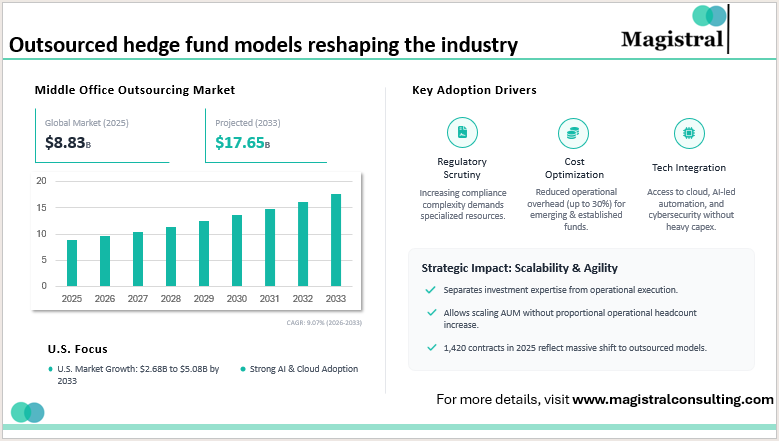
The Middle Office Outsourcing market, which was valued at 8.83 billion USD in 2025, is expected to grow to 17.65 billion USD by 2033, with a growth rate of 9.07% during 2026-2033, with 2025 as the base year. The global outsourcing market size stood at 1,420 contracts in 2025, which indicates a high level of adoption of cloud-based operating models.
Outsourced hedge fund models reshaping the industry

Outsourced hedge fund models reshaping the industry

The Middle Office Outsourcing market in the USA is expected to grow from 2.68 billion USD in 2025 to 5.08 billion USD in 2033, with a growth rate of 8.37%. This growth will be driven by digitalization, AI-led automation, and increased regulatory needs for asset managers and investment firms.

Outsourced hedge fund structures are changing the face of modern hedge fund management by decoupling investment talent from operational capabilities.

This change will allow hedge fund managers to stay nimble while growing efficiently in a competitive global marketplace.

Evolution from in-house to outsourced models

Traditionally, hedge funds have had in-house teams to handle various activities, including accounting, reporting, and compliance. However, due to increasing costs and regulatory requirements, this is no longer a sustainable option. As a result, hedge funds have started exploring alternative strategies, including outsourcing.

Furthermore, this is in line with the evolution of alternative investment strategies, including private equity, which has benefited from outsourcing operations.

Major driving factors for the adoption of outsourcing

1. The regulatory environment is becoming increasingly complex, which is driving the cost of compliance.
2. Cost optimization is still an important factor, particularly for emerging hedge funds.
3. Technology is an important factor, as integrating with existing technologies requires specialized skill sets that are not always available within the hedge fund.

These driving factors are resulting in the accelerated adoption of the outsourced hedge fund model worldwide.

Role of technology in outsourced hedge fund operations

Technology is an integral part of the outsourced hedge fund process. Cloud-based technologies, automation tools, and artificial intelligence-based analytical tools provide the outsourced provider with the ability to deliver faster and more accurate results. According to PwC’s 2025 asset management report, firms that utilize outsourced digital technologies have been able to reduce the cost of operations by as much as 30 percent.

Automation in reporting and reconciliation

Automation is used to reduce the potential for human error in reporting while ensuring the timely delivery of reports to investors. This is particularly important for hedge funds with complex portfolios comprising various asset classes.

Data security and compliance frameworks

Today, outsourcing firms heavily invest in data security and compliance systems, thereby ensuring that financial information is secure and at the same time meets international regulatory requirements.

Impact on fund scalability

The outsourced model of hedge funds enables firms to scale their operations without a corresponding rise in cost. For instance, a hedge fund that has seen its asset base double does not have to double its operational staff because of an outsourced model. This is particularly important in a fluctuating marketplace.

Outsourced hedge fund services and functional coverage

The outsourced hedge fund solutions range across a variety of operational areas, thus allowing them to outsource non-core activities while maintaining control over investment decisions.

Fund administration and accounting

Fund administration is one of the most outsourced areas in hedge funds. Fund administration includes calculating net asset value, financial reporting, and communicating with investors. According to Preqin, more than 80 percent of hedge funds utilize third-party administrators for these operations, as indicated in their 2024 data.

Financial reporting is also an important aspect of fund management strategies.

Middle office support

Outsourcing of middle office support activities such as trade processing, risk management, and performance analysis is also increasing. Such activities demand high technology and expertise and are thus good candidates for outsourcing.

Risk analytics and portfolio monitoring

Service providers use high technology for real-time monitoring of risks associated with portfolios. This helps fund managers make informed decisions regarding their portfolios.

Trade lifecycle management

Trade processing is an important activity for any investment firm. Outsourcing of trade processing is increasing due to its significance for operational reliability.

Compliance and regulatory reporting

Compliance is a major problem for hedge funds that operate globally. Outsourcing of hedge fund services provides specialized solutions for such problems and helps investment firms comply with regulations and laws of different countries and jurisdictions.

Investor relations and reporting

Investor needs have changed over time and are demanding greater transparency and quicker reporting of information. Outsourcing of hedge fund services helps investment managers maintain better relationships with investors by providing them with accurate and quicker information about the performance of the investment portfolios.

Integration with broader investment ecosystems

Outsourcing also helps investment managers to leverage other investment strategies such as venture capital, in which operational efficiency is critical for portfolio scalability.

Outsourced hedge fund benefits and strategic advantages

Outsourced hedge fund models have several advantages that go beyond cost savings and are important for the long-term success of a hedge fund.

Cost efficiency and resource optimization

One of the most attractive advantages of an outsourced hedge fund is cost optimization. Outsourced hedge funds do not have to maintain a large team of employees and do not have to invest heavily in infrastructure. According to reports, a hedge fund may achieve a cost optimization of 20-40% by outsourcing its operations.

Enhanced focus on core competencies

Outsourcing also helps hedge fund managers focus on their core competencies. This is a significant advantage for a hedge fund because a focus on core competencies is essential for the success of a hedge fund.

Access to specialized expertise

Outsourcing also helps a hedge fund gain access to expertise in different fields. This is another significant advantage of an outsourced hedge fund model.

Improved accuracy and operational reliability

Outsourced providers have access to the latest technology and tools and are better able to achieve accuracy and reliability in their operations. This is a significant advantage for a hedge fund because accuracy and reliability are essential for the long-term success of a hedge fund.

AI in Hedge Funds

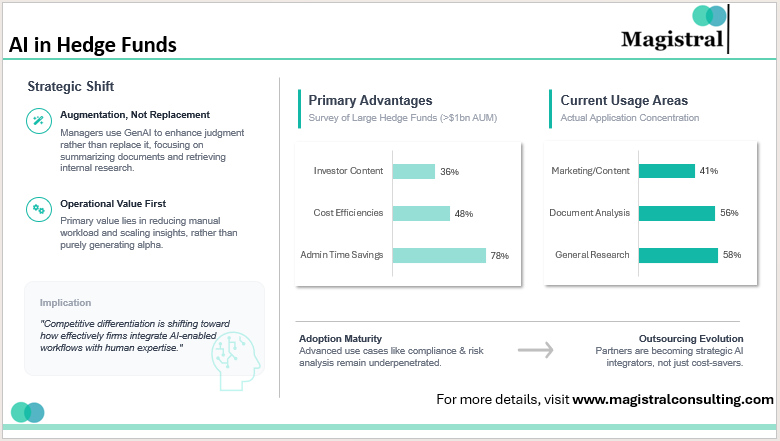
The evolution of generative AI from experimentation to infrastructure in hedge funds, specifically in areas like research, operations, and risk, has been swift. The leading hedge funds have not adopted GenAI to substitute investment judgment but to provide an additional layer to existing workflows, like document summarization, internal research, code creation, and even simulation/stress testing of portfolios. The most interesting aspect, however, lies in the fact that the most important aspect of adopting AI in hedge funds today is operational, not alpha generative. The funds have adopted AI to make their work easier, faster, and more efficient.

This can be understood from the fact that, according to a survey, 78% of large hedge funds with AUM over $1 billion find time savings in administrative tasks to be the biggest advantage of adopting AI, followed by 45-51% who find cost savings to be the most important advantage, and another 33-39% who find content creation for investor communication to be an important advantage. However, the usage of AI in hedge funds today remains more in areas like general research (up to 58%), document analysis (56%), and marketing/content enhancement (37-45%) rather than more complex front office automation. The more complex and advanced usage of AI in areas like compliance, risk, and pattern recognition remains low.
Outsourced hedge fund

AI in Hedge Funds

From a hedge fund outsourced model viewpoint, this is particularly pertinent as GenAI standardises and automates high-volume, routine activities such as research synthesis, reporting, and regulatory checks; in doing so, it naturally fits into a framework of outsourcing these activities at scale. The inference here is that competitive differentiation is moving away from these types of executional activities and more towards how effectively these firms leverage AI-driven workflows in conjunction with their human expertise – thus making outsourcing partners more strategically important rather than cost-driven.

Outsourced hedge fund support by Magistral Consulting

Magistral Consulting offers extensive support to hedge funds according to their specific needs.

End-to-end operational support

Magistral offers a variety of services for outsourced hedge fund, including fund administration, financial modeling, and investor reporting. These services allow hedge funds to operate efficiently.

Advanced analytics and technology integration

The company utilizes advanced analytics and technology to provide precise and timely information. This enables the company to perform better.

Customized solutions for diverse fund strategies

Magistral understands that every hedge fund has different operations. Thus, the company provides customized solutions for specific fund strategies.

Expertise across investment domains

The company has expertise in different asset classes, such as hedge funds, private equity, and venture capital. Thus, the company can provide holistic solutions.

About Magistral Consulting

Magistral Consulting has helped multiple funds and companies in outsourcing operations activities. It has service offerings for Private Equity, Venture Capital, Family Offices, Investment Banks, Asset Managers, Hedge Funds, Financial Consultants, Real Estate, REITs, RE funds, Corporates, and Portfolio companies. Its functional expertise is around Deal origination, Deal Execution, Due Diligence, Financial Modelling, Portfolio Management, and Equity Research

For setting up an appointment with a Magistral representative visit www.magistralconsulting.com/contact

About the Author

Dhanita is a BD and Marketing professional with 6+ years’ experience in sales strategy, growth execution, and client acquisition; credentials include Stanford Seed (Stanford GSB), an MBA from USMS–GGSIPU, and a B.Com (Hons) from the University of Delhi. Expertise spans market research and opportunity mapping, sales strategy, CRM, brand positioning, integrated campaigns, content development, lead generation, and analytics; currently oversees business development calls and end-to-end marketing operations

FAQs

What is an outsourced hedge fund model?

An outsourced hedge fund model involves delegating operational functions such as accounting, compliance, and reporting to third-party service providers while retaining investment decision-making in-house.

Why are hedge funds adopting outsourcing?

Hedge funds adopt outsourcing to reduce costs, improve efficiency, access specialized expertise, and focus on core investment activities.

Is outsourcing safe for hedge funds?

Yes, outsourcing is safe when funds select reputable providers with strong cybersecurity measures and compliance frameworks in place.

What functions can be outsourced in hedge funds?

Functions such as fund administration, middle office operations, compliance, and investor reporting can be outsourced effectively.

How does outsourcing impact investor confidence?
Outsourcing improves transparency, accuracy, and reporting speed, which enhances investor trust and confidence in the fund’s operations.

Picture a hedge fund that deals with very dynamic markets, unceasing regulatory pressure, and an influx of alternative data. In this scenario, the outsourced hedge fund analytics has become one of the most tactical moves for the enhancement of speed, precision, and investment confidence. This change is encouraged by the growing cost pressures and the desire for more quantitative insight. While the managers encounter thinner spreads and heavy scrutiny, outsourcing enables them to concentrate their internal skills on high-value areas. At the same time, leverage specialized models, alternative datasets, and scalable analytical power that organizations usually invest heavily in for internal use.

With the use of more advanced models similar to those used in real estate financial modeling, hedge funds have started to outsource as a way of acquiring specific modeling expertise in the sector without the long hiring cycles. This results in smoother deal screenings and quicker portfolio decisions.


Outsourced Hedge Fund Analytics: Market Overview

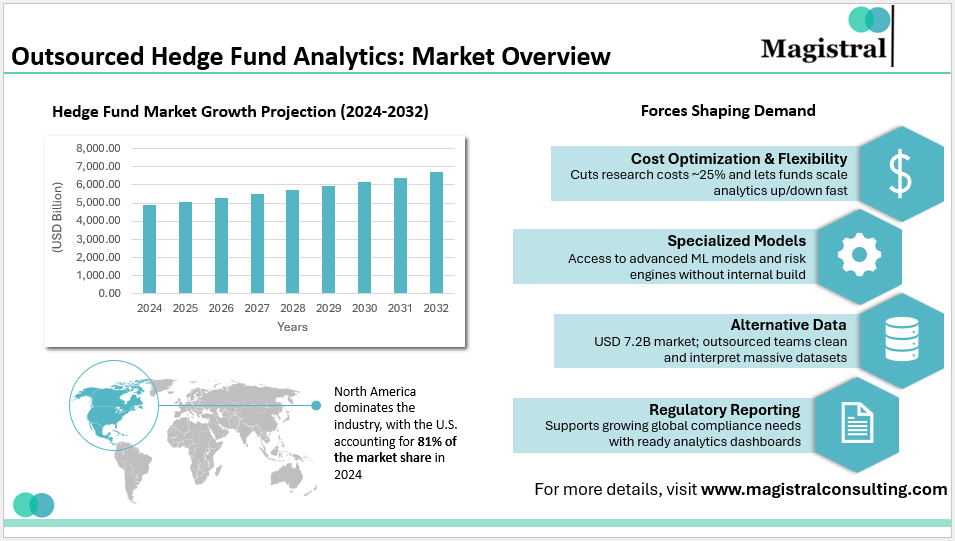
The global hedge fund industry is large and growing. The hedge fund market was valued at USD 4,879.6 billion in 2024. It is projected to grow to USD 6,396.4 billion by 2032, at a compound annual growth rate (CAGR) of ~4.0%. Geographically, North America dominates the industry, with the U.S. accounting for 81% of the market share in 2024. By investor type, institutional investors (such as pensions, endowments, and insurers) are the largest segment, followed by high-net-worth individuals, family offices, funds of funds, and retail investors. This concentration reflects how allocators continue to lean on hedge funds for diversification, risk-adjusted returns, and alternative strategies. The demand for outsourced hedge fund analytics is accelerating because asset managers need to operate leaner while analyzing more data exponentially.

Outsourced Hedge Fund Analytics: Market Overview

Outsourced Hedge Fund Analytics: Market Overview

This section explores the forces shaping demand, including cost optimization, alternative data growth, and regulatory expectations.

Cost Optimization and Operational Flexibility

Hedge funds are under pressure to deliver alpha while keeping management fees competitive. Outsourced hedge fund analytics reduces fixed costs by converting analytics functions into variable expenses. A recent PwC operational benchmarking study noted that funds using external analytics partners experience up to twenty-five percent lower research-related cost burdens. The flexibility to scale up or scale down quickly is especially valuable in volatile markets, allowing funds to avoid large internal teams during quieter macro cycles.

Access to Specialized Analytical Models

External analytics teams bring niche capabilities that many funds cannot build internally. These include machine-learning-based factor modeling, risk decomposition engines, and automated screening systems. Many hedge funds now rely on outsourced quantitative modeling similar in structure to what private equity teams use for portfolio analytics. The result is a stronger ability to evaluate new asset classes, back-test ideas, and deploy capital faster.

Surge of Alternative Data

The market for alternative data was valued at USD 7.20 billion in 2023. It is projected to continue its rapid expansion at a compound annual growth rate (CAGR) of 50.6% through 2030. Hedge funds now integrate credit card data, satellite imagery, social sentiment, and supply chain feeds. Outsourcing accelerates ingestion, cleaning, and interpretation of these huge datasets. External partners frequently operate with advanced data engineering stacks, which hedge funds utilize to derive signals with higher precision. The raw data stream has rendered contracted personnel particularly crucial in tasks like venture capital market research. It is characterized by a mixture of structured and unstructured datasets used in predictive modeling.

Regulatory Pressures Driving Better Reporting

Regulators in the U.S., Europe, and Asia now require very detailed portfolio analytics, scenario modeling, and liquidity stress tests. Outsourced hedge fund analytics gives access to standardized reporting dashboards, helping them stay compliant without expanding internal compliance teams.


How Outsourced Hedge Fund Analytics Enhances Investment Decision-Making

Outsourced hedge fund analytics is an innovation that dramatically transforms investment workflows by making signal generation, risk management, portfolio attribution, and decision-making faster and easier.

Sharper Alpha Generation through Quant-Led Research

Outsourced modelers help create factor screens, produce hypothesis-driven datasets, and signal comparisons across different regions. Multi-factor strategies now account for more than one-third of global equity flows managed by quants, indicating that there is a demand for more in-depth analytical foundations.

Faster Idea Validation and Back-Testing

External analytics teams cut down the time required for the validation of ideas. Rather than waiting for internal quant teams to conduct comprehensive back-tests, outsourced professionals can provide model simulations in just one overnight session. This speed-up in the cycle makes the market more competitive, where execution gaps of milliseconds influence the results.

Risk Decomposition and Exposure Management

The application of sophisticated risk modeling remains the most significant reason for outsourcing. Funds use partners to quantify factor-based exposures, track systematic and idiosyncratic risks, and understand sectoral bifurcations. The capability of performing fast scenario analysis is yet another point attracting investors in capital raising conversations. Because the demand for risk transparency is getting deeper.

Portfolio Attribution and Performance Diagnostics

Attribution analytics is how managers get to know the actual sources of alpha. Outsourced teams can analyze daily P&L contributions, factor premiums, and execution analytics. This is to make a small adjustment to the strategy, thereby creating a stronger alignment between the investment vision and performance.

Automation and AI-Driven Efficiency

Automated insights cut down on manual spreadsheet work and boost the reliability of results. This trend coincides with the progress made in DCF valuation and financial modeling.


Operational Advantages of Outsourced Hedge Fund Analytics

Outsourced hedge fund analytics not only enhance the performance of investments but also the very foundation of hedge funds, consisting of operations.

Scalable Analytics Without Long Hiring Cycles

Hiring senior quants, data engineers, or econometricians is expensive and slow. Outsourced analytics teams provide instant access to talent without compromising work quality.

Higher Accuracy and Reduced Human Error

Utilization of a structured analytic pipeline brings about the elimination of human error and inaccuracies in reports. External recruiting firms enforce consistent practices for their auditing and thereby enhance accuracy for the entire research, risk, and valuation process.

Faster Turnaround for Research and Reporting

Hedge fund analytics teams that are hired from outside often work in different time zones. This means that hedge funds can have a workflow that is almost continuous. This leads to quicker reporting, faster and desk-ready model creations, and improved execution strategies.

Improved Business Continuity and Redundancy

Analytics production might be held up because of disturbances like fluctuating markets, changes in staff, and regulations. However, outsourcing partners through their globally spread teams add redundancy to the process, thus ensuring an uninterrupted and continuous flow of analytics and reporting cycles.


Outsourced Hedge Fund Analytics: Future Outlook

This section elucidates the future projection of outsourced hedge fund analytics concerning large datasets, cross-asset strategies, and advanced AI models.

Outsourced Hedge Fund Analytics: Future Outlook

Outsourced Hedge Fund Analytics: Future Outlook

AI-Driven Modeling Will Become Standard

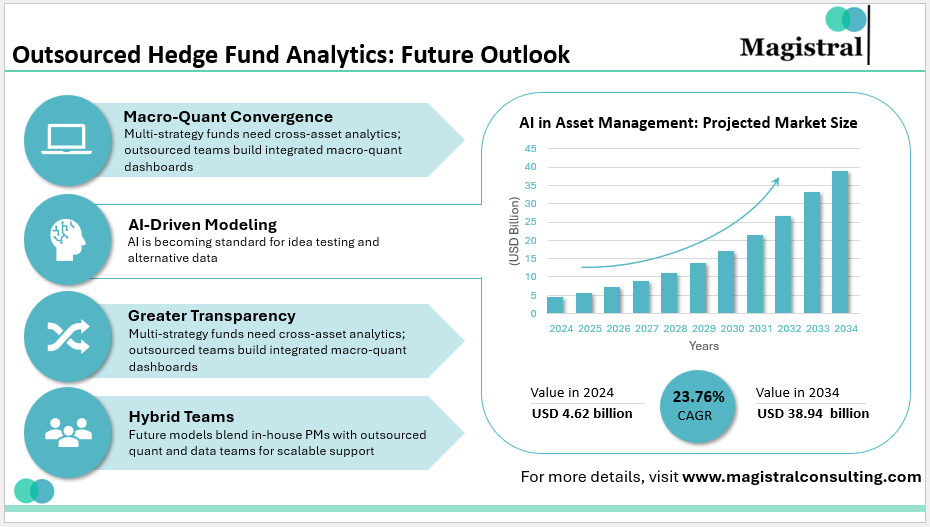
Generative AI is changing the scenario of hedge funds for the better by providing them with new ways of thinking, analyzing alternative data, and drawing conclusions. By 2028, AI-supported research is expected to be standard across most asset managers. Analysts value the AI in asset management market at USD 4.62 billion in 2024 and predict it will reach USD 38.94 billion by 2034, growing at 23.76% annually.

Multi-Asset and Macro-Quant Convergence

As multi-strategy funds expand into commodities, credit, and macro, outsourced analytics teams will support cross-asset research by building integrated macro-quant dashboards. AI has also started changing the way of doing investment banking analytics because of the removal of partners who are excellent at working with capital-intensive modeling.

Increasing Institutional Demand for Transparency

The generation of investors is expecting nothing less than full disclosure and ESG metrics along with real-time reporting. Analytics done by the outsourced groups make this possible since they create pipelines for reporting that are standardized across the globe, thus enabling real-time reporting.

Hybrid Teams as the New Normal

Outsourcing will not replace internal analysts but will create hybrid working models where external quant teams will be directly collaborating with portfolio managers and risk officers.


How Magistral Consulting Supports Outsourced Hedge Fund Analytics

Magistral provides a wide range of outsourced hedge fund analytics services. It includes support for risk modeling, compliance reporting, and operational scalability. Its cross-functional teams of quants, analysts, research specialists, and data engineers handle everything from screening and back-testing to factor modeling and portfolio diagnostics.
>Magistral’s outsourced hedge fund analytics services align with industry needs by offering standardized research frameworks, customized quant models, and alternative data processing capabilities. The firm assists hedge funds in adopting AI-enabled analytics so they can enhance trading signals and portfolio intelligence. Using the same disciplined approach found in its investor intelligence solutions, Magistral ensures that hedge funds receive predictive models, automated dashboards, and actionable scenario analyses. The company’s expertise includes AI-assisted deal analysis and portfolio surveillance systems, thereby solidifying its position as a strategic ally for funds that need large-scale analytical support.


About Magistral Consulting

Magistral Consulting has helped multiple funds and companies in outsourcing operations activities. It has service offerings for Private Equity, Venture Capital, Family Offices, Investment Banks, Asset Managers, Hedge Funds, Financial Consultants, Real Estate, REITs, RE funds, Corporates, and Portfolio companies. Its functional expertise is around Deal origination, Deal Execution, Due Diligence, Financial Modelling, Portfolio Management, and Equity Research

For setting up an appointment with a Magistral representative visit www.magistralconsulting.com/contact

About the Author

Nitin is a Partner and Co-Founder at Magistral Consulting. He is a Stanford Seed MBA (Marketing) and electronics engineer with 19 + years at S&P Global and Evalueserve, leading research, analytics, and inside‑sales teams. An investment‑ and financial‑research specialist, he has delivered due‑diligence, fund‑administration, and market‑entry projects for clients worldwide. He now shapes Magistral Consulting’s strategic direction, oversees global operations, and drives business‑development support.

FAQs

What tasks can be outsourced in hedge fund analytics?

Funds commonly outsource quantitative modeling, factor analysis, alternative data processing, back-testing, portfolio attribution, risk modeling, and compliance reporting.

Is outsourcing analytics secure for hedge funds?

Yes, leading providers follow strict data governance protocols, access controls, and compliance standards to ensure secure handling of sensitive financial information.

How does outsourcing improve investment decisions?

Outsourcing provides access to specialized models, advanced analytical tools, and faster turnaround times, helping managers test ideas and manage risk with greater accuracy.

Why is alternative data central to outsourced analytics?

The scale and complexity of alternative data require specialized engineering, cleaning, and modeling workflows that outsourced teams can provide efficiently.

Are outsourced analytics suitable for small hedge funds?

Absolutely. Smaller funds benefit most because outsourcing allows them to access institutional-grade analytics without building expensive internal teams.