Tag Archives: AI in market research

The investment research ecosystem is going through a structural reset. The shrinking commission pools on the sell-side, along with persistent fee compression on the buy-side, are creating a cost-pressure wave that is reshaping how research teams operate. Firms are now reassessing hiring, reducing single-coverage roles, and shifting to outsourced, scalable research models.

Here, the equity research analyst is right at the center of this disruption. Expectations are growing, while budgets are not, and demands on productivity have never been higher.

Why Research Costs Are Under Pressure

Cost pressures have mounted as the industry undergoes a structural shift toward low-cost investing. Passive products make up over 40% of global equity fund assets, from less than 30% five years ago. In markets such as India, passive AUM has crossed ₹12 lakh crore in 2025, growing over six times since 2019. As more money flows into index products, fee pools for active managers continue to shrink, leaving less budget for traditional in-house research teams.

Industry Trends Putting Pressure on Research Budgets

Industry Trends Putting Pressure on Research Budgets

Simultaneously, the operational cost of high-quality research production has increased. Compliance, data subscriptions, ESG reporting, and alternative data needs have increased the estimated research costs upwards by 15–20% over the past three years. As margins contract and workloads increase, both buy-side and sell-side firms are consolidating coverage and cutting sector specialists. This turns increasingly toward outsourced research support to stay efficient.

Sell-Side: Shrinking Commission Pools

Brokerage firms are making substantially less from traditional trading commissions-a revenue source that subsidized large analyst teams in the past. In the U.S., institutional equity commissions fell 17.5% in 2022, declining from about US$8.9 billion to US$7.3 billion. Across Europe, the total equity commissions fell by 14% in 2023, which reduced the commission pool to approximately US$2.2 billion.

With asset managers trading less frequently, relying more on low-cost electronic platforms, and demanding greater transparency, a research desk now has to operate with a tighter budget and more stringent productivity metrics. The result is clear: fewer sector specialists, more generalist coverage, and increased pressure on analysts to deliver differentiated insights at lower cost.

Buy-Side: Ongoing Fee Compression

Asset managers nowadays suffer from real pricing pressure due to the rise of passive funds, robo-advisors, and other low-cost alternatives. Passively managed funds currently make up about 43% of the total fund market share worldwide, up sharply from ~23% in 2015. Consequently, management fees have been falling industry-wide. The average asset-weighted fees for mutual funds are projected to decline by almost 20% in 2025 compared to 2017 levels.

In this environment, research departments at buy-side firms come under increasing scrutiny. As fee income per AUM shrinks, justifying full in-house research teams becomes increasingly difficult, particularly when needs for coverage fluctuate. Many firms now outsource repetitive or maintenance-heavy work so that internal resources are only invested in strategic, high-value research work. This helps them control costs while retaining core analytical capabilities.

How This Changes the Role of the Equity Research Analyst

Today’s equity research analyst works in an environment where expectations keep growing, yet resources do not. Global coverage requirements have sharply increased-there are now 44,000 listed companies globally as of 2024. And over 16,200 growth-company listings across 59 jurisdictions, a segment that has steadily been ramping up its share of global equity markets. This increasing universe, coupled with accelerated disclosure cycles and information-heavy earnings seasons. It forces analysts to churn out more updates and integrate more comprehensive information flows despite leaner teams. Although firms do not disclose publicly the number of companies each analyst covers, industry-wide downsizing and steady listing growth make it clear that the workload per analyst has materially intensified, even as internal headcount has not kept pace.

From Sector Specialists to Multi-Coverage Analysts

Fewer analysts are doing more today. Headcount at major global investment banks fell about 30% over the last decade, as equity-research teams shrunk from roughly 4,600 analysts to about 3,000.  This has put pressure on many firms to consolidate coverage-analysts handle a broader universe of companies, including more small- and mid-cap names. As a result, analysts are under greater pressure to produce frequent updates, across more companies, often at the cost of deep, sector-specific research.

Higher Demands for Speed and Insight

Today’s equity research analysts are fighting against the clock because expectations for rapid, high-quality output keep rising. Portfolio managers now expect instant earnings takeaways, intraday commentary, quick-turn models, and deeper thematic insights-all delivered with accuracy and context. Meanwhile, reporting cycles, news flow, and market volatility continue to accelerate, each forcing analysts to respond faster and cover more ground. With limited support and expanding responsibilities, analysts are required to constantly balance speed with depth, They often produce more in less time while striving to deliver differentiated insights that will shine bright in a crowded market.

Reliance on Technology and External Research Partners

Analysts also use automation, sophisticated data platforms, and partners for outsourced research to keep pace with rising analytical demands. The mundane model refreshes, data pulls, and first-draft notes are increasingly done outside; the in-house analyst focuses on deep insights, idea generation, and high-impact coverage. In fact, this tech-enabled hybrid model has become a requirement to maintain speed and quality without expanding internal teams.

Why Outsourcing is Becoming a Strategic Necessity

Outsourcing has transformed from a cost-cutting strategy to a strategic enabler. Today, about 80% of asset managers outsource or will outsource portions of their research workflow. It represents one of the fastest-growing front-office support sectors. The middle-office outsourcing market is also growing fast, at an estimated value of approximately USD 9 billion with forecasts for a near doubling in the next ten years. With the help of specialized partners, firms can outsource key data-heavy and repetitive tasks. This to maintain quality, increase coverage, and free up internal teams to focus on higher-value analysis.

Outsourcing Market Growth & Regional Snapshot

Outsourcing Market Growth & Regional Snapshot

Flexible, On-Demand Research Capacity

Firms are increasingly relying on outsourced research capacity to stay agile. In fact, an industry survey conducted in 2025 showed that around 52% of the boutique asset managers plan to outsource key functions over the next 12-24 months. This is because of the pressure of regulations, coverage, and workload. The global financial-services outsourcing market is projected to reach $181.6 billion in 2025. Many institutions outsourcing operations in a bid to reduce costs and boost scalability. This flexibility enables firms to scale up their research support during earnings seasons, sector-wide events, or special situations-without having to commit to permanent headcount increases. It makes outsourcing not just a cost-saving tactic but more of a strategic necessity as well.

Coverage Expansion Without Headcount

Many firms are increasing sector and geographic coverage without adding to their internal headcount. One recent industry survey shows that more than 50% of boutique asset managers intend to outsource front-office functions as they enter new markets or launch global products. This model lets firms cover frontier markets, emerging themes, and lower-priority names quickly, without the cost and delay of hiring and onboarding new analysts.

More Time for High-Value Work

By outsourcing routine tasks like data pulls, model updates, and basic research, firms free up their in-house analysts to focus on deeper analysis and high-impact insights. With many asset managers currently outsourcing pieces of their research workflow as a way to better drive efficiency. Internal teams can invest more time in strategic work that directly supports investment decisions.

The Road Ahead

Cost pressures will not abate anytime soon. Both buy-side and sell-side firms will keep rebalancing their cost structures, moving toward hybrid research models, and expecting more from analysts with fewer resources.

The firms that will thrive in this environment are those that can build a research model blending in-house expertise with scalable third-party support. It’s a hybrid approach that’s fast becoming the new norm.

The future of the modern equity research analyst isn’t to do more, but to do the right work and find the right partners to handle the rest.

How Magistral Consulting Fits Into This Shift

Magistral Consulting positions itself directly at the intersection of cost pressures and research efficiency. As research teams shrink or restructure, the need for a scalable, high-quality external partner becomes essential.

End-to-End Research Support

Magistral supports equity research analysts with model building, financial forecasting, sector analysis, comps, valuation work, and recurring earnings updates. This strengthens internal research output without expanding payroll.

Cost-Efficient Research Bench

Our delivery model reduces research costs by 60–70% while maintaining the same level of analytical rigor. This is particularly valuable for firms dealing with reduced commission pools or squeezed management fees.

Speed and Consistency During Heavy Cycles

Earnings season, rapid market events, or large pipeline workloads require additional hands. Magistral’s teams act as an extension of in-house analysts, ensuring deadlines are met and output remains consistent.

Support for Multi-Coverage Analysts

As analysts take on more companies, Magistral assists with the “overflow” updates, model revisions, quick-turnaround requests. It enables analysts to protect their bandwidth for deeper coverage and thesis-building.

About Magistral Consulting

Magistral Consulting has helped multiple funds and companies in outsourcing operations activities. It has service offerings for Private Equity, Venture Capital, Family Offices, Investment Banks, Asset Managers, Hedge Funds, Financial Consultants, Real Estate, REITs, RE funds, Corporates, and Portfolio companies. Its functional expertise is around Deal origination, Deal Execution, Due Diligence, Financial Modelling, Portfolio Management, and Equity Research

For setting up an appointment with a Magistral representative visit www.magistralconsulting.com/contact

About the Author
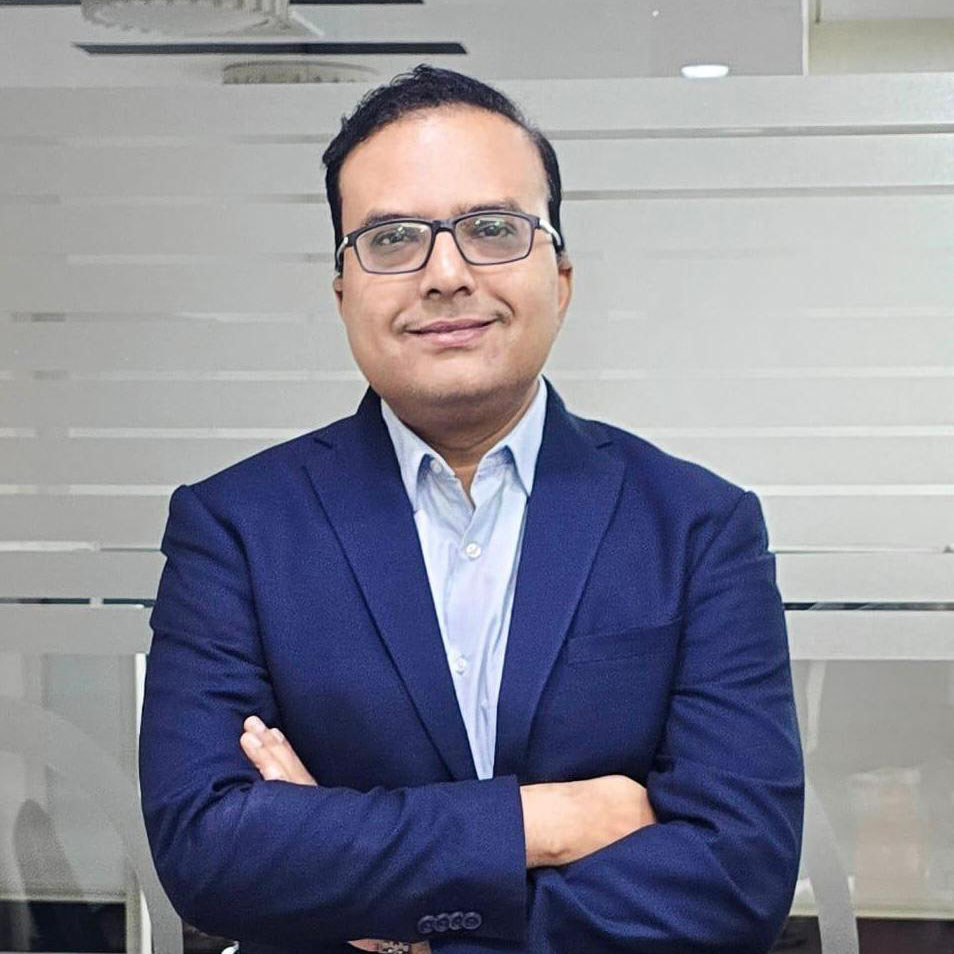
Prabhash Choudhary is the CEO of Magistral Consulting. He is a Stanford Seed alumnus and mechanical engineer with 20 + years’ leadership at Fortune 500 firms- Accenture Strategy, Deloitte, News Corp, and S&P Global. At Magistral Consulting, he directs global operations and has delivered over $3.5 billion in client impact across finance, research, analytics, and outsourcing. His expertise spans management consulting, investment and strategic research, and operational excellence for 1,200 + clients worldwide

FAQs

What services does Magistral Consulting specialize in?

Magistral provides research, analytics, investment support, deal sourcing, financial modeling, strategy support, and outsourcing solutions for global consulting firms, PE/VC funds, investment banks, and corporates.

How flexible are Magistral’s engagement models?

We offer multiple formats: dedicated analysts, project-based delivery, monthly retainers, and on-demand research support depending on client needs.

How do analysts ensure accuracy and consistency in deliverables?

Each output undergoes multi-stage quality checks, including peer review, senior oversight, and alignment with client formats and expectations.

How quickly can analysts ramp up on a new project or sector?
Analysts are trained across multiple industries and can typically onboard and start delivering value within 3–5 working days.


Market Research has evolved from a traditional survey-driven function into a strategic intelligence engine that informs investment, innovation, and operational efficiency. According to Deloitte’s 2024 Global Insights Report, over 70% of businesses that adopted advanced research analytics reported higher ROI from product launches and investment decisions. Across sectors, from financial services to real estate and technology, market research is now a data-powered compass guiding competitive positioning and future-readiness.

The Expanding Role of Market Research in Today’s Economy

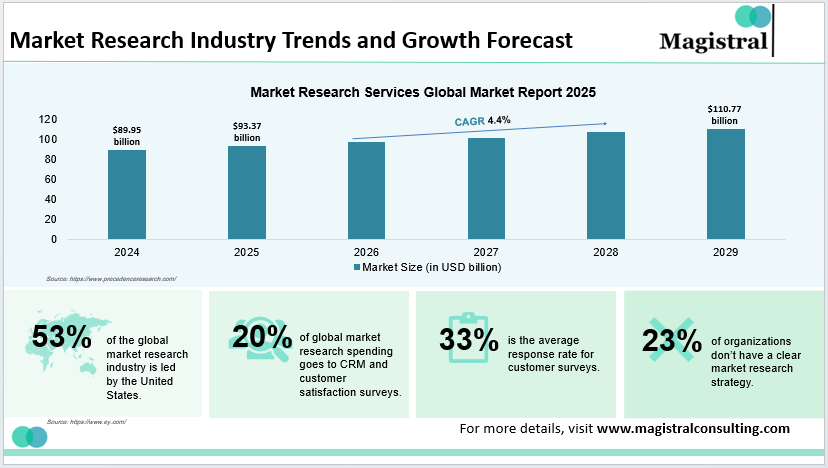
In a rapidly shifting global economy, market research has evolved from a background function to a cornerstone of strategic planning and competitive growth. Valued at USD 84.3 billion in 2024 and expected to exceed USD 138 billion by 2032 at a 6.3% CAGR, the industry reflects how deeply insights now shape business decisions. Organizations across sectors increasingly rely on advanced analytics, AI-driven modeling, and real-time data to understand changing consumer behavior, forecast market shifts, and identify emerging opportunities. Around 60% of global enterprises actively use market research to steer innovation and customer engagement strategies. As digital transformation accelerates, market research has become the bridge between data and decision helping businesses navigate volatility with evidence-based clarity and confidence.

Market Research Industry Trends and Growth Forecast

Market Research Industry Trends and Growth Forecast

Understanding Market Dynamics in Financial Services

In the financial world, market research identifies patterns in capital flows, emerging markets, and investor sentiment. PwC’s 2025 Financial Outlook projects that financial institutions leveraging continuous market intelligence outperform their peers by 15–20% in portfolio growth. This emphasizes why firms integrating advanced research with private equity and venture capital strategies remain resilient amid volatility.

The Integration of AI and Predictive Analytics

AI-driven market research tools now analyze billions of data points to forecast economic shifts. Platforms leveraging Natural Language Processing (NLP) detect sentiment from financial reports, media narratives, and investor communication. According to MSCI’s 2024 review, predictive analytics have improved market forecast accuracy by 30% across major institutions.

The Human-AI Synergy

Despite automation, human expertise remains irreplaceable. Analysts interpret nuances in geopolitical trends, consumer trust, and regulatory landscapes factors AI alone cannot fully quantify.

Beyond Finance: Cross-Industry Applications

From technology to real estate, market research underpins every major business decision. CBRE’s 2025 Real Estate Trends study revealed that organizations conducting quarterly market assessments saw 40% faster adaptation to demand shifts in commercial property valuations. This integration of real estate financial modeling ensures asset managers align capital deployment with market signals.

Case Study: Market Research in Tech & Consumer Sectors

In the technology sector, market research is guiding product innovation cycles. Gartner reports that firms applying real-time customer insights reduced product failure rates by 23%. Meanwhile, in consumer goods, market analytics influence pricing elasticity and regional expansion strategies, especially in emerging economies where data transparency is still evolving.

Market Research as a Competitive Advantage for Financial Institutions

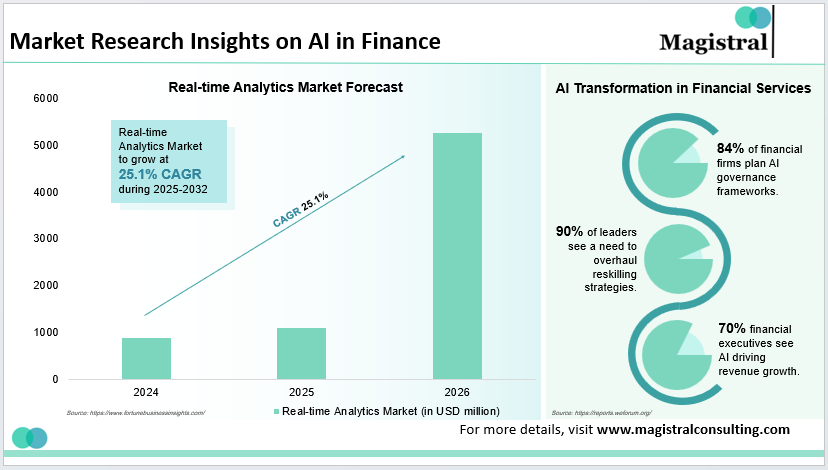
Market research has become a key competitive advantage for financial institutions, enabling data-driven decision-making in an increasingly dynamic market. With global spending on financial market data and research surpassing USD 44.3 billion in 2024, banks and investment firms are investing heavily in intelligence capabilities to stay ahead. Nearly 70% of financial executives believe that leveraging research-backed insights directly contributes to revenue growth, while 84% of firms are implementing AI governance frameworks to strengthen analytical accuracy and compliance. By integrating real-time analytics, behavioral insights, and customer sentiment tracking, financial institutions are using market research not just to understand market trends but to anticipate them — driving innovation, personalization, and sustained competitive differentiation.

Portfolio Optimization through Market Intelligence

Investors increasingly use research-backed models to anticipate asset class shifts. According to Precedence Research (2025), firms employing comprehensive market tracking reported a 12% increase in fund efficiency. This applies to both funds and investment banking operations where granular insights can forecast deal pipeline movements.

Identifying Investor Behavior Trends

Modern investors are informed and cautious. Market research now captures behavioral data from ESG preferences to digital trading patterns. This helps portfolio managers tailor outreach and capital allocation strategies aligned with ethical and sustainable investing frameworks.

Regulatory Insight and Compliance Tracking

Research isn’t limited to markets alone. Monitoring policy changes, central bank decisions, and geopolitical indicators gives firms a competitive edge. For instance, a study by EY in 2024 found that proactive research-driven compliance frameworks reduced operational risks by 17%.

Building Investor Confidence

Transparency, backed by credible research, strengthens investor relations. A well-researched fund prospectus or market update boosts trust, signaling due diligence and adaptability two pillars of sustainable financial management.

The Digital Revolution Transforming Market Research

The digital revolution is transforming the market research industry, driving a shift from traditional surveys to real-time, data-driven intelligence. Nearly 47% of researchers worldwide already use AI in their research processes, and 83% plan to invest further in AI technologies by 2025. The global digital transformation market that enables these advancements is expected to reach USD 2.1 trillion in 2025, growing at a 20% CAGR. This shift is accelerating the adoption of automation, real-time analytics, and cloud-based research tools, allowing financial institutions and other sectors to access faster, deeper, and more predictive insights that directly influence strategic decision-making.

Market Research Insights on AI in Finance

Market Research Insights on AI in Finance

Rise of Real-Time Intelligence Platforms

Modern platforms such as Qualtrics and Tableau now enable enterprises to monitor sentiment shifts within minutes. McKinsey’s 2025 digital adoption study noted that 68% of organizations using real-time intelligence outperformed competitors in market responsiveness.

The Role of Social Listening and Behavioral Analytics

Social media has become a goldmine for consumer sentiment. Financial institutions and consumer brands alike use behavioral analytics to anticipate market reactions to product launches, interest rate decisions, or economic policy changes.

Cloud and Data Democratization

Cloud computing democratizes access to high-quality data. Startups, mid-sized firms, and large corporations can now afford sophisticated analytics once reserved for large institutions. This scalability fuels innovation across industries.

Cross-Sector Collaboration in Research

Collaborative research ecosystems are emerging. Financial analysts, economists, and data scientists co-create insights that merge qualitative and quantitative perspectives enabling precision in decision-making.

How Magistral Consulting Supports Global Market Research Needs

Magistral Consulting has positioned itself as a strategic partner for firms seeking outsourced research capabilities that balance accuracy, efficiency, and cost-effectiveness. Leveraging its global analyst network, the firm delivers specialized research solutions across financial services, technology, and manufacturing sectors.

End-to-End Research Outsourcing

From data collection to insight synthesis, Magistral provides end-to-end solutions designed to enhance decision-making speed. This includes market sizing, competitive benchmarking, and deal support.

Financial and Investment Research

Through its investment banking and private equity support functions, the firm aids clients in opportunity mapping, investor profiling, and M&A intelligence essential tools in today’s competitive investment ecosystem.

Customized Data and Research Dashboards

Magistral integrates technology into research delivery. Interactive dashboards enable real-time updates, comparative market analytics, and cross-sector forecasting empowering decision-makers with accessible intelligence.

Global Expertise, Local Insights

With research coverage across North America, EMEA, and APAC, Magistral offers localized insight tailored to client geographies. This hybrid approach blends global trends with local market intricacies, ensuring strategic relevance.

The Future Outlook

The future of market research will be defined by automation, predictive modeling, and AI-driven insight synthesis. However, human judgment the ability to contextualize data will remain the differentiator. Firms that blend both will lead the next era of evidence-based strategy.

About Magistral Consulting

Magistral Consulting has helped multiple funds and companies in outsourcing operations activities. It has service offerings for Private Equity, Venture Capital, Family Offices, Investment Banks, Asset Managers, Hedge Funds, Financial Consultants, Real Estate, REITs, RE funds, Corporates, and Portfolio companies. Its functional expertise is around Deal origination, Deal Execution, Due Diligence, Financial Modelling, Portfolio Management, and Equity Research

For setting up an appointment with a Magistral representative visit www.magistralconsulting.com/contact

About the Author

Dhanita is a BD and Marketing professional with 6+ years’ experience in sales strategy, growth execution, and client acquisition; credentials include Stanford Seed (Stanford GSB), an MBA from USMS–GGSIPU, and a B.Com (Hons) from the University of Delhi. Expertise spans market research and opportunity mapping, sales strategy, CRM, brand positioning, integrated campaigns, content development, lead generation, and analytics; currently oversees business development calls and end-to-end marketing operations

FAQs

Can Magistral Consulting provide on-demand or project-based support?

Yes. Clients can choose between full-time dedicated analyst models or flexible, project-based engagements to meet short-term or specialized research needs.


How does Magistral Consulting ensure data confidentiality and quality?

We follow strict data security protocols, NDAs, and a multi-level quality assurance process to ensure the accuracy, reliability, and confidentiality of every client engagement.


How is Magistral’s market research aligned with digital transformation trends?

We integrate advanced analytics, AI-based data mining, and cloud-enabled platforms to deliver faster, scalable, and predictive research — making insights more agile and actionable.


How does Magistral Consulting assist clients with market research?

We deliver end-to-end market research solutions from industry analysis and market sizing to competitor benchmarking and customer insights tailored to investment and strategic decisions.