Tag Archives: Commercial Loan Underwriting Outsourcing

Commercial loan underwriting assesses whether a company can pay back its debt not only under normal operating circumstances but also during times of stress. This process involves far more than just analyzing the company’s credit rating or the collateral. Underwriting considers the company’s past performance, anticipated cash flow, managerial ability, exposure to industry risks, leverage, liquidity, guarantees, and loan structure.

It has become increasingly difficult in recent years due to an unpredictable economic environment, varying sector performance, and competitive pressure from private credit firms. According to the April 2026 Senior Loan Officer Opinion Survey conducted by the Federal Reserve, banks have tightened their underwriting practices for commercial and industrial loans of various types, increased pricing on riskier facilities, made covenants tighter, and improved collateral. All these factors make commercial loan underwriting especially important today.

Commercial Loan Underwriting Foundations and Credit Context

An effective Commercial loan underwriting process combines the analysis of the borrower with facility structuring. The purpose is to establish the key funding source of the borrower, test its reliability, and design the facility such that the repayment is consistent with the borrower’s operations cycle.

Understanding the Borrower and Loan Purpose

Each analysis should start with explaining why the financing is needed by the borrower. A revolving facility is required for seasonality in working capital, while a term facility is used for purchasing equipment, acquisition, properties, or expanding operations. The underwriter needs to find out if the required product type, maturity, repayment schedule, and amount fit the underlying need.

Mismatched financing may lead to unnecessary risks. Long-term financing of the equipment through a short-term facility can leave the borrower exposed to refinancing difficulties. Alternatively, a long-term facility may not be appropriate to finance the seasonal inventories, resulting in increased costs.
The analysis needs to address the ownership structure, management experience, operations history, customers, suppliers, competitiveness, and legal structure. This is very much like the transaction-level due diligence, which requires the consideration of financial and commercial risk factors together.

Historical Financial Statement Analysis

Underwriting spreads usually involve at least three years of income statements and balance sheets, as well as any available interim figures. The idea is not to calculate ratios but to analyze how cash is generated by the firm and why performance has been changing.

Growth in revenue needs to be analyzed in light of margins, working capital, capital spending, and debt. For instance, a borrower may be showing an improvement in earnings while its liquidity position is deteriorating because receivables and inventories are tying up cash. Non-recurring income, salaries of the owners, related party income and expenses need to be removed before analyzing recurring performance.

According to the guidance on commercial lending from OCC, trends in balance sheet and income statement items, contingent liabilities, working capital requirements, repayment sources, and sufficiency of cash flow after deducting debt servicing and capital spending should be reviewed. Practically, what this means is that commercial loan underwriting needs to relate ratio analysis to the operations cycle of the borrower.

Cash Flow and Debt-Service Capacity

Cash flow is the primary source of repayment for most commercial loans. The security is a secondary form of protection and does not take precedence over sustainable business performance.

Common measures include:

Debt-Service Coverage Ratio

The debt service coverage ratio is the ratio of cash available for servicing the debt to the sum of the principal and interest payments. The exact formula should be stable for the portfolio and should conform to the lender’s methodology. The adjustments for dividends, tax payments, capital expenditures, leases, and one-time items should be documented rather than mechanically applied.

Leverage and Fixed-Charge Coverage

Leverage is the ratio that shows how much the company relies on debt financing, and fixed charge coverage is an extended version that considers leases and other commitments. Both current and historical ratios should be analyzed since a trend decline during several periods may show problems before the first debt payment defaults.

Collateral and Guarantor Assessment

When evaluating collateral, consideration must be given to the owner, lien position, valuation process, liquidity, insurance coverage, enforcement issues, and cost of liquidation. Receivables need ageing and concentration analysis. Inventory needs evaluation in terms of obsolescence, seasonality, and discount on liquidation. Real estate needs independent valuation and evaluation of type, occupancy, and location.

The OCC also expects that the bank’s policy on commercial loans will include definition of acceptable collateral, loan-to-value ratios, documentation requirements, verification of assets, monitoring of risks, and credit review process.

Personal or corporate guarantors could be an added strength in some transactions, but their value will depend upon liquidity, net worth, other commitments, and enforceability. An unsupported guarantor does not take the place of borrower’s cash flow.

Credit Memorandum and Approval Discipline

The end credit memo should be a balanced memo that outlines the borrower, request, repayment, the performance, risks, mitigants, covenants, exceptions to policy, collateral and risk rating being recommended.

Good credit memos separate fact from fiction. Good credit memos also outline the rationale for accepting all risks. This is what makes good credit memos and enables consistent approvals, review, audits and monitoring of portfolio in the future.

Commercial Loan Underwriting Applications and Use Cases

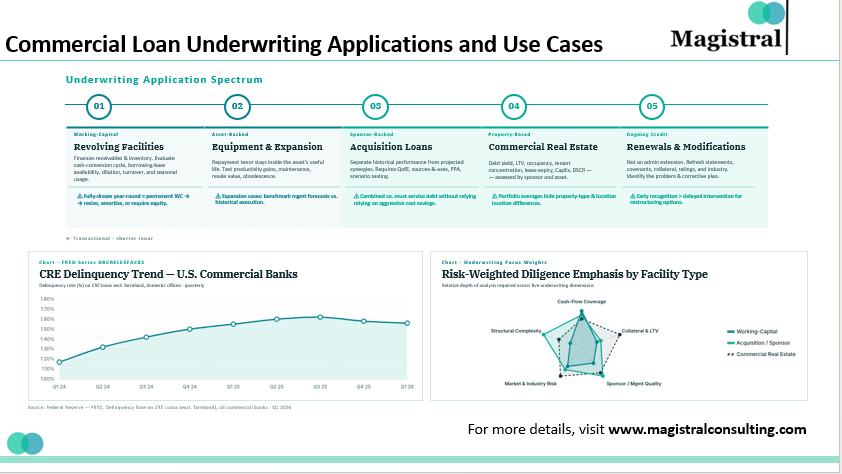
Commercial loan underwriting varies based on the borrower, industry, size of transaction, and repayment. The use of a template is very helpful; however, the analysis has to incorporate the business model.
Commercial Loan Underwriting Applications and Use Cases

Commercial Loan Underwriting Applications and Use Cases

Working-Capital Facilities

The revolving credit facility will normally be used to finance accounts receivable and inventory. The underwriter should consider factors such as the cash conversion cycle, the borrowing base capacity, customer concentration, dilution, inventory turn, and seasonality of use.
If the revolving credit facility is always fully drawn during the year, it may indicate that the working capital being financed is permanent and not temporary. In this case, the underwriter may have to either revise the revolver, include amortizing debt, or add more equity.

Acquisition and Sponsor-Backed Transactions

Acquisition financing presents integration, valuation, leverage, and execution risk. The creditor needs to distinguish between the target’s historical performance and synergies, and check whether the combined entity can cover debt service without being overly aggressive on cost cuts.
The transaction typically involves skills related to investment banking practice: quality-of-earnings adjustments, modeling, sources and uses analysis, purchase price allocation, scenario testing, etc.

Commercial Real Estate Loans

Commercial real estate lending involves underwriting of both sponsor and property. Debt yield, LTV ratio, occupancy, tenant concentration, lease expiration date, capital expenditure, and debt service coverage ratios are among factors considered.

There is great disparity in risks associated with offices, multifamily housing, industrial buildings, hospitality, and retail. The delinquency rate on commercial real estate loans in the United States, excluding farmland and booked in the offices of all commercial banks in the country, according to the Federal Reserve, reported through FRED, was 1.56% in Q1 2026 compared to 1.58% in Q4 2025. Nonetheless, there may still be significant disparities between property types, locations, and borrowers; hence, CLU is expected to evaluate rent-roll integrity, refinancing risks, tenant turnover, and sponsor liquidity independently.

Market Trends and the Future of Commercial Loan Underwriting

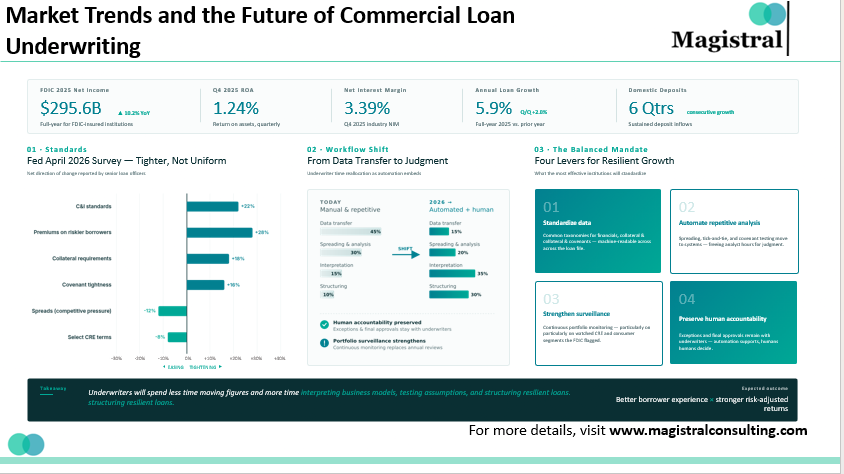
The future phase of commercial credit would involve stricter risk management combined with selective automation. The April 2026 Federal Reserve survey indicated tighter C&I underwriting standards, higher premiums paid by risky borrowers, higher collateralization requirements, and tighter covenants. At the same time, due to competition, some lenders lowered the spread and eased certain commercial real estate terms.
Market Trends and the Future of Commercial Loan Underwriting

Market Trends and the Future of Commercial Loan Underwriting

Overall, the banking system entered 2026 in good shape as far as capital and liquidity are concerned. For the year 2025, FDIC-insured institutions recorded full-year net income of $295.6 billion, which was a 10.2% increase over 2024. Also, for the fourth quarter of 2025, the return on assets was 1.24%, net interest margin stood at 3.39%, the loan growth rate stood at 2.0% on a quarterly basis and at 5.9% on an annualized basis, and domestic deposits increased for the sixth quarter in a row.

The above-mentioned scenario sets up a well-rounded mandate for commercial loan underwriting. Credit quality needs to be safeguarded without letting process delays steer deserving borrowers to faster players. Most efficient organizations will streamline data, automate analysis, enhance portfolio monitoring, and keep humans in charge of exceptions and final decision-making.

In an era where technology becomes increasingly ingrained in financial services, the underwriting team will spend less time moving numbers around and more time analyzing business models and structuring robust loans. This should help in providing better service to the borrower and delivering better portfolio performance.

How Magistral Consulting Helps in Commercial Loan Underwriting

Magistral supports commercial loan underwriting teams with scalable offshore analyst capacity, standardized workflows, and research-driven support that reduces manual effort while keeping credit decisions with lenders. Our services include financial spreading and ratio analysis, cash flow and sensitivity modeling, borrower and industry research, credit memorandum preparation, portfolio monitoring, and transaction support such as financial modeling, data room management, and lender outreach. By acting as an extension of in-house credit teams, Magistral helps lenders improve turnaround times, manage fluctuating underwriting volumes, and enable senior underwriters to focus on complex credit decisions.


About Magistral Consulting

Magistral Consulting has helped multiple funds and companies in outsourcing operations activities. It has service offerings for Private Equity, Venture Capital, Family Offices, Investment Banks, Asset Managers, Hedge Funds, Financial Consultants, Real Estate, REITs, RE funds, Corporates, and Portfolio companies. Its functional expertise is around Deal origination, Deal Execution, Due Diligence, Financial Modelling, Portfolio Management, and Equity Research

For setting up an appointment with a Magistral representative visit www.magistralconsulting.com/contact

About the Author

Nitin is a Partner and Co-Founder at Magistral Consulting. He is a Stanford Seed MBA (Marketing) and electronics engineer with 19 + years at S&P Global and Evalueserve, leading research, analytics, and inside‑sales teams. An investment‑ and financial‑research specialist, he has delivered due‑diligence, fund‑administration, and market‑entry projects for clients worldwide. He now shapes Magistral Consulting’s strategic direction, oversees global operations, and drives business‑development support.


FAQs

What information is required for a commercial loan review?

Lenders typically request historical and interim financial statements, tax returns, debt schedules, projections, ownership details, bank statements, collateral information, and an explanation of the financing requirement.

What is the primary source of repayment for a business loan?

The primary source is normally recurring operating cash flow. Collateral, guarantor support, refinancing, and asset sales should generally serve as secondary repayment sources.

How does a lender calculate debt-service capacity?

The lender compares normalized cash available for debt service with scheduled principal and interest payments, while considering capital expenditure, distributions, taxes, leases, and other fixed obligations.

Can artificial intelligence approve commercial loans independently?

AI can support extraction, spreading, memo drafting, and risk identification. Final approval should remain subject to documented policy, model governance, explainability, and qualified human oversight.

Why are loan covenants important?

Covenants establish financial and operating boundaries, create reporting obligations, and provide early warning when borrower performance begins to weaken.


Commercial loan underwriting is at the heart of business financial decision-making. It provides the basis for evaluating the creditworthiness of borrowers and the stability of financial institutions. It is also done for spurring economic growth. In the recent past, the underwriting process has seen a significant transformation in light of technological advances, regulatory changes, and market dynamics.

Effects of Commercial Loan Underwriting Outsourcing

Advanced technology, expert rating, and scalability in outsourcing may facilitate the process of transformation for commercial loan underwriting. This process will be a benefit for both lenders and borrowers. The subsequent section explains the process of how outsourcing works with commercial loan underwriting and the role of such outsourcing in the modernization of lending trends:

Risk Mitigation

It limits the loan risk by checking every borrower for full creditworthiness, hence limiting the issuance of loans to less creditworthy clients and applicants.

High accuracy

Applying special expertise along with advanced technology in commercial loan underwriting would bring more precise appraisals and risk estimation. This makes the understanding of true financial implications, on both lenders’ and borrowers’ sides, accurate.

Cost Efficiency

Outsourcing commercial loan underwriting can save a financial institution a lot of overhead costs that are incurred in recruiting, training, and maintaining an in-house underwriting team. It helps to use resources more efficiently.

Scalability

The flow of loan applications is highly volatile and can change without notice at the period of the year and is majorly volatile with the peak flows. Outsourcing underwriting would also help lenders gain scalability in managing operations up to scale or any significant downsizing when it does without impacting the internal space.

Faster Turnaround Times

Processes and know-how usually lead to timely approval of a loan, which in turn offers quick access for customers to funds to run their respective businesses.

Improved Compliance

A professional underwriting service would have all regulatory compliances and other industry standards and thus decrease chances of facing some legal issue which in turn can enhance the credibility in general.

IT Integration

Commercial loan underwriting will become more efficient and effective as it would take into consideration artificial intelligence and data analytics, taking huge amounts of data to help make better decisions.

Expert Evaluation

Access to experienced underwriters means using their experience and judgment to arrive at better loan decisions that balance risk and return.

Focus on Core Business

Outsourcing underwriting allows financial institutions to focus on their core business activities, such as customer relationship management and strategic growth initiatives, without getting bogged down by the complexities of underwriting processes.

Risk Management

Standardized and comprehensive appraisals reduce the rate of defaults, contributing to the overall health and stability of the financial institution.


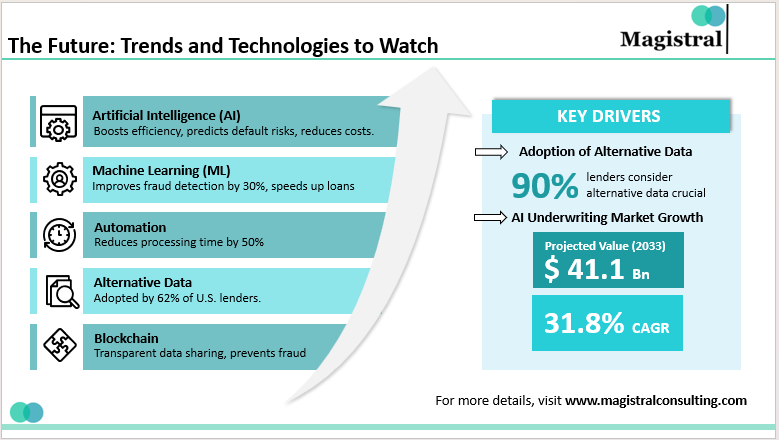
The Future: Trends and Technologies to Watch

The landscape of credit underwriting in the United States is rapidly changing. This paper takes a closer look at how technologies are driving change in the credit market.

The Future: Trends and Technologies to Watch in Commercial Lending Underwriting Outsourcing

The Future: Trends and Technologies to Watch in Commercial Lending Underwriting Outsourcing

Artificial Intelligence

Credit underwriting is not possible without AI. The efficiency and accuracy achieved are unparalleled. AI helps hasten loan approvals, thus allowing lenders to process applications faster, predict default risks with great precision, minimize bad debts, and automate decisions to reduce operational costs.

Machine Learning

Machine Learning enables lenders to be smarter through data-driven decisions. US lenders utilizing ML have realized a 30% fraud detection rate improvement accompanied by faster loan processing. The tools also help institutions adhere to regulatory requirements by identifying potential risks in areas of compliance early on.

Automation

Automation reduces tedious, manual underwriting steps. This decreases processing time and helps lenders achieve up to 50% faster loan approvals. Documentation errors are reduced through automation.

Alternative Data

The use of alternative data such as rent payments, utility bills, and even social media behavior allows lenders to make more comprehensive assessments of creditworthiness. Research shows that 62% of U.S. financial institutions currently include alternative data in their underwriting, and the trend is going to grow exponentially in the coming years.

Blockchain

With decentralized data storage, it enhances stakeholder trust and tamper-proof audit trails. It automatically disburses loans once predefined criteria are met and protects confidentiality, reducing fraud and transparent records easing audits and legal compliance.

Key Drivers

AI Underwriting Market Growth

The AI underwriting market is projected to grow to USD 41.1 billion by 2033, with a CAGR of 31.8%.

Adoption of Alternative Data

Over 90% of lenders consider alternative data crucial, yet only 43% have integrated it, highlighting a significant growth opportunity.

5 Key Ratios for Commercial Loan Underwriting

Understanding key financial ratios is essential in commercial loan underwriting, as they provide valuable insights into a borrower’s financial health, risk profile, and repayment capacity.

Profit Margin Ratio

This is a widely used profitability ratio, and it indicates the amount of profit generated over sales. This ratio measures the company’s ability to earn enough profit to sustain its business. Profit margins often vary from industry to industry, so, a prudent banker should always compare it with close competition and with the average industry standard.

Debt Ratio

This is a solvency ratio, which indicates the debt level of the borrower as a percentage of total assets. A lower debt ratio suggests a more stable business and a higher is the reverse. Experts consider a ratio of 0.5 or less healthy, as it means the company has twice as many assets as liabilities. They carefully examine anything above 0.5 before making a decision.

Loan to Value (LTV) Ratio

This is a risk assessment coverage ratio that is very critical for mortgage underwriting. The LTV ratio ensures that the collateral is worth more than the size of the loan. The higher the LTV ratio, the more risk involved.

Debt Service Coverage Ratio (DSCR)

This is a liquidity ratio, which indicates the amount of cash generated by the business to service its debts (principal, interest, and leases). DSCR validates the borrower’s capacity to pay back the debt and keep running the business. DSCR between 1.25-1.5 is a relatively safe number to consider. However, it differs from business to business and depends on the risk aversion policies of the bank.

Net Worth to Loan Size Ratio

This ratio is used to compare the borrower’s net worth to the size of the requested loan. A high net worth indicates stable financial health, ultimately ensuring the repayment of the loan.


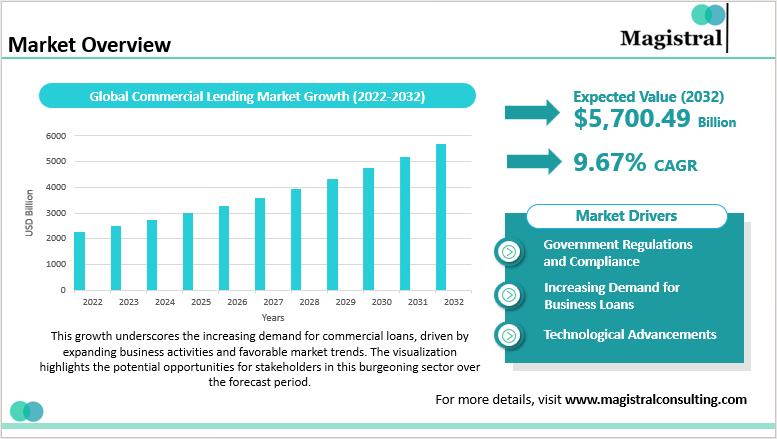
Market Overview

The commercial lending market was at USD 2264.82 billion in the year 2022. The commercial lending market size was estimated at USD 2483.83 billion in the year 2023 and it is projected to grow at 5700.0 billion (USD Billion) in 2032. The growth trend is expected to provide good news with respect to the market trends in the coming years, claiming the growth rate to be a CAGR of around 9.67% for the forecast period, i.e., ending 2032.

Market Overview of Commercial Lending Underwriting Outsourcing

Market Overview of Commercial Lending Underwriting Outsourcing

Commercial Lending Market Drivers

Increasing Demand for Business Loans

The growing demand for business loans among small and big companies fuels this market with the help of online lenders offering prompt approvals and government initiatives supporting small businesses.

Government Regulations and Compliance

Strict government regulations, combining stability with business operations costs related to compliance in financial institutions, guarantee stability in financial operations and loan borrowers, in compliance with relevant policy guidelines set by the government.

Technological Advancements

AI, machine learning, and mobile banking have helped tremendously in shaping instant lending situations in easy credit checks, prompt loan approvals, and good customer satisfaction.

Magistral’s Services for Commercial Loan Underwriting

Magistral Consulting provides expert services to enhance the efficiency, accuracy, and compliance of commercial loan underwriting processes. It thereby directs financial institutions in making informed lending decisions and mitigating risks.

Risk Assessment and Creditworthiness Evaluation

Magistral provides a comprehensive analysis of financial data, market trends, and borrower profiles to assess the credit risk and creditworthiness of applicants, ensuring well-informed lending decisions in commercial loan underwriting.

Loan Application Processing and Verification

We conveniently process all commercial loan applications, including verifying all financial documents, collateral, and borrower information to ensure accuracy and compliance with regulatory standards.

Financial Modeling and Risk Analysis

We employ state-of-the-art financial modeling and risk analysis tools to assess the potential for defaults on loans by looking at the ability of the borrower to repay through cash flow, debt service, coverage ratios, and other metrics central to the financial facets of the facility in commercial loan underwriting.

Regulatory Compliance and Due Diligence

Magistral provides that the local and federal laws guide every step of the underwriting process, maintaining the legal risks to a minimum. We rigorously assess and ensure the proper execution of all documentation and legal obligations.

Technology-Driven Solutions

We enable an improved commercial loan underwriting process through the incorporation of leading-edge technologies. It involved such as artificial intelligence, machine learning, and data analytics. It is assuring thereby that the institutions adopt more rapid yet credible decisions.

Portfolio Risk Management and Monitoring

To continue evaluating and analyzing loan performance with the aim of risk identification and mitigation support. We provide post-approval monitoring to assist institutions in maintaining a healthy loan portfolio.

Tailored Underwriting Strategies

Depending on the needs of a client, for commercial loan underwriting, whether they be small loans, corporate loans, or specialized financing, we develop custom underwriting solutions aimed at making the underwriting process work far more effectively.


About Magistral Consulting

Magistral Consulting has helped multiple funds and companies in outsourcing operations activities. It has service offerings for Private Equity, Venture Capital, Family Offices, Investment Banks, Asset Managers, Hedge Funds, Financial Consultants, Real Estate, REITs, RE funds, Corporates, and Portfolio companies. Its functional expertise is around Deal origination, Deal Execution, Due Diligence, Financial Modelling, Portfolio Management, and Equity Research

For setting up an appointment with a Magistral representative visit www.magistralconsulting.com/contact

About the Author

The article is authored by the Marketing Department of Magistral Consulting. For any business inquiries, you can reach out to prabhash.choudhary@magistralconsulting.com

[sp_easyaccordion id=”3389″]