Tag Archives: Underwriting Outsourcing

Investment banking capital-markets activity improved in the first half of 2026, although the recovery remained unusually concentrated. LSEG reported that the total value of global M&A transactions reached a record US$2.85 trillion in the first half of 2026, while transaction volume fell to a six-year low. In the United States, PwC reported that M&A value reached US$1.2 trillion in the first five months of the year, nearly double the comparable 2025 figure, even as transaction volume declined 4%. These patterns have changed the approach to underwriting in investment banking.

Larger transactions, complex financing structures, volatile interest rates, and divergent sector expectations require underwriting teams to assess not only whether a transaction is viable under a base case, but also how quickly its economics deteriorate when interest expense, revenue expectations, working-capital, or exit assumptions move against the investment thesis. As a result, underwriting now places greater emphasis on scenario analysis, downside protection, information quality, and transaction structure.

The 2026 Underwriting in Investment Banking Environment: More Capital, Greater Selectivity

High deal values are apparent from headlines; underwriting conditions are still tough underneath. Regional variation also means underwriting in investment banking must reflect local liquidity, regulation, and investor demand.
Underwriting in Investment Banking

The 2026 Underwriting in Investment Banking Environment: More Capital, Greater Selectivity

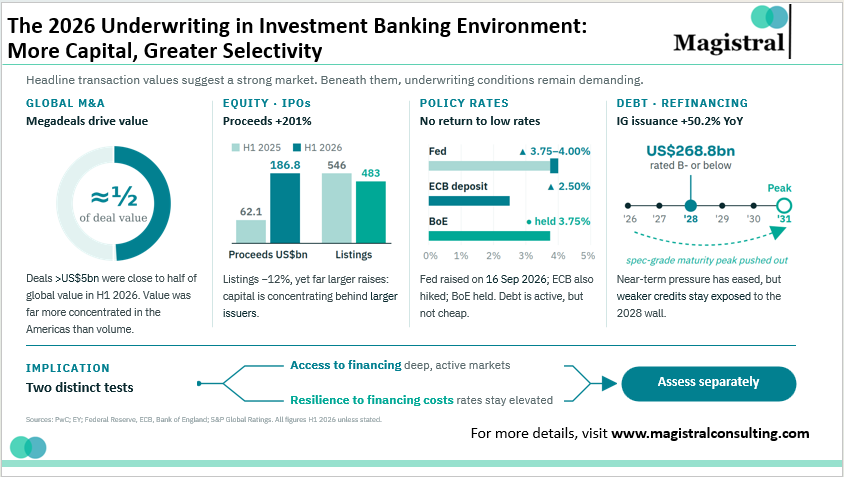
An example from global M&A provides evidence of this dichotomy. Deals valued above US$5 billion accounted for nearly half of the global deal value in the first half of 2026, as revealed by PwC. The deal value was much more concentrated in the Americas region compared to the number of deals there.

The equity issuance activity is robust, too. As reported by EY, there were 483 global IPOs generating US$186.8 billion of proceeds in H1 2026, compared to 546 IPOs raising US$62.1 billion in H1 2025, a 201% increase despite a 12% reduction in the number of IPOs.

Debt markets are active, but funding costs have not returned to the low levels of the previous decade. On September 16, 2026, the Federal Reserve raised the target range for the federal funds rate to 3.75%–4.00%. The European Central Bank raised its deposit facility rate to 2.50%, effective September 16, while the Bank of England maintained the bank rate at 3.75% at its September meeting. These decisions reinforce the need to evaluate transaction economics under a range of financing-cost scenarios. Targeted external support can strengthen underwriting in investment banking by expanding analytical capacity during peak workloads.

Nevertheless, refinancing activity has been substantial. According to S&P Global Ratings, nonfinancial investment-grade issuance increased 50.2% from the first half of 2025, pushing the peak maturity year for speculative-grade bonds to 2031. Although near-term refinancing pressure has eased for most borrowers, weaker credits remain vulnerable; S&P identified US$268.8 billion of debt rated B− or lower that matures in 2028.

The underwriting implication is clear: financing availability and refinancing risk must be evaluated separately.

These pressures make underwriting in investment banking more demanding when information is incomplete, or market conditions shift quickly.

Underwriting in Investment Banking: How Assumptions Are Changing

A traditional base case model is not sufficient to evaluate transactions in 2026.

Downside scenarios are receiving greater weight. Revenue growth, margin assumptions, and valuation multiples need to be analyzed together rather than individually. A company that appears appropriately leveraged under management’s estimates may look substantially different if revenue growth slows and elevated financing costs persist.

Debt-service capability is receiving a more stringent test. Floating rate exposure, a refinancing schedule, and covenant cushion join leverage as key underwriting factors. Underwriting evaluation increasingly focuses on interest coverage, fixed charge coverage, free cash-flow yield, and liquidity in various capital structures.

Earnings quality is becoming more important than the headline EBITDA figure. S&P Global Ratings’ review of U.S. speculative-grade issuers found that EBITDA add-backs represented approximately 30% of market-adjusted EBITDA across a decade of data. This finding underscores the importance of validating adjustments, projected synergies, and management-defined earnings measures.

Cash-flow sustainability is also receiving greater emphasis. Working-capital seasonality, customer concentration, recurring versus project-driven revenue, capital-expenditure requirements, and contractual revenue recognition all affect whether accounting earnings support debt service.

Sponsor-led deals add another dimension to underwriting. In addition to operating performance, underwriters must assess the equity contribution, shareholder support, dividend capacity, and refinancing or exit potential. A deal that depends on multiple expansions or early refinancing has a substantially different risk profile from one that reduces debt through cash flow. As a result, underwriting in investment banking benefits from consistent data, transparent models, and clear escalation paths.

Regional Underwriting in Investment Banking

Regional underwriting approaches vary considerably across markets, reflecting differences in deal activity, financing conditions, regulatory frameworks, and investor appetite.
Underwriting in Investment Banking

Regional Underwriting in Investment Banking

North America

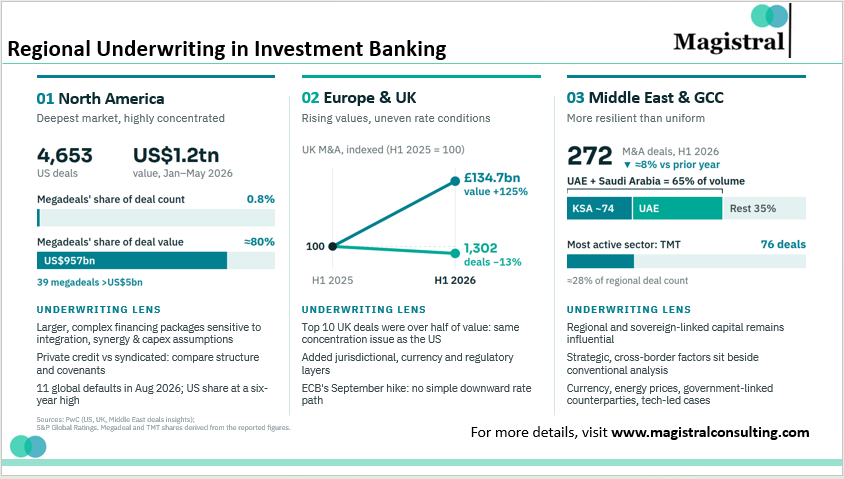
North America continues to have the deepest transaction and financing markets, although activity is highly concentrated. According to PwC, 4,653 U.S. deals worth US$1.2 trillion were announced in the first five months of 2026. Of these, 39 transactions were valued at more than US$5 billion, and those megadeals represented US$957 billion of total value.

From a financing perspective, larger transactions are more difficult to finance and are especially sensitive to assumptions about integration, synergies, and future capital requirements. The availability of both private credit and broadly syndicated financing also makes comparisons of structures and covenants increasingly important.

Credit deterioration has not disappeared. S&P Global Ratings reported 11 global corporate defaults in August 2026 and stated that the U.S. share of global defaults reached a six-year high. Consequently, underwriting in investment banking increasingly depends on disciplined risk selection and evidence-based judgment.

Europe and the UK

Europe and the United Kingdom show rising average transaction values against an unsettled economic and interest-rate backdrop. In the United Kingdom, PwC estimated that first-half 2026 M&A value totaled £134.7 billion, an increase of 125% from the prior-year period, while transaction volume declined 12.6% to 1,302 deals. The ten largest transactions accounted for more than half of total deal value.

European underwriters therefore face the same concentration concerns as their U.S. counterparts, along with additional legal complexity, currency exposure, and cross-border execution risks. The ECB’s September rate increase also indicates that underwriters should not assume a smooth decline in European financing costs.

Middle East and GCC

Transactions in the Middle East have experienced more stability and resilience than consistency. PwC estimated 272 M&A transactions in the Middle East in H1 2026, 8% less than in the preceding year. In this period, the UAE and Saudi Arabia contributed 65% of total deal volume, and the number of deals in Saudi Arabia was around 74. Technology, media and telecommunications was the busiest industry, with 76 deals.

Regional and sovereign-related capital is still quite powerful. Hence, the underwriting process may consider such factors as strategy and cross-border issues, along with other financial factors, like the currency of the transaction, energy price risk, sovereign counterparties and, increasingly, technology-focused investment opportunities. For deal teams, underwriting in investment banking now requires earlier validation of assumptions and downside cases.

What Is Making Underwriting in Investment Banking More Difficult in 2026?

Scattered data is one of the biggest challenges. Financial data could be spread out in management accounts, audited statements, operating databases, virtual data rooms and third-party databases.

Challenging capital structures need an examination of senior debt, revolving credit lines, subordinated securities, preferred stock and other securities beyond the leverage ratio alone.
Refinance assumptions need more attention. Successful 2026 issuances have long maturities, yet some companies will still need considerable refinancing.

Disruptive trends are hard to forecast. Trends like AI, energy prices, geopolitics, and supply chain changes can affect business operations faster than financial statements can show.
Timelines for transactions have not improved. When due diligence, valuation, financing, and documentation all occur at the same time, more data must be processed without reducing the validity of the process.

Information consistency has also become an underwriting risk. EBITDA in a bank presentation may differ from EBITDA in the operating model; revenue projections may not reconcile with customer-level data; and management adjustments may materially change leverage calculations. These discrepancies require strong analytical skills and thorough review.

Magistral’s Support for Underwriting in Investment Banking

Magistral Consulting supports investment banks, private equity firms, private credit investors, and other financial institutions during underwriting and transaction evaluation. Its analytical support may include financial-statement analysis and spreading, company and industry research, peer and precedent-transaction analysis, financial modeling, scenario and sensitivity analysis, leverage and debt-capacity analysis, investment-banking due diligence, transaction research, preparation of underwriting and investment memoranda, data-room review, and ongoing portfolio or credit monitoring.

The objective is to operate as an extension of the client’s investment or transaction team by providing research and execution support, while final underwriting decisions remain with the client. Used carefully, technology can make underwriting in investment banking faster without weakening professional review.


About Magistral Consulting

Magistral Consulting has helped multiple funds and companies in outsourcing operations activities. It has service offerings for Private Equity, Venture Capital, Family Offices, Investment Banks, Asset Managers, Hedge Funds, Financial Consultants, Real Estate, REITs, RE funds, Corporates, and Portfolio companies. Its functional expertise is around Deal origination, Deal Execution, Due Diligence, Financial Modelling, Portfolio Management, and Equity Research

For setting up an appointment with a Magistral representative visit www.magistralconsulting.com/contact

About the Author

Prabhash Choudhary is the CEO of Magistral Consulting. He is a Stanford Seed alumnus and mechanical engineer with 20 + years’ leadership at Fortune 500 firms- Accenture Strategy, Deloitte, News Corp, and S&P Global. At Magistral Consulting, he directs global operations and has delivered over $3.5 billion in client impact across finance, research, analytics, and outsourcing. His expertise spans management consulting, investment and strategic research, and operational excellence for 1,200 + clients worldwide


FAQs


How is AI changing investment banking underwriting in 2026?

AI is primarily reducing the time required for information-intensive tasks rather than replacing underwriting judgment. Tools can extract financial information, review documents, organize diligence materials, and assist with scenario analysis. This allows professionals to spend more time reviewing assumptions and identifying risks. The control framework remains important: outputs must be reconciled with source documents, financial models require quality checks, and ambiguous accounting, legal, or commercial information still requires experienced interpretation.


Which financial metrics are receiving greater attention during underwriting?

Headline leverage remains relevant, but underwriters increasingly examine cash interest coverage, free cash-flow conversion, covenant headroom, liquidity, working-capital requirements and refinancing capacity together. Revenue visibility, customer concentration and recurring versus non-recurring earnings also affect how much confidence can be placed in projected EBITDA. For leveraged transactions, the relationship between leverage reduction, capital expenditure and cash generation can be more informative than a single debt-to-EBITDA figure.


How does underwriting differ between private credit, M&A and equity transactions?

The analytical foundation overlaps, but the risk being evaluated differs. Credit underwriting focuses heavily on downside protection, cash flow, leverage, documentation and repayment capacity. M&A underwriting may place greater emphasis on valuation, synergies, financing structure and integration risk. Equity underwriting also assesses market positioning, earnings quality, investor appetite and valuation support. In each case, sector research, financial modeling and sensitivity analysis help translate transaction assumptions into measurable outcomes.


What work can external underwriting teams support?

External analytical teams can assist with financial spreading, industry research, peer benchmarking, comparable-company analysis, precedent transactions, financial modeling, debt-capacity analysis, scenario testing, data-room review, diligence tracking, and preparation of underwriting or investment materials. They can also perform consistency and source-validation checks. Risk appetite, transaction approval, and final investment or credit decisions should remain with the institution’s authorized professionals and committees.


What are the largest underwriting risks in the current market?
The principal risks are often interconnected: higher-for-longer financing costs can reduce coverage ratios just as weaker growth affects cash generation; aggressive EBITDA adjustments can overstate debt capacity; refinancing assumptions can underestimate future funding costs; and sector disruption can weaken historical relationships between revenue, margins and valuation. Data inconsistency is another material concern because underwriting decisions increasingly rely on information drawn from numerous financial, operational and third-party sources.


Commercial loan underwriting is at the heart of business financial decision-making. It provides the basis for evaluating the creditworthiness of borrowers and the stability of financial institutions. It is also done for spurring economic growth. In the recent past, the underwriting process has seen a significant transformation in light of technological advances, regulatory changes, and market dynamics.

Effects of Commercial Loan Underwriting Outsourcing

Advanced technology, expert rating, and scalability in outsourcing may facilitate the process of transformation for commercial loan underwriting. This process will be a benefit for both lenders and borrowers. The subsequent section explains the process of how outsourcing works with commercial loan underwriting and the role of such outsourcing in the modernization of lending trends:

Risk Mitigation

It limits the loan risk by checking every borrower for full creditworthiness, hence limiting the issuance of loans to less creditworthy clients and applicants.

High accuracy

Applying special expertise along with advanced technology in commercial loan underwriting would bring more precise appraisals and risk estimation. This makes the understanding of true financial implications, on both lenders’ and borrowers’ sides, accurate.

Cost Efficiency

Outsourcing commercial loan underwriting can save a financial institution a lot of overhead costs that are incurred in recruiting, training, and maintaining an in-house underwriting team. It helps to use resources more efficiently.

Scalability

The flow of loan applications is highly volatile and can change without notice at the period of the year and is majorly volatile with the peak flows. Outsourcing underwriting would also help lenders gain scalability in managing operations up to scale or any significant downsizing when it does without impacting the internal space.

Faster Turnaround Times

Processes and know-how usually lead to timely approval of a loan, which in turn offers quick access for customers to funds to run their respective businesses.

Improved Compliance

A professional underwriting service would have all regulatory compliances and other industry standards and thus decrease chances of facing some legal issue which in turn can enhance the credibility in general.

IT Integration

Commercial loan underwriting will become more efficient and effective as it would take into consideration artificial intelligence and data analytics, taking huge amounts of data to help make better decisions.

Expert Evaluation

Access to experienced underwriters means using their experience and judgment to arrive at better loan decisions that balance risk and return.

Focus on Core Business

Outsourcing underwriting allows financial institutions to focus on their core business activities, such as customer relationship management and strategic growth initiatives, without getting bogged down by the complexities of underwriting processes.

Risk Management

Standardized and comprehensive appraisals reduce the rate of defaults, contributing to the overall health and stability of the financial institution.


The Future: Trends and Technologies to Watch

The landscape of credit underwriting in the United States is rapidly changing. This paper takes a closer look at how technologies are driving change in the credit market.

The Future: Trends and Technologies to Watch in Commercial Lending Underwriting Outsourcing

The Future: Trends and Technologies to Watch in Commercial Lending Underwriting Outsourcing

Artificial Intelligence

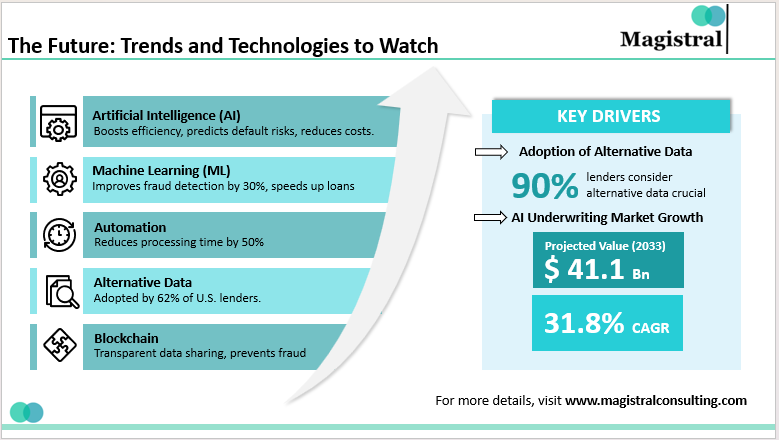
Credit underwriting is not possible without AI. The efficiency and accuracy achieved are unparalleled. AI helps hasten loan approvals, thus allowing lenders to process applications faster, predict default risks with great precision, minimize bad debts, and automate decisions to reduce operational costs.

Machine Learning

Machine Learning enables lenders to be smarter through data-driven decisions. US lenders utilizing ML have realized a 30% fraud detection rate improvement accompanied by faster loan processing. The tools also help institutions adhere to regulatory requirements by identifying potential risks in areas of compliance early on.

Automation

Automation reduces tedious, manual underwriting steps. This decreases processing time and helps lenders achieve up to 50% faster loan approvals. Documentation errors are reduced through automation.

Alternative Data

The use of alternative data such as rent payments, utility bills, and even social media behavior allows lenders to make more comprehensive assessments of creditworthiness. Research shows that 62% of U.S. financial institutions currently include alternative data in their underwriting, and the trend is going to grow exponentially in the coming years.

Blockchain

With decentralized data storage, it enhances stakeholder trust and tamper-proof audit trails. It automatically disburses loans once predefined criteria are met and protects confidentiality, reducing fraud and transparent records easing audits and legal compliance.

Key Drivers

AI Underwriting Market Growth

The AI underwriting market is projected to grow to USD 41.1 billion by 2033, with a CAGR of 31.8%.

Adoption of Alternative Data

Over 90% of lenders consider alternative data crucial, yet only 43% have integrated it, highlighting a significant growth opportunity.

5 Key Ratios for Commercial Loan Underwriting

Understanding key financial ratios is essential in commercial loan underwriting, as they provide valuable insights into a borrower’s financial health, risk profile, and repayment capacity.

Profit Margin Ratio

This is a widely used profitability ratio, and it indicates the amount of profit generated over sales. This ratio measures the company’s ability to earn enough profit to sustain its business. Profit margins often vary from industry to industry, so, a prudent banker should always compare it with close competition and with the average industry standard.

Debt Ratio

This is a solvency ratio, which indicates the debt level of the borrower as a percentage of total assets. A lower debt ratio suggests a more stable business and a higher is the reverse. Experts consider a ratio of 0.5 or less healthy, as it means the company has twice as many assets as liabilities. They carefully examine anything above 0.5 before making a decision.

Loan to Value (LTV) Ratio

This is a risk assessment coverage ratio that is very critical for mortgage underwriting. The LTV ratio ensures that the collateral is worth more than the size of the loan. The higher the LTV ratio, the more risk involved.

Debt Service Coverage Ratio (DSCR)

This is a liquidity ratio, which indicates the amount of cash generated by the business to service its debts (principal, interest, and leases). DSCR validates the borrower’s capacity to pay back the debt and keep running the business. DSCR between 1.25-1.5 is a relatively safe number to consider. However, it differs from business to business and depends on the risk aversion policies of the bank.

Net Worth to Loan Size Ratio

This ratio is used to compare the borrower’s net worth to the size of the requested loan. A high net worth indicates stable financial health, ultimately ensuring the repayment of the loan.


Market Overview

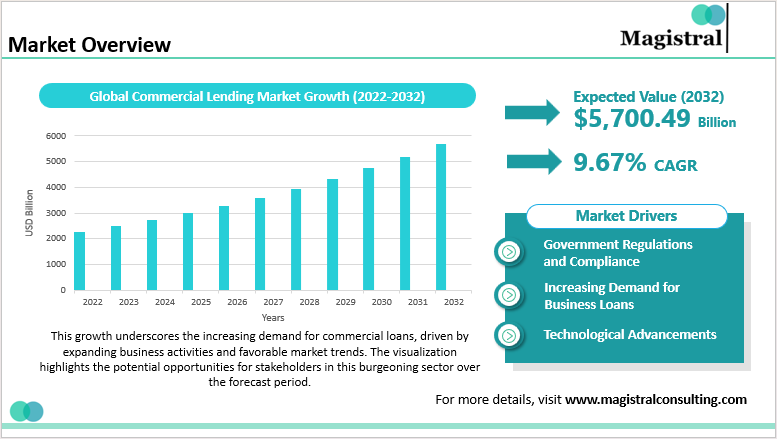
The commercial lending market was at USD 2264.82 billion in the year 2022. The commercial lending market size was estimated at USD 2483.83 billion in the year 2023 and it is projected to grow at 5700.0 billion (USD Billion) in 2032. The growth trend is expected to provide good news with respect to the market trends in the coming years, claiming the growth rate to be a CAGR of around 9.67% for the forecast period, i.e., ending 2032.

Market Overview of Commercial Lending Underwriting Outsourcing

Market Overview of Commercial Lending Underwriting Outsourcing

Commercial Lending Market Drivers

Increasing Demand for Business Loans

The growing demand for business loans among small and big companies fuels this market with the help of online lenders offering prompt approvals and government initiatives supporting small businesses.

Government Regulations and Compliance

Strict government regulations, combining stability with business operations costs related to compliance in financial institutions, guarantee stability in financial operations and loan borrowers, in compliance with relevant policy guidelines set by the government.

Technological Advancements

AI, machine learning, and mobile banking have helped tremendously in shaping instant lending situations in easy credit checks, prompt loan approvals, and good customer satisfaction.

Magistral’s Services for Commercial Loan Underwriting

Magistral Consulting provides expert services to enhance the efficiency, accuracy, and compliance of commercial loan underwriting processes. It thereby directs financial institutions in making informed lending decisions and mitigating risks.

Risk Assessment and Creditworthiness Evaluation

Magistral provides a comprehensive analysis of financial data, market trends, and borrower profiles to assess the credit risk and creditworthiness of applicants, ensuring well-informed lending decisions in commercial loan underwriting.

Loan Application Processing and Verification

We conveniently process all commercial loan applications, including verifying all financial documents, collateral, and borrower information to ensure accuracy and compliance with regulatory standards.

Financial Modeling and Risk Analysis

We employ state-of-the-art financial modeling and risk analysis tools to assess the potential for defaults on loans by looking at the ability of the borrower to repay through cash flow, debt service, coverage ratios, and other metrics central to the financial facets of the facility in commercial loan underwriting.

Regulatory Compliance and Due Diligence

Magistral provides that the local and federal laws guide every step of the underwriting process, maintaining the legal risks to a minimum. We rigorously assess and ensure the proper execution of all documentation and legal obligations.

Technology-Driven Solutions

We enable an improved commercial loan underwriting process through the incorporation of leading-edge technologies. It involved such as artificial intelligence, machine learning, and data analytics. It is assuring thereby that the institutions adopt more rapid yet credible decisions.

Portfolio Risk Management and Monitoring

To continue evaluating and analyzing loan performance with the aim of risk identification and mitigation support. We provide post-approval monitoring to assist institutions in maintaining a healthy loan portfolio.

Tailored Underwriting Strategies

Depending on the needs of a client, for commercial loan underwriting, whether they be small loans, corporate loans, or specialized financing, we develop custom underwriting solutions aimed at making the underwriting process work far more effectively.


About Magistral Consulting

Magistral Consulting has helped multiple funds and companies in outsourcing operations activities. It has service offerings for Private Equity, Venture Capital, Family Offices, Investment Banks, Asset Managers, Hedge Funds, Financial Consultants, Real Estate, REITs, RE funds, Corporates, and Portfolio companies. Its functional expertise is around Deal origination, Deal Execution, Due Diligence, Financial Modelling, Portfolio Management, and Equity Research

For setting up an appointment with a Magistral representative visit www.magistralconsulting.com/contact

About the Author

The article is authored by the Marketing Department of Magistral Consulting. For any business inquiries, you can reach out to prabhash.choudhary@magistralconsulting.com

[sp_easyaccordion id=”3389″]

Underwriting outsourcing services has become a very important business strategy for companies in the financial sector, providing substantial operational benefits. Outsourcing can help organizations save up to 40% of their operational costs and accelerate processing times by 30-50% using specialized technology. The practice has gained popularity in loan, mortgage, and financial underwriting markets due to increasing demand for efficiency, better risk management, and cost savings. This article reviews the main benefits of underwriting outsourcing, including scalability and cost efficiency along with faster turn-around times; however, in light of the new third-party underwriters along with advanced technologies like AI and data analytics reshaping the industry. The underwriting software market is expected to grow rapidly. As such, for business houses, it stands as a strategic imperative to outsource operations to streamline their efforts in a constantly dynamic financial world.

Effects of Underwriting Outsourcing

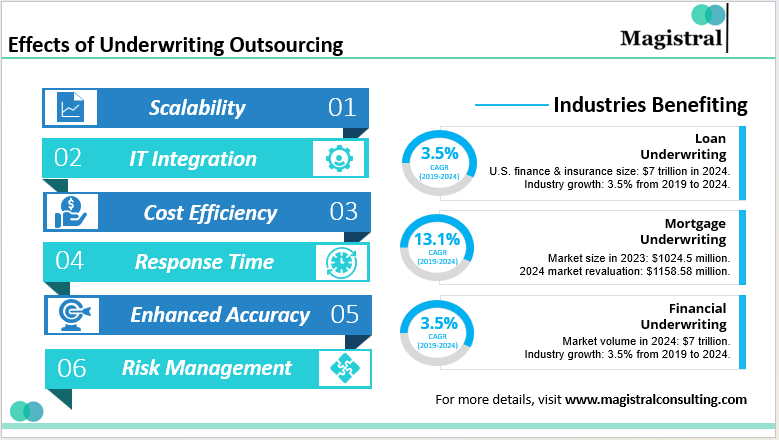
Underwriting outsourcing services would save up to 40% in operational costs as the specialized technology would help complete the process up to 30-50% faster. This has very much become a necessity in the loan, mortgage, and financial underwriting markets because of such operational efficiency, improved risk management, and cost reduction. Underwriting outsourcing is important because:

Effects of Underwriting Outsourcing

Effects of Underwriting Outsourcing

Scalability

Lenders can operate with changing volumes of loans using a minimal amount of in-house personnel, and especially at peak times, prevent disruption in service delivery.

Risk Management

Specialized third-party credit analysis reduces the rate of defaults by ensuring standardized and comprehensive appraisals, leading to better lending decisions.

Cost Efficiency

Underwriting outsourcing reduces overhead costs, which are recruitment, training, and maintaining underwriting teams through a more strategic use of resources.

Response Time

Automation combined with skilled teams means quicker loan approvals, resulting in faster turnaround time and higher customer satisfaction.

Enhanced Accuracy

They allow the underwriters with specific expertise in appraising properties and examining risks to increase the accuracy on results with more limited errors.

IT Integration

The services provider usually integrates advanced technologies that include AI together with data analysis for efficient processing of risk assessment and faster result generation. This leads to performance improvement in general underwriting outsourcing processes.

Industries Benefiting from Underwriting Outsourcing

Underwriting is central to the U.S. finance sector and incorporates several sub-markets, a few of which include loan underwriting, mortgage underwriting, and financial underwriting. Here’s a look at the market value and growth rate for each sub-market:

Loan Underwriting

Loan underwriting is one of the industries under the US finance and insurance sector. The size of this market as of 2024 is approximately $7 trillion, while the compound annual growth rate between 2019 and 2024 is 3.5%.

Mortgage Underwriting

The mortgage lender market in the United States has vastly grown in size. The size of the market in 2023 was estimated to be $1024.5 million, and it is set to enter into the year 2024 with a revaluation of $1158.58 million, showing a growth of CAGR 13.1%. All seemingly upward-downward trends lead the market to the amount of $1809.66 million by the year 2028, representing a CAGR of 11.8% during the forecast period. The professional mortgage underwriting field might grow from a 4% increase from 2018-2028, adding 12,600 jobs over the decade. Currently, an estimate puts over 123,503 mortgage underwriters working in the States.

Financial Underwriting

Financial underwriting is a part of the larger finance and insurance industry in the U.S., which has, once more, a market volume estimated at about $7.0 trillion by 2024. The industry managed to grow at about 3.5% CAGR from 2019 to 2024. The growth will most likely continue for another five years.


Market Dynamics

Following are the market dynamics in Europe and North America for loan, mortgage and financial underwriting services

Europe

In Q2 2024, loan volumes came to €21.5 billion 10% increase from the previous period to 82.83% of which Western European leverage loans represented: mostly accounted for by increasing volumes in distressed debt trading. Meanwhile, European mortgage origination is thoroughly undermined by soaring interest rates-greatly disappointing for the year, which was already projected to be stagnant, in sharp contrast to the 4.9% growth we saw in 2022, the slowest in over ten years. The financial underwriting market remains stable, with pricing adjustments in the range of -1%-+10%. Capacity is still decent, and the disturbed underwriting remains cautious with generally constant coverage terms.

North America

The loan underwriting market in North America is still on the growth track. It is projected that this market will range from $252.06 billion in 2023 to $287.26 billion in 2024, indicating a compound annual growth rate of 14%.
The continuing interest rates were in opposition to pleas for the mortgage underwriting industry. Lending slowed down both nationally and internationally, which led the insurers to revise their strategies by scaling back coverage of the most severely impacted states. In the meantime, financial underwriting is coming under heavy pressure from substantial losses that are born mostly of increased natural disasters and inflation. This is serving to drive premiums higher and render a more conservative approach to underwriting.

Underwriting Software Market

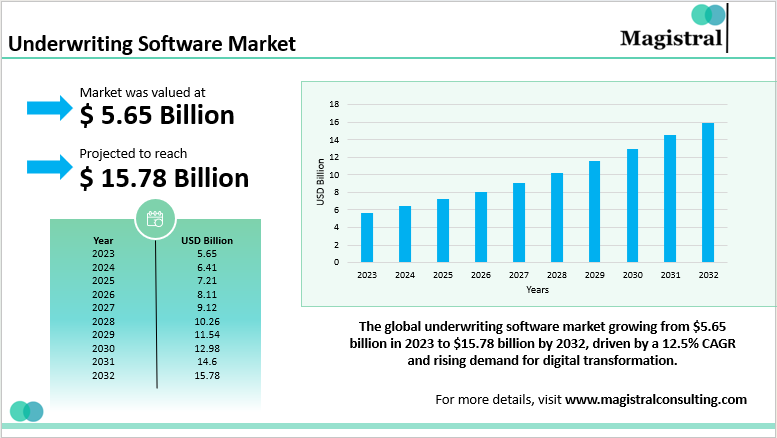
The worldwide marketplace for underwriting software was worth about $5.65 billion in 2023 and is expected to reach approximately $15.78 billion in value by 2032, growing at a CAGR of 12.5% from 2024 to 2032. The demand for digital transformation and data-based decision-making has provided great opportunities for market growth since business organizations have been working on innovative solutions to improve underwriting processes.

Underwriting Software Market

Underwriting Software Market

Market Segmentation 

The underwriting software market segments by functionality, deployment mode, end user, and region. By deployment, it includes on-premises and cloud solutions. By functionality, it comprises automated underwriting systems (AUS), rating engines, and decision support systems. For end users, the market serves insurance companies, brokers and agencies, reinsurers, and managing general agents (MGAs). Regionally, it covers North America, Europe, Asia-Pacific, and LAMEA.

Magistral’s Services for Underwriting Outsourcing

At Magistral Consulting, we provide bespoke underwriting outsourcing solutions for financial institutions to augment their underwriting functions. We designed our services to offer increased efficiency, mitigate risk, and optimize costs. This allows our clients to focus on what matters most. We offer the following services to our clients:

Adaptable Capacity for Shifting Loan Demands

Our solutions empower lenders to deal with fluctuating loan volumes in a manner that decreases the burden on internal resources in times of peak demand. We offer a flexible approach that adjusts to the business’s requirements, ensuring uninterrupted service.

Comprehensive Risk Assessment

A team of talented specialists prepares credit reports and performs risk pricing analysis to offer a productive risk-aid strategy. Our specialized underwriting outsourcing practices will provide you with credible, quantifiable analyses. These will be used for sound decisions and decrease solutions in the default.

Operational Cost Reduction

By underwriting outsourcing functions to Magistral Consulting, clients save on recruitment, training, and operational overhead costs. We streamline processes and reduce the need for in-house underwriting teams, providing significant cost-saving opportunities.

Expedited Processing

We use automation and specialized human skills in underwriting outsourcing. It can accelerate processing, thus reducing the turnaround time for loan approval. The lender and the loan applicant gain more when they make a quick decision.

Accurate Assessments and Evaluations

We have sufficient reputable underwriters with enough expertise to conduct a reasonably sound property valuation. The underwriters guarantee they base decisions on effective qualitative analysis rather than guesswork, minimizing errors.

About Magistral Consulting

Magistral Consulting has helped multiple funds and companies in outsourcing operations activities. It has service offerings for Private Equity, Venture Capital, Family Offices, Investment Banks, Asset Managers, Hedge Funds, Financial Consultants, Real Estate, REITs, RE funds, Corporates, and Portfolio companies. Its functional expertise is around Deal origination, Deal Execution, Due Diligence, Financial Modelling, Portfolio Management, and Equity Research

For setting up an appointment with a Magistral representative visit www.magistralconsulting.com/contact

About the Author

The article is authored by the Marketing Department of Magistral Consulting. For any business inquiries, you can reach out to prabhash.choudhary@magistralconsulting.com

[sp_easyaccordion id=”3362″]