Tag Archives: financial modeling underwriting

Investment banking capital-markets activity improved in the first half of 2026, although the recovery remained unusually concentrated. LSEG reported that the total value of global M&A transactions reached a record US$2.85 trillion in the first half of 2026, while transaction volume fell to a six-year low. In the United States, PwC reported that M&A value reached US$1.2 trillion in the first five months of the year, nearly double the comparable 2025 figure, even as transaction volume declined 4%. These patterns have changed the approach to underwriting in investment banking.

Larger transactions, complex financing structures, volatile interest rates, and divergent sector expectations require underwriting teams to assess not only whether a transaction is viable under a base case, but also how quickly its economics deteriorate when interest expense, revenue expectations, working-capital, or exit assumptions move against the investment thesis. As a result, underwriting now places greater emphasis on scenario analysis, downside protection, information quality, and transaction structure.

The 2026 Underwriting in Investment Banking Environment: More Capital, Greater Selectivity

High deal values are apparent from headlines; underwriting conditions are still tough underneath. Regional variation also means underwriting in investment banking must reflect local liquidity, regulation, and investor demand.
Underwriting in Investment Banking

The 2026 Underwriting in Investment Banking Environment: More Capital, Greater Selectivity

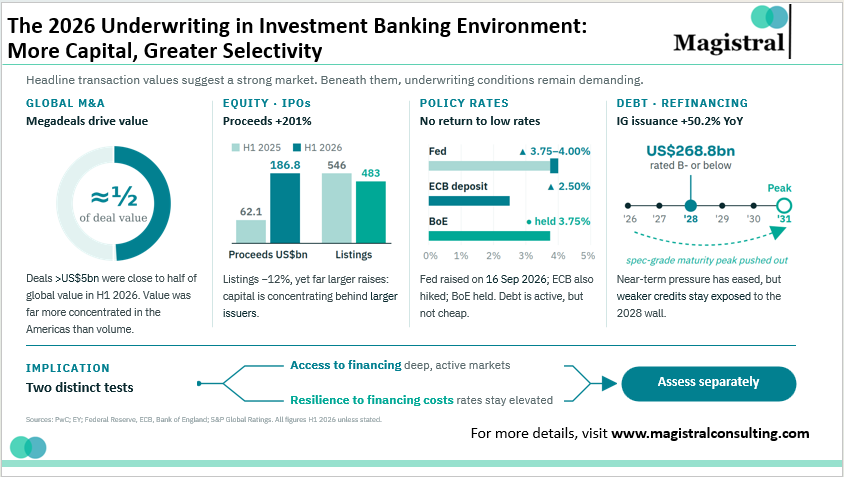
An example from global M&A provides evidence of this dichotomy. Deals valued above US$5 billion accounted for nearly half of the global deal value in the first half of 2026, as revealed by PwC. The deal value was much more concentrated in the Americas region compared to the number of deals there.

The equity issuance activity is robust, too. As reported by EY, there were 483 global IPOs generating US$186.8 billion of proceeds in H1 2026, compared to 546 IPOs raising US$62.1 billion in H1 2025, a 201% increase despite a 12% reduction in the number of IPOs.

Debt markets are active, but funding costs have not returned to the low levels of the previous decade. On September 16, 2026, the Federal Reserve raised the target range for the federal funds rate to 3.75%–4.00%. The European Central Bank raised its deposit facility rate to 2.50%, effective September 16, while the Bank of England maintained the bank rate at 3.75% at its September meeting. These decisions reinforce the need to evaluate transaction economics under a range of financing-cost scenarios. Targeted external support can strengthen underwriting in investment banking by expanding analytical capacity during peak workloads.

Nevertheless, refinancing activity has been substantial. According to S&P Global Ratings, nonfinancial investment-grade issuance increased 50.2% from the first half of 2025, pushing the peak maturity year for speculative-grade bonds to 2031. Although near-term refinancing pressure has eased for most borrowers, weaker credits remain vulnerable; S&P identified US$268.8 billion of debt rated B− or lower that matures in 2028.

The underwriting implication is clear: financing availability and refinancing risk must be evaluated separately.

These pressures make underwriting in investment banking more demanding when information is incomplete, or market conditions shift quickly.

Underwriting in Investment Banking: How Assumptions Are Changing

A traditional base case model is not sufficient to evaluate transactions in 2026.

Downside scenarios are receiving greater weight. Revenue growth, margin assumptions, and valuation multiples need to be analyzed together rather than individually. A company that appears appropriately leveraged under management’s estimates may look substantially different if revenue growth slows and elevated financing costs persist.

Debt-service capability is receiving a more stringent test. Floating rate exposure, a refinancing schedule, and covenant cushion join leverage as key underwriting factors. Underwriting evaluation increasingly focuses on interest coverage, fixed charge coverage, free cash-flow yield, and liquidity in various capital structures.

Earnings quality is becoming more important than the headline EBITDA figure. S&P Global Ratings’ review of U.S. speculative-grade issuers found that EBITDA add-backs represented approximately 30% of market-adjusted EBITDA across a decade of data. This finding underscores the importance of validating adjustments, projected synergies, and management-defined earnings measures.

Cash-flow sustainability is also receiving greater emphasis. Working-capital seasonality, customer concentration, recurring versus project-driven revenue, capital-expenditure requirements, and contractual revenue recognition all affect whether accounting earnings support debt service.

Sponsor-led deals add another dimension to underwriting. In addition to operating performance, underwriters must assess the equity contribution, shareholder support, dividend capacity, and refinancing or exit potential. A deal that depends on multiple expansions or early refinancing has a substantially different risk profile from one that reduces debt through cash flow. As a result, underwriting in investment banking benefits from consistent data, transparent models, and clear escalation paths.

Regional Underwriting in Investment Banking

Regional underwriting approaches vary considerably across markets, reflecting differences in deal activity, financing conditions, regulatory frameworks, and investor appetite.
Underwriting in Investment Banking

Regional Underwriting in Investment Banking

North America

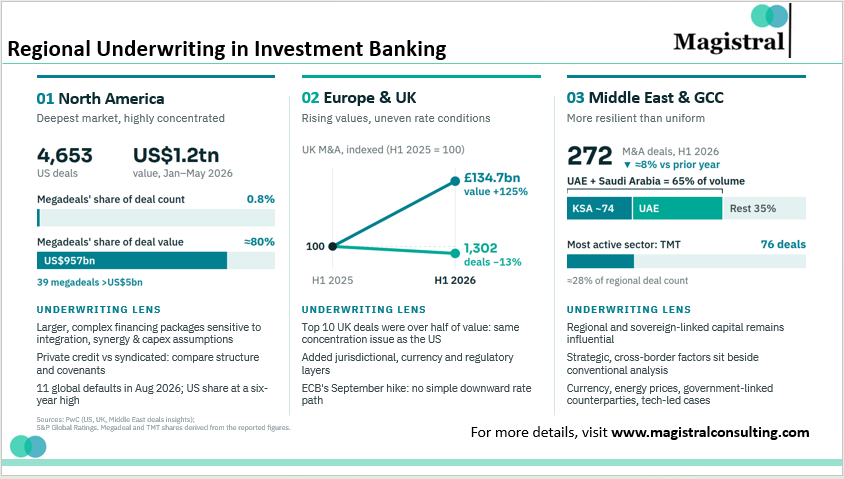
North America continues to have the deepest transaction and financing markets, although activity is highly concentrated. According to PwC, 4,653 U.S. deals worth US$1.2 trillion were announced in the first five months of 2026. Of these, 39 transactions were valued at more than US$5 billion, and those megadeals represented US$957 billion of total value.

From a financing perspective, larger transactions are more difficult to finance and are especially sensitive to assumptions about integration, synergies, and future capital requirements. The availability of both private credit and broadly syndicated financing also makes comparisons of structures and covenants increasingly important.

Credit deterioration has not disappeared. S&P Global Ratings reported 11 global corporate defaults in August 2026 and stated that the U.S. share of global defaults reached a six-year high. Consequently, underwriting in investment banking increasingly depends on disciplined risk selection and evidence-based judgment.

Europe and the UK

Europe and the United Kingdom show rising average transaction values against an unsettled economic and interest-rate backdrop. In the United Kingdom, PwC estimated that first-half 2026 M&A value totaled £134.7 billion, an increase of 125% from the prior-year period, while transaction volume declined 12.6% to 1,302 deals. The ten largest transactions accounted for more than half of total deal value.

European underwriters therefore face the same concentration concerns as their U.S. counterparts, along with additional legal complexity, currency exposure, and cross-border execution risks. The ECB’s September rate increase also indicates that underwriters should not assume a smooth decline in European financing costs.

Middle East and GCC

Transactions in the Middle East have experienced more stability and resilience than consistency. PwC estimated 272 M&A transactions in the Middle East in H1 2026, 8% less than in the preceding year. In this period, the UAE and Saudi Arabia contributed 65% of total deal volume, and the number of deals in Saudi Arabia was around 74. Technology, media and telecommunications was the busiest industry, with 76 deals.

Regional and sovereign-related capital is still quite powerful. Hence, the underwriting process may consider such factors as strategy and cross-border issues, along with other financial factors, like the currency of the transaction, energy price risk, sovereign counterparties and, increasingly, technology-focused investment opportunities. For deal teams, underwriting in investment banking now requires earlier validation of assumptions and downside cases.

What Is Making Underwriting in Investment Banking More Difficult in 2026?

Scattered data is one of the biggest challenges. Financial data could be spread out in management accounts, audited statements, operating databases, virtual data rooms and third-party databases.

Challenging capital structures need an examination of senior debt, revolving credit lines, subordinated securities, preferred stock and other securities beyond the leverage ratio alone.
Refinance assumptions need more attention. Successful 2026 issuances have long maturities, yet some companies will still need considerable refinancing.

Disruptive trends are hard to forecast. Trends like AI, energy prices, geopolitics, and supply chain changes can affect business operations faster than financial statements can show.
Timelines for transactions have not improved. When due diligence, valuation, financing, and documentation all occur at the same time, more data must be processed without reducing the validity of the process.

Information consistency has also become an underwriting risk. EBITDA in a bank presentation may differ from EBITDA in the operating model; revenue projections may not reconcile with customer-level data; and management adjustments may materially change leverage calculations. These discrepancies require strong analytical skills and thorough review.

Magistral’s Support for Underwriting in Investment Banking

Magistral Consulting supports investment banks, private equity firms, private credit investors, and other financial institutions during underwriting and transaction evaluation. Its analytical support may include financial-statement analysis and spreading, company and industry research, peer and precedent-transaction analysis, financial modeling, scenario and sensitivity analysis, leverage and debt-capacity analysis, investment-banking due diligence, transaction research, preparation of underwriting and investment memoranda, data-room review, and ongoing portfolio or credit monitoring.

The objective is to operate as an extension of the client’s investment or transaction team by providing research and execution support, while final underwriting decisions remain with the client. Used carefully, technology can make underwriting in investment banking faster without weakening professional review.


About Magistral Consulting

Magistral Consulting has helped multiple funds and companies in outsourcing operations activities. It has service offerings for Private Equity, Venture Capital, Family Offices, Investment Banks, Asset Managers, Hedge Funds, Financial Consultants, Real Estate, REITs, RE funds, Corporates, and Portfolio companies. Its functional expertise is around Deal origination, Deal Execution, Due Diligence, Financial Modelling, Portfolio Management, and Equity Research

For setting up an appointment with a Magistral representative visit www.magistralconsulting.com/contact

About the Author

Prabhash Choudhary is the CEO of Magistral Consulting. He is a Stanford Seed alumnus and mechanical engineer with 20 + years’ leadership at Fortune 500 firms- Accenture Strategy, Deloitte, News Corp, and S&P Global. At Magistral Consulting, he directs global operations and has delivered over $3.5 billion in client impact across finance, research, analytics, and outsourcing. His expertise spans management consulting, investment and strategic research, and operational excellence for 1,200 + clients worldwide


FAQs


How is AI changing investment banking underwriting in 2026?

AI is primarily reducing the time required for information-intensive tasks rather than replacing underwriting judgment. Tools can extract financial information, review documents, organize diligence materials, and assist with scenario analysis. This allows professionals to spend more time reviewing assumptions and identifying risks. The control framework remains important: outputs must be reconciled with source documents, financial models require quality checks, and ambiguous accounting, legal, or commercial information still requires experienced interpretation.


Which financial metrics are receiving greater attention during underwriting?

Headline leverage remains relevant, but underwriters increasingly examine cash interest coverage, free cash-flow conversion, covenant headroom, liquidity, working-capital requirements and refinancing capacity together. Revenue visibility, customer concentration and recurring versus non-recurring earnings also affect how much confidence can be placed in projected EBITDA. For leveraged transactions, the relationship between leverage reduction, capital expenditure and cash generation can be more informative than a single debt-to-EBITDA figure.


How does underwriting differ between private credit, M&A and equity transactions?

The analytical foundation overlaps, but the risk being evaluated differs. Credit underwriting focuses heavily on downside protection, cash flow, leverage, documentation and repayment capacity. M&A underwriting may place greater emphasis on valuation, synergies, financing structure and integration risk. Equity underwriting also assesses market positioning, earnings quality, investor appetite and valuation support. In each case, sector research, financial modeling and sensitivity analysis help translate transaction assumptions into measurable outcomes.


What work can external underwriting teams support?

External analytical teams can assist with financial spreading, industry research, peer benchmarking, comparable-company analysis, precedent transactions, financial modeling, debt-capacity analysis, scenario testing, data-room review, diligence tracking, and preparation of underwriting or investment materials. They can also perform consistency and source-validation checks. Risk appetite, transaction approval, and final investment or credit decisions should remain with the institution’s authorized professionals and committees.


What are the largest underwriting risks in the current market?
The principal risks are often interconnected: higher-for-longer financing costs can reduce coverage ratios just as weaker growth affects cash generation; aggressive EBITDA adjustments can overstate debt capacity; refinancing assumptions can underestimate future funding costs; and sector disruption can weaken historical relationships between revenue, margins and valuation. Data inconsistency is another material concern because underwriting decisions increasingly rely on information drawn from numerous financial, operational and third-party sources.


Commercial loan underwriting has evolved into a more data-intensive and regulated process, requiring greater strategic planning. Lenders now assess deals using a combination of borrower financials, asset values, sector signals, and cash flow quality, supported by faster digital workflows. This shift is driving market growth, with the global commercial lending market projected to expand from $10.9 trillion in 2025 to $28.4 trillion by 2034, alongside advancements in underwriting technology and risk assessment.

Commercial Loan Underwriting Market Size and Growth

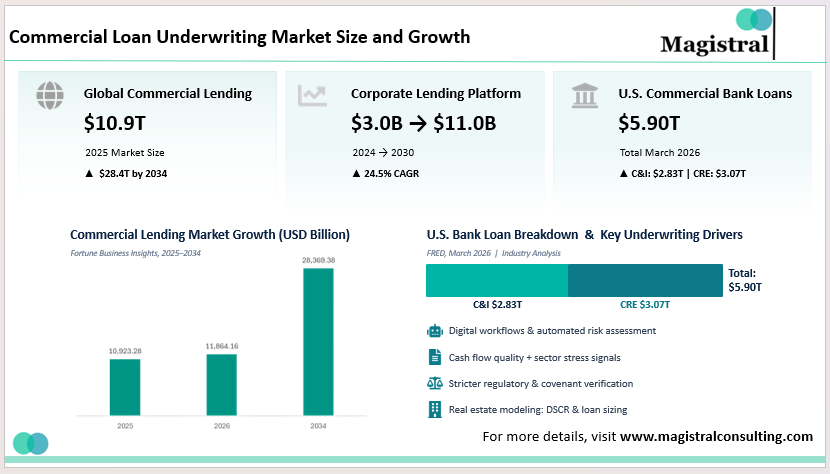
The process of Commercial Loan Underwriting operates within an extensive lending network that continues to expand even when certain areas experience restricted credit conditions. Fortune Business Insights estimates the global commercial lending market at $10,923.28 billion in 2025 and projects $28,369.38 billion by 2034, which indicates substantial market growth during the next few decades. The corporate lending platform market will reach a value of $3.0 billion in 2024, according to MarketsandMarkets, and grow to $11.0 billion by 2030 with a compound annual growth rate of 24.5% because underwriting processes increasingly adopt digital systems and automated workflows.

Commercial Loan Underwriting Market Size and Growth

Commercial Loan Underwriting Market Size and Growth

Why this growth matters for lenders

Underwriters who need to evaluate increased loan volumes must maintain their credit assessment standards while managing their workload. The lenders combine traditional review methods with analytical tools, workflow solutions, and expert assistance. Underwriting now operates through a system that combines modeling processes, documentation assessment, covenant verification, and sector analysis. The interconnected systems of real estate financial modeling become necessary in property secured transactions because even small changes in assumptions produce major impacts on both debt service coverage and loan sizing calculations.

Recent signals from the U.S. credit market

American businesses maintain their commercial credit balances at elevated levels according to the latest data. FRED reports that Commercial and Industrial Loans at all commercial banks reached about $2.828 trillion in March 2026, while Commercial Real Estate Loans at all commercial banks stood at about $3.073 trillion in the same month. The data shows that banks use Commercial Loan Underwriting as their main function because even small changes in approval criteria result in significant impacts on their credit portfolios.

Commercial Loan Underwriting Trends in Risk, Demand, and Approval Standards

The current credit standards show a dual development because some borrower segments demonstrate increasing demand while other segments maintain their existing credit standards. The Federal Reserve’s January 2026 Senior Loan Officer Opinion Survey said banks reported generally unchanged standards and stronger demand for commercial real estate loans, while expecting demand to strengthen across 2026.

Credit standards are still cautious

Credit standards maintain their cautious approach, which prevents lenders from extending credit. The FRED series shows banks expanding their lending standards to CRE construction loans, which demonstrates the industry shift from previous practices. The measure showed a decrease from 11.1 in Q2 2025 to 1.8 in Q1 2026, which shows declining pressure on underwriting standards. The risk signals continue to function while demand shows signs of improvement.

Demand is improving with risk signals intact

The same survey found stronger demand for CRE loans while asset quality remained under observation. The FDIC data shows that non-owner-occupied CRE delinquency rates reached 2.02% in 2024, which remains higher than the historical average. The structured underwriting practices that use due diligence and valuation frameworks demonstrate their critical value to the process.

Commercial Loan Underwriting and Technology Adoption

The process of Commercial Loan Underwriting has started to evolve into a function that requires technological solutions. Markets and markets projects lending platforms to grow from $3.0 billion in 2024 to $11.0 billion by 2030. The increase in this development occurs because businesses now use artificial intelligence along with automation and data analytics to improve their underwriting operations.

Practical impact of automation

The underwriter teams use technology to enhance their ability to process documents, track covenants, and assess risks at an early stage. McKinsey suggests that AI-enabled underwriting can reduce decision time significantly while improving consistency.

The solution maintains compatibility with present financial transformation efforts because Finance ecosystem connections enable better borrower profile development and monitoring activities.

Balance between automation and judgment

Both automation and human judgment must reach a state of equal equilibrium. Underwriters who possess experience make the final decision for lenders despite the system’s automated processes. Automated systems cannot handle the complete evaluation of borrower strategy, industry outlook, and potential negative outcomes, which are needed for complex deals.

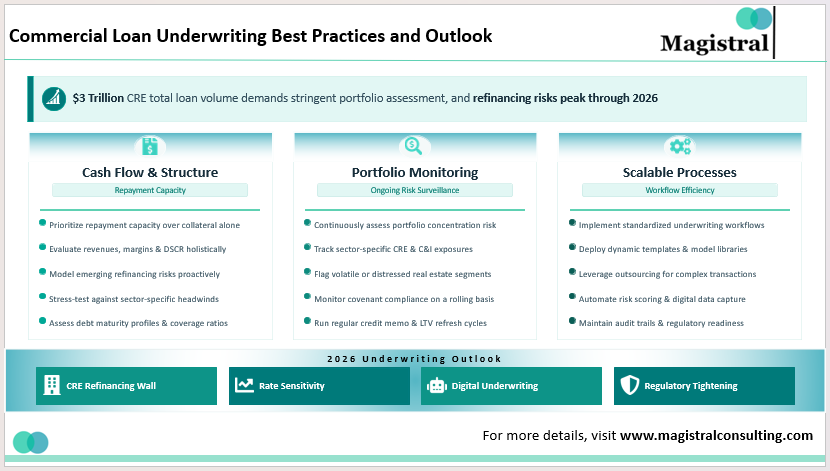
Commercial Loan Underwriting Best Practices and Outlook

Lenders need to balance three factors when underwriting commercial loans because their underwriting process will succeed at its highest level. Institutions require structured processes that enable them to manage increasing demand while maintaining their service quality.

Commercial Loan Underwriting Best Practices and Outlook

Commercial Loan Underwriting Best Practices and Outlook

Focus on cash flow and structure

Underwriters use repayment capacity as their primary factor to make their lending decisions. Lenders need to evaluate their revenues and margins together with their refinancing risk, while they should not depend solely on their collateral strength.

Portfolio level monitoring

U.S. commercial real estate lenders need to assess their portfolio concentration together with their sector exposure because their total loan volume has surpassed $3 trillion.

Scalable and efficient processes

The establishment of standardized workflows together with templates and outsourcing support enables lenders to achieve efficient underwriting operations. The process becomes especially important when organizations deal with complex transactions that involve private equity and venture capital financing for their borrowers.

How Magistral Supports Commercial Loan Underwriting

Magistral Consulting supports lenders by combining financial expertise with scalable execution capabilities. Their teams assist in financial analysis, credit memo preparation, covenant tracking, and portfolio monitoring, allowing lenders to focus on core decision-making.

They also provide specialized support in areas like cash flow modeling, borrower risk profiling, and collateral analysis, which improves underwriting accuracy and turnaround time. In addition, Magistral’s experience across sectors such as real estate, structured finance, and mid-market lending enables lenders to handle complex transactions more effectively.

Magistral enables institutions to optimize their commercial loan underwriting processes through its combination of technology-based workflows and expert knowledge, which results in cost savings and preservation of high credit quality standards in competitive lending markets.

About Magistral Consulting

Magistral Consulting has helped multiple funds and companies in outsourcing operations activities. It has service offerings for Private Equity, Venture Capital, Family Offices, Investment Banks, Asset Managers, Hedge Funds, Financial Consultants, Real Estate, REITs, RE funds, Corporates, and Portfolio companies. Its functional expertise is around Deal origination, Deal Execution, Due Diligence, Financial Modelling, Portfolio Management, and Equity Research

For setting up an appointment with a Magistral representative visit www.magistralconsulting.com/contact

About the Author

Nitin is a Partner and Co-Founder at Magistral Consulting. He is a Stanford Seed MBA (Marketing) and electronics engineer with 19 + years at S&P Global and Evalueserve, leading research, analytics, and inside‑sales teams. An investment‑ and financial‑research specialist, he has delivered due‑diligence, fund‑administration, and market‑entry projects for clients worldwide. He now shapes Magistral Consulting’s strategic direction, oversees global operations, and drives business‑development support.

FAQs

What is Commercial Loan Underwriting?

Commercial Loan Underwriting is the process of evaluating borrower risk, financial health, and collateral before approving a business loan.

What is the market size of commercial lending?

The global commercial lending market is estimated at around $10.9 trillion in 2025 and is projected to grow significantly over the next decade.

How is technology impacting underwriting?

Technology enables faster processing, better risk prediction, and improved efficiency through automation and AI tools.

What are the main risks in underwriting?

Key risks include economic volatility, borrower default, poor data quality, and regulatory challenges.