Tag Archives: credit risk analysis

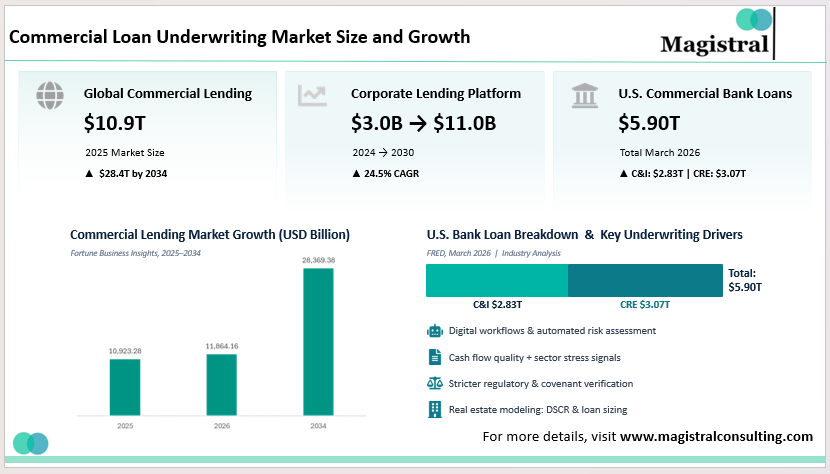
Commercial loan underwriting has evolved into a more data-intensive and regulated process, requiring greater strategic planning. Lenders now assess deals using a combination of borrower financials, asset values, sector signals, and cash flow quality, supported by faster digital workflows. This shift is driving market growth, with the global commercial lending market projected to expand from $10.9 trillion in 2025 to $28.4 trillion by 2034, alongside advancements in underwriting technology and risk assessment.

Commercial Loan Underwriting Market Size and Growth

The process of Commercial Loan Underwriting operates within an extensive lending network that continues to expand even when certain areas experience restricted credit conditions. Fortune Business Insights estimates the global commercial lending market at $10,923.28 billion in 2025 and projects $28,369.38 billion by 2034, which indicates substantial market growth during the next few decades. The corporate lending platform market will reach a value of $3.0 billion in 2024, according to MarketsandMarkets, and grow to $11.0 billion by 2030 with a compound annual growth rate of 24.5% because underwriting processes increasingly adopt digital systems and automated workflows.
Commercial Loan Underwriting Market Size and Growth

Commercial Loan Underwriting Market Size and Growth

Why this growth matters for lenders

Underwriters who need to evaluate increased loan volumes must maintain their credit assessment standards while managing their workload. The lenders combine traditional review methods with analytical tools, workflow solutions, and expert assistance. Underwriting now operates through a system that combines modeling processes, documentation assessment, covenant verification, and sector analysis. The interconnected systems of real estate financial modeling become necessary in property secured transactions because even small changes in assumptions produce major impacts on both debt service coverage and loan sizing calculations.

Recent signals from the U.S. credit market

American businesses maintain their commercial credit balances at elevated levels according to the latest data. FRED reports that Commercial and Industrial Loans at all commercial banks reached about $2.828 trillion in March 2026, while Commercial Real Estate Loans at all commercial banks stood at about $3.073 trillion in the same month. The data shows that banks use Commercial Loan Underwriting as their main function because even small changes in approval criteria result in significant impacts on their credit portfolios.

Commercial Loan Underwriting Trends in Risk, Demand, and Approval Standards

The current credit standards show a dual development because some borrower segments demonstrate increasing demand while other segments maintain their existing credit standards. The Federal Reserve’s January 2026 Senior Loan Officer Opinion Survey said banks reported generally unchanged standards and stronger demand for commercial real estate loans, while expecting demand to strengthen across 2026.

Credit standards are still cautious

Credit standards maintain their cautious approach, which prevents lenders from extending credit. The FRED series shows banks expanding their lending standards to CRE construction loans, which demonstrates the industry shift from previous practices. The measure showed a decrease from 11.1 in Q2 2025 to 1.8 in Q1 2026, which shows declining pressure on underwriting standards. The risk signals continue to function while demand shows signs of improvement.

Demand is improving with risk signals intact

The same survey found stronger demand for CRE loans while asset quality remained under observation. The FDIC data shows that non-owner-occupied CRE delinquency rates reached 2.02% in 2024, which remains higher than the historical average. The structured underwriting practices that use due diligence and valuation frameworks demonstrate their critical value to the process.

Commercial Loan Underwriting and Technology Adoption

The process of Commercial Loan Underwriting has started to evolve into a function that requires technological solutions. Markets and markets projects lending platforms to grow from $3.0 billion in 2024 to $11.0 billion by 2030. The increase in this development occurs because businesses now use artificial intelligence along with automation and data analytics to improve their underwriting operations.

Practical impact of automation

The underwriter teams use technology to enhance their ability to process documents, track covenants, and assess risks at an early stage. McKinsey suggests that AI-enabled underwriting can reduce decision time significantly while improving consistency.

The solution maintains compatibility with present financial transformation efforts because Finance ecosystem connections enable better borrower profile development and monitoring activities.

Balance between automation and judgment

Both automation and human judgment must reach a state of equal equilibrium. Underwriters who possess experience make the final decision for lenders despite the system’s automated processes. Automated systems cannot handle the complete evaluation of borrower strategy, industry outlook, and potential negative outcomes, which are needed for complex deals.

Commercial Loan Underwriting Best Practices and Outlook

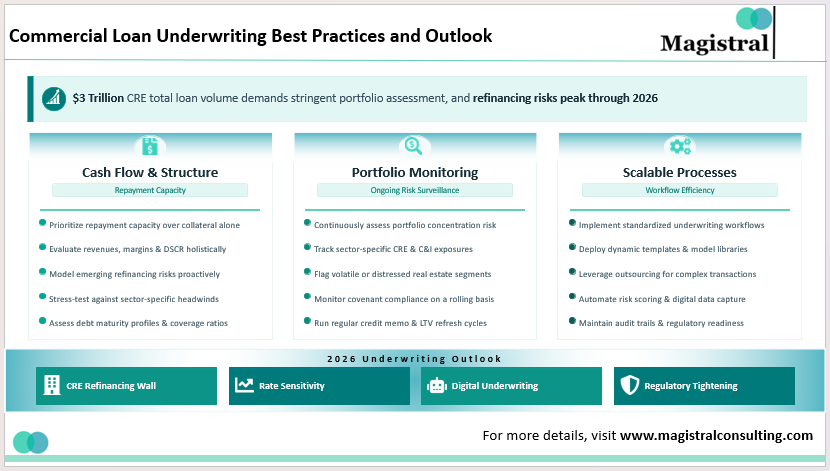
Lenders need to balance three factors when underwriting commercial loans because their underwriting process will succeed at its highest level. Institutions require structured processes that enable them to manage increasing demand while maintaining their service quality.
Commercial Loan Underwriting Best Practices and Outlook

Commercial Loan Underwriting Best Practices and Outlook

Focus on cash flow and structure

Underwriters use repayment capacity as their primary factor to make their lending decisions. Lenders need to evaluate their revenues and margins together with their refinancing risk, while they should not depend solely on their collateral strength.

Portfolio level monitoring

U.S. commercial real estate lenders need to assess their portfolio concentration together with their sector exposure because their total loan volume has surpassed $3 trillion.

Scalable and efficient processes

The establishment of standardized workflows together with templates and outsourcing support enables lenders to achieve efficient underwriting operations. The process becomes especially important when organizations deal with complex transactions that involve private equity and venture capital financing for their borrowers.

How Magistral Supports Commercial Loan Underwriting

Magistral Consulting supports lenders by combining financial expertise with scalable execution capabilities. Their teams assist in financial analysis, credit memo preparation, covenant tracking, and portfolio monitoring, allowing lenders to focus on core decision-making.

They also provide specialized support in areas like cash flow modeling, borrower risk profiling, and collateral analysis, which improves underwriting accuracy and turnaround time. In addition, Magistral’s experience across sectors such as real estate, structured finance, and mid-market lending enables lenders to handle complex transactions more effectively.

Magistral enables institutions to optimize their commercial loan underwriting processes through its combination of technology-based workflows and expert knowledge, which results in cost savings and preservation of high credit quality standards in competitive lending markets.

About Magistral Consulting

Magistral Consulting has helped multiple funds and companies in outsourcing operations activities. It has service offerings for Private Equity, Venture Capital, Family Offices, Investment Banks, Asset Managers, Hedge Funds, Financial Consultants, Real Estate, REITs, RE funds, Corporates, and Portfolio companies. Its functional expertise is around Deal origination, Deal Execution, Due Diligence, Financial Modelling, Portfolio Management, and Equity Research

For setting up an appointment with a Magistral representative visit www.magistralconsulting.com/contact

About the Author

Nitin is a Partner and Co-Founder at Magistral Consulting. He is a Stanford Seed MBA (Marketing) and electronics engineer with 19 + years at S&P Global and Evalueserve, leading research, analytics, and inside‑sales teams. An investment‑ and financial‑research specialist, he has delivered due‑diligence, fund‑administration, and market‑entry projects for clients worldwide. He now shapes Magistral Consulting’s strategic direction, oversees global operations, and drives business‑development support.

FAQs

What is Commercial Loan Underwriting?

Commercial Loan Underwriting is the process of evaluating borrower risk, financial health, and collateral before approving a business loan.

What is the market size of commercial lending?

The global commercial lending market is estimated at around $10.9 trillion in 2025 and is projected to grow significantly over the next decade.

How is technology impacting underwriting?

Technology enables faster processing, better risk prediction, and improved efficiency through automation and AI tools.

What are the main risks in underwriting?

Key risks include economic volatility, borrower default, poor data quality, and regulatory challenges.

Private credit has quietly transformed how risk is structured, priced, and controlled across global capital markets. As private equity sponsors, credit funds, banks, and growth-stage companies rely more heavily on non-bank capital, credit research has shifted from analyzing visible risks to uncovering hidden structural risks.

While public credit is based on ratings, liquidity, and standardised disclosures, private credit sits within tailored legal frameworks, layered capital stacks, and covenant-driven control rights. That evolution has made credit research a structural discipline, now at the core of capital preservation and risk control.

Private Credit Has Changed What Credit Research Actually Does

The public credit market was designed to be transparent. Analysts used rating agencies, trading spreads, standardized contracts, or market behaviour as references to determine risk. In the case of private credit, nearly all these references have been abolished.

From Market-Driven Risk to Structure-Driven Risk: In a Growing Private Credit Universe

The private credit market universe has grown significantly over the past few years. In fact, global private credit assets under management (AUM) exceeded US$3 trillion as of 2025, reflecting growth from approximately US$2 trillion as of 2020.

This is a pointer to why public market-style credit research is inadequate. As a multi-trillion-dollar asset class for private credit, the risk is no longer about being transparent or well-known on public markets. It is now a question of structured design. Moreover, credit market research has to transition from reading market opinions to understanding uniquely structured deal memoranda.

Capital Structures That Public Credit Was Never Built to Analyse 

In today’s private credit transactions, sophisticated financing arrangements are common. These arrangements include unitranche loans, second-lien facilities, mezzanine loans, PIK toggle bonds, and hybrid equity components. These are not evaluated by traditional credit analysis.

In private credit, research must pose the question: Just how does the value flow through the layers, and how does the inter-creditor rights mechanism split the recovery proceeds, and where are the losses? This has become mainstream, no longer a niche issue, because of the scale of the capital out there.

Covenants as Active Risk Mechanisms in a Competitive Funding Environment

The more complex the structures, the more central the covenant design becomes to risk control. Maintenance covenants, liquidity floors, aggressive EBITDA add-backs, and cure-rights have been among the common lender-protective provisions in private credit deals.

Without public market liquidity or mark-to-market pricing, research teams must stress-test covenant headroom across scenarios, assess breach risk, and model renegotiation or default outcomes.

In particular, with private credit funds managing multi-billion-dollar portfolios, covenant risk no longer remains a side analysis but rather a core determinant of downside.

Operational Risk as a Core Credit Research Input: Early Signals Matter

Operational risk has thus emerged as a focal point within contemporary research, reflecting the growing size of the global private credit industry. As of 2025, the global private credit industry manages more than $3 trillion in assets. Means, even small operational risks can have a significant impact on portfolio performance.

Consequently, stress has emerged in business operations rather than financial statements, compelling credit researchers to shift focus upstream within operational risk monitoring.

Although its reported non-finance corporate default rate remains relatively low, around 1.5%–2.0% in 2024, there has been a sharp increase in amending and restructuring. Consequently, credit analysts now view operational warning signs. Like, customer payment delays, capex pressures, and supplier risk and margin compression as more significant factors than leverage ratios when assessing credit risk.

How Private Credit Is Rewriting Risk Ownership Across Capital Providers

Private credit market evolution is now a dominant force for allocation and resource distribution. Early 2025 data showed the amount under management for global private credit at about 3 trillion USD; this was 2 trillion USD in 2020. Volatility becomes more costly when such a market is operating at this level because even the slightest carelessness is magnified and can affect risk management.

How the Rise of Private Credit Is Reshaping Credit Research

How the Rise of Private Credit Is Reshaping Credit Research

Private Equity and Credit Funds Now Carry Structural Risk

To private equity sponsors and credit funds, the risk is no longer solely about whether a borrower defaults but resides in covenant engineering, capital-stack hierarchy, and recovery sequencing. Recent data shows that in 2025, more deals, especially in middle-market direct lending, are based on layered structures and flexible interest/payment terms, such as PIK toggles or covenant-lite provisions. With this level of complexity, funds that invest in rigorous, structure-aware research can better manage hidden downside and deliver stronger risk-adjusted returns.

Banks Face a Precision Problem, Not a Volume Problem

This growing private credit market increasingly poses unique risks and opportunities for banks as traditional lenders and institutional lenders. These dynamics play out in custom-made financings that sit outside the boundaries of typical business loans and bond issuances. Based on a 2024–2025 industry study, global private credit outstanding has grown from approximately US$1 trillion in 2020 to around US$1.6 trillion as of early 2024.The CAGR here stands at around 16%.

This rapid expansion generates pressure on traditional credit risk frameworks. Conventional credit analysis templates are incapable of analysing structural risk, covenant vulnerability, or recovery profiles. This necessitates intensive credit research that is heavily dependent on the underlying credit structure.

Founders Are Now Judged on Transparency, Not Just Growth

Today, for borrowers, especially in the middle market and leveraged firms, access to private credit significantly relies on whether operational transparency and reporting discipline are available. Lenders increasingly expect visibility of operating metrics, liquidity cycles, and cash-flow behaviour in real-time. Recent market surveys of private credit funds in India, a microcosm of broader global trends, reported that private credit investments reached US$9.0 billion for H1 2025, up by 53% over H1 2024.

But it was only such deals that had robust cash-flow discipline and sharp covenant compliance frameworks that were granted. In such an environment, founders need to run their businesses with clear alignment to lender expectations. Credit research no longer depends solely on past performance. It also evaluates forward-looking structural and operational integrity.

Credit Research as Strategic Infrastructure

What was non-core is now strategic. Increasingly, as private credit grows into a multi-trillion-dollar asset class, deal complexity continues to rise. Private equity players are embracing hybrid approaches, where in-house decision-making meets external research facilitation. This shift enables enhanced downside research, constant covenant monitoring, and analysis of complex structures. It achieves this without expanding headcount, a key differentiator for best-in-class managers.

What Lies Ahead for Credit Research

Private credit development outpaces all available analysis infrastructure that attempts to study it. By 2030, global private credit assets under management are expected to reach $4.5–$6 trillion, nearly doubling from 2024 levels and increasing exposure to opaque, highly customized structures that render traditional research methods insufficient.

The Structural Shift Redefining Credit Research

The Structural Shift Redefining Credit Research

Future research on credit for PE firms, credit funds, banks, and entrepreneurs in the future would be predictive in nature and would be continuous. More than 60% of private credit investors are already increasing their investments in data analysis, modelling, and outsourced research, and this trend is expected to accelerate in the future. Organizations that treat credit market research as a form of infrastructure would be safeguarding their capital.

How Magistral Supports Modern Credit Research

As credit risk shifts from public markets to private, illiquid, and structured exposures, credit market research has moved beyond rating interpretation. It now focuses on deal-level underwriting, downside protection, and continuous monitoring.

Magistral’s teams integrate financial analysis, legal and structural review, macro sensitivity, and asset-level diligence. This integrated approach supports investment decisions, risk committees, and portfolio monitoring across the credit lifecycle.

Deal-Level Credit Underwriting

Cash-flow modeling, leverage analysis, downside and recovery scenarios for private and structured credit deals.

Covenant and Documentation Analysis

Review of loan agreements, intercreditor terms, security packages, and control rights to assess true downside protection.

Private Credit Due Diligence

Business, borrower, and asset-level diligence for direct lending, unitranche, asset-backed, and special situations credit.

Portfolio Credit Monitoring & Surveillance

Ongoing tracking of covenant compliance, liquidity headroom, performance drift, and early-warning signals.

Recovery & Distressed Credit Analysis

Recovery modeling, restructuring scenarios, enforcement pathways, and control outcomes in downside cases.

Regulatory & Risk Reporting Support

Credit documentation and analytics aligned with regulatory scrutiny, internal risk frameworks, and audit requirements.

About Magistral Consulting

Magistral Consulting has helped multiple funds and companies in outsourcing operations activities. It has service offerings for Private Equity, Venture Capital, Family Offices, Investment Banks, Asset Managers, Hedge Funds, Financial Consultants, Real Estate, REITs, RE funds, Corporates, and Portfolio companies. Its functional expertise is around Deal origination, Deal Execution, Due Diligence, Financial Modelling, Portfolio Management, and Equity Research

For setting up an appointment with a Magistral representative visit www.magistralconsulting.com/contact

About the Author

Aman is an investment-research specialist with 5+ years of experience across business and investment research, including 2+ years with Big Four firms like KPMG. A Stanford Seed alumnus with an MBA in Finance and a Bachelor of Commerce (Hons) from University of Delhi, he focuses on private equity, venture capital, and renewable energy sectors. He leads project teams at Magistral Consulting, delivering financial research, due diligence, deal sourcing, and M&A support, while driving strong process management and analytics. His blend of attention to detail, strategic thinking, and dynamic execution enables him to turn complex data into actionable investment insights.

FAQs

What differentiates Magistral from traditional research providers?

Magistral combines investment-grade analysis with execution depth, delivering bespoke, decision-ready insights rather than templated research.

How does Magistral integrate with client teams?

Magistral operates as an embedded extension of investment and risk teams, aligned to internal IC standards, timelines, and governance processes.

How does Magistral approach credit research differently today?

Magistral designs credit research for private markets, focusing on deal-level underwriting, downside protection, and long-hold risk rather than market pricing signals.

Can Magistral support ongoing portfolio credit monitoring?

Yes. Magistral provides continuous credit surveillance, covenant tracking, early-warning indicators, and periodic risk reviews for private credit portfolios.