Tag Archives: DCF Modeling

Valuation is one of the most contentious areas in fundraising in the current capital markets. As startups and growth-stage companies look to raise capital, the gap between their internal assessment of their business value and investors’ willingness to pay for it has grown significantly.  
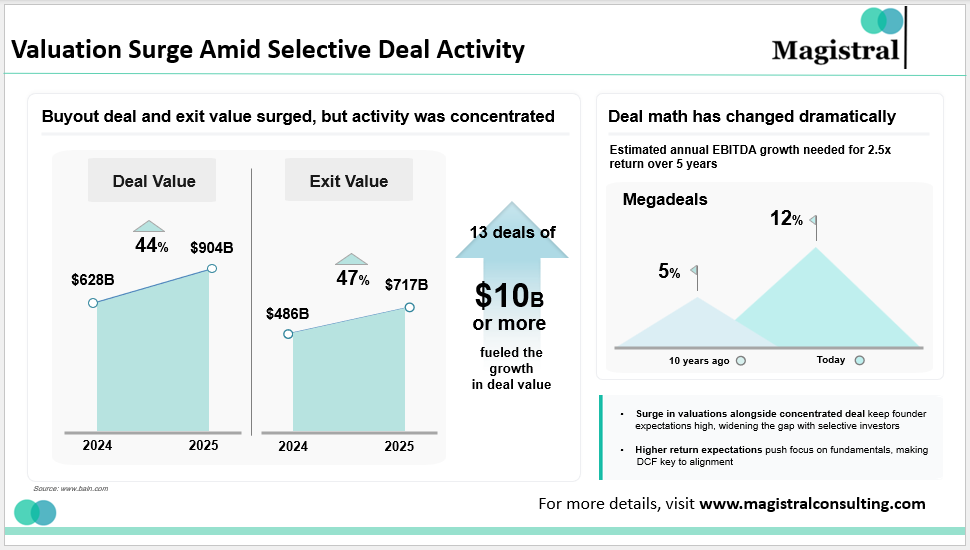
Valuation Surge Amid Selective Deal Activity

Valuation Surge Amid Selective Deal Activity

According to data from PitchBook, the median valuations for startups have fallen by 15-25% across various stages from 2022 to 2024. This is a correction after the peak funding environment in 2021. However, the gap in valuations is a result of founders’ high valuations, especially for earlier-stage companies.  

The gap in valuations is not just a result of over- or under-optimism. There is a fundamental difference in approach. Founders focus on potential, while investors focus on returns. In this context, DCF modeling has re-emerged as a key framework for alignment in valuations. 

Why Founders and Investors Disagree on Valuation 

This is primarily due to differences in how they approach valuation. Founders usually concentrate on growth potential, market opportunity, and overall strategy, whereas investors usually concentrate on return on investment, cash flow, and overall risk. These differences become more apparent in uncertain market conditions. However, DCF modeling helps in bridging this gap by providing a common ground for both parties. It does this by quantifying risks and growth potential in terms of financial outcomes, making it easier for both parties to arrive at a more objective and less biased position. 

Potential vs. Probability: A Structural Disconnect 

At the core of valuation disagreements lies a difference in perspective. Founders are generally interested in valuations of potential and look at growth, scalability, and market size, whereas investors are interested in valuations of probability. 

A study by McKinsey & Company indicates that currently, there is a greater focus on profitability and cash flow predictability over growth at all costs, especially in a higher interest rate environment. 

In such situations, DCF modeling helps both founders and investors clearly articulate their assumptions around growth and risk, thereby bridging the fundamental gap. 

Information Asymmetry in Financial Projections 

Another key driver of valuation gaps is information asymmetry. Founders, being more aware of the business, make more optimistic assumptions, whereas investors make more pessimistic assumptions based on market data. 

This lack of a standardized framework causes a valuation gap. With DCF modeling, both parties will be able to evaluate each other’s assumptions in a more objective and realistic way. 

Market Conditions Are Widening Valuation Gaps 

Resilient global economic growth with moderation in inflation rates implies that macroeconomic conditions are gradually returning to normal. Nevertheless, even with the moderation in inflationary pressures, the overall market conditions are still being dictated by relatively high interest rates, tight liquidity, and an uncertain exit scenario. These factors have led to more conservative estimates being used, especially with regard to discount rates and cash flow estimates. On the other hand, founders are using growth rate estimates based on more favorable market conditions. This is leading to an increasing expectation gap. DCF analysis is also important in this regard, as it takes into consideration the impact of macroeconomic conditions on valuations. 
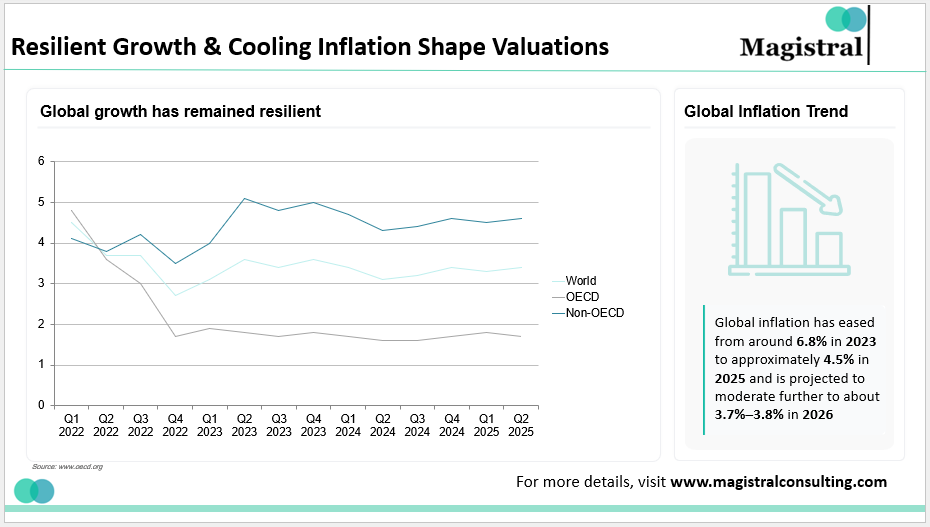
Resilient Growth & Cooling Inflation Shape Valuations

Resilient Growth & Cooling Inflation Shape Valuations

Higher Cost of Capital and Its Impact on Valuation 

Rising interest rates have increased the cost of capital, directly affecting how future cash flows are valued. 

Data from CB Insights indicates that global venture funding declined by over 30% in 2023, reflecting tighter liquidity and increased investor selectivity. 

In DCF modeling, higher discount rates reduce the present value of projected cash flows, resulting in lower valuations. However, founders often adjust expectations more slowly, leading to persistent valuation gaps. 

Exit Uncertainty and Delayed Liquidity Events 

The exit markets, too, are becoming increasingly challenging. According to EY, “public listings are lower than pre-2021 levels, and private equity firms are holding assets for longer as exit conditions remain weak.” 

This again adds to the divergence in DCF modeling as the founders continue to assume exit scenarios from pre-pandemic days. 

Multiple Compression and Market Volatility Are Distorting Comparable-Based Valuations 

Market volatility and declining valuation multiples have made comparable-based methods less reliable, as investors adjust expectations faster than founders. This has created a disconnect where historical data is not representative of current reality. In these situations, a more stable approach is offered by DCF modeling, where companies are valued on their fundamental attributes instead of multiples. 

The Impact of Public Market Corrections 

One of the most notable changes in the past few years has been the significant correction in the valuation levels of the public markets. Technology and growth equities saw a significant compression in valuation multiples post 2021, which has impacted the private markets. 

The use of comparable company analysis, which relies on public market multiples, has been impacted by the volatility in the public markets. This has resulted in the private market valuation levels temporarily deviating from the founder and investor views. 

Why Intrinsic Valuation Is Gaining Importance 

Unlike market-based techniques, DCF modeling offers an intrinsic valuation approach that relies on a company’s underlying financials and cash flow projections. 

For example, DCF modeling’s focus on underlying fundamentals like revenue growth, margins, and capital efficiency minimizes reliance on unstable external references. This technique becomes more relevant in a volatile market where comparable data may not be a true representation of a company’s value. 

Today, DCF modeling has emerged as a popular technique that many investors use to verify or refute traditional comparable-based valuation approaches. 

How DCF Modeling Bridges the Valuation Gap 

Valuation gaps often arise from differing assumptions around growth, risk, and returns. DCF modeling assists in closing the gap by providing a framework wherein both the founders and the investors are able to agree upon key variables like cash flows and discount rates. 

Bringing Transparency to Valuation Assumptions 

One of the key benefits associated with DCF modeling is the ability to make assumptions around valuation transparent. This means items such as growth rates, margins, capital expenditures, and discount rates are all defined and can be adjusted. 

This allows for a much more constructive dialogue between founders and investors as they are able to better understand the implications of changing assumptions around valuation. 

Moving from Point Estimates to Scenario-Based Valuation 

Rather than relying on a single valuation figure, DCF modeling allows for scenario analysis. Founders can make an upside case based on high growth assumptions, while investors can analyze downside risk based on low growth assumptions. 

This takes the discussion away from a fixed valuation number and puts it towards understanding the range of outcomes, which makes DCF modeling a very effective tool for alignment during fundraising. 

The Increasing Role of DCF Modeling in Institutional Investment Decisions 

Institutional investors are increasingly adopting structured valuation frameworks as an integral part of their due diligence process. As capital becomes more selective, the reliance on narrative-driven valuation approaches is falling out of favor. 

According to a report by Deloitte, investors are increasingly focusing on cash flow-based valuation methods, especially for private markets due to transparency issues. 

In the current scenario, DCF modeling is widely used for evaluating downside risk, understanding value creation over a period of time, and making investment decisions across various industries. This is because DCF modeling has the ability to incorporate various factors under a single analytical framework. 

The valuation gaps between founders and investors have widened in the current volatile market scenario due to various factors such as differing expectations, macroeconomic factors, and valuation approaches. DCF modeling can play an important role in bridging valuation gaps between founders and investors. As capital becomes more selective, adopting strong valuation approaches becomes imperative for successful fundraising and better investor alignment. 

How Magistral Consulting Supports Financial Modeling 

As financial modeling plays an integral role in investment decisions, fundraising activities, and valuation analysis, companies are looking for well-structured, accurate, and scalable financial models. At Magistral Consulting, we are committed to assisting our clients in developing robust financial models that clearly interpret the business assumptions into meaningful data-driven insights. 

DCF modeling to assess intrinsic valuation based on projected cash flows and risk assumptions

Three-statement financial modeling integrating income statement, balance sheet, and cash flow projections

Scenario and sensitivity analysis to evaluate upside, downside, and risk-adjusted outcomes

LBO and investment modeling to support private equity transactions and return analysis

Financial model validation and audit to ensure accuracy, consistency, and investor readiness

Customized models for fundraising and M&A aligned with specific deal structures and investor requirements

About Magistral Consulting

Magistral Consulting has helped multiple funds and companies in outsourcing operations activities. It has service offerings for Private Equity, Venture Capital, Family Offices, Investment Banks, Asset Managers, Hedge Funds, Financial Consultants, Real Estate, REITs, RE funds, Corporates, and Portfolio companies. Its functional expertise is around Deal origination, Deal Execution, Due Diligence, Financial Modelling, Portfolio Management, and Equity Research

For setting up an appointment with a Magistral representative visit www.magistralconsulting.com/contact

About the Author

Nitin is a Partner and Co-Founder at Magistral Consulting. He is a Stanford Seed MBA (Marketing) and electronics engineer with 19 + years at S&P Global and Evalueserve, leading research, analytics, and inside‑sales teams. An investment‑ and financial‑research specialist, he has delivered due‑diligence, fund‑administration, and market‑entry projects for clients worldwide. He now shapes Magistral Consulting’s strategic direction, oversees global operations, and drives business‑development support.

FAQs

What are the core services offered by Magistral Consulting?

The firm offers services such as financial modeling, market research, outsourced industry benchmarking reports, competitive intelligence, and investor presentation support.

How does Magistral Consulting support data-driven decision-making?

Magistral Consulting helps transform complex data into structured insights, enabling firms to make informed strategic and financial decisions.

How does Magistral Consulting help in investor communication through financial models?

The firm ensures that financial models are investor-ready, with clear assumptions, structured outputs, and insights that can be effectively presented in pitch decks and discussions.

Why is outsourcing financial modeling beneficial for firms?
Outsourcing financial modeling to Magistral Consulting allows firms to access specialized expertise, improve model accuracy, and focus internal teams on strategic activities such as deal execution and portfolio management.

All orbit around one fundamental question with Venture investing, M&A, and corporate finance: What is its real worth? The Discounted Cash Flow (DCF) model remains the constant anchor in valuation, while trends come and go from market comps to sentiment-driven pricing. DCF modeling has re-emerged not just as a spreadsheet exercise, but as a strategic discipline in 2025, with macro volatility and AI-driven markets.

DCF modeling is no more just about predicting free cash flows. Value, which marries data and judgment and simulates multiple futures, is about building a clear, strategic narrative. To assess present worth but to future-proof their decision-making with clarity and confidence Investors, founders, and CFOs are integrating and not limited to DCF only.

From Spreadsheets to Strategy: The Evolved Role of DCF Modeling

Generally, DCF models were observed as normal static, complex, and sensitive to the assumptions, relegated to investment banking specialists and finance interns, but the new wave of DCF applications reflects to the given models as well.

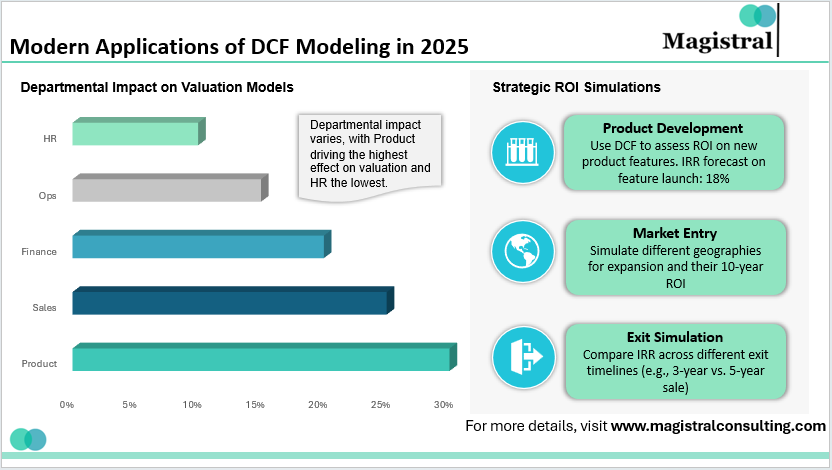
Modern Applications of DCF Modeling in 2025

Modern Applications of DCF Modeling in 2025

Scenario-based forecasting

It is for macroeconomic swings, policy shifts, and operational variability accounting.

AI-powered model validation

They include assumptions through real-time benchmarks, market sentiment and stress testing.

Narrative-linked financials

They work with strategic goals, product launches, or market expansion plans and aligning forecast assumptions.

Modern DCF is about storytelling through numbers. A well-constructed model helps secure investor buy-in, justify acquisitions, and guide capital allocation.

Beyond Valuation: DCF as a Decision Engine

DCF Modeling works as a decision engine in various aspects beyond traditional valuations

DCF Modeling in Action: A SaaS Founder’s Toolkit

Consider a B2B SaaS startup aiming to raise a Series B. Their growth story is strong, but market sentiment is cautious. Instead of relying solely on comps, the founder builds a DCF model with:

Revenue growth tiers (base, stretch, conservative),

Customer churn sensitivity toggles,

CAC payback analysis embedded into operating cash flow assumptions.

The model shows that even with modest churn increases, the NPV (Net Present Value) remains attractive. When shared with prospective investors, the transparent modeling earns trust. The round closes faster, and the lead investor increases their check size citing “financial discipline.”

DCF for CFOs

Smart CFOs are treating DCF not just as a pitch tool but as an internal guide for:

Product pipeline prioritization

What new features drive long-term FCF growth?

Market entry decisions

Which geography offers optimal ROI over a 10-year horizon?

Exit timing simulation

How does IRR change based on different acquisition dates?

One PE-backed healthcare company built an internal DCF engine updated quarterly. By integrating live P&L data with operational KPIs, they aligned boardroom decisions with long-term value creation, resulting in a 20% increase in exit valuation during their eventual trade sale.

Building a Culture of Value Modeling

Just as branding and marketing are becoming everyone’s job, valuation fluency is no longer limited to finance teams. Progressive firms are building DCF literacy across:

Product managers

They input roadmap costs and timelines.

Sales leaders

They model pricing and retention dynamics.

Operations teams

Those who understand cost drivers’ impact on cash flow.

A fintech startup instituted quarterly “Valuation Days,” where cross-functional teams refine the DCF model collaboratively. The result? Sharper strategic alignment and better inter-departmental communication.

The DCF Premium: How Investors Perceive Model-Driven Startups

Data from a 2024 CFA Institute report found that startups presenting robust DCFs at early stages:

Attracted 15–20% higher term sheet offers on average,

Faced less pushback during diligence,

Saw better post-funding alignment with their boards.

Why? A credible DCF signals operational maturity. It shows that founders aren’t just chasing TAM, but are grounded in unit economics, margin trajectories, and sustainable cash flow.

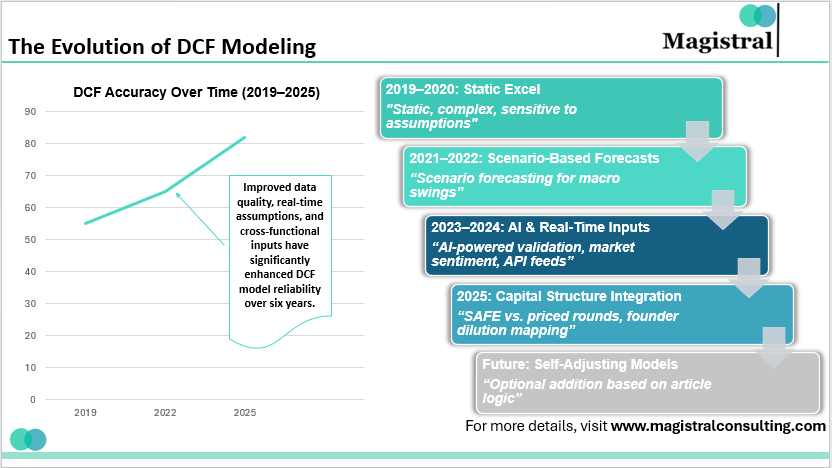
Four Evolutionary Trends in DCF Modeling

DCF modeling has evolved from a traditional valuation technique to something much more meaningful in analysis and scenario building. Some of the trends observed are as follows.

The Evolution of DCF Modeling

The Evolution of DCF Modeling

Integrated Scenario Design via AI

Tools now auto-generate market, competitor, and cost-of-capital scenarios based on sector dynamics. Founders can toggle through future environments instead of manually creating worst/best/base cases.

Narrative-Driven Assumptions

Models now begin with a “Valuation Memo” that frames each assumption in strategic context. This memo travels with the model, improving transparency for investors and internal stakeholders.

Live Model Feeds

Gone are the days of static Excel files. Platforms like Fathom, Cube, and Strupp allow for API-based real-time integration with ERP, CRM, and banking systems for keeping models current at all times.

Capital Structure Optimization

Modern DCFs now layer in different financing structures to SAFE vs. convertible note vs. priced round and visualize the impact on founder dilution and IRR. Strategic capital decisions are embedded in the valuation logic itself.

Institutionalizing DCF Modeling: A GP’s Playbook

A growth equity fund recently rolled out a “DCF-first” mandate across its portfolio. Each investment candidate must include:

10-year free cash flow forecasts with industry benchmarks,

IRR waterfalls across three exit timing options,

DCF sensitivity matrix based on WACC, terminal growth, and margin variation.

The result? Stronger internal consensus, fewer post-investment surprises, and improved LP reporting clarity. One GP summarized: DCF helps us value patience and avoid shiny object syndrome.”

Case Study: Rescuing a Growth-Stage Deal

A health tech founder was preparing to accept a down round at a $30M pre-money valuation. Their banker built a DCF showing $60M in value even under conservative assumptions, based on:

High recurring revenue,

Low churn,

A clear pathway to breakeven in 18 months.

The narrative flipped. The startup paused the round, refined their messaging, and raised $10M at a $45M valuation three months later, with investor appetite doubling. The DCF didn’t just justify the ask; it protected equity.

From Assumptions to Alignment: The Strategic ROI of DCF

According to KPMG, companies that routinely use DCF for internal decision-making outperform peers by 18% in ROIC over five years. Why?

Capital budgeting becomes more grounded.

Expansion bets are evaluated with rigor.

Founders have stronger conviction during investor negotiations.

In essence, DCF builds muscle memory for value-based decision-making through across planning, fundraising, and exit.

DCF Modeling: Communicating and Building Value

DCF modeling is not only about crunching numbers, but it also strengthens trust, avoids common mistakes, and enhances transparency. It can serve as a communication bridge, where it can reinforce valuation discipline. It can also act as a strategic compass, thus ensuring long-term credibility and value creation.

Common Pitfalls in DCF Modeling (and How to Avoid Them)

Overly optimistic growth projections

Solution: Anchor to industry benchmarks and apply sanity checks from prior actuals.

Misaligned terminal value assumptions

Solution: Use both perpetuity growth and exit multiple methods for a range-based TV.

Ignoring working capital needs

Solution: Model realistic receivables, payables, and inventory cycles.

One-size-fits-all discount rate

Solution: Calibrate WACC per scenario and geography in especially for global ventures.

DCF as a Communication Bridge

Modeling isn’t just a technical task- it’s a trust-building mechanism. When done right, it:

Helps founders speak the investor’s language.

Equips CFOs to defend capital allocation plans.

Enables boards to make time-consistent strategic decisions.

One veteran VC put it best: “A good DCF doesn’t guarantee returns. But it guarantees the founder has thought.”

Building Brand Value through Valuation Discipline

Just as companies build brand equity through consistent messaging, they build investor trust through a consistent valuation strategy. Some accelerators now include DCF modeling in demo day prep. Leading VCs expect DCFs for anything post-Series A.

A global accelerator offers founders a “Valuation Maturity Score,” based on

Granularity of assumptions,

Historical vs. projected performance gaps,

Integration with operational KPIs.

Founders in the top decile raised 40% faster on average, because confidence in valuation leads to confidence in vision.

The Strategic Compass

In an era where market froth and hype cycles obscure fundamentals, DCF modeling is a steadying force. It demands thoughtfulness, encourages rigor, and rewards realism. Whether you’re a founder, investor, or finance leader, DCF is no longer optional.

DCF Modeling Services Offered by Magistral Consulting

Magistral Consulting offers specialized services in DCF (Discounted Cash Flow) modeling to support investment evaluation, fundraising, and strategic decision-making. Their expertise includes building detailed financial models that forecast free cash flows, calculate terminal value, and estimate enterprise and equity value under various scenarios. Magistral assists clients in creating base, upside, and downside valuation cases, incorporating assumptions like revenue growth, cost structures, WACC, and exit multiples. These models are tailored for private equity firms, startups, and corporates aiming to validate investment theses or optimize capital structure. They also support pitch deck preparation and investor presentations based on DCF insights.


About Magistral Consulting

Magistral Consulting has helped multiple funds and companies in outsourcing operations activities. It has service offerings for Private Equity, Venture Capital, Family Offices, Investment Banks, Asset Managers, Hedge Funds, Financial Consultants, Real Estate, REITs, RE funds, Corporates, and Portfolio companies. Its functional expertise is around Deal origination, Deal Execution, Due Diligence, Financial Modelling, Portfolio Management, and Equity Research

For setting up an appointment with a Magistral representative visit www.magistralconsulting.com/contact

About the Author

Utkarsh is a finance professional with expertise in investment research, M&A, and financial modeling. He has built and applied models including DCF, LBO, and comparable analysis, supporting investment banks, private equity, and venture capital firms across diverse sectors. Utkarsh holds an MBA in International Business & Finance from Symbiosis International University, a B.Com (Hons) from Delhi University, and has completed the Stanford Seed program at Stanford Graduate School of Business.

FAQs

What makes DCF different from market comps?

DCF focuses on the intrinsic value of a business based on future cash flows, while comps reflect how similar businesses are priced today. DCF is forward-looking; comps are market reactive.

How often should we update a DCF model?

Ideally, quarterly. Update after major product launches, market entries, or capital raises.

What tools can streamline DCF modeling today?

Popular platforms include Fathom, Equidam, Strupp, and Google Sheets/Excel with AI plugins. GPT copilots also help explain assumptions in plain language.

Is DCF useful for early-stage startups?

Yes, especially for those with early revenues or predictable business models (like SaaS). It signals maturity even when metrics are limited.