Tag Archives: Hedge Fund Operations Outsourcing

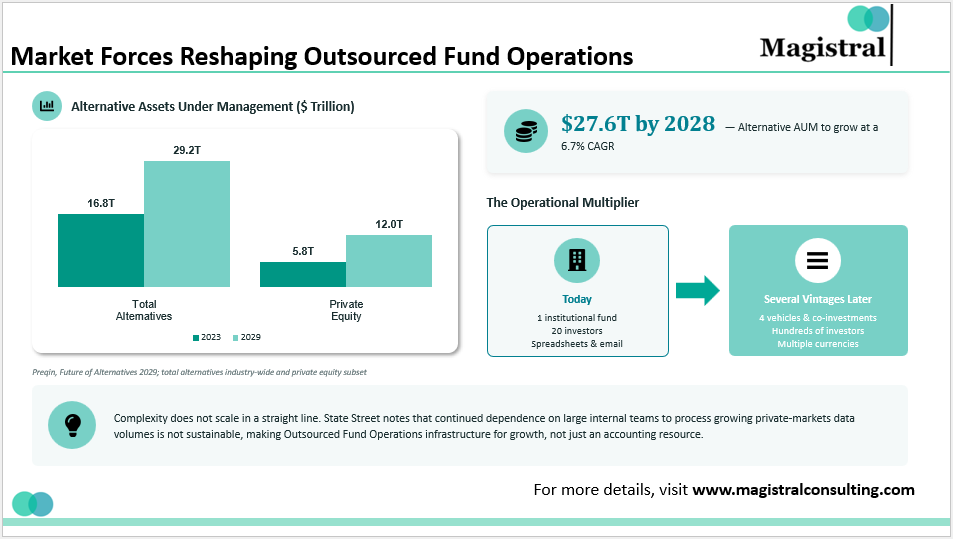
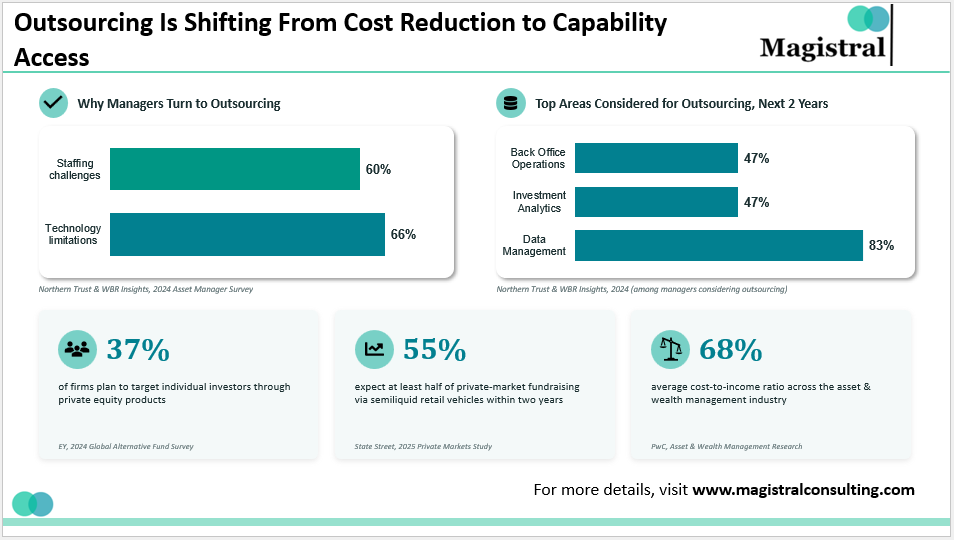
The hedge fund industry is evolving, with rising performance pressure and operational complexity driving greater adoption of outsourcing. Instead of building large in-house teams, firms are increasingly relying on external providers for middle- and back-office functions. Reflecting this shift, Deloitte reports that over 70% of hedge funds now outsource at least one operational activity.

Outsourced hedge fund models are reshaping the industry

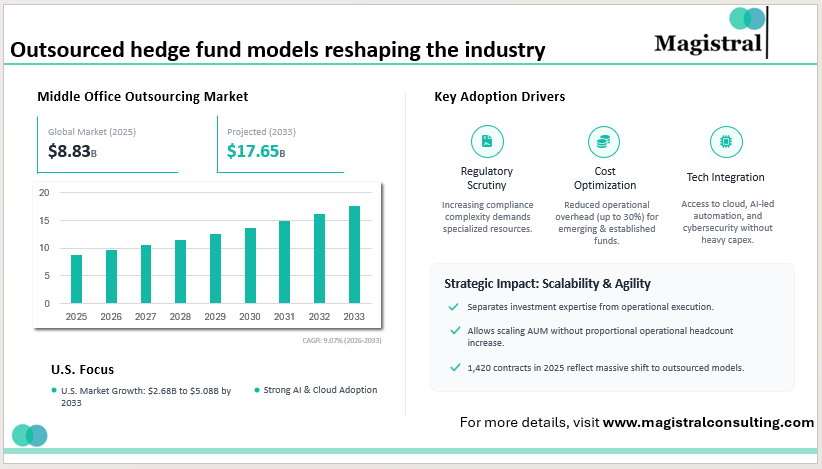
The Middle Office Outsourcing market, which was valued at 8.83 billion USD in 2025, is expected to grow to 17.65 billion USD by 2033, with a growth rate of 9.07% during 2026-2033, with 2025 as the base year. The global outsourcing market size stood at 1,420 contracts in 2025, which indicates a high level of adoption of cloud-based operating models.
The Middle Office Outsourcing market in the USA is expected to grow from 2.68 billion USD in 2025 to 5.08 billion USD in 2033, with a growth rate of 8.37%. This growth will be driven by digitalization, AI-led automation, and increased regulatory needs for asset managers and investment firms.

Outsourced hedge fund models reshaping the industry

Outsourced hedge fund models reshaping the industry

Outsourced hedge fund structures are changing the face of modern hedge fund management by decoupling investment talent from operational capabilities.
This change will allow hedge fund managers to stay nimble while growing efficiently in a competitive global marketplace.

Evolution from in-house to outsourced models

Traditionally, hedge funds have had in-house teams to handle various activities, including accounting, reporting, and compliance. However, due to increasing costs and regulatory requirements, this is no longer a sustainable option. As a result, hedge funds have started exploring alternative strategies, including outsourcing.
Furthermore, this is in line with the evolution of alternative investment strategies, including private equity, which has benefited from outsourcing operations.

Major driving factors for the adoption of outsourcing

The regulatory environment is becoming increasingly complex, which is driving the cost of compliance.

Cost optimization is still an important factor, particularly for emerging hedge funds.

Technology is an important factor, as integrating with existing technologies requires specialized skill sets that are not always available within the hedge fund.

These driving factors are resulting in the accelerated adoption of the outsourced hedge fund model worldwide.

Role of technology in outsourced hedge fund operations

Technology is an integral part of the outsourced hedge fund process. Cloud-based technologies, automation tools, and artificial intelligence-based analytical tools provide the outsourced provider with the ability to deliver faster and more accurate results. According to PwC’s 2025 asset management report, firms that utilize outsourced digital technologies have been able to reduce the cost of operations by as much as 30 percent.

Automation in reporting and reconciliation

Automation is used to reduce the potential for human error in reporting while ensuring the timely delivery of reports to investors. This is particularly important for hedge funds with complex portfolios comprising various asset classes.

Data security and compliance frameworks

Today, outsourcing firms heavily invest in data security and compliance systems, thereby ensuring that financial information is secure and at the same time meets international regulatory requirements.

Impact on fund scalability

The outsourced model of hedge funds enables firms to scale their operations without a corresponding rise in cost. For instance, a hedge fund that has seen its asset base double does not have to double its operational staff because of an outsourced model. This is particularly important in a fluctuating marketplace.

Outsourced hedge fund services and functional coverage

The outsourced hedge fund solutions range across a variety of operational areas, thus allowing them to outsource non-core activities while maintaining control over investment decisions.

Fund administration and accounting

Fund administration is one of the most outsourced areas in hedge funds. Fund administration includes calculating net asset value, financial reporting, and communicating with investors. According to Preqin, more than 80 percent of hedge funds utilize third-party administrators for these operations, as indicated in their 2024 data.

Financial reporting is also an important aspect of fund management strategies.

Middle office support

Outsourcing of middle office support activities such as trade processing, risk management, and performance analysis is also increasing. Such activities demand high technology and expertise and are thus good candidates for outsourcing.

Risk analytics and portfolio monitoring

Service providers use high technology for real-time monitoring of risks associated with portfolios. This helps fund managers make informed decisions regarding their portfolios.

Trade lifecycle management

Trade processing is an important activity for any investment firm. Outsourcing of trade processing is increasing due to its significance for operational reliability.

Compliance and regulatory reporting

Compliance is a major problem for hedge funds that operate globally. Outsourcing of hedge fund services provides specialized solutions for such problems and helps investment firms comply with regulations and laws of different countries and jurisdictions.

Investor relations and reporting

Investor needs have changed over time and are demanding greater transparency and quicker reporting of information. Outsourcing of hedge fund services helps investment managers maintain better relationships with investors by providing them with accurate and quicker information about the performance of the investment portfolios.

Integration with broader investment ecosystems

Outsourcing also helps investment managers to leverage other investment strategies such as venture capital, in which operational efficiency is critical for portfolio scalability.

Outsourced hedge fund benefits and strategic advantages

Outsourced hedge fund models have several advantages that go beyond cost savings and are important for the long-term success of a hedge fund.

Cost efficiency and resource optimization

One of the most attractive advantages of an outsourced hedge fund is cost optimization. Outsourced hedge funds do not have to maintain a large team of employees and do not have to invest heavily in infrastructure. According to reports, a hedge fund may achieve a cost optimization of 20-40% by outsourcing its operations.

Enhanced focus on core competencies

Outsourcing also helps hedge fund managers focus on their core competencies. This is a significant advantage for a hedge fund because a focus on core competencies is essential for the success of a hedge fund.

Access to specialized expertise

Outsourcing also helps a hedge fund gain access to expertise in different fields. This is another significant advantage of an outsourced hedge fund model.

Improved accuracy and operational reliability

Outsourced providers have access to the latest technology and tools and are better able to achieve accuracy and reliability in their operations. This is a significant advantage for a hedge fund because accuracy and reliability are essential for the long-term success of a hedge fund.

AI in Hedge Funds

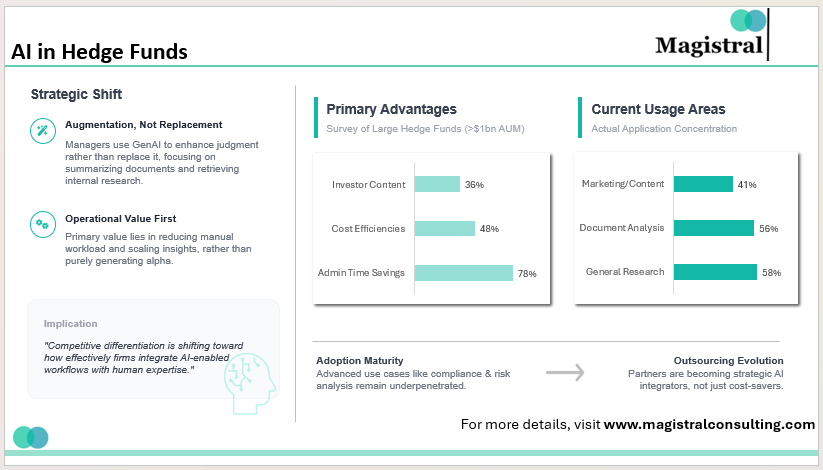
Generative AI in hedge funds has rapidly evolved from experimentation to a core operational tool, primarily supporting research, reporting, and workflow efficiency rather than replacing investment judgment. Its biggest impact is operational—improving speed and productivity.

Surveys show that 78% of large hedge funds use AI for time savings in administrative tasks, while many also benefit from cost reduction and improved investor communication. Current usage is concentrated in areas like research, document analysis, and content creation, with more advanced applications in risk and compliance still emerging.

AI in Hedge Funds

AI in Hedge Funds

From a hedge fund outsourced model viewpoint, this is particularly pertinent as GenAI standardizes and automates high-volume, routine activities such as research synthesis, reporting, and regulatory checks; in doing so, it naturally fits into a framework of outsourcing these activities at scale. The inference here is that competitive differentiation is moving away from these types of executional activities and more towards how effectively these firms leverage AI-driven workflows in conjunction with their human expertise – thus making outsourcing partners more strategically important rather than cost-driven.

Outsourced hedge fund support by Magistral Consulting

Magistral Consulting offers extensive support to hedge funds according to their specific needs.

End-to-end operational support

Magistral offers a variety of services for outsourced hedge fund, including fund administration, financial modeling, and investor reporting. These services allow hedge funds to operate efficiently.

Advanced analytics and technology integration

The company utilizes advanced analytics and technology to provide precise and timely information. This enables the company to perform better.

Customized solutions for diverse fund strategies

Magistral understands that every hedge fund has different operations. Thus, the company provides customized solutions for specific fund strategies.

Expertise across investment domains

The company has expertise in different asset classes, such as hedge funds, private equity, and venture capital. Thus, the company can provide holistic solutions.

About Magistral Consulting

Magistral Consulting has helped multiple funds and companies in outsourcing operations activities. It has service offerings for Private Equity, Venture Capital, Family Offices, Investment Banks, Asset Managers, Hedge Funds, Financial Consultants, Real Estate, REITs, RE funds, Corporates, and Portfolio companies. Its functional expertise is around Deal origination, Deal Execution, Due Diligence, Financial Modelling, Portfolio Management, and Equity Research

For setting up an appointment with a Magistral representative visit www.magistralconsulting.com/contact

About the Author
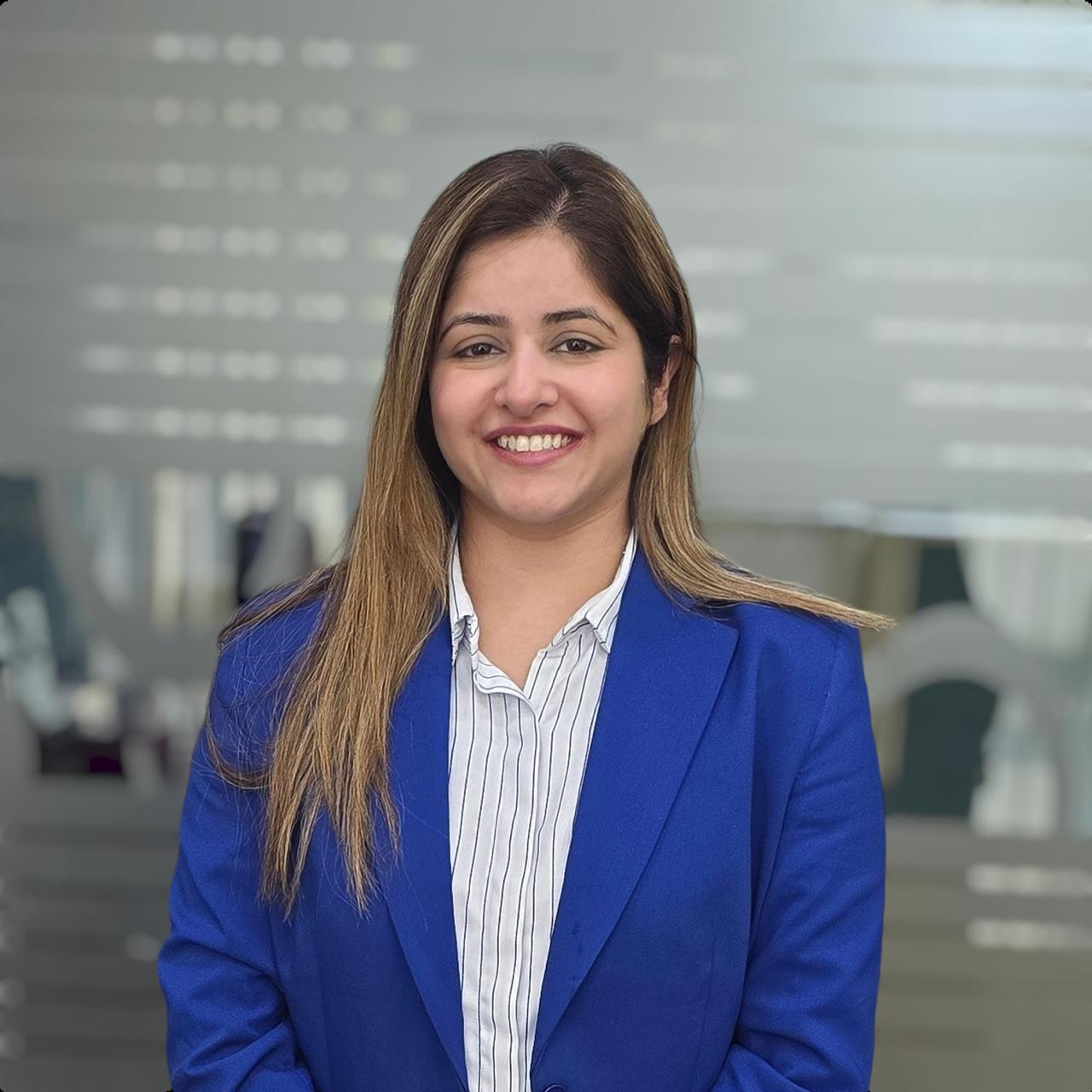
Prabhash Choudhary is the CEO of Magistral Consulting. He is a Stanford Seed alumnus and mechanical engineer with 20 + years’ leadership at Fortune 500 firms- Accenture Strategy, Deloitte, News Corp, and S&P Global. At Magistral Consulting, he directs global operations and has delivered over $3.5 billion in client impact across finance, research, analytics, and outsourcing. His expertise spans management consulting, investment and strategic research, and operational excellence for 1,200 + clients worldwide

FAQs

What is an outsourced hedge fund model?

An outsourced hedge fund model involves delegating operational functions such as accounting, compliance, and reporting to third-party service providers while retaining investment decision-making in-house.

Why are hedge funds adopting outsourcing?

Hedge funds adopt outsourcing to reduce costs, improve efficiency, access specialized expertise, and focus on core investment activities.

Is outsourcing safe for hedge funds?

Yes, outsourcing is safe when funds select reputable providers with strong cybersecurity measures and compliance frameworks in place.

What functions can be outsourced in hedge funds?

Functions such as fund administration, middle office operations, compliance, and investor reporting can be outsourced effectively.

How does outsourcing impact investor confidence?

Outsourcing improves transparency, accuracy, and reporting speed, which enhances investor trust and confidence in the fund’s operations.

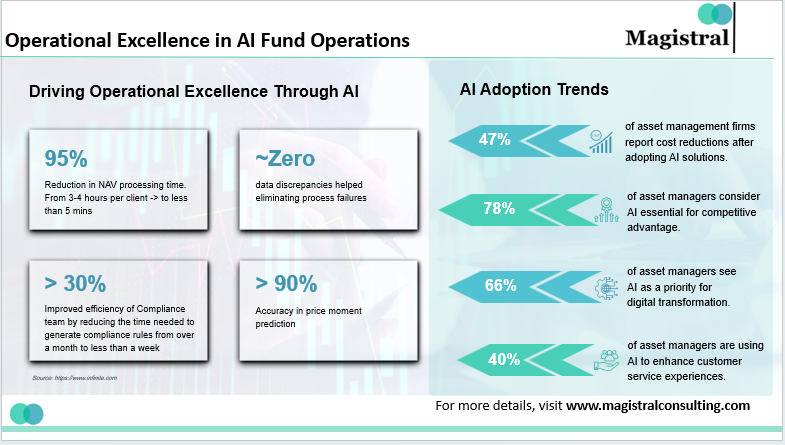
Artificial intelligence is increasingly becoming the working engine of contemporary funds. From portfolio analysis to compliance tracking, automation is reducing operational turnaround time by 40–60% among leading asset managers. But as they race to implement, one vital question takes center stage in C-suite meetings: Can we believe what AI is reporting?

In AI fund operations, explainable AI (XAI) is becoming the connector between speed and accountability. It makes sure that all AI-based decisions—whether from NAV validation, transaction screening, or investment scoring. They are traceable, auditable, and justifiable. To the top fund executives, explainability is not a technicality. It is the cornerstone of governance, investor trust, and operational integrity.

The New AI Imperative in Fund Operations: From Efficiency to Explainability

The function of AI fund operations has developed much beyond reconciliations or cost savings. Now, the real differentiator is the degree to which firms can explain, govern, and defend the results generated by their AI models. The future of AI fund operations is not efficient; it’s explainability.

According to Accenture’s 2025 Asset Management Technology Outlook, nearly 70% of global funds have adopted AI for middle- and back-office processes, yet less than 35% have implemented explainable frameworks. This gap exposes funds to reputational, regulatory, and operational risks. Speed without transparency is no longer acceptable in an environment where investors and regulators demand clarity.

Operational Excellence in AI Fund Operations

Operational Excellence in AI Fund Operations

Fund leaders are aiming at sharper questions than ever before:

Can we ever justify an AI-driven NAV adjustment during an LP audit?

Can our compliance and risk teams articulate every flagged transaction?

What hidden biases could be affecting AI-based investment choices?

The new AI imperative is thus one of trust engineering—designing systems that integrate algorithmic efficiency with human control. Three forces are propelling this strategic shift:

Regulatory Accountability

The SEC and ESMA are global regulators that are implementing model-risk and explainability requirements for AI fund operations. Funds are now required to have traceable audit trails for all model-driven decisions.

Investor Transparency

LPs increasingly seek transparency into how AI influences fund valuations, ESG ratings, and compliance processes. Companies that can explain AI logic foster greater investor trust.

Operational Scalability

As capital expands automation across valuation, reporting, and due diligence, explainability provides stable performance. It also avoids model drift, and enables improved governance.

Explainability transforms AI from a “black box” to a strategic tool—one that energizes analysts, reinforces compliance, and raises investor trust. Top-performing funds that incorporate explainable AI achieve 20–30% faster audit closings. They also have reduced model risk events, and increased stakeholder satisfaction.

In the new landscape of AI fund operations, being efficient will take you leaders far, but explainability will allow them to sustain. Those firms that will succeed will be ones that can not only use AI to act smarter but also explain how and why they made those decisions.

Quantifying the Impact: What Explainability Delivers for Fund Performance

The impact of AI fund operations is increasingly being measured not just by speed and cost reduction. It is also by how transparently and reliably those efficiencies are achieved. As AI systems handle more valuation, compliance, and reporting workflows, the ability to explain every model-driven outcome is becoming a defining factor for fund credibility. Explainable AI (XAI) brings this accountability, turning automation from a black box into a measurable and defensible performance driver.

Explainability: The Next Layer of ROI in AI Fund Operations

Traditional automation metrics—turnaround time and cost savings—are now being replaced by decision quality, audit traceability, and investor trust. According to McKinsey’s 2025 report on asset management, firms that embed explainability frameworks experience 20–25% faster operational decision cycles and up to 30% lower model-risk costs.

Similarly, EY’s 2024 Asset Management Operations Study found that explainable AI led to 40% fewer regulatory interventions and a 25% improvement in investor audit confidence. These gains prove that interpretability adds more than compliance comfort—it adds measurable business resilience.

Building Trust through Decision Traceability

For senior fund leaders, explainability delivers what automation alone cannot: decision traceability. In an environment where investors and regulators demand transparency, the ability to articulate why AI made a particular call is as important as the decision itself.

When analysts can see which variables influenced a valuation, how an AI model flagged a compliance anomaly. Or why a certain risk threshold was triggered, they can validate outcomes faster and defend them confidently. This not only builds internal trust but also enhances LP relationships, as funds demonstrate governance maturity and operational integrity.

Real-World Impact Across AI-Driven Fund Workflows

Firms that integrate explainable AI into their fund operations report transformative results. Across global benchmarks, explainability has contributed to:

48% faster exception resolution in reconciliation workflows,

35% fewer operational escalations, and

Up to 2x faster LP reporting cycles.

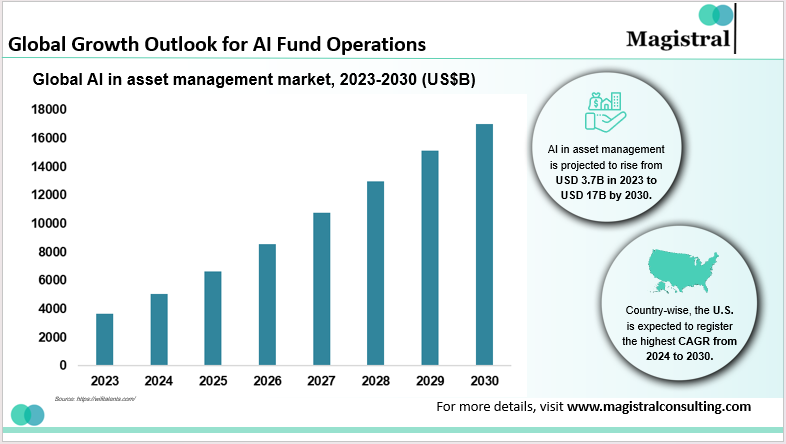
Global Growth Outlook for AI Fund Operations

Global Growth Outlook for AI Fund Operations

These results demonstrate that explainability doesn’t slow automation—it accelerates it by reducing ambiguity. Analysts no longer waste time deciphering opaque outputs; instead, they focus on strategic decision-making and anomaly management.

Explainable AI as the Catalyst for Sustainable Performance

In an environment where markets are unpredictable and investor scrutiny is intensifying, explainability has become the foundation for sustainable fund performance. Transparent AI models lead to fewer operational disruptions, more consistent compliance, and greater stakeholder trust.

According to Gartner’s 2025 AI Maturity Index, funds that integrate explainable AI achieve up to 1.8x higher operational scalability and 20% better long-term cost efficiency than those relying on opaque systems.

The future of AI fund operations will be defined not by how intelligent systems are, but by how understood they are.

As fund operations evolve under the influence of automation, explainable AI (XAI) has become the differentiator separating efficiency from excellence. It quantifies trust, enhances decision quality, and transforms compliance into a performance asset. By ensuring every algorithmic outcome can be interpreted, validated, and improved, explainability delivers measurable gains. From faster NAV cycles to stronger investor confidence and reduced model-risk costs.

The next wave of AI fund operations will not be judged by how much they automate, but by how clearly they can explain every automated action. In this shift, transparency becomes strategy—and explainable AI, the new foundation of operational leadership in the asset management industry.

The Strategic Payoff: Explainability as a Competitive Advantage

In the next phase of digital transformation, the winners in fund management will not be the ones who deploy AI first—but the ones who can explain it best.

As LPs demand greater transparency and regulators tighten scrutiny, explainable AI offers a rare blend of speed, credibility, and control. For senior fund leaders, investing in explainable AI is less about technology and more about institutional trust.

It transforms operational AI from a “black box” into a boardroom asset—one that strengthens compliance posture, enhances investor relations, and elevates analyst productivity.

Magistral’s Role in Explainable AI Fund Operations

At Magistral Consulting, we help asset managers, private equity firms, and hedge funds embed explainability into every layer of AI adoption. Our offerings are designed to balance automation with interpretability:

AI-Assisted NAV Calculation and Validation: Deploying models with traceable logic and exception-handling layers.

Explainable Due Diligence Platforms: NLP-based document scanning with highlighted reasoning for each flag.

RegTech Integration for FATCA, CRS, and AML: Automated reporting with full data lineage and traceability dashboards.

Portfolio Risk Intelligence Systems: AI models that explain variable drivers behind risk shifts, empowering analysts to act faster.

Training and Change Management: Helping analyst teams evolve into AI-fluent, oversight-ready professionals.

Magistral’s approach ensures AI adoption drives efficiency and earns stakeholder trust — positioning funds for scalable, transparent operations.

About Magistral Consulting

Magistral Consulting has helped multiple funds and companies in outsourcing operations activities. It has service offerings for Private Equity, Venture Capital, Family Offices, Investment Banks, Asset Managers, Hedge Funds, Financial Consultants, Real Estate, REITs, RE funds, Corporates, and Portfolio companies. Its functional expertise is around Deal origination, Deal Execution, Due Diligence, Financial Modelling, Portfolio Management, and Equity Research

For setting up an appointment with a Magistral representative visit www.magistralconsulting.com/contact

About the Author

Tanya is an investment-research specialist with 6 + years advising venture-capital, private-equity and lending clients worldwide. A Stanford Seed alumnus with an MBA and an Economics (Hons) degree, she heads project teams at Magistral Consulting, delivering financial modelling, due-diligence and deal support on 3,000 + mandates. Her blend of rigorous analytics, sharp project management and clear client communication turns complex data into actionable investment insight.


FAQs

How does Magistral help funds begin their AI journey?

Magistral provides strategy design, model integration, and analyst enablement for AI fund operations—ensuring automation comes with governance and clarity

Which industries does Magistral primarily serve?

Magistral works with Private Equity, Venture Capital, Hedge Funds, and Real Estate funds, alongside Investment Banks and Consulting firms. Its expertise lies in data-intensive operations, where research, financial analysis, and process precision directly impact investment performance

How does Magistral balance automation and analyst expertise?

Magistral’s approach to AI fund operations is analyst-augmented, not analyst-replacing. AI handles repetitive data validation and reconciliation, while human analysts focus on interpreting complex insights and regulatory nuances—creating a transparent, high-trust operations model

What makes Magistral different from typical outsourcing firms?

Unlike transactional outsourcing firms, Magistral focuses on strategic partnerships and domain depth. Its analysts come from investment backgrounds, ensuring each deliverable—be it a valuation model or compliance dashboard—is both technically accurate and contextually relevant for fund managers


Every great fund starts with a vision. A unique strategy, an untapped market, a brilliant thesis. You, the fund manager, are the architect of that vision. Your focus is singular: producing stellar returns throughout its prestigious legacy.

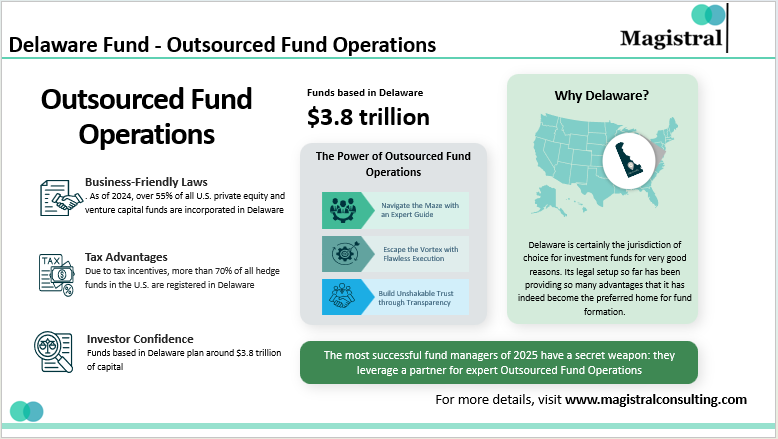
You plant a flag in Delaware-the undisputed gold standard for private equity, VC, and hedge funds. It’s an apt choice. With business-friendly laws and major tax advantages, this has become the bedrock of investor confidence. Funds birthed here manage more than $3.8 trillion of capital for a reason.

Delaware Fund - Outsourced Fund Operations

Delaware Fund – Outsourced Fund Operations

Your plans are well-laid out. But after getting all set up, a different reality drags itself into your view. Placing your fund creation between your eyes and spirit proves not a straightforward matter. It’s a mountain-best climb with expert outsourced fund operations.

Why Delaware? The Tax-Friendly Foundation of Fund Success

Delaware is certainly the jurisdiction of choice for investment funds for very good reasons. Its legal setup so far has been providing so many advantages that it has indeed become the preferred home for fund formation. Here are some of the main reasons why Delaware continues to be in great demand:

Business-Friendly Laws

Domestic and international funds choose Delaware LP and LLC structures for their flexibility, privacy, and robust asset protection. By 2024, managers incorporated more than 55 % of all U.S. private equity and venture capital funds in Delaware (Delaware Division of Corporations, 2024).

Tax Advantages

Delaware eliminates state corporate tax on out-of-state income, charges no sales tax, and grants investment entities favorable treatment. Thanks to these incentives, managers have registered over 70 % of U.S. hedge funds in Delaware (National Venture Capital Association, 2024).

Investor Confidence

Delaware-based funds now manage roughly $3.8 trillion in capital, earning the trust of investors worldwide (Delaware Division of Corporations, 2024).

Industry Trends & Insights

Some of the industry trends that underline the importance of fund operation outsourcing include the following:

Outsourced Fund Operations - Industry Trends & Insights

Outsourced Fund Operations – Industry Trends & Insights

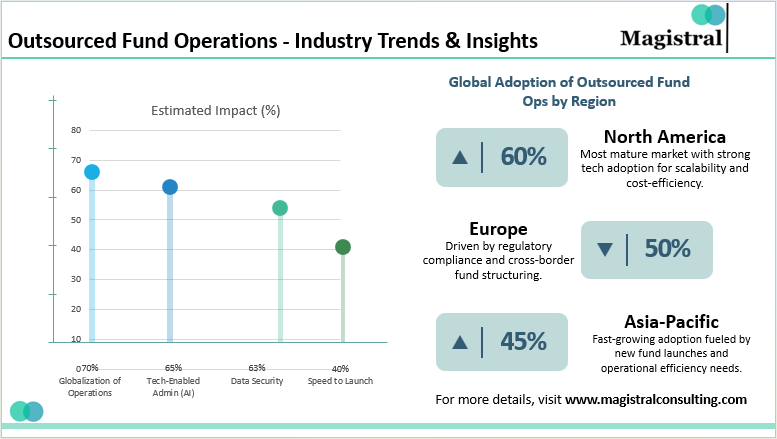
Globalization of Operations

Delaware funds increasingly serve international LPs, and outsourced partners help navigate cross-border compliance and tax complexities.

Tech-Enabled Administration

Leading firms now use AI and automation for faster, more accurate NAV calculations, reconciliations, and investor communications.

Data Security

In light of rising cyber risks, Delaware’s confidentiality laws combined with secure outsourced platforms provide peace of mind. The 2024 Cybersecurity & Data Protection in Fund Administration Report found that 63% of firms now prioritize data security as a core part of their outsourcing strategy.

Speed to Launch

With expert support, Delaware funds can go live in just 4-6 weeks, critical for managers seeking a first-mover advantage. According to a report 2024 data, 40% of funds now launch within 6 weeks of formation.

Growing Adoption

Over 55% of global asset managers now outsource some or all back-office operations.

The Power of Outsourced Fund Operations

The most successful fund managers of 2025 have a secret weapon: they leverage a partner for expert outsourced fund operations. This strategic shift allows them to conquer the operational mountain and focus entirely on performance.

The core value of outsourced fund operations: It does not merely save you money; it sells you back your most valuable asset: time, and truly terpenes the expertise into the fund’s composition.

Here’s how outsourced fund operations change the game:

Navigate the Maze with an Expert Guide

Instead of dealing with compliance issues, your partner ensures a smooth launch in 4–6 weeks, a key feature of premier outsourced fund operations.

Escape the Vortex with Flawless Execution

Imagine a world where every administrative task is executed with precision and efficiency. For a partner of this caliber, it cannot be otherwise!

Build Unshakable Trust through Transparency

With cutting-edge platforms, your partner in outsourced fund operations delivers the real-time reporting that modern investors demand.

Future-Proof Your Fund with the Power to Scale

As your fund grows, your operational support scales with you. 79% of fund managers now adopt these flexible models to manage growth effectively.

How Magistral Becomes Your Co-Pilot

At Magistral Consulting, an end-of-end solution is offered to fund managers. The services offered constitute specialized outsourced fund operations that take care of all aspects of your fund’s operations to ensure smooth functioning. Services will enable the funds to be launched, grown, and scaled efficiently, so you can focus on generating returns and building a legacy.

Comprehensive Fund Administration

We handle all the operational components so that your Fund may continue to operate efficiently, real-time NAV, investor reporting, and capital call management are some of them. Our team ensures that these critical functions are executed with precision, so you can maintain focus on the strategic aspects of your fund while we handle the day-to-day operations.

Regulatory & Compliance Fortress

Navigating SEC filings and tax compliance can be overwhelming, especially in a regulatory landscape that is constantly changing. Magistral Consulting offers expert handling of such matters, to make certain that your fund remains in compliance and that all legal exposures are kept out of harm’s way. We serve as a regulatory fortress before you, mitigating all risks while making sure that your operations are efficient and in accordance with legal requirements.

Scalable, Flexible Support

As the operational needs of a fund change with its growth, we, therefore, offer scalable and flexible support befitting the fund’s size and complexity. Whether you are a first-time manager or an established portfolio holder, our services grow with you and maintain operational efficiency at every stage.

Cutting-Edge Technology

Technology today plays a big role in operational success in this fast-paced environment. We use secure cloud environments and automation to provide real-time reporting, safe data storage, and smooth communication. Our technology allows you to get fund information in real-time from anywhere in the world while maintaining the highest levels of data security. Due to AI-powered analytics and advanced reporting tools, there is complete control over and visibility to be obtained of what goes on with the assets.

Proven Cost Efficiency

Outsourced fund operations to Magistral Consulting provides significant cost savings, with our clients seeing a reduction in operational costs by an average of 25%. In other words, with a blend of our team’s expertise and technology, you can keep overhead costs lean, instead choosing to focus on the things that really matter, whetting your investment appetite. Our solution is to give you maximum value at the most efficient costs, therefore offering you a competitive advantage without lowering any quality standards.

Case Study

A Story of Speed and Success – The $300M Launch

Background

A first-time private equity manager with a brilliant fintech thesis raised $300 million in commitments. They wanted to focus on sourcing deals and needed expert help with the entity formation, regulatory filings, and investor reporting.

The manager partnered with Magistral Consulting to navigate the operational complexities and ensure a timely launch.

The Challenge

Key operational tasks, such as forming the fund entity, meeting regulatory requirements, and ensuring accurate investor reporting, need to be handled seamlessly and efficiently. The manager required a trusted partner to manage these while they focused on deal sourcing.

The Solution

Magistral Consulting provided:

  • Entity Formation: Ensuring compliance with Delaware regulations.
  • Regulatory Filings: SEC and tax filings timely done.
  • Investor Reporting: Transparent investor reports in real time.

With these outsourced fund operations tasks in expert hands, the manager could concentrate on their core strategy.

The Result

The fund was launched in just six weeks, impressing investors and gaining immediate momentum. The fund manager avoided common launch delays and established a solid operational foundation.


About Magistral Consulting

Magistral Consulting has helped multiple funds and companies in outsourcing operations activities. It has service offerings for Private Equity, Venture Capital, Family Offices, Investment Banks, Asset Managers, Hedge Funds, Financial Consultants, Real Estate, REITs, RE funds, Corporates, and Portfolio companies. Its functional expertise is around Deal origination, Deal Execution, Due Diligence, Financial Modelling, Portfolio Management, and Equity Research

For setting up an appointment with a Magistral representative visit www.magistralconsulting.com/contact

About the Author

The article is authored by the Marketing Department of Magistral Consulting. For any business inquiries, you can reach out to prabhash.choudhary@magistralconsulting.com

They involve delegating key back-office tasks—like fund admin, compliance, and reporting—to experts, allowing fund managers to stay focused on investment strategy.

With the right partner, a Delaware fund can launch in just 4–6 weeks—crucial for first-mover advantage and early investor momentum.

Without expert support, fund managers often face delays in fund launch, compliance risks, reporting errors, and high overhead costs—taking time and focus away from their core investment strategy.

Rising complexity, tighter compliance standards, and investor demand for transparency are pushing fund managers to adopt outsourcing. It offers speed, accuracy, and flexibility without increasing internal overhead.

Introduction to Hedge Fund Outsourcing

Operations Outsourcing for Hedge Funds is slowly becoming a viable proposition to improve analytical excellence and reduce the operations’ cost. Almost all types of hedge funds can benefit from outsourcing and research support services. It aids the smooth functioning of Hedge Fund operations. Hedge Fund outsourcing not only helps in reducing operations cost, but it is also immensely helpful in raising the analytical standards of the fund.

Hedge Funds are investment vehicles that invest in stocks to give superlative returns to their investors. They follow multiple strategies like long-short equity, market neutral, merger arbitrage, convertible arbitrage, event-driven, credit, fixed income arbitrage, global macro, Short only, and Quantitative. Here is what these strategies are and what could be outsourced by each strategy

Long-Short Equity Hedge Fund

This is by far the most common form of Hedge Funds. Here the fund manager takes long and short positions on the stocks where he believes the stock will go up and the stock will go down respectively. Ideally, long positions should match short positions, so that risk from overall market movements is hedged. However, in practice, the ratio of long and short positions varies with every fund manager. Generally, there are more long positions than short ones. Taking long positions on expected winners acts as collateral to short positions in the expected losers

Long-short Equity is an extension of pairs trading, where a fund manager takes opposing positions in similar stocks in the same industry. If a stock looks overvalued as compared to another in the same industry, the fund manager goes short on the overvalued stock and long on the undervalued one. This relative positioning hedges the risks of market fluctuations in either direction

Hedge Fund outsourcing in long-short equity funds have reduced operations cost by 40-70% and at the same time is known to bring the new skills to the fold of the fund.

What could be Outsourced

Here is what could be outsourced conveniently in a Long-Short Equity Hedge Fund

-Equity Research

-Middle Office

-Fund Administration and Accounting

-Data Management (Collection, Cleansing, Automating and Templatizing for Insights)

-Industry Research

Market Neutral Hedge Funds

Market neutral hedge funds are long-short equity funds that hedge the value of long and short positions. The value and volume of long positions match the value and volume of short positions. This ensures that the risks of market movement are minimized. That also means that the returns from such hedge funds are far moderated than the funds that are biased towards long positions. As its type of a long-short equity fund, outsourcing carries similar potential.

Here is what could be outsourced conveniently in a Market Neutral Hedge Fund

-Equity Research

-Middle Office

-Fund Administration and Accounting

-Data Management (Collection, Cleansing, Automating and Templatizing for Insights)

-Industry Research

Merger Arbitrage Hedge Funds

This is a unique kind of event-driven hedge funds that play on a merger event. Whenever a merger event is announced, the fund manager buys the shares in the target company and shorts the shares of the acquiring company in the prescribed share swap ratio. It creates a spread that incentivizes the fund if the merger goes through. This is however a risky proposition and fund loses in case the merger does not go through due to any regulatory or internal reasons.

Apart from usual activities, here is what could be outsourced:

-News tracking related to M&A

-Merger Modeling

-Valuations

-Industry Reports

Convertible Arbitrage Hedge Funds

Convertible Arbitrage is securities that combine bonds and equity. Fund Managers are usually long on bonds and short on the equity that they convert to. Fund managers maintain a delta neutral position throughout. So if the equity value goes down, they need to buy more equity and hedge more if the stock price goes up. It forces fund managers to buy low and sell high. These funds return superior performance if there is volatility in the market.

There are multiple facets of operations that could be outsourced here

Event-Driven and Credit Hedge Funds

This is another unique type of hedge fund that thrives on special situations like bankruptcy. These funds focus on acquiring senior debt that gets paid over other kinds of debts in case of bankruptcy. Credit Hedge Fund on the other hand looks for arbitrage between senior and junior debt from the same issuer. They also trade between securities of different qualities from different issuers

Apart from regular operational aspects, here is what could be outsourced here

-Research around the events that allow the opportunity to kick in for the Hedge Fund

Fixed Income Arbitrage Hedge Funds

These Hedge Funds buy securities on one market and sell them on another market and make money from the arbitrage existing between the two market prices of the securities.

Global Macro based Hedge Funds

Some Hedge Fund focus on macro trends around countries, markets, commodities, trades, etc. to bet on different investment and trade from opportunities that these macro changes may throw-in.

Global macro changes research could be outsourced here.

Short Only Hedge Funds

These Hedge Funds bet on the failure of a company. They look for companies that may have unsustainable business models and go short on them. It’s the short part of the Long-Short Equity Hedge Fund.

All the elements of the Long-Short Hedge Fund could be outsourced.

Quantitative Hedge Funds

Quant based Hedge Funds solely depend on mathematical models to make buy or sell decisions. Their algorithms are obscure and they use tools like Machine Learning, Artificial Intelligence, High-Frequency Trading, and other technological tools to produce returns.

All regular activities related to Hedge Funds like Administration could be outsourced here.

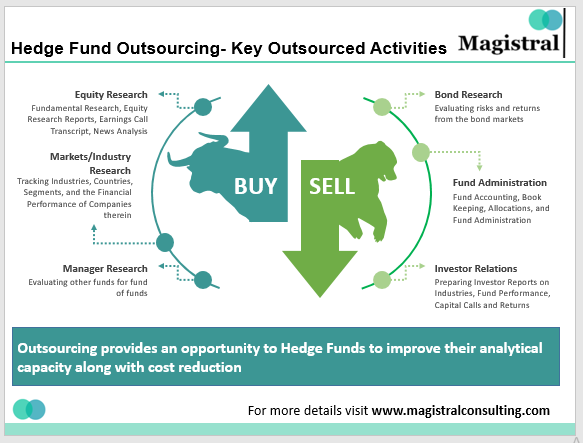
Here are the activities that Hedge Funds commonly outsource:

Hedge Fund Outsourcing Activities

Activities that are commonly outsourced by Hedge Funds

Equity Research Outsourcing/ Hedge Fund Outsourcing

Equity Research Outsourcing is by far the most important element of Hedge Fund Outsourcing. Equity Research outsourcing helps the in-house team track more stocks and sometimes to give more depth to the same set of stocks that are tracked by the fund. Fundamental and technical equity research, both could be outsourced effectively.  DCF models are prepared for each stock and then tracked progressively for any changes or news related to that particular stock. Earnings call transcripts are duly recorded and analyzed for a recommendation. A short 2-3-page report is prepared for every stock with the overall recommendation and the rationale for the recommendations. Hedge Fund Research tasks are completed seamlessly with the offshore team acting as a natural extension to the in-house team

Markets/Industry Research

If an investment theme is weaved around a specific country, industry or an emerging theme, its imperative to track that industry, market, or theme closely and regularly. A market is tracked for any macro-level changes like new tech, change in regulations, key movements, trends, etc periodically say quarterly. Several indices are also tracked regarding this. It’s quite common to track 14 S&P industries or some of its components therein. For index hedge funds, the performance of various indices is tracked

Typical examples may be tracking the insurance market in North Africa or metals and mining in South America. If your fund has a bigger interest in stocks that are based in those markets, it makes sense to have the key metrics of these industries reported to you regularly.

Manager Research

This is important for Fund of Funds. As part of their investment strategy, they are continuously on a look-out for hedge funds that fulfill a given set of criteria like vintage, past returns, investment themes, etc. Each fund is analyzed for risk-adjusted returns over a fairly long period like 10 years or so to find out the most suitable funds.

This requires getting in touch with multiple funds across the globe, collecting information, analyzing it, and then presenting holistic recommendations on where the fund stands. All of this could be outsourced.

Bond and Other Fixed Income Instruments Research

For hedge funds that operate on the lines of fixed income, the research is done that is related to sovereign and government bonds, corporate bonds, fixed income instruments, and several other investment options like that.

Fund Administration and Accounting

Fund Administration is outsourced for activities related to accounting, bookkeeping, and general administration of the funds. This also forms part of Hedge Fund Middle Office Outsourcing. Some bookkeeping aspects also come under Hedge Funds’ back-office outsourcing. It keeps the documentation trail of all the trades, makes sure all operational processes are followed and exceptions are duly approved. Hedge Fund books are maintained in the prescribed format. It also takes care of investor communications like portfolio allocations, portfolio valuation, capital calls, taxes, profits, fees, NAV, portfolio, etc. Customized Hedge Fund newsletters for investors is sometimes prepared and sent separately to current and potential investors.

Investor Relations

This is a subset of the Fund Administration process. However, some elements of organic investors’ reach out could be outsourced as well. A tool or a portal for all the investors with all relevant information for them is prepared for seamless and updated communication. This is communication related to the Hedge Fund investments made by the investors. This might be customized to carry Hedge Fund news, Strategy, Returns, and Performance. In the case of Fund of Funds, the performance of all the underlying funds is covered.

About Magistral

Magistral has helped multiple hedge funds in outsourcing operations. You can check www.magistralconsulting.com for more details.

About the Author

The Author, Prabhash Choudhary is the CEO of Magistral Consulting and can be reached at Prabhash.choudhary@magistralconsulting.com for queries on this article or business inquiries in general.


Magistral Consulting (www.magistralconsulting.com) was approached by a Family Office for an assignment related to finalizing a Long-Short Equity Hedge Fund. Our assignment was to find a fund that generated alpha over a long period with minimal risk. We required the fund to focus on a specific global region, meet minimum investment values, have a threshold AUM, and a defined vintage. Here are the steps that we took to identify the fund:

Secondary Research for all best performing Asset Managers in the region:

We searched the internet for all the best performing Asset Managers in the region. It ended in us drawing a list of more than a hundred Asset Managers in the region. This was pretty much the universe of Asset Managers in that specific region.

Finding the fund satisfying the criteria with the Asset Managers:

We reached out to all the Asset Managers for the funds that satisfied our criteria (like minimums, AUMs, regional focus, etc.). This reach-out was done over the emails and several calls.

Information gathering from all relevant Funds:

We asked for Net Returns MoM since inception for all the funds that satisfied our initial criteria. This information was fed into our analytics model that calculated all fund performance parameters like Cumulative Returns, Annualized Returns, Standard Deviation, Sharpe Ratio, Sortino Ratio, Max Drawdowns, Average Up-capture, Index Capture, Average Down Capture, Index Correlations, and several other objective and subjective parameters. This process took weeks as many Fund Managers needed support from us in calculating the metrics, some needed multiple follow-ups for the information to be provided to us. The picture became clearer when all returns information was fed into the model separating the performing funds from the non-performing ones. The robust model also ensured proper consideration of risks taken by the fund manager to deliver the returns. Best performing funds were shortlisted for the due diligence.

Due-Diligence of shortlisted funds:

Due diligence involved preparing a detailed report running into tens of pages analyzing all operational aspects of the Asset Manager and the fund. We collected and analyzed information on parameters including Human Resources, Compliance Frameworks, IT systems, and Business Continuity plans. for the Asset Manager or the Management company. For funds, we collected information related to Legal framework and structure, Transactions, Valuations and Accounting, Risk Management and Monitoring, Service Providers (Admin, PB, Auditor, etc.), Ownership Structures, Current Investors and their holdings, Key personnel bio and their relevant experience, Exception to general allocation rules and several other parameters.

Evaluation of fund performance on all parameters:

We created a sanity checklist and designed a questionnaire to collect information from funds during meetings. After gathering verbal inputs, we analyzed documentary proofs to assess the depth of each parameter. Based on the numbers, documentation, and evidence, we assigned a rating to each fund parameter. Considering the weightage and performance across all parameters, we recommended one fund for investment.

This was one of the examples where the Magistral team worked closely with the client team to arrive at a recommendation that moved millions across a cross-border transaction, into a fund that has a solid track record of providing superlative returns when compared to others.

We are in the process of doing due diligence for several other funds as I write this.

The Author is the CEO of Magistral Consulting (www.magistralconsulting.com), a research and analytics firm, that helps Family Offices in identifying best performing fund managers. For any inquiries you can reach out to him at Prabhash.choudhary@magistralconsulting.com

Tags/ Keywords: hedge fund outsourcing, hedge fund, outsourcing, outsourced trading, asset manager, fund, fund manager, trading desk, trading, hedge fund managers, portfolio manager, investment managers, due diligence, firm, institutional investors, bton financial, outsourced trading desk, investor, JPMorgan, prime brokers, fund administrators, trading operations, prime brokerage, emerging managers, asset class, cloud providers, fixed income, service provider, outsourced trading services, hedge fund industry, pension funds, fund administration, brokers, CFO, Private Equity Funds, Private Fund, Outsourcing Services, Trade Execution, Private Equity, Fund Strategies, Traditional Asset Managers, Operational Due Diligence, Operational Risk, Management, Financial Firms, Financial Services, Infrastructure, Investments, Alternative Investment Firms, Assets