Tag Archives: investment analytics AI

Generative AI in Investment has moved well beyond conference demos and innovation lab talk. Investment firms now see it as a practical layer inside research, diligence, portfolio monitoring, client communication, and operating control. That shift matters because the industry is under pressure from both sides. Costs remain stubborn, while expectations for speed, personalization, and accuracy continue to rise. McKinsey notes that global assets under management reached a record $147 trillion by the end of June 2025, even as profitability stayed tight, which explains why firms are looking for tools that improve operating leverage rather than simply add more headcount.

At the same time, market data from Precedence Research shows that the generative AI opportunity inside financial services is scaling quickly from a small base, signaling that adoption is no longer theoretical.

Why Generative AI in Investment Is Gaining Strategic Weight

The headline story is not just about automation. It is about where value is being created inside modern investment organizations. Firms want faster synthesis of messy data, better coverage of sprawling information flows, and more consistent execution across teams. That is why Generative AI in Investment is shifting from experiments to operating models. reference
Generative AI in Investment

Why Generative AI in Investment Is Gaining Strategic Weight

A fast-growing market is meeting a very large industry

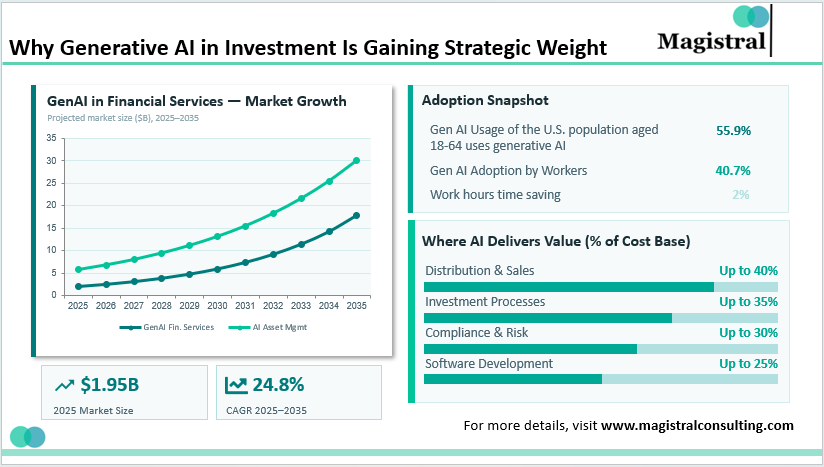
Precedence Research estimates that the global generative AI in financial services market stood at $1.95 billion in 2025 and is projected to reach about $17.88 billion by 2035, with a 24.81% CAGR. In parallel, the broader AI in the asset management market is expected to rise from $5.75 billion in 2025 to $38.94 billion by 2034. Those are still modest numbers relative to total financial industry revenue, yet the growth rate is the real signal. The technology is becoming part of core investment infrastructure rather than a side experiment.

Margin pressure is forcing firms to rethink workflow design

This is where the economics become compelling. McKinsey says an average asset manager could see AI, generative AI in investment, and agentic AI deliver value equal to 25% to 40% of its cost base. The same research highlights specific areas where value is already visible, including distribution, investment processes, compliance, and software development. When margins are tight, that kind of improvement is not a nice extra. It becomes a strategic lever. This is also why firms exploring investment banking support and adjacent execution models increasingly look at AI as part of the workflow, not as a separate technology purchase.

Adoption is now budget-backed, not curiosity-led

Deloitte reports that 91% of organizations plan to spend more on AI, while its 2025 M&A Generative AI study found that 86% of respondents had already integrated GenAI into M&A workflows and 65% had done so within the past year. That matters for investment teams because it shows adoption is happening where speed, document intensity, and competitive pressure are highest. In other words, firms are no longer asking whether AI belongs in investment work. They are deciding where to deploy it first and how to govern it properly.

How Generative AI in Investment Is Changing Day-to-Day Work

Once you look inside the workflow, the appeal becomes obvious. Analysts spend hours pulling together notes from earnings calls, filings, expert calls, transcripts, and market data. Deal teams live inside document-heavy processes. Portfolio and client teams need faster reporting without losing nuance. This is exactly where AI earns attention.

Research assistants are compressing the first draft of the analysis

McKinsey notes that analysts are already using generative AI-powered research assistants to synthesize earnings calls, financial reports, and conference materials. It also says generative AI can create around an 8% efficiency impact in investment management workflows, while client-facing roles can see about a 9% efficiency impact, and risk and compliance about 5%. That does not mean the machine replaces judgment. It means the first pass becomes dramatically faster, which leaves more room for deeper reasoning, debate, and scenario testing. A similar logic is already shaping conversations around AI in portfolio management, where the real advantage is not novelty but speed plus consistency.

Where the biggest near-term gains appear

The near-term wins tend to cluster around summarization, document comparison, model explanation, watchlist generation, and report drafting. These are repetitive but high-consequence tasks. When done well, they reduce analyst drag without diluting professional accountability.

Dealmaking teams are using it because the workload is brutal

Deloitte’s 2025 study of 1,000 senior corporate and private equity leaders shows how quickly adoption accelerated in M&A. That finding should not surprise anyone who has sat in a live process. A deal team may need to review thousands of pages across data rooms, management presentations, customer materials, and contracts while simultaneously updating working files and internal memos. Generative AI can shorten that grind. It can flag clauses, summarize diligence themes, suggest question lists, and accelerate memo drafting. For firms active in private equity or venture capital, the real value lies in covering more opportunities without letting quality collapse under volume.

Distribution and investor communication are becoming more personalized

Deloitte’s investment management outlook says firms like Invesco and WisdomTree are using a generative AI approach to build more personalized marketing strategies, while AI-based tools are supporting customized portfolio recommendations and real-time client insight. That trend matters because fundraising and distribution are becoming more data-led and less generic. A manager who understands investor context can tailor communication more effectively. This is one reason capital raising teams now look at AI not only for content creation but also for sharper segmentation, faster preparation, and better follow-through.

Live market examples are now appearing in wealth and guidance models

The shift is no longer theoretical. Reuters reported on April 21, 2026, that Lloyds became the first UK lender to pilot an AI-powered investment guidance tool through Scottish Widows, and that the UK Financial Conduct Authority is live testing AI applications with Lloyds, Barclays, UBS, and others. That is important because it shows the market moving from back-office productivity into client-facing use cases, even under regulatory scrutiny.

Regional Adoption Trends in Generative AI in Investment

Generative AI in Investment shows clear regional variation, shaped by differences in investment levels, regulatory environments, and technological readiness, as highlighted in the referenced study.
Generative AI in Investment

Regional Adoption Trends

North America Leading Adoption

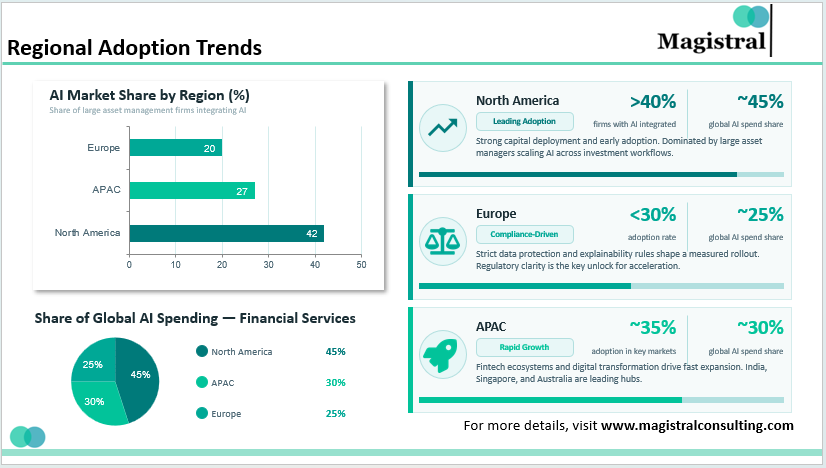
North America dominates adoption, with over 40% of large asset management firms integrating AI into investment processes. The region also accounts for roughly 45% of global AI spending in financial services, reflecting strong capital deployment and early adoption of advanced technologies.

Europe’s Controlled and Compliance-Driven Approach

Europe demonstrates a more cautious trajectory, with adoption rates remaining below 30%. This slower pace is primarily due to strict regulatory requirements focused on data protection, transparency, and explainability, which influence how quickly firms can scale AI solutions.

APAC’s Rapid Growth and Expansion

APAC is emerging as a high-growth region, with adoption levels nearing 35% in key markets. The region contributes approximately 30% of global AI investment in financial services, supported by strong fintech ecosystems and increasing digital transformation initiatives.

Strategic Implications

These regional differences indicate that Generative AI in Investment cannot follow a uniform strategy. Firms must align deployment with local regulatory expectations, investment capacity, and technological infrastructure to achieve scalable and compliant growth.

How Magistral Consulting Executes Generative AI in Investment in Practice

The smartest use of AI in finance is rarely the flashiest. It usually sits inside messy, deadline-driven processes that need more coverage, more consistency, and lower turnaround time. Generative AI in Investment is most useful when it is tied to a clear delivery process. That is exactly where operational partners can create real value.

Turning AI from pilot work into repeatable delivery

Magistral can apply Generative AI in Investment across research support, screening, memo preparation, data extraction, investor mapping, portfolio reporting, and workflow QA. In practical terms, that means combining domain specialists with controlled AI-enabled processes rather than handing judgment to a model. For firms spanning public markets, alternatives, and special situations, the goal is simple: faster output, better documentation, and tighter review discipline.

Supporting investment teams across the full funnel

That support can start before a deal or mandate is even live. A team may need market maps, investor lists, sector screens, peer sets, or early thesis materials. Later, it may need management question banks, summary decks, monitoring notes, and reporting packs. Because these workflows connect across research, execution, and fundraising, the best model is often integrated support rather than isolated task outsourcing. That is why firms in funds and adjacent strategies are increasingly looking for partners who understand both finance and process design.

About Magistral Consulting

Magistral Consulting has helped multiple funds and companies in outsourcing operations activities. It has service offerings for Private Equity, Venture Capital, Family Offices, Investment Banks, Asset Managers, Hedge Funds, Financial Consultants, Real Estate, REITs, RE funds, Corporates, and Portfolio companies. Its functional expertise is around Deal origination, Deal Execution, Due Diligence, Financial Modelling, Portfolio Management, and Equity Research

For setting up an appointment with a Magistral representative visit www.magistralconsulting.com/contact

About the Author

Dhanita is a BD and Marketing professional with 6+ years’ experience in sales strategy, growth execution, and client acquisition; credentials include Stanford Seed (Stanford GSB), an MBA from USMS–GGSIPU, and a B.Com (Hons) from the University of Delhi. Expertise spans market research and opportunity mapping, sales strategy, CRM, brand positioning, integrated campaigns, content development, lead generation, and analytics; currently oversees business development calls and end-to-end marketing operations

FAQs

What makes this technology different from traditional automation?

Traditional automation follows fixed rules. This technology can interpret unstructured information, generate first drafts, compare documents, and respond to nuanced prompts, which makes it useful for research and communication heavy workflows.

Can it replace analysts and deal teams?

No. It can reduce time spent on repetitive synthesis and drafting, but investment judgment, source verification, and final decision making still need experienced professionals.

Which functions usually adopt it first?

Research, due diligence, memo drafting, investor communication, portfolio monitoring, and compliance support usually move first because they are document intensive and time sensitive.

What is the biggest risk?

The biggest risk is over trust. A polished output can still be incomplete, biased, or wrong, so firms need review controls, approved data sources, and accountability at the human level.

How should firms start?

Start with a few high volume workflows where success can be measured clearly, then add governance, validation, and user training before scaling further.

AI in portfolio management is no longer a “nice to have” but a necessity as investment complexity rises and traditional alpha declines. With global AUM expected to reach $200 trillion by 2030 and nearly 85% of active managers underperforming benchmarks, firms are rethinking how they make investment decisions.

The use of AI in portfolio management is a solution to this problem, where the firm can enhance its ability to improve the precision of its investment decision-making process. At the same time, the firm can manage exponentially increasing data sets consistently. As background, in the context of the more data-intensive and interconnected investment marketplace, firms that are using AI in their decision-making and investment process are more likely to be able to transform information into investment alpha, as opposed to simply gathering more information.

AI in Portfolio Management and the Economics of Alpha

The economics of the investment management industry are changing, with more difficulty sustaining the traditional sources of alpha. Declining performance and increasing research costs are causing firms to look at more structured and technology-driven investment decision-making processes.

Decline in the performance of active funds

The above-mentioned trends in the long-term performance of funds indicate structural inefficiencies in conventional portfolio management techniques. S&P Global states that 85% of actively managed equity mutual funds fail to beat their benchmark in the long term. This is creating an environment for the adoption of systemic investment management.

Increasing cost of generating alpha

To generate differentiated insights, investment managers today require access to large-scale data, tools, and talent. McKinsey & Company states that investment managers are significantly increasing their spending on analytics and digital technologies. Thus, the cost of generating alpha continues to increase.

Signal to Noise Imbalance

The amount of data produced by the market is huge, but the number of signals is limited. The issue is no longer access to data but the ability to filter the noise.

The Shift towards Systemic Thinking

The use of AI in portfolio management helps create disciplined decision-making processes. AI also reduces the variability of the decision-making process, which ensures systemic thinking in the investment strategies.

AI in Portfolio Management and Signal Extraction at Scale

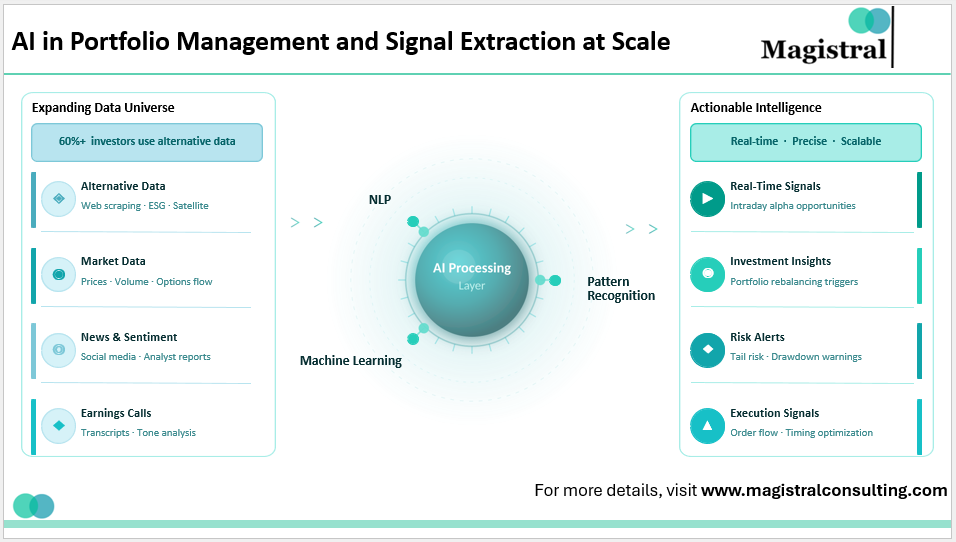
The exponential growth of data is revolutionizing the investment industry. The key to success today is the effective use of data, which is a significant competitive advantage

AI in Portfolio Management and Signal Extraction at Scale

AI in Portfolio Management and Signal Extraction at Scale

Increasing adoption of alternative data

At present, institutional investors are using non-traditional data sets. MSCI states that over 60% of investors are using alternative data in their investment process. Non-traditional data sets can offer an alternative source of information, which is not provided by conventional financial data.

Increasing unstructured data sources

This valuable investment information is unstructured, which means it contains information such as earnings calls, news sentiment, and social media. The issue with such information is that it cannot be efficiently processed using conventional tools. This is where AI can fill in the gap.

Advanced Pattern Recognition Capabilities

Machine learning is also capable of recognizing patterns and relationships in large datasets. Such data may not be available through other channels, which could give the firm a competitive advantage.

Generation of Real-Time Insights

AI in portfolio management allows for near real-time analysis of available information. This helps the firm respond to market conditions on time, giving a competitive edge in both opportunity capture and risk management.

AI in Portfolio Management and Execution Speed Advantage

Speed is becoming a differentiating factor for investment firms. It directly impacts returns and risk management for the firm.

AI in Portfolio Management and Execution Speed Advantage

AI in Portfolio Management and Execution Speed Advantage

Reduction in Decision Latency

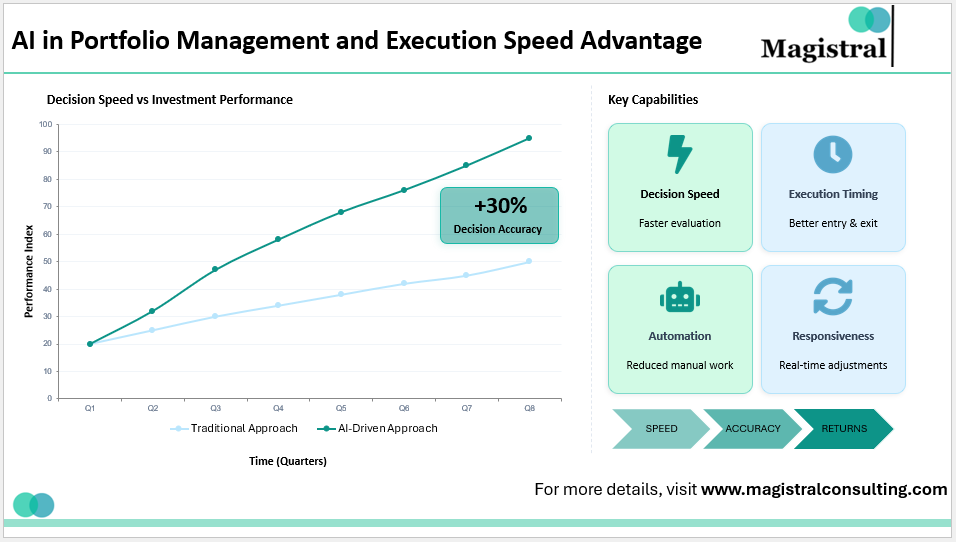
AI helps reduce the time required for the analysis of investment opportunities. According to a report by McKinsey & Company, the accuracy of decisions can be improved by up to 30% through the use of AI, along with a reduction in time required for analysis.

Improvement in Trade Execution Speed

This allows for better entry and exit of trades. In a competitive environment, even a small difference in time can result in significant returns.

Automation of Operations

AI helps automate repetitive tasks, allowing for better efficiency in operations.

Continuous Responsiveness to Market Conditions

AI helps create a system that can adapt to changing market conditions. This allows for a better alignment of the portfolio to the current environment.

AI in Portfolio Management and Cost-to-Serve Compression

As the asset management industry faces fee compression, it becomes important for firms to reduce costs while maintaining quality and depth of analysis.

Reduction in Operational Costs

AI helps automate operations, reducing the need for conventional methods. This helps reduce costs, especially as the industry faces a fee compression.

Enhanced analyst productivity

Productivity and quality of decisions are improved as AI frees the analyst to concentrate on more strategic activities and not on data management.

Scalable operating models

AI in portfolio management enables firms to grow their portfolios and complexity without proportionally increasing costs. This is essential in a high-AUM environment.

Alignment with industry fee trends

Firms in the investment management industry are forced to be more efficient in their operations as fee structures continue to fall. AI in portfolio management is essential in ensuring that the firm is cost-efficient while still meeting performance standards.

AI in Portfolio Management and the Scaling Challenge

While investment in AI is rising, most firms are still not able to scale their AI capabilities beyond the pilot project level. This is an indication of the disconnect between investment in AI and the actual implementation of AI in the firm.

High investment but limited outcomes

According to Deloitte, over 70% of investment management firms are investing in AI capabilities, but only a small percentage of them can scale their AI capabilities.

Fragmented data ecosystem

Firms in the investment management industry face challenges in implementing AI in their operations because of the fragmented data ecosystem. This makes it difficult to integrate insights and make them more effective.

Lack of integration of workflows

AI in portfolio management is often not fully effective in the investment management firm’s operations because of the lack of integration of AI in the workflows of the firm.

Lack of talent

Firms in the investment management industry lack the skills and talents of data scientists and engineers, which makes it difficult to implement AI in their operations.

Need for operating model redesign

AI in portfolio management is essential in improving the operations of investment management firms and thus the need to integrate AI in the workflows of the firm.

AI in Portfolio Management and Model Oversight Requirements

As AI becomes central to investment decision-making, the need for governance frameworks that are transparent, accurate, and regulatory-compliant arises.

Data quality and consistency

AI requires accurate and consistent input data. A structured validation process for accuracy and elimination of errors in decision-making is necessary.

Model transparency and explainability

AI models need to be transparent and explainable for investment decisions to be understandable by stakeholders.

The processes carried out by AI should be in line with financial regulations and laws. This means that financial information should be accurate, and audits should be conducted accordingly.

Cybersecurity and data protection

The financial information should be provided with top-grade security measures such as encryption, access control, and surveillance.

Human oversight and accountability

AI works in conjunction with humans, never replacing them. Investment managers are still required to validate information and align it with the larger business objectives.

About Magistral Consulting

Magistral Consulting has helped multiple funds and companies in outsourcing operations activities. It has service offerings for Private Equity, Venture Capital, Family Offices, Investment Banks, Asset Managers, Hedge Funds, Financial Consultants, Real Estate, REITs, RE funds, Corporates, and Portfolio companies. Its functional expertise is around Deal origination, Deal Execution, Due Diligence, Financial Modelling, Portfolio Management, and Equity Research

For setting up an appointment with a Magistral representative visit www.magistralconsulting.com/contact

About the Author

Nitin is a Partner and Co-Founder at Magistral Consulting. He is a Stanford Seed MBA (Marketing) and electronics engineer with 19 + years at S&P Global and Evalueserve, leading research, analytics, and inside‑sales teams. An investment‑ and financial‑research specialist, he has delivered due‑diligence, fund‑administration, and market‑entry projects for clients worldwide. He now shapes Magistral Consulting’s strategic direction, oversees global operations, and drives business‑development support.

FAQs

What is AI in portfolio management?

The use of AI in portfolio management is the use of advanced analytics and machine learning techniques to aid in decision-making.

Why is AI adoption increasing in asset management?

The increasing complexities of data and the need to outperform others are the main reasons why asset management firms are adopting AI techniques to aid in decision-making.

How does AI improve investment outcomes?

AI is helpful in quicker decision-making, risk detection, and diversification.

What are the challenges faced in the adoption of AI in portfolio management?

The challenges faced are data fragmentation, a lack of integration, and access to resources.

Can AI replace portfolio managers?

AI helps in decision-making, but humans are required for better decision-making.