Tag Archives: investment outsourcing

Hedge fund outsourcing has gradually transitioned from being just an ancillary measure for saving costs to being one of the critical features of the operation strategy for such financial institutions. Indeed, considering the current trends in the global market where financial markets become increasingly more complicated and stringent regulation takes its place, hedge fund managers are constantly under pressure in terms of being effective yet fully compliant with all the requirements. Therefore, outsourcing non-core activities related to fund accounting, compliance reporting, trade support, and data management seems to be a natural step for any institution in today’s environment.

According to industry estimates, outsourcing has already been adopted by almost 70% of hedge funds that use it to outsource their middle and back-office functions. Furthermore, the growth of operational costs associated with such activities as compliance and IT over the past ten years serves as additional evidence that outsourcing plays a key role in running a hedge fund today. In addition to the fact that outsourcing companies employ sophisticated technologies and tools, such as automation and artificial intelligence-powered analytics to reduce operational risks and accelerate the process, outsourcing has become essential for hedge funds’ success today.

Hedge Fund Outsourcing Market Trends and Growing Importance

Outsourcing in hedge funds has turned out to be an influential player in contemporary asset management, making companies manage their challenges while remaining flexible. The rise in scale and sophistication of investments and regulatory systems has forced companies to adopt outsourcing. reference
Market Trends & Growing Importance

Market Trends & Growing Importance

Rising Adoption Across Global Markets

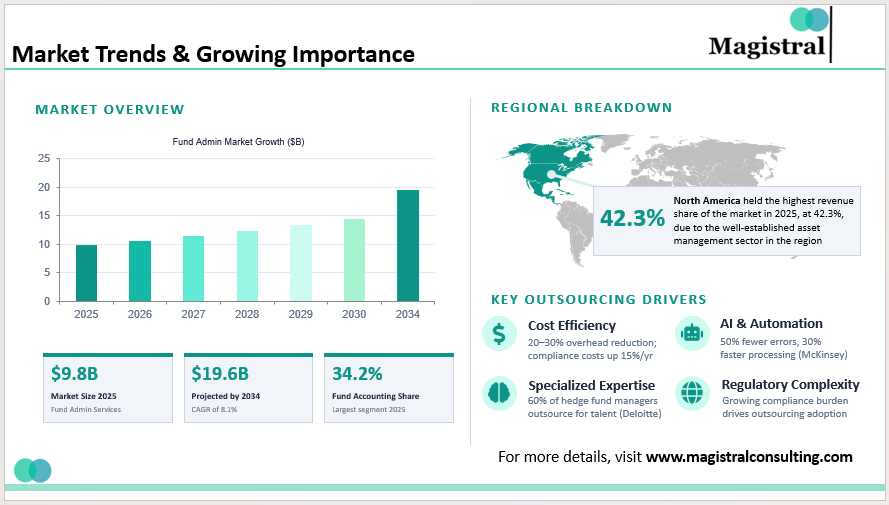
The fund administration services market was worth $9.8 billion in 2025 and is forecasted to touch $19.6 billion in 2034, growing at a CAGR of 8.1%. Fund Accounting emerged as the biggest service segment in the market, contributing to 34.2% of the market share in 2025. North America held the highest revenue share of the market in 2025, at 42.3%, due to the well-established asset management sector in the region. The market growth can be attributed to an increase in investments in alternative assets, increasing regulatory complexities, and widespread adoption of cloud automation services for fund administration purposes.
Concurrently, private equity companies have adopted outsourcing services to deal with intricate report filing and compliance matters.

Cost Efficiency and Operational Scalability

The operating costs associated with hedge funds have seen an increase because of compliance and technology costs. The cost increase resulting from compliance alone has been around 15 percent each year for medium-sized hedge funds.
Through outsourcing, it becomes possible to transform the fixed costs into variable costs, lowering the overhead costs by between 20 and 30 percent in many cases. It is through such cost savings that the hedge funds will be able to scale up their operations in times of fast growth and expansion.

Access to Specialized Expertise

One of the reasons why many hedge fund managers choose outsourcing is because of the availability of specialized knowledge that the providers offer. About 60 percent of hedge fund managers outsource for talent.
This is also evident in related fields such as venture capital, where firms outsource for specialization and expertise.

Technology Integration and Automation

Technology has been one of the primary motivators for outsourcing activities in the hedge fund industry. Providers of services have made significant investments in automation, artificial intelligence (AI), and cloud computing technologies. McKinsey projects a reduction of up to 50% in operational mistakes while increasing processing speed by 30%, courtesy of automation.
Further, the use of analytics based on AI is enhancing the way the data is managed.

Hedge Fund Outsourcing: Efficiency and Strategic Advantage

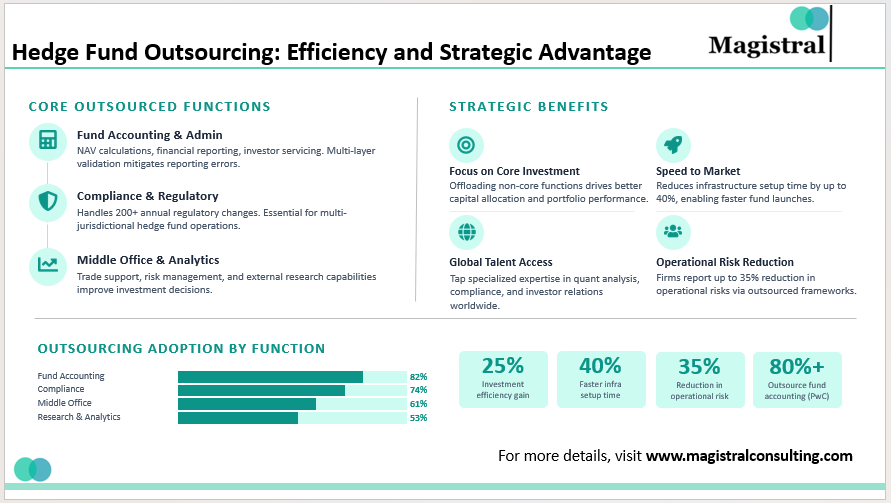
Hedge fund outsourcing enhances operational efficiency and scalability, with over 80% of funds outsourcing functions like fund accounting, NAV calculations, and investor servicing. Accurate NAV reporting is crucial to avoid significant risks, which outsourcing providers address through advanced software and validation processes. With hedge funds encountering over 200 regulatory changes annually, outsourced compliance support is vital, especially for multi-jurisdictional operations. Additionally, middle office functions such as trade support, risk management, and research are often outsourced to boost decision-making efficiency, with McKinsey noting that external research can improve investment efficiency by up to 25%.

Beyond operational support, hedge fund outsourcing delivers strategic benefits that extend well beyond cost savings. By offloading non-core functions, fund managers can focus more effectively on core investment activities, driving better capital allocation and performance. Outsourcing also strengthens risk management frameworks, with firms reporting up to a 35% reduction in operational risks. It accelerates time to market, reducing infrastructure setup time by as much as 40%, and provides access to a global talent pool, which is particularly valuable for specialized areas like quantitative analysis, compliance, and investor relations. Collectively, these advantages enable investment firms to operate more agilely and competitively in an increasingly complex financial landscape.
Hedge Fund Outsourcing: Efficiency and Strategic Advantage

Hedge Fund Outsourcing: Efficiency and Strategic Advantage

Hedge Fund Outsourcing Challenges and Risk Considerations

While it has several benefits, hedge fund outsourcing also poses some issues that must be addressed.

Data Security and Confidentiality

Data protection is still important. As stated by the IBM 2024 report, the average cost of a data breach in the finance industry is greater than USD 5 million.

Implementing Strong Cybersecurity Measures

The use of robust cybersecurity protocols is necessary to keep sensitive information secure.

Vendor Management and Oversight

Vendor management can be difficult. The firm should have effective ways to communicate and monitor vendor performance.

Regulatory Risks

Even with outsourcing, firms must still comply with regulations. Non-compliance could lead to severe penalties.

Integration with Existing Systems

It may be difficult to integrate outsourced solutions into existing systems.

Hedge Fund Outsourcing Strategies and Best Practices for Success

Hedge fund outsourcing can be maximally beneficial for companies if done properly. There are some recommendations from the professionals about how to use outsourcing to boost business.

Selecting the Right Outsourcing Partner

It is very important to find the right partners. When doing it, it is necessary to consider their competence, technological capabilities, and track record. Many successful partnerships with outsourcing companies depend on aligning with the right partner.

Defining Clear Objectives and KPIs

It is necessary to have clearly set goals and measures to make sure both hedge funds and outsourcing companies work in harmony.

Leveraging Technology for Integration

The cloud and API integrations can provide real-time data. Such an approach for hedge fund outsourcing increases efficiency by up to 20 percent.

Continuous Monitoring and Improvement

Regular performance reviews and feedback loops help maintain high standards. Continuous improvement ensures that outsourcing arrangements remain aligned with business objectives.

How Magistral Consulting Supports Hedge Fund Outsourcing

Magistral Consulting offers hedge fund outsourcing to companies with an aim of improving the level of research analysis, operational efficiency, and cost effectiveness. In terms of research analysis, Magistral provides research analysis for investing activities that include fundamental research, technical analysis, industry/sector analysis, corporate profile studies, and recommendations. The other service offered by Magistral under the category of analytics is that it offers valuation services, such as the preparation of DCF valuation models and scenarios. Moreover, Magistral provides services for investor communication and reporting. This includes the preparation of pitches, investor relations, and performance reporting. Also, the company offers hedge fund companies back-office and middle-office support, including market information and data analytics.

About Magistral Consulting

Magistral Consulting has helped multiple funds and companies in outsourcing operations activities. It has service offerings for Private Equity, Venture Capital, Family Offices, Investment Banks, Asset Managers, Hedge Funds, Financial Consultants, Real Estate, REITs, RE funds, Corporates, and Portfolio companies. Its functional expertise is around Deal origination, Deal Execution, Due Diligence, Financial Modelling, Portfolio Management, and Equity Research

For setting up an appointment with a Magistral representative visit www.magistralconsulting.com/contact

About the Author

Prabhash Choudhary is the CEO of Magistral Consulting. He is a Stanford Seed alumnus and mechanical engineer with 20 + years’ leadership at Fortune 500 firms- Accenture Strategy, Deloitte, News Corp, and S&P Global. At Magistral Consulting, he directs global operations and has delivered over $3.5 billion in client impact across finance, research, analytics, and outsourcing. His expertise spans management consulting, investment and strategic research, and operational excellence for 1,200 + clients worldwide

FAQs

What is hedge fund outsourcing?

Hedge fund outsourcing involves delegating operational and administrative functions to third-party providers to improve efficiency and scalability.

Why is hedge fund outsourcing growing?

It is growing due to rising operational costs, increasing regulatory complexity, and the need for specialized expertise and technology.

Which functions are most commonly outsourced?

Fund accounting, compliance, middle office operations, and research support are the most commonly outsourced functions.

How much cost can hedge funds save through outsourcing?

Hedge funds can reduce operational costs by 20 to 30 percent depending on the scope of outsourcing.

Is hedge fund outsourcing suitable for small funds?
Yes, smaller funds benefit significantly as outsourcing allows them to access expertise and infrastructure without large capital investments.

Introduction

Investment banks utilize pitchbooks, which are sales books, to pitch potential clients as well as sell goods and services. It gives a general picture of the company, including historical information, financial strength, and services offered to potential customers. The sales crew of a company will utilize a pitchbook as a form of field guide to remember key benefits and to make clear crucial points. A pitch book should contain the crucial information required to persuade a potential investor, client, or business partner. Therefore, avoid using too many words and focus on the most critical things.

Key topics covered in a typical pitch book include details on the investment highlights, significant financial data, the company’s core clients and customer base diversity, obstacles to entry for competitors, ability, and plan to meet future projections, future growth opportunities, management team strength, scalability of functions, prospects in the external market place, and known risks. The information provided in the pitchbook is used by an investment bank’s sales team to market its services to potential customers. Pitchbooks can be very helpful for companies, investment bankers, investors, and other stakeholders.

Types of Pitchbook

There are four different types of pitchbooks, which are explained below:

General Pitchbook

A general pitchbook offers a wide picture of the organization and includes significant details such as past profitable investments, present transactions, trends in the market, and profit metrics. Additionally, it includes details on the company such as its history, size, key executives, and global outreach.

It includes a client list broken down by various sectors, along with the relevant services offered to each client. Finally, the pitchbook might also include information on the firm’s rivals. It gives a general overview of the company’s top rivals, their performance, and the firm’s market position in relation to them.

Deal Pitchbook

For specific deals, the team creates a pitchbook that highlights how the investment business can deliver services to meet the client’s financial needs. They use graphs to display market rates, trends, and explain the firm’s valuation. The pitchbook also includes a list of potential buyers, financial institutions, acquisitions, and a brief summary. Additionally, the team provides a summary of advice and suggestions to help the client achieve their objectives.

Management Presentation

After the business finalizes an agreement with a client, the team conducts management presentations to pitch to potential investors. These presentations detail the client’s business, outline investment needs, present financial metrics, and provide information about the project requiring funding.

Sell-Side M&A Pitchbook

A sell-side M&A pitchbook’s principal goal is to persuade the customer to choose the investment bank to conduct the transaction. It includes a list of prospective purchasers for the client’s business, an overview of the valuation, suggestions, information on the bank’s profitable transactions in the client’s sector, etc.

Challenges faced by companies in the creation of a Pitchbook

While creating the pitchbook, various challenges are faced by the companies as discussed below:

Streamlining, Structuring, and Customization

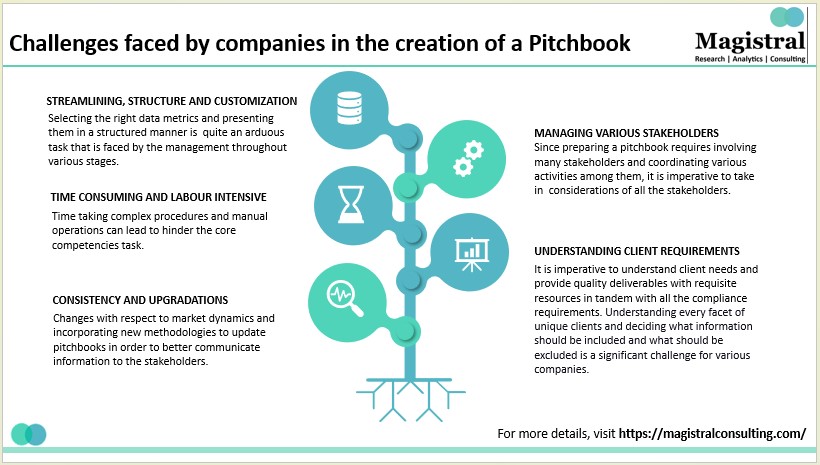
Often, companies face challenges in understanding their prospective clients/ customers, and hence collating, customizing, and structuring the Pitchbook is not efficient. Selecting the right data metrics and presenting them in a structured manner is quite an arduous task that is faced by the management throughout various stages.

Challenges faced by companies in the creation of a pitchbook

Challenges faced by companies in the creation of a Pitchbook

Time-consuming and Labour-intensive

For firms, it is a challenge, as it takes a lot of time to build and finalize the framework and create a pitchbook in tandem with all the requisite information. A business team working on a Pitchbook devotes its bandwidth to requirement gathering and other tasks related to Pitchbook, eventually losing focus on other priority tasks and core competencies, which can be detrimental to the organization’s growth.

Consistency and Upgradations

Continuously upgrading pitchbooks with respect to changing market scenarios/customer requirements is a must. The companies shall incorporate new ways and develop new methodologies to work and update pitchbooks regularly to better transpire and communicate the information to its stakeholders.

Managing various Stakeholders

Many people, including the managing director, vice president, associates, and analysts, are involved in the pitchbook preparation. To outperform the competition and persuade the client that they are the greatest in the market, the company must ensure that they are utilizing the most recent industry facts. The areas that require successful management include collaboration and coordination.

Understanding Client Requirements

An effective pitchbook must be able to focus on the important details while also meeting the client’s requirements. Understanding each aspect of a unique client and deciding what information to include and exclude presents a significant challenge for businesses.

Benefits of Pitchbook Support

Below are some of the major benefits of pitchbook support:

Focus on core competency 

Pitchbook assistance can allow businesses to focus on their core operations rather than devoting time to creating a Pitchbook in which they lack expertise. As a result, prioritizing the main job is critical.

Benefits of Pitchbook Support

Benefits of Pitchbook Support

Better Analysis and Structure

Pitchbook Support will better manage and coordinate various tasks while creating a Pitchbook. It will highlight the strengths, and showcase how the organization is different from its competitors in terms of experience, expertise, and modus operandi.

Cost and Expenditure control

You can convert fixed costs into variable prices with pitchbook support, meaning you only pay for the services you utilize. Consequently, adopting a support service can enable you to cut costs on a range of expenses, such as staffing, purchasing software, expertise, etc.

Better Branding and Messaging

Materials with inconsistent or poorly thought-out messaging could be detrimental to the brand’s reputation. Given the fierce competition in the market, having a brand and pitchbook approach that is compliance-focused is essential. Pitchbook support services help present your market position, strengths, and goodwill in a meaningful way.

Better Presentation 

Pitchbook support services can help to exercise brevity and incorporate various Charts, and graphs which makes the data metrics easy to understand. Moreover, it may also take up various cases to explain various elements to its prospective clients/customers.

Magistral’s Services on Pitchbook Support

By having a Pitchbook support service, an organization can save both time and costs. It can also focus on its core competencies. It can provide a platform where it can understand the needs and requirements. Following which it can offer tailor-made support services as you deem appropriate. At Magistral, in addition to providing an extension to your employees to assist with your particular needs, we give the strategic knowledge you want to assess change. To provide the most effective and cutting-edge financial solution for every client requirement, we draw upon the multi-function knowledge base and experience of professionals in many market segments. Magistral can help in Pitchbook support in various ways such as:

Enhancing Service Requirements:

Provide tailor-made services as per the needs and requirements of the customer. Taking into consideration of various stakeholders and employing various recommendations provided by them.

Data Management:

Cleaning and filtering out the data and ensuring that significant information is showcased in tandem with the graphical representations. Employing various data metrics and collating information as per the client’s requirement

Compliance and Research Management:

By merging information from internal, external, and third parties, we have a strong knowledge of the opportunities and challenges facing your firm. We have carefully chosen insights on markets, categories, competitors, and consumers. It will help your commercial and marketing teams make better strategic decisions with respect to compliance requirements.

Analysis and Execution:

We have a dedicated team of experts for handling respective operations for creating a Pitchbook. Having exposure to diverse fields and expertise in handling various functions handling in an efficient manner.

About Magistral Consulting

Magistral Consulting has helped multiple funds and companies in outsourcing operations activities. It has service offerings for Private Equity, Venture Capital, Family OfficesInvestment BanksAsset Managers, Hedge Funds, Financial Consultants, Real Estate, REITs, RE fundsCorporates, and Portfolio companies. Its functional expertise is around Deal originationDeal Execution, Due Diligence, Financial ModellingPortfolio Management, and Equity Research.

For setting up an appointment with a Magistral representative visit www.magistralconsulting.com/contact

About the Author

The article is Authored by the Marketing Department of Magistral Consulting. For any business inquiries, you could reach out to  prabhash.choudhary@magistralconsulting.com