Tag Archives: Investment Portfolio Management

Global financial systems now use automated investment portfolio management as an essential element of their operations, which started out as a basic instrument for users. Investors today deal with three major challenges, which include unpredictable market conditions, increasing inflation rates, and swift changes in capital among different asset categories. According to PwC’s Global Asset and Wealth Management Outlook, global assets under management are projected to approach 147 trillion dollars by the end of the decade, increasing the demand for scalable digital solutions. Deloitte found that more than 60 percent of asset managers now speed up their AI technology implementation for investment management tasks.

Automated management systems enable organizations to achieve operational efficiency while minimizing costs and maintaining ongoing performance evaluation through their ability to process data.

The Growing Importance of Automated Investment Portfolio Management

The practice of automated investment portfolio management has become essential for both retail investors and institutional investors when they develop their investment strategies. The global market for robo advisory services will grow at more than 30 percent annual compound growth, according to market research conducted by Precedence Research. The fast development of this technology shows that investors trust algorithmic systems, which use allocation models to handle their investments.

The Growing Importance of Automated Investment Portfolio Management

The Growing Importance of Automated Investment Portfolio Management

Expansion of Digital Advisory Assets

Digital advisory platforms now manage trillions in client assets worldwide. PwC shows that digitally powered wealth platforms attract major market share because millennials and first-time investors use these platforms. Investors use automated investment portfolio management to achieve a multiple asset class distribution, which includes equities, bonds, and exchange-traded funds, while keeping their expenses low.

Institutional AI Adoption

Large asset managers increasingly embed AI into portfolio construction. MSCI research shows that AI risk analytics tools help investors better forecast drawdown risks during periods of market uncertainty. Hedge funds now use algorithmic systems to enhance their alpha strategies, which mirrors the changes described in AI in hedge funds, where data science improves their ability to make instant choices.

Cost Efficiency and Margin Optimization

The process of automation produces major savings in advisory service costs. Digital portfolio platforms enable organizations to decrease their operational expenses by as much as 30 percent when compared to traditional advisory models, according to Deloitte research. Companies that maintain lower overhead costs can accommodate more customers while retaining control over investment management. This enables businesses to expand their operations while safeguarding their profit margins.

Data Driven Discipline

Emotional investing often leads to suboptimal timing decisions. Automated systems eliminate bias by following rule-based allocation strategies. This aligns with the broader evolution outlined in AI in portfolio management, where machine intelligence supports precision and transparency in asset allocation.

Core Technologies Powering Automated Investment Portfolio Management

The core structure of automated investment portfolio management depends on technological systems. Artificial intelligence and machine learning, together with cloud infrastructure, provide organizations with advanced abilities to run their analytics and modify their investment portfolios at quicker speeds.

Machine Learning in Asset Allocation

The researchers use machine learning models to analyze both past relationships between different factors and present economic conditions. McKinsey’s digital asset management insights indicate that AI-driven allocation can enhance risk-adjusted returns by improving forecasting consistency. The platforms for automated investment portfolio management execute constant portfolio adjustments in response to changing market volatility.

Predictive Risk Modeling

Predictive analytics simulate multiple market scenarios that include both inflation spikes and rate hikes. The approach helps organizations minimize their losses during unpredictable market conditions.

Behavioral Data Insights

The advanced algorithms use investor behavior data together with their past trading records to create customized portfolio management solutions. The process of customizing investment experience for investors leads to better investor satisfaction results, while investors still need to follow their necessary diversification rules.

Cloud-Based Infrastructure

Cloud technology provides organizations with the ability to observe their investment portfolios throughout every moment of the day. Asset managers process large datasets efficiently without heavy infrastructure investments. The same digital transformation trends that affect the investment banking industry also transform its outsourcing processes through analytics and automation technologies that enhance operational efficiency.

Integration with Alternative Investments

Contemporary platforms provide users with access to investment opportunities that extend beyond traditional stock and bond markets. Institutions worldwide adopt alternative investment options, which include private markets and structured products. Fund managers who operate in institutional settings have started using automated screening systems to achieve better risk management results and improved portfolio diversity outcomes.

Benefits of Automated Investment Portfolio Management for Investors

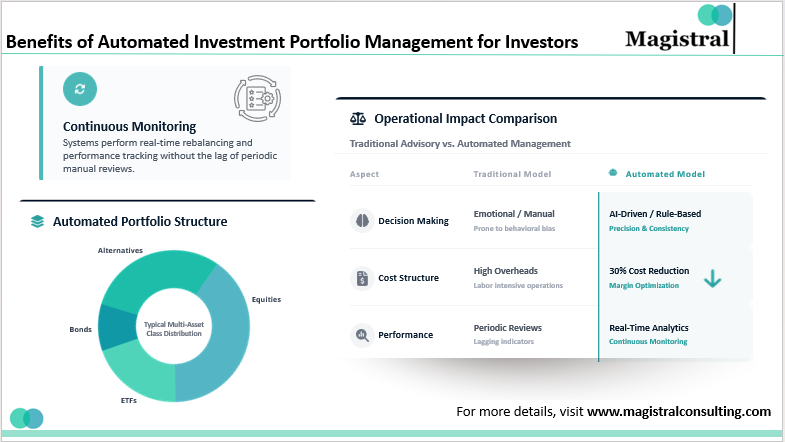
Automated investment portfolio management delivers many advantages across cost, performance tracking, and risk management. As global markets grow more interconnected, investors demand solutions that combine speed with analytical depth.
Benefits of Automated Investment Portfolio Management for Investors

Benefits of Automated Investment Portfolio Management for Investors

Enhanced Portfolio Diversification

Algorithms allocate capital across asset classes based on predefined risk thresholds. According to MSCI, diversified portfolios supported by quantitative models show improved resilience during downturns compared to concentrated allocations.

Continuous Rebalancing

Most manual portfolio rebalancing activities take place either every three months or every twelve months. The automated systems track asset distributions throughout the day and make corrections whenever they detect changes beyond set limits. This approach to management keeps operations in sync with established long-term business targets.

Transparency and Reporting

Digital dashboards display performance metrics through immediate, real-time monitoring. Investors receive immediate access to changes in their allocations, together with information about sector distribution and risk assessment scores. The system provides complete visibility, which enhances both trust and accountability in the organization.

Lower Entry Barriers

Retail investors can now enter the market because investment firms have reduced their minimum capital requirements. This system enables all investors to use advanced investment techniques that used to be exclusive to wealthy individuals.

How Magistral Supports Automated Investment Portfolio Management

The process of managing automated investment portfolios requires organizations to establish both technological systems and operational structures. Magistral Consulting helps asset managers, family offices, and institutional investors create scalable portfolio management systems.

Data Analytics and Model Support

The teams at Magistral provide analytical expertise that improves both algorithm development and reporting precision

Integration with Capital Strategies

The capital raising advisory process shows that structured investor communication works better with digital portfolio reporting than with other methods.

Operational Optimization

Automatic systems need to operate within the boundaries of compliance regulations and reporting requirements. Magistral helps organizations create operational processes that enhance their governance capabilities and improve their reporting practices to show how their portfolios meet regulatory requirements.

Long Term Strategic Alignment

The global financial system demands that organizations find partners who possess knowledge about both technological advancements and market dynamics. The practice of automated investment portfolio management reaches its highest efficiency when organizations use both strategic advisory services and operational excellence. Organizations can handle market fluctuations by using analytical tools and systems that can grow and enhance their professional knowledge of their industry.

About Magistral Consulting

Magistral Consulting has helped multiple funds and companies in outsourcing operations activities. It has service offerings for Private Equity, Venture Capital, Family Offices, Investment Banks, Asset Managers, Hedge Funds, Financial Consultants, Real Estate, REITs, RE funds, Corporates, and Portfolio companies. Its functional expertise is around Deal origination, Deal Execution, Due Diligence, Financial Modelling, Portfolio Management, and Equity Research

For setting up an appointment with a Magistral representative visit www.magistralconsulting.com/contact

About the Author

Prabhash Choudhary is the CEO of Magistral Consulting. He is a Stanford Seed alumnus and mechanical engineer with 20 + years’ leadership at Fortune 500 firms- Accenture Strategy, Deloitte, News Corp, and S&P Global. At Magistral Consulting, he directs global operations and has delivered over $3.5 billion in client impact across finance, research, analytics, and outsourcing. His expertise spans management consulting, investment and strategic research, and operational excellence for 1,200 + clients worldwide

FAQs

How secure is automated investment portfolio management?

Leading platforms use encrypted cloud infrastructure and regulatory compliant frameworks to protect investor data and transaction integrity.

Can automated systems outperform human advisors?

While results vary, automated systems improve consistency and reduce emotional bias, which can enhance long term risk adjusted performance.

Is automated investment portfolio management suitable for institutions?

Yes, many institutional investors use algorithm driven allocation and AI based analytics to strengthen diversification and risk forecasting.

How does automation reduce costs?

Automation reduces manual advisory effort and operational overhead, allowing firms to scale services efficiently while lowering client fees.

Investment portfolio management is on the cusp of a new era defined by technology, data, and scale.

AI is at the heart of this transition, how portfolios are built, how risk is managed, and how investment execution is conducted. The growth of the robo-advisory market is a great example of AI democratizing sophisticated investment tools.

As investors seek greater personalization of service, transparency, and sustainably produced efficacious results. It is apparent that firms actively transitioning investment via AI are placing themselves at an advantage over the competition.

Investment Portfolio Management: Market Overview

The global asset management sector, which encompasses all investment portfolio management. It is evolving at an extraordinary growth rate. The market is expected to be around USD 12,741.10 billion by 2034. This reflects a compound annual growth rate (CAGR) of 33.95% from 2025 to 2034. This evolving trajectory illustrates the growing institutionalization of wealth and the increasing reliance on professional money management to generate the best returns, while managing risk in an ever-changing financial landscape.

Investment Portfolio Management: Market Overview

Investment Portfolio Management: Market Overview

North America is at the forefront with 39.14% of the global assets under management, taking advantage of an established capital market.  It involves institutional investors and an increasing proportion of high-net-worth investors. This region will continue to lead the market while growing at an impressive CAGR of 33.98% through 2034. In addition, emerging economies in the Asia-Pacific and the Middle East are quickly improving. It is driven by increasing income levels, savings, and levels of participation within capital markets.

For portfolio management professionals, this data suggests two strategic realities. First, the competition and service landscape is growing at an accelerated pace, requiring firms to efficiently scale. It also requires an open digital infrastructure, and for them to distinguish their investment offerings. Second, the growth tailwind is favorable for firms that are innovative, specifically those that are using AI-driven analytics. They also use ESG embedded investment models, and exposure to alternative asset classes like private equity, infrastructure, and sustainable funds will most likely secure an outsized share of future flows.

In conclusion, investment portfolio management exists in an incredibly fast-growing ecosystem. The future of the industry will most likely be shaped by technology adoption, outsourcing efficiencies, and strategic scale. Firms seek to help fulfill the complicated investment objectives of institutional and individual investors.

Investment Portfolio Management: Key Investor Behavior Trends in 2025

Investor behavior in 2025 is driven by the demand for personalized, low-cost, and diversified portfolios. It is shaped by technology developments (especially AI), sustainability goals (ESG), and macroeconomic uncertainty.

Rise of the Individual Investor and Democratization

Retail investing has surged since 2023, with younger and lower-income individuals entering the market earlier in their lives. This is better than prior generations because of readily available low-cost digital investing platforms and robo-advisors.

Focus on Cost and Passive Investing

The low-expense fund appetite remains strong, with passive ETFs (Exchange-Traded Funds) consistently earning the largest share of inflows. It is at the expense of traditional active mutual funds.

Growing Demand for Alternatives

To develop diversification as well as seek higher, uncorrelated returns in a volatile and uncertain landscape, investors are actively pursuing alternative investments like private equity, private credit, infrastructure, and real estate.

Prioritizing Sustainable (ESG) Investing

Environmental, Social, and Governance (ESG) factors have transitioned from niche to attending to the core of the investment implementation framework. This is because investors, across the spectrum, retail and institutional, seek the ability to make an impact and maintain resilience over the long term.

Influence of Technology and Data

Investors are examining available market data through various digital platforms and social media. This may impact behavior, such as “trend-chasing” or “dip-buying.” Therefore, new entrants into the market will require educational opportunities to enhance financial literacy.

Behavioral Biases and Volatility Management

Although information is widely available, psychological biases, such as loss aversion and herd mentality, still influence investor decisions and actions, especially in uncertain and volatile markets.

Investment Management Adaptation

Investment management firms are adapting their investment portfolio management process by:

Integrating AI and Digital Tools

Managers are incorporating AI and Machine learning into their investment management framework, from predictive analytics, personalized client journeys, operational efficiencies, and improved risk management.

Offering Hybrid Solutions

Investment firms are creating hybrid strategies that combine the efficiency and cost savings of passive investing with the ability to generate alpha (returns above benchmark) through active management in the ETF wrapper, for example.

Expanding Product Suites

Managers are increasingly diversifying product offerings into profitable, higher-margin products in alternative investments and more sustainable solutions to address evolving client preferences.

Enhancing Client Education

Aware of the influx of new investors into their firms and the greater complexity of new products, firms are beginning to prioritize educational content to build client trust in the firm and help measure the suitability.

Focusing on Risk and Regulation

Firms are focusing their efforts on potential technology-induced risk management and cybersecurity in the context of new regulatory environments involving complex investments, while fostering trust with investors.

AI in Investment Portfolio Management

Artificial intelligence (AI) has moved well beyond pilot projects in investment portfolio management and is now becoming a strategic enabler across portfolio construction, risk management, and trade execution. A survey found that 91% of investment managers are either using (54%) or planning to use (37%) AI in their strategies.

AI in Investment Portfolio Management

AI in Investment Portfolio Management

Simultaneously, the robo-advisory segment-one of the most visible AI-enabled delivery models, is growing at a strong clip. The global robo-advisory services market is estimated at ~USD 14.29 billion in 2025 and expected to reach ~USD 54.73 billion by 2030, implying a CAGR of approximately 30.8% between 2025 and 2030.

Real-time, data-driven decision-making

AI systems will process large amounts of data- market ticks, economic releases, alternative data (satellite imagery, consumer sentiment). Its done using machine learning to identify patterns faster and allow for more real-time adjustments to portfolios. This is better than traditional approaches based on historical datasets or human judgement.

Automated asset-allocation & rebalancing

AI models will be able to monitor portfolios 24/7 and support investment portfolio management, consider the risk-return balance of the portfolio. They also trigger a rebalance or tactical move based on incremental market changes or investors’ risk objectives. AI solves the manual bottlenecks while minimizing the time-sensitivity of decisions between market events.

Enhanced risk-management

Machine learning tools provide finer granularity on forward-looking risk- for example, identifying early stress in the market, liquidity shocks, or behavioural changes in correlations, which allows the portfolio manager to take action in a proactive rather than reactive manner.

Implications for Investment Portfolio Managers

AI is increasingly becoming a strategic imperative rather than an optional enhancement in investment portfolio management.

Scalability & cost-efficiency

Artificial intelligence systems lessen dependence on human resources or repeating self-contained tasks, allowing firms (both institutional and outsourced) to increase operational scale, while increasing accuracy and lowering error.

Competitive differentiation

As competitors continue to integrate artificial intelligence into their systems or workflows, the firms that will develop and establish a competitive advantage will be able to marry their operational workflow with artificial intelligence.

Data & infrastructure readiness

The establishment and management of a robust data pipeline to realise the value of artificial intelligence will be paramount to successful implementation, along with algorithmic oversight, model governance, transparency, and regulation.

Evolving roles of humans

The manager’s role in investment portfolio management is evolving from exclusively execution to more strategic roles. This includes model framework selection; interpretation of artificial intelligence, and use of judgment calls in situations where models still will struggle. The oversight of the ethics or control frameworks of artificial intelligence.

Risk of lagging if no adoption

Companies that are slow to adopt could not only lag in efficiency but also in the quality of insights that the process produces. AI generally facilitates faster turnaround times or a broader reach across data. So the laggards will possibly incur opportunity costs in investment portfolio management.

Magistral’s Services for Investment Portfolio Management

Magistral Consulting delivers comprehensive assistance throughout the investment portfolio management process.

Portfolio Research and Strategy Development

Magistral’s analysts will conduct thorough and original fundamental and quantitative research. It helps to identify your investment opportunities across sectors, securities, and themes. We assist with the creation of asset allocation strategies across equities, fixed income, alternatives, and ESG portfolios. This is for investment portfolio management.

Portfolio Monitoring and Rebalancing Support

We continually monitor portfolios to evaluate performance against benchmarks and investment objectives. They are together with forward-looking risk monitoring, exposure analysis, and performance attribution. Magistral will also provide recommendations for rebalancing the portfolio and provide you with dashboards for performance analytics built for your decision-making process.

Financial Modeling and Valuation

Our team designs sophisticated valuation models, including DCF, comparable company analyses, and precedent transactions. It is to continue assisting portfolio managers with assessing fair value.

ESG and Thematic Investment Support

Magistral supports the integration of ESG and sustainability investment themes into the portfolio approach. We carry out all of the screening associated with ESG, impact, and sustainability reporting. It is to ensure the portfolio reflects the mandate of the investor and aligns with whatever requirements have been established by regulation.

Operations and Reporting Outsourcing

We operate back-office functions, including trade reconciliation, data management, client reporting, and any other operational needs. The outsourcing model from Magistral supports accuracy, regulatory compliance, and scalability. It is for portfolio managers to have more time to generate alpha and engage with clients.


About Magistral Consulting

Magistral Consulting has helped multiple funds and companies in outsourcing operations activities. It has service offerings for Private Equity, Venture Capital, Family Offices, Investment Banks, Asset Managers, Hedge Funds, Financial Consultants, Real Estate, REITs, RE funds, Corporates, and Portfolio companies. Its functional expertise is around Deal origination, Deal Execution, Due Diligence, Financial Modelling, Portfolio Management, and Equity Research

For setting up an appointment with a Magistral representative visit www.magistralconsulting.com/contact

About the Author

Prabhash Choudhary is the CEO of Magistral Consulting. He is a Stanford Seed alumnus and mechanical engineer with 20 + years’ leadership at Fortune 500 firms- Accenture Strategy, Deloitte, News Corp, and S&P Global. At Magistral Consulting, he directs global operations and has delivered over $3.5 billion in client impact across finance, research, analytics, and outsourcing. His expertise spans management consulting, investment and strategic research, and operational excellence for 1,200 + clients worldwide


FAQs

What is investment portfolio management?

Investment portfolio management is the process of strategically allocating assets, such as equities, fixed income, and alternatives- to achieve specific financial objectives. It involves research, asset selection, monitoring, and rebalancing to optimize returns while managing risk.

How is the investment portfolio management market growing?

The global asset management market—closely tied to portfolio management- is projected to rise from USD 685 billion in 2024 to USD 12.74 trillion by 2034, at a CAGR of 33.95%. This growth is driven by rising global wealth, institutional participation, and the adoption of technology in investment processes.

What are the key trends shaping investor behavior in 2025?

Investors are increasingly favoring low-cost, diversified portfolios, ESG-integrated strategies, and alternative assets. There’s also a surge in retail participation via digital platforms and robo-advisors, alongside growing demand for transparency, real-time insights, and sustainable investment options.

How is artificial intelligence (AI) changing investment portfolio management?

AI is transforming the field by enabling real-time data analysis, predictive modeling, and automated rebalancing. It enhances portfolio construction, risk assessment, and execution efficiency. The global robo-advisory market, a major AI-driven segment, is projected to grow from USD 14.29 billion in 2025 to USD 54.73 billion by 2030.