Tag Archives: investment research services

Today’s investment environment is faster, more volatile, and far more data-heavy than it was even a few years ago. In this backdrop, outsourced investment research has grown from being a cost-saving measure into a strategic advantage. Many asset managers now rely on external research teams to gain access to specialized skills, deeper analytics, and flexible capacity without expanding internal headcount.

This approach helps investment teams react more quickly to market shifts, maintain steady sector coverage, and bring added analytical depth to areas that need it the most. It also allows research bandwidth to expand or contract with deal flow, rather than staying limited by fixed internal resources. The result: sharper insights and more time for in-house teams to focus on high-value activities such as portfolio strategy and client engagement.

Outsourced Investment Research as a Strategic Response to Market Complexity

As markets become increasingly data-driven, outsourcing helps firms manage everything from alternative datasets to regulatory reporting. By delegating time-intensive analytical work, investment professionals can stay focused on decision-making and client relationships. Industry outlooks continue to highlight the role of technology, workflow optimization, and smart outsourcing in improving research efficiency and scalability.

Outsourced Investment Research in Complex Markets

Outsourced Investment Research in Complex Markets

Expanding Coverage Without Increasing Headcount

A major benefit of outsourced investment research is the ability to widen coverage quickly. External analysts help firms explore new sectors, geographies, or investment themes without needing to hire full-time staff. This flexibility becomes particularly valuable when deal flow becomes unpredictable, as often seen in private equity and growth investing.

Supporting Data‑Intensive Investment Models

Modern investment strategies rely heavily on robust financial models and scenario testing. External research teams bring specialization in valuation, forecasting, and comparative analysis, helping internal teams validate assumptions and ensure models remain aligned with current market benchmarks.

Enhancing Decision Speed and Accuracy

In competitive markets, speed matters. Dedicated external teams help maintain consistency and analytical rigor across research outputs especially when multiple investment committees depend on standardized reporting. This contributes to faster, better-informed decisions.

Aligning Research with Portfolio Strategy

It is most effective when aligned closely with portfolio strategy. Rather than acting as a standalone function, external analysts work as an extension of the investment team. Clear mandates, feedback loops, and performance metrics ensure that research outputs support broader goals such as alpha generation, risk management, or sector rotation. Over time, this alignment transforms outsourcing from a transactional service into a strategic partnership.

Outsourced Investment Research Across Asset Classes and Investment Styles

The role of outsourced investment research varies across asset classes, each with its own demands and processes. Understanding these differences ensures that outsourcing adds real value rather than unnecessary complexity.

Public Markets and Equity Strategies

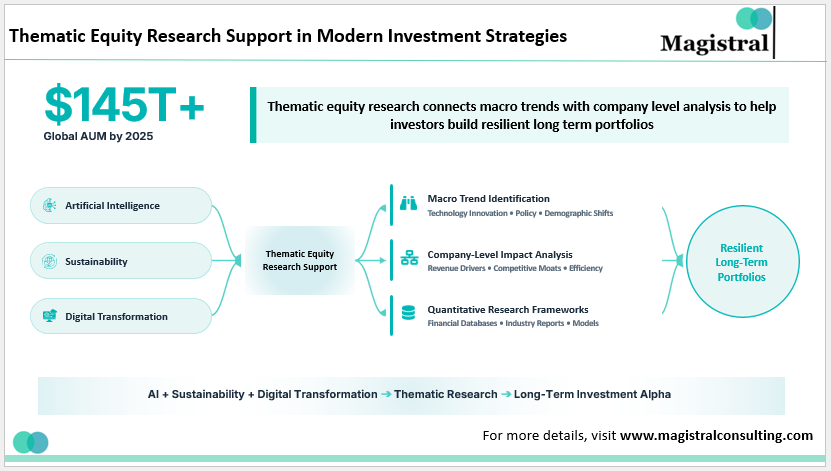
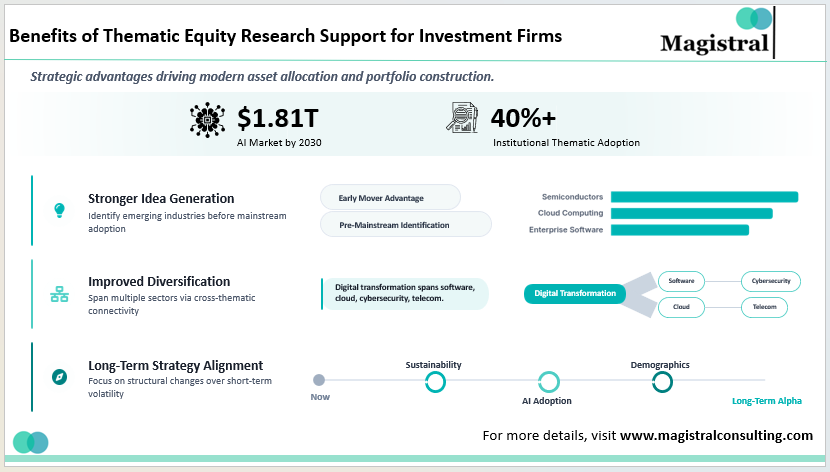
In listed equities, outsourced teams typically assist with sector tracking, earnings monitoring, and thematic research. They help maintain ongoing coverage of fundamentals and macro trends, allowing portfolio managers to concentrate on high‑conviction decisions while retaining oversight of the final calls.

Private Markets and Illiquid Assets

Private markets require deeper due diligence and detailed analysis. External research teams support market studies, target company screening, competitive assessments, and benchmarking. Their work also enhances capital‑raising materials by providing well‑structured analysis for limited partners.

Hedge Funds and Alternative Strategies

Hedge funds often operate on tight timelines and require sophisticated analytical capabilities. Outsourced teams contribute through fast scenario assessments, factor analysis, and macro research that feeds directly into trading models. With the growing use of AI-enabled analytics, external support increasingly integrates into internal systems to strengthen signal generation and risk oversight.

Advisory Firms and Institutional Investors

For advisory firms and institutional investors, Outsourcing Investment Research ensures objectivity and breadth. Independent research reduces concentration risk and supports fiduciary responsibilities. Institutions managing large pools of capital often rely on external analysts to evaluate fund managers, assess strategy fit, and monitor performance trends over time. This approach improves governance while controlling internal workload.

The Economics Behind Outsourced Investment Research

While cost efficiency is a common driver, the value of outsourcing extends beyond reduced labour expenses. The ability to convert fixed costs into flexible ones while improving output quality has made outsourcing an essential tool for many investment organizations.

Outsourced Investment Research and the Economics of Efficiency

Outsourced Investment Research and the Economics of Efficiency

Converting Fixed Costs into Variable Costs

Maintaining a large internal research team involves ongoing investment in salaries, training, and specialized tools. Outsourcing allows firms to shift part of these expenses into variable costs that reflect actual activity levels, particularly useful during slow markets when internal teams may otherwise be underutilized.

Accessing Specialized Skills on Demand

Skills such as advanced valuation, sector-specific expertise, and alternative data analysis can be expensive to build internally. Outsourced investment research provides access to these capabilities when needed, without long-term commitments.

Improving Research Consistency and Documentation

High-quality outsourced teams usually work with well-structured templates, peer‑review processes, and documentation standards. This improves consistency, strengthens audit readiness, and helps firms maintain an organized research library, valuable for training and institutional memory.

Enhancing Return on Investment Decisions

In the end, how well outsourced investment research performs is determined by how it affects investment results. Businesses report more disciplined decision-making, better downside risk identification, and increased screening efficiency. By freeing internal teams from repetitive tasks, outsourcing allows senior professionals to focus on high-value activities such as strategy refinement and investor communication.

Outsourced Investment Research and Risk, Compliance, and Governance

Risk management and compliance have become central to investment operations. It plays an increasingly important role in strengthening governance frameworks. Regulators and investors alike expect transparent processes and well-documented decision rationales.

Supporting Due Diligence and Risk Assessment

External research teams contribute significantly to due diligence by conducting independent market assessments and operational reviews. This independent perspective helps uncover blind spots and challenge internal assumptions. In transactions where operational due diligence is critical, outsourced research adds an additional layer of scrutiny that enhances confidence in final decisions.

Maintaining Regulatory Alignment

Regulatory requirements around disclosures, suitability, and reporting continue to evolve. Outsourced Investment Research providers often stay closely aligned with regulatory developments across jurisdictions. Their inputs help firms ensure that investment recommendations and reports meet compliance standards, reducing regulatory risk and reputational exposure.

Strengthening Investment Committee Processes

Investment committees rely on clear, balanced information. Outsourced research enhances committee discussions by providing standardized analysis and scenario comparisons. This consistency improves decision quality and reduces reliance on anecdotal evidence or individual biases.

Managing Conflicts and Ensuring Objectivity

Independent research support can help mitigate conflicts of interest, particularly in advisory and multi-asset environments. By separating analysis from execution, firms reinforce objectivity and strengthen trust with clients and stakeholders.

How Magistral Consulting Supports Investment Firms

As Outsourced Investment Research matures, firms increasingly look for partners who combine analytical depth with operational understanding. The goal is not just producing reports but embedding research into decision workflows.

Magistral Consulting supports investment firms by acting as an extension of their research and analytics teams. Its approach integrates financial analysis, market intelligence, and strategic insights tailored to specific investment mandates.

Magistral’s teams work closely with fund managers, investors, and advisory firms to deliver research that aligns with portfolio goals and risk frameworks. By supporting activities across screening, valuation, and ongoing monitoring, the firm enables clients to focus on strategy while maintaining analytical rigor.

This partnership model ensures that Outsourced Investment Research remains flexible, scalable, and outcome driven. As markets continue to evolve, firms that treat research outsourcing as a strategic capability rather than a back-office function are better positioned to navigate uncertainty and capture opportunity.


About Magistral Consulting

Magistral Consulting has helped multiple funds and companies in outsourcing operations activities. It has service offerings for Private Equity, Venture Capital, Family Offices, Investment Banks, Asset Managers, Hedge Funds, Financial Consultants, Real Estate, REITs, RE funds, Corporates, and Portfolio companies. Its functional expertise is around Deal origination, Deal Execution, Due Diligence, Financial Modelling, Portfolio Management, and Equity Research

For setting up an appointment with a Magistral representative visit www.magistralconsulting.com/contact

About the Author

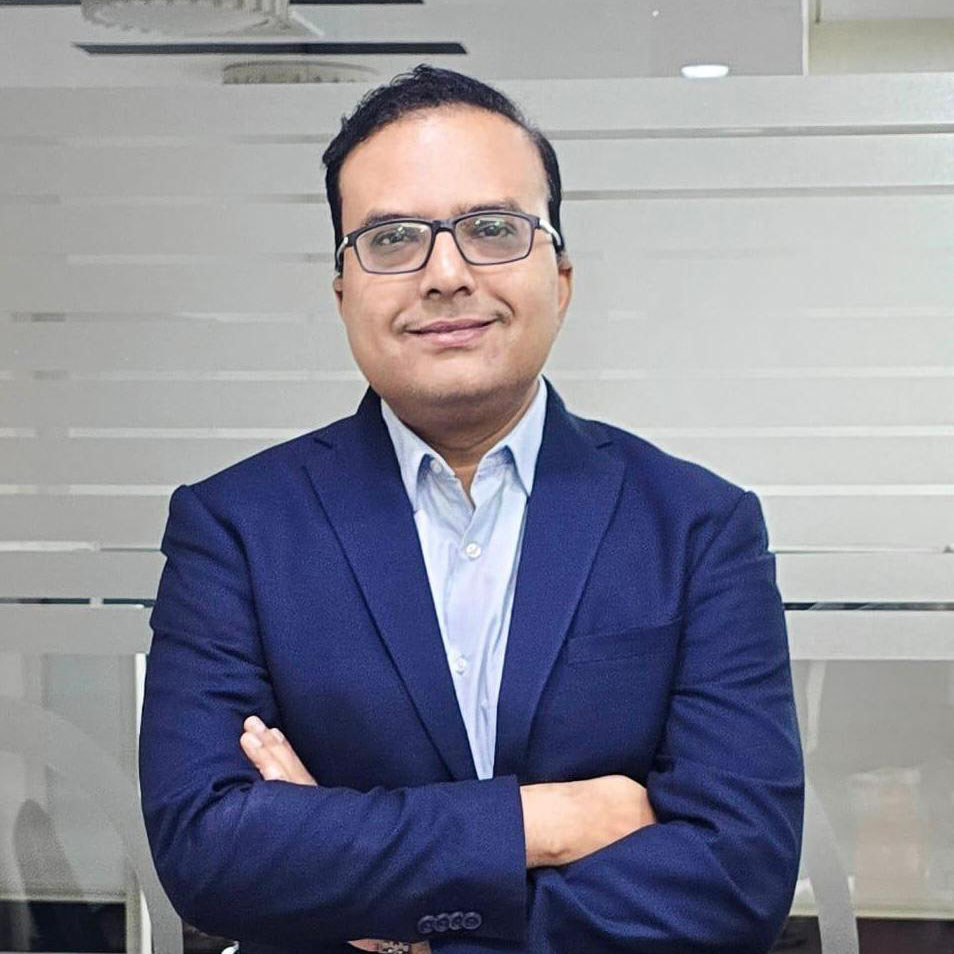
Prabhash Choudhary is the CEO of Magistral Consulting. He is a Stanford Seed alumnus and mechanical engineer with 20 + years’ leadership at Fortune 500 firms- Accenture Strategy, Deloitte, News Corp, and S&P Global. At Magistral Consulting, he directs global operations and has delivered over $3.5 billion in client impact across finance, research, analytics, and outsourcing. His expertise spans management consulting, investment and strategic research, and operational excellence for 1,200 + clients worldwide

FAQs

What is outsourced investment research?

Outsourced investment research refers to partnering with external specialists to conduct financial analysis, market studies, and investment due diligence instead of relying solely on in-house teams.

Why are asset managers adopting outsourced investment research?

Asset managers use outsourced investment research to access specialized expertise, scale coverage efficiently, reduce fixed costs, and improve decision speed in complex markets.

Does outsourced investment research reduce control over decisions?

No. Investment decisions remain with internal teams. External research supports analysis and insight generation while final judgments stay firmly in house.

Which asset classes benefit most from outsourced investment research?

Public equities, private markets, hedge funds, and multi-asset portfolios all benefit, although the scope and depth of outsourcing vary by strategy.

How does outsourced investment research support compliance?

External research providers help maintain documentation, independent analysis, and regulatory alignment, strengthening governance and audit readiness.


Market Research has evolved from a traditional survey-driven function into a strategic intelligence engine that informs investment, innovation, and operational efficiency. According to Deloitte’s 2024 Global Insights Report, over 70% of businesses that adopted advanced research analytics reported higher ROI from product launches and investment decisions. Across sectors, from financial services to real estate and technology, market research is now a data-powered compass guiding competitive positioning and future-readiness.

The Expanding Role of Market Research in Today’s Economy

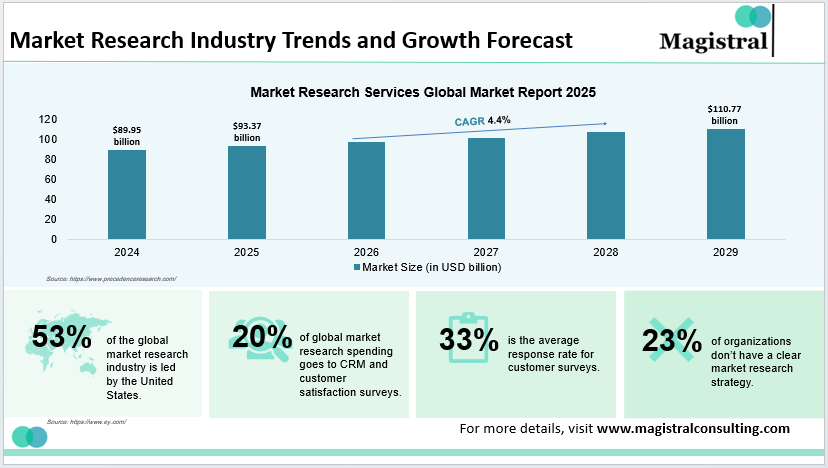
In a rapidly shifting global economy, market research has evolved from a background function to a cornerstone of strategic planning and competitive growth. Valued at USD 84.3 billion in 2024 and expected to exceed USD 138 billion by 2032 at a 6.3% CAGR, the industry reflects how deeply insights now shape business decisions. Organizations across sectors increasingly rely on advanced analytics, AI-driven modeling, and real-time data to understand changing consumer behavior, forecast market shifts, and identify emerging opportunities. Around 60% of global enterprises actively use market research to steer innovation and customer engagement strategies. As digital transformation accelerates, market research has become the bridge between data and decision helping businesses navigate volatility with evidence-based clarity and confidence.

Market Research Industry Trends and Growth Forecast

Market Research Industry Trends and Growth Forecast

Understanding Market Dynamics in Financial Services

In the financial world, market research identifies patterns in capital flows, emerging markets, and investor sentiment. PwC’s 2025 Financial Outlook projects that financial institutions leveraging continuous market intelligence outperform their peers by 15–20% in portfolio growth. This emphasizes why firms integrating advanced research with private equity and venture capital strategies remain resilient amid volatility.

The Integration of AI and Predictive Analytics

AI-driven market research tools now analyze billions of data points to forecast economic shifts. Platforms leveraging Natural Language Processing (NLP) detect sentiment from financial reports, media narratives, and investor communication. According to MSCI’s 2024 review, predictive analytics have improved market forecast accuracy by 30% across major institutions.

The Human-AI Synergy

Despite automation, human expertise remains irreplaceable. Analysts interpret nuances in geopolitical trends, consumer trust, and regulatory landscapes factors AI alone cannot fully quantify.

Beyond Finance: Cross-Industry Applications

From technology to real estate, market research underpins every major business decision. CBRE’s 2025 Real Estate Trends study revealed that organizations conducting quarterly market assessments saw 40% faster adaptation to demand shifts in commercial property valuations. This integration of real estate financial modeling ensures asset managers align capital deployment with market signals.

Case Study: Market Research in Tech & Consumer Sectors

In the technology sector, market research is guiding product innovation cycles. Gartner reports that firms applying real-time customer insights reduced product failure rates by 23%. Meanwhile, in consumer goods, market analytics influence pricing elasticity and regional expansion strategies, especially in emerging economies where data transparency is still evolving.

Market Research as a Competitive Advantage for Financial Institutions

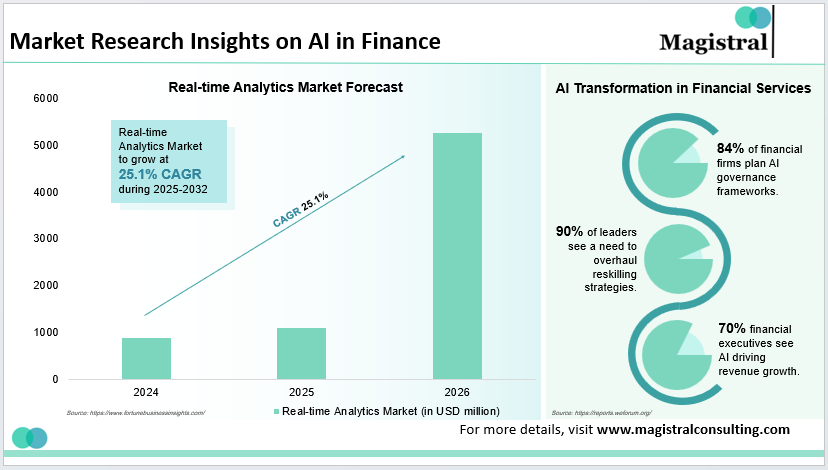
Market research has become a key competitive advantage for financial institutions, enabling data-driven decision-making in an increasingly dynamic market. With global spending on financial market data and research surpassing USD 44.3 billion in 2024, banks and investment firms are investing heavily in intelligence capabilities to stay ahead. Nearly 70% of financial executives believe that leveraging research-backed insights directly contributes to revenue growth, while 84% of firms are implementing AI governance frameworks to strengthen analytical accuracy and compliance. By integrating real-time analytics, behavioral insights, and customer sentiment tracking, financial institutions are using market research not just to understand market trends but to anticipate them — driving innovation, personalization, and sustained competitive differentiation.

Portfolio Optimization through Market Intelligence

Investors increasingly use research-backed models to anticipate asset class shifts. According to Precedence Research (2025), firms employing comprehensive market tracking reported a 12% increase in fund efficiency. This applies to both funds and investment banking operations where granular insights can forecast deal pipeline movements.

Identifying Investor Behavior Trends

Modern investors are informed and cautious. Market research now captures behavioral data from ESG preferences to digital trading patterns. This helps portfolio managers tailor outreach and capital allocation strategies aligned with ethical and sustainable investing frameworks.

Regulatory Insight and Compliance Tracking

Research isn’t limited to markets alone. Monitoring policy changes, central bank decisions, and geopolitical indicators gives firms a competitive edge. For instance, a study by EY in 2024 found that proactive research-driven compliance frameworks reduced operational risks by 17%.

Building Investor Confidence

Transparency, backed by credible research, strengthens investor relations. A well-researched fund prospectus or market update boosts trust, signaling due diligence and adaptability two pillars of sustainable financial management.

The Digital Revolution Transforming Market Research

The digital revolution is transforming the market research industry, driving a shift from traditional surveys to real-time, data-driven intelligence. Nearly 47% of researchers worldwide already use AI in their research processes, and 83% plan to invest further in AI technologies by 2025. The global digital transformation market that enables these advancements is expected to reach USD 2.1 trillion in 2025, growing at a 20% CAGR. This shift is accelerating the adoption of automation, real-time analytics, and cloud-based research tools, allowing financial institutions and other sectors to access faster, deeper, and more predictive insights that directly influence strategic decision-making.

Market Research Insights on AI in Finance

Market Research Insights on AI in Finance

Rise of Real-Time Intelligence Platforms

Modern platforms such as Qualtrics and Tableau now enable enterprises to monitor sentiment shifts within minutes. McKinsey’s 2025 digital adoption study noted that 68% of organizations using real-time intelligence outperformed competitors in market responsiveness.

The Role of Social Listening and Behavioral Analytics

Social media has become a goldmine for consumer sentiment. Financial institutions and consumer brands alike use behavioral analytics to anticipate market reactions to product launches, interest rate decisions, or economic policy changes.

Cloud and Data Democratization

Cloud computing democratizes access to high-quality data. Startups, mid-sized firms, and large corporations can now afford sophisticated analytics once reserved for large institutions. This scalability fuels innovation across industries.

Cross-Sector Collaboration in Research

Collaborative research ecosystems are emerging. Financial analysts, economists, and data scientists co-create insights that merge qualitative and quantitative perspectives enabling precision in decision-making.

How Magistral Consulting Supports Global Market Research Needs

Magistral Consulting has positioned itself as a strategic partner for firms seeking outsourced research capabilities that balance accuracy, efficiency, and cost-effectiveness. Leveraging its global analyst network, the firm delivers specialized research solutions across financial services, technology, and manufacturing sectors.

End-to-End Research Outsourcing

From data collection to insight synthesis, Magistral provides end-to-end solutions designed to enhance decision-making speed. This includes market sizing, competitive benchmarking, and deal support.

Financial and Investment Research

Through its investment banking and private equity support functions, the firm aids clients in opportunity mapping, investor profiling, and M&A intelligence essential tools in today’s competitive investment ecosystem.

Customized Data and Research Dashboards

Magistral integrates technology into research delivery. Interactive dashboards enable real-time updates, comparative market analytics, and cross-sector forecasting empowering decision-makers with accessible intelligence.

Global Expertise, Local Insights

With research coverage across North America, EMEA, and APAC, Magistral offers localized insight tailored to client geographies. This hybrid approach blends global trends with local market intricacies, ensuring strategic relevance.

The Future Outlook

The future of market research will be defined by automation, predictive modeling, and AI-driven insight synthesis. However, human judgment the ability to contextualize data will remain the differentiator. Firms that blend both will lead the next era of evidence-based strategy.

About Magistral Consulting

Magistral Consulting has helped multiple funds and companies in outsourcing operations activities. It has service offerings for Private Equity, Venture Capital, Family Offices, Investment Banks, Asset Managers, Hedge Funds, Financial Consultants, Real Estate, REITs, RE funds, Corporates, and Portfolio companies. Its functional expertise is around Deal origination, Deal Execution, Due Diligence, Financial Modelling, Portfolio Management, and Equity Research

For setting up an appointment with a Magistral representative visit www.magistralconsulting.com/contact

About the Author

Dhanita is a BD and Marketing professional with 6+ years’ experience in sales strategy, growth execution, and client acquisition; credentials include Stanford Seed (Stanford GSB), an MBA from USMS–GGSIPU, and a B.Com (Hons) from the University of Delhi. Expertise spans market research and opportunity mapping, sales strategy, CRM, brand positioning, integrated campaigns, content development, lead generation, and analytics; currently oversees business development calls and end-to-end marketing operations

FAQs

Can Magistral Consulting provide on-demand or project-based support?

Yes. Clients can choose between full-time dedicated analyst models or flexible, project-based engagements to meet short-term or specialized research needs.


How does Magistral Consulting ensure data confidentiality and quality?

We follow strict data security protocols, NDAs, and a multi-level quality assurance process to ensure the accuracy, reliability, and confidentiality of every client engagement.


How is Magistral’s market research aligned with digital transformation trends?

We integrate advanced analytics, AI-based data mining, and cloud-enabled platforms to deliver faster, scalable, and predictive research — making insights more agile and actionable.


How does Magistral Consulting assist clients with market research?

We deliver end-to-end market research solutions from industry analysis and market sizing to competitor benchmarking and customer insights tailored to investment and strategic decisions.