For investment firms, private equity houses, and corporate finance teams, financial modelling outsourcing has shifted from a basic cost-saving measure to a strategic advantage. The global financial modelling service market was valued at USD 2.5 billion in 2023 and is projected to reach USD 5.8 billion by 2032, with a CAGR of 9.7%. As deal complexity increases and internal resources become constrained, more companies are partnering with specialists to outsource model development rather than overextending in-house teams.
Thank you for reading this post, don't forget to subscribe!The Real Deal About Financial Modelling Outsourcing
Financial modelling outsourcing is broader than most firms initially expect. It encompasses the full spectrum of models that support investment decisions and strategic planning activities.
Three Statement and Cash Flow Models
The most fundamental deliverable in financial modelling outsourcing is the three-statement model. This model integrates the income statement, balance sheet, and cash flow statement into one cohesive framework. These models are typically developed and maintained by outsourced teams.
Valuation Models and Discounted Cash Flow
DCF modelling really needs technical precision mixed with some commercial judgement, not just one or the other. Discount rate assumptions, how the terminal value is handled, and the sensitivity tables are areas where financial modelling outsourcing teams typically lean on, so the valuations come out more accurate for the investment.
LBO and M&A Modelling
As financial modelling outsourcing becomes more complex, leveraged buyout and merger models are becoming more complex as well. They include the purchase price stuff, the capital stack, what equity is actually put in, the IRR-based analysis, and cash-on-cash multipliers, sort of everything that helps quantify potential returns and risks for both investors and sponsors in a deal.
Integration and Scenario Models
The modelling of consolidation eliminates the elimination of intercompany transactions for multi-entity companies. As such, the modelling provides one overall view of the financial results of a business. Additionally, scenario modelling is used together with consolidation modelling to stress test assumptions using bull, base and bear conditions, giving decision-makers a structured way to see their risk before committing capital.
FP&A & Forecasting Support
Outsourcing is a growing trend for FP&A – this was discovered in the FP&A Trends Survey 2024. Geography plays an important role in how FP&A maturity is allocated throughout the world. Right now, most of the structured FP&A maturity is sitting in North America 39% and in Europe, 34%, so yeah, not like everywhere else is keeping up, it kind of feels concentrated there.
Why Companies Prefer Financial Modelling Outsourcing over In-House Build
When companies turn to financial modelling outsourcing, they rarely do it just because it’s cheaper, more like there’s a bigger, less obvious perspective that factors in speed, quality, available capacity, and overall strategic attention.
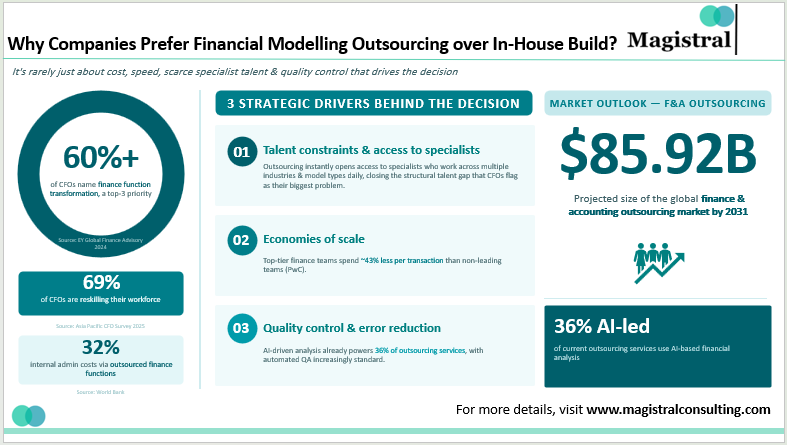
Why Companies Prefer Financial Modelling Outsourcing over In-House?
Talent constraints and access to specialists
The time and money needed to build a solid modelling team in-house can be quite heavy; yet, financial modelling outsourcing quickly gives clients access to specialists who work with different kinds of models across the various industries they touch, almost daily. The 2024 Global Financial Accounting Advisory Services report by EY found that more than 60% of CFO’s have named transforming the finance function as one of their top three priorities. However, they also point to a talent gap as their biggest problem.
Plus, the Asia Pacific CFO Survey 2025 reports that 69% of CFOs are focusing on reskilling their workforce to keep up with new technologies, so a more structural lack of people can be eased, or at least handled better, through outsourcing.
Economies of Scale
The World Bank says multinational companies can lower their internal admin costs by about 32% through outsourcing, especially when they use an outsourced financial management function. PwC’s Finance Benchmarking note that top-tier finance teams could spend about 43% less per transaction compared with non-leading finance teams; so outsourcing ends up being a really solid method for shutting those gaps down. The cost reasoning still holds even if the firm is small or big, or if they are anywhere location-wise, demonstrating how financial modelling outsourcing drives the global finance and accounting outsourcing market, expected to hit $85.92 billion by 2031.
Quality Control and Error Reduction
Outsourced financial modelling teams follow various pretty rigorous QA procedures, like logic checks, consistency checks and formula audits, to make sure that model errors don’t end up hurting valuations, or cause really bad investment decisions. AI-based financial analysis makes up 36% of current outsourcing services, and at the same time, automated QA layers are showing up more and more, as part of the usual delivery model.
How Technology Shaped Financial Modelling Outsourcing in 2025
Advances in technology have also really shifted the range and general quality of what financial modelling outsourcing teams can put on the table. Things like AI automation and cloud computing are changing how those teams actually package and deliver their work, kind of quietly, but at the same time in a big way.
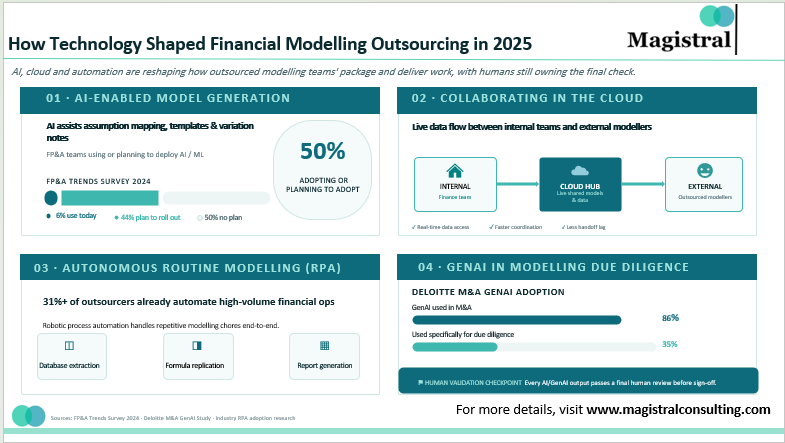
How Technology Shaped Financial Modelling Outsourcing in 2025
AI-Enabled Model Generation
AI tools are now helping with the early steps of financial modelling outsourcing services, for instance, assumption mapping, template filling, variation note drafting, and similar tasks. Per the FP&A Trends Survey 2024, 6% of FP&A teams currently use AI and machine learning, and 44% say they plan to roll out these technologies later on.
Collaborating in the Cloud
Using cloud-based software kind of lets outside outsourcing employees access live data coming from internal systems. The result is a smoother, faster kind of coordination, and it also removes some of the typical waiting time tied to more traditional outsourcing setups.
Autonomous Routine Modelling Tasks
Companies can further lean on robotic process automation, or RPA, to take on repetitive modelling chores. Think pulling information from databases, repeating formulas across a bunch of cells, and producing financial reports. According to research, more than 31% of outsourcing companies have already used RPA to automate high-volume financial operations.
GenAI in Modelling Due Diligence
As reported in Deloitte’s survey, 86% of corporate and private equity managers whose companies or organisations have already used AI in their M&A process say they are also already using GenAI for M&A related activities. From that group, 35% have stated that they used Gen AI during a specific slice of the deal process, namely due diligence. Of course, these workflows still rely on human validation as a final check, as the last layer of review before anything is considered settled.
How Magistral Consulting Helps with Financial Modelling Outsourcing
Magistral Consulting works alongside investment banks, corporate development groups, private equity investors and their advisors for financial modelling outsourcing across the entire transaction and planning life cycle, more or less.
They build and keep transactional models used for M&A deals, Leveraged Buyouts (LBOs), capital raising transactions, and asset purchase transactions. Depending on the client’s deal type, they also develop three statement models: Discounted Cash Flow (DCF) models, LBO, and Consolidation, tied to the client’s deal structure and investment strategy.
In their approach to financial modelling outsourcing services, Magistral pairs a structured delivery framework with real analytical deliverables. The target of the partnership is not just to deliver a model and stop there, but to make sure every outcome actually connects to a choice, a negotiation, or a strategy.
About Magistral Consulting
Magistral Consulting has helped multiple funds and companies in outsourcing operations activities. It has service offerings for Private Equity, Venture Capital, Family Offices, Investment Banks, Asset Managers, Hedge Funds, Financial Consultants, Real Estate, REITs, RE funds, Corporates, and Portfolio companies. Its functional expertise is around Deal origination, Deal Execution, Due Diligence, Financial Modelling, Portfolio Management, and Equity Research
For setting up an appointment with a Magistral representative visit www.magistralconsulting.com/contact
About the Author
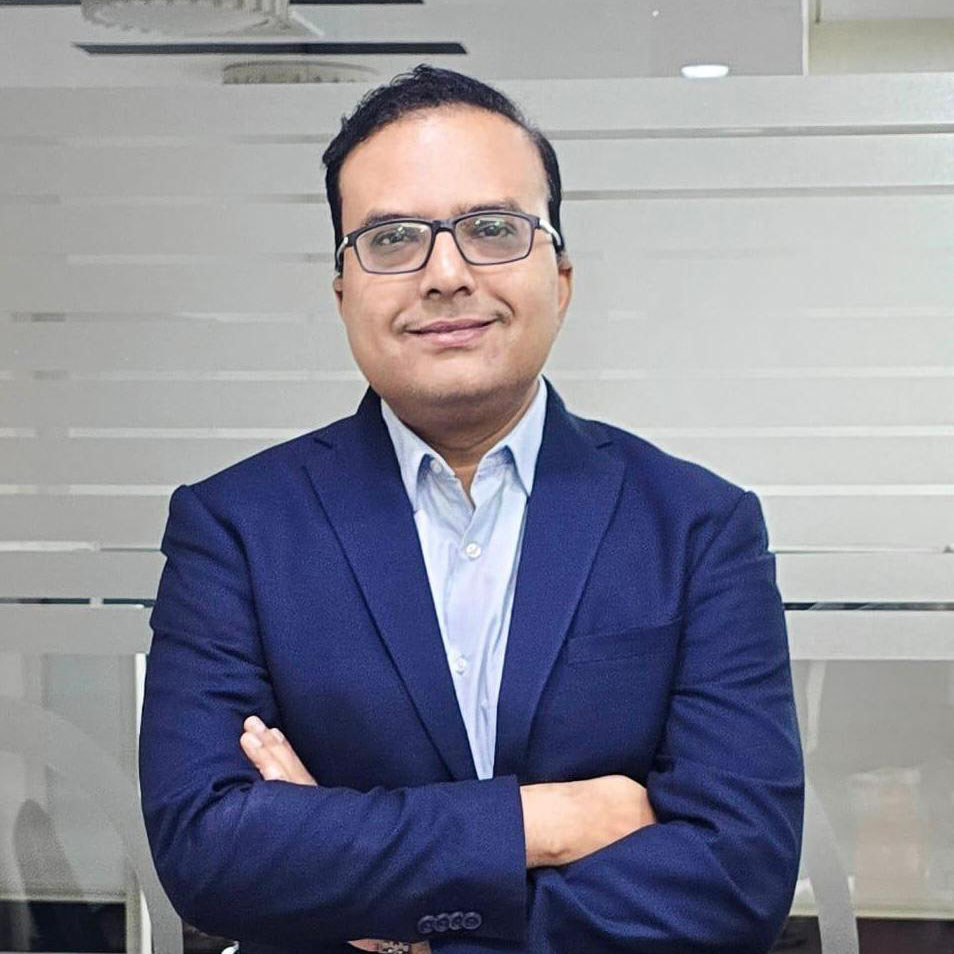
Prabhash Choudhary is the CEO of Magistral Consulting. He is a Stanford Seed alumnus and mechanical engineer with 20 + years’ leadership at Fortune 500 firms- Accenture Strategy, Deloitte, News Corp, and S&P Global. At Magistral Consulting, he directs global operations and has delivered over $3.5 billion in client impact across finance, research, analytics, and outsourcing. His expertise spans management consulting, investment and strategic research, and operational excellence for 1,200 + clients worldwide
FAQs
What types of models are usually included in financial modelling outsourcing?
What is the difference between financial modelling outsourcing and hiring an analyst full-time?
does a business ensure the quality of the outsourced financial models?
Does financial modelling outsourcing work for new and smaller fund managers?
What is the impact of Artificial Intelligence on the quality of outsourced financial models?