A carve out model converts an integrated business unit into a credible standalone financial story. Carve out model separates revenue, costs, assets, liabilities, cash flows, employees, systems, and shared services from the parent company while showing how the divested entity could operate after closing. This work has become increasingly important as corporations use divestitures to sharpen strategic focus, redeploy capital, and simplify operating structures. Deloitte’s 2026 Global Divestiture Survey says divestitures are now becoming intentional, strategy-led separations rather than opportunistic disposals; it also notes that 2025 divestiture volumes declined while deal values rose, pointing to fewer but larger and more deliberate transactions.
Thank you for reading this post, don't forget to subscribe!Carve Out Model Foundations and Financial Context
A carve out model must connect historical accounting records with the commercial reality of an independently operated business. It is not enough to extract a division’s reported profit and loss statement. Analysts must define the transaction perimeter, rebuild standalone economics, reconcile the results to the parent company, and create forecasts that buyers, lenders, auditors, and investment committees can test.
Defining the Deal Perimeter
The perimeter determines which legal entities, products, contracts, employees, customers, assets, liabilities, intellectual property, and geographies will transfer. This step should precede detailed modeling because even a small perimeter change can affect revenue, working capital, taxes, capital expenditure, and separation costs.
A strong perimeter schedule connects every financial line to an operational owner. For example, a manufacturing division may transfer its production assets but continue using the parent’s procurement platform under a transition service agreement. The carve out model must therefore distinguish between transferred resources, temporarily shared services, retained obligations, and capabilities that the buyer must recreate.
Reconstructing Historical Financial Statements
Financial statements prepared using the carve-out method are typically prepared from the books of the larger parent company rather than those of an independent company. As such, reconstruction of the historical income statement, balance sheet, and cash-flow statements requires the use of transaction-level details, management accounting information, legal entity information, and allocation methodology.
Direct revenues, cost of goods sold, people, inventories, receivables, and property, plant and equipment must be identified where possible. Common expenses such as finance, legal, human resources, insurance, technology, and facilities may need to be allocated using headcount, revenue, transaction volume, space, or use of the system as an allocation driver. Each allocation should be documented. Buyers will examine whether historical corporate allocations understate or overstate the resources required after separation.
Building Standalone Economics
Reported divisional EBITDA rarely equals sustainable standalone EBITDA. The model should bridge from historical earnings to normalized and fully separated performance:
Modeling RemainCo and Stranded Costs
It is also important for the seller to be aware of the situation in terms of finances in respect of the company remaining. Costs which were charged by the divested company do not simply go away following closing of the transaction. Some examples of costs that might remain with the parent include rent, software, corporation-wide employees, facilities, and vendor commitments.
The process should identify who is responsible for removing them, implementing them, or transferring them. EY emphasizes that RemainCo forecasting should incorporate transaction costs, stranded expenses, financing changes, and remediation initiatives. This work connects closely with due diligence, because financial assumptions must align with operating processes, contractual obligations, technology dependencies, and management capacity.
Forecasting and Valuation
The forecast should usually cover at least three to five years and reconcile historical performance with management’s commercial plan. Core drivers may include customer retention, pricing, volume, capacity, headcount, procurement savings, working-capital cycles, capital expenditure, and separation milestones. Scenario analysis should test delayed TSA exits, customer attrition, higher standalone costs, slower margin expansion, and additional technology investment. These scenarios help management distinguish value that exists today from value that depends on future execution.
The forecast then supports valuation through discounted cash flow analysis, public-company comparisons, precedent transactions, and leveraged-buyout returns. EY states that the deal model provides a basis for estimating DivestCo’s value, testing transaction structures, and supporting price negotiations.
Carve Out Model Applications and Use Cases
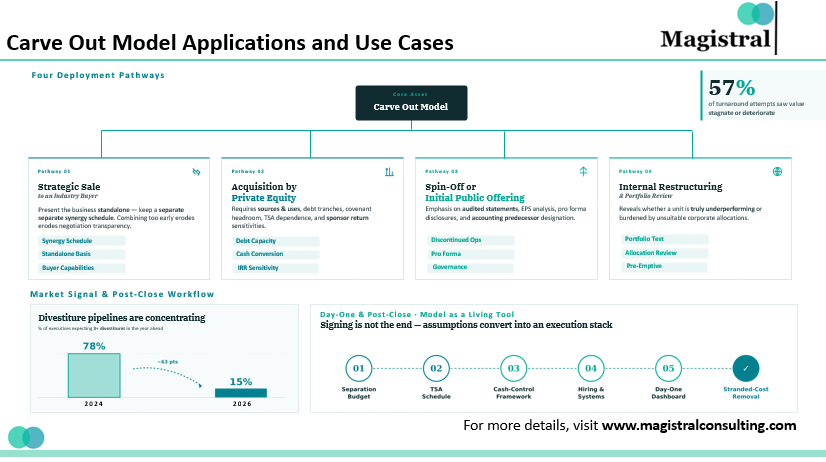
A carve out model serves different purposes depending on the transaction structure and intended buyer. The underlying financial logic remains consistent, but the level of audit support, operational detail, financing analysis, and disclosure changes across a strategic sale, sponsor acquisition, spin-off, or public listing.
Carve Out Model Applications and Use Cases
Strategic Sale to an Industry Buyer
A strategic acquirer may already possess finance, procurement, technology, distribution, or manufacturing capabilities. Its valuation could therefore include achievable synergies that are unavailable to a standalone owner.
The seller should present the business on an independent basis while maintaining a separate synergy schedule. Combining standalone and buyer-specific synergies too early can weaken transparency and create disputes during negotiations.
Acquisition by Private Equity
A private equity buyer typically examines debt capacity, cash conversion, management requirements, recurring capital expenditure, TSA dependence, and exit opportunities. The model should therefore include a sources-and-uses schedule, debt tranches, interest calculations, covenant headroom, mandatory repayments, and sponsor return sensitivities.
A sponsor will also test whether proposed cost reductions are achievable without the parent’s infrastructure. Clear separation between verified savings, management initiatives, and buyer-controlled upside makes the investment case more credible.
Deloitte’s 2026 research also signals a shift toward concentrated deal pipelines: only 15% of executives expected three or more divestitures, down from 78% in 2024, according to a public summary of the survey findings. For sponsors, that means competition may focus on fewer, higher-quality assets where a carve out model clearly proves standalone cash generation, separation funding, and value-creation upside.
Spin-Off or Initial Public Offering
A spin-off or IPO requires greater emphasis on audited financial statements, governance, public-company readiness, capital structure, earnings-per-share analysis, and regulatory disclosures. Management must also define which entity represents the accounting predecessor and how common-control reorganizations affect historical presentation.
Depending on transaction significance, the parent may need to report discontinued operations and submit pro forma information showing its position without the separated entity. These requirements depend on jurisdiction and transaction-specific circumstances, so companies should involve auditors, securities counsel, and accounting advisers early.
Internal Restructuring and Portfolio Review
Management can use separation analysis before deciding whether to sell. It can reveal whether a business is truly underperforming or simply burdened by unsuitable corporate allocations and operating constraints.
PwC’s 2025 portfolio strategy research found that only 39% of companies have a robust, data-driven portfolio-review process. The same PwC research found that 57% of executives who tried to turn around underperforming business units instead of selling them saw value stagnate or deteriorate. These findings support regular, data-led portfolio evaluation and early carve out model preparation rather than waiting for an unsolicited bid or financial crisis.
Day-One and Post-Close Planning
The financial model should remain active after signing. Management can convert its assumptions into a separation budget, TSA schedule, cash-control framework, hiring plan, system-migration roadmap, and Day-One dashboard.
This approach turns the model into a practical deal support tool. Actual spending, service exits, headcount transfers, and stranded-cost removal can be tracked against the transaction case rather than managed through disconnected spreadsheets.
Carve Out Model Market Trends and the Future
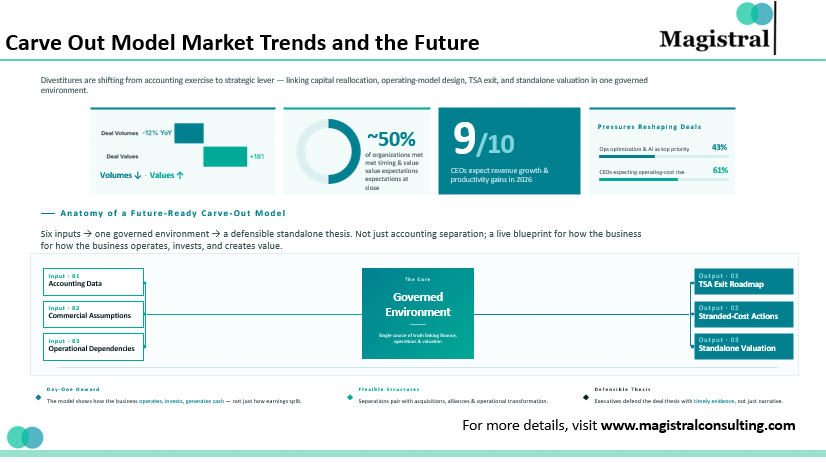
The carve out model will become more integrated with portfolio strategy, operational separation, and digital execution. Deloitte’s 2026 Global Divestiture Survey found that divestitures are entering 2026 as a more strategic lever for portfolio renewal, capital reallocation, and enterprise transformation. The survey notes that 2025 volumes declined while deal values rose, and Deloitte’s Ireland summary adds that only about half of organizations met timing and value expectations, with stranded costs eroding post-close performance.
Carve Out Model Market Trends and the Future
Transaction structures are also becoming more flexible as companies use separations alongside acquisitions, alliances, and operational transformation. EY’s January 2026 CEO Outlook press release, based on 1,200 CEOs across 21 countries, reported that nine in 10 CEOs expected revenue growth and productivity gains in 2026, even as 61% anticipated operating-cost increases. EY also reported that 43% of CEOs cited operational optimization and productivity, including AI and digitalization, as their top adaptation priority. Those pressures increase the need for a carve out model that can quantify both separation risk and transformation upside.
Future-ready models will connect accounting data, commercial assumptions, operational dependencies, TSA exits, stranded-cost actions, and valuation in one governed environment. The most useful models will not merely explain historical earnings. They will show how the separated business can operate, invest, generate cash, and create value from Day One onward.
Across 2026 planning cycles, the practical implication is clear: companies need a carve out model that is not limited to accounting separation. It should link portfolio strategy, capital allocation, operating-model design, technology readiness, TSA exit planning, and standalone valuation so executives can defend the deal thesis with timely evidence.
Magistral’s Services For Carve Out Model
Magistral Consulting supports carve out model transactions by extending its expertise in financial modeling, valuation, investment research, and transaction support. The team helps extract and reconcile financial data, build integrated standalone financial models, analyze separation and TSA costs, perform valuation and scenario analysis, and align model outputs with transaction documents such as teasers, information memoranda, management presentations, and data-room schedules. With a scalable offshore delivery model for carve out model, Magistral provides additional execution capacity during tight deal timelines, enabling clients and advisors to focus on strategic decision-making and negotiations.
About Magistral Consulting
Magistral Consulting has helped multiple funds and companies in outsourcing operations activities. It has service offerings for Private Equity, Venture Capital, Family Offices, Investment Banks, Asset Managers, Hedge Funds, Financial Consultants, Real Estate, REITs, RE funds, Corporates, and Portfolio companies. Its functional expertise is around Deal origination, Deal Execution, Due Diligence, Financial Modelling, Portfolio Management, and Equity Research
For setting up an appointment with a Magistral representative visit www.magistralconsulting.com/contact
About the Author

Aman is an investment-research specialist with 5+ years of experience across business and investment research, including 2+ years with Big Four firms like KPMG. A Stanford Seed alumnus with an MBA in Finance and a Bachelor of Commerce (Hons) from University of Delhi, he focuses on private equity, venture capital, and renewable energy sectors. He leads project teams at Magistral Consulting, delivering financial research, due diligence, deal sourcing, and M&A support, while driving strong process management and analytics. His blend of attention to detail, strategic thinking, and dynamic execution enables him to turn complex data into actionable investment insights.
FAQs
What is the main purpose of carve-out financial modeling?
How are shared corporate costs treated?
What is the difference between standalone and separation costs?
Why should RemainCo be modeled separately?
How early should modeling begin?