Tag Archives: Deal Analysis

Financial modeling outsourcing has rapidly evolved from a tactical cost decision into a strategic necessity for finance-driven organizations. In today’s environment, where capital is selective and market conditions shift quickly, businesses need models that are not only accurate but also adaptable to changing assumptions. Building such capabilities entirely in-house can be expensive and time-consuming, especially when demand for modeling fluctuates across deal cycles, fundraising rounds, or budgeting periods. As a result, companies are increasingly relying on external experts who bring specialized skills, sector experience, and the ability to deliver under tight timelines.

This shift aligns with broader industry trends. The global finance and accounting outsourcing market continues to expand significantly, reflecting how organizations prioritize efficiency, scalability, and access to expertise. At the same time, deal activity remains strong, particularly in private equity and corporate transactions, where decision-makers must evaluate multiple opportunities simultaneously. In such a high-pressure landscape, financial modeling outsourcing enables firms to quickly build, revise, and stress-test models without overburdening internal teams. Ultimately, it supports better decision-making by combining technical precision with speed, allowing organizations to respond confidently to both risks and opportunities.

Why Financial Modeling Outsourcing is Becoming Important

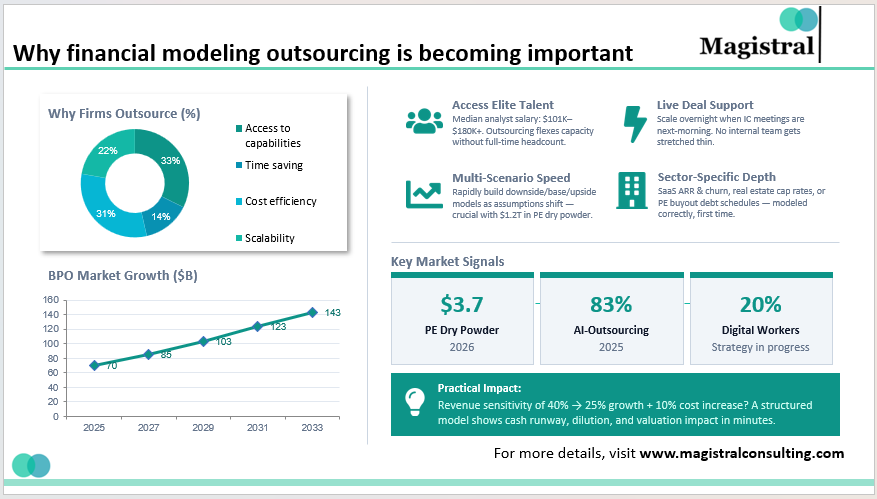
Financial modeling outsourcing helps organizations gain professional modeling skills without creating a whole department in-house. It proves beneficial when there are tight deadlines, changing assumptions, or the requirement of different scenarios by investors to secure funding. The total financial and accounting services BPO market in the world was about $70.19 billion in 2025, but will grow to $142.66 billion in 2033, reflecting the growing trend in terms of companies outsourcing their expert finances. However, deal-making is still going on, as revealed by Deloitte, whereby 79% of corporate executives and 87% of private equity executives projected a rise in deal volume in 2025. reference
Why financial modeling outsourcing is becoming important

Why financial modeling outsourcing is becoming important

Rising demand for specialist finance capacity

An efficient model requires accounting sense, business acumen, valuation knowledge, and formatting. To acquire such talent internally can prove costly. According to the United States Bureau of Labor Statistics, the median salary per year for financial and investment analysts stood at USD 101,350 as of May 2024, with the highest 10 percent receiving salaries beyond USD 180,550. Therefore, it becomes difficult for most emerging organizations to hire such talent internally.
This point holds true for private equity firms dealing with numerous acquisitions simultaneously. While one internal analyst can suffice, there will always be challenges when three acquisition models, two refinancing situations, and one exit model are concurrently underway.

Market volatility makes scenario work essential

Fluctuations in interest rates, inflation, cost pressures, and customer needs make a model from last quarter seem outdated. Bain said that there was around USD 1.2 trillion of buyout dry powder in 2025 globally, 25% of which was aged by at least four years. It imposes a need to invest money prudently, not carelessly.

Outsourcing is moving beyond cost saving

According to Deloitte, in 2024, 83% of executives used AI in their outsourced services, and 20% planned to develop strategies to cope with digital labor. Data suggests that financial modeling outsourcing now contributes to faster processing, analytics, and design of workflows, and is no longer about cheap labor costs.

How Financial Modeling Outsourcing Improves Decision Quality

The best financial modeling outsourcing provides decision-makers with clean data, reasonable assumptions, and clear results. An outsourcing partner should be more than a person who “builds Excel files.” The team should explain to its stakeholders how it generates value.

Better valuation discipline

Valuation relies on assumptions. Even a slight deviation in assumptions such as revenue growth, margin, working capital, and exit multiples can affect the enterprise value substantially. That is why investors commonly rely on DCF analysis, comparable company analysis, precedent transactions, and sensitivity tables

Faster support for live transactions

Deal teams are unlikely to have a perfect schedule. One day, a call with management might alter the revenue assumption. The next day, a deal committee will discuss a transaction. Financial modeling outsourcing helps organizations scale their support during busy periods without overstressing internal teams.

Stronger sector-specific models

Every business sector will have its own requirements for models. Models will require churn rates, growth rates, CAC paybacks, and assumptions about ARR for a software-as-a-service (SaaS) company. For real estate companies, models require lease accounting, rental increases, capitalization rate, debt structure, and exit strategy assumptions.

Best Practices for Financial Modeling Outsourcing

Financial modeling outsourcing requires clients to establish scope, access, review cycle, and quality criteria from the outset. Otherwise, the best model becomes unusable regardless of its technical quality.
Best Practices for Financial Modeling Outsourcing

Best Practices for Financial Modeling Outsourcing

Start with the decision, not the spreadsheet

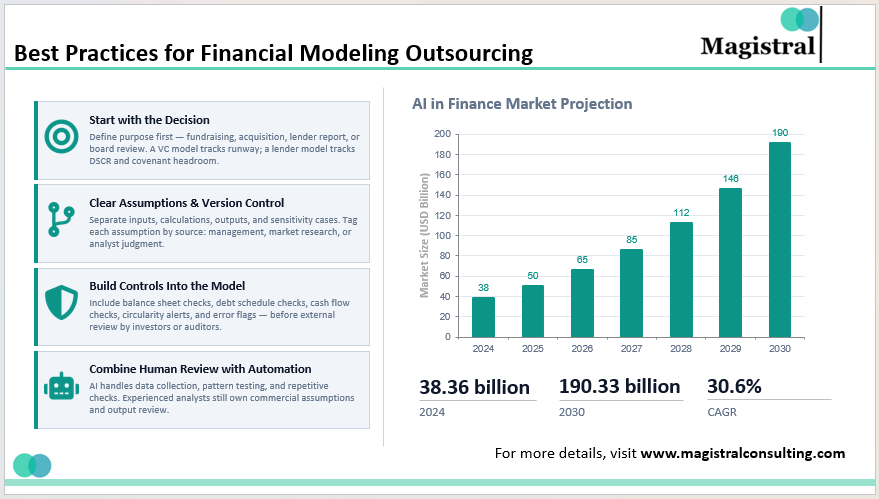
The client needs to state the purpose of the analysis before creating tabs in an Excel file. Is the model used for fundraising, acquisitions, lender presentations, budgeting, or board meetings? The venture capital model might focus on runway financing and milestones, whereas the lender model might center on debt servicing and covenants.

Use clear assumptions and version control

Any model must be constructed in such a way as to ensure a clear distinction between the model’s inputs, calculations, results, and sensitivity scenarios. Such an approach will simplify the review process for a team. In addition, it will allow the analyst to differentiate which assumptions were provided by management, research, or the analyst.

Build controls into the model

Any professional model must incorporate a balance sheet, a debt schedule, cash flows, circularity tests, and error flags. These elements protect decision makers from making errors. At the same time, they will help with external review when potential investors or lenders scrutinize the file.

Combine human review with automation

The use of AI in finance is increasing rapidly. As reported by Gartner, 58 percent of financial processes incorporated AI in 2024, as compared to 37 percent in 2023. However, the application of AI technology does not make business sense redundant. AI is used for data collection, analysis, and repeated testing, but the business analyst will ultimately interpret the premises and outcomes.

How Magistral Supports Financial Modeling Outsourcing

Financial modeling outsourcing is much more beneficial when there is an understanding of the investment process in addition to mathematical concepts. The Magistral firm assists investors, CFOs, lenders, startups, and corporate companies with financial modeling outsourcing, valuation, research, and deal support in various applications.

Custom financial model development

The Magistral team constructs three-statement models, operating models, valuation models, transaction models, LBO models, and scenario models. They help in acquisition processes, financing, internal planning, refinancing, and portfolio management.

Valuation and investment analysis

The Magistral team assists in valuation using DCF, comparables analysis, precedent transactions, sensitivity analysis, and return on investment analysis. This is useful for firms preparing to raise capital, and it aids in turning business models into investor-friendly calculations.

CFO and portfolio support

Most companies on a growth trajectory require financial expertise prior to the establishment of their own finance departments. The role of the outsourced CFO can be of great help in areas such as budgeting, forecasting, management information system reports, cash flow projection, and board meetings.

Scalable support for transaction teams

The international business process outsourcing market for business analytics is predicted to be worth USD 32.94 billion in 2025 and will increase to USD 82.35 billion in 2033. This is consistent with the contemporary nature of deal teams. While the workload fluctuates, there is an expectation of quality work. Financial modeling outsourcing allows businesses to deal with the variability in demand while achieving quality outputs.

About Magistral Consulting

Magistral Consulting has helped multiple funds and companies in outsourcing operations activities. It has service offerings for Private Equity, Venture Capital, Family Offices, Investment Banks, Asset Managers, Hedge Funds, Financial Consultants, Real Estate, REITs, RE funds, Corporates, and Portfolio companies. Its functional expertise is around Deal origination, Deal Execution, Due Diligence, Financial Modelling, Portfolio Management, and Equity Research

For setting up an appointment with a Magistral representative visit www.magistralconsulting.com/contact

About the Author

Nitin is a Partner and Co-Founder at Magistral Consulting. He is a Stanford Seed MBA (Marketing) and electronics engineer with 19 + years at S&P Global and Evalueserve, leading research, analytics, and inside‑sales teams. An investment‑ and financial‑research specialist, he has delivered due‑diligence, fund‑administration, and market‑entry projects for clients worldwide. He now shapes Magistral Consulting’s strategic direction, oversees global operations, and drives business‑development support.

FAQs

What is the main benefit of outsourcing financial models?

It gives firms access to specialized modeling skills, faster turnaround, and flexible capacity without hiring a full internal team.

Which companies use outsourced modeling support?

Private equity firms, venture capital funds, startups, investment banks, lenders, real estate investors, CFO offices, and corporates use it for deals, planning, and reporting.

How does outsourcing improve model accuracy?

It improves accuracy through structured assumptions, version control, formula checks, sensitivity testing, and review by experienced finance professionals.

Is outsourced modeling suitable for fundraising?

Yes. It helps companies prepare investor ready forecasts, valuation cases, runway analysis, and funding scenarios.

Can AI replace financial analysts in modeling?
No. AI can speed up data work and checks, but analysts still need to validate assumptions, understand business context, and explain results.

Outsourcing the preparation of Investment Committee (IC) memos is becoming increasingly popular among financial institutions, private equity firms, and venture capitalists. This practice ensures that decision-making processes are streamlined, efficient, and backed by comprehensive research. Outsourced IC Memo Preparation allows firms to focus on high-level strategic decisions while leaving the detailed, time-consuming tasks to external experts. This article explores the key benefits, processes, best practices, challenges, and future outlook for outsourcing IC memo preparation, ultimately helping organizations make informed, data-driven investment decisions.

Benefits of Outsourced IC Memo Preparation

Outsourced IC memo preparation provides several key advantages that can significantly enhance the efficiency and effectiveness of the decision-making process.

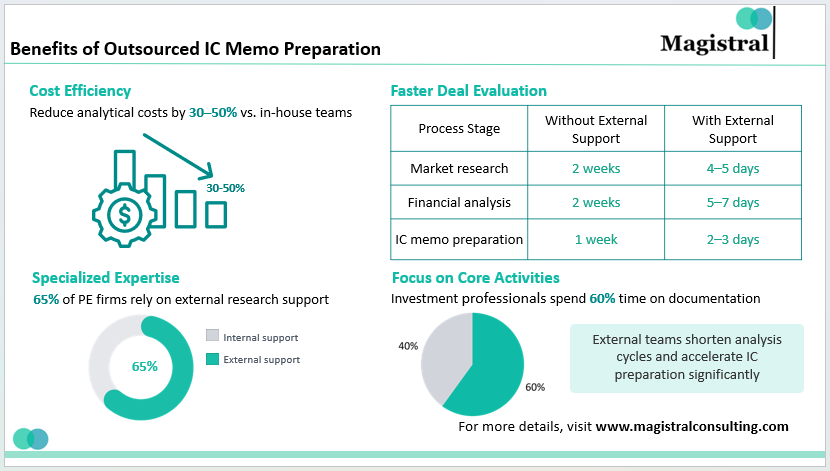
Benefits of Outsourced IC Memo Preparation

Benefits of Outsourced IC Memo Preparation

Cost Efficiency

One of the primary reasons companies outsource IC memo preparation is the potential cost savings. Through Outsourced IC Memo Preparation, firms avoid the need to hire full-time employees or allocate internal resources to memo creation. This allows firms to focus their budgets on core business operations, which is especially crucial for startups and mid-sized firms that need to optimize operational costs.

Expertise and Specialization

Outsourcing to specialized firms or consultants ensures that the IC memo is prepared by experts who understand the intricacies of investment analysis, market trends, and financial modeling. These professionals bring in-depth knowledge, ensuring that the memo is of the highest quality and meets all necessary standards. The external team is equipped with the latest research tools, industry data, and market trends, enabling them to provide cutting-edge insights.

Improved Efficiency

Outsourced IC memo preparation allows for faster turnaround times. External firms have established workflows and processes that streamline the preparation of IC memos. This can be especially beneficial when dealing with tight deadlines or high-pressure investment decisions, as outsourced partners can often manage multiple projects simultaneously without compromising quality. Many investment firms now rely on outsourcing IC Memo Preparation to maintain consistent documentation standards across transactions.

Focus on Core Activities

By outsourcing the preparation of IC memos, in-house teams can focus on higher-level strategic tasks such as investment analysis, portfolio management, and client relationship building, rather than spending time on detailed documentation. This delegation not only saves time but also allows internal teams to concentrate on revenue-generating activities, such as deal sourcing and investor relations. In this way, Outsourced IC Memo Preparation becomes a productivity multiplier for investment teams.

The Process of Outsourced IC Memo Preparation

Understanding the steps involved in outsourced IC memo preparation can help firms ensure that the process is efficient and meets their expectations.

Initial Consultation and Briefing

The outsourcing partner typically begins by meeting with the firm’s leadership or investment team to understand the scope of the investment decision, the key issues to be addressed, and any specific data or requirements for the memo. This is a crucial step as it ensures the external team aligns with the firm’s goals and objectives, avoiding the need for major revisions later. A structured kick-off meeting helps ensure Outsourced IC Memo Preparation aligns closely with the firm’s investment framework.

Research and Data Collection

The external team conducts thorough research, including market analysis, industry reports, financial models, and due diligence findings. This data forms the backbone of the IC memo, providing the necessary insights to support investment decisions. This phase often involves gathering proprietary data, competitor analysis, and macroeconomic trends, which are critical for making informed investment decisions within the process.

Memo Drafting

Based on the research findings, the outsourcing partner drafts the memo, following a structured format. The memo includes key sections such as the investment thesis, risk analysis, financial projections, and strategic fit. It’s essential that the memo is clear, concise, and data driven. Additionally, the memo should consider any regulatory or compliance requirements relevant to the investment.

Review and Feedback

Once the draft is complete, the memo is reviewed by the client’s internal team, who provides feedback or requests revisions. This iterative process ensures that the memo aligns with the firm’s investment strategy and decision-making framework. Feedback should be specific to avoid ambiguity, particularly regarding financial metrics and risk evaluation.

Finalization and Delivery

After addressing any revisions or feedback, the final version of the IC memo is prepared and delivered to the investment committee. The memo is designed to be ready for presentation, helping the committee make informed decisions quickly. Some firms may opt for a brief executive summary for quick consumption, with detailed appendices for deeper dives.

Key Considerations for Successful Outsourced IC Memo Preparation

When outsourcing IC memo preparation, there are several important considerations to ensure a successful partnership.

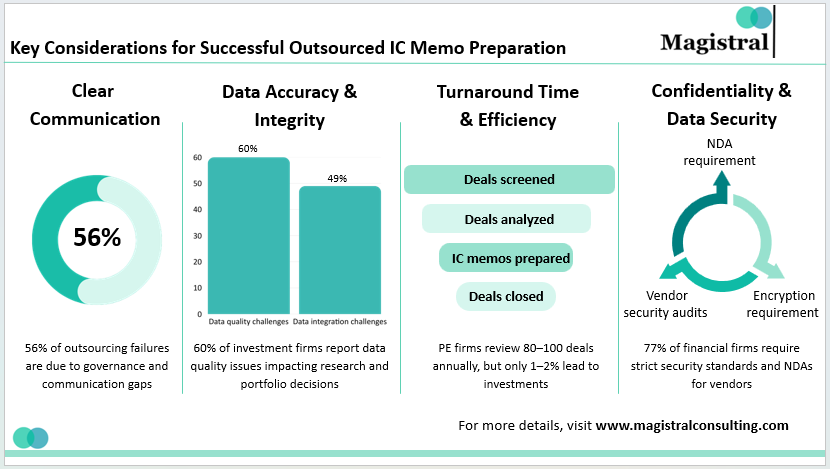
Key Considerations for Successful Outsourced IC Memo Preparation

Key Considerations for Successful Outsourced IC Memo Preparation

Clear Communication

It’s vital that there is a clear and open line of communication between the client firm and the outsourcing partner. Clear expectations and requirements should be established at the outset to avoid misunderstandings and ensure the memo aligns with the firm’s needs. This includes agreeing on data sources, formatting preferences, and key stakeholders in the review process.

Data Accuracy and Integrity

The accuracy of the data presented in the IC memo is critical. Firms should ensure that the outsourcing partner uses reliable, credible sources for market research and financial data. Any inconsistencies or inaccuracies could undermine the quality of the decision-making process. It’s essential that the external team cross-checks data, especially when drawing comparisons between similar investment opportunities.

Turnaround Time

The timeline for preparing the IC memo should be well-defined, with clear milestones and deadlines. Outsourcing partners should be capable of delivering high-quality work within the agreed timeframe to prevent delays in the decision-making process. Tight schedules can often be managed by outsourcing firms with robust project management systems in place.

Confidentiality and Security

Given the sensitive nature of investment decisions, firms must ensure that their outsourcing partner adheres to strict confidentiality and data security protocols. This protects both the firm’s strategic interests and any proprietary information. NDAs (Non-Disclosure Agreements) and data encryption should be a standard part of the contractual agreement with the outsourcing provider. Strong governance frameworks are particularly important in Outsourced IC Memo Preparation, where confidential deal information is frequently handled.

How Magistral Consulting Supports Outsourced IC Memo Preparation

Magistral Consulting offers comprehensive outsourced services for IC memo preparation, ensuring your investment decisions are backed by thorough analysis and professional insights.

Industry Expertise

With a deep understanding of various industries and investment landscapes, Magistral Consulting brings specialized knowledge to each memo, ensuring that all factors, including market trends and financial forecasts, are accurately represented through Outsourced IC Memo Preparation.

Data-Driven Approach

We leverage a range of credible sources, including reports from PwC, Deloitte, and other leading consultancies, to gather accurate and relevant data. This ensures that every memo we produce is not only well-written but also supported by the latest market research and industry insights.

Tailored Solutions

At Magistral Consulting, we understand that each investment decision is unique. Our team works closely with clients to customize each memo to meet their specific needs and objectives. Whether you are making a short-term investment or a long-term strategic decision, we ensure that the memo is tailored to your goals.

Timely Delivery

We pride ourselves on providing quick turnaround times without sacrificing quality. Our efficient processes and experienced team ensure that IC memos are delivered on time, every time.

End-to-End Support

From the initial briefing to final delivery, Magistral Consulting provides end-to-end support. We help clients make informed investment decisions with comprehensive, high-quality memos that meet all regulatory and strategic requirements through structured services.

About Magistral Consulting

Magistral Consulting has helped multiple funds and companies in outsourcing operations activities. It has service offerings for Private Equity, Venture Capital, Family Offices, Investment Banks, Asset Managers, Hedge Funds, Financial Consultants, Real Estate, REITs, RE funds, Corporates, and Portfolio companies. Its functional expertise is around Deal origination, Deal Execution, Due Diligence, Financial Modelling, Portfolio Management, and Equity Research

For setting up an appointment with a Magistral representative visit www.magistralconsulting.com/contact

About the Author

Tanya is an investment-research specialist with 6 + years advising venture-capital, private-equity and lending clients worldwide. A Stanford Seed alumnus with an MBA and an Economics (Hons) degree, she heads project teams at Magistral Consulting, delivering financial modelling, due-diligence and deal support on 3,000 + mandates. Her blend of rigorous analytics, sharp project management and clear client communication turns complex data into actionable investment insight.

FAQ’s

What is an IC memo?

An Investment Committee (IC) memo is a detailed document that outlines the key aspects of an investment opportunity, including the investment thesis, financial analysis, risk assessment, and strategic fit. It is presented to the investment committee to facilitate informed decision-making.

Why should firms outsource IC memo preparation?

Outsourcing IC memo preparation allows firms to save time and costs, gain access to expert analysis, and focus on higher-level strategic decisions. It also ensures the memo is data-driven and of the highest quality.

How long does it take to prepare an outsourced IC memo?

The preparation timeline depends on the complexity of the investment and the amount of research required. Typically, it can take anywhere from a few days to a couple of weeks for a comprehensive IC memo to be prepared and delivered.

What are the key components of an IC memo?

An IC memo typically includes an executive summary, investment thesis, market and industry analysis, financial projections, risk analysis, and a strategic fit assessment.