Tag Archives: investment analysis

Financial modeling outsourcing has rapidly evolved from a tactical cost decision into a strategic necessity for finance-driven organizations. In today’s environment, where capital is selective and market conditions shift quickly, businesses need models that are not only accurate but also adaptable to changing assumptions. Building such capabilities entirely in-house can be expensive and time-consuming, especially when demand for modeling fluctuates across deal cycles, fundraising rounds, or budgeting periods. As a result, companies are increasingly relying on external experts who bring specialized skills, sector experience, and the ability to deliver under tight timelines.

This shift aligns with broader industry trends. The global finance and accounting outsourcing market continues to expand significantly, reflecting how organizations prioritize efficiency, scalability, and access to expertise. At the same time, deal activity remains strong, particularly in private equity and corporate transactions, where decision-makers must evaluate multiple opportunities simultaneously. In such a high-pressure landscape, financial modeling outsourcing enables firms to quickly build, revise, and stress-test models without overburdening internal teams. Ultimately, it supports better decision-making by combining technical precision with speed, allowing organizations to respond confidently to both risks and opportunities.

Why Financial Modeling Outsourcing is Becoming Important

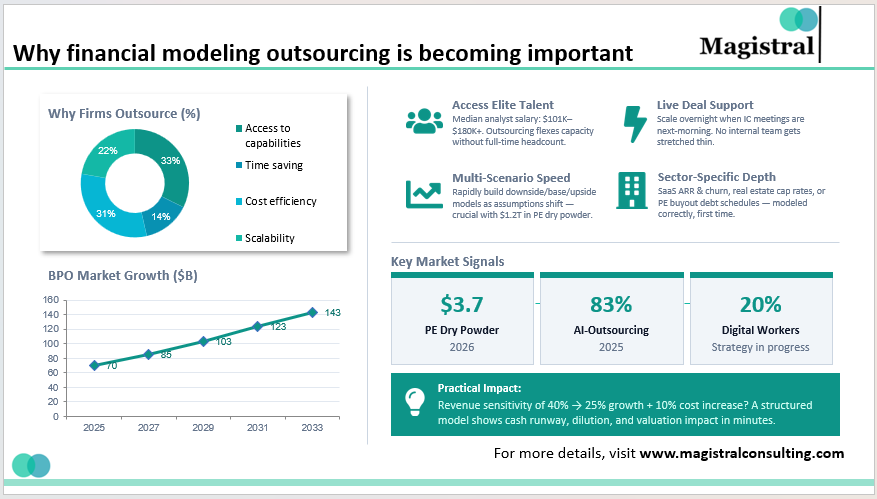
Financial modeling outsourcing helps organizations gain professional modeling skills without creating a whole department in-house. It proves beneficial when there are tight deadlines, changing assumptions, or the requirement of different scenarios by investors to secure funding. The total financial and accounting services BPO market in the world was about $70.19 billion in 2025, but will grow to $142.66 billion in 2033, reflecting the growing trend in terms of companies outsourcing their expert finances. However, deal-making is still going on, as revealed by Deloitte, whereby 79% of corporate executives and 87% of private equity executives projected a rise in deal volume in 2025. reference
Why financial modeling outsourcing is becoming important

Why financial modeling outsourcing is becoming important

Rising demand for specialist finance capacity

An efficient model requires accounting sense, business acumen, valuation knowledge, and formatting. To acquire such talent internally can prove costly. According to the United States Bureau of Labor Statistics, the median salary per year for financial and investment analysts stood at USD 101,350 as of May 2024, with the highest 10 percent receiving salaries beyond USD 180,550. Therefore, it becomes difficult for most emerging organizations to hire such talent internally.
This point holds true for private equity firms dealing with numerous acquisitions simultaneously. While one internal analyst can suffice, there will always be challenges when three acquisition models, two refinancing situations, and one exit model are concurrently underway.

Market volatility makes scenario work essential

Fluctuations in interest rates, inflation, cost pressures, and customer needs make a model from last quarter seem outdated. Bain said that there was around USD 1.2 trillion of buyout dry powder in 2025 globally, 25% of which was aged by at least four years. It imposes a need to invest money prudently, not carelessly.

Outsourcing is moving beyond cost saving

According to Deloitte, in 2024, 83% of executives used AI in their outsourced services, and 20% planned to develop strategies to cope with digital labor. Data suggests that financial modeling outsourcing now contributes to faster processing, analytics, and design of workflows, and is no longer about cheap labor costs.

How Financial Modeling Outsourcing Improves Decision Quality

The best financial modeling outsourcing provides decision-makers with clean data, reasonable assumptions, and clear results. An outsourcing partner should be more than a person who “builds Excel files.” The team should explain to its stakeholders how it generates value.

Better valuation discipline

Valuation relies on assumptions. Even a slight deviation in assumptions such as revenue growth, margin, working capital, and exit multiples can affect the enterprise value substantially. That is why investors commonly rely on DCF analysis, comparable company analysis, precedent transactions, and sensitivity tables

Faster support for live transactions

Deal teams are unlikely to have a perfect schedule. One day, a call with management might alter the revenue assumption. The next day, a deal committee will discuss a transaction. Financial modeling outsourcing helps organizations scale their support during busy periods without overstressing internal teams.

Stronger sector-specific models

Every business sector will have its own requirements for models. Models will require churn rates, growth rates, CAC paybacks, and assumptions about ARR for a software-as-a-service (SaaS) company. For real estate companies, models require lease accounting, rental increases, capitalization rate, debt structure, and exit strategy assumptions.

Best Practices for Financial Modeling Outsourcing

Financial modeling outsourcing requires clients to establish scope, access, review cycle, and quality criteria from the outset. Otherwise, the best model becomes unusable regardless of its technical quality.
Best Practices for Financial Modeling Outsourcing

Best Practices for Financial Modeling Outsourcing

Start with the decision, not the spreadsheet

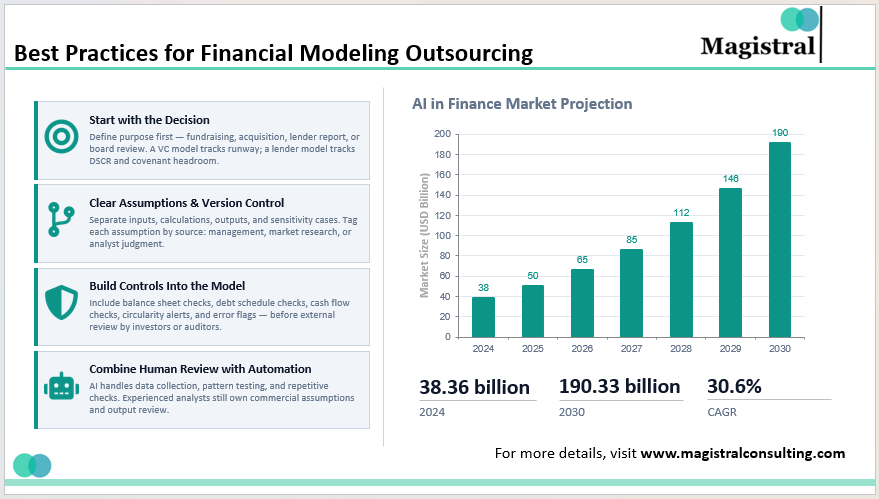
The client needs to state the purpose of the analysis before creating tabs in an Excel file. Is the model used for fundraising, acquisitions, lender presentations, budgeting, or board meetings? The venture capital model might focus on runway financing and milestones, whereas the lender model might center on debt servicing and covenants.

Use clear assumptions and version control

Any model must be constructed in such a way as to ensure a clear distinction between the model’s inputs, calculations, results, and sensitivity scenarios. Such an approach will simplify the review process for a team. In addition, it will allow the analyst to differentiate which assumptions were provided by management, research, or the analyst.

Build controls into the model

Any professional model must incorporate a balance sheet, a debt schedule, cash flows, circularity tests, and error flags. These elements protect decision makers from making errors. At the same time, they will help with external review when potential investors or lenders scrutinize the file.

Combine human review with automation

The use of AI in finance is increasing rapidly. As reported by Gartner, 58 percent of financial processes incorporated AI in 2024, as compared to 37 percent in 2023. However, the application of AI technology does not make business sense redundant. AI is used for data collection, analysis, and repeated testing, but the business analyst will ultimately interpret the premises and outcomes.

How Magistral Supports Financial Modeling Outsourcing

Financial modeling outsourcing is much more beneficial when there is an understanding of the investment process in addition to mathematical concepts. The Magistral firm assists investors, CFOs, lenders, startups, and corporate companies with financial modeling outsourcing, valuation, research, and deal support in various applications.

Custom financial model development

The Magistral team constructs three-statement models, operating models, valuation models, transaction models, LBO models, and scenario models. They help in acquisition processes, financing, internal planning, refinancing, and portfolio management.

Valuation and investment analysis

The Magistral team assists in valuation using DCF, comparables analysis, precedent transactions, sensitivity analysis, and return on investment analysis. This is useful for firms preparing to raise capital, and it aids in turning business models into investor-friendly calculations.

CFO and portfolio support

Most companies on a growth trajectory require financial expertise prior to the establishment of their own finance departments. The role of the outsourced CFO can be of great help in areas such as budgeting, forecasting, management information system reports, cash flow projection, and board meetings.

Scalable support for transaction teams

The international business process outsourcing market for business analytics is predicted to be worth USD 32.94 billion in 2025 and will increase to USD 82.35 billion in 2033. This is consistent with the contemporary nature of deal teams. While the workload fluctuates, there is an expectation of quality work. Financial modeling outsourcing allows businesses to deal with the variability in demand while achieving quality outputs.

About Magistral Consulting

Magistral Consulting has helped multiple funds and companies in outsourcing operations activities. It has service offerings for Private Equity, Venture Capital, Family Offices, Investment Banks, Asset Managers, Hedge Funds, Financial Consultants, Real Estate, REITs, RE funds, Corporates, and Portfolio companies. Its functional expertise is around Deal origination, Deal Execution, Due Diligence, Financial Modelling, Portfolio Management, and Equity Research

For setting up an appointment with a Magistral representative visit www.magistralconsulting.com/contact

About the Author

Nitin is a Partner and Co-Founder at Magistral Consulting. He is a Stanford Seed MBA (Marketing) and electronics engineer with 19 + years at S&P Global and Evalueserve, leading research, analytics, and inside‑sales teams. An investment‑ and financial‑research specialist, he has delivered due‑diligence, fund‑administration, and market‑entry projects for clients worldwide. He now shapes Magistral Consulting’s strategic direction, oversees global operations, and drives business‑development support.

FAQs

What is the main benefit of outsourcing financial models?

It gives firms access to specialized modeling skills, faster turnaround, and flexible capacity without hiring a full internal team.

Which companies use outsourced modeling support?

Private equity firms, venture capital funds, startups, investment banks, lenders, real estate investors, CFO offices, and corporates use it for deals, planning, and reporting.

How does outsourcing improve model accuracy?

It improves accuracy through structured assumptions, version control, formula checks, sensitivity testing, and review by experienced finance professionals.

Is outsourced modeling suitable for fundraising?

Yes. It helps companies prepare investor ready forecasts, valuation cases, runway analysis, and funding scenarios.

Can AI replace financial analysts in modeling?
No. AI can speed up data work and checks, but analysts still need to validate assumptions, understand business context, and explain results.

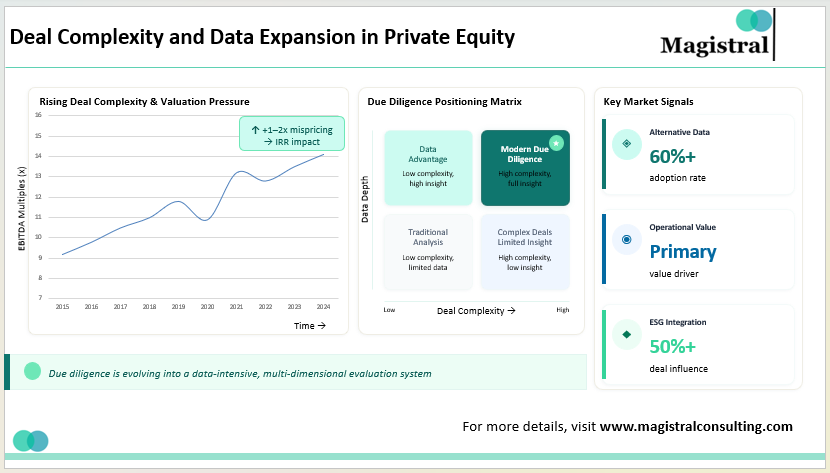
Due diligence for private equity is a dynamic process with the increase in the number of deals in the market, coupled with high valuation multiples. Bain & Company indicates that there is a huge dry powder of over $3.7 trillion available in the market for investment in private equity deals globally. This is a clear indication of high competition, with a small margin of error in the deals. McKinsey & Company indicates that the major reason for failed deals in the market is a result of a failure in commercial and operational due diligence, as opposed to a failure in financial due diligence.

The high valuation multiples in the market are a clear indication of high complexity in the deals, which in turn makes the process of due diligence a dynamic process, changing from a static process to a continuous analytical process. Deloitte indicates that over 70 percent of investment professionals use advanced analytics in the process of due diligence. This is an indicator that the process is changing with the complexity involved in deals.

Deal Complexity and Data Expansion in Private Equity

Due diligence is changing with the trends in the market. The trends are changing significantly, as is evident from the fact that the trends are quantifiable.

Deal Complexity and Data Expansion in Private Equity

Deal Complexity and Data Expansion in Private Equity

Rise in complexity involved in deals and valuation multiples

Valuation multiples continue to remain elevated. McKinsey & Company points out that EBITDA multiples in competitive sectors have grown significantly over the last decade. This increases the risk of overpaying for companies. A miscalculation in the multiple by 1-2x can have a substantial impact on the internal rate of returns (IRR). Hence, there is a need to carry out more validation in the due diligence process for private equity firms.

Expansion of alternative and unstructured data

The usage of alternative data has become mainstream. MSCI points out that more than 60% of institutional investors use alternative data sources, like web traffic, transaction data, and sentiment analysis, in their investment decision-making. This adds more scope to the due diligence process for private equity firms, who have to process unstructured data in addition to financial data.

Operational value creation as a primary driver

The focus has shifted to operational value creation rather than multiple expansion. PwC points out that operational initiatives account for a large portion of the value creation in private equity deals. Hence, operational due diligence has become an integral part of the due diligence process for private equity firms.

Increased emphasis on ESG and governance

Environmental, social, and governance concerns have become an essential part of investment decision-making. According to Deloitte, ESG concerns have an influence on over 50% of private equity investment decisions. This is another level of due diligence for private equity firms.

Designing Scalable Diligence Systems

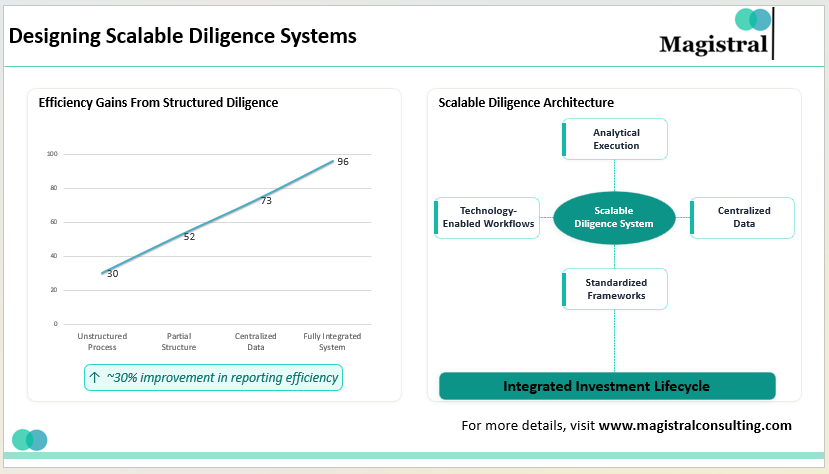
Due diligence helps a private equity firm create value if it is conducted based on a well-structured private equity operating model and framework. The private equity due diligence framework includes a clear sense of ownership and data centralization.

Designing Scalable Diligence Systems

Designing Scalable Diligence Systems

Separation of analytical execution and decision-making

Investment teams are involved in decision-making for due diligence for private equity. The analytical teams are involved in data aggregation and validation. Industry statistics have shown that investment teams are involved in diligence activities for about 50-60% of their total activities. Structured due diligence for private equity is about decision-making and investor engagement.

Centralized data infrastructure and single source of truth

Having a centralized data infrastructure helps private equity firms maintain consistency in all due diligence activities. According to McKinsey & Company, having a centralized data framework helps companies achieve a 30% improvement in reporting efficiencies.

Standardization of diligence frameworks

Standardizing templates in financial modelling, commercial analysis, and risk assessment ensures consistency in all due diligence outputs. This ensures consistency in due diligence.

Technology-enabled diligence workflows

Technology is becoming more integrated in due diligence processes in private equity deals. Virtual data rooms and AI-based analytics are becoming more popular in due diligence.

Integration with investment lifecycle

Due diligence is no longer limited to pre-investment activities in private equity deals. It is becoming more integrated in investment deals.

Linking Diligence Quality to Investment Outcomes

Due diligence in private equity has a significant impact on key performance indicators.

Deal selection accuracy improvement

Advanced analytics play a significant role in improving decision-making in due diligence deals. McKinsey & Company has reported a 20-30 percent improvement in investment decision accuracy using data-driven decision-making.

Risk detection improvement

A structured approach in due diligence ensures early risk detection in financial, commercial, and risk assessment dimensions. According to Deloitte, firms using advanced analytics can improve risk detection by more than 25 percent in volatile markets.

Acceleration of deal timelines

Speed is a key factor in differentiating in a competitive environment. Bain & Company emphasizes that delays in evaluation can cause a significant impact on the conversion of deals. Efficient due diligence can help in accelerating deal-making.

Impact on deal conversion rates

It has been observed that there are considerable drops in deal pipelines. Industry standards have shown that only 10% to 20% of the total opportunities can progress to advanced due diligence, and less than 5% of those can result in deals. Structured due diligence for private equity can help in improving the conversion of deals.

Improved post-investment performance

Accurate due diligence can help in improving the alignment of the investment thesis. This can further help in improving performance over time.

Due diligence for private equity on governance and control mechanisms

As due diligence for private equity is becoming more complex, there is a need for effective governance mechanisms to ensure consistency, accuracy, and compliance in all aspects of due diligence.

Data validation and quality control

Accurate data is the key to successful due diligence for private equity. Structured data validation can help in achieving consistency in financial models and reports, thus reducing errors in due diligence.

Regulatory compliance alignment

Private equity firms have operations in different countries, each with different regulations. Due diligence for private equity can help in achieving compliance.

Security and confidentiality controls

Accurate due diligence for private equity requires security of sensitive information. PwC has emphasized that data security is of prime concern for investment firms. It can help in achieving security.

Standardized review and approval workflows

Review mechanisms are also structured to ensure that all diligence outputs are up to internal standards before any investment decision is made.

Process discipline and cadence

Regular pipeline reviews, milestone tracking, and workflow help in avoiding inefficiencies in the deal-making process.

Due Diligence for Private Equity as a Scalable Competitive Advantage

Due diligence is becoming a scalable function rather than a deal-specific activity. Thus, firms that develop a structured due diligence function have a significant competitive advantage in terms of efficiency and performance.

As the environment for deals is becoming more competitive, due diligence addresses the need for information processing, risk identification, and execution efficiency. Thus, over time, due diligence has transformed from a deal-specific activity to a scalable function for the entire organization. This has helped in improving deal execution efficiency, conversion rates, and overall performance.

About Magistral Consulting

Magistral Consulting has helped multiple funds and companies in outsourcing operations activities. It has service offerings for Private Equity, Venture Capital, Family Offices, Investment Banks, Asset Managers, Hedge Funds, Financial Consultants, Real Estate, REITs, RE funds, Corporates, and Portfolio companies. Its functional expertise is around Deal origination, Deal Execution, Due Diligence, Financial Modelling, Portfolio Management, and Equity Research

For setting up an appointment with a Magistral representative visit www.magistralconsulting.com/contact

About the Author

Nitin is a Partner and Co-Founder at Magistral Consulting. He is a Stanford Seed MBA (Marketing) and electronics engineer with 19 + years at S&P Global and Evalueserve, leading research, analytics, and inside‑sales teams. An investment‑ and financial‑research specialist, he has delivered due‑diligence, fund‑administration, and market‑entry projects for clients worldwide. He now shapes Magistral Consulting’s strategic direction, oversees global operations, and drives business‑development support.

FAQs

What is due diligence for private equity?

It is a structured process of evaluating investment opportunities on financial, operational, and market levels.

Why is due diligence critical in private equity?

It is critical because it helps in improving accuracy in decisions, risk identification, and conversion of deals.

What has changed in due diligence in the context of private equity?

It has changed from being manual to becoming more data-driven due to the use of analytics, alternative data, and technology.

What are key metrics in due diligence?

The key metrics in due diligence in the context of private equity are revenue growth, margins, market size, efficiency, and risk exposure.

What can help in improving due diligence efficiency?

It can be achieved through data centralization, structured frameworks, and analytics.