Tag Archives: Investment Research Outsourcing Services

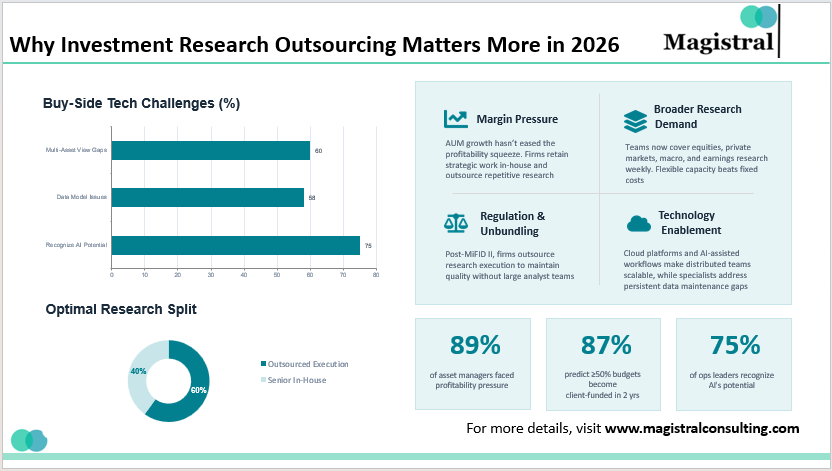
Today’s investment environment is faster, more volatile, and far more data-heavy than it was even a few years ago. In this backdrop, outsourced investment research has grown from being a cost-saving measure into a strategic advantage. Many asset managers now rely on external research teams to gain access to specialized skills, deeper analytics, and flexible capacity without expanding internal headcount.

This approach helps investment teams react more quickly to market shifts, maintain steady sector coverage, and bring added analytical depth to areas that need it the most. It also allows research bandwidth to expand or contract with deal flow, rather than staying limited by fixed internal resources. The result: sharper insights and more time for in-house teams to focus on high-value activities such as portfolio strategy and client engagement.

Outsourced Investment Research as a Strategic Response to Market Complexity

As markets become increasingly data-driven, outsourcing helps firms manage everything from alternative datasets to regulatory reporting. By delegating time-intensive analytical work, investment professionals can stay focused on decision-making and client relationships. Industry outlooks continue to highlight the role of technology, workflow optimization, and smart outsourcing in improving research efficiency and scalability.

Outsourced Investment Research in Complex Markets

Outsourced Investment Research in Complex Markets

Expanding Coverage Without Increasing Headcount

A major benefit of outsourced investment research is the ability to widen coverage quickly. External analysts help firms explore new sectors, geographies, or investment themes without needing to hire full-time staff. This flexibility becomes particularly valuable when deal flow becomes unpredictable, as often seen in private equity and growth investing.

Supporting Data‑Intensive Investment Models

Modern investment strategies rely heavily on robust financial models and scenario testing. External research teams bring specialization in valuation, forecasting, and comparative analysis, helping internal teams validate assumptions and ensure models remain aligned with current market benchmarks.

Enhancing Decision Speed and Accuracy

In competitive markets, speed matters. Dedicated external teams help maintain consistency and analytical rigor across research outputs especially when multiple investment committees depend on standardized reporting. This contributes to faster, better-informed decisions.

Aligning Research with Portfolio Strategy

It is most effective when aligned closely with portfolio strategy. Rather than acting as a standalone function, external analysts work as an extension of the investment team. Clear mandates, feedback loops, and performance metrics ensure that research outputs support broader goals such as alpha generation, risk management, or sector rotation. Over time, this alignment transforms outsourcing from a transactional service into a strategic partnership.

Outsourced Investment Research Across Asset Classes and Investment Styles

The role of outsourced investment research varies across asset classes, each with its own demands and processes. Understanding these differences ensures that outsourcing adds real value rather than unnecessary complexity.

Public Markets and Equity Strategies

In listed equities, outsourced teams typically assist with sector tracking, earnings monitoring, and thematic research. They help maintain ongoing coverage of fundamentals and macro trends, allowing portfolio managers to concentrate on high‑conviction decisions while retaining oversight of the final calls.

Private Markets and Illiquid Assets

Private markets require deeper due diligence and detailed analysis. External research teams support market studies, target company screening, competitive assessments, and benchmarking. Their work also enhances capital‑raising materials by providing well‑structured analysis for limited partners.

Hedge Funds and Alternative Strategies

Hedge funds often operate on tight timelines and require sophisticated analytical capabilities. Outsourced teams contribute through fast scenario assessments, factor analysis, and macro research that feeds directly into trading models. With the growing use of AI-enabled analytics, external support increasingly integrates into internal systems to strengthen signal generation and risk oversight.

Advisory Firms and Institutional Investors

For advisory firms and institutional investors, Outsourcing Investment Research ensures objectivity and breadth. Independent research reduces concentration risk and supports fiduciary responsibilities. Institutions managing large pools of capital often rely on external analysts to evaluate fund managers, assess strategy fit, and monitor performance trends over time. This approach improves governance while controlling internal workload.

The Economics Behind Outsourced Investment Research

While cost efficiency is a common driver, the value of outsourcing extends beyond reduced labour expenses. The ability to convert fixed costs into flexible ones while improving output quality has made outsourcing an essential tool for many investment organizations.

Outsourced Investment Research and the Economics of Efficiency

Outsourced Investment Research and the Economics of Efficiency

Converting Fixed Costs into Variable Costs

Maintaining a large internal research team involves ongoing investment in salaries, training, and specialized tools. Outsourcing allows firms to shift part of these expenses into variable costs that reflect actual activity levels, particularly useful during slow markets when internal teams may otherwise be underutilized.

Accessing Specialized Skills on Demand

Skills such as advanced valuation, sector-specific expertise, and alternative data analysis can be expensive to build internally. Outsourced investment research provides access to these capabilities when needed, without long-term commitments.

Improving Research Consistency and Documentation

High-quality outsourced teams usually work with well-structured templates, peer‑review processes, and documentation standards. This improves consistency, strengthens audit readiness, and helps firms maintain an organized research library, valuable for training and institutional memory.

Enhancing Return on Investment Decisions

In the end, how well outsourced investment research performs is determined by how it affects investment results. Businesses report more disciplined decision-making, better downside risk identification, and increased screening efficiency. By freeing internal teams from repetitive tasks, outsourcing allows senior professionals to focus on high-value activities such as strategy refinement and investor communication.

Outsourced Investment Research and Risk, Compliance, and Governance

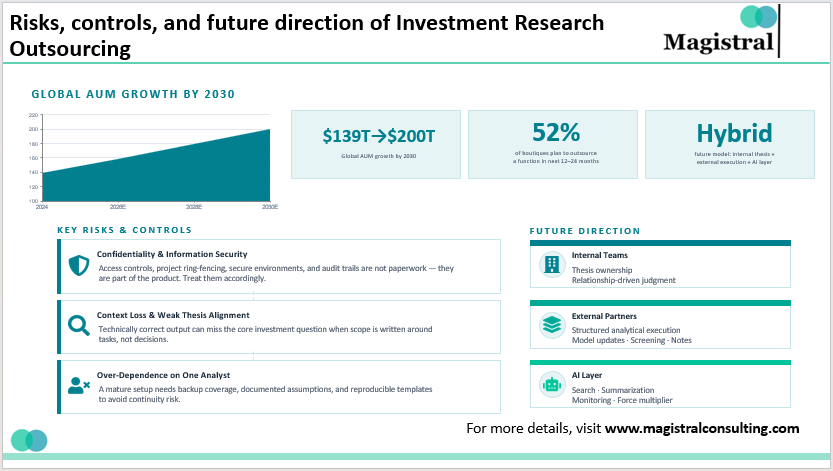
Risk management and compliance have become central to investment operations. It plays an increasingly important role in strengthening governance frameworks. Regulators and investors alike expect transparent processes and well-documented decision rationales.

Supporting Due Diligence and Risk Assessment

External research teams contribute significantly to due diligence by conducting independent market assessments and operational reviews. This independent perspective helps uncover blind spots and challenge internal assumptions. In transactions where operational due diligence is critical, outsourced research adds an additional layer of scrutiny that enhances confidence in final decisions.

Maintaining Regulatory Alignment

Regulatory requirements around disclosures, suitability, and reporting continue to evolve. Outsourced Investment Research providers often stay closely aligned with regulatory developments across jurisdictions. Their inputs help firms ensure that investment recommendations and reports meet compliance standards, reducing regulatory risk and reputational exposure.

Strengthening Investment Committee Processes

Investment committees rely on clear, balanced information. Outsourced research enhances committee discussions by providing standardized analysis and scenario comparisons. This consistency improves decision quality and reduces reliance on anecdotal evidence or individual biases.

Managing Conflicts and Ensuring Objectivity

Independent research support can help mitigate conflicts of interest, particularly in advisory and multi-asset environments. By separating analysis from execution, firms reinforce objectivity and strengthen trust with clients and stakeholders.

How Magistral Consulting Supports Investment Firms

As Outsourced Investment Research matures, firms increasingly look for partners who combine analytical depth with operational understanding. The goal is not just producing reports but embedding research into decision workflows.

Magistral Consulting supports investment firms by acting as an extension of their research and analytics teams. Its approach integrates financial analysis, market intelligence, and strategic insights tailored to specific investment mandates.

Magistral’s teams work closely with fund managers, investors, and advisory firms to deliver research that aligns with portfolio goals and risk frameworks. By supporting activities across screening, valuation, and ongoing monitoring, the firm enables clients to focus on strategy while maintaining analytical rigor.

This partnership model ensures that Outsourced Investment Research remains flexible, scalable, and outcome driven. As markets continue to evolve, firms that treat research outsourcing as a strategic capability rather than a back-office function are better positioned to navigate uncertainty and capture opportunity.


About Magistral Consulting

Magistral Consulting has helped multiple funds and companies in outsourcing operations activities. It has service offerings for Private Equity, Venture Capital, Family Offices, Investment Banks, Asset Managers, Hedge Funds, Financial Consultants, Real Estate, REITs, RE funds, Corporates, and Portfolio companies. Its functional expertise is around Deal origination, Deal Execution, Due Diligence, Financial Modelling, Portfolio Management, and Equity Research

For setting up an appointment with a Magistral representative visit www.magistralconsulting.com/contact

About the Author
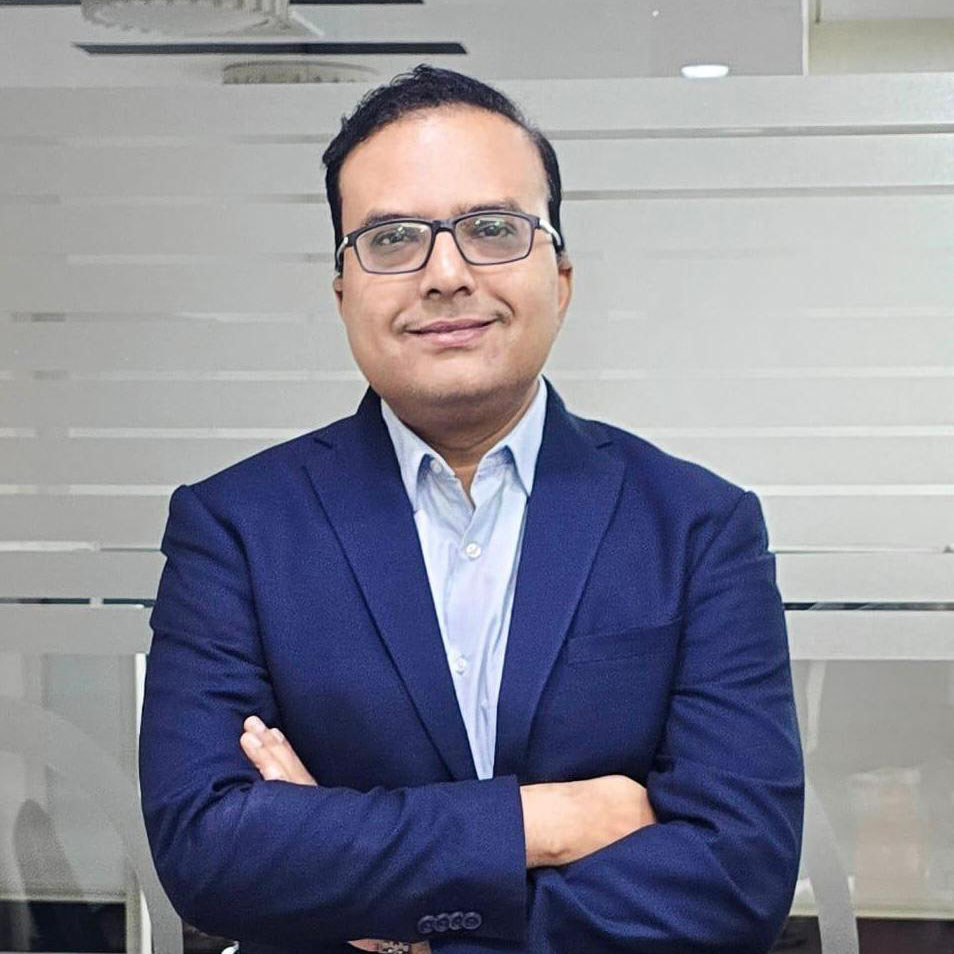
Prabhash Choudhary is the CEO of Magistral Consulting. He is a Stanford Seed alumnus and mechanical engineer with 20 + years’ leadership at Fortune 500 firms- Accenture Strategy, Deloitte, News Corp, and S&P Global. At Magistral Consulting, he directs global operations and has delivered over $3.5 billion in client impact across finance, research, analytics, and outsourcing. His expertise spans management consulting, investment and strategic research, and operational excellence for 1,200 + clients worldwide

FAQs

What is outsourced investment research?

Outsourced investment research refers to partnering with external specialists to conduct financial analysis, market studies, and investment due diligence instead of relying solely on in-house teams.

Why are asset managers adopting outsourced investment research?

Asset managers use outsourced investment research to access specialized expertise, scale coverage efficiently, reduce fixed costs, and improve decision speed in complex markets.

Does outsourced investment research reduce control over decisions?

No. Investment decisions remain with internal teams. External research supports analysis and insight generation while final judgments stay firmly in house.

Which asset classes benefit most from outsourced investment research?

Public equities, private markets, hedge funds, and multi-asset portfolios all benefit, although the scope and depth of outsourcing vary by strategy.

How does outsourced investment research support compliance?

External research providers help maintain documentation, independent analysis, and regulatory alignment, strengthening governance and audit readiness.


Global investment research plays a critical role in shaping financial strategies and decisions across the world’s capital markets. As global markets continue to grow and the economies of the world become more interconnected it has come to be that quite advanced and sophisticated global investment research techniques are needed by institutional investors, asset managers and hedge funds especially. Such investors rely on using developing techniques that involve macroeconomic analysis, sector knowledge as well as security-specific analysis in making investment decisions in very uncertain and dynamic markets.

Macroeconomic Dynamics and Geopolitical Influences

External environment and the risk factors can chiefly influence investment decisions.

COVID-19 Influence on Inflationary Trends

The COVID–19 outbreak significantly contributed to rising inflation all over the world and by the year 2020 inflation stood at 8.8% the highest in a couple of years. As a result of the inflationary pressures, the central banks resorted to very forceful monetary policies, with that of the US entering as high as 5.25%-5.50% rate in the year 2023.

For Emerging Markets

Rising inflation and the changes in policies led to a great deal of capital flight from emerging markets. This situation has resulted in depreciating currencies, recession, and low growth rates in the respective areas.

Disruption in Trade Activities

Lockdowns imposed on the outbreak of the pandemic disrupted trade activities greatly, revealing the extent of global business operations. Close to these trade wars are causes like the one between America and China which also affect investment decisions among other issues in sectors like technology, energy, and agriculture that face tariffs that threaten business.

Rationale of Continuous Tracking

The members of the global investment research teams should also ensure that they monitor current economic developments, as well as changes in the relevant policy environment towards the future. It is necessary to know how geo-political factors impact in order to devise investment plans that would succeed.

Sector-Specific Research Identifying Trends and Opportunities

There are various trends in opportunities with regards to the different sectors. Some of them are:

Trends and Opportunities in Global Investment Research

Trends and Opportunities in Global Investment Research

Renewable Energy

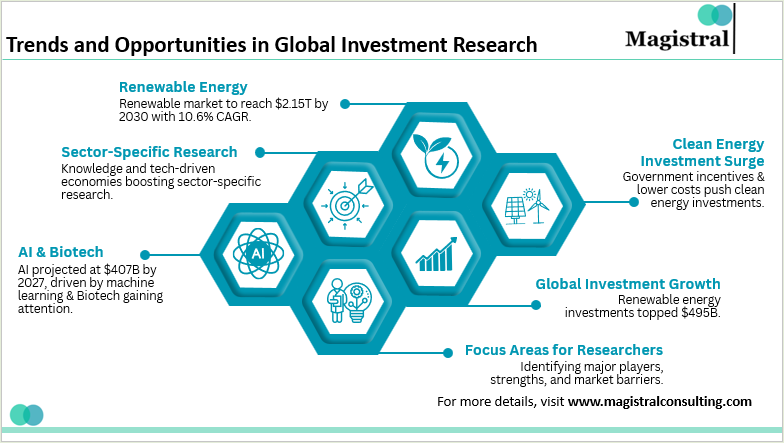
In addition to the above, the renewable energy market is forecasted to grow in value to 2.15 trillion dollars by the year 2030 with the compound annual growth rate (CAGR) being 10.6%. This area has thus become a principal area of focus for a study on the trends of investments due to the changes towards the use of energy in a more sustainable manner.

Emerging Sectors AI & Biotech

Artificial Intelligence and Biotechnology are making their way towards convergence owing to the technology in these fields. The value of the AI industry can reach $407 billion by 2017, given the advances in machine learning and intelligence of various systems.

Investment In Clean Energy on The Rise

In reaction to these changes in perspectives, several nations have been providing crucial government returns on investment and the corresponding infrastructure costs for solar and wind, which has led to the clean energy drive seeing huge funding. In the year 2022 alone, the amount of money spent on clean energy projects out of all investments reached over 495 billion dollars, which indicates that investors have very positive expectations concerning this business.

Global Investment Growth

Increased investments in renewable energy, artificial intelligence, and biotechnology, among other levels, further affirm the global growth in investments. There has been a trend whereby technology and sustainability are driving most of the growth in such sectors.

Areas of Focus for Researchers

In the case of growing industries, global investment research teams are looking at the emerging industries, looking for the key players, their power and the barriers in the respective markets. This in turn puts most equities on an attractive investment climate for those who are concerned.

Quantitative Models and Advanced Data Analytics

Today quantitative analysis and applied big data science in global investment research are essential components of any investment research. In this respect, financial institutions have greatly utilized market models to assess future market performance. The global alternative data trends market in the financial services industry is expected to grow at a CAGR of 50.6% between 2024 and 2030. This is because of technological breakthroughs in machine learning and artificial intelligence.

Hedge funds have always been at the cutting edge as far as the development of sophisticated algorithms to engage in systematic trading optimally and more recently in high-frequency trading (HFT) which takes advantage of arbitrage opportunities. These funds apply sophisticated models to analyze huge amounts of data. This includes but not limited to historical prices of stocks, earnings data, and even social network sentiment. Studies on the subject have found that firms employing AI-based trading strategies outperform traditional strategies by about 25%.

The Role of Alternative Data in Decision-Making

Global investment research has experienced a shift with the incorporation of alternative data within its pyramid structure. Information obtained from various sources including satellite, web browsing, and geographical information gives current updates. This enables better decision-making for global investment research. The worldwide market for alternative data is predicted to expand at a CAGR of 52.1% between 2023 and 2030. This is because these insights assist investors in developing strategies.

For example, satellite images have enabled the modeling of dicot yield in regions. Thus, giving an alert when potential threats to food security arise. It can also extend to analyzing the social media sentiment towards the target brands or sectors to explain investor confidence.

The Future of Global Investment Research

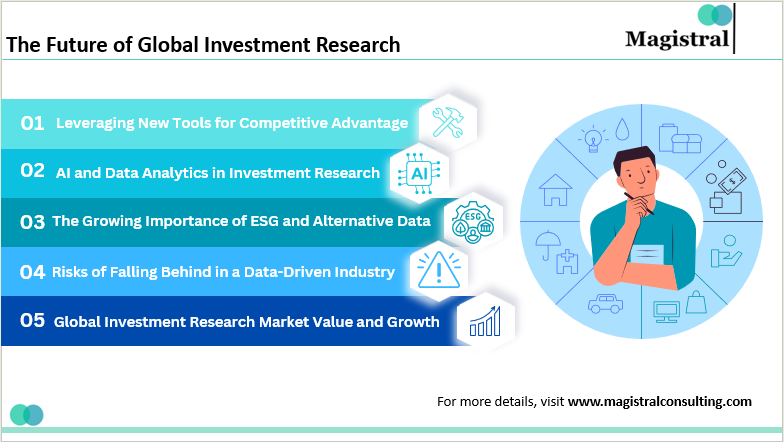
The future of global investment research is undergoing a significant transformation. This is driven by technological advancements and evolving market dynamics in every sector.

The Future of Global Investment Research

The Future of Global Investment Research

Technological Advancements Shaping Research

AI will transform capabilities in research, especially in the speed of making resultant decisions. Advanced Data Analytics tools will go beyond and widen the research undertaken enhancing the precision and insight obtained.

Introduction of ESG and Other Data

Environmental, Social and Governance (ESG) factors will increasingly influence the investment decision-making process. The use of alternative data will be part of the analysis process to enhance the existing traditional methods.

Market Development and Projection

The Market is forecasted to Reach In the year 2024. The size of the global investment research market is estimated to be worth $19.4 billion. Estimation of Future Business Performance Forecasted to have a Compound Annual Growth Rate (CAGR) of 6.2% in the proceeding five years.

Factors for the Successful Future of Investment Management Companies

Agencies which successfully employ sophisticated technologies with updated tools and methods, will be in a position to tackle the challenges of the world. In an information industry where information is time it is hard to survive for firms that remain in stagnation.

Magistral’s Services for Global Investment Research


Magistral Consulting provides a complete range of global investment research services intended to facilitate value-added investment decision-making throughout the investment process. Our research capabilities are ranked by sectors, markets, and geography so that those investment firms that count on us will always have the right insights for their investment strategies. Below you can find some of our services for global investment research

Industry Research

Magistral’s thorough Industry Research supports global investment research. We enable firms to gain deep insights into industry movements, market features, and competitive environments. We evaluate the drivers of growth, regulatory changes, new technologies, and general economies to deliver market-ready solutions. Be it finding the right market or going into the depths of the sector. Our industry research surfacing threats and opportunities for investments allows providing all with statistics-centered choices in foresight of practice.

Company Profiling and Competitive Landscaping

Our Company Profiling and Competitive Landscaping services include an in-depth understanding of a company and its place in a given industry. Magistral, for instance, assesses the financial status of target companies, their operational effectiveness, market presence, and strategic movements in comparison with other participants.

Preparing Investment Memos

For global investment research, we also assist in preparing investment memos. More specifically in composing Memos where relevant information is compiled, analyzed, and presented clearly and concisely. Such documents include industry analysis, company business and financial plans, investment risk levels, and other more relevant information. This gives investors an awareness of the opportunities in the investment.

Research Incoming Pipeline

Magistral also assists investment firms in enhancing their deal flow through the Research Incoming Pipeline. We examine and screen potential investment opportunities according to a set of criteria such as business financial strength, market share, growth capacity, risks, and others, by our professional team.


About Magistral Consulting

Magistral Consulting has helped multiple funds and companies in outsourcing operations activities. It has service offerings for Private Equity, Venture Capital, Family Offices, Investment Banks, Asset Managers, Hedge Funds, Financial Consultants, Real Estate, REITs, RE funds, Corporates, and Portfolio companies. Its functional expertise is around Deal origination, Deal Execution, Due Diligence, Financial Modelling, Portfolio Management, and Equity Research

For setting up an appointment with a Magistral representative visit www.magistralconsulting.com/contact

About the Author

The article is authored by the Marketing Department of Magistral Consulting. For any business inquiries, you can reach out to prabhash.choudhary@magistralconsulting.com

Alternative data refers to non-traditional data sources like satellite imagery, social media sentiment, and web analytics. This data provides real-time insights that traditional data may not capture, allowing investors to better assess consumer behavior, supply chain risks, and environmental factors, leading to more informed investment decisions.

Regulatory frameworks, such as MiFID II in the EU, have changed how investment research is consumed and paid for. Additionally, regulations in emerging markets like China and India are continually evolving, affecting capital flows, taxation, and corporate governance. Research teams must stay updated on regulatory changes to ensure compliance and mitigate risks.

The future of investment research lies in the growing integration of artificial intelligence, big data analytics, ESG considerations, and alternative data sources. Investment firms that adopt these technologies and approaches will be better positioned to manage the increasing complexities of global markets and stay competitive.

Investment Research Outsourcing

Multiple Investment Services firms like Investment Banks, Private Equity, Venture Capital, Hedge Funds, Family Offices, and Asset Management firms are looking to outsource investment research in the post-Covid 19 pandemic era. The article describes the concept of Investment Research and the ways to go about outsourcing the process.

What is Investment Research? Investment Research Definition

Investment Research and Analysis or Investment Analytics combines multiple activities related to investments in Equity of companies (both public and private) and other financial instruments.

The major activities related to securities research are equity research, Fixed Income and Credit Research, Index and Quantitative Research, and Macroeconomic Research.

Another important aspect of Investment research is the support services towards Corporate Finance and Valuations. It includes activities like Investment banking support, Valuation support, business information services, and Private Equity and Venture Capital support.

Investment research also comprise of data governance-related activities like outsourced CFO.

Is Outsourcing a Good Idea?

Investment Research Outsourcing is fast catching up. Here are the trends that are leading to expending the concept of Investment Research Outsourcing

The pressure to lower costs: Investment Banking is not what it used to be. The digital world has shrunk the opportunities to make big dollars brokering big deals or IPOs. This has also led to pressure on costs. This leads to outsourcing non-critical jobs to low-cost countries like India.

Diversification on investment types: An Investment manager has way too many asset classes to handle today. It’s not only limited to public equity but now has diversified into private equity, real estate, cryptocurrencies, commodities, REITs, Index-linked instruments, and many other asset classes. If the investment team is small, it’s difficult to have a combination of skillsets to provide a holistic solution to their clients. As outsourcing vendors understand Investment Research dynamics well, Outsourcing helps in bridging the skill gap. Outsourcing vendors also have access to multiple investment research tools.

Information Sources and Databases: With the proliferation in investment type, also gone up is the requirement of multiple databases for varied data points. It’s a costly affair to maintain access to multiple databases in-house. Investment research tools are also used to fine-tune the data and information.

Confidentiality: There is pressure to keep all information confidential. An outsourced team doing due diligence is perfect, as it leaves no trace of who the client maybe, that is doing the due diligence. An analyst can talk to potential target with or without introducing the client.

Quality: Outsourced players have better quality than the in-house team. The outsourced team typically is bigger and has done similar tasks multiple times before. In the process, they usually create an information bank or templates that are ready to use. They also sit on the hoard of best practices for multiple situations. If the outsourced player has its knowledge process well documented, they are in a better position to offer work quality.

Effective Supervision: When internal teams are working on an analytical project, it’s difficult for a partner to take time out to get into the details of data, information, and analytics therein. But with an experienced outsourcing player, there are multiple levels of supervision, governance structures, and quality control processes to establish an error-free work every time.

Variable Costs: Firms can modify the outsourcing agreement to pay based on hours consumed or per assignment outsourced, rather than hiring a full-time virtual investment analysis. This brings immense flexibility in terms of costs. An investment firm can hire only for the assignment and then go back to the original structure, once the job is done. This is very useful for smaller investment teams and firms with partners only, who need an on-demand investment research analyst. An investment research team can come together ad-hoc and then could be dismantled when the job is done.

What jobs can be performed with Outsourced Investment Research?
Outsourced Investment Research Activities

There are multiple elements of the Investment Research Process, that could be potentially outsourced:

Equity Research: Equity Research is the most voluminous work as Investment Banks usually outsource quantitative investment research. Equity research teams typically conduct fundamental analysis on a set of regularly tracked stocks. They publish a report each quarter for every stock covered, detailing developments and valuation-related metrics. These Investment Research Reports are updated periodically, and their format is customized based on client preferences. Outsourcing this activity allows the in-house team to cover more stocks than it would have covered otherwise. Teams can also break this task into multiple streams before outsourcing—for example, preparing the DCF model, updating it periodically, or analyzing investor calls from the company’s management. Investment Research Analysts work as an extended offshore team to the in-house team. Investment research software aids the in-house tech capability.

Due Diligence of Private and Public Companies: Due diligence is time-consuming and requires huge efforts. Sometimes the due diligence can last even for a year analyzing tons of data and information. A dedicated support team that handles requests and delivers as promised enhances efficiency and ensures due diligence is completed within prescribed timelines and at appropriate valuations. It also ensures that the asset delivers the intended value for investors post-investment.

Fund Administration and Investor Relations: There are multiple activities of fund administration and investor relations that could be outsourced like Newsletters, MISs, Expense Tracking, Accounting, Company Registration, and multiple other similar activities. Firms use Investment Research Management Software or Investment Research Platforms to coordinate and streamline multiple related activities.

Outsourced CFO/ Outsourced CMO/ Outsourced CPO for portfolio companies: This is very relevant for Venture Capital and Private Equity firms that go into the nitty-gritty of operations for portfolio companies. Rather than hiring a full-time Chief Financial Officer, Chief Marketing Officer, or Chief Procurement Officer, one can just outsource these activities and pay for the services when needed. Some activities related to lead generation in sales and business development could be outsourced as well. Outsourced CFO is the most popular option.

Research and Strategy: Organizations generally run Research and Strategy projects parallel to core operations. These projects often experience phases of hyperactivity followed by periods of lull in the number of initiatives undertaken. Outsourcing these keep the focus of operations’ team on the day to day operations and an unbiased view of the strategic potential from someone who has a fresh eyes perspective on things.

Financial Modeling: Financial modeling is more of an art than science. Asking the right questions and capturing detailed insights is a skill developed over time. Most internal teams lack expertise in these tasks, as they typically handle them only occasionally. An outsourcing entity has ready templates and has done these over time to know the exact pain points and the right questions for the perfect financial model. Investment Banking Research Analysts are well versed with multiple aspects of financial modeling.

Deal Origination: Private Equity and Venture Capital firms must continually populate their deal pipeline to operate like well-oiled machines. They can effectively outsource most deal origination activities by breaking them into sub-activities and delegating non-critical tasks. While the firm retains investment decision-making in-house, it can outsource company profiling, list generation, and initial due diligence. After making an investment decision, the firm can also outsource parts of the detailed due diligence process.

How to Go About Outsourcing Investment Research?

There are multiple investment research companies and investment research firms which assist in outsourcing investment research services by offering virtual investment research analyst. They are varied in size and geographical presence. There are multiple investment research firms in India, that offer low-cost advantages.  You can make a list of suitable vendors either from Google search, references or when a sales leader reaches out to you. The very first step towards establishing suitability is to ask for past work samples. Once you have had a look at the work samples and they appear good quality, ask for a proposal for a pilot project. Teams undertake a pilot as a smaller project before outsourcing a larger portion of the operations, allowing them to assess capabilities and ensure alignment.

A pilot project should ideally last from a week to a quarter. This should give you ample time to experience the vendor’s capability and skills. Once the pilot succeeds, you should negotiate a larger engagement. Also, ensure the vendor offers competitive pricing for the quality of services delivered.

Magistral Consulting has helped dozens of buy-sides and sell-side firms in outsourcing their investment research operations. It is one of the leading Investment Research companies in India with the capability of performing global investment research. A one-stop-shop for all requirements of investment research and analysis. It has delivery centers in India that give it a cost advantage with sales offices in all the major cities across the world. To drop a business inquiry with Magistral, click, https://magistralconsulting.com/contact/

The author, Prabhash Choudhary is the CEO of Magistral Consulting and can be reached at Prabhash.choudhary@magistralconsulting.com for any queries. For further details on Magistral and its services, visit www.magistralconsulting.com