Tag Archives: Investment Research Firms

Faster markets, broader coverage, and increasingly thin margins have driven Investment research outsourcing from a tactical expense reduction to an operational strategy for investment banks, asset managers, hedge funds, private markets players, and family offices. This necessitates a requirement for greater sector expertise, clean models, speed, and research capacity to adapt to changing mandates. In addition, the entire asset/wealth management sector is scaling up its addressable market.

As per PwC projections, assets under management across the world will grow from $139 trillion in 2023 to $200 trillion by 2030. Even as margins continue to be squeezed, efficient operations have thus become even more important than before. On the other hand, Deloitte reports that the number of M&A transactions dealing with investment and wealth management organizations grew significantly in the first half of 2025 relative to 2024.

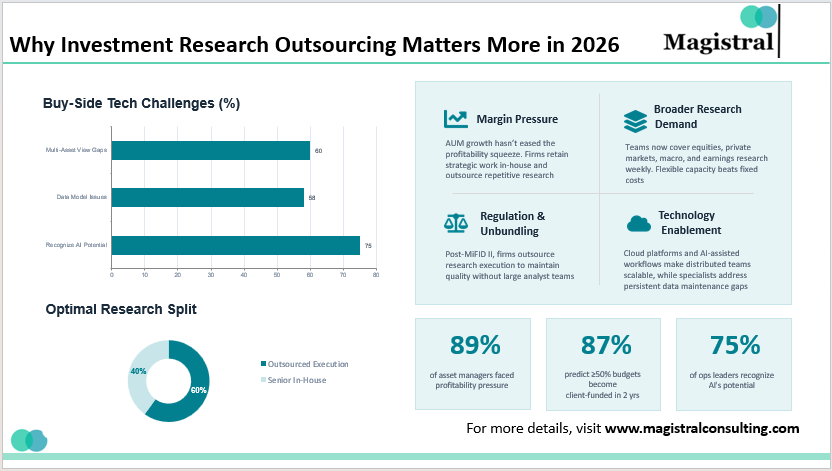
Why Investment Research Outsourcing Matters More in 2026

The case for this model is no longer just about labor arbitrage. In 2026, firms are using external research teams to expand coverage, shorten turnaround time, and free internal professionals to focus on idea generation, portfolio decisions, and client conversations. reference
Why Investment Research Outsourcing Matters More in 2026

Why Investment Research Outsourcing Matters More in 2026

Margin pressure is forcing smarter operating models

Asset growth sounds impressive on paper, but it has not removed the squeeze on profitability. PwC reports that 89% of asset managers faced profitability pressure over the past five years, even while industry AUM continues to climb. That creates a very practical question for leadership teams: where should scarce senior time really go? For many firms, the answer is to keep high judgment work in-house and move repeatable research execution to specialists.

Research demand has become broader and more continuous

A single research team can nowadays encompass listed equities, private company coverage, thematic screenings, macroeconomic analysis, earnings research, valuations, and competitor research all in a single week. That would be difficult to achieve without outside support. It has therefore become common practice to supplement a firm’s in-house analysts with outsourced capabilities for channel checks, model upgrades, screenings, and presentations. Similar trends hold for related businesses like private equity and venture capital, which also have to cope with flexible demands.

Regulation and unbundling changed the economics of research

The discussion around research budget allocation has become more urgent with MiFID II and the resulting developments. Substantive Research discovered that 87% of survey respondents from the buy side expected at least half of the research budget to be covered by clients within the next two years. It is relevant because the focus has been shifting to who provides research, how it should be funded, and which processes absolutely require high-priced senior analysts. Investment research outsourcing responds to these changes by allowing firms to secure research quality while not supporting an oversized analyst pool.

Technology made distributed research teams more workable

A decade back, managers were concerned about delays caused by external teams. But things have evolved since then. Cloud computing, collaboration platforms, research management tools, and AI-assisted writing tools have all been game changers in this context. The latest report published by SimCorp for 2025 has revealed that while 75% of operations leaders see potential in AI, almost 58% of them are facing challenges with managing data models, and 60% lack the ability to have an integrated view of multiple assets.

How Investment Research Outsourcing works across the investment lifecycle

This process will work best when it stops being considered an overflow activity to be outsourced and is instead viewed as an integral part of the firm’s operating model. The best relationships will specify what should be outsourced, what should remain in-house, and how the transfer of quality occurs along the way.

Origination and idea screening

At this level of the sales and trading funnel, investment research outsourcing partners can create long candidate lists, draw sector maps, keep tabs on fundraising trends, create peer groups, and produce initial company write-ups. Investment research outsourcing is especially beneficial for those in the investment banking business, as it means more efficient utilization of their senior bankers, as they have more time to analyze instead of collecting data. Good outsourcers do not replace judgment; they make better use of it.

What gets outsourced most often at this stage- Tasks that can be outsourced are sector maps, target screens, potential investors lists, earnings recaps, transcript analysis, and management meeting recaps.

Diligence and deep dive analysis

Whereas names that pass through the first filter face more thorough investigation. Usually, in such cases, investment research outsourcing includes such components as financial statement spreading, sensitivity analysis, customer and competitor mapping, industry sizing, transcript review, and scenario modeling improvement. Here, connections with the work on DCF are particularly significant, since valuation research requires strict adherence to the principle of model hygiene prior to any review by an investment committee.

Why does this stage benefit from external support

It is not always a nice process, but diligence windows tend to close very fast, while managers will always expect quality analysis. Investment research outsourcing allows firms to expand their focus without losing the speed of execution. This is particularly important in markets characterized by information fragmentation, when there is a need to extract insights from various data.

Portfolio monitoring and coverage maintenance

After the investment, there comes no relief for the firm that still requires regular reporting and updates, including quarterlies, KPIs, competitive environment changes, macroeconomic overlay, as well as new investment memos. For this reason, some buy-side players make use of investment research outsourcing not once but twice. Besides, portfolio reporting for multiple funds requires standardization of the whole process.

Marketing and investor communication support

Research does not live only inside an IC memo. It also shapes pitchbooks, manager commentary, strategy notes, and fundraising materials. Deloitte’s 2026 investment management outlook points to continued product expansion, private market access, and deal activity as firms compete for growth, which means analytical content increasingly supports distribution as much as investment teams.

Risks, controls, and future direction of Investment Research Outsourcing

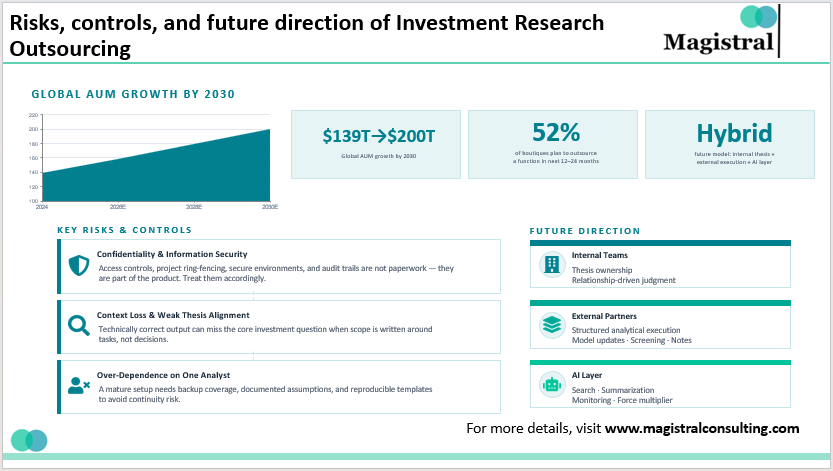
Global assets under management are expected to grow from $139 trillion to $200 trillion by 2030, and profitability will remain challenging; thus, lean operations have never been as important as they are now. Although the approach offers significant benefits, it brings risks as well. Luckily, in most cases, all risks can be mitigated with proper planning of the workflow. reference
Risks, controls, and future direction of Investment Research Outsourcing

Risks, controls, and future direction of Investment Research Outsourcing

Confidentiality and information security

Many research assignments involve dealing with unpublished management opinions, internal finances, and transactions. Thus, access controls, project ring fencing, safe environments, and audit trails are important. Security documentation cannot be viewed simply as an additional burden – it is part of the product.

Context loss and weak thesis alignment

An external team may produce correct results without answering the core business question. Such a situation arises due to the fact that the scope focuses on tasks and does not define the key decision context, the target audience, the output format, and the top three issues that need answers.

Overdependence on one person or one team

A mature system requires redundancy, recorded assumptions, and replicable templates. The problem is that everything falls apart as soon as the lead analyst is no longer available. This is particularly significant when the organization has other concurrent requirements, such as capital raising, portfolio management, and quarterly investor communications.

The future is blended, not fully external

Investment research outsourcing is going to move towards being a combination of the internal and external systems. Internally, the organizations will retain thesis ownership and relationship-based judgment capabilities. Externally, the organizations will focus on the structurally analytically oriented tasks. In between all this, artificial intelligence will be used as a force multiplier. This is in line with how market trends indicate that things should move: Universal Investment found in its 2025 boutique asset manager survey that 52% of firms would consider outsourcing at least one business function within the next 12 to 24 months, and SimCorp’s operations leaders still require AI expertise in process improvement.

How Magistral Supports Investment Research Outsourcing

The firms that gain the most from this model usually want more than generic analyst capacity. They want domain familiarity, flexible staffing, clean deliverables, and processes that fit live investment workflows. That is where a specialist partner can make a difference with investment research outsourcing.

Sector-aligned research support

Magistral’s broader body of work across equity research, financial modeling, fund support, deal execution, and investment operations suggests a model built for financial services rather than generalist outsourcing. That matters because sector language, valuation nuance, and timeline discipline are very different in this field.

Support across multiple use cases

A practical engagement can include company profiles, industry research, valuation models, earnings notes, portfolio monitoring, pitch materials, and competitor mapping. For clients that also operate across real estate financial modeling or adjacent private market mandates, cross-functional familiarity can reduce handoff friction.

Scalable capacity without a fixed bench burden

That matters in an environment where global AUM is growing, product complexity is increasing, and operating leverage is still hard to achieve. When internal teams stay lean, but mandate flow remains unpredictable, external support gives firms room to move without rebuilding headcount every cycle. PwC’s industry outlook and Deloitte’s 2026 investment management commentary both point to a future where growth and efficiency have to coexist.

Better research workflows, not just lower cost

The strongest reason to explore this model is not the cheaper output. It is a better-organized output. A well-run external research setup can improve turnaround time, standardization, coverage depth, and internal focus. If that sounds like the real objective, then investment research outsourcing is not a temporary workaround. It is a more deliberate way to build research capacity for 2026.


About Magistral Consulting

Magistral Consulting has helped multiple funds and companies in outsourcing operations activities. It has service offerings for Private Equity, Venture Capital, Family Offices, Investment Banks, Asset Managers, Hedge Funds, Financial Consultants, Real Estate, REITs, RE funds, Corporates, and Portfolio companies. Its functional expertise is around Deal origination, Deal Execution, Due Diligence, Financial Modelling, Portfolio Management, and Equity Research

For setting up an appointment with a Magistral representative visit www.magistralconsulting.com/contact

About the Author
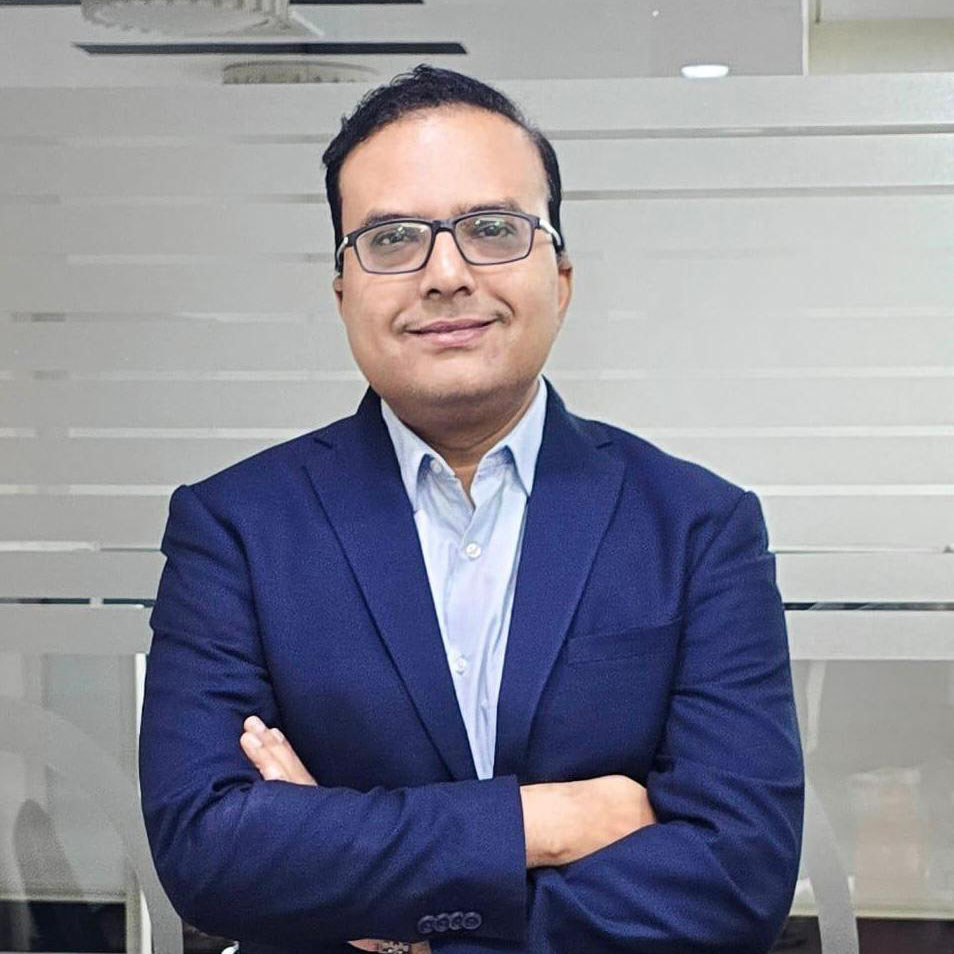
Prabhash Choudhary is the CEO of Magistral Consulting. He is a Stanford Seed alumnus and mechanical engineer with 20 + years’ leadership at Fortune 500 firms- Accenture Strategy, Deloitte, News Corp, and S&P Global. At Magistral Consulting, he directs global operations and has delivered over $3.5 billion in client impact across finance, research, analytics, and outsourcing. His expertise spans management consulting, investment and strategic research, and operational excellence for 1,200 + clients worldwide

FAQs

What is Investment Research Outsourcing?

It is the practice of assigning selected research activities such as screening, market mapping, model updates, diligence support, and portfolio tracking to an external specialist team while keeping final investment judgment in house.

Which firms use Investment Research Outsourcing most often?

Investment banks, asset managers, hedge funds, private equity firms, venture capital firms, family offices, and independent research providers use it most frequently.

Does outsourcing reduce research quality?

Not if the workflow is designed properly. Quality usually improves when firms define scope clearly, use templates, maintain review steps, and assign work to domain trained analysts.

What tasks should stay in house?

Final thesis formation, investment committee positioning, relationship driven judgment, and ultimate decision rights should generally remain internal.

Is AI replacing outsourced research teams?

No. AI is improving data extraction, summarization, and monitoring, but firms still need humans for judgment, validation, and context specific interpretation.


Introduction

Around the globe, there is a trillion-dollar business of investing in all sorts of assets like equity, both public and private, real estate, and upcoming assets like cryptocurrencies. Once the investment is made, the task on the part of the investor shifts to investment management. There are many activities of investment management that could be outsourced and that is what leads us to analyze the stream of investment management outsourcing. Investment management and hence investment management outsourcing takes all forms depending on the asset being invested in, and the prime business of the asset or investment manager.

Here we take a look at major activities of each type of investment manager or asset manager which could be effectively outsourced to save on costs and improve quality.

Who Should Outsource Investment Management and How?

Outsourced Investment Management

Outsourced Investment Management for different types of Asset Managers

Private Equity and Venture Capital firms

The underlying asset that a Private Equity or a Venture Capital firm invests in is equity. Sometimes it’s for stocks listed on exchanges but most of the time these are private investments, the target of which are start-ups are unlisted companies.

In the PE/VC value chain of investing, there are activities like Fundraising, Deal origination, Deal execution, and Portfolio Management. Quite a few activities in these departments are outsourceable. For fundraising, the activities like investor reach-out, investor profiling, CRMs, newsletters, white papers, and data management jobs could be effectively outsourced. Regarding, Deal origination, the deal pipeline management has a great potential of outsourcing along with initial due diligence. Deal execution processes like valuation and financial modeling are templatized and could be considered. Portfolio management has varied activities and outsourcing potential vary as per the nature of the business of the portfolio companies. Most activities related to Strategy and Marketing have great potential for outsourcing when it comes to Portfolio Management.

Hedge Funds

For the most common type of hedge fund out there, that is a long-short equity hedge fund, multiple activities should be considered for outsourcing. Equity Research is the foremost one. The research that is done for the investors is almost always best to be outsourced. Apart from Equity Research, Fund Administration and Fund Accounting are better done when outsourced. It makes sense from the cost and expertise point of view. Marketing activities almost always have great potential for offshoring.

Real Estate

Managing a real estate asset after the investment comprises standardized work-streams. Most of it relates to collecting data, analyzing it, making reports, and raising red flags if any. Accounting and administration along with research has a great potential for outsourcing

Investment Banks

Investment Banks are into all sorts of assets directly or for their clients. For the varying types of their work pallet, there is varying potential for outsourcing.  For investment banks, activities that are commonly outsourced are Equity Research, Security-based Investment Research, development of excel or other automated models, investment research for private investments, marketing, deal origination, and deal execution. In fact, 30-50% of all activities performed by an investment bank has a solid potential for outsourcing that may be explored

Asset Management Firms

These are for specialized asset managers like managers managing a portfolio of crypto or commodities. There is no one size fits all approach to outsourcing for these asset managers. As a thumb rule, everything related to technology like platform development, automation, website development, or software development can be outsourced. Also, anything that is of support function’s nature like Strategy or Marketing could be looked at.

Models of engagement with the outsourcing vendor

Once you have made your mind to explore outsourcing, the biggest concern is around the way an outsourced vendor or the service provider would work with you and your team. There are three established models of working while outsourcing. These are FTEs, Retainer, and Ad-hoc. Some progressive vendors like Magistral are signing up success-based contracts too.

Outsourcing Engagement Model

Investment Management Outsourcing Engagement Model

FTEs

FTE the most common engagement model for investment management outsourcing.

FTE stands for Full-Time Employee equivalent. It’s like a virtual employee who is operating from a different country. This virtual employee could be coordinated with, on email, video calls, WhatsApp, chats, or any other mode that is suitable to the client and is convenient as per time zone differences. It looks like a person is aligned with the client full time and he works seamlessly with the client. That is always the case, but the vendor, his processes, training, supervision, and culture play a big role in ensuring the continuity of services. A vendor enables the FTE to perform optimally by providing training and desired supervision. The vendor’s processes ensure that the client is insulated from the bad performance of FTE as the work is supervised by more senior resources. In case the individual decides to leave the organization, similarly, qualified and trained professionals are available on the bench for the replacement. That is the reason it makes sense to work with individuals through the service providers who may be an established name in their industry. Working directly through freelancing websites or hiring directly exposes clients to manage costs and risks, which is not the case while dealing with an established service provider.

This also is the cheapest model on per hour basis. But it is inflexible as there may be contractual obligations for a minimum period of support. This case is more prominent when resources are specialized in niche skills

Typical jobs that require FTE engagements are operational, where the offshored team works with the onsite team seamlessly. So, if a task is part of your ongoing investment management operations, mostly it will be outsourced on FTE-based engagement.

Retainer

You know there is a need for outsourcing tasks. At the same time, you think a full-time individual working on these jobs may be overkill. In these situations, where tasks just require some hours every month, the retainer model of engagement comes in handy. Say rather than hiring an FTE or a full-time virtual employee, you would only want 100 hours’ worth of tasks outsourced every month. A retainer is far more flexible than FTEs but costs higher on per hour cost basis. Typical jobs that are suitable for retainer-type outsourcing are newsletters, MIS, reports preparation, and other marketing-related tasks.

Ad-hoc Projects

As the name suggests the engagement is for one-time projects only. A client gives out the scope of the project. The service provider or the vendor provides a proposal that carries, scope of work, timelines, and commercials. The project kicks off after the client signs off the proposal and is paid after the delivery of the project. Almost any project that is strategic and is not expected to be repeated on an ongoing basis is an ideal candidate for ad-hoc based outsourcing. Also, it’s an ideal mode, if you would want to test the services of a vendor before signing a longer-term contract. It is the most flexible outsourcing arrangement as projects may start or end at your convenience, but at the same time, it is costliest in terms of cost per hour basis.

Success Based

Most traditional service providers shy from signing a success-based engagement. The fear stems from the trust deficit, performance fears, and the complications of defining a success scenario. Magistral signs success-based engagements with clients, with whom it has existing relationships. Existing relationships take the risks related to trust deficit and performance. A mutually agreed “success” scenario could also be defined in those situations. The tasks that are outsourced under these arrangements usually relate to fundraising, deal sourcing, and meetings’ set up

Magistral has helped more than 100 clients in outsourcing and offshoring multiple activities related to the Investment Management process. To start a conversation drop a line here.

About Magistral

Magistral Consulting has helped multiple funds and companies in outsourcing operations activities. It has service offerings for Private Equity, Venture Capital, Family OfficesInvestment BanksAsset Managers, Hedge Funds, Financial Consultants, Real Estate, REITs, RE fundsCorporates and Portfolio companies. Its functional expertise is around Deal originationDeal Execution, Due Diligence, Financial ModelingPortfolio Management and Equity Research

For setting up an appointment with a Magistral representative visit www.magistralconsulting.com/contact

About the Author

The Author, Prabhash Choudhary is the CEO of Magistral Consulting and can be reached at Prabhash.choudhary@magistralconsutling.com for any queries or business inquiries.


Investment Research Outsourcing

Multiple Investment Services firms like Investment Banks, Private Equity, Venture Capital, Hedge Funds, Family Offices, and Asset Management firms are looking to outsource investment research in the post-Covid 19 pandemic era. The article describes the concept of Investment Research and the ways to go about outsourcing the process.

What is Investment Research? Investment Research Definition

Investment Research and Analysis or Investment Analytics combines multiple activities related to investments in Equity of companies (both public and private) and other financial instruments.

The major activities related to securities research are equity research, Fixed Income and Credit Research, Index and Quantitative Research, and Macroeconomic Research.

Another important aspect of Investment research is the support services towards Corporate Finance and Valuations. It includes activities like Investment banking support, Valuation support, business information services, and Private Equity and Venture Capital support.

Investment research also comprise of data governance-related activities like outsourced CFO.

Is Outsourcing a Good Idea?

Investment Research Outsourcing is fast catching up. Here are the trends that are leading to expending the concept of Investment Research Outsourcing

The pressure to lower costs: Investment Banking is not what it used to be. The digital world has shrunk the opportunities to make big dollars brokering big deals or IPOs. This has also led to pressure on costs. This leads to outsourcing non-critical jobs to low-cost countries like India.

Diversification on investment types: An Investment manager has way too many asset classes to handle today. It’s not only limited to public equity but now has diversified into private equity, real estate, cryptocurrencies, commodities, REITs, Index-linked instruments, and many other asset classes. If the investment team is small, it’s difficult to have a combination of skillsets to provide a holistic solution to their clients. As outsourcing vendors understand Investment Research dynamics well, Outsourcing helps in bridging the skill gap. Outsourcing vendors also have access to multiple investment research tools.

Information Sources and Databases: With the proliferation in investment type, also gone up is the requirement of multiple databases for varied data points. It’s a costly affair to maintain access to multiple databases in-house. Investment research tools are also used to fine-tune the data and information.

Confidentiality: There is pressure to keep all information confidential. An outsourced team doing due diligence is perfect, as it leaves no trace of who the client maybe, that is doing the due diligence. An analyst can talk to potential target with or without introducing the client.

Quality: Outsourced players have better quality than the in-house team. The outsourced team typically is bigger and has done similar tasks multiple times before. In the process, they usually create an information bank or templates that are ready to use. They also sit on the hoard of best practices for multiple situations. If the outsourced player has its knowledge process well documented, they are in a better position to offer work quality.

Effective Supervision: When internal teams are working on an analytical project, it’s difficult for a partner to take time out to get into the details of data, information, and analytics therein. But with an experienced outsourcing player, there are multiple levels of supervision, governance structures, and quality control processes to establish an error-free work every time.

Variable Costs: Firms can modify the outsourcing agreement to pay based on hours consumed or per assignment outsourced, rather than hiring a full-time virtual investment analysis. This brings immense flexibility in terms of costs. An investment firm can hire only for the assignment and then go back to the original structure, once the job is done. This is very useful for smaller investment teams and firms with partners only, who need an on-demand investment research analyst. An investment research team can come together ad-hoc and then could be dismantled when the job is done.

What jobs can be performed with Outsourced Investment Research?
Outsourced Investment Research Activities

There are multiple elements of the Investment Research Process, that could be potentially outsourced:

Equity Research: Equity Research is the most voluminous work as Investment Banks usually outsource quantitative investment research. Equity research teams typically conduct fundamental analysis on a set of regularly tracked stocks. They publish a report each quarter for every stock covered, detailing developments and valuation-related metrics. These Investment Research Reports are updated periodically, and their format is customized based on client preferences. Outsourcing this activity allows the in-house team to cover more stocks than it would have covered otherwise. Teams can also break this task into multiple streams before outsourcing—for example, preparing the DCF model, updating it periodically, or analyzing investor calls from the company’s management. Investment Research Analysts work as an extended offshore team to the in-house team. Investment research software aids the in-house tech capability.

Due Diligence of Private and Public Companies: Due diligence is time-consuming and requires huge efforts. Sometimes the due diligence can last even for a year analyzing tons of data and information. A dedicated support team that handles requests and delivers as promised enhances efficiency and ensures due diligence is completed within prescribed timelines and at appropriate valuations. It also ensures that the asset delivers the intended value for investors post-investment.

Fund Administration and Investor Relations: There are multiple activities of fund administration and investor relations that could be outsourced like Newsletters, MISs, Expense Tracking, Accounting, Company Registration, and multiple other similar activities. Firms use Investment Research Management Software or Investment Research Platforms to coordinate and streamline multiple related activities.

Outsourced CFO/ Outsourced CMO/ Outsourced CPO for portfolio companies: This is very relevant for Venture Capital and Private Equity firms that go into the nitty-gritty of operations for portfolio companies. Rather than hiring a full-time Chief Financial Officer, Chief Marketing Officer, or Chief Procurement Officer, one can just outsource these activities and pay for the services when needed. Some activities related to lead generation in sales and business development could be outsourced as well. Outsourced CFO is the most popular option.

Research and Strategy: Organizations generally run Research and Strategy projects parallel to core operations. These projects often experience phases of hyperactivity followed by periods of lull in the number of initiatives undertaken. Outsourcing these keep the focus of operations’ team on the day to day operations and an unbiased view of the strategic potential from someone who has a fresh eyes perspective on things.

Financial Modeling: Financial modeling is more of an art than science. Asking the right questions and capturing detailed insights is a skill developed over time. Most internal teams lack expertise in these tasks, as they typically handle them only occasionally. An outsourcing entity has ready templates and has done these over time to know the exact pain points and the right questions for the perfect financial model. Investment Banking Research Analysts are well versed with multiple aspects of financial modeling.

Deal Origination: Private Equity and Venture Capital firms must continually populate their deal pipeline to operate like well-oiled machines. They can effectively outsource most deal origination activities by breaking them into sub-activities and delegating non-critical tasks. While the firm retains investment decision-making in-house, it can outsource company profiling, list generation, and initial due diligence. After making an investment decision, the firm can also outsource parts of the detailed due diligence process.

How to Go About Outsourcing Investment Research?

There are multiple investment research companies and investment research firms which assist in outsourcing investment research services by offering virtual investment research analyst. They are varied in size and geographical presence. There are multiple investment research firms in India, that offer low-cost advantages.  You can make a list of suitable vendors either from Google search, references or when a sales leader reaches out to you. The very first step towards establishing suitability is to ask for past work samples. Once you have had a look at the work samples and they appear good quality, ask for a proposal for a pilot project. Teams undertake a pilot as a smaller project before outsourcing a larger portion of the operations, allowing them to assess capabilities and ensure alignment.

A pilot project should ideally last from a week to a quarter. This should give you ample time to experience the vendor’s capability and skills. Once the pilot succeeds, you should negotiate a larger engagement. Also, ensure the vendor offers competitive pricing for the quality of services delivered.

Magistral Consulting has helped dozens of buy-sides and sell-side firms in outsourcing their investment research operations. It is one of the leading Investment Research companies in India with the capability of performing global investment research. A one-stop-shop for all requirements of investment research and analysis. It has delivery centers in India that give it a cost advantage with sales offices in all the major cities across the world. To drop a business inquiry with Magistral, click, https://magistralconsulting.com/contact/

The author, Prabhash Choudhary is the CEO of Magistral Consulting and can be reached at Prabhash.choudhary@magistralconsulting.com for any queries. For further details on Magistral and its services, visit www.magistralconsulting.com