Tag Archives: Investment Management Outsourcing

Private markets are embarking on a paradigm shift in their market structure. What primarily consisted of institutional investment is currently being rewritten due to a carefully planned and implemented wave of retail market participation.

Private Market Outlook

Private Market Outlook

Global private market assets under management have surpassed USD 13 trillion, more than doubling over the past decade, with retail investors expected to drive most growth over the next five years. For investment management services providers, this shift emphasizes how they structure private assets rather than how they distribute them.

The Structural Forces Expanding Retail Access to Private Markets

The rise of retail participation in private markets does not occur due to a single catalyst. Instead, it is the cumulative effect of several structural drivers operating concurrently: the evolution of regulation, product innovation, and operational facilitation. They are combining to redefine who has access to private assets and under what terms.

Regulatory Frameworks Are Being Re-Engineered, Not Relaxed

In major jurisdictions, regulators are updating safeguards rather than dismantling them. They are developing qualification frameworks that reflect both financial sophistication and wealth. While reforms such as ELTIF 2.0 have expanded access and simplified distribution for non-professional investors, with similar adjustments emerging in the UK and parts of Asia.

Such developments are an indication that there is acceptance by the regulators that private markets are not just secondary tools but are instead an essential part of long-term capital structuring. Over 50% of asset managers believe that regulatory reforms will accelerate retail involvement in private assets by 2027. When it comes to investment management services, it is not regulations, but execution that matters.

Product Innovation Is Redefining Liquidity, Not Eliminating It

Illiquidity is still a characteristic of private markets, but it is managed differently. Evergreen funds, interval funds, and tender offer funds have provided a degree of periodic liquidity without altering the investment idea.

“Semi-liquid private market funds,” where the vehicle is quasi-liquid, have grown rapidly, with evergreen funds or the equivalent “interval funds” now representing over USD 700 billion in assets under management, up from under USD 200 billion at the end of 2020. The concept of liquidity in these cases is certainly no longer a Black-and-White concept but one that is engineered, conditional, and portfolio specific.

Technology Is Lowering Friction but Raising Expectations

Online platforms have enabled streamlined onboarding, compliance, reporting, and administration. All these have become infrastructure, not differentiators.

What varies across firms is where technology is applied:

Unpacking intricate valuation mechanics and cash flow considerations into actionable information

Aiding in understanding liquidity terms and redemption processes

Combining privately managed assets into portfolio analysis instead of standalone reporting

As private strategies expand in scale to reach a broader client base, operational efficiency will be crucial. Technology helps create this efficiency and scale. But it’s judgment that helps maintain integrity, and that’s the crucial focus for sound investment management services.

How Portfolio Construction Logic Is Quietly Changing

As retail distribution expands, it increasingly reshapes portfolio-level considerations. Investors can no longer view private assets as point-in-time allocations; instead, they must assess their impact on liquidity, risk, and long-term portfolio strategy. As this trend continues, it has become increasingly important for there to be an adaptation in overall portfolio design principles, thus pushing the need for expert portfolio design services in terms of investment management services.

Private Assets Are Moving From Satellite to Structural Roles

Retail access to private markets is redefining the very fabric of portfolio construction. Today, private equity can no longer be considered the only foundation for private markets. With assets under management now in excess of USD 1.5 trillion, private credit increasingly finds itself described as an income stabilizer. Infrastructure investing now offers access through an “inflation- linked allocator,” and secondaries are finding “relevance as a duration-managed asset.”

This is not an oversimplification. This is institutional portfolio thinking, scaled for wider involvement. Those who have the ability and the focus not to water down the discipline will establish the next era of investment management services.

Liquidity Is Becoming a Strategic Variable in Portfolio Design

Because the portfolios include semi-liquid private assets, it means that liquidity was no longer viewed as a constraint at the product level, but at the portfolio level, it becomes a variable.

A good portfolio today must be able to:

Matching liquidity profiles to cash flow needs

Stress-testing the assumptions about redemption in unfavorable market conditions

Sequencing private allocations over time instead of isolating capital deployment

Modern market disruptions remind us of these imperatives with secondaries crossing USD 100 billion a year in market activity, signifying rising demands for rebalancing tools for investment portfolios. Once again, investment management services move from allocation to architecture.

Risk Has Not Increased: Governance Has Become Central

The increase in retail sector exposure to private credit and yield strategies has also received consideration from rating agencies and regulatory bodies. However, these are not oppositions to access but rather to misalignment.

Strong underwriting, open and sound valuation methodologies, and sound risk disciplines are now the norm, not the differentiator. They must remain pillars of strong investment management functions operating in the private markets, especially in the face of scaled retail allocations.

What This Means for the Future of Investment Management Services

The blurring of lines for retail capital and private markets is transforming the role of the investment manager. From a role founded on access and allocation, it is increasingly one of ownership, of governance, of outcomes. In this way, the role of the investment manager remains particularly well placed to exploit these changes.

Retail Access to Private Markets

Retail Access to Private Markets

From Product Distribution to Portfolio Stewardship

As retail capital emerges as a sustained source of private market inflows, a paradigm shift is underway in the investment management services space. It is a future reality where investment managers will be judged based on ownership of portfolio narrative, contribution of private assets to investment outcomes, adaptability, and overall long-term strategy.

Such an approach demands the need for investment management services based on advice, well-structured, and rooted in governance, rather than product momentum.

Institutional Discipline at Retail Scale

The next wave of growth will be kind to firms that can deliver institutional-grade due diligence, risk management, and reporting within retail-accessible formats. Lower minimums cannot mean lower standards.

In fact, with retail-oriented private market vehicles expected to account for nearly half of new private market inflows by 2027, maintaining institutional discipline at scale becomes both a competitive advantage and a fiduciary necessity.

Emerging Markets Are Accelerating the Shift

In markets like India, an increasingly sophisticated investor base is driving alternate investments through PMS and AIF frameworks. It has already exceed ₹23 lakh crores (approximately USD 280 billion) and are growing at a compound rate of over 30%. As a result, the demand for thoughtful, insight-driven investment management services is increasing, not diminishing.

Closing Perspective

The role of private markets in portfolio construction becomes more central, not less complex. Going forward, it will become more important for investment management services to analyze whether retail participation leads to lasting outcomes or structural misalignment.

Leaders will define the next era of private market investing by designing for longevity, treating liquidity as a deliberate decision, and anchoring growth in strong governance.

How Magistral Enhances Investment Management Services

Magistral Consulting assists investment managers throughout the investment life cycle in scalable ways. It helps in extending internal resources to benefit from research intensity, execution support, and operational efficiency. This is done to enhance core investment management services.

Research, Market Intelligence & Investment Analytics

End-to-end sector research, company analysis, thematic studies, benchmarking, and portfolio analytics that strengthen investment theses and support faster, better-informed decisions.

Deal Origination, Due Diligence & Execution Support

Deal sourcing, opportunity screening, financial and operational due diligence, ESG assessments, and execution support. It is for the investment teams to go from idea to close with confidence.

Modelling, Valuation & Portfolio Monitoring

Institutional-grade financial models, valuation analysis, and scenario planning. It is complemented by ongoing portfolio performance tracking, meet the needs of an investment committee.

Fundraising, Investor Materials & LP Support

Preparation of pitch decks, CIMs, data rooms, LP targeting, and investor reporting in support of effective capital raise. It also deals with stakeholder communication with consistency.

Fund Operations, Reporting & Strategic Advisory

Middle- and back-office support, fund administration, ESG reporting, and strategic advisory services that enhance operational efficiency and free up investment teams to focus on alpha generation.


About Magistral Consulting

Magistral Consulting has helped multiple funds and companies in outsourcing operations activities. It has service offerings for Private Equity, Venture Capital, Family Offices, Investment Banks, Asset Managers, Hedge Funds, Financial Consultants, Real Estate, REITs, RE funds, Corporates, and Portfolio companies. Its functional expertise is around Deal origination, Deal Execution, Due Diligence, Financial Modelling, Portfolio Management, and Equity Research

For setting up an appointment with a Magistral representative visit www.magistralconsulting.com/contact

About the Author
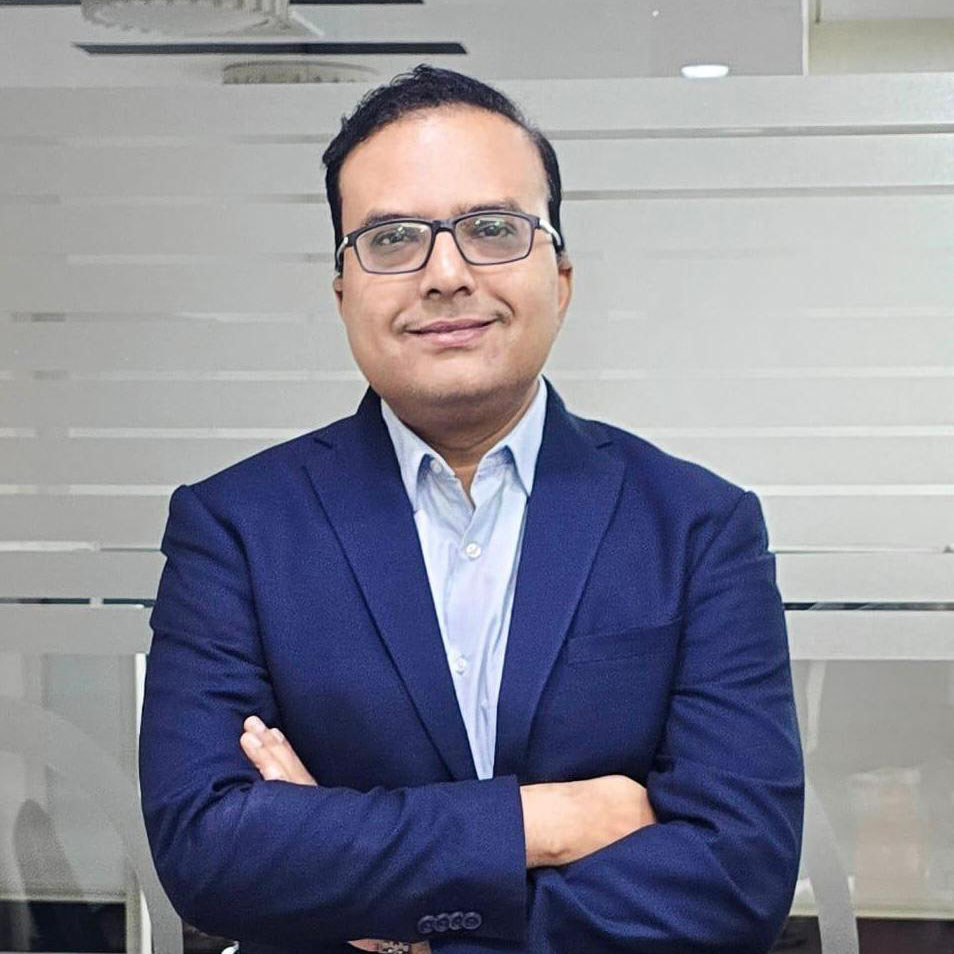
Nitin is a Partner and Co-Founder at Magistral Consulting. He is a Stanford Seed MBA (Marketing) and electronics engineer with 19 + years at S&P Global and Evalueserve, leading research, analytics, and inside‑sales teams. An investment‑ and financial‑research specialist, he has delivered due‑diligence, fund‑administration, and market‑entry projects for clients worldwide. He now shapes Magistral Consulting’s strategic direction, oversees global operations, and drives business‑development support.

FAQs

How is Magistral different from traditional consulting firms?

Magistral combines deep financial expertise with scalable offshore execution, allowing clients to access high-quality analysis and support without the cost structure of large advisory firms.

Can Magistral help improve decision-making for investment committees?

Yes, through rigorous research, financial modelling, scenario analysis, and data-driven insights that enhance clarity and comparability at the investment committee level.

Which industries does Magistral primarily serve?

Magistral works across investment management, private equity, venture capital, hedge funds, banking, and corporate strategy functions, with a strong focus on financial services.

How does Magistral help investment managers scale efficiently?

By outsourcing research, analytics, and operational workloads, Magistral enables investment managers to scale investment management services without increasing fixed internal costs.


Fund administration has evolved from a relatively straightforward back-office function into a complex operational discipline, driven by heightened regulatory scrutiny and increasing investor demands for timely, transparent reporting. As fund structures and compliance requirements expand globally, outsourcing has shifted from a cost-focused decision to a strategic operating choice. Rather than building large in-house teams, many fund managers now rely on experienced third-party administrators to deliver scale, process rigor, and risk control. As highlighted in Deloitte’s Investment Management Outlook, management teams are increasingly prioritizing process efficiency and operational risk reduction, allowing fund managers to focus on alpha generation while ensuring accurate, compliant, and scalable fund operations throughout the fund lifecycle.

Fund Admin Outsourcing and the Evolution of Fund Operations

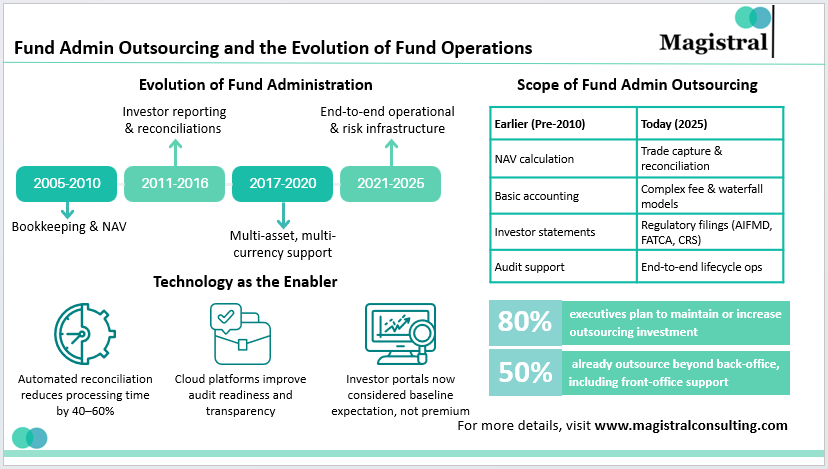
Fund Admin Outsourcing has evolved alongside the growth of alternative assets and cross-border investing. What once covered basic bookkeeping now spans end-to-end operational support across complex structures.

Fund Admin Outsourcing and the Evolution of Fund Operations

Fund Admin Outsourcing and the Evolution of Fund Operations

Expanding the scope of Fund Admin Outsourcing services

Earlier models focused largely on NAV calculation and investor statements. Today, administrators handle trade capture, reconciliation, fee calculations, waterfall models, and regulatory filings. Deloitte’s Global Outsourcing Survey 2024 reports that 80% of executives plan to maintain or increase investment in third-party outsourcing, and 50% used outsourced services for front-office capabilities

Role in supporting diverse fund structures

Modern portfolios span hedge funds, private credit, infrastructure, and hybrid strategies. Each structure brings its own accounting and reporting nuance. Through Fund Admin Outsourcing, managers tap teams with broad experience across asset classes-including multi-currency, multi-jurisdiction funds. This depth is particularly valuable when managers expand into new strategies without building parallel internal teams.

Technology as a catalyst for change

Cloud-based accounting platforms, automated reconciliations, and secure investor portals have redefined service expectations. Administrators invest heavily in technology, spreading costs across clients. PwC notes that from investment analysis to regulatory reporting, processes that once took weeks can be completed far faster with advanced automation, while improving audit readiness.

Impact on operational resilience

Due to the upheaval in the Market, Operational Risk now occupies a significant place among the concerns of board-level personnel. By establishing redundant practices and procedures, standardising Operations, documenting all Controls related to Financial Operations, and utilising Dedicated Oversight Teams for all processes, Fund Administration Outsourcing can be viewed as an Operational Risk Management Tool, as opposed to simply a Cost Savings Solution.

Fund Admin Outsourcing for Compliance, Accuracy, and Transparency

Regulation and investor scrutiny continue to intensify, making compliance and data integrity central to fund credibility. Fund Admin Outsourcing plays a critical role in meeting these expectations.

Strengthening regulatory compliance frameworks

Regulatory requirements are expanding across jurisdictions (e.g., SEC rulemaking/enforcement and AIFMD2 updates), increasing the burden of reporting, controls, and governance, driving demand for specialist compliance and reporting capability.

Enhancing accuracy in financial reporting

Accurate NAVs and timely reports form the backbone of investor trust. Outsourced administrators apply maker-checker controls, standardized valuation policies, and independent verification processes. This structured approach improves accuracy, particularly during volatile markets when pricing errors are more likely.

Investor reporting and transparency demands

Limited partners now expect near real-time visibility into portfolio performance. Through Fund Admin Outsourcing, managers can offer consistent reporting packages, secure portals, and standardized disclosures. This transparency is especially important for institutional investors allocating across private equity and other alternative strategies where comparability matters.

Audit readiness and governance support

External audits consume significant management bandwidth. Administrators streamline audits by maintaining clean documentation, reconciled data, and clear audit trails. As a result, audit cycles shorten, and governance oversight improves without overburdening internal teams.

Fund Admin Outsourcing as a Cost and Scalability Lever

Beyond compliance, Fund Operations Support offers a flexible operating model that aligns costs with growth and complexity.

Fund Admin Outsourcing as a Cost and Scalability Lever

Fund Admin Outsourcing as a Cost and Scalability Lever

Variable cost structure and efficiency gains

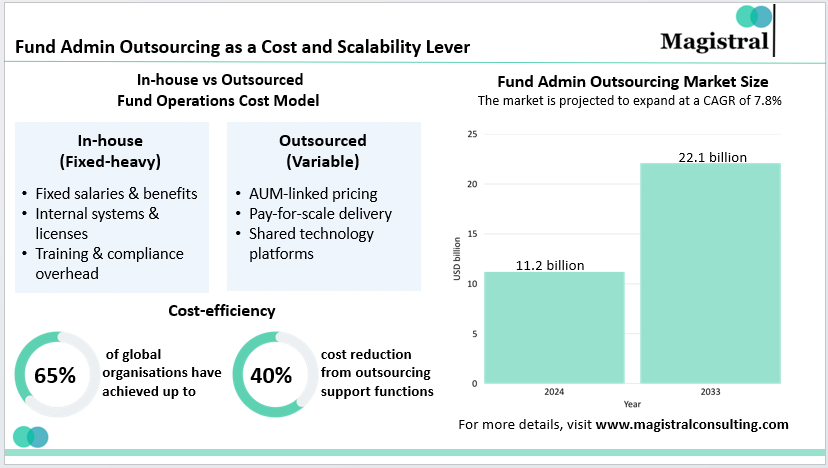
Building an internal operations team involves fixed salaries, systems, and training costs. Outsourcing converts these into variable expenses that scale with assets under management. PwC highlights an industry reality of sustained profitability pressure and high cost-to-income dynamics, reinforcing why firms pursue cost-efficient operating models (automation, scalable delivery, partner ecosystems).

Supporting growth without operational strain

As funds raise new vehicles or expand geographically, operational demands increase sharply. Outsourced administrators absorb this complexity, allowing managers to scale without disruption. This flexibility proves valuable for firms active in venture capital or emerging strategies where growth can be uneven.

Focus on core investment activities

By shifting administrative responsibilities externally, internal teams dedicate more time to portfolio construction, risk analysis, and investor engagement. This sharper focus often translates into stronger performance narratives and more effective capital raising efforts.

Alignment with digital transformation

Administrators continuously upgrade systems to meet client expectations. Funds benefit from enterprise-grade platforms without bearing full implementation costs. Over time, this alignment with digital best practices strengthens operational maturity across the organization.

Fund Admin Outsourcing and Strategic Decision Making

Operational data generated through this increasingly feeds into higher-level decision-making rather than sitting in silos.

Data-driven insights for fund managers

The use of timely and standardized operational data allows the manager to identify performance trends and analyze liquidity and fee structures more effectively. This increased understanding and ability to forecast and make better decisions regarding investment portfolios, particularly in today’s volatile market.

Integration with broader finance functions

Many times, outsourced administration supports outsourced accounting, compliance, and CFO services, which combine to create a more coordinated approach between finance and operations (i.e. to eliminate/reduce double counting and errors).

Supporting institutional-grade governance

As managers begin to attract larger institutional investors, governance expectations are increasing and provide a level of documentation discipline and reporting controls that pension funds, endowments, and sovereign investors expect.

Preparing for future regulatory and market shifts

The regulatory environment will continue to change over time and by working with an experienced administration, managers can be ahead of such changes instead of being reactive. This proactive approach creates long-term resiliency.

How Magistral Consulting Enables Value Through Fund Admin Outsourcing

The selection of an appropriate outsourcing partner is just as critical as the act of outsourcing itself. Magistral Consulting takes the position that Fund Admin Outsourcing should be viewed as a tool for enabling strategic growth rather than as a simple transaction.

Customized operating models for diverse funds

Magistral creates administrative models that fit the fund’s overall strategy, structure, and plans for future growth. Both emerging managers and long-established platforms are supported by a continued focus on scalability and control.

Process optimization and oversight

In addition to performing the actual tasks of administration, Magistral prioritizes the policies and processes associated with governance, oversight, and the process of continuous improvement. Well-defined metrics associated with service levels, full transparency in the reporting, and a regular schedule of performance reviews will ensure that funds remain aligned with the objectives of fund investors.

Technology-enabled delivery

By taking advantage of modern technologies and automation, Magistral is able to optimize the timeframes to execute transactions, improve the accuracy of data, and has tight internal controls. This ensures the proper balance between efficiency and risk management.

Long-term partnership mindset

Fund Admin Outsourcing should be viewed as a partnership. In addition to performing the usual tasks associated with Fund Admin Outsourcing, Magistral partners closely with management teams, developing the administrative model as funds continue to evolve. As such, Magistral can create a sustainable model for growth rather than a short-term solution.

About Magistral Consulting

Magistral Consulting has helped multiple funds and companies in outsourcing operations activities. It has service offerings for Private Equity, Venture Capital, Family Offices, Investment Banks, Asset Managers, Hedge Funds, Financial Consultants, Real Estate, REITs, RE funds, Corporates, and Portfolio companies. Its functional expertise is around Deal origination, Deal Execution, Due Diligence, Financial Modelling, Portfolio Management, and Equity Research

For setting up an appointment with a Magistral representative visit www.magistralconsulting.com/contact

About the Author

Nitin is a Partner and Co-Founder at Magistral Consulting. He is a Stanford Seed MBA (Marketing) and electronics engineer with 19 + years at S&P Global and Evalueserve, leading research, analytics, and inside‑sales teams. An investment‑ and financial‑research specialist, he has delivered due‑diligence, fund‑administration, and market‑entry projects for clients worldwide. He now shapes Magistral Consulting’s strategic direction, oversees global operations, and drives business‑development support.

FAQs

What functions are typically included in Fund Admin Outsourcing?

Fund Admin Outsourcing usually covers fund accounting, NAV calculation, investor reporting, regulatory filings, and audit support, with scope varying by fund strategy and size.

Is Fund Admin Outsourcing suitable for smaller or emerging managers?

Yes. Smaller managers often benefit the most because outsourcing provides access to experienced teams and technology without heavy upfront investment.

How does Fund Admin Outsourcing improve investor confidence?

Consistent reporting, independent controls, and timely disclosures enhance transparency and accuracy, which directly strengthens investor trust.

Does outsourcing reduce control over fund operations?

Outsourcing does not eliminate control. Clear governance frameworks and oversight mechanisms ensure managers retain decision-making authority.

How long does it take to transition to Fund Admin Outsourcing?

Transition timelines vary, but most funds complete onboarding within three to six months depending on complexity and data readiness.


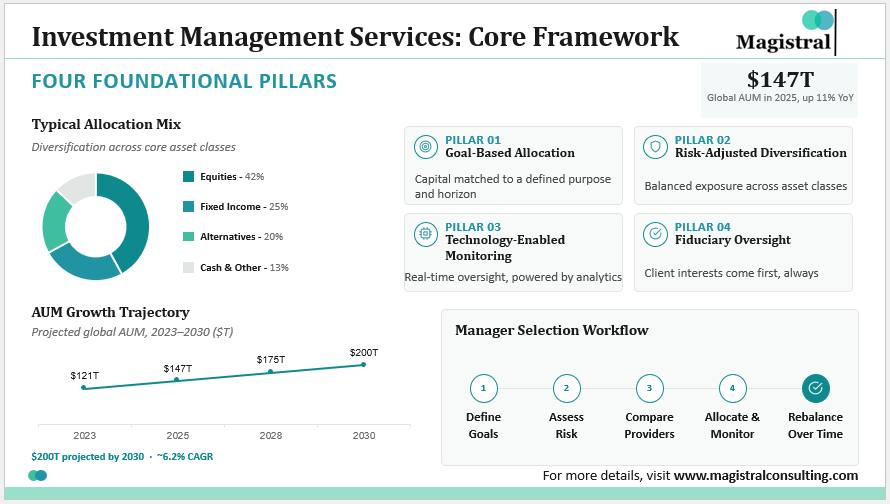
By 2025, volatility will remain a feature of contemporary markets, shaped as it is by inflationary pressure, geopolitical uncertainty, changing regulation, and technological change. Investment management services now mean more than just portfolio construction; it comprises strategies built upon an integrated, governance-based approach that creates sustainable returns. With an estimated USD 145.4 trillion globally subject to professional management, an ever-growing function of investment management services is to help investors know how to invest when they are faced with complexity. Capital flows and risk regimes are changing, and investment management services will help institutions and individuals navigate uncertainty into growth opportunities.


The Escalating Role of Investment Management Services in 2025

With increasing market complexity and investors’ ever-growing aspirations, investment management services are now more essential than ever.

Demand from Institutions and Affluent Clients

Large institutions including pension funds, insurers, sovereign wealth funds are increasingly without portfolio oversight and risk management by specialists. Deloitte’s 2025 outlook warns firms that do not incorporate new technologies or diversify their product offering may lag in an increasingly competitive environment. At the same time, high net worth individuals and family offices are looking for investments with bespoke solutions that integrate both traditional and alternative assets, while relying on service providers to help them utilize and monitor bespoke strategies, including modeling, structuring, and governance.

The Rise of Alternatives & Private Markets

Alternative assets have swiftly become a key element of nearly all institutional portfolios. In the McKinsey Global Private Markets Report 2025, although fundraising has been inconsistent, private markets keep attracting significant capital. Accessing alternative investment opportunities involves deep operations knowledge, valuation, and creation of aligned incentive structures, which are all part of a professional investment management offering.

Technology as the Catalyst

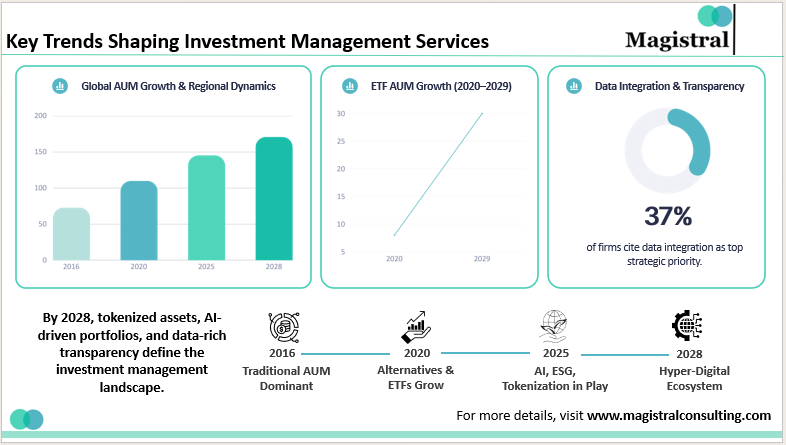
In 2025, generative AI, data engineering, automation, and blockchain have moved from pilot projects to mission-critical systems. Deloitte’s outlook envisions innovative firms that embrace AI in their distribution and operations will create separation from firms that do not. Beyond operations, data integration and transparency are strategic differentiators: according to BNY’s “Future of Asset Management” report, 37% of asset managers say integrating data sources is a top priority over the next 24 months.

Core Functions Defining Investment Management Services in 2025

To achieve the desired impact, investment management services include several integrated capabilities. Here is how each capability begins to evolve in 2025.

Core Functions Defining Investment Management Services

Core Functions Defining Investment Management Services

Portfolio Construction & Asset Allocation

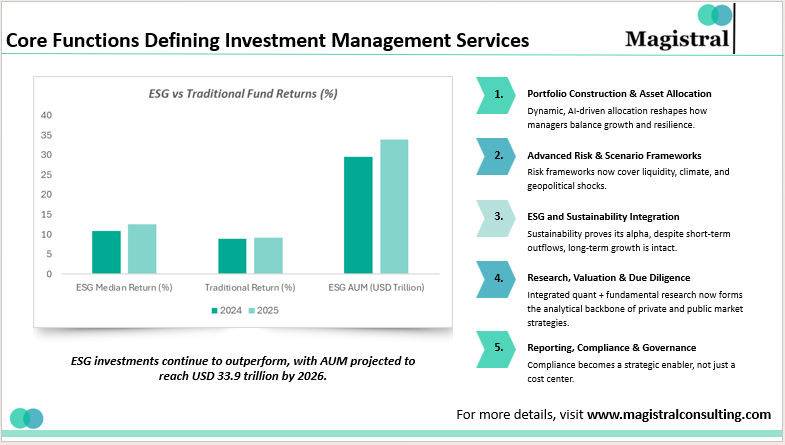
Asset allocation will still be the lead indicator of portfolio results. Managers will overlay strategic, tactical, and regime-aware allocation decisions from equities, fixed income, alternatives, and liquidity. By 2025, some firms will be using dynamic allocation techniques that will use AI and regime-switching models to change exposures to reflect macro or sentiment changes.

Advanced Risk & Scenario Frameworks

Risk management is broadening beyond market risk to include liquidity, operational, regulatory, and climate risks. Asset managers plan to boost investment in advanced risk analytics by over 70% in 2025, with stress testing now covering inflation, supply-chain, climate, and geopolitical shocks to strengthen portfolio resilience.

ESG and Sustainability Integration

ESG has become a core construct rather than a mere adjunct. In January-June 2025, sustainable funds gave 12.5% as median returns in contrast to only 9.2% for their traditional counterparts, thereby proving the alpha potential of ESG. However, with altering volatilities, ESG funds saw outflows to the tune of USD 8.6 billion in Q1. Nevertheless, institutional ESG investments are expected to swell to USD 33.9 trillion by 2026, thereby steadily accounting for more than 21.5% of global AUM.

Research, Valuation & Due Diligence

The rigorous practice of fundamental and quantitative research is still core. In private markets, long-horizon value – 5 to 10 years – will depend upon the depth of due diligence, operations research, and proprietary models with state-of-the-art capabilities. In quant strategies, momentum, regime detection, and tail-risk models are already finding multiple uses when combined with ESG sentiment regimes into new innovative frameworks.

Reporting, Compliance & Governance

As regulatory scrutiny and investor demand for clarity and transparency expand, reporting and compliance become strategic assets. Firms are building proficient tech-based reporting engines and governance layers to enhance auditability, ESG metrics transparency, and fee disclosure. In 2025, compliance spend continues to rise as firms cope with the new pace and dynamics the regulatory space is creating across jurisdictions and more granular ESG rules.

Key Trends Shaping Investment Management Services

Several macro- and industry-level trends continue to reshape investment management services.

Core Functions Defining Investment Management Services

Core Functions Defining Investment Management Services

Global AUM Growth & Regional Dynamics

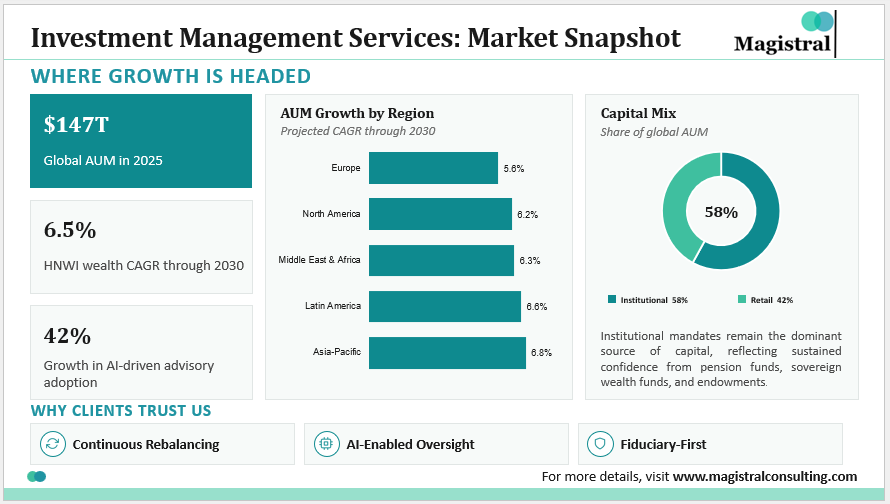
It is estimated that global AUM will be USD 145.4 trillion by 2025, an approximate doubling from levels in 2016. Looking further ahead, PwC predicts that global AUM will by 2028 reach USD 171 trillion, especially driven by alternative and tokenized assets.

Regionally:

North America remains the largest, underpinned by strong institutional flows.

Europe is innovating concerning ESG and sustainable finance, which also brings new regulations demanding deeper disclosures.

Asia-Pacific is currently the fastest-growing region on the back of increasing wealth and the foundation of institutional capital expansion. Major AUM growth expected from Asia in the projection by PwC.

ETF & Passive Vehicle Expansion

Global ETF AUM grew by 27% in 2024, reaching USD 14.6 trillion, and is projected to grow more than double to 30 trillion by 2029. The increasing release of passive and semi-passive vehicles tends to contrast the older standing traditional active managers, as such, expecting a justification of values from these newer real-time offerings, insights, and nimbleness.

Consolidation, M&A, and Outsourcing

From the industry consolidation perspective, it is going premium as firms seek scale in distribution, infrastructure, and alternatives. PwC states that activity in deals will rebound in 2025, while smaller managers will outsource those non-core functions to focus on alpha and client relationships.

Data Integration & Transparency

Data remains the central heart. In 2025, organizations will prioritize integrating disparate systems, ensuring data lineage, and enabling end-to-end visibility. The firm capable of seamless external-internal data infusing ahead (market, ESG, sentiment, alternative) will enjoy a powerful advantage in insight and execution.

Strategies & Best Practices for Investment Management Providers

To be successful within investment management services, firms must take forward-thinking approaches built on flexibility, technology, and a client focus.

Multi-Asset & Regime-Aware Portfolios

Blending equities, bonds, alternatives, and liquid assets helps manage volatility. Regime detection (inflation, rate, or geopolitical shifts) enables dynamic allocation—using AI to de-risk in stress and capture upside in recovery.

Client-Centric Customization & Reporting

Clients demand tailored mandates- tax-aware, legacy-focused, ESG-tilted. Firms offering flexible, transparent reporting and personalized insights build stronger, longer-lasting relationships.

AI, Automation & Model Scaling

AI enhances execution, optimization, risk, and client engagement. While 60% of firms use AI in distribution, only 11% scale it deeply. Success starts with pilots, data governance, and strong model validation.

ESG as Strategy, Not Add-on

Sustainability is integral to portfolio design and risk management. Firms now embed ESG into thematic and transition strategies, focusing on clarity, metrics, and resilience amid volatile flows.

Outlook for Investment Management Services (2025–2028)

Investment management services are likely to develop in response to macro trends, changing client preferences, and advances in technology.

Democratization of Alternatives

Digital platforms will democratize retail access to previously closed alternative asset classes –fractional private credit, tokenized real estate, and niche strategies.

AI-First Decision Architectures

We may see predictive analytics, scenario engines, and AI-based optimization increasingly form the basis of selection allocation decisions, although there may be some human decision-making involved. Traditional firms that develop these AI-first practices will make it harder for incumbents.

ESG Scrutiny & Verification

With pressure from regulators and investors for accountability, sustainability claims will need to be scrutinized. Disclosure, third-party verifications, and metrics to validate impact will be necessary.

Cross-Border Capital & Emerging Market Growth

Emerging markets are becoming sources of capital and destinations for capital. Managers with more local presence and offerings may start to find new flows in Asia, Latin America, and Africa.

Magistral collaborates with investment firms to offer a complete suite of investment management services. They are research and valuations, AI-based analytics, ESG analysis, fund administration, outsourced CFO, and compliance capabilities. By shifting operational burden, we allow clients to focus on strategy, growth, and investor relations. This helps in improving resilience, scalability, and international competitiveness.

About Magistral Consulting

Magistral Consulting has helped multiple funds and companies in outsourcing operations activities. It has service offerings for Private Equity, Venture Capital, Family Offices, Investment Banks, Asset Managers, Hedge Funds, Financial Consultants, Real Estate, REITs, RE funds, Corporates, and Portfolio companies. Its functional expertise is around Deal origination, Deal Execution, Due Diligence, Financial Modelling, Portfolio Management, and Equity Research

For setting up an appointment with a Magistral representative visit www.magistralconsulting.com/contact

About the Author

Prabhash Choudhary is the CEO of Magistral Consulting. He is a Stanford Seed alumnus and mechanical engineer with 20 + years’ leadership at Fortune 500 firms- Accenture Strategy, Deloitte, News Corp, and S&P Global. At Magistral Consulting, he directs global operations and has delivered over $3.5 billion in client impact across finance, research, analytics, and outsourcing. His expertise spans management consulting, investment and strategic research, and operational excellence for 1,200 + clients worldwide


FAQs

What are investment management services?

These are professional services that manage portfolios, allocate assets, conduct research, and ensure compliance and risk oversight for institutions and individuals, aiming to optimize returns while controlling risk.

Why are investment management services important in 2025?

They provide expertise, scale, and technology to help investors navigate complexity, allocate capital dynamically, integrate ESG, and meet escalating regulatory demands.

How do investment management services integrate ESG?

By embedding ESG into risk frameworks, portfolio construction, research scoring, and client reporting, rather than treating sustainability as a separate overlay.

What role does technology play in investment management services?

In 2025, AI, big data, and automation drive efficiency, predictive modeling, client engagement, risk control, and scalable operations across all layers of service delivery.

Introduction

Around the globe, there is a trillion-dollar business of investing in all sorts of assets like equity, both public and private, real estate, and upcoming assets like cryptocurrencies. Once the investment is made, the task on the part of the investor shifts to investment management. There are many activities of investment management that could be outsourced and that is what leads us to analyze the stream of investment management outsourcing. Investment management and hence investment management outsourcing takes all forms depending on the asset being invested in, and the prime business of the asset or investment manager.

Here we take a look at major activities of each type of investment manager or asset manager which could be effectively outsourced to save on costs and improve quality.

Who Should Outsource Investment Management and How?

Outsourced Investment Management

Outsourced Investment Management for different types of Asset Managers

Private Equity and Venture Capital firms

The underlying asset that a Private Equity or a Venture Capital firm invests in is equity. Sometimes it’s for stocks listed on exchanges but most of the time these are private investments, the target of which are start-ups are unlisted companies.

In the PE/VC value chain of investing, there are activities like Fundraising, Deal origination, Deal execution, and Portfolio Management. Quite a few activities in these departments are outsourceable. For fundraising, the activities like investor reach-out, investor profiling, CRMs, newsletters, white papers, and data management jobs could be effectively outsourced. Regarding, Deal origination, the deal pipeline management has a great potential of outsourcing along with initial due diligence. Deal execution processes like valuation and financial modeling are templatized and could be considered. Portfolio management has varied activities and outsourcing potential vary as per the nature of the business of the portfolio companies. Most activities related to Strategy and Marketing have great potential for outsourcing when it comes to Portfolio Management.

Hedge Funds

For the most common type of hedge fund out there, that is a long-short equity hedge fund, multiple activities should be considered for outsourcing. Equity Research is the foremost one. The research that is done for the investors is almost always best to be outsourced. Apart from Equity Research, Fund Administration and Fund Accounting are better done when outsourced. It makes sense from the cost and expertise point of view. Marketing activities almost always have great potential for offshoring.

Real Estate

Managing a real estate asset after the investment comprises standardized work-streams. Most of it relates to collecting data, analyzing it, making reports, and raising red flags if any. Accounting and administration along with research has a great potential for outsourcing

Investment Banks

Investment Banks are into all sorts of assets directly or for their clients. For the varying types of their work pallet, there is varying potential for outsourcing.  For investment banks, activities that are commonly outsourced are Equity Research, Security-based Investment Research, development of excel or other automated models, investment research for private investments, marketing, deal origination, and deal execution. In fact, 30-50% of all activities performed by an investment bank has a solid potential for outsourcing that may be explored

Asset Management Firms

These are for specialized asset managers like managers managing a portfolio of crypto or commodities. There is no one size fits all approach to outsourcing for these asset managers. As a thumb rule, everything related to technology like platform development, automation, website development, or software development can be outsourced. Also, anything that is of support function’s nature like Strategy or Marketing could be looked at.

Models of engagement with the outsourcing vendor

Once you have made your mind to explore outsourcing, the biggest concern is around the way an outsourced vendor or the service provider would work with you and your team. There are three established models of working while outsourcing. These are FTEs, Retainer, and Ad-hoc. Some progressive vendors like Magistral are signing up success-based contracts too.

Outsourcing Engagement Model

Investment Management Outsourcing Engagement Model

FTEs

FTE the most common engagement model for investment management outsourcing.

FTE stands for Full-Time Employee equivalent. It’s like a virtual employee who is operating from a different country. This virtual employee could be coordinated with, on email, video calls, WhatsApp, chats, or any other mode that is suitable to the client and is convenient as per time zone differences. It looks like a person is aligned with the client full time and he works seamlessly with the client. That is always the case, but the vendor, his processes, training, supervision, and culture play a big role in ensuring the continuity of services. A vendor enables the FTE to perform optimally by providing training and desired supervision. The vendor’s processes ensure that the client is insulated from the bad performance of FTE as the work is supervised by more senior resources. In case the individual decides to leave the organization, similarly, qualified and trained professionals are available on the bench for the replacement. That is the reason it makes sense to work with individuals through the service providers who may be an established name in their industry. Working directly through freelancing websites or hiring directly exposes clients to manage costs and risks, which is not the case while dealing with an established service provider.

This also is the cheapest model on per hour basis. But it is inflexible as there may be contractual obligations for a minimum period of support. This case is more prominent when resources are specialized in niche skills

Typical jobs that require FTE engagements are operational, where the offshored team works with the onsite team seamlessly. So, if a task is part of your ongoing investment management operations, mostly it will be outsourced on FTE-based engagement.

Retainer

You know there is a need for outsourcing tasks. At the same time, you think a full-time individual working on these jobs may be overkill. In these situations, where tasks just require some hours every month, the retainer model of engagement comes in handy. Say rather than hiring an FTE or a full-time virtual employee, you would only want 100 hours’ worth of tasks outsourced every month. A retainer is far more flexible than FTEs but costs higher on per hour cost basis. Typical jobs that are suitable for retainer-type outsourcing are newsletters, MIS, reports preparation, and other marketing-related tasks.

Ad-hoc Projects

As the name suggests the engagement is for one-time projects only. A client gives out the scope of the project. The service provider or the vendor provides a proposal that carries, scope of work, timelines, and commercials. The project kicks off after the client signs off the proposal and is paid after the delivery of the project. Almost any project that is strategic and is not expected to be repeated on an ongoing basis is an ideal candidate for ad-hoc based outsourcing. Also, it’s an ideal mode, if you would want to test the services of a vendor before signing a longer-term contract. It is the most flexible outsourcing arrangement as projects may start or end at your convenience, but at the same time, it is costliest in terms of cost per hour basis.

Success Based

Most traditional service providers shy from signing a success-based engagement. The fear stems from the trust deficit, performance fears, and the complications of defining a success scenario. Magistral signs success-based engagements with clients, with whom it has existing relationships. Existing relationships take the risks related to trust deficit and performance. A mutually agreed “success” scenario could also be defined in those situations. The tasks that are outsourced under these arrangements usually relate to fundraising, deal sourcing, and meetings’ set up

Magistral has helped more than 100 clients in outsourcing and offshoring multiple activities related to the Investment Management process. To start a conversation drop a line here.

About Magistral

Magistral Consulting has helped multiple funds and companies in outsourcing operations activities. It has service offerings for Private Equity, Venture Capital, Family OfficesInvestment BanksAsset Managers, Hedge Funds, Financial Consultants, Real Estate, REITs, RE fundsCorporates and Portfolio companies. Its functional expertise is around Deal originationDeal Execution, Due Diligence, Financial ModelingPortfolio Management and Equity Research

For setting up an appointment with a Magistral representative visit www.magistralconsulting.com/contact

About the Author

The Author, Prabhash Choudhary is the CEO of Magistral Consulting and can be reached at Prabhash.choudhary@magistralconsutling.com for any queries or business inquiries.