Tag Archives: fund administration services

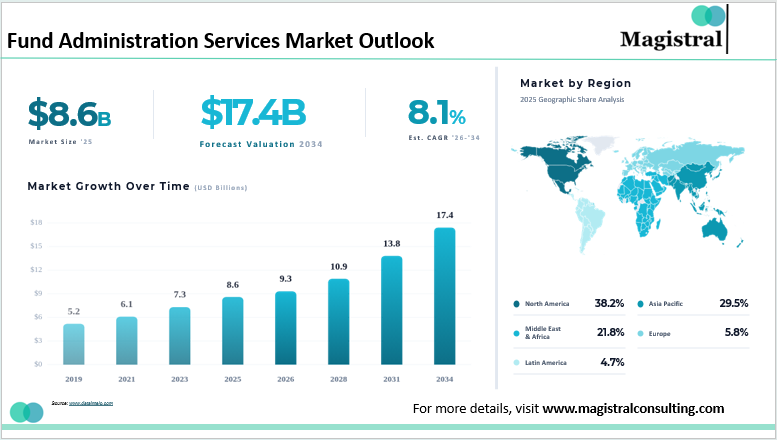
As the size and intricacy of the private markets grow, shifts have elevated fund administration and accounting from a purely back-office function to an essential part of the investment operation. In this regard, the steady expansion of the global fund administration services market can be considered as an indication. Specifically, according to the latest projections, the market will rise from about $5.2 billion in 2019 to $17.4 billion in 2034, recording a CAGR of 8.1% during this period. reference
Fund Administration and Accounting

Fund Administration Services Market Outlook

However, behind all this growth, there is an intricate network that enables all this to be accomplished. Indeed, there are many aspects that require the involvement of fund administration and accounting professionals.

Moreover, over $60 trillion in global assets are being managed using structures supported by the work of fund administration and accounting specialists.

The Evolution of Fund Administration and Accounting

Changes in fund administration and accounting can be attributed to a change in the approach of how companies in the private markets conduct their operations due to increasing competition and reliance on technology. The scaling up of firms alongside a globalization of investors has created the need for a more efficient operation process.

This involves the ability to exercise greater control and make decisions quickly. Additionally, there should be alignment of objectives between the fund manager and the investor. Thus, fund administration and accounting have come to play an essential role in this scenario.

From Back-Office Function to Strategic Enabler

Historically, fund administration and accounting were regarded as support functions concerned only with meeting compliance, keeping records, and conducting periodic financial reporting. Fund administrators’ and accountants’ roles were limited to ensuring that the required regulations were complied with and financial statements were prepared accurately and delivered on schedule for the benefit of the investors. Nowadays, due to the growth and complexity of the private markets, both functions have become strategic enablers that help establish an investor’s confidence and positively affect overall fund performance.

There are several reasons that contribute to this transformation of the functions performed by fund administrators and accountants. Firstly, there is increasing regulation with higher demands regarding the quality and promptness of reports, together with the growing requests of the investors for transparency and more information about fund performance. Secondly, the requirement for the availability of information in real time has become a crucial necessity. Hence, it has become necessary for firms to move from routine reporting towards more flexible approaches to processing data.

Increasing Complexity Across Private Markets

The complexities of the market have grown greatly. Global deal value in terms of private equity transactions has reached the $2 trillion mark, despite a fall in deal flow, pointing towards an increase in deal size.

Moreover, the holding period now extends to around six years, adding to the need for valuations that have to be done for a longer duration and complicated distributions.

Technology and Market Transformation in Fund Administration

Fund administration and accounting are changing in response to market growth, combined with technology advancements. With the growing complexities in fund architecture and investor demands, firms must adjust their operations through more efficient processes that leverage new technology.

This change brings about new dynamics with regard to data flow within organizations and how they process insights, as well as enabling firms to cater to regulatory and client demands. With all these factors considered, it is clear that the current evolution in fund administration and accounting is being driven by technology advancements.

Growth of the Fund Administration Ecosystem

The fund administration industry itself is expanding rapidly, with the global market projected to reach around $68 billion by 2027. The rapid growth is fueled by the increased need for specialization within the financial sphere due to the growing complexity of operations carried out and regulatory compliance requirements. At the same time, the trend indicates a growing tendency to outsource services as companies aim at maintaining high performance through automation.

Finally, the fund accounting software market does not stand still as well and now exceeds the size of $20 billion. The fast growth can be explained by the ever-increasing need for automation and sophisticated technical support which can help to cope with vast amounts of information and complex operations.

The Role of Automation, Data, and AI

The Fund Administration & Accounting industry is being transformed by technology due to increasing efficiency and capabilities. Automation is cutting down on mistakes made and speeding up the reporting process. At the same time, cloud platforms allow for real-time access to the fund’s data.

The introduction of artificial intelligence is also allowing for some more advanced activities like identifying anomalies in data, predicting future events, and recognizing patterns. This means that fund administrators will be able to recognize discrepancies in their calculations sooner and better predict future cash flow trends. Thus, fund management is slowly changing from a process of retrospective reporting to a real-time process.

The Strategic Importance of Fund Administration and Accounting

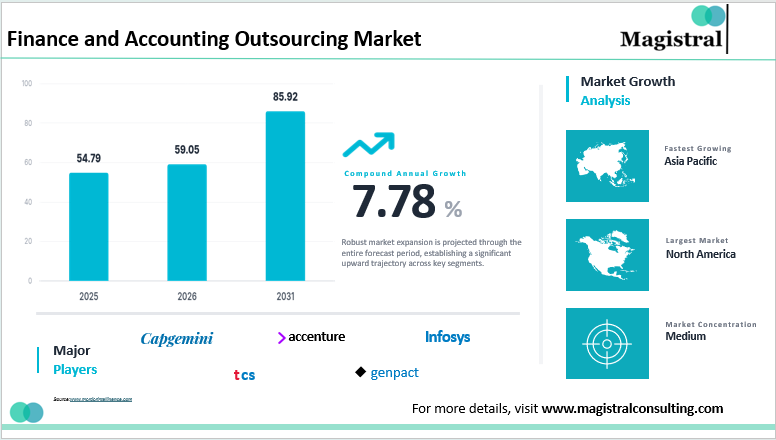
In the case when the capital markets have become very selective when it comes to resource allocation, operational excellence is becoming the key difference between the success and failure of fund managers. Indeed, in line with that, there is an overall trend towards the development of the market of finance and accounting outsourcing, where the size of it is expected to reach almost $95 billion by 2031 with an annual increase of 7.78%. In such conditions, reporting quality will affect investors’ decisions directly, while the efficiency of the process itself will have an impact on both the operation and performance of the funds.
Fund Administration and Accounting

Finance and Accounting Outsourcing Market

Given that investors have become very cautious and use more data-driven approaches to decision-making, the relevance of high-quality fund administration and accounting is increasing. It is not a secret that a well-developed administration has a huge impact on fundraising processes, and, consequently, on future partnerships between the company and its stakeholders. In these conditions, any small improvement in reporting accuracy and efficiency will bring a substantial advantage for the fund manager.

Future Outlook

The future of fund administration and accounting will be driven by scale, standardization, and smarter use of data. Alternative investments are set to rise further in popularity, with private market assets expected to surpass the $10 trillion mark by 2030. Meanwhile, regulatory pressures will become more rigorous and standardized, especially in relation to increased reporting needs. In response, fund administrators will have to adapt their systems to keep pace with changing demands and ensure compliance.

Technology will be the key factor here, as the utilization of AI and analytics within finance is forecasted to increase at over 25% CAGR until 2030. In light of changing investor expectations for increased transparency and real-time access, fund administration and accounting is bound to take on the form of a control centre fueled by data analytics.

How Magistral Supports Fund Administration and Accounting

In an environment where accuracy, transparency, and speed are critical, Magistral supports fund managers by strengthening their fund administration and accounting functions through structured, scalable, and insight-driven solutions. The approach focuses on improving financial reporting quality, ensuring compliance, and streamlining operational workflows to handle increasing complexity across fund structures. By combining domain expertise with process efficiency, Magistral enables firms to maintain tighter control over fund operations while meeting evolving investor and regulatory expectations.

Magistral’s support includes:

Fund accounting and financial reporting aligned with industry standards

NAV calculations and portfolio valuation support

Waterfall modeling and distribution analysis

Investor reporting and capital account management

Reconciliation, audit support, and compliance assistance

Financial data management and reporting process optimization

Automation support to improve accuracy and reduce manual effort

This integrated approach ensures that fund managers can operate with greater efficiency and confidence, while focusing on core investment activities.


About Magistral Consulting

Magistral Consulting has helped multiple funds and companies in outsourcing operations activities. It has service offerings for Private Equity, Venture Capital, Family Offices, Investment Banks, Asset Managers, Hedge Funds, Financial Consultants, Real Estate, REITs, RE funds, Corporates, and Portfolio companies. Its functional expertise is around Deal origination, Deal Execution, Due Diligence, Financial Modelling, Portfolio Management, and Equity Research

For setting up an appointment with a Magistral representative visit www.magistralconsulting.com/contact

About the Author
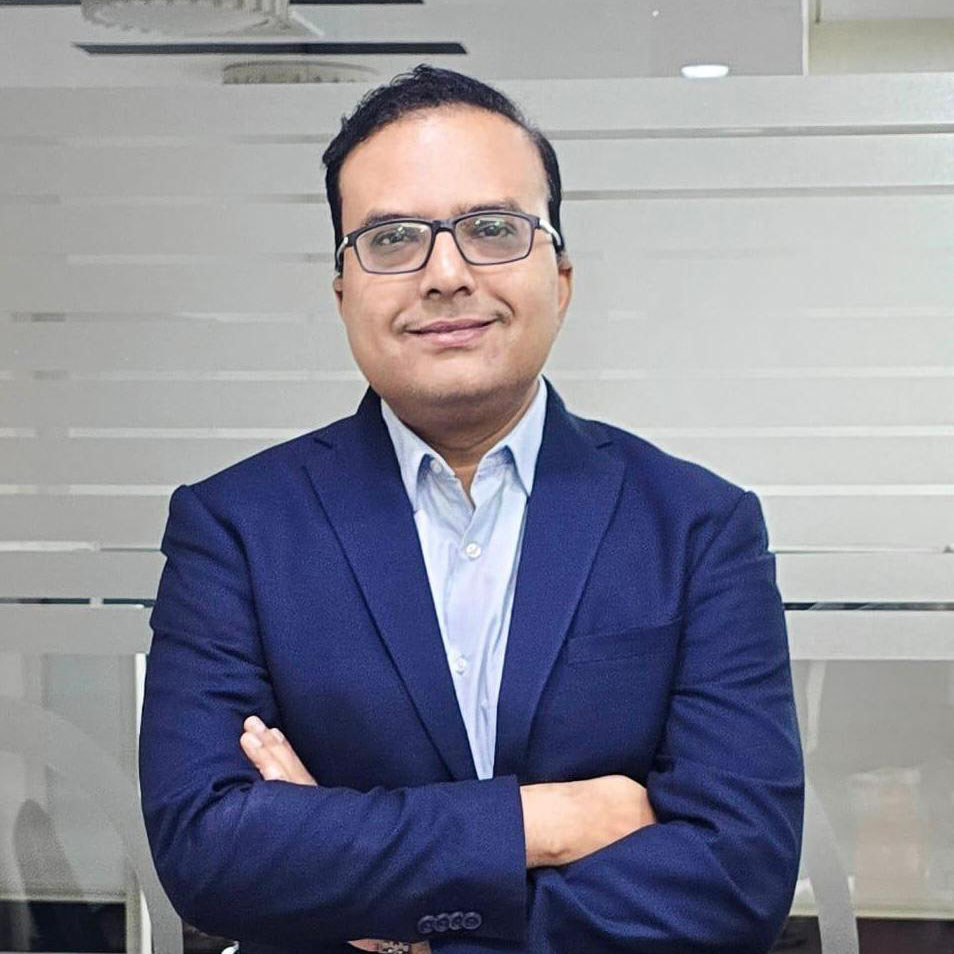
Prabhash Choudhary is the CEO of Magistral Consulting. He is a Stanford Seed alumnus and mechanical engineer with 20 + years’ leadership at Fortune 500 firms- Accenture Strategy, Deloitte, News Corp, and S&P Global. At Magistral Consulting, he directs global operations and has delivered over $3.5 billion in client impact across finance, research, analytics, and outsourcing. His expertise spans management consulting, investment and strategic research, and operational excellence for 1,200 + clients worldwide


FAQs

Who does Magistral typically work with?

Magistral works with a wide range of clients including private equity and venture capital firms, hedge funds, family offices, and corporates seeking data-driven insights and execution support.

Does Magistral offer customized solutions?

Yes, Magistral provides tailored solutions based on client requirements, whether it is for fundraising, investment analysis, or fund operations. Each engagement is aligned with the client’s strategy, sector focus, and operational needs.

What specific fund accounting services does Magistral provide?

Magistral provides support across NAV calculations, financial reporting, portfolio valuation, waterfall modeling, and investor reporting, ensuring that all key accounting functions are managed accurately and efficiently.

How does Magistral enhance efficiency in fund administration operations?
Magistral improves efficiency by optimizing workflows, reducing manual effort through automation support, and ensuring better data management. This allows fund managers to focus more on investment activities while maintaining strong operational control.


The hedge fund industry is evolving, with rising performance pressure and operational complexity driving greater adoption of outsourcing. Instead of building large in-house teams, firms are increasingly relying on external providers for middle- and back-office functions. Reflecting this shift, Deloitte reports that over 70% of hedge funds now outsource at least one operational activity.

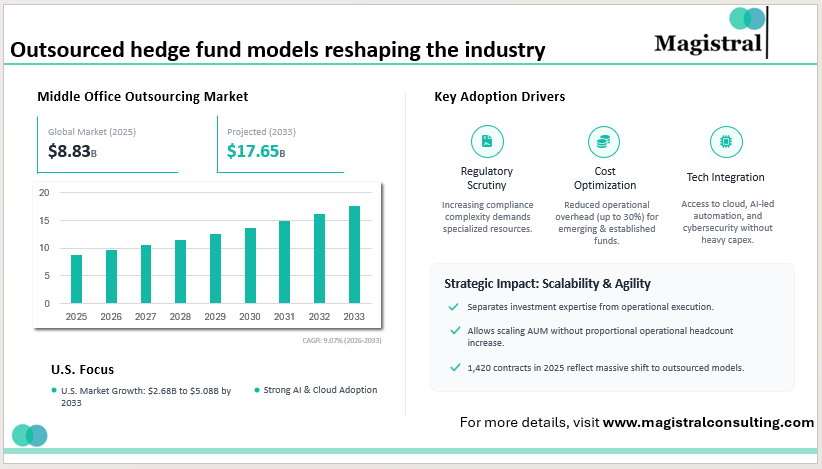
Outsourced hedge fund models are reshaping the industry

The Middle Office Outsourcing market, which was valued at 8.83 billion USD in 2025, is expected to grow to 17.65 billion USD by 2033, with a growth rate of 9.07% during 2026-2033, with 2025 as the base year. The global outsourcing market size stood at 1,420 contracts in 2025, which indicates a high level of adoption of cloud-based operating models.
The Middle Office Outsourcing market in the USA is expected to grow from 2.68 billion USD in 2025 to 5.08 billion USD in 2033, with a growth rate of 8.37%. This growth will be driven by digitalization, AI-led automation, and increased regulatory needs for asset managers and investment firms.

Outsourced hedge fund models reshaping the industry

Outsourced hedge fund models reshaping the industry

Outsourced hedge fund structures are changing the face of modern hedge fund management by decoupling investment talent from operational capabilities.
This change will allow hedge fund managers to stay nimble while growing efficiently in a competitive global marketplace.

Evolution from in-house to outsourced models

Traditionally, hedge funds have had in-house teams to handle various activities, including accounting, reporting, and compliance. However, due to increasing costs and regulatory requirements, this is no longer a sustainable option. As a result, hedge funds have started exploring alternative strategies, including outsourcing.
Furthermore, this is in line with the evolution of alternative investment strategies, including private equity, which has benefited from outsourcing operations.

Major driving factors for the adoption of outsourcing

The regulatory environment is becoming increasingly complex, which is driving the cost of compliance.

Cost optimization is still an important factor, particularly for emerging hedge funds.

Technology is an important factor, as integrating with existing technologies requires specialized skill sets that are not always available within the hedge fund.

These driving factors are resulting in the accelerated adoption of the outsourced hedge fund model worldwide.

Role of technology in outsourced hedge fund operations

Technology is an integral part of the outsourced hedge fund process. Cloud-based technologies, automation tools, and artificial intelligence-based analytical tools provide the outsourced provider with the ability to deliver faster and more accurate results. According to PwC’s 2025 asset management report, firms that utilize outsourced digital technologies have been able to reduce the cost of operations by as much as 30 percent.

Automation in reporting and reconciliation

Automation is used to reduce the potential for human error in reporting while ensuring the timely delivery of reports to investors. This is particularly important for hedge funds with complex portfolios comprising various asset classes.

Data security and compliance frameworks

Today, outsourcing firms heavily invest in data security and compliance systems, thereby ensuring that financial information is secure and at the same time meets international regulatory requirements.

Impact on fund scalability

The outsourced model of hedge funds enables firms to scale their operations without a corresponding rise in cost. For instance, a hedge fund that has seen its asset base double does not have to double its operational staff because of an outsourced model. This is particularly important in a fluctuating marketplace.

Outsourced hedge fund services and functional coverage

The outsourced hedge fund solutions range across a variety of operational areas, thus allowing them to outsource non-core activities while maintaining control over investment decisions.

Fund administration and accounting

Fund administration is one of the most outsourced areas in hedge funds. Fund administration includes calculating net asset value, financial reporting, and communicating with investors. According to Preqin, more than 80 percent of hedge funds utilize third-party administrators for these operations, as indicated in their 2024 data.

Financial reporting is also an important aspect of fund management strategies.

Middle office support

Outsourcing of middle office support activities such as trade processing, risk management, and performance analysis is also increasing. Such activities demand high technology and expertise and are thus good candidates for outsourcing.

Risk analytics and portfolio monitoring

Service providers use high technology for real-time monitoring of risks associated with portfolios. This helps fund managers make informed decisions regarding their portfolios.

Trade lifecycle management

Trade processing is an important activity for any investment firm. Outsourcing of trade processing is increasing due to its significance for operational reliability.

Compliance and regulatory reporting

Compliance is a major problem for hedge funds that operate globally. Outsourcing of hedge fund services provides specialized solutions for such problems and helps investment firms comply with regulations and laws of different countries and jurisdictions.

Investor relations and reporting

Investor needs have changed over time and are demanding greater transparency and quicker reporting of information. Outsourcing of hedge fund services helps investment managers maintain better relationships with investors by providing them with accurate and quicker information about the performance of the investment portfolios.

Integration with broader investment ecosystems

Outsourcing also helps investment managers to leverage other investment strategies such as venture capital, in which operational efficiency is critical for portfolio scalability.

Outsourced hedge fund benefits and strategic advantages

Outsourced hedge fund models have several advantages that go beyond cost savings and are important for the long-term success of a hedge fund.

Cost efficiency and resource optimization

One of the most attractive advantages of an outsourced hedge fund is cost optimization. Outsourced hedge funds do not have to maintain a large team of employees and do not have to invest heavily in infrastructure. According to reports, a hedge fund may achieve a cost optimization of 20-40% by outsourcing its operations.

Enhanced focus on core competencies

Outsourcing also helps hedge fund managers focus on their core competencies. This is a significant advantage for a hedge fund because a focus on core competencies is essential for the success of a hedge fund.

Access to specialized expertise

Outsourcing also helps a hedge fund gain access to expertise in different fields. This is another significant advantage of an outsourced hedge fund model.

Improved accuracy and operational reliability

Outsourced providers have access to the latest technology and tools and are better able to achieve accuracy and reliability in their operations. This is a significant advantage for a hedge fund because accuracy and reliability are essential for the long-term success of a hedge fund.

AI in Hedge Funds

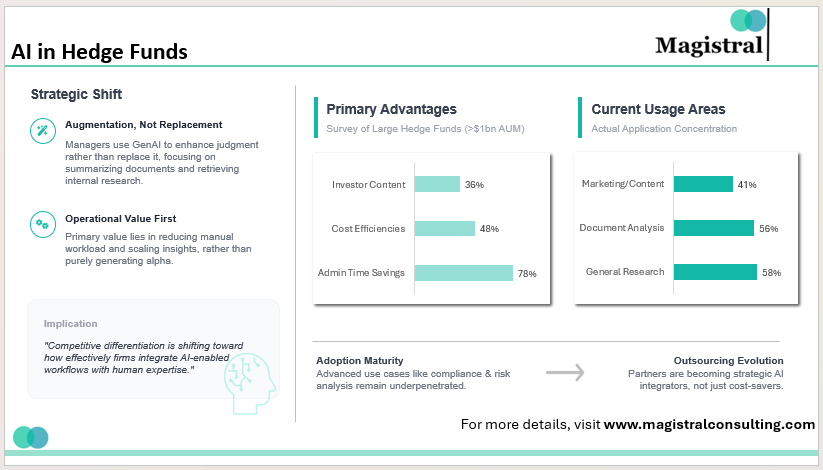
Generative AI in hedge funds has rapidly evolved from experimentation to a core operational tool, primarily supporting research, reporting, and workflow efficiency rather than replacing investment judgment. Its biggest impact is operational—improving speed and productivity.

Surveys show that 78% of large hedge funds use AI for time savings in administrative tasks, while many also benefit from cost reduction and improved investor communication. Current usage is concentrated in areas like research, document analysis, and content creation, with more advanced applications in risk and compliance still emerging.

AI in Hedge Funds

AI in Hedge Funds

From a hedge fund outsourced model viewpoint, this is particularly pertinent as GenAI standardizes and automates high-volume, routine activities such as research synthesis, reporting, and regulatory checks; in doing so, it naturally fits into a framework of outsourcing these activities at scale. The inference here is that competitive differentiation is moving away from these types of executional activities and more towards how effectively these firms leverage AI-driven workflows in conjunction with their human expertise – thus making outsourcing partners more strategically important rather than cost-driven.

Outsourced hedge fund support by Magistral Consulting

Magistral Consulting offers extensive support to hedge funds according to their specific needs.

End-to-end operational support

Magistral offers a variety of services for outsourced hedge fund, including fund administration, financial modeling, and investor reporting. These services allow hedge funds to operate efficiently.

Advanced analytics and technology integration

The company utilizes advanced analytics and technology to provide precise and timely information. This enables the company to perform better.

Customized solutions for diverse fund strategies

Magistral understands that every hedge fund has different operations. Thus, the company provides customized solutions for specific fund strategies.

Expertise across investment domains

The company has expertise in different asset classes, such as hedge funds, private equity, and venture capital. Thus, the company can provide holistic solutions.

About Magistral Consulting

Magistral Consulting has helped multiple funds and companies in outsourcing operations activities. It has service offerings for Private Equity, Venture Capital, Family Offices, Investment Banks, Asset Managers, Hedge Funds, Financial Consultants, Real Estate, REITs, RE funds, Corporates, and Portfolio companies. Its functional expertise is around Deal origination, Deal Execution, Due Diligence, Financial Modelling, Portfolio Management, and Equity Research

For setting up an appointment with a Magistral representative visit www.magistralconsulting.com/contact

About the Author

Prabhash Choudhary is the CEO of Magistral Consulting. He is a Stanford Seed alumnus and mechanical engineer with 20 + years’ leadership at Fortune 500 firms- Accenture Strategy, Deloitte, News Corp, and S&P Global. At Magistral Consulting, he directs global operations and has delivered over $3.5 billion in client impact across finance, research, analytics, and outsourcing. His expertise spans management consulting, investment and strategic research, and operational excellence for 1,200 + clients worldwide

FAQs

What is an outsourced hedge fund model?

An outsourced hedge fund model involves delegating operational functions such as accounting, compliance, and reporting to third-party service providers while retaining investment decision-making in-house.

Why are hedge funds adopting outsourcing?

Hedge funds adopt outsourcing to reduce costs, improve efficiency, access specialized expertise, and focus on core investment activities.

Is outsourcing safe for hedge funds?

Yes, outsourcing is safe when funds select reputable providers with strong cybersecurity measures and compliance frameworks in place.

What functions can be outsourced in hedge funds?

Functions such as fund administration, middle office operations, compliance, and investor reporting can be outsourced effectively.

How does outsourcing impact investor confidence?

Outsourcing improves transparency, accuracy, and reporting speed, which enhances investor trust and confidence in the fund’s operations.

Fund administration has evolved from a relatively straightforward back-office function into a complex operational discipline, driven by heightened regulatory scrutiny and increasing investor demands for timely, transparent reporting. As fund structures and compliance requirements expand globally, outsourcing has shifted from a cost-focused decision to a strategic operating choice. Rather than building large in-house teams, many fund managers now rely on experienced third-party administrators to deliver scale, process rigor, and risk control. As highlighted in Deloitte’s Investment Management Outlook, management teams are increasingly prioritizing process efficiency and operational risk reduction, allowing fund managers to focus on alpha generation while ensuring accurate, compliant, and scalable fund operations throughout the fund lifecycle.

Fund Admin Outsourcing and the Evolution of Fund Operations

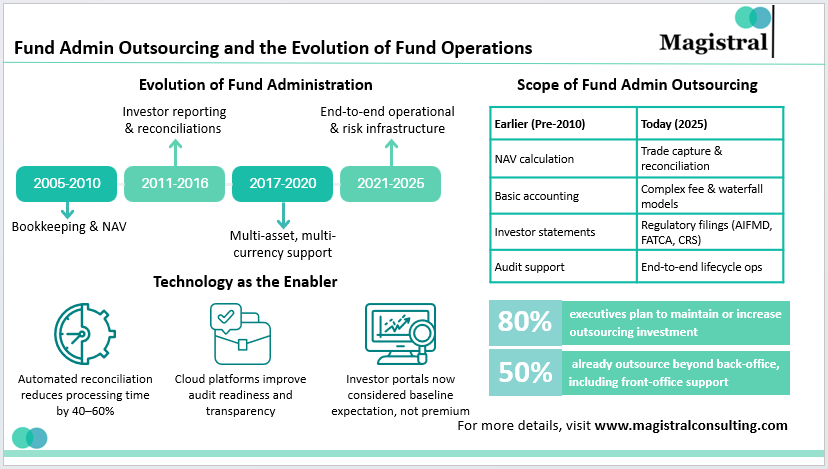
Fund Admin Outsourcing has evolved alongside the growth of alternative assets and cross-border investing. What once covered basic bookkeeping now spans end-to-end operational support across complex structures.

Fund Admin Outsourcing and the Evolution of Fund Operations

Fund Admin Outsourcing and the Evolution of Fund Operations

Expanding the scope of Fund Admin Outsourcing services

Earlier models focused largely on NAV calculation and investor statements. Today, administrators handle trade capture, reconciliation, fee calculations, waterfall models, and regulatory filings. Deloitte’s Global Outsourcing Survey 2024 reports that 80% of executives plan to maintain or increase investment in third-party outsourcing, and 50% used outsourced services for front-office capabilities

Role in supporting diverse fund structures

Modern portfolios span hedge funds, private credit, infrastructure, and hybrid strategies. Each structure brings its own accounting and reporting nuance. Through Fund Admin Outsourcing, managers tap teams with broad experience across asset classes-including multi-currency, multi-jurisdiction funds. This depth is particularly valuable when managers expand into new strategies without building parallel internal teams.

Technology as a catalyst for change

Cloud-based accounting platforms, automated reconciliations, and secure investor portals have redefined service expectations. Administrators invest heavily in technology, spreading costs across clients. PwC notes that from investment analysis to regulatory reporting, processes that once took weeks can be completed far faster with advanced automation, while improving audit readiness.

Impact on operational resilience

Due to the upheaval in the Market, Operational Risk now occupies a significant place among the concerns of board-level personnel. By establishing redundant practices and procedures, standardising Operations, documenting all Controls related to Financial Operations, and utilising Dedicated Oversight Teams for all processes, Fund Administration Outsourcing can be viewed as an Operational Risk Management Tool, as opposed to simply a Cost Savings Solution.

Fund Admin Outsourcing for Compliance, Accuracy, and Transparency

Regulation and investor scrutiny continue to intensify, making compliance and data integrity central to fund credibility. Fund Admin Outsourcing plays a critical role in meeting these expectations.

Strengthening regulatory compliance frameworks

Regulatory requirements are expanding across jurisdictions (e.g., SEC rulemaking/enforcement and AIFMD2 updates), increasing the burden of reporting, controls, and governance, driving demand for specialist compliance and reporting capability.

Enhancing accuracy in financial reporting

Accurate NAVs and timely reports form the backbone of investor trust. Outsourced administrators apply maker-checker controls, standardized valuation policies, and independent verification processes. This structured approach improves accuracy, particularly during volatile markets when pricing errors are more likely.

Investor reporting and transparency demands

Limited partners now expect near real-time visibility into portfolio performance. Through Fund Admin Outsourcing, managers can offer consistent reporting packages, secure portals, and standardized disclosures. This transparency is especially important for institutional investors allocating across private equity and other alternative strategies where comparability matters.

Audit readiness and governance support

External audits consume significant management bandwidth. Administrators streamline audits by maintaining clean documentation, reconciled data, and clear audit trails. As a result, audit cycles shorten, and governance oversight improves without overburdening internal teams.

Fund Admin Outsourcing as a Cost and Scalability Lever

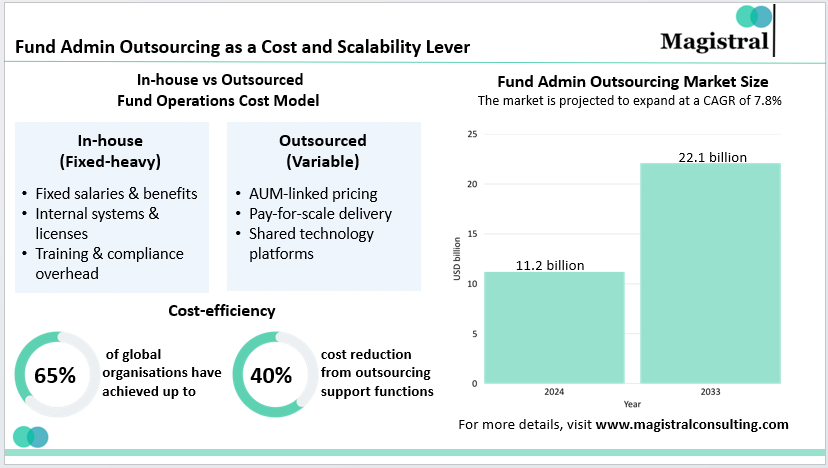
Beyond compliance, Fund Operations Support offers a flexible operating model that aligns costs with growth and complexity.

Fund Admin Outsourcing as a Cost and Scalability Lever

Fund Admin Outsourcing as a Cost and Scalability Lever

Variable cost structure and efficiency gains

Building an internal operations team involves fixed salaries, systems, and training costs. Outsourcing converts these into variable expenses that scale with assets under management. PwC highlights an industry reality of sustained profitability pressure and high cost-to-income dynamics, reinforcing why firms pursue cost-efficient operating models (automation, scalable delivery, partner ecosystems).

Supporting growth without operational strain

As funds raise new vehicles or expand geographically, operational demands increase sharply. Outsourced administrators absorb this complexity, allowing managers to scale without disruption. This flexibility proves valuable for firms active in venture capital or emerging strategies where growth can be uneven.

Focus on core investment activities

By shifting administrative responsibilities externally, internal teams dedicate more time to portfolio construction, risk analysis, and investor engagement. This sharper focus often translates into stronger performance narratives and more effective capital raising efforts.

Alignment with digital transformation

Administrators continuously upgrade systems to meet client expectations. Funds benefit from enterprise-grade platforms without bearing full implementation costs. Over time, this alignment with digital best practices strengthens operational maturity across the organization.

Fund Admin Outsourcing and Strategic Decision Making

Operational data generated through this increasingly feeds into higher-level decision-making rather than sitting in silos.

Data-driven insights for fund managers

The use of timely and standardized operational data allows the manager to identify performance trends and analyze liquidity and fee structures more effectively. This increased understanding and ability to forecast and make better decisions regarding investment portfolios, particularly in today’s volatile market.

Integration with broader finance functions

Many times, outsourced administration supports outsourced accounting, compliance, and CFO services, which combine to create a more coordinated approach between finance and operations (i.e. to eliminate/reduce double counting and errors).

Supporting institutional-grade governance

As managers begin to attract larger institutional investors, governance expectations are increasing and provide a level of documentation discipline and reporting controls that pension funds, endowments, and sovereign investors expect.

Preparing for future regulatory and market shifts

The regulatory environment will continue to change over time and by working with an experienced administration, managers can be ahead of such changes instead of being reactive. This proactive approach creates long-term resiliency.

How Magistral Consulting Enables Value Through Fund Admin Outsourcing

The selection of an appropriate outsourcing partner is just as critical as the act of outsourcing itself. Magistral Consulting takes the position that Fund Admin Outsourcing should be viewed as a tool for enabling strategic growth rather than as a simple transaction.

Customized operating models for diverse funds

Magistral creates administrative models that fit the fund’s overall strategy, structure, and plans for future growth. Both emerging managers and long-established platforms are supported by a continued focus on scalability and control.

Process optimization and oversight

In addition to performing the actual tasks of administration, Magistral prioritizes the policies and processes associated with governance, oversight, and the process of continuous improvement. Well-defined metrics associated with service levels, full transparency in the reporting, and a regular schedule of performance reviews will ensure that funds remain aligned with the objectives of fund investors.

Technology-enabled delivery

By taking advantage of modern technologies and automation, Magistral is able to optimize the timeframes to execute transactions, improve the accuracy of data, and has tight internal controls. This ensures the proper balance between efficiency and risk management.

Long-term partnership mindset

Fund Admin Outsourcing should be viewed as a partnership. In addition to performing the usual tasks associated with Fund Admin Outsourcing, Magistral partners closely with management teams, developing the administrative model as funds continue to evolve. As such, Magistral can create a sustainable model for growth rather than a short-term solution.

About Magistral Consulting

Magistral Consulting has helped multiple funds and companies in outsourcing operations activities. It has service offerings for Private Equity, Venture Capital, Family Offices, Investment Banks, Asset Managers, Hedge Funds, Financial Consultants, Real Estate, REITs, RE funds, Corporates, and Portfolio companies. Its functional expertise is around Deal origination, Deal Execution, Due Diligence, Financial Modelling, Portfolio Management, and Equity Research

For setting up an appointment with a Magistral representative visit www.magistralconsulting.com/contact

About the Author

Nitin is a Partner and Co-Founder at Magistral Consulting. He is a Stanford Seed MBA (Marketing) and electronics engineer with 19 + years at S&P Global and Evalueserve, leading research, analytics, and inside‑sales teams. An investment‑ and financial‑research specialist, he has delivered due‑diligence, fund‑administration, and market‑entry projects for clients worldwide. He now shapes Magistral Consulting’s strategic direction, oversees global operations, and drives business‑development support.

FAQs

What functions are typically included in Fund Admin Outsourcing?

Fund Admin Outsourcing usually covers fund accounting, NAV calculation, investor reporting, regulatory filings, and audit support, with scope varying by fund strategy and size.

Is Fund Admin Outsourcing suitable for smaller or emerging managers?

Yes. Smaller managers often benefit the most because outsourcing provides access to experienced teams and technology without heavy upfront investment.

How does Fund Admin Outsourcing improve investor confidence?

Consistent reporting, independent controls, and timely disclosures enhance transparency and accuracy, which directly strengthens investor trust.

Does outsourcing reduce control over fund operations?

Outsourcing does not eliminate control. Clear governance frameworks and oversight mechanisms ensure managers retain decision-making authority.

How long does it take to transition to Fund Admin Outsourcing?

Transition timelines vary, but most funds complete onboarding within three to six months depending on complexity and data readiness.