Tag Archives: Middle Office Outsourcing

The hedge fund industry is evolving, with rising performance pressure and operational complexity driving greater adoption of outsourcing. Instead of building large in-house teams, firms are increasingly relying on external providers for middle- and back-office functions. Reflecting this shift, Deloitte reports that over 70% of hedge funds now outsource at least one operational activity.

Outsourced hedge fund models are reshaping the industry

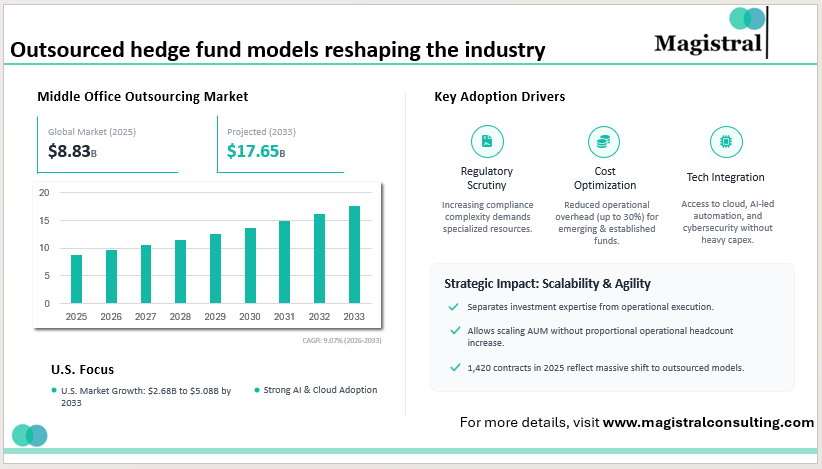
The Middle Office Outsourcing market, which was valued at 8.83 billion USD in 2025, is expected to grow to 17.65 billion USD by 2033, with a growth rate of 9.07% during 2026-2033, with 2025 as the base year. The global outsourcing market size stood at 1,420 contracts in 2025, which indicates a high level of adoption of cloud-based operating models.
The Middle Office Outsourcing market in the USA is expected to grow from 2.68 billion USD in 2025 to 5.08 billion USD in 2033, with a growth rate of 8.37%. This growth will be driven by digitalization, AI-led automation, and increased regulatory needs for asset managers and investment firms.
Outsourced hedge fund models reshaping the industry

Outsourced hedge fund models reshaping the industry

Outsourced hedge fund structures are changing the face of modern hedge fund management by decoupling investment talent from operational capabilities.
This change will allow hedge fund managers to stay nimble while growing efficiently in a competitive global marketplace.

Evolution from in-house to outsourced models

Traditionally, hedge funds have had in-house teams to handle various activities, including accounting, reporting, and compliance. However, due to increasing costs and regulatory requirements, this is no longer a sustainable option. As a result, hedge funds have started exploring alternative strategies, including outsourcing.
Furthermore, this is in line with the evolution of alternative investment strategies, including private equity, which has benefited from outsourcing operations.

Major driving factors for the adoption of outsourcing

The regulatory environment is becoming increasingly complex, which is driving the cost of compliance.

Cost optimization is still an important factor, particularly for emerging hedge funds.

Technology is an important factor, as integrating with existing technologies requires specialized skill sets that are not always available within the hedge fund.

These driving factors are resulting in the accelerated adoption of the outsourced hedge fund model worldwide.

Role of technology in outsourced hedge fund operations

Technology is an integral part of the outsourced hedge fund process. Cloud-based technologies, automation tools, and artificial intelligence-based analytical tools provide the outsourced provider with the ability to deliver faster and more accurate results. According to PwC’s 2025 asset management report, firms that utilize outsourced digital technologies have been able to reduce the cost of operations by as much as 30 percent.

Automation in reporting and reconciliation

Automation is used to reduce the potential for human error in reporting while ensuring the timely delivery of reports to investors. This is particularly important for hedge funds with complex portfolios comprising various asset classes.

Data security and compliance frameworks

Today, outsourcing firms heavily invest in data security and compliance systems, thereby ensuring that financial information is secure and at the same time meets international regulatory requirements.

Impact on fund scalability

The outsourced model of hedge funds enables firms to scale their operations without a corresponding rise in cost. For instance, a hedge fund that has seen its asset base double does not have to double its operational staff because of an outsourced model. This is particularly important in a fluctuating marketplace.

Outsourced hedge fund services and functional coverage

The outsourced hedge fund solutions range across a variety of operational areas, thus allowing them to outsource non-core activities while maintaining control over investment decisions.

Fund administration and accounting

Fund administration is one of the most outsourced areas in hedge funds. Fund administration includes calculating net asset value, financial reporting, and communicating with investors. According to Preqin, more than 80 percent of hedge funds utilize third-party administrators for these operations, as indicated in their 2024 data.

Financial reporting is also an important aspect of fund management strategies.

Middle office support

Outsourcing of middle office support activities such as trade processing, risk management, and performance analysis is also increasing. Such activities demand high technology and expertise and are thus good candidates for outsourcing.

Risk analytics and portfolio monitoring

Service providers use high technology for real-time monitoring of risks associated with portfolios. This helps fund managers make informed decisions regarding their portfolios.

Trade lifecycle management

Trade processing is an important activity for any investment firm. Outsourcing of trade processing is increasing due to its significance for operational reliability.

Compliance and regulatory reporting

Compliance is a major problem for hedge funds that operate globally. Outsourcing of hedge fund services provides specialized solutions for such problems and helps investment firms comply with regulations and laws of different countries and jurisdictions.

Investor relations and reporting

Investor needs have changed over time and are demanding greater transparency and quicker reporting of information. Outsourcing of hedge fund services helps investment managers maintain better relationships with investors by providing them with accurate and quicker information about the performance of the investment portfolios.

Integration with broader investment ecosystems

Outsourcing also helps investment managers to leverage other investment strategies such as venture capital, in which operational efficiency is critical for portfolio scalability.

Outsourced hedge fund benefits and strategic advantages

Outsourced hedge fund models have several advantages that go beyond cost savings and are important for the long-term success of a hedge fund.

Cost efficiency and resource optimization

One of the most attractive advantages of an outsourced hedge fund is cost optimization. Outsourced hedge funds do not have to maintain a large team of employees and do not have to invest heavily in infrastructure. According to reports, a hedge fund may achieve a cost optimization of 20-40% by outsourcing its operations.

Enhanced focus on core competencies

Outsourcing also helps hedge fund managers focus on their core competencies. This is a significant advantage for a hedge fund because a focus on core competencies is essential for the success of a hedge fund.

Access to specialized expertise

Outsourcing also helps a hedge fund gain access to expertise in different fields. This is another significant advantage of an outsourced hedge fund model.

Improved accuracy and operational reliability

Outsourced providers have access to the latest technology and tools and are better able to achieve accuracy and reliability in their operations. This is a significant advantage for a hedge fund because accuracy and reliability are essential for the long-term success of a hedge fund.

AI in Hedge Funds

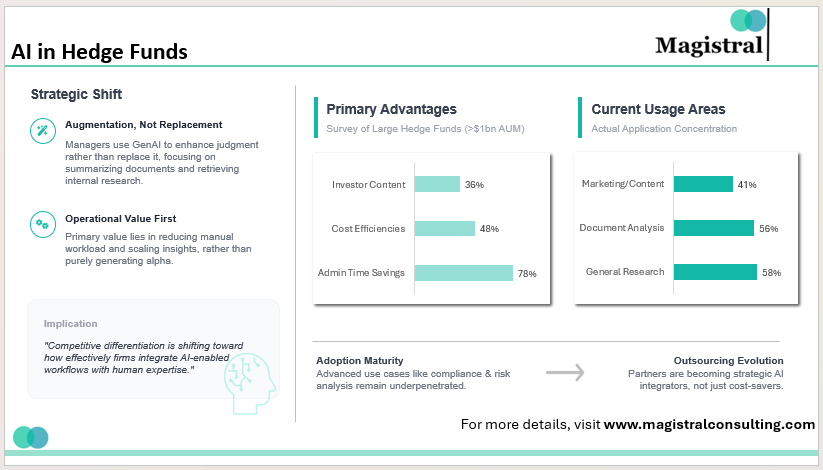
Generative AI in hedge funds has rapidly evolved from experimentation to a core operational tool, primarily supporting research, reporting, and workflow efficiency rather than replacing investment judgment. Its biggest impact is operational—improving speed and productivity.

Surveys show that 78% of large hedge funds use AI for time savings in administrative tasks, while many also benefit from cost reduction and improved investor communication. Current usage is concentrated in areas like research, document analysis, and content creation, with more advanced applications in risk and compliance still emerging.
AI in Hedge Funds

AI in Hedge Funds

From a hedge fund outsourced model viewpoint, this is particularly pertinent as GenAI standardizes and automates high-volume, routine activities such as research synthesis, reporting, and regulatory checks; in doing so, it naturally fits into a framework of outsourcing these activities at scale. The inference here is that competitive differentiation is moving away from these types of executional activities and more towards how effectively these firms leverage AI-driven workflows in conjunction with their human expertise – thus making outsourcing partners more strategically important rather than cost-driven.

Outsourced hedge fund support by Magistral Consulting

Magistral Consulting offers extensive support to hedge funds according to their specific needs.

End-to-end operational support

Magistral offers a variety of services for outsourced hedge fund, including fund administration, financial modeling, and investor reporting. These services allow hedge funds to operate efficiently.

Advanced analytics and technology integration

The company utilizes advanced analytics and technology to provide precise and timely information. This enables the company to perform better.

Customized solutions for diverse fund strategies

Magistral understands that every hedge fund has different operations. Thus, the company provides customized solutions for specific fund strategies.

Expertise across investment domains

The company has expertise in different asset classes, such as hedge funds, private equity, and venture capital. Thus, the company can provide holistic solutions.

About Magistral Consulting

Magistral Consulting has helped multiple funds and companies in outsourcing operations activities. It has service offerings for Private Equity, Venture Capital, Family Offices, Investment Banks, Asset Managers, Hedge Funds, Financial Consultants, Real Estate, REITs, RE funds, Corporates, and Portfolio companies. Its functional expertise is around Deal origination, Deal Execution, Due Diligence, Financial Modelling, Portfolio Management, and Equity Research

For setting up an appointment with a Magistral representative visit www.magistralconsulting.com/contact

About the Author
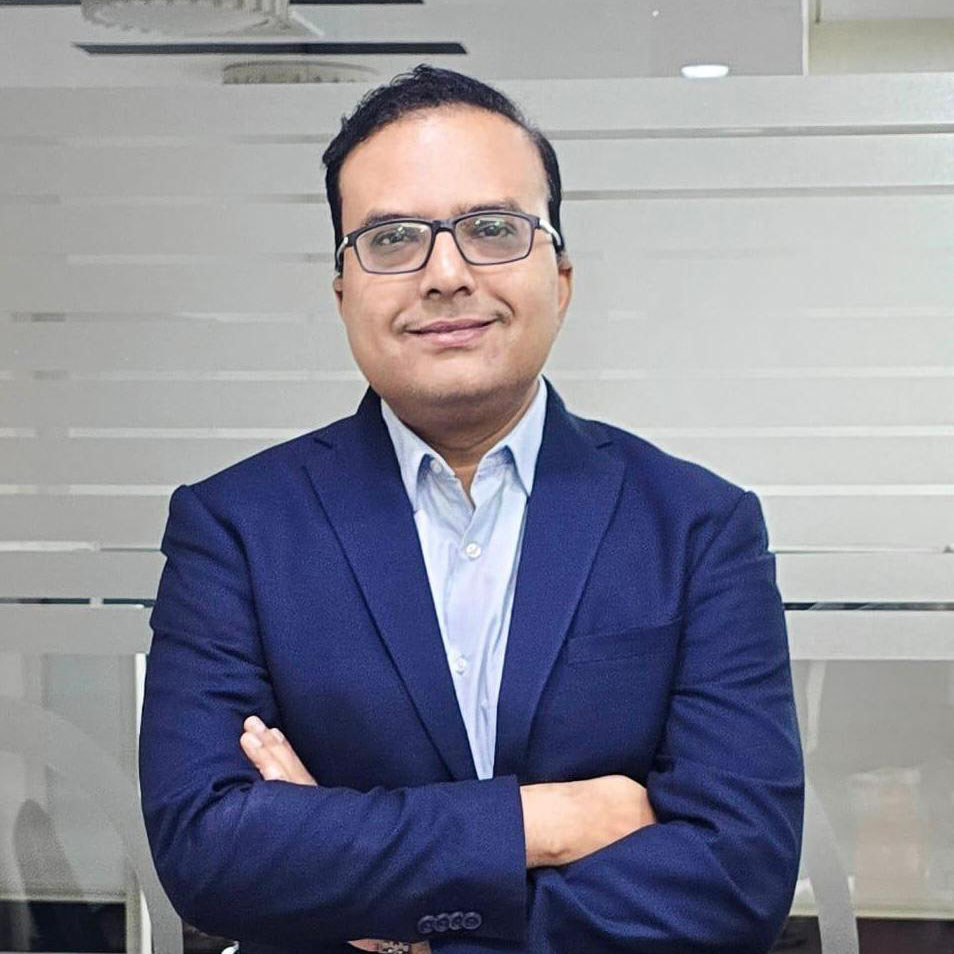
Prabhash Choudhary is the CEO of Magistral Consulting. He is a Stanford Seed alumnus and mechanical engineer with 20 + years’ leadership at Fortune 500 firms- Accenture Strategy, Deloitte, News Corp, and S&P Global. At Magistral Consulting, he directs global operations and has delivered over $3.5 billion in client impact across finance, research, analytics, and outsourcing. His expertise spans management consulting, investment and strategic research, and operational excellence for 1,200 + clients worldwide
FAQs

What is an outsourced hedge fund model?

An outsourced hedge fund model involves delegating operational functions such as accounting, compliance, and reporting to third-party service providers while retaining investment decision-making in-house.

Why are hedge funds adopting outsourcing?

Hedge funds adopt outsourcing to reduce costs, improve efficiency, access specialized expertise, and focus on core investment activities.

Is outsourcing safe for hedge funds?

Yes, outsourcing is safe when funds select reputable providers with strong cybersecurity measures and compliance frameworks in place.

What functions can be outsourced in hedge funds?

Functions such as fund administration, middle office operations, compliance, and investor reporting can be outsourced effectively.

How does outsourcing impact investor confidence?

Outsourcing improves transparency, accuracy, and reporting speed, which enhances investor trust and confidence in the fund’s operations.

Middle office outsourcing has emerged as a strategic option for businesses looking to increase productivity and streamline operations in the fast-paced financial landscape of today. Serving as an important middleman between the front and back offices, the middle office handles trade assistance, compliance, risk management, portfolio valuation, and reporting, among other critical tasks. 

This article delves into the concept of middle office outsourcing, examines its benefits, highlights the challenges involved, and offers insights on how organizations can maximize the advantages of this approach.

Introduction to Middle Office Outsourcing

Middle office outsourcing involves entrusting specialized external service providers with the operational functions and activities of the middle office in a financial institution. The middle office serves as a vital connection between the revenue-generating front office and the settlement and custody functions of the back office. It encompasses a range of tasks, including trade support, risk management, compliance, portfolio valuation, and reporting.

Through middle office outsourcing, financial institutions can capitalize on the expertise, technological infrastructure, and scalability provided by external service providers. These providers assume responsibility for essential tasks like trade processing, risk analysis and management, compliance monitoring, performance measurement, and reporting. This arrangement enables the financial institution to concentrate on its core competencies, such as devising investment strategies, acquiring clients, and nurturing relationships. The outsourcing partner assumes responsibilities such as trade processing, risk management, compliance, and reporting, enabling organizations to reallocate resources and concentrate on revenue generation and relationship management.  

Benefits of Middle Office Outsourcing

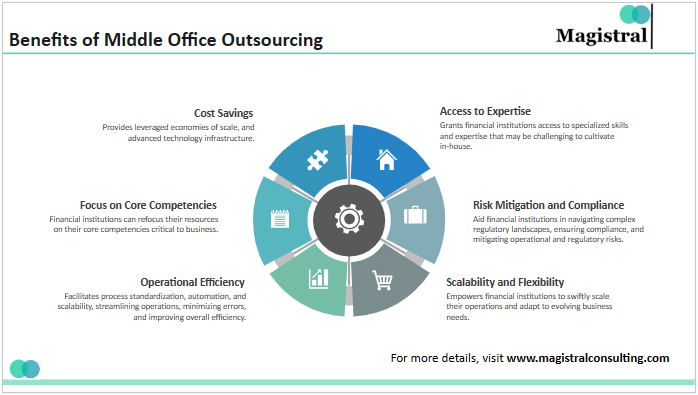
Financial institutions can reap numerous benefits that contribute to their overall efficiency through middle office outsourcing, here are some common benefits:

Benefits of Middle Office Outsourcing

Benefits of Middle Office Outsourcing

Cost Savings

Financial institutions can realize cost savings by opting for middle office outsourcing. External service providers leverage economies of scale, specialized expertise, and advanced technology infrastructure, enabling them to perform these functions more efficiently and cost-effectively. This leads to reduced expenses related to infrastructure, technology, staffing, and training.

Focus on Core Competencies

Financial institutions can reallocate their resources to their core competencies by outsourcing non-core middle office operations. This covers topics including client acquisition, relationship management, and investment techniques. This increased focus on core operations frequently results in better performance and increased market competitiveness.

Operational Efficiency

Process automation, scalability, and standardization are made possible by middle office outsourcing. Service providers reduce errors, increase overall efficiency, and streamline operations by utilizing cutting-edge technology like robotic process automation, artificial intelligence, and machine learning. Decision-making that is better informed is made possible by the quicker trade processing, improved risk management, and timely reporting that follow.

Access to Expertise

Outsourcing middle office functions grants financial institutions access to specialized skills and expertise that may be challenging to cultivate in-house. Service providers employ professionals with extensive experience in various middle office disciplines. This ensures the execution of critical tasks with a high degree of quality and accuracy.

Risk Mitigation and Compliance

External service providers are well-versed in industry best practices and legal standards. They support financial organizations in managing operational and regulatory risks, assuring compliance, and navigating complicated regulatory environments. Strong risk management frameworks are frequently in place at service providers, supporting businesses’ risk mitigation tactics.

Scalability and Flexibility

Middle office outsourcing empowers financial institutions to swiftly scale their operations and adapt to evolving business needs. Service providers offer flexible service models that accommodate growth, facilitate the introduction of new products, and support geographical expansions. This scalability and flexibility can be achieved without significant internal investments or operational disruptions.

Challenges and Considerations of Middle Office Outsourcing

While middle office outsourcing offers numerous advantages, it is essential to consider the following challenges and factors before embarking on such a strategy:

Data Security and Confidentiality

Financial institutions must prioritize data security and confidentiality. It is essential to ensure that potential service providers have robust data security measures and strict protocols in place to protect sensitive information. Conduct thorough due diligence to assess the provider’s track record, data protection practices, and adherence to industry standards and regulations.

Vendor Selection and Due Diligence

Thorough due diligence is necessary in order to choose the best outsourcing partner. Examine the service provider’s standing, capacity for handling risk, technological setup, adherence to laws and regulations, and experience with the particular middle office tasks that are being outsourced. Decision-making can be aided by openness in the selection process as well as suggestions and references from colleagues in the field.

Transition and Change Management

Successful outsourcing requires effective change management strategies. Plan the transition meticulously to minimize disruptions to day-to-day operations. Implement adequate communication and training programs to prepare employees for the changes and ensure a smooth handover of responsibilities.

Maintaining Control and Oversight

Establish strong governance frameworks to maintain control and oversight throughout the outsourcing process. Regular monitoring, performance reviews, and robust service level agreements should be in place to ensure that the service provider meets the desired standards and fulfils contractual obligations. This helps to maintain transparency and accountability.

Cultural and Organizational Fit

Consider the cultural and organizational fit between the financial institution and the outsourcing partner. Alignment of values, work ethics, and operational processes contributes to a successful partnership. A collaborative and compatible relationship between both entities enhances the overall outsourcing experience.

Financial institutions should minimise risks and optimise middle-office outsourcing benefits by taking proactive measures to address these issues and circumstances. Thorough assessment, thorough investigation, and efficient administration are necessary to guarantee a fruitful outsourcing collaboration and attain the intended results.

Magistral’s Services on Middle Office Outsourcing

Magistral's Services on Middle Office Outsourcing

Magistral’s Services on Middle Office Outsourcing

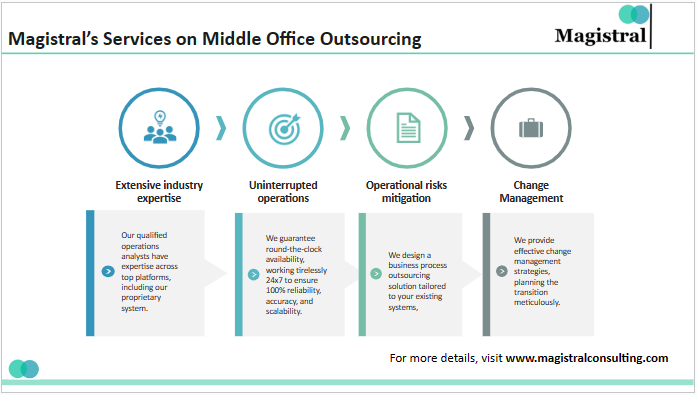
Magistral Consulting Services is a renowned industry leader, specializing in delivering extensive and customized solutions for middle office outsourcing. Leveraging our deep expertise and vast experience, we provide tailored services to financial institutions aiming to streamline their operations, achieve cost savings, and gain a competitive edge. Our comprehensive middle office outsourcing services cover a wide range of critical functions, including trade processing, risk management, compliance, portfolio valuation, and reporting.

Extensive Industry Expertise

Our team consists of industry experts who possess a wealth of operational and fund accounting knowledge gained from over two decades of serving the asset management industry. Our qualified operations analysts and accountants have comprehensive expertise across top platforms, including our proprietary system.

Uninterrupted Operations

We guarantee round-the-clock availability, working tirelessly 24×7 to ensure 100% reliability, accuracy, and scalability. Our middle-office services leverage a skilled workforce, digital processes, and innovative technology to provide exceptional support. This empowers you to maintain control while dedicating your focus to core activities and investment decisions.

Mitigation of Operational Risks

Through utilizing our services, you can expand your business without recruiting more staff or taking on more risk involving significant individuals. In addition to helping, you select and deploy the most suitable technology for your particular requirements. We can provide a business process outsourcing solution that is customized to work with your current systems. We provide strong controls, improve transparency, and reduce operational risk by leveraging digital processes and audit trails.

Change Management Strategies

We offer efficient change management tactics, painstakingly organizing the shift to reduce interruptions and guarantee a seamless transfer of duties.

Partnering with Magistral Consulting Services for middle office outsourcing equips financial institutions with the capacity to streamline operations, reduce costs, enhance efficiency, mitigate risks, and focus on their core competencies. We place the highest priority on data security, conducting thorough due diligence, and providing extensive support throughout the entire outsourcing journey.

About Magistral

Magistral Consulting has helped multiple funds and companies in outsourcing operations activities. It has service offerings for Private Equity, Venture Capital, Family OfficesInvestment BanksAsset Managers, Hedge Funds, Financial Consultants, Real Estate, REITs, RE fundsCorporates, and Portfolio companies. Its functional expertise is around Deal originationDeal Execution, Due Diligence, Financial ModellingPortfolio Management, and Equity Research

For setting up an appointment with a Magistral representative: 

visit www.magistralconsulting.com/contact

About the Author

The article is authored by the Marketing Department of Magistral Consulting. For any business inquiries, you can reach out to  prabhash.choudhary@magistralconsulting.com

Activities under Back and Middle Offices and their Potential for Outsourcing

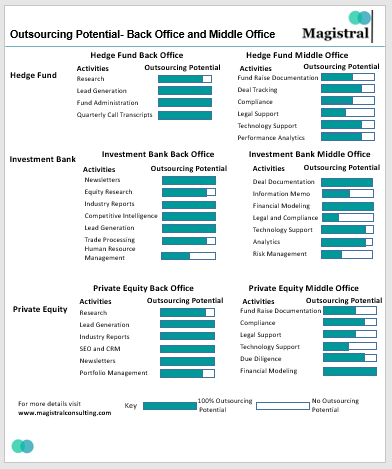
Back Office Outsourcing has been around for over a decade and picked up the pace since the financial meltdown of 2008. Middle Office Outsourcing is something that is picking up now and is expected to gather pace after the Corona pandemic. So, what is Back and Middle Office outsourcing, and does it make sense for financial services firms like Investment Banks, Private Equity, Venture Capital, and Hedge Fund firms to outsource these activities?


What is a Back Office?

There are not many definitions that clearly demarcate back-office activities from middle-office. A front office at an Investment Bank or a Private Equity firm is the one that interacts with the clients. It comprises people who are in touch with the market like traders, deal makers, Investor relations, and rainmakers. On similar lines, back-office functions are ones that never interact with clients, like fund administration, accounting, record keeping, etc. Back Office has now long been designated as the right candidate for outsourcing to reduce operational costs.

What is Middle Office?

Middle Office are the functions that coordinate between the front and back office. Similar functions in similar financial institutions can often be categorized as Middle Office, back office, or even Front Office. So, there are lots of blurry lines between Middle and Back Office definitions. Also, an activity that will form a Back Office activity at an investment bank can be categorized as a Middle Office activity at a Hedge Fund. Technology is now getting all the more important than it was ever before. Biggest of Investment Banks now have more than 30% of their employees working in technology-related functions. Technology and Risk Management functions are commonly being categorized as Middle Office functions across financial institutions like Investment Banks, Hedge Funds, Private Equity, and Venture Capital firms.

Potential of Back Office Outsourcing

Back Office needs to be outsourced is a forgone conclusion. It was probably a matter of discussion a decade back. Almost all big Investment Banks have outsourced their back office. Private Equity, Venture Capital and Hedge Funds are playing catch-up when it comes to back-office outsourcing. The reason for them lagging behind is that their teams are comparatively smaller to start with, which leads to limited cost advantages of outsourcing for them. Hedge funds have rather taken the technology way to reduce costs with developments like AI, ML, and Automation. Traders on most trading floors have been replaced by robots now. The conclusion here is that if your firm has a well-demarcated back office, it needs to be outsourced, big, or small. As the industry has started to rely on back-office outsourcing defacto, it will be difficult to compete in the market for those who decide to keep it in-house.

Potential of Middle Office Outsourcing

Middle Office Outsourcing is a hot topic now. It is gaining ground with investment banks who were pioneers even in the back office outsourcing space. Increased capabilities of vendors, further pressure to reduce costs and improve bottom-lines, and competitive pressures are the major trends that are aiding the phenomenon. It’s not right to suggest that all functions of the Middle Office could be outsourced right away. It depends on the processes, culture, and cost structure of the financial institution in question.  In conclusion, Middle Office Outsourcing is something that is still taking shape. Though a lot of it could be outsourced, the moot subject is what and how much.

Outsourcing for smaller firms

If an Investment Bank, Private Equity firm, Hedge Fund or a venture capital firm is around 20 people or less, they are continuously caught up in the dilemma to outsource or not. A big firm with hundreds and hundreds of traders would save millions of dollars by outsourcing, the same could not be said about the smaller firms. Smaller firms operate in a niche and fear losing the competitive edge if they go for outsourcing. The low-quality perception of outsourcing does not help give them confidence either. It was so far so good. Some smaller players did survive the last financial meltdown on the back of their superlative services and the network of loyal clients. It’s debatable if they will survive the current pandemic too. In the changed scenario, it is almost imperative for a smaller firm to outsource both the back office and middle office if they need a worthwhile shot at survival. When we talk about the back office and middle office of a smaller financial services firm, it’s pretty much all of their analyst capacities. Thousands of one-man shops are thriving on the formula of outsourcing when the deal is there and conserving the cash when it is not.

Middle Office and Back Office Outsourcing Trends

Multiple trends are evident in the market. Some of the prominent ones are:

Back Offices at bigger financial institutions have been outsourced. A mode could be different in a way having owned captives in a low-cost country or giving a big contract to a leading vendor, but the fact remains, that the physical location of the back office now is a low-cost country.

Middle Office Outsourcing is in a transitional phase: A middle office is being planned to be outsourced. Some players have outsourced the junior positions with mid-level and senior positions in-house. Some are toying with outsourcing the simpler functions over the complex ones

Outsourcing is catching up with Private Equity, Venture Capital and Hedge Funds: Investment Banks definitely took a lead in outsourcing but now even typically smaller financial institutions like Private Equity, Venture Capital, Family Office, Hedge Funds, Real Estate, and Asset Management firms have also started to experiment with varying degrees of exposure to outsourcing

It’s not only about costs: Outsourcing has come a long way from being a lever of only saving costs. Vendors have developed advanced skills and now are in a better position to enhance the skill of the in-house team. It is possible because the vendor is working across geographies, financial institutions, and investment philosophies. A vendor can now bring a fresh eyes’ perspective to the operations and help the financial institution up its game

Pandemic will relay the rules: If outsourcing was just an option before the pandemic, it may not be so afterward. Financial institutions are expected to face cost-related headwinds that will force them to outsource to survive

Increasingly complicated assignments being outsourced: Assignments like Financial Modeling, Investment Research, Outsourced CFO, Fund Administration Process, Hedge Fund Analytics, Pitch Decks, Portfolio Management, etc. are increasingly being outsourced by Investment Banks, Private Equity, Venture Capital and Hedge Fund firms.

Overall back office and middle office outsourcing are at different stages of maturity across the financial institutions. While large investment banks are pared to the bone when it comes to taking advantage of outsourcing, the mid-sized and smaller investment banks have only started recently experimenting with the trend. While Investment Banks, in general, are more mature and warm towards outsourcing, firms like Private Equity, Venture Capital, Hedge Funds, Family Offices, Real Estate, and Asset Management are now opening more and more to the idea. What large institutions identified as a tool to maintain their profit margins, smaller institutions are finding that tool to be the key to survival and profitable growth.

Service Offerings of Magistral Consulting

Here are the service offerings that Magistral provides:

-Daily/Weekly/Monthly Review of NAVs

-Reconciling Cash Trades and Portfolios

-Monitor Trades and Corporate Actions

-Maintain Investment Book of Records

-Independently price the portfolio

-Performing Investor Allocations

-Reporting Profit and Loss

-Client reporting for funds

-Reviewing and preparing all financial statements

-Managing relationships with service providers

-Providing tools to monitor systems and processes

Magistral Consulting (www.magistralconsulting.com) is a premier outsourcing firm that has helped multiple firms like Investment Banks, Private Equity, Venture Capital, Hedge Funds, Asset Managers, Real Estate, and Family Offices in outsourcing their back and middle office. To schedule a free discussion without any commitment, drop a line at   https://magistralconsulting.com/contact/


The Author Prabhash Choudhary is the CEO of Magistral Consulting and can be reached at Prabhash.choudhary@magistralconsulting.com for any queries on the article of business inquiries in general