Tag Archives: Merger Model

AI adoption has rapidly accelerated in financial services, becoming integral to forecasting, risk analysis, compliance, and investment research. According to Gartner’s 2025 survey, 59% of finance leaders report actively using AI, while a report by AllAboutAI indicates that 60% of banks deploy AI. It is across four to six major functions, including fraud detection, lending, and regulatory compliance. Adoption of generative AI is also growing, with nearly half of US banks using it internally for insight derivation. Despite such advances, however, most AI deployments still remain siloed, generating fragmented outputs that analysts must manually reconcile.
The Business Case for Model Merging in Finance

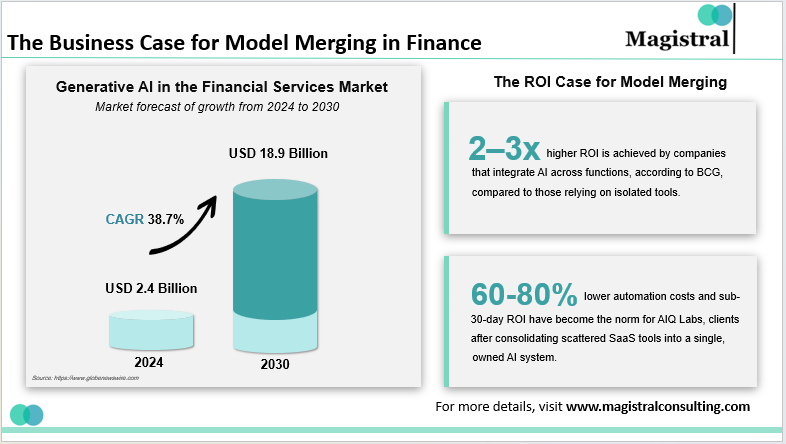
The Business Case for Model Merging in Finance

This fragmented landscape brings into sharp focus the strategic importance of model merging. It creates a unified intelligence layer via the integration of specialist models. This includes sentiment analysis engines, quant forecasts, ESG scoring platforms, and risk simulations. This process can help financial institutions cut redundancy, clarify conflicting signals, and quicken the pace toward decisions. Merging allows firms to leverage past AI investments, improve insight quality, and unlock higher operational and financial returns. It is as the base for a more connected, multi-dimensional approach to financial research.

How Model Merging Is Quietly Redefining Financial Research

Financial institutions are operating in an environment where the volume of data has multiplied, uncertainty has intensified, and investor expectations have risen sharply. Despite meaningful spending on analytics and automation, most research teams continue to grapple with a familiar problem. It is that different models give different answers. Sentiment engines interpret earnings calls, quant models forecast price movements, ESG platforms score disclosures, and risk engines evaluate downside scenarios-yet each operates independently. Such fragmentation delays insight and often forces analysts to manually reconcile conflicting signals.

A shift is underway as firms explore model merging, a method that brings these disparate engines together into a single, composite intelligence layer. Rather than constructing one giant model, institutions are merging several specialized ones. It includes building a unified system that processes the financial world like a seasoned analyst: multidimensionally, contextually, and with greater sensitivity to regime shifts.

The Forces Pushing the Industry Toward Composite Intelligence

There is nothing accidental about the momentum in this shift. Global investment in AI for financial services is growing at a rapid pace: from an estimated US$38 billion in 2024 to nearly US$190 billion by 2030. Much of this spend is directed toward unstructured data-earnings transcripts, alternative datasets, macro commentary, and regulatory updates, which have grown at a pace no single model can comfortably handle alone.
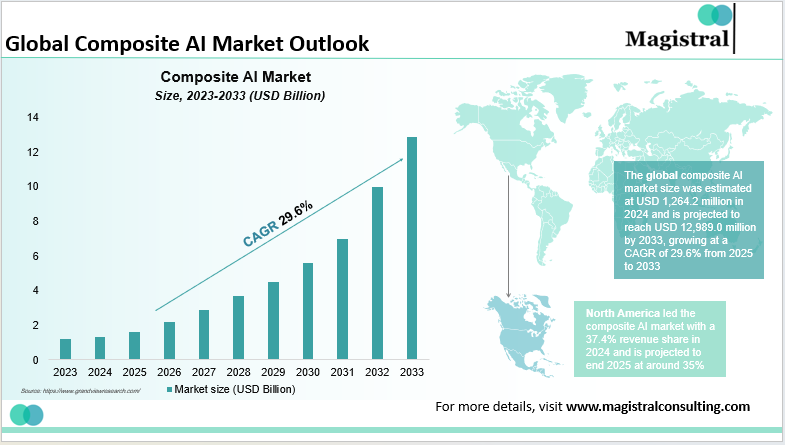
Global Composite AI Market Outlook

Global Composite AI Market Outlook

Market conditions also pressurize research workflows. Over the past four years alone, institutions have been called to navigate inflation surges, interest-rate tightening, geopolitical shocks, liquidity shifts, and record earnings volatility. Traditional AI systems, often trained for static regimes, struggle with these dynamics. Indeed, recent OECD research has pointed to rising “AI herding risks” as firms increasingly fall back on similar single-model approaches that may then amplify systemic vulnerabilities.

Model merging responds to these pressures by allowing institutions to combine various forms of intelligence in one system: numerical, linguistic, behavioral, and macroeconomic.

How Merged Intelligence Changes the Way Insights Are Generated

When multiple models are combined, the research workflow doesn’t just get faster; it becomes qualitatively different. A single system can read through the quarterly results of a company, assess the financials, comprehend the tone of management commentary. They find patterns in hiring or customer traffic, and incorporate peer behaviour in one pass. Analysts receive outputs that feel closer to a complete research narrative than to raw model signals.

This is a shift of equal importance both in credit and in risk domains. Early-warning indicators become much stronger once the models of default probability are combined with the macro-sensitive LLMs and anomaly-detection systems. A subtle change in the language of a management call, put together with deteriorating sector liquidity or weakening alternative data trends, can surface as an actionable alert sooner than conventional models would allow.

Quant teams can benefit, too. By combining factor models with narrative intelligence, model merging architectures enable the strategies to adapt more seamlessly to macro regimes around the inflection points where so many purely statistical models tend to become rigid.

The Strategic Value of Merging Models Instead of Replacing Them

Unlike building a large, monolithic AI system, model merging enables firms to maintain and improve the tools they already trust. Most financial institutions have developed models over years of domain-specific development. These represent intellectual property, tuning, and historical familiarity. It is neither feasible nor desirable to replace those with one generic LLM.

Merged architectures deliver a more strategic alternative. They let institutions integrate their existing models, enrich them with generative capabilities, and create a proprietary intelligence layer. It reflects the firm’s unique philosophy and datasets. Every organization merges its models differently, which turns the resulting intelligence into a competitive moat that peers using similar datasets can’t easily replicate.

There is also a clear operational advantage. Maintaining half a dozen independent pipelines is expensive and cumbersome. Model merging system simplifies governance, reduces duplication, and centralizes retraining and monitoring. This improves both cost efficiency and model reliability.

Building Trustworthy, Explainable Merged Models

Like any AI system that informs financial decisions, merged models have to be explainable and auditable. One of the strong positives of model merging is that institutions are able to trace which component contributed to a particular output. If a credit alert triggers, the firm can trace whether macro patterns, sentiment shifts, or financial metrics predominantly drove it. It’s this layered interpretability that gives risk, compliance, and audit teams confidence to scale.

Rigorous backtesting remains paramount. Merged models should be checked against stress periods, such as the 2008 crisis, COVID-19 shocks, inflation periods, and geopolitical disruptions. It is to confirm that the combined intelligence performs well across regimes.

Future Outlook

Model merging is still emerging, but the trajectory is unmistakable. As financial institutions move toward composite intelligence architectures, firms relying on isolated models will continue to face delays, blind spots, and higher costs. Those who adopt merged systems early will operate with deeper context, faster synthesis, and more resilient decision-making.

For research-driven organizations planning their AI roadmap for 2025, model merging is no longer a niche experiment- it is becoming essential infrastructure for competitive financial insight.

How Magistral Consulting Supports This Transition

Magistral Consulting supports the rationalization and enhancement of financial institutions’ research processes. It is by facilitating the better integration of insights derived from different analytical models, be it related to markets, sectors, deals, or risk insights. While we do not build or deploy AI models, our teams definitely play a critical role in helping clients operationalize intelligence. Magistral consolidates scattered data inputs, standardizes research outputs, and creates cohesive analytical pipelines. It is for decision-makers who can then work with unified, high-quality insights. This enhances the way firms consume model-driven information and strengthens consistency, clarity, and speed in the research processes.

Relevant Magistral services supporting model merging are:

Investment Research Support

Translates multiple model-generated signals (market, sector, sentiment, and risk) into cohesive research deliverables. This is via structured analyses, earnings tracking, and cross-model benchmarking.

Buy-Side & Sell-Side Support

Synthesizes insights from varied quant and fundamental perspectives into consolidated portfolios, thematic notes, investment screens, and fund intelligence that support merged-model decision workflows.

Investment Banking & Deal Support

Develop and integrate disparate datasets of market, financial, operational, and alternative data. It is then into key CIM/IM content, valuations, comps, and industry research in a consistent manner. This is done across model-assisted analytics.

Data & Insights Standardization

It cleans, aligns, and structures data flowing from multiple analytical engines. It enables clients to create unified dashboards, research repositories, and insight streams, mirroring the logic of model merging.

Custom Research & Analytics

Provides deep-dive reports, ESG datasets, and customized analytics that advance the interpretability and usability of merged-model intelligence within decision-support systems.


About Magistral Consulting

Magistral Consulting has helped multiple funds and companies in outsourcing operations activities. It has service offerings for Private Equity, Venture Capital, Family Offices, Investment Banks, Asset Managers, Hedge Funds, Financial Consultants, Real Estate, REITs, RE funds, Corporates, and Portfolio companies. Its functional expertise is around Deal origination, Deal Execution, Due Diligence, Financial Modelling, Portfolio Management, and Equity Research

For setting up an appointment with a Magistral representative visit www.magistralconsulting.com/contact

About the Author

Utkarsh is a finance professional with expertise in investment research, M&A, and financial modeling. He has built and applied models including DCF, LBO, and comparable analysis, supporting investment banks, private equity, and venture capital firms across diverse sectors. Utkarsh holds an MBA in International Business & Finance from Symbiosis International University, a B.Com (Hons) from Delhi University, and has completed the Stanford Seed program at Stanford Graduate School of Business.

FAQs

Can Magistral Consulting provide on-demand or project-based support?

Yes. Clients can choose between full-time dedicated analyst models or flexible, project-based engagements to meet short-term or specialized research needs.

How does Magistral Consulting ensure data confidentiality and quality?

We follow strict data security protocols, NDAs, and a multi-level quality assurance process to ensure the accuracy, reliability, and confidentiality of every client engagement.

Does Magistral provide real-time or ongoing market tracking?

Yes. We offer ongoing monitoring and real-time intelligence dashboards that track industry movements, pricing shifts, regulatory changes, and competitor activity.

How is Magistral’s market research aligned with digital transformation trends?
We integrate advanced analytics, AI-based data mining, and cloud-enabled platforms to deliver faster, scalable, and predictive research — making insights more agile and actionable.


A merger model is a financial construct that assesses if a merger or acquisition generates value for shareholders. The model projects how the financial performance of two companies comes together to assess the merger or acquisition’s impact on earnings, valuation, and capital structure. Referring to the global strength of M&A, “an anticipated 12% year-over-year recovery in 2024 based on underlying technology, healthcare, and infrastructure trends,” in PwC’s 2024 M&A Outlook, the model is a crucial tool for decision-makers. It serves as a bridge from strategic intent to quantitative validation, helping firms quantify synergy potential and financial viability before signing the deal.

The Strategic Significance of the Merger Model in Modern M&A

The model plays a central role in today’s data-centric M&A environment. It provides not only a feasibility analysis on the deal but also quantifies value creation, synergy realization, and capital efficiency.

It takes both companies’ income statements, balance sheets, and statement of cash flows and consolidates these documents from the transaction perspective to project future performance after the merger or acquisition. This exercise allows the executives to understand if the merger and acquisition is accretive or dilutive, as well as identify how to balance leverage and growth in a capital structure.

Accretion and Dilution Analysis

Pro forma accretion/dilution tests are the bedrock of any merger model. An accretive merger meaningfully increases EPS, which means the deal was structured economically, to the benefit of the acquiror.

Synergy Evaluation

The synergy realizations of cost savings, cross-selling opportunities, and tax benefits are the most compelling arguments for merging. According to Deloitte’s 2025 M&A Value Report, the average expectation of realizing synergies is 10-15% of deal value, resulting in an enormously persuasive argument for pursuing mergers. An astounding 45% of firms do not realize these synergies primarily due to poor integration planning.

Scenario and Sensitivity Testing

The merger model will have value as a tool to aid in estimating financial performance under varying interest rate environments, currency rates, and tax realities. As the model can stress test assumptions, management can surface earlier in the process financial sensitivities and vulnerabilities earlier to prepare contingency plans for scenario testing in case a variable requires adjustment.

Connection to Valuation Models

A DCF model calculates the value of a firm on a standalone basis; the merger model helps identify value to the firm adjacent, including any synergies, contingencies, and capital and operating costs (see DCF reference). Combined, these models will help ensure that the valuation work complies with the purpose of a transaction.

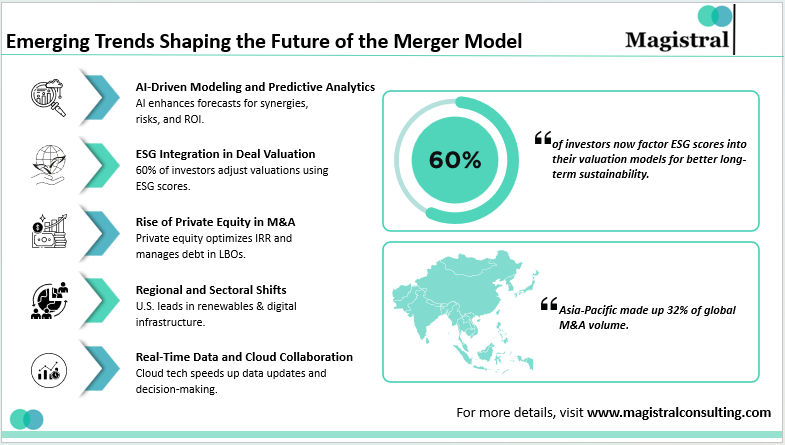
Emerging Trends Shaping the Future of the Merger Model (2023–2025)

As global dealmaking evolves, the merger model is transforming from a spreadsheet-based analysis into a dynamic, technology-enabled forecasting system.

Emerging Trends Shaping the Future of the Merger Model

Emerging Trends Shaping the Future of the Merger Model

AI-Driven Modeling and Predictive Analytics

AI and machine learning are now enhancing forecasts for synergy capture, risk exposure, and return on investment. In equity research, AI is helping to more accurately model outcomes by analysing thousands of historical transactions to benchmark realistic options.

ESG Integration in Deal Valuation

As sustainability becomes impossible to ignore in mergers, the MSCI 2024 ESG Outlook suggests that 60% of institutional investors are adjusting valuations based on ESG scores. A more full-proof model includes environmental and social risk assessment as part of transaction valuation, emphasizing the importance of long-term sustainability.

Rise of Private Equity in M&A

Private equity firms are increasingly using enhanced merger models to assess the value of portfolio-scale consolidation and exits. Their models tend to play a significant role in leveraged buyout (LBO) scenarios, optimizing the internal rate of return (IRR) while monitoring debt exposure.

Regional and Sectoral Shifts

Based on CBRE’s Capital Markets Report, Asia-Pacific made up 32% of global M&A volume, whereas megadeals in renewable energy and digital infrastructure represented larger overall value creation from U.S. entities. Recognizing shifts and regions is essential when calibrating global merger model assumptions.

Real-Time Data and Cloud Collaboration

Today’s financial teams can leverage cloud-based technologies that allow for instantaneous updates to the model. This supports pulling data faster to accelerate cycles of decision-making and work more effectively across finance, legal, and strategy teams.

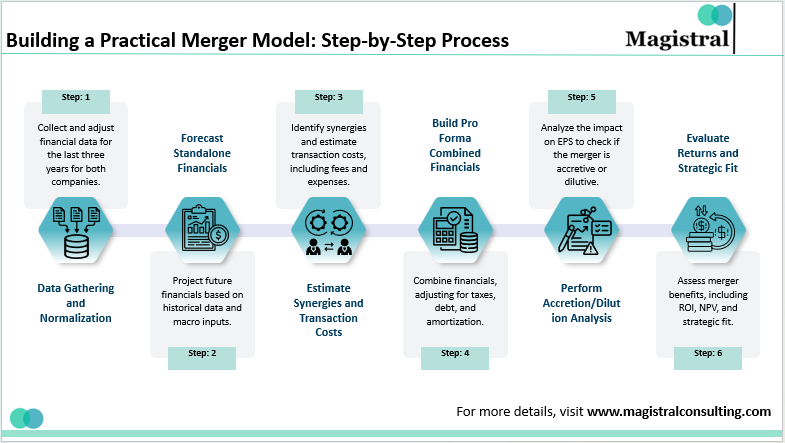
Building a Practical Merger Model: Step-by-Step Process

A merger model is an extremely complicated and sophisticated financial tool, which must be designed step-by-step with the integration of financial logic, integration planning, and valuation insight all together.

Building a Practical Merger Model: Step-by-Step Process

Building a Practical Merger Model: Step-by-Step Process

Step 1: Data Gathering and Normalization

Prepare financial documents for the last three years for both companies. Make the necessary adjustments to items not part of regular operations, modify the accounting methods, and verify the accuracy of the data.

Step 2: Forecast Standalone Financials

The base-case projections for the companies are determined using the macroeconomic inputs from Deloitte and the IMF as a springboard. The revenue, cost, and capital expenditure forecasts are extended to a period of 5-10 years.

Step 3: Estimate Synergies and Transaction Costs

Cost synergies (SG&A savings, facility optimization) are to be identified alongside revenue synergies (cross-selling, new markets). Advisory and legal fees, amongst others, are to be mentioned as transaction costs.

Step 4: Build Pro Forma Combined Financials

It will be necessary to combine the two statements and take into consideration the financing structure, taxes, and amortization. The debt or equity issuance needs to be reflected by adjusting the capital structure.

Step 5: Perform Accretion/Dilution Analysis

Calculate pre- and post-merger EPS and determine if the operation is accretive by computing the sensitivity testing on synergy assumptions, interest rates, and currency exposure.

Step 6: Evaluate Returns and Strategic Fit

The evaluation of the qualitative rationale- market expansion, diversification, or technological advantage goes together with the quantitative validation by measuring criteria such as ROI, NPV of synergies, and payback period.

How Magistral Consulting Supports Merger Model Excellence

Magistral Consulting carries out the entire M&A process from the strategy through valuation to the post-merger integration. The company’s know-how changes complicated financial modeling into usable information.

Financial Modeling and Deal Support

The deal support team at Magistral designs comprehensive models tailored to various industries and transaction types. All features, such as synergy monitoring, tax optimization, and capital structuring, are integrated into the models for realistic forecasting.

Due Diligence and Risk Validation

Using detailed financial and operational due diligence, Magistral uncovers secret risks and confirms merger assumptions before giving a final go-ahead.

Post-Merger Integration and Synergy Tracking

Not only before-deal analytics, but also after-deal, the company helps the clients to carry out the integration. Its well-defined synergy realization method delivers the expected results within the specified period.

AI and Analytics-Driven Forecasting

With the use of its proprietary Artificial Intelligence tools, the company predicts several merger outcomes with much greater precision. Its insights on operations and data modeling help to cut down the decision-making time of the acquirers.

Strategic Advisory for Institutional Investors

Magistral works closely with venture capital and funds to make merger models compatible with the strategies of the broader portfolio. This all-embracing advisory approach turns transactional analysis into strategic foresight.

To summarize, the merging model acts simultaneously as a financial compass and a strategic dashboard. In the age of uncertainty, data-driven modeling allows firms to pursue ambitious yet accountable deals.


About Magistral Consulting

Magistral Consulting has helped multiple funds and companies in outsourcing operations activities. It has service offerings for Private Equity, Venture Capital, Family Offices, Investment Banks, Asset Managers, Hedge Funds, Financial Consultants, Real Estate, REITs, RE funds, Corporates, and Portfolio companies. Its functional expertise is around Deal origination, Deal Execution, Due Diligence, Financial Modelling, Portfolio Management, and Equity Research

For setting up an appointment with a Magistral representative visit www.magistralconsulting.com/contact

About the Author

Utkarsh is a finance professional with expertise in investment research, M&A, and financial modeling. He has built and applied models including DCF, LBO, and comparable analysis, supporting investment banks, private equity, and venture capital firms across diverse sectors. Utkarsh holds an MBA in International Business & Finance from Symbiosis International University, a B.Com (Hons) from Delhi University, and has completed the Stanford Seed program at Stanford Graduate School of Business.

FAQs

What is the primary purpose of a merger model?

A merger model evaluates how combining two companies affects financial performance and shareholder value. It projects EPS impact, synergy realization, and balance sheet strength to assess deal feasibility.

How does a merger model differ from a DCF model?

A DCF model values a standalone company, while a merger model forecasts the combined entity’s financials, accounting for synergies, financing, and taxes.

What are the main inputs of a merger model?

Key inputs include financial statements, synergy estimates, purchase price, financing assumptions, and tax implications.

Why is synergy estimation important in a merger model?

Synergies represent cost savings and revenue enhancements that justify deal premiums. Accurate estimation determines whether a merger truly creates value.