Tag Archives: Portfolio Management Outsourcing

There has been another kind of pressure on portfolio management teams now, which was not there even five years back. Not only creating alpha, but now it has become very crucial to manage them amidst tighter margins, more intense regulatory focus, complex data requirements, and investor communities who continue to press for institutional-quality reporting. In this background, portfolio management outsourcing has emerged as more of an issues-based organizational model choice than being a cost-saving technique. Asset managers, alternative investment firms, family offices, as well as hedge funds, continue to increasingly turn to experts for assistance with portfolio analytics and reporting, risk monitoring, and more, so that portfolio investment decisions can continue to remain their core discriminator. In 2024–2025, this has increased as more money has come under their management, which has also become more complex.

Why Portfolio Management Outsourcing Is Accelerating in 2024–2025

The renewed momentum behind portfolio management outsourcing is best understood by looking at the broader industry context rather than isolated cost pressures.

Why Portfolio Management Outsourcing Is Accelerating in 2024–2025?

Why Portfolio Management Outsourcing Is Accelerating in 2024–2025?

The total global assets under management passed the $135 trillion mark in 2024, and there was a resurgence in organic growth compared to the previous year, 2023. With an ever-increasing asset base, the number of moving parts increases as well. There are several factors involved. For many firms, scaling internal teams at the same pace simply isn’t economical or operationally efficient.

Secondly, the modern financial landscape is also propelling the trend. The reality is that nonbank financial institutions currently represent slightly more than half of worldwide financial assets. This increases the challenge of proper risk management. Investors not only judge managers based on return performance. They also judge them based on the quality of the portfolios they deliver. The outsourcing of managers is no longer considered “back-office delegation.” It is the institutionalization of portfolio management.

On the human capital side, skilled portfolio analysis professionals, risk experts, and reporting professionals with performance expertise continue to be in short supply and cost-prohibitively in major financial hubs.

Core Functions Covered Under Portfolio Management Outsourcing

Although the scope varies by firm, portfolio management outsourcing would typically support several core areas that sit close to the investment decision-making process.

Portfolio Analytics and Performance Measurement

The foundation of portfolio oversight is accurate, timely performance analytics. Outsourced teams perform tasks such as return attribution, benchmark comparisons, factor analysis, and multi-period performance reviews. That way, portfolio managers know immediately what is driving the results, without needing to spend hours reconciling data across systems.

For alternative strategies such as private credit, real assets, or structured products, analytics often rely on bespoke models. Specialist providers bring experience from a host of fund structures and asset classes, reducing the risk of misinterpretation or inconsistent methodologies.

Risk Monitoring and Exposure Management

Today’s investors have higher expectations of risk oversight than just information on volatility. They expect to receive detailed, easy-to-understand descriptions of concentration risk; liquidity profiles; potential drawdown scenarios; and answers to their stress testing. The portfolio management outsourcing partner has implemented a risk framework or tool that will continuously detect any type of exposure and notify the firm of problems prior to their becoming a serious concern.

This function is important for any firm that is operating in both private equity and public markets because both have varying degrees of liquidity. Creating these views internally for the firm requires a significant number of resources. The external specialist, however, has created the views for both sectors of the business to accommodate that intersection.

Operational and Strategic Benefits Beyond Cost Savings

While cost savings are still a motivator for many firms, the true benefit of employing outsourced support for portfolio management is its strategic effect.

Improved Focus for Investment Teams

By eliminating the need to perform operational tasks and prepare data for reporting and reconciliation. Portfolio managers now dedicate their time and energy to assisting with research, asset allocation, and assessing risk-to-reward ratios. Thus, portfolio managers have greater clarity when making strategic decisions and ultimately make better decisions. Especially during the high-stress, volatile times of the markets when the ability to react quickly is critical.

Scalability Without Disruption

When a firm has a growing fund or is preparing to launch a new product, the outsourced model makes scaling seamless. Firms launch new portfolios or mandates and investor reporting requirements evolve. So the outsourced model absorbs these new demands without extensive hiring or major system changes

Risk and Compliance Alignment

With the growing expectations from regulators worldwide, the portfolio oversight function has become heavily scrutinized. The right portfolio management outsourcing partners will provide you with experience. It deals with how to implement controls, maintain documentation standards, and develop processes that are ready for audit. This will reduce operational risk and aid in achieving compliance.

Market Trends Shaping Portfolio Management Outsourcing

The 2024-2025 years saw a noticeable shift in trends, prompting companies to rethink their strategies for portfolio management outsourcing.

Market Trends Shaping Portfolio Management Outsourcing

Market Trends Shaping Portfolio Management Outsourcing

Integration With Middle-Office and Data Functions

Firms are now integrating portfolio tasks instead of outsourcing them one at a time. The market expects the global main-office outsourcing sector, valued at around $8 billion in 2024, to more than double over the next decade, reflecting sustained demand for end-to-end solutions.

Performance-Linked Outsourcing Outcomes

Recent surveys conducted in the industry indicate that over 80% of the firms taking advantage of outsourced trading and analytics functions report being able to make better investments. This brings an end to the myth that outsourcing merely affects productivity; it rather stresses that having better data and quicker insights can lead to returns.

Customization Over Standardization

Firms are no longer relying on the same outsourcing contracts for all roles. They opt for a tailor-made service that best suits their specific strategy, asset class, or investor profile. This is a notable trend observed in the case of alternative managers managing complex portfolios that span both public and private markets.

Technology-Enabled Oversight

The use of automation, dashboards, and real-time reporting tools is becoming a standard procedure. Among portfolio management outsourcing partners, those who combine human skills with cutting-edge technology are gaining popularity, as they provide the expected level of transparency without giving up control.

How Magistral Adds Value to Portfolio Management Outsourcing

Magistral considers portfolio management outsourcing to be a partnership model, not a task-oriented service. Magistral leverages its deep financial industry knowledge with its offshore execution capabilities, and it caters to its asset management clients. It is in terms of analytics, risk management, reporting, and operational management, without sacrificing control. Instead, its personnel are considered an extension of its clients’ investment management. They operate alongside adaptive processes that are aligned with each firm’s strategy, assets, and client necessities. Multi-asset portfolios, alternative platforms, or any other form of engagement in public, private, or equity markets. Its primary goal remains to help portfolio managers concentrate on what is most imperative to them: informed decision-making.


About Magistral Consulting

Magistral Consulting has helped multiple funds and companies in outsourcing operations activities. It has service offerings for Private Equity, Venture Capital, Family Offices, Investment Banks, Asset Managers, Hedge Funds, Financial Consultants, Real Estate, REITs, RE funds, Corporates, and Portfolio companies. Its functional expertise is around Deal origination, Deal Execution, Due Diligence, Financial Modelling, Portfolio Management, and Equity Research

For setting up an appointment with a Magistral representative visit www.magistralconsulting.com/contact

About the Author

Nitin is a Partner and Co-Founder at Magistral Consulting. He is a Stanford Seed MBA (Marketing) and electronics engineer with 19 + years at S&P Global and Evalueserve, leading research, analytics, and inside‑sales teams. An investment‑ and financial‑research specialist, he has delivered due‑diligence, fund‑administration, and market‑entry projects for clients worldwide. He now shapes Magistral Consulting’s strategic direction, oversees global operations, and drives business‑development support.

FAQs

Is portfolio management outsourcing suitable for small funds?

Yes. Smaller managers often benefit the most, as outsourcing provides access to experienced talent and advanced infrastructure without fixed overheads.

Does outsourcing reduce control over portfolios?

When structured correctly, it enhances control by improving data quality, transparency, and oversight, while decision-making authority remains with the manager.

How does outsourcing support investor reporting?

Outsourced teams produce standardized, accurate, and timely reports aligned with LP expectations, helping managers build credibility and trust.

Can outsourcing adapt as portfolios grow or strategies change?
Scalability is one of its main advantages. Services can expand or adjust as assets, strategies, or regulatory requirements evolve.


Introduction

Portfolio Management in the context of private equity (PE) involves the active management and oversight of a collection of investments in privately held companies. Private equity firms raise funds from investors, such as institutional investors, pension funds, and high-net-worth individuals, and use these funds to acquire ownership stakes in companies with the goal of enhancing their value and ultimately generating attractive returns.

Portfolio Management in the context of venture capital (VC) involves the active management and oversight of a collection of investments in early-stage startups and emerging companies with high growth potential. Venture capital firms provide funding, mentorship, and strategic guidance to these startups to help them scale and succeed.

Overall, it involves overseeing and optimizing a collection of investments in privately held companies. The goals of portfolio management in these fields differ from traditional asset management due to the unique characteristics of private investments.

How Portfolio Management works in Venture Capital

Investment Thesis and Focus:

Venture capital firms define their investment thesis, which outlines the types of startups they are interested in funding. This includes the industries, technologies, and business models that align with the firm’s expertise and strategic goals.

Deal Sourcing and Screening in Portfolio Management

Portfolio managers actively seek out investment opportunities by sourcing deals through networks, referrals, pitch events, accelerator programs, and other channels. Startups are screened based on their market potential, innovative solutions, founding team, and growth trajectory.

Investment Decision

After evaluating potential investments, portfolio managers decide which startups to fund. This decision involves assessing the startup’s business plan, market opportunity, competitive landscape, and scalability.

Investment Terms and Negotiation:

Portfolio managers negotiate the terms of investment, including the equity stake the VC firm will receive in the startup, the investment amount, and any additional rights or preferences.

Value Addition and Mentorship:

Venture capital firms provide more than just capital; they offer mentorship, guidance, and strategic support to help startups navigate challenges and accelerate growth. Portfolio managers might assist with product development, market entry, business development, and talent acquisition.

Follow-on Investments:

Successful startups often require multiple rounds of funding as they grow. Portfolio managers decide whether to participate in follow-on investment rounds to maintain their ownership stake and support the startup’s continued growth.

Exit Strategy in Portfolio Management

Venture capital firms plan exit strategies to realize returns on their investments. Exits can occur through acquisition by larger companies, mergers, or initial public offerings (IPOs).

Risk Management in Portfolio Management

Startups inherently carry a high level of risk, and portfolio managers assess and manage these risks by closely monitoring the startups’ progress, addressing challenges, and making adjustments as needed.

Performance Monitoring and Reporting:

Portfolio managers continuously monitor the financial and operational performance of their portfolio companies and provide regular updates to their investors.

Fundraising and Investment Strategy:

Private equity firms raise funds from investors, creating a pool of capital known as a private equity fund.

The firm outlines its investment strategy, which includes the types of companies it intends to invest in, the industries it will focus on, the geographic regions of interest, and the anticipated investment timeline.

How Portfolio Management works in Private Equity  

How Portfolio Management works in Private Equity

How Portfolio Management works in Private Equity

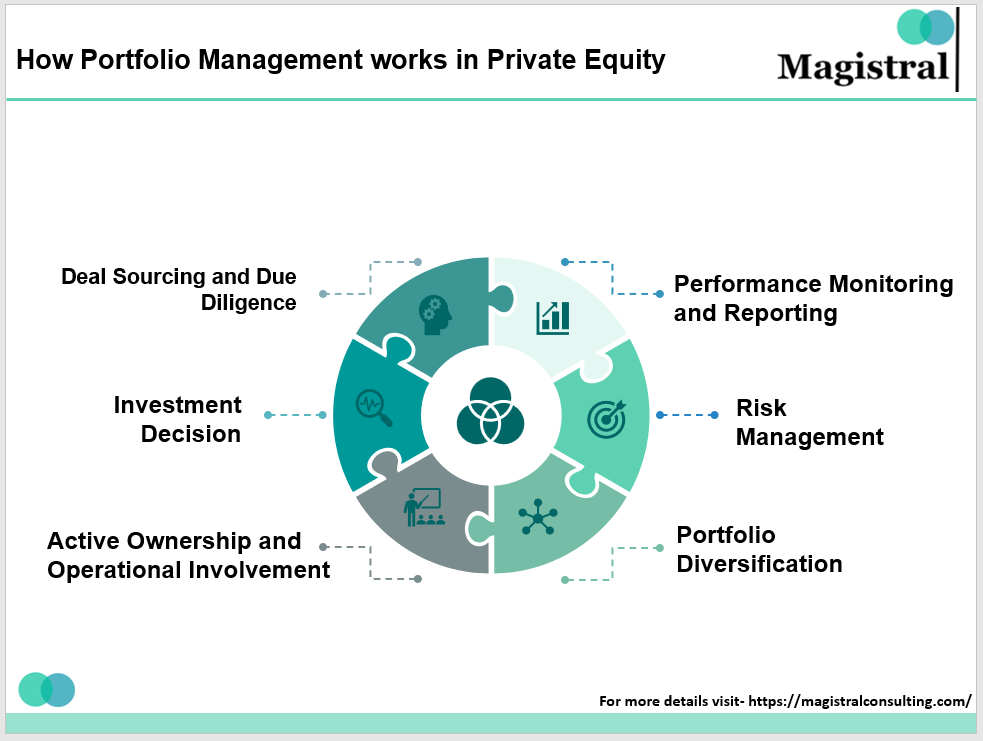
Deal Sourcing and Due Diligence:

Portfolio managers actively seek out investment opportunities by sourcing deals through various channels, including networking, industry connections, and proprietary research. Due diligence is conducted to thoroughly assess the target company’s financials, operations, market position, competitive landscape, growth prospects, and potential risks.

Investment Decision  of Portfolio Management

Based on the findings of due diligence, portfolio managers decide whether to invest in the target company and negotiate the terms of the investment, including the purchase price, equity stake, and governance structure.

Value Creation:

After acquiring a company, private equity firms work closely with the company’s management team to implement strategic initiatives aimed at improving operations, increasing efficiency, expanding market share, and driving growth.

Streamlining operations, entering new markets, introducing new products or services, and optimising the capital structure are all examples of value creation strategies.

Active Ownership and Operational Involvement:

Private equity portfolio managers take an active role in the companies they invest in. They might appoint board members, provide strategic guidance, and leverage their industry expertise to help the company succeed.

Exit Strategy:

Portfolio managers develop an exit strategy to realize returns for the fund’s investors. This could involve selling the company to a strategic buyer, merging with another company, or taking the company public through an IPO.

Portfolio Diversification:

Private equity firms manage a diversified portfolio of investments to mitigate risk. They may invest in companies across different industries, geographies, and stages of development.

Risk Management:

Portfolio managers assess and manage risks associated with each investment, including industry-specific risks, regulatory changes, macroeconomic factors, and competitive pressures.

Performance Monitoring and Reporting:

Private equity firms closely monitor the financial and operational performance of their portfolio companies on an ongoing basis.

Regular reporting to investors provides transparency into the performance of the fund’s investments.

Distribution of Returns:

As portfolio companies achieve milestones and are eventually sold or exit the investment, the private equity firm distributes returns to its investors based on the terms of the fund.

Challenges in Portfolio Management

Following are the challenges in Portfolio Management:

Challenges in Portfolio Management

Challenges in Portfolio Management

Value Creation:

Private equity portfolio managers need to implement effective value creation strategies within portfolio companies to enhance their performance and increase their value. Achieving operational improvements, strategic growth, and cost optimization can be challenging.

Exit Timing and Strategy:

Identifying the right time and strategy for exiting an investment is crucial. Economic conditions, market dynamics, and company-specific factors can all impact the success of an exit strategy.

Due Diligence Complexity of Portfolio Management

Conducting thorough due diligence on potential investment targets can be complex and time-consuming. Ensuring accurate financial information, evaluating operational risks, and assessing the quality of the management team are critical.

Management Team Alignment:

Aligning the goals and strategies of the private equity firm with the existing management team of the portfolio company can be challenging. Differences in management styles and objectives can hinder successful value creation.

Cyclical Industry Exposure:

Private equity investments can be exposed to specific industry cycles, economic downturns, and regulatory changes. Portfolio managers need to manage risk by diversifying across industries and adapting to changing market conditions.

Capital Allocation:

Allocating capital efficiently across a diverse portfolio of investments while maintaining a balance between risk and return can be a complex task.

Venture Capital

Following are the challenges faced by the venture capital firms:

Early-Stage Risk:

Venture capital investments are made in startups with high growth potential, but they also carry a significant level of risk. Many startups fail to reach profitability, making the success rate of investments uncertain.

Valuation Challenges:

Valuing early-stage startups can be challenging due to limited financial history and market comparable. Over- or undervaluing startups can impact the returns generated from the investments.

Exit Challenges:

The time and method of exit for venture capital investments can be uncertain. The IPO market may not always be favourable, and finding suitable acquisition opportunities can be difficult.

Portfolio Diversification:

Investing in startups requires diversification to mitigate risk, but building a diversified portfolio of early-stage companies can be resource-intensive and may require a large number of investments.

Information Asymmetry:

Gathering accurate and timely information from startups can be challenging, especially when startups are focused on growth and may not have standardized reporting.

Regulatory and Legal Complexity:

Startups often operate in industries with evolving regulatory landscapes, requiring portfolio managers to navigate legal and compliance challenges.

Magistral’s Services on Portfolio Management

Magistral provides portfolio management services for numerous kinds of businesses such as portfolios for venture capital and private equity funds. It is a hassle for all the investors who serve on numerous boards to apply what works in one portfolio business to another. When all businesses are in related industries and are contending with very comparable challenges, the issue becomes more serious. The lack of resources across companies, the short amount of time that board members may spend supervising, and the concentration of implementation expertise in a single portfolio company all work against board members.

Portfolio Management for VCs

Portfolio Management for VCs

We assist portfolio managers in consolidating their Marketing (mostly digital), Strategy (fund-raising and exits), and Finance at a fraction of the expense necessary to have specific duties in each portfolio firm, no matter how big or little. The off-shored extended team also makes sure that no information is lost for projects that are comparable across firms, and that several projects in different organizations can run simultaneously, prioritized by the calendar of board meetings.

Our service packages for Portfolio Management include:

Collecting Data– Collecting portfolio Data weekly/ monthly/ quarterly as per the client requirements.

Financial Models-  Preparing various types of financials models, financial statements and cash positions.

Data visualization- Creating dashboards in consistent formats across portfolio companies.

Review Meeting- Attending review meetings and prepare actionable notes.

Audits- First level audit of the data collected to ensure the quality and reliability of the data.

About Magistral Consulting

Magistral Consulting has helped multiple funds and companies in outsourcing operations activities. It has service offerings for Private Equity, Venture Capital, Family OfficesInvestment BanksAsset Managers, Hedge Funds, Financial Consultants, Real Estate, REITs, RE fundsCorporates, and Portfolio companies. Its functional expertise is around Deal originationDeal Execution, Due Diligence, Financial Modelling, Portfolio Management, and Equity Research.

For setting up an appointment with a Magistral representative: visit www.magistralconsulting.com/contact

About the Author

The article is authored by the Marketing Department of Magistral Consulting. For any business inquiries, you can reach out to  prabhash.choudhary@magistralconsulting.com


Introduction- What is Portfolio Management?

Portfolio Management Services are the services that keep a portfolio of investments healthy and prime them to produce expected returns on investments.

Sometimes portfolio management is passive, where it mostly deals with analyzing the assets and its performance. In some cases, portfolio management is quite active, where the manager is expected to get into the operations of the invested company and make sure its operational aspects are fine-tuned so that the asset enhances its intrinsic value

Whatever is the underlying nature of the portfolio, portfolio management concerns about managing the asset properly and prepare it to give superlative returns for the investors

What constitutes a Portfolio?

A portfolio has a different meaning for different institutional investors. A Venture Capital or a Private Equity firm may mean invested companies as its portfolio. These companies can vary in size. Sometimes they are start-ups or smaller companies, whereas some other times they could be multibillion-dollar enterprises with businesses in many countries. These companies could be public or private

A Hedge Fund calls the stocks where it has invested as its portfolio. These are publicly traded stocks and trade on global exchanges.

A Fund of Funds will call its underlying Hedge Funds as its portfolio. A Fund of Funds invests in funds like Hedge Funds. So all the hedge funds where it decides to park the money are its portfolio

A Real Estate fund will call its Real Estate investment as its portfolio. Various funds specialize in multiple RE asset classes like residential, commercial, infrastructure, and multiple other versions of it therein.

An Investment Bank or a Commercial Bank may have different asset classes, depending on its business model and clientele, calling an underlying asset as the portfolio. They can be Real Estate, Real Estate Classes, Cryptocurrencies, Commodities, and anything else that generates a return and is invested with an aim of either generating returns or appreciation in capital value.

Depending on the underlying asset, the portfolio management approach takes different paths

Portfolio Management for Private Equity and Venture Capital

When Portfolio Management is talked about for Private Equity or Venture Capital firms, it means helping the portfolio of companies, mostly private, in appreciating its valuation. This appreciation in value comes from improving revenue or cutting costs. The ultimate aim of investing in companies by Private Equity or Venture Capital firm is to exit at a valuation that is multiple times over the initial investment. A significant part of the fund is in the portfolio management business.

Multiple things could be done to make sure the portfolio company grows its revenue and keeps its costs in control

Outsourcing some of these services produce multiple benefits like reduction in operations’ cost, improvement in quality, etc.

Here are the services and all of it could be effectively outsourced in the portfolio management process to further net in the cost savings:

Portfolio Management-Companies

All the elements of companies’ portfolio management that could be outsourced

Business Research

Business Research touches multiple aspects of operations for a small company. It plays a vital role in Finance, Sales, Marketing, Strategy, and Procurement. Almost all research tasks in these functions could be outsourced. Investors taking in hands the research function take the nerve cells of the organization in control. From there, the company could be managed more closely and with better control. One of the most important aspects of business research is fine-tuning the business strategy. Investors can devise the expansion plans and study whether they are on track.

Marketing

Marketing and specifically the elements of Digital marketing could be outsourced well. Components of digital marketing like content marketing, web design, social media advertising, SEO, and everything else related could be outsourced and outsourced well. Marketing is the most important lever when it comes to growing the business of a small company aggressively. Topline growth increases the valuation of the company almost simultaneously.

Business Development

Specifically, for B2B businesses in the portfolio, there are multiple outsourceable elements for business development. This includes list and lead generation to onboard newer accounts faster. Also, account-based management is important for bigger clients of a smaller portfolio company.

Mergers and Acquisition

After the initial investment, the struggle for the investor takes another direction. It is to raise further rounds of fund-raising or start finding a bigger buyer for the company. Multiple activities are spanned out of this objective. For example, generating the list of potential buyers or investors and all the accompanying documents that go towards an M&A exercise.

Fund-Raising

Fund Raising is an ongoing cause for venture-funded companies. After the seed round, the preparations start for a further round of fund-raise like Series A, Series B, Series C, and so on. This leads to a continued quest for generating a pipeline of investors for further rounds of fund-raising. This activity of generating and populating pipeline could be effectively outsourced while the management focuses on revenue and profitability

Outsourced CFO

A full-time CFO is something that a small start-up may struggle to have. When a VC fund invests in multiple start-ups, it could have a centrally located CFO for all these companies. To further save costs, this CFO or parts of the CFO team could be outsourced. An outsourced CFO brings in the expertise of a tenured CFO along with the scalability of an outsourced team.

Product Design and Development

Many investments specifically in the VC space happens in the pre-product development stage or immediately after the proof of concept still leaving the product with some problems that need to be ironed out. This is when product design and development services come into play. It helps in setting up websites, making apps, and initial marketing to gain the users and change the UI or business strategy if required. It’s just that with outsourcing, these business and technical iterations become a lot cheaper.

Lead and List Generation

An ongoing company needs a list-building exercise all the time whether it’s about getting a new client or an investor or a vendor or anyone else for any other type of business collaboration.


Portfolio Management for Hedge Funds, Investment Banks and other Asset Managers

This section is for anyone else who is not dealing with investing in private companies. This is also for anyone who does not get into an active management role in a company’s day to day affairs. The underlying assets in this portfolio could range from Real Estate and all its classes like residential, commercial, land, buildings, infrastructure, etc., cryptocurrencies, public company stocks, commodities, and everything else that is bought, sold, or traded for capital appreciation or returns. Portfolio Management strategies, in this case, differ significantly from explained earlier and here different tools and models are used for Portfolio Management

Here are the aspects of such a portfolio management project that could be outsourced effectively

Portfolio Management- Funds

Activities that could be outsourced for Portfolio Management of funds and other assets

NAV Tracking

Almost all types of assets need regular NAV tracking. NAV which stands for Net Asset Value is the underlying value of the asset that changes from time to time.  All the changes need capturing for investor communication periodically. NAV of some assets is easy to capture, whereas with other assets it follows a difficult process. Portfolio Management and Investment Analysis are connected as the successful investing strategy need to be doubled down on. Several KPIs for Portfolio Management are tracked as well.

Investor Relations

Investors need to be reached out for all the information like the value of their holdings, taxes, fund management fees, waterfalls, etc. Sometimes they would also need a primer on the strategy of the fund or change in the plans by the fund manager. A Portfolio Management dashboard is often prepared and is automated for the information of investors

Middle Office

All the middle office activities like fund administration could be effectively outsourced. This form majority of research, and analytics jobs performed at a Fund. Automated tools for portfolio management is used here.

Back Office

All the tasks like book-keeping could be outsourced at a fraction of the cost. There are multiple software for portfolio management and book-keeping that could be used in the process

Marketing

Most marketing activities like CRM, Marketing communications, reports, and content could be outsourced as well.

Why outsource portfolio management?

Outsourcing has multiple benefits for a Portfolio Management Office. Cost-saving is an obvious one. Here are the factors that add to the charm of an outsourced deal:

Cost: Cost savings of 30-70% from outsourcing portfolio management is very typical. The cost that you save depend on the geography from where you want to outsource and the technical skills required to do the job effectively

Skill inventory: Many small fund management teams operate at a suboptimal level and are not able to meet the standards of bigger funds as their support services don’t match up with that of much bigger funds. Outsourcing presents an opportunity for smaller fund teams for skill enhancements. Outsourcing brings the skills to the team without permanent hiring

Quality: The work quality that is outsourced is of global standards and helps raise the bar for the internal team as well

Risk: Outsourcing reduces the portfolio management risk significantly

Flexibility: A Portfolio Management Analyst can either be hired full-time offshore or in parts or services can be availed on an hourly basis

Magistral has helped multiple fund managers in outsourcing portfolio management and other aspects of operations.

About Magistral

Magistral Consulting has helped multiple funds and companies in outsourcing CIO related activities. It has service offerings for Private Equity, Venture Capital, Family OfficesInvestment BanksAsset Managers, Hedge Funds, Financial Consultants, Real Estate, REITs, RE fundsCorporates and Portfolio companies. Its functional expertise is around Deal originationDeal Execution, Due Diligence, Financial ModelingPortfolio Management and Equity Research

For setting up an appointment with a Magistral representative visit www.magistralconsulting.com/contact

About the Author

The Author, Prabhash Choudhary is the CEO of Magistral Consulting and can be reached at Prabhash.choudhary@magistralconsutling.com for any queries or business inquiries.