Tag Archives: Real Estate Outsourcing

The real estate industry has changed shape over the past decade and so has the way firms get their work done. Rising operating costs, tighter margins, and a growing demand for specialized skills have pushed owners, brokers, and asset managers to rethink how they staff their operations. As a result, real estate outsourcing has moved from a cost-cutting tactic to a core part of business strategy. Firms now outsource everything from property management to financial modelling, allowing internal teams to focus on decision-making rather than routine tasks.

This shift is not limited to small players either; large institutional investors are adopting outsourced models at scale. The following sections explore why this trend is accelerating and what it means for the industry. 
Real Estate Outsourcing

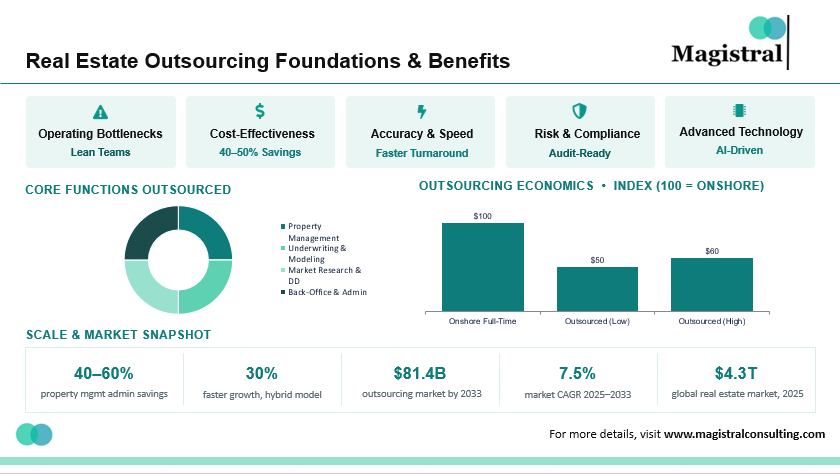
Real Estate Outsourcing Foundations & Benefits

Why Real Estate Outsourcing Is Gaining Momentum 

This practice has grown from a niche approach into a mainstream operating model. Multiple market forces are converging to make third-party support a practical necessity rather than an option. Firms across residential, commercial, and institutional segments are reassessing how much work truly needs to sit in-house. As margins tighten and portfolios grow more complex, outsourcing has become one of the more reliable ways to stay competitive without overextending internal teams. 

Rising Operational Costs Push Firms Toward Outsourcing 

Labor and compliance costs have climbed steadily across major real estate markets. Consequently, many firms find it cheaper to outsource repetitive functions than to expand in-house headcount. Property management alone carries recurring fees that often range between 3-5% for commercial assets, and firms are looking for ways to protect these margins. 

Technology Adoption Accelerates the Shift 

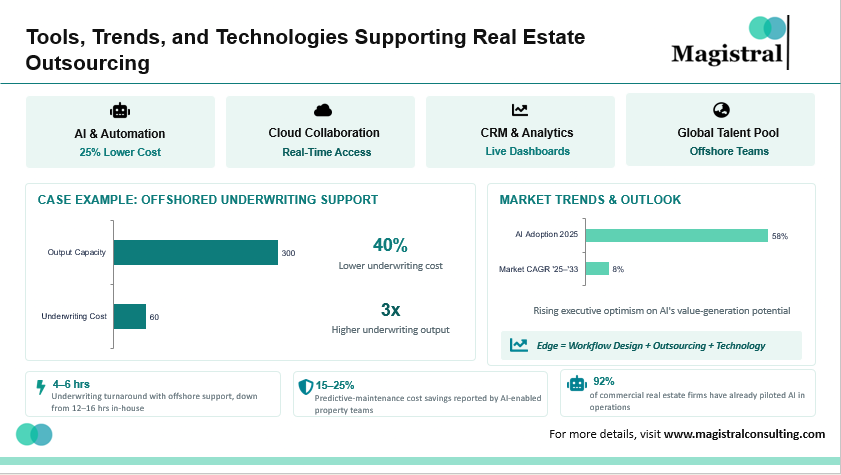
Digital platforms now automate leasing, valuations, and reporting, narrowing the efficiency gap between firms that adopt technology and those that don’t. Outsourcing partners often bring these tools along with trained staff, which shortens the learning curve for smaller firms. 

Institutional Capital Demands Specialized Support 

Institutional investors, including pension funds and insurance companies, have pushed global real estate investment volumes past $12 trillion in recent years. Managing portfolios at this scale requires deep financial modelling and reporting capabilities, which many asset managers choose to outsource rather than build internally. 

Talent Shortages in Core Markets 

Skilled analysts, underwriters, and property accountants remain hard to hire in several regions. This approach gives firms access to trained professionals without competing in a tight local labour market. 

Key Drivers Behind Real Estate Outsourcing Growth 

The decision to outsource is rarely about cost alone. Firms weigh scalability, expertise, and strategic focus before handing off functions to external partners. In most cases, the choice reflects a broader push to run leaner operations while still meeting investor and client expectations. Understanding these drivers helps firms decide which functions are worth outsourcing first. 
Real Estate Outsourcing

Tools, Trends, and Technologies Supporting Real Estate Outsourcing

Cost Efficiency and Scalability 

Outsourcing converts fixed costs into variable ones. This means firms can scale teams up or down as deal flow changes, without the burden of layoffs or idle staff during slower periods. It also removes much of the overhead tied to recruitment, training, and benefits administration. 

Access to Specialized Expertise 

Not every firm can afford a full-time underwriting or GIS analytics team. Outsourcing gives access to niche skills on demand, which is particularly useful for firms entering new asset classes such as logistics or build-to-rent housing. It also lets firms tap into experience across multiple markets rather than relying on one internal team’s view. 

Focus on Core Business Activities 

When back-office and analytical work move off internal desks, leadership can concentrate on deal sourcing, investor relations, and strategic growth. Real Estate Outsourcing, therefore, acts as a filter that removes distraction from higher-value work. Teams end up spending more time on decisions that directly affect returns. 

Global Talent Pool Access 

Real Estate Outsourcing partners often operate across time zones, which allows for near-round-the-clock turnaround on research, reporting, and administrative tasks. This has become especially valuable for firms managing cross-border portfolios. It also gives smaller firms access to talent pools that would otherwise be out of reach locally. 

Functions Commonly Covered Under Real Estate Outsourcing 

This practice today spans far more than basic administrative support. It touches nearly every stage of the property lifecycle. From acquisition through ongoing management, firms are handing off both routine and analytically demanding tasks to specialized teams. This broader scope reflects growing confidence in outsourced providers to handle work that once stayed strictly in-house. 

Property Management Support 

Rent collection, tenant communication, and maintenance coordination are frequently outsourced, especially for portfolios spread across multiple regions. Property management is also the fastest-growing service line in the broader real estate services market, expanding at nearly 6% annually. 

Financial Modelling and Underwriting

Deal teams often outsource cash flow modelling, sensitivity analysis, and underwriting support to specialized providers who understand real estate-specific metrics like cap rates and NOI. This allows firms to evaluate more deals in parallel without stretching internal analysts too thin. 

Market Research and Due Diligence 

Competitive benchmarking, demographic studies, and site-level due diligence require significant manpower. Outsourced research teams help firms move faster without adding permanent headcount. This is especially useful during periods of active deal sourcing, when research demands spike unpredictably. 

Back-Office and Administrative Tasks 

Lease abstraction, document management, and accounting support are among the most commonly outsourced functions, given their repetitive and time-intensive nature. Handing these off frees internal staff to focus on tenant relationships and higher-value coordination work. 

Challenges and Considerations in Real Estate Outsourcing 

Real estate outsourcing brings clear benefits. However, it is not without risk, and firms need to manage a few recurring concerns before committing to a long-term arrangement. Poorly managed vendor relationships can offset the cost savings that outsourcing is meant to deliver. Being aware of these pitfalls in advance makes it easier to structure agreements that actually work. 

Data Security and Confidentiality 

Property and investor data is sensitive, so firms must vet outsourcing partners on data handling practices, encryption standards, and compliance history. Clear contractual terms around data ownership and access help avoid disputes later on. 

Quality Control and Communication 

Time zone differences and unclear scopes of work can lead to inconsistent output. Regular check-ins and documented workflows help minimize this risk. Setting clear turnaround expectations upfront also reduces friction as the relationship scales. 

Choosing the Right Outsourcing Partner 

Not every provider understands real estate terminology or workflows. Firms should evaluate partners on sector experience rather than price alone, since a mismatched vendor can cost more in rework than it saves. Checking references and past project scope can reveal a lot before signing a long-term contract. 

How Magistral Consulting Supports Real Estate Outsourcing 

Real estate outsourcing works best when it is backed by sector expertise rather than generic support staff. Magistral Consulting works with real estate firms, fund managers, and property investors on research, financial modelling, and reporting needs that arise across the investment lifecycle. Rather than offering generic back-office support, the firm builds teams around real estate-specific workflows, which shortens onboarding time and reduces rework for clients. 

Research, Financial Modelling, and Investor Reporting Support 

Magistral’s teams help firms build market studies, competitor benchmarking, and location analysis to support acquisition and leasing decisions. On the financial side, the firm assists asset managers with underwriting models and portfolio-level cash flow analysis, helping ensure that assumptions and outputs remain investor-ready. Beyond modelling, Magistral also supports firms in preparing periodic reports, data rooms, and diligence materials that align with institutional expectations.

Consistent, well-documented reporting builds investor confidence over time, and it also makes future fundraising rounds easier to execute. As a result, clients working with Magistral can extend their internal capacity without adding permanent headcount, while keeping quality and turnaround times consistent across projects. 

About Magistral Consulting

Magistral Consulting has helped multiple funds and companies in outsourcing operations activities. It has service offerings for Private Equity, Venture Capital, Family Offices, Investment Banks, Asset Managers, Hedge Funds, Financial Consultants, Real Estate, REITs, RE funds, Corporates, and Portfolio companies. Its functional expertise is around Deal origination, Deal Execution, Due Diligence, Financial Modelling, Portfolio Management, and Equity Research

For setting up an appointment with a Magistral representative visit www.magistralconsulting.com/contact

About the Author

Prabhash Choudhary is the CEO of Magistral Consulting. He is a Stanford Seed alumnus and mechanical engineer with 20 + years’ leadership at Fortune 500 firms- Accenture Strategy, Deloitte, News Corp, and S&P Global. At Magistral Consulting, he directs global operations and has delivered over $3.5 billion in client impact across finance, research, analytics, and outsourcing. His expertise spans management consulting, investment and strategic research, and operational excellence for 1,200 + clients worldwide

FAQs

What does real estate outsourcing typically include?

It usually covers property management, financial modelling, market research, due diligence, and back-office administrative work.

Is real estate outsourcing only for large firms?

No. Both small brokerages and large institutional investors use this model, though the scope of services often differs based on portfolio size.

How does real estate outsourcing affect data security?

Firms need to choose outsourcing partners with strong data protection practices, since property and investor information is sensitive and often subject to compliance requirements.

Does real estate outsourcing replace in-house teams?

Not usually. Most firms use this approach to support internal teams by handling repetitive or specialized tasks, allowing staff to focus on strategy and client relationships.

What industries within real estate benefit most from outsourcing?
Property management, commercial real estate investment, and real estate funds benefit significantly, given their heavy reliance on research, modelling, and reporting functions.

The global property industry has expanded rapidly as institutional investors increasingly allocate capital to real assets. According to Savills’ global property report, the value of global real estate assets reached nearly $379 trillion in 2024, making it the largest asset class worldwide. Managing such vast portfolios requires complex financial analysis, market research, and operational coordination. As a result, many firms are turning to real estate outsourcing to streamline operations and improve analytical capabilities.

Outsourcing enables property investment firms to access specialized expertise in financial modelling, market intelligence, and transaction support without significantly expanding internal teams. Deloitte’s 2024 real estate industry outlook indicates that over 70 percent of real estate organizations now collaborate with external providers for analytics, research, and reporting functions. This shift reflects the growing complexity of property investment decisions and the need for scalable operational models.

As global investment volumes rise and technology transforms property markets, outsourcing has become a strategic tool rather than just a cost-saving practice. Real estate firms increasingly rely on external specialists to support data-driven investment decisions while internal teams focus on asset management, deal sourcing, and investor relationships.

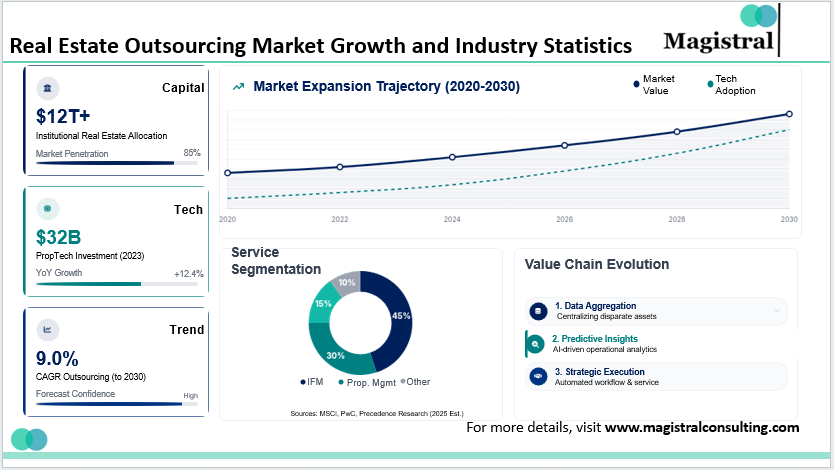
Real Estate Outsourcing Market Growth and Industry Statistics

The adoption of Outsourcing has accelerated as global property investments expand, and institutional investors demand greater analytical rigor.

Real Estate Outsourcing Market Growth and Industry Statistics

Real Estate Outsourcing Market Growth and Industry Statistics

Institutional Capital Driving Property Investment

Institutional investors such as pension funds, insurance companies, and sovereign wealth funds have significantly increased their exposure to real estate assets. MSCI’s real assets research indicates that institutional real estate investment volumes have exceeded $12 trillion globally in recent years.

Managing large property portfolios requires extensive financial modelling, asset monitoring, and investment reporting. Many asset managers therefore outsource analytical tasks to specialized teams while internal professionals focus on strategic decision making.

Property funds often operate within investment frameworks like private equity structures where lean internal teams manage investments while outsourcing research and operational support.

Rising Complexity of Property Portfolios

Property portfolios today span multiple geographies and asset classes including residential, office, logistics, and retail properties. Each asset requires continuous evaluation of rental income, operating expenses, tenant performance, and market trends.

Large real estate investment firms may review hundreds of potential transactions annually. Without external analytical support, managing such deal flow would require extensive internal staffing. Real estate outsourcing helps firms evaluate opportunities quickly while maintaining analytical accuracy.

Technology Investment in Real Estate Operations

Digital transformation has also accelerated the adoption of outsourcing in property markets. According to PwC, global investment in property technology exceeded $32 billion in 2023, reflecting the growing reliance on data analytics and digital platforms.

Advanced analytical frameworks such as real estate financial modelling are increasingly used to forecast property performance and evaluate acquisition scenarios. Outsourcing these analytical processes helps ensure accuracy while reducing operational burden on internal teams.

Growth of the Real Estate Outsourcing Market

Research from Precedence Research suggests that outsourcing services across property operations are expanding steadily. The broader real estate services outsourcing market is projected to grow at approximately 9 percent annually through 2030.

This growth reflects the industry’s transition toward flexible operational models. Instead of maintaining large internal research departments, property firms increasingly rely on specialized external partners who provide scalable analytical support.

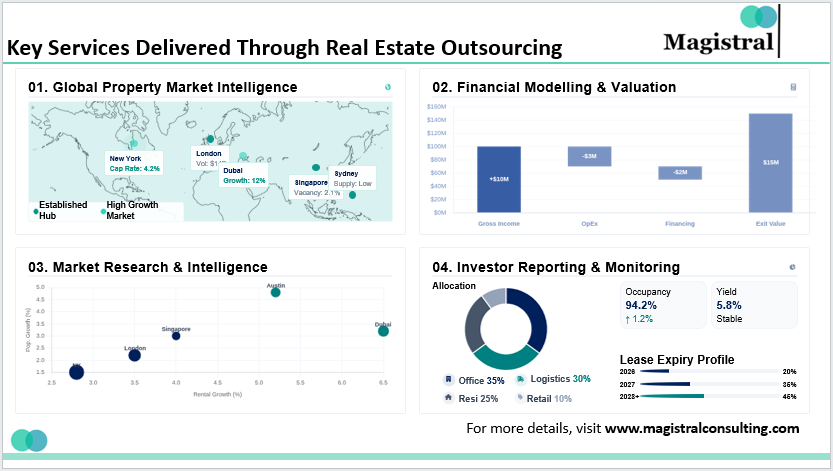
Key Services Delivered Through Real Estate Outsourcing

The scope of real estate outsourcing has expanded significantly. What once focused primarily on administrative support now includes strategic analytical services that influence investment decisions.

Key Services Delivered Through Real Estate Outsourcing

Key Services Delivered Through Real Estate Outsourcing

Financial Modelling and Property Valuation

Financial modelling is one of the most outsourced functions in property investment. Analysts build detailed models that estimate rental income, operating costs, financing structures, and exit values.

These models help investors determine whether a property acquisition will generate attractive long-term returns. In large property transactions, even minor modelling inaccuracies can significantly affect investment outcomes.

Outsourcing financial modelling ensures that property valuations incorporate reliable assumptions and detailed market data.

Market Research and Property Intelligence

Successful real estate investment depends heavily on market intelligence. Analysts evaluate demographic growth, employment trends, supply pipelines, and rental demand before recommending investments.

Through real estate outsourcing, firms gain access to dedicated research teams that monitor property markets across multiple regions. These insights help investors identify high growth cities and emerging property sectors.

Institutional investors allocating capital through diversified funds often rely on such research to determine which markets offer the strongest long-term potential.

Due Diligence and Transaction Support

Real estate acquisitions require extensive due diligence to verify property performance and risk exposure. Analysts review lease agreements, tenant credit profiles, financial statements, and regulatory documentation.

Outsourcing partners assist investment teams by preparing investment memorandums, validating financial assumptions, and conducting property performance analysis. This support allows firms to process transactions faster and manage multiple acquisitions simultaneously.

Investor Reporting and Portfolio Monitoring

Institutional investors require transparent reporting and detailed portfolio updates. Asset managers must regularly communicate property performance, financial projections, and market outlooks.

Through real estate outsourcing, firms obtain professional reporting support that ensures consistent communication with investors. Many property funds follow reporting standards like those used in venture capital investment structures where transparency is essential.

Strategic Benefits of Real Estate Outsourcing

Beyond operational efficiency, Real estate Outsourcing provides several strategic advantages that improve the competitiveness of property investment firms.

Cost Efficiency and Flexible Operations

Building internal analytics teams requires substantial investment in salaries, training, and technology infrastructure. Outsourcing provides access to skilled professionals at lower operational costs while maintaining analytical quality.

Firms can also scale analytical resources based on deal flow and investment activity. This flexibility is particularly beneficial for real estate funds that experience fluctuating transaction volumes.

Faster Investment Decision Making

Speed plays a crucial role in property investment. Attractive opportunities often receive multiple bids from competing investors.

Outsourced analytical teams help evaluate deals quickly by preparing financial models, conducting market research, and validating investment assumptions. Faster analysis enables investment committees to make timely decisions and secure attractive assets.

Access to Specialized Real Estate Expertise

Real estate investments require expertise in finance, market research, and regulatory frameworks. Outsourcing partners often employ professionals with experience in property analytics and transaction support.

This expertise improves the accuracy of investment models and enhances the quality of insights available to decision makers.

Focus on Core Investment Strategy

By delegating analytical tasks to external specialists, property firms can concentrate on strategic priorities such as deal sourcing, asset management, and investor relationships.

This strategic focus enables firms to allocate internal resources toward growth initiatives rather than routine operational work.

Real Estate Outsourcing Trends and Future Industry Outlook

As the property sector becomes more data driven and globally interconnected, the role of real estate outsourcing is expected to expand further.

Artificial Intelligence in Property Analytics

Artificial intelligence is increasingly used to analyse large real estate datasets including rental trends, demographic shifts, and pricing patterns. McKinsey estimates that AI adoption could improve productivity in real estate investment analysis by around 20 percent over the next decade.

Outsourcing providers are integrating AI driven analytics into their services to enhance property valuation and market forecasting.

Expansion of Cross Border Property Investment

Institutional investors increasingly diversify property portfolios across international markets. Capital flows from pension funds and sovereign wealth funds now support property investments across North America, Europe, and Asia Pacific.

Evaluating international markets requires extensive research on regulatory environments and economic indicators. Real estate outsourcing allows investors to access specialized research teams with regional expertise.

Rising Demand for Data Driven Reporting

Institutional investors increasingly demand transparent and data backed reporting. PwC’s real estate survey indicates that investors prioritize detailed analytics when allocating capital to property funds.

Magistral Consulting supports property firms adopting real estate outsourcing by providing research, financial modelling, and transaction support services. Its analysts assist clients in evaluating investment opportunities, conducting market research, and preparing documentation for institutional investors.


About Magistral Consulting

Magistral Consulting has helped multiple funds and companies in outsourcing operations activities. It has service offerings for Private Equity, Venture Capital, Family Offices, Investment Banks, Asset Managers, Hedge Funds, Financial Consultants, Real Estate, REITs, RE funds, Corporates, and Portfolio companies. Its functional expertise is around Deal origination, Deal Execution, Due Diligence, Financial Modelling, Portfolio Management, and Equity Research

For setting up an appointment with a Magistral representative visit www.magistralconsulting.com/contact

About the Author

Tanya is an investment-research specialist with 6 + years advising venture-capital, private-equity and lending clients worldwide. A Stanford Seed alumnus with an MBA and an Economics (Hons) degree, she heads project teams at Magistral Consulting, delivering financial modelling, due-diligence and deal support on 3,000 + mandates. Her blend of rigorous analytics, sharp project management and clear client communication turns complex data into actionable investment insight.

FAQs

What is real estate outsourcing?

Real estate outsourcing refers to delegating operational or analytical tasks such as financial modelling, research, due diligence, and investor reporting to specialized external service providers.

Why is real estate outsourcing growing in popularity?

The growth is driven by increasing institutional investment, complex property portfolios, and the need for specialized analytics in real estate investment decisions.

Which services are most outsourced in real estate?

Common services include financial modelling, property valuation, market research, due diligence, transaction analysis, and investor reporting.

How does real estate outsourcing benefit property investors?

Outsourcing improves analytical accuracy, reduces operational costs, and enables faster evaluation of investment opportunities.

Can smaller property firms benefit from real estate outsourcing?

Yes. Outsourcing allows smaller firms to access experienced analysts and advanced research capabilities without building large internal teams.