Tag Archives: real estate outsourcing services

The real estate industry has changed shape over the past decade and so has the way firms get their work done. Rising operating costs, tighter margins, and a growing demand for specialized skills have pushed owners, brokers, and asset managers to rethink how they staff their operations. As a result, real estate outsourcing has moved from a cost-cutting tactic to a core part of business strategy. Firms now outsource everything from property management to financial modelling, allowing internal teams to focus on decision-making rather than routine tasks.

This shift is not limited to small players either; large institutional investors are adopting outsourced models at scale. The following sections explore why this trend is accelerating and what it means for the industry. 

Real Estate Outsourcing

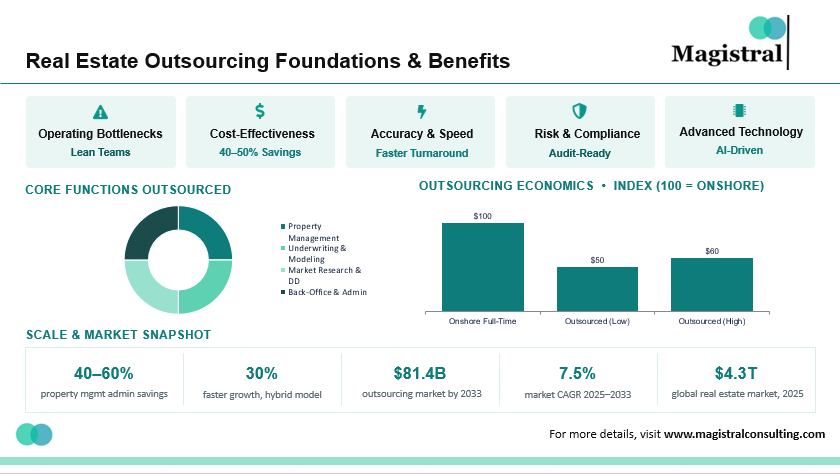
Real Estate Outsourcing Foundations & Benefits

Why Real Estate Outsourcing Is Gaining Momentum 

This practice has grown from a niche approach into a mainstream operating model. Multiple market forces are converging to make third-party support a practical necessity rather than an option. Firms across residential, commercial, and institutional segments are reassessing how much work truly needs to sit in-house. As margins tighten and portfolios grow more complex, outsourcing has become one of the more reliable ways to stay competitive without overextending internal teams. 

Rising Operational Costs Push Firms Toward Outsourcing 

Labor and compliance costs have climbed steadily across major real estate markets. Consequently, many firms find it cheaper to outsource repetitive functions than to expand in-house headcount. Property management alone carries recurring fees that often range between 3-5% for commercial assets, and firms are looking for ways to protect these margins. 

Technology Adoption Accelerates the Shift 

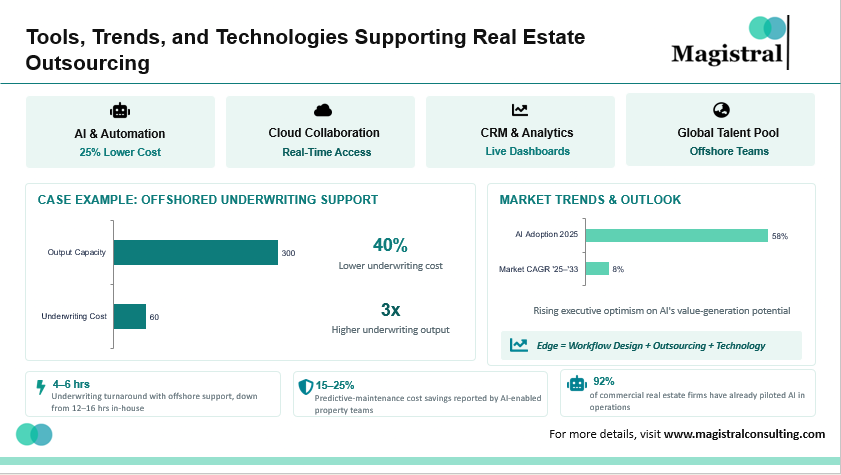
Digital platforms now automate leasing, valuations, and reporting, narrowing the efficiency gap between firms that adopt technology and those that don’t. Outsourcing partners often bring these tools along with trained staff, which shortens the learning curve for smaller firms. 

Institutional Capital Demands Specialized Support 

Institutional investors, including pension funds and insurance companies, have pushed global real estate investment volumes past $12 trillion in recent years. Managing portfolios at this scale requires deep financial modelling and reporting capabilities, which many asset managers choose to outsource rather than build internally. 

Talent Shortages in Core Markets 

Skilled analysts, underwriters, and property accountants remain hard to hire in several regions. This approach gives firms access to trained professionals without competing in a tight local labour market. 

Key Drivers Behind Real Estate Outsourcing Growth 

The decision to outsource is rarely about cost alone. Firms weigh scalability, expertise, and strategic focus before handing off functions to external partners. In most cases, the choice reflects a broader push to run leaner operations while still meeting investor and client expectations. Understanding these drivers helps firms decide which functions are worth outsourcing first. 

Real Estate Outsourcing

Tools, Trends, and Technologies Supporting Real Estate Outsourcing

Cost Efficiency and Scalability 

Outsourcing converts fixed costs into variable ones. This means firms can scale teams up or down as deal flow changes, without the burden of layoffs or idle staff during slower periods. It also removes much of the overhead tied to recruitment, training, and benefits administration. 

Access to Specialized Expertise 

Not every firm can afford a full-time underwriting or GIS analytics team. Outsourcing gives access to niche skills on demand, which is particularly useful for firms entering new asset classes such as logistics or build-to-rent housing. It also lets firms tap into experience across multiple markets rather than relying on one internal team’s view. 

Focus on Core Business Activities 

When back-office and analytical work move off internal desks, leadership can concentrate on deal sourcing, investor relations, and strategic growth. Real Estate Outsourcing, therefore, acts as a filter that removes distraction from higher-value work. Teams end up spending more time on decisions that directly affect returns. 

Global Talent Pool Access 

Real Estate Outsourcing partners often operate across time zones, which allows for near-round-the-clock turnaround on research, reporting, and administrative tasks. This has become especially valuable for firms managing cross-border portfolios. It also gives smaller firms access to talent pools that would otherwise be out of reach locally. 

Functions Commonly Covered Under Real Estate Outsourcing 

This practice today spans far more than basic administrative support. It touches nearly every stage of the property lifecycle. From acquisition through ongoing management, firms are handing off both routine and analytically demanding tasks to specialized teams. This broader scope reflects growing confidence in outsourced providers to handle work that once stayed strictly in-house. 

Property Management Support 

Rent collection, tenant communication, and maintenance coordination are frequently outsourced, especially for portfolios spread across multiple regions. Property management is also the fastest-growing service line in the broader real estate services market, expanding at nearly 6% annually. 

Financial Modelling and Underwriting

Deal teams often outsource cash flow modelling, sensitivity analysis, and underwriting support to specialized providers who understand real estate-specific metrics like cap rates and NOI. This allows firms to evaluate more deals in parallel without stretching internal analysts too thin. 

Market Research and Due Diligence 

Competitive benchmarking, demographic studies, and site-level due diligence require significant manpower. Outsourced research teams help firms move faster without adding permanent headcount. This is especially useful during periods of active deal sourcing, when research demands spike unpredictably. 

Back-Office and Administrative Tasks 

Lease abstraction, document management, and accounting support are among the most commonly outsourced functions, given their repetitive and time-intensive nature. Handing these off frees internal staff to focus on tenant relationships and higher-value coordination work. 

Challenges and Considerations in Real Estate Outsourcing 

Real estate outsourcing brings clear benefits. However, it is not without risk, and firms need to manage a few recurring concerns before committing to a long-term arrangement. Poorly managed vendor relationships can offset the cost savings that outsourcing is meant to deliver. Being aware of these pitfalls in advance makes it easier to structure agreements that actually work. 

Data Security and Confidentiality 

Property and investor data is sensitive, so firms must vet outsourcing partners on data handling practices, encryption standards, and compliance history. Clear contractual terms around data ownership and access help avoid disputes later on. 

Quality Control and Communication 

Time zone differences and unclear scopes of work can lead to inconsistent output. Regular check-ins and documented workflows help minimize this risk. Setting clear turnaround expectations upfront also reduces friction as the relationship scales. 

Choosing the Right Outsourcing Partner 

Not every provider understands real estate terminology or workflows. Firms should evaluate partners on sector experience rather than price alone, since a mismatched vendor can cost more in rework than it saves. Checking references and past project scope can reveal a lot before signing a long-term contract. 

How Magistral Consulting Supports Real Estate Outsourcing 

Real estate outsourcing works best when it is backed by sector expertise rather than generic support staff. Magistral Consulting works with real estate firms, fund managers, and property investors on research, financial modelling, and reporting needs that arise across the investment lifecycle. Rather than offering generic back-office support, the firm builds teams around real estate-specific workflows, which shortens onboarding time and reduces rework for clients. 

Research, Financial Modelling, and Investor Reporting Support 

Magistral’s teams help firms build market studies, competitor benchmarking, and location analysis to support acquisition and leasing decisions. On the financial side, the firm assists asset managers with underwriting models and portfolio-level cash flow analysis, helping ensure that assumptions and outputs remain investor-ready. Beyond modelling, Magistral also supports firms in preparing periodic reports, data rooms, and diligence materials that align with institutional expectations.

Consistent, well-documented reporting builds investor confidence over time, and it also makes future fundraising rounds easier to execute. As a result, clients working with Magistral can extend their internal capacity without adding permanent headcount, while keeping quality and turnaround times consistent across projects. 

About Magistral Consulting

Magistral Consulting has helped multiple funds and companies in outsourcing operations activities. It has service offerings for Private Equity, Venture Capital, Family Offices, Investment Banks, Asset Managers, Hedge Funds, Financial Consultants, Real Estate, REITs, RE funds, Corporates, and Portfolio companies. Its functional expertise is around Deal origination, Deal Execution, Due Diligence, Financial Modelling, Portfolio Management, and Equity Research

For setting up an appointment with a Magistral representative visit www.magistralconsulting.com/contact

About the Author

Prabhash Choudhary is the CEO of Magistral Consulting. He is a Stanford Seed alumnus and mechanical engineer with 20 + years’ leadership at Fortune 500 firms- Accenture Strategy, Deloitte, News Corp, and S&P Global. At Magistral Consulting, he directs global operations and has delivered over $3.5 billion in client impact across finance, research, analytics, and outsourcing. His expertise spans management consulting, investment and strategic research, and operational excellence for 1,200 + clients worldwide

FAQs

What does real estate outsourcing typically include?

It usually covers property management, financial modelling, market research, due diligence, and back-office administrative work.

Is real estate outsourcing only for large firms?

No. Both small brokerages and large institutional investors use this model, though the scope of services often differs based on portfolio size.

How does real estate outsourcing affect data security?

Firms need to choose outsourcing partners with strong data protection practices, since property and investor information is sensitive and often subject to compliance requirements.

Does real estate outsourcing replace in-house teams?

Not usually. Most firms use this approach to support internal teams by handling repetitive or specialized tasks, allowing staff to focus on strategy and client relationships.

What industries within real estate benefit most from outsourcing?

Property management, commercial real estate investment, and real estate funds benefit significantly, given their heavy reliance on research, modelling, and reporting functions.

The global property industry has expanded rapidly as institutional investors increasingly allocate capital to real assets. According to Savills’ global property report, the value of global real estate assets reached nearly $379 trillion in 2024, making it the largest asset class worldwide. Managing such vast portfolios requires complex financial analysis, market research, and operational coordination. As a result, many firms are turning to real estate outsourcing to streamline operations and improve analytical capabilities.

Outsourcing enables property investment firms to access specialized expertise in financial modelling, market intelligence, and transaction support without significantly expanding internal teams. Deloitte’s 2024 real estate industry outlook indicates that over 70 percent of real estate organizations now collaborate with external providers for analytics, research, and reporting functions. This shift reflects the growing complexity of property investment decisions and the need for scalable operational models.

As global investment volumes rise and technology transforms property markets, outsourcing has become a strategic tool rather than just a cost-saving practice. Real estate firms increasingly rely on external specialists to support data-driven investment decisions while internal teams focus on asset management, deal sourcing, and investor relationships.

Real Estate Outsourcing Market Growth and Industry Statistics

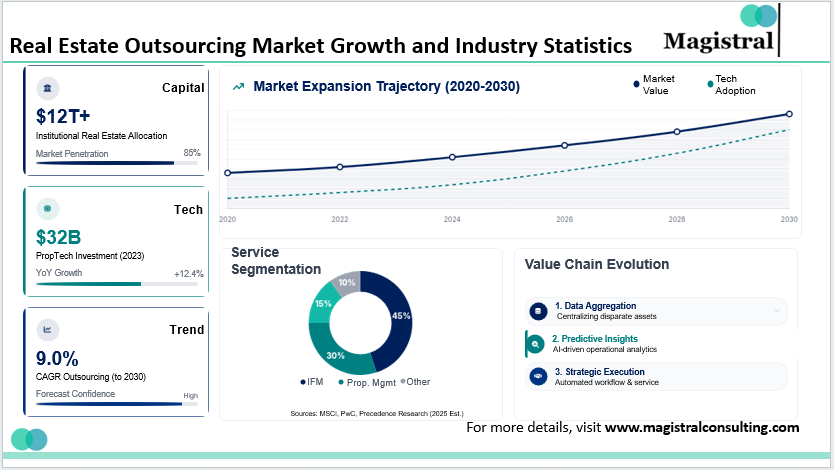
The adoption of Outsourcing has accelerated as global property investments expand, and institutional investors demand greater analytical rigor.

Real Estate Outsourcing Market Growth and Industry Statistics

Real Estate Outsourcing Market Growth and Industry Statistics

Institutional Capital Driving Property Investment

Institutional investors such as pension funds, insurance companies, and sovereign wealth funds have significantly increased their exposure to real estate assets. MSCI’s real assets research indicates that institutional real estate investment volumes have exceeded $12 trillion globally in recent years.

Managing large property portfolios requires extensive financial modelling, asset monitoring, and investment reporting. Many asset managers therefore outsource analytical tasks to specialized teams while internal professionals focus on strategic decision making.

Property funds often operate within investment frameworks like private equity structures where lean internal teams manage investments while outsourcing research and operational support.

Rising Complexity of Property Portfolios

Property portfolios today span multiple geographies and asset classes including residential, office, logistics, and retail properties. Each asset requires continuous evaluation of rental income, operating expenses, tenant performance, and market trends.

Large real estate investment firms may review hundreds of potential transactions annually. Without external analytical support, managing such deal flow would require extensive internal staffing. Real estate outsourcing helps firms evaluate opportunities quickly while maintaining analytical accuracy.

Technology Investment in Real Estate Operations

Digital transformation has also accelerated the adoption of outsourcing in property markets. According to PwC, global investment in property technology exceeded $32 billion in 2023, reflecting the growing reliance on data analytics and digital platforms.

Advanced analytical frameworks such as real estate financial modelling are increasingly used to forecast property performance and evaluate acquisition scenarios. Outsourcing these analytical processes helps ensure accuracy while reducing operational burden on internal teams.

Growth of the Real Estate Outsourcing Market

Research from Precedence Research suggests that outsourcing services across property operations are expanding steadily. The broader real estate services outsourcing market is projected to grow at approximately 9 percent annually through 2030.

This growth reflects the industry’s transition toward flexible operational models. Instead of maintaining large internal research departments, property firms increasingly rely on specialized external partners who provide scalable analytical support.

Key Services Delivered Through Real Estate Outsourcing

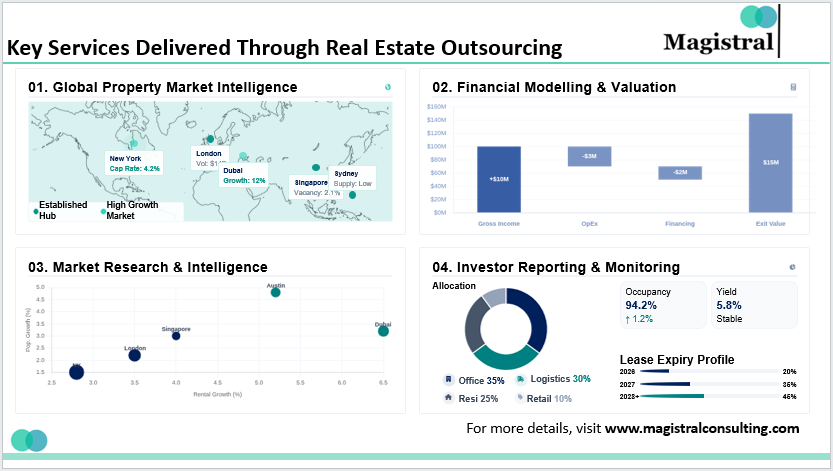
The scope of real estate outsourcing has expanded significantly. What once focused primarily on administrative support now includes strategic analytical services that influence investment decisions.

Key Services Delivered Through Real Estate Outsourcing

Key Services Delivered Through Real Estate Outsourcing

Financial Modelling and Property Valuation

Financial modelling is one of the most outsourced functions in property investment. Analysts build detailed models that estimate rental income, operating costs, financing structures, and exit values.

These models help investors determine whether a property acquisition will generate attractive long-term returns. In large property transactions, even minor modelling inaccuracies can significantly affect investment outcomes.

Outsourcing financial modelling ensures that property valuations incorporate reliable assumptions and detailed market data.

Market Research and Property Intelligence

Successful real estate investment depends heavily on market intelligence. Analysts evaluate demographic growth, employment trends, supply pipelines, and rental demand before recommending investments.

Through real estate outsourcing, firms gain access to dedicated research teams that monitor property markets across multiple regions. These insights help investors identify high growth cities and emerging property sectors.

Institutional investors allocating capital through diversified funds often rely on such research to determine which markets offer the strongest long-term potential.

Due Diligence and Transaction Support

Real estate acquisitions require extensive due diligence to verify property performance and risk exposure. Analysts review lease agreements, tenant credit profiles, financial statements, and regulatory documentation.

Outsourcing partners assist investment teams by preparing investment memorandums, validating financial assumptions, and conducting property performance analysis. This support allows firms to process transactions faster and manage multiple acquisitions simultaneously.

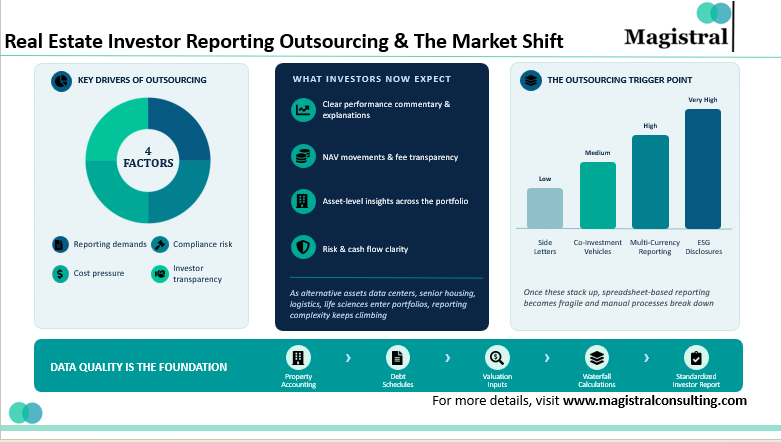
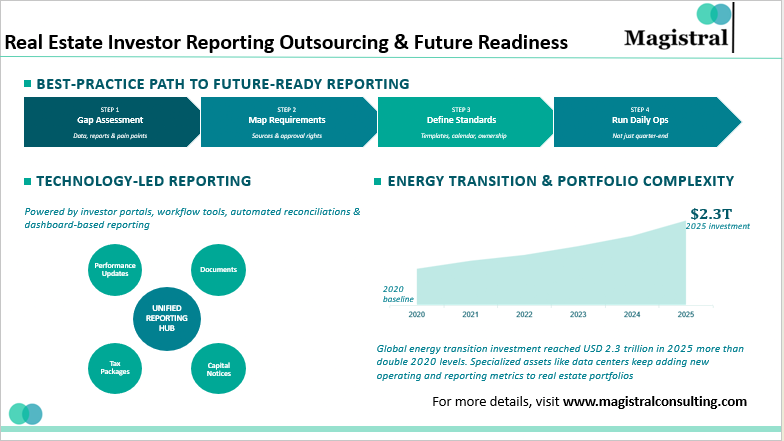
Investor Reporting and Portfolio Monitoring

Institutional investors require transparent reporting and detailed portfolio updates. Asset managers must regularly communicate property performance, financial projections, and market outlooks.

Through real estate outsourcing, firms obtain professional reporting support that ensures consistent communication with investors. Many property funds follow reporting standards like those used in venture capital investment structures where transparency is essential.

Strategic Benefits of Real Estate Outsourcing

Beyond operational efficiency, Real estate Outsourcing provides several strategic advantages that improve the competitiveness of property investment firms.

Cost Efficiency and Flexible Operations

Building internal analytics teams requires substantial investment in salaries, training, and technology infrastructure. Outsourcing provides access to skilled professionals at lower operational costs while maintaining analytical quality.

Firms can also scale analytical resources based on deal flow and investment activity. This flexibility is particularly beneficial for real estate funds that experience fluctuating transaction volumes.

Faster Investment Decision Making

Speed plays a crucial role in property investment. Attractive opportunities often receive multiple bids from competing investors.

Outsourced analytical teams help evaluate deals quickly by preparing financial models, conducting market research, and validating investment assumptions. Faster analysis enables investment committees to make timely decisions and secure attractive assets.

Access to Specialized Real Estate Expertise

Real estate investments require expertise in finance, market research, and regulatory frameworks. Outsourcing partners often employ professionals with experience in property analytics and transaction support.

This expertise improves the accuracy of investment models and enhances the quality of insights available to decision makers.

Focus on Core Investment Strategy

By delegating analytical tasks to external specialists, property firms can concentrate on strategic priorities such as deal sourcing, asset management, and investor relationships.

This strategic focus enables firms to allocate internal resources toward growth initiatives rather than routine operational work.

Real Estate Outsourcing Trends and Future Industry Outlook

As the property sector becomes more data driven and globally interconnected, the role of real estate outsourcing is expected to expand further.

Artificial Intelligence in Property Analytics

Artificial intelligence is increasingly used to analyse large real estate datasets including rental trends, demographic shifts, and pricing patterns. McKinsey estimates that AI adoption could improve productivity in real estate investment analysis by around 20 percent over the next decade.

Outsourcing providers are integrating AI driven analytics into their services to enhance property valuation and market forecasting.

Expansion of Cross Border Property Investment

Institutional investors increasingly diversify property portfolios across international markets. Capital flows from pension funds and sovereign wealth funds now support property investments across North America, Europe, and Asia Pacific.

Evaluating international markets requires extensive research on regulatory environments and economic indicators. Real estate outsourcing allows investors to access specialized research teams with regional expertise.

Rising Demand for Data Driven Reporting

Institutional investors increasingly demand transparent and data backed reporting. PwC’s real estate survey indicates that investors prioritize detailed analytics when allocating capital to property funds.

Magistral Consulting supports property firms adopting real estate outsourcing by providing research, financial modelling, and transaction support services. Its analysts assist clients in evaluating investment opportunities, conducting market research, and preparing documentation for institutional investors.


About Magistral Consulting

Magistral Consulting has helped multiple funds and companies in outsourcing operations activities. It has service offerings for Private Equity, Venture Capital, Family Offices, Investment Banks, Asset Managers, Hedge Funds, Financial Consultants, Real Estate, REITs, RE funds, Corporates, and Portfolio companies. Its functional expertise is around Deal origination, Deal Execution, Due Diligence, Financial Modelling, Portfolio Management, and Equity Research

For setting up an appointment with a Magistral representative visit www.magistralconsulting.com/contact

About the Author

Tanya is an investment-research specialist with 6 + years advising venture-capital, private-equity and lending clients worldwide. A Stanford Seed alumnus with an MBA and an Economics (Hons) degree, she heads project teams at Magistral Consulting, delivering financial modelling, due-diligence and deal support on 3,000 + mandates. Her blend of rigorous analytics, sharp project management and clear client communication turns complex data into actionable investment insight.

FAQs

What is real estate outsourcing?

Real estate outsourcing refers to delegating operational or analytical tasks such as financial modelling, research, due diligence, and investor reporting to specialized external service providers.

Why is real estate outsourcing growing in popularity?

The growth is driven by increasing institutional investment, complex property portfolios, and the need for specialized analytics in real estate investment decisions.

Which services are most outsourced in real estate?

Common services include financial modelling, property valuation, market research, due diligence, transaction analysis, and investor reporting.

How does real estate outsourcing benefit property investors?

Outsourcing improves analytical accuracy, reduces operational costs, and enables faster evaluation of investment opportunities.

Can smaller property firms benefit from real estate outsourcing?

Yes. Outsourcing allows smaller firms to access experienced analysts and advanced research capabilities without building large internal teams.


The real estate industry has proved to be very turbulent over the last few years, an aspect mostly presented by technological advancements, globalization, and changing client expectations. The most effective strategy that has been witnessed in recent times is that of real estate outsourcing. The article aims to broaden this concept of real estate outsourcing, the various benefits it brings along, and the compelling data illustrating its importance in the sector.

Understanding Real Estate Outsourcing

Real estate outsourcing is delegating specific business functions or processes wherein an organisation entrusts specific tasks or activities with other external service providers. They include property management, marketing, financial analysis, legal services, and IT support. Outsourcing helps to hold back some complexities in a wide range of real estate tasks, leading to streamlined operations, cost-cutting, and leverage of specialized expertise.

Current Trends in Real Estate Outsourcing

Current Trends in Real Estate Outsourcing

Emergence of Integrated Facilities Management

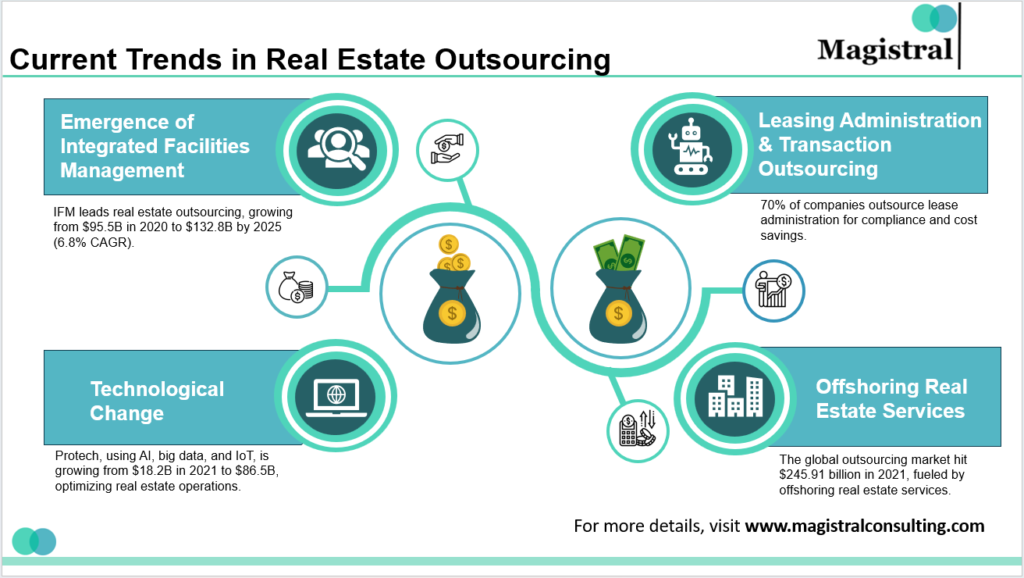
IFM is the current leader in the graph of real estate outsourcing. This is where organizations are increasingly looking for a single provider in building operations, maintenance, and security. It was estimated that the global IFM market was $95.5 billion in 2020 and would be at $132.8 billion in 2025, with a CAGR of 6.8%. Business cases would form the demand for higher operational efficiency with streamlined facility service provision.

Leasing Administration and Transaction Outsourcing

The urge to handle the complications of leasing and, with it, the ever-increasing requirement of multi-large companies to outsource the administration and management of a lease transaction is driving this process. According to a Deloitte report, 70% of the companies have outsourced at least a portion of their lease administration in the last few years. Third-party vendors increasingly take on lease auditing, rent payment processing, and lease abstraction to guarantee compliance, minimize error and cut costs.

Technological Change

Protech refers to AI, big data, and IoT. They are inducting these at a tremendous speed to increase the outsourcing ability in real estate. The global Protech market was valued at $18.2 billion in 2021; it is going to surge above $86.5 billion at a CAGR of 16.8% in between. Among those integrated into the outsourced services are the technologies aimed at optimizing real estate operations. These, in turn, help property managers collect and analyse data in order to better improve performance in buildings, reduce energy consumption, and predict future needs for maintenance.

Offshoring Real Estate Services

There have been documented growing trends in offshoring real estate services to countries such as India, the Philippines, and Eastern Europe. The global outsourcing market as an overall market is now worth $245.91 billion as of 2021 and continues to rise steadily. Companies involved in real estate are offering back-office support services in the following: property accounting, contract administration, and legal support using skilled people located in lower-cost areas.

Key Statistics and Figures

The real estate outsourcing market globally is expected to have growth of 5.2% CAGR throughout 2025, according to the estimates by Statista.

Cost Savings: Organizations have reported that outsourcing has resulted in tremendous cost savings. Real estate outsourcing can help deliver 20%-30% savings of facility and operational expenditures, states Deloitte.

Sustainability Initiatives, GRESB, or Global Real Estate Sustainability Benchmark, has identified that 90% of real estate companies outsource specific services related to sustainability and energy management to specialized providers.

Real Estate Outsourcing into the Future

Future of Real Estate Outsourcing

Future of Real Estate Outsourcing

Data-driven decision-making

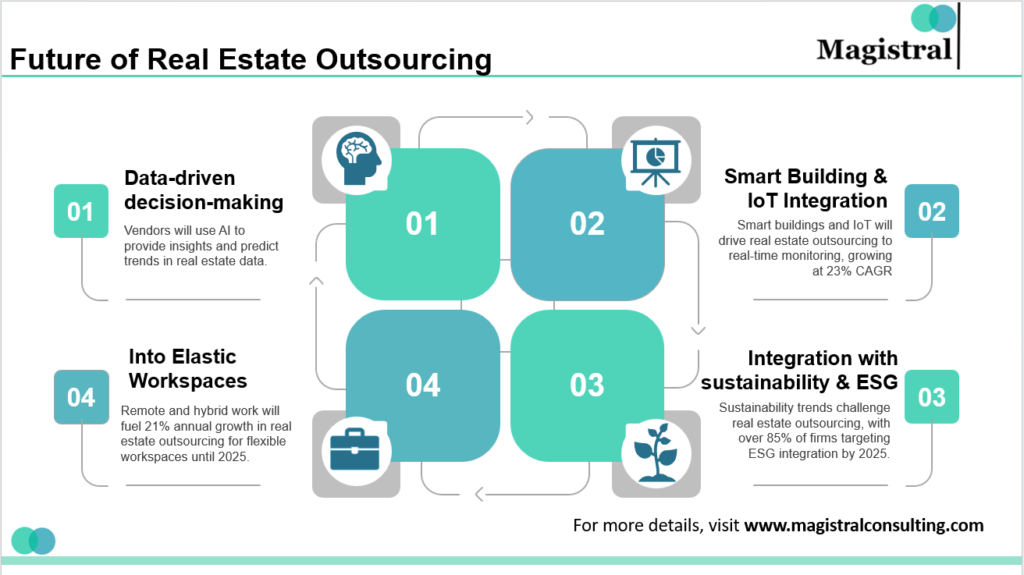
With the continued flow of mass data by real estate companies, outsourced vendors will assume an even more crucial role in analytics and decision-making. Not so long from now, however, services that the outsourcing companies will be used for will no longer only encompass property management but also interpret data from buildings into actionable insights. AI and machine learning tools will be able to predict trends, identify inefficiencies, and then make decisions on behalf of the owners of the properties.

Smart Building and IoT Integration

Smart buildings and IoT growth will make real estate sector outsourcing firms focus more on real-time building monitoring and predictive maintenance. The smart building IoT market size was about $67.60 billion in 2021. For the next five years, it is likely to grow at a CAGR of 23%. These systems are going to be used by outsourcing companies to take care of all the aspects that can improve efficiency while reducing costs and keeping up with increasing sustainability standards.

Into Elastic Workspaces: Main driver

The rise in adoption of remote and hybrid work models combined with the pressure on the real estate outsourcing industry to open services related to the management of flexible workspaces are expected to be the primary growth drivers. Flexible office spaces, according to the report by JLL, are set to grow at a pace of 21% annually up to 2025. Most of them outsource the design, management, and optimization of the office space as companies shift from traditional leases.

Integration with sustainability and ESG

As for the long term, there is a trend for sustainability and ESG in which opportunities and challenges are presented before outsourced providers of real estate on how sustainable practices can be integrated with the property management service. More than 85% of the real estate firms report EY in integrating ESG strategies into their functions by 2025, and it mainly helps their outsourcing partners achieve that aim. In addition to the experiences above, outsourcing companies will also face pressure in terms of experience on matters related to green building certifications.

Magistral’s Services for Real Estate Outsourcing

Fund-Raising

We provide full-service investor outreach support from analysis of the funding environment to conducting all macroeconomic research to producing sharp, polished pitch decks that help get your strategy across.

Pre-Deal Support

We provide summarize investment memorandums, and create detailed models of financial modeling, and property profiling, thus providing an overall understanding of each potential investment.

Deals Structuring

This involved structuring deals with advanced real estate modeling as well as preparing investor committee memorandums to ensure that every transaction would be well-planned and documented.

Portfolio Management and Exits

We provide portfolio reporting and design thoughtful exit strategies, thus optimizing returns while ensuring a smooth transition in the liquidation of the portfolio.

Operations Outsourcing

We offer operational outsourcing services and provide smooth, back-end processes for real estate management, which ensures that you can truly focus on growing.


About Magistral Consulting

Magistral Consulting has helped multiple funds and companies in outsourcing operations activities. It has service offerings for Private Equity, Venture Capital, Family Offices, Investment Banks, Asset Managers, Hedge Funds, Financial Consultants, Real Estate, REITs, RE funds, Corporates, and Portfolio companies. Its functional expertise is around Deal origination, Deal Execution, Due Diligence, Financial Modelling, Portfolio Management, and Equity Research

For setting up an appointment with a Magistral representative visit www.magistralconsulting.com/contact

About the Author

The article is authored by the Marketing Department of Magistral Consulting. For any business inquiries, you can reach out to prabhash.choudhary@magistralconsulting.com

[sp_easyaccordion id=”3125″]

Introduction

The real estate industry, encompassing property development, transactions, and management, plays a crucial role in the global economy. Real estate firms act as facilitators, ensuring smooth transactions and providing vital services. This article explores the multifaceted world of real estate firms, emphasizing their key functions, challenges, and the solutions they can leverage for success.

Real estate firms serve as intermediaries between buyers and sellers, landlords and tenants, and developers and investors. Their expertise in market analysis, valuation, and legal processes instills trust and confidence in clients. As the industry evolves, these firms must navigate complexities and adopt innovative strategies to stay competitive.

Understanding Real Estate Firms

Real estate firms operate across various sectors, including residential, commercial, industrial, and retail. They play a pivotal role in executing transactions and ensuring the efficient management of properties. Beyond sales, they provide critical services such as market analysis, investment advisory, and property management.

These firms are instrumental in high-value acquisitions, strategic development projects, and optimizing investment portfolios. Their expertise in lease administration, asset enhancement, and risk mitigation adds substantial value to clients’ holdings.

Technology adoption has transformed the industry, streamlining operations and improving client experiences. Digital platforms enable virtual property tours and advanced analytics support informed decision-making. By leveraging automation and data-driven insights, real estate firms enhance efficiency, transparency, and agility.

Key Functions of Real Estate Firms

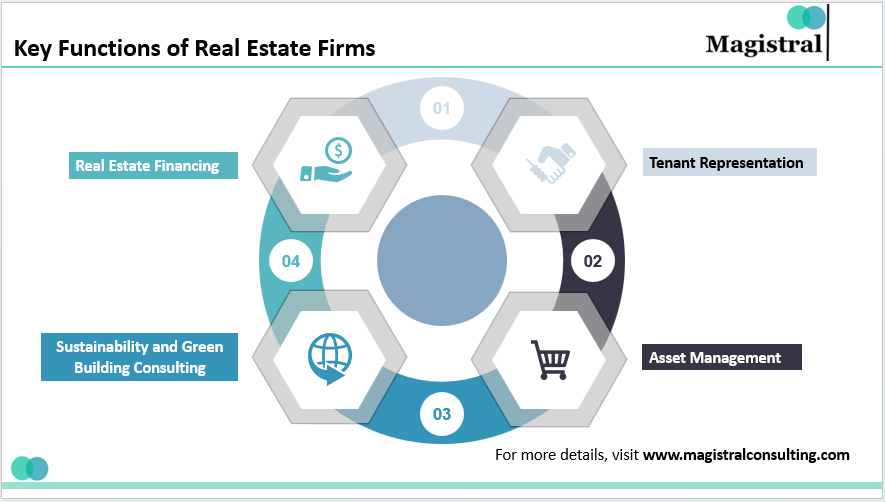
Real estate firms contribute to the efficient operation of the market through various functions:

Key Functions of Real Estate Firms

Key Functions of Real Estate Firms

Tenant Representation

Additionally, real estate firms offer tenant representation services. They assist tenants in finding suitable spaces for lease, negotiate lease terms on their behalf, and advocate for their interests throughout the leasing process.

Asset Management

Apart from property management, real estate firms engage in asset management activities to maximize the value of real estate portfolios. This involves strategic planning, performance analysis, and implementing value-add initiatives to enhance asset performance and investor returns.

Sustainability and Green Building Consulting

Real estate firms offer consulting services in green building practices and sustainability initiatives. They advise clients on incorporating energy-efficient technologies, sustainable materials, and green certifications into their projects to reduce environmental impact and enhance long-term value.

Real Estate Financing

Many firms facilitate real estate financing by connecting clients with lenders and financial institutions, structuring deals, and securing funding for acquisitions, development, and investments.

Challenges Faced by Real Estate Firms

While real estate firms offer numerous benefits, they also face significant challenges:

Market Volatility

The industry is highly sensitive to economic conditions, interest rate fluctuations, and investor sentiment shifts. Economic expansions drive property values up, while downturns lead to decreased demand. Navigating market volatility requires expertise in risk management and a proactive approach to economic trends.

Regulatory Changes

Real estate operates within complex regulatory frameworks, including zoning laws, environmental policies, and tax regulations. Legislative shifts introduce uncertainties that impact property development and investment decisions. Firms must engage with policymakers, maintain compliance, and adapt to evolving regulations.

Competition

The industry is highly competitive, requiring firms to differentiate through specialization, innovation, and technology. Strong client relationships, market expertise, and a commitment to service excellence are essential for long-term success.


Economic Uncertainty

The interconnected nature of the global economy exposes the real estate sector to economic uncertainty stemming from geopolitical events, trade tensions, and economic downturns. Global events such as geopolitical conflicts, natural disasters, or public health crises can trigger market volatility and erode investor confidence, leading to hesitancy in investment decisions and tightening of financing availability. Economic downturns, characterized by recessionary pressures, declining consumer spending, and rising unemployment, exert downward pressure on property prices and demand across various real estate segments. Navigating economic uncertainty requires proactive risk management strategies, diversified investment portfolios, and a focus on liquidity and financial resilience. Moreover, maintaining robust relationships with financial institutions, staying abreast of macroeconomic trends, and leveraging data analytics for informed decision-making are essential for mitigating risks and capitalizing on opportunities amidst economic turbulence.

Magistral Consulting: Tailored Solutions for Real Estate Firms

Magistral Consulting specializes in offering tailored services to real estate firms, addressing their unique challenges and needs.

Magistral's Services on Real Estate Firms

Magistral’s Services on Real Estate Firms

Strategic Fundraising Campaigns

Magistral Consulting specializes in crafting bespoke fundraising campaigns tailored to the specific needs and goals of real estate firms. Leveraging their expertise in market dynamics and investor relations, they develop compelling narratives and engagement strategies designed to attract potential investors. Through meticulous analysis of market conditions and investor preferences, they identify optimal fundraising opportunities and guide clients through every stage of the fundraising process.

Targeted Investor Engagement

Magistral Consulting excels in cultivating meaningful relationships with potential investors who are aligned with the investment objectives and philosophies of their clients. Using tailored outreach efforts and personalized communication strategies, they identify and engage with high-net-worth individuals, institutional investors, family offices, and other relevant stakeholders. By aligning clients’ investment propositions with the interests and preferences of prospective investors, they establish mutually beneficial connections that lay the foundation for successful fundraising campaigns.

Comprehensive Funding Environment Analysis

Magistral Consulting conducts thorough analyses of the funding environment, offering real estate firm’s valuable insights into market trends, investor sentiment, and capital allocation dynamics. Through rigorous research and data-driven analysis, they monitor macroeconomic indicators, regulatory developments, and industry trends that influence the investment landscape.

In-depth Macroeconomic Research

Magistral Consulting stands out in the field of macroeconomic research, providing real estate firms with actionable insights into broader economic trends and their impact on the real estate market. By analyzing key indicators such as GDP growth, interest rates, inflation, and employment figures, they assess the overall economic health and identify potential drivers of real estate demand and investment activity.

About Magistral Consulting

Magistral Consulting has helped multiple funds and companies in outsourcing operations activities. It has service offerings for Private Equity, Venture Capital, Family OfficesInvestment BanksAsset Managers, Hedge Funds, Financial Consultants, Real Estate, REITs, RE fundsCorporates, and Portfolio companies. Its functional expertise is around Deal originationDeal Execution, Due Diligence, Financial ModellingPortfolio Management, and Equity Research

For setting up an appointment with a Magistral representative visit www.magistralconsulting.com/contact

About the Author

The article is Authored by the Marketing Department of Magistral Consulting. For any business inquiries, you could reach out to prabhash.choudhary@magistralconsulting.com

Introduction

These businesses focus on managing the daily operations and tactical supervision of real estate assets with the intention of maximizing investment returns and minimizing risks. The improvement of a property or portfolio’s worth and profitability is the main goal of real estate asset management. This entails a variety of tasks, including the purchase and sale of real estate, leasing, tenant interactions, financial analysis, budgeting, property administration, renovations, and overall portfolio improvement.

To create and implement a customized asset management strategy, real estate asset management companies frequently collaborate closely with investors or property owners. This approach takes into account the precise goals and objectives of the investor or property owner, the state of the market, and the particular qualities of the asset or portfolio.

Asset managers draw on their expertise and sector knowledge to evaluate market trends, spot possibilities for wealth creation, and make educated decisions on their client’s behalf. They keep a close eye on the assets’ performance, evaluate the state of the market, and put strategies into place to raise occupancy rates, rental revenue, and the overall value of the assets.

Real estate asset management companies offer thorough reporting, financial analysis, and regular property management tasks. They give frequent financial statements, keep clients updated on the status of their assets, and make suggestions for raising returns and lowering risks.

In general, real estate asset management companies offer their knowledge to efficiently manage and increase the value of real estate assets, acting as trusted partners for investors and property owners. In the fast-paced and cutthroat real estate market, their emphasis on strategic planning, operational execution, and financial optimization helps customers realize their investment goals.

Benefits of Real Estate Asset Management

Property owners, investors, and institutions can all profit from real estate asset management in several ways. These advantages show the value that real estate asset management provides to investors and property owners, allowing them to fulfill their investment objectives, maximize the performance of their properties, and reduce risks in the constantly changing real estate market. The following are some major advantages of managing real estate assets:

Benefits of Real Estate Asset Management

Benefits of Real Estate Asset Management

-Maximize Property Value

Real estate asset managers employ tactics to boost rental income, lower vacancies, and improve property performance to maximize the value of properties. They evaluate market conditions, seek out chances to add value and carry out strategies to optimize returns on investments.

-Experience and Sector Knowledge

The real estate market, developments, and optimal procedures are all deeply ingrained in the understanding of asset managers. They keep up with local market conditions, legislative changes, and business prospects, enabling them to make wise judgments and successfully manage risks.

-Risk Minimization

Asset managers recognize and control risk factors connected to real estate holdings. They create risk management plans, put insurance in place, and make sure all legal and regulatory requirements are met. This minimizes potential damages and protects the property owner’s investment.

-Financial Efficiency Evaluation

To evaluate the efficacy of real estate assets, asset managers conduct financial analysis and reporting. They offer information about cash flow, rental revenue, costs, and return on investment. Property owners can make informed judgments and improve financial performance with the help of this information.

-Portfolio Optimization and Diversification

Property owners can diversify and improve their real estate assets with the aid of asset managers. To create a balanced and high-performing portfolio, they monitor market conditions, appraise the portfolio’s composition, and suggest investment options.

-Resource and Time Conservation

Property owners may conserve time and money by giving experts the task of managing their assets. Property owners can concentrate on other issues since asset managers take care of the daily tasks, financial evaluation, tenant administration, and other challenging activities.

-Connections and Contacts

Asset managers have wide-ranging connections with brokers, suppliers, and other real estate industry experts. For the benefit of property owners, they use these networks to gain access to market knowledge, real estate prospects, and potential alliances.

Steps in Managing Real Estate Assets

It’s crucial to remember that these stages may change depending on the particular property, investor requirements, and market conditions. To provide the best results, real estate asset management is a dynamic, iterative process that needs constant review and modification. The general steps in managing real estate assets are as follows:

Steps in Managing Real Estate Assets

Steps in Managing Real Estate Assets

-Establishing Expectations: 

The first stage is to set up particular aspirations and targets for the real estate asset. Identifying the owner’s or investor’s financial goals, willingness to take risks, and anticipated return on investment is necessary for this.

-Asset Handling Approach:

Create a customized asset management plan based on the owner’s objectives and the property analysis. This plan defines the course of action to be followed to increase property value, optimize income, reduce empty spaces, and reduce risks.

-Property Analysis:

Analyze the property or portfolio thoroughly to comprehend its existing state, standing in the market, and the possibility of value amplification. This entails assessing elements like location, physical state, market demand, and possible rental income.

-Property Development and Preservation:

To maintain the property’s aesthetic appeal and physical condition, implement a preventative maintenance strategy. This covers routine checks, preventative maintenance, and required improvements to raise the property’s worth.

-Mitigate Risk:

Determine and reduce the property’s risks, including market turbulence, legal and regulatory compliance, and environmental problems. Put into practice risk management solutions, such as insurance coverage, backup plans, and legal compliance procedures.

-Performance Assessment:

Keep an eye on the asset’s performance in comparison to stated objectives and key performance indicators (KPIs). Monitoring the property’s performance entails examining financial records, occupancy rates, rental income, and other pertinent measures.

-Interaction and Reporting:

Give the investor or property owner frequent information and updates. Financial documents, performance reports, and suggestions for maximizing property value are included.

-Making Strategic Decisions:

Analyze market circumstances, industry developments, and prospects for value creation constantly. To optimize returns, choose wisely when buying, selling, refinancing, and making other strategic decisions about real estate.

Magistral Consulting’s Real Estate Asset Management Services

Magistral Consulting offers high-quality Real Estate Operations Outsourcing services. While all other asset class experiences ups and downs, real estate is the only one that is consistently profitable. Even during economic downturns, it retains investors’ trust. With the assurance of long-term income, it is convenient to hang onto the tangible quality of the asset class. It provides the finest profits and investment safety available today. It’s critical to comprehend a property’s potential in terms of returns to succeed in RE funds. Consistent returns are guaranteed year after year when the property is managed over a longer period.

Magistral helps you navigate the exciting world of Real Estate investments. Our services of Real Estate Operations outsourcing are helpful for Real Estate Private Equity, Real Estate Developers and Owners, REITs, and, Property Consultants and Brokers.

Here are the service categories we provide:

-Fund Raising and Exits

Identifying Limited Partners, Funding Strategy, Funding Environment Analysis, Pitch Deck, Investor Committee Presentations, Equity Waterfall Analysis, and, other similar assignments.

-Pre-Deal Support

Investment Memorandums, Financial Modeling, Real Estate Valuations and Returns, Market Analysis, Property Profiling, and, Data Management. Real Estate Due Diligence Is also performed under this bouquet of services.

-Deal Structuring

Real Estate Modeling, Rent Rolls Analysis, Rental Comps, Equity Waterfalls, Funding Requirement Analysis, and, Investor Committee Memorandums.

-Portfolio Management

Board Updates, Occupancy and Yield Trackers, Real Estate Yields, REIT Dividend Calculations, Tracking Real Estate Fund Indices, Rent Roll Analysis, Expenses & Budgets, Real Estate Fund Accounting, Fund Administration and Accounting, Fund Fee Structures, and, Portfolio Dashboards.

About Magistral Consulting

Magistral Consulting has helped multiple funds and companies in outsourcing operations activities. It has service offerings for Private Equity, Venture Capital, Family OfficesInvestment BanksAsset Managers, Hedge Funds, Financial Consultants, Real Estate, REITs, RE fundsCorporates, and Portfolio companies. Its functional expertise is around Deal originationDeal Execution, Due Diligence, Financial ModellingPortfolio Management, and Equity Research.

For setting up an appointment with a Magistral representative: visit www.magistralconsulting.com/contact

About the Author

The article is authored by the Marketing Department of Magistral Consulting. For any business inquiries, you can reach out to  prabhash.choudhary@magistralconsulting.com