Tag Archives: fundraising for real estate

The real estate industry has changed shape over the past decade and so has the way firms get their work done. Rising operating costs, tighter margins, and a growing demand for specialized skills have pushed owners, brokers, and asset managers to rethink how they staff their operations. As a result, real estate outsourcing has moved from a cost-cutting tactic to a core part of business strategy. Firms now outsource everything from property management to financial modelling, allowing internal teams to focus on decision-making rather than routine tasks.

This shift is not limited to small players either; large institutional investors are adopting outsourced models at scale. The following sections explore why this trend is accelerating and what it means for the industry. 
Real Estate Outsourcing

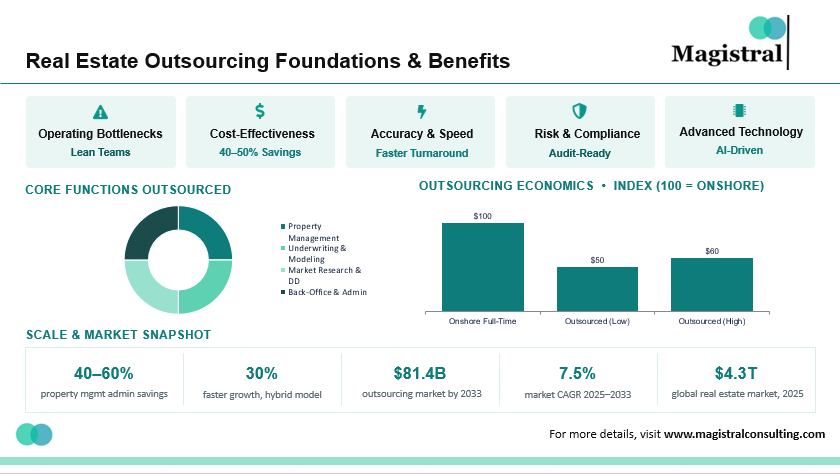
Real Estate Outsourcing Foundations & Benefits

Why Real Estate Outsourcing Is Gaining Momentum 

This practice has grown from a niche approach into a mainstream operating model. Multiple market forces are converging to make third-party support a practical necessity rather than an option. Firms across residential, commercial, and institutional segments are reassessing how much work truly needs to sit in-house. As margins tighten and portfolios grow more complex, outsourcing has become one of the more reliable ways to stay competitive without overextending internal teams. 

Rising Operational Costs Push Firms Toward Outsourcing 

Labor and compliance costs have climbed steadily across major real estate markets. Consequently, many firms find it cheaper to outsource repetitive functions than to expand in-house headcount. Property management alone carries recurring fees that often range between 3-5% for commercial assets, and firms are looking for ways to protect these margins. 

Technology Adoption Accelerates the Shift 

Digital platforms now automate leasing, valuations, and reporting, narrowing the efficiency gap between firms that adopt technology and those that don’t. Outsourcing partners often bring these tools along with trained staff, which shortens the learning curve for smaller firms. 

Institutional Capital Demands Specialized Support 

Institutional investors, including pension funds and insurance companies, have pushed global real estate investment volumes past $12 trillion in recent years. Managing portfolios at this scale requires deep financial modelling and reporting capabilities, which many asset managers choose to outsource rather than build internally. 

Talent Shortages in Core Markets 

Skilled analysts, underwriters, and property accountants remain hard to hire in several regions. This approach gives firms access to trained professionals without competing in a tight local labour market. 

Key Drivers Behind Real Estate Outsourcing Growth 

The decision to outsource is rarely about cost alone. Firms weigh scalability, expertise, and strategic focus before handing off functions to external partners. In most cases, the choice reflects a broader push to run leaner operations while still meeting investor and client expectations. Understanding these drivers helps firms decide which functions are worth outsourcing first. 
Real Estate Outsourcing

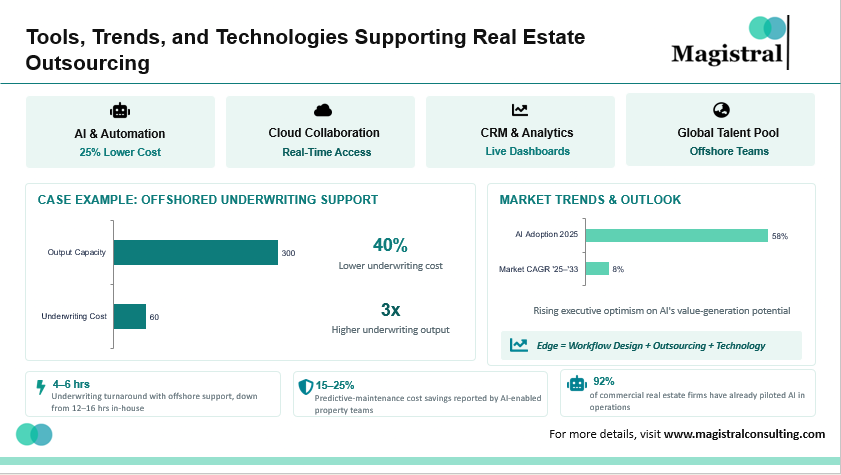
Tools, Trends, and Technologies Supporting Real Estate Outsourcing

Cost Efficiency and Scalability 

Outsourcing converts fixed costs into variable ones. This means firms can scale teams up or down as deal flow changes, without the burden of layoffs or idle staff during slower periods. It also removes much of the overhead tied to recruitment, training, and benefits administration. 

Access to Specialized Expertise 

Not every firm can afford a full-time underwriting or GIS analytics team. Outsourcing gives access to niche skills on demand, which is particularly useful for firms entering new asset classes such as logistics or build-to-rent housing. It also lets firms tap into experience across multiple markets rather than relying on one internal team’s view. 

Focus on Core Business Activities 

When back-office and analytical work move off internal desks, leadership can concentrate on deal sourcing, investor relations, and strategic growth. Real Estate Outsourcing, therefore, acts as a filter that removes distraction from higher-value work. Teams end up spending more time on decisions that directly affect returns. 

Global Talent Pool Access 

Real Estate Outsourcing partners often operate across time zones, which allows for near-round-the-clock turnaround on research, reporting, and administrative tasks. This has become especially valuable for firms managing cross-border portfolios. It also gives smaller firms access to talent pools that would otherwise be out of reach locally. 

Functions Commonly Covered Under Real Estate Outsourcing 

This practice today spans far more than basic administrative support. It touches nearly every stage of the property lifecycle. From acquisition through ongoing management, firms are handing off both routine and analytically demanding tasks to specialized teams. This broader scope reflects growing confidence in outsourced providers to handle work that once stayed strictly in-house. 

Property Management Support 

Rent collection, tenant communication, and maintenance coordination are frequently outsourced, especially for portfolios spread across multiple regions. Property management is also the fastest-growing service line in the broader real estate services market, expanding at nearly 6% annually. 

Financial Modelling and Underwriting

Deal teams often outsource cash flow modelling, sensitivity analysis, and underwriting support to specialized providers who understand real estate-specific metrics like cap rates and NOI. This allows firms to evaluate more deals in parallel without stretching internal analysts too thin. 

Market Research and Due Diligence 

Competitive benchmarking, demographic studies, and site-level due diligence require significant manpower. Outsourced research teams help firms move faster without adding permanent headcount. This is especially useful during periods of active deal sourcing, when research demands spike unpredictably. 

Back-Office and Administrative Tasks 

Lease abstraction, document management, and accounting support are among the most commonly outsourced functions, given their repetitive and time-intensive nature. Handing these off frees internal staff to focus on tenant relationships and higher-value coordination work. 

Challenges and Considerations in Real Estate Outsourcing 

Real estate outsourcing brings clear benefits. However, it is not without risk, and firms need to manage a few recurring concerns before committing to a long-term arrangement. Poorly managed vendor relationships can offset the cost savings that outsourcing is meant to deliver. Being aware of these pitfalls in advance makes it easier to structure agreements that actually work. 

Data Security and Confidentiality 

Property and investor data is sensitive, so firms must vet outsourcing partners on data handling practices, encryption standards, and compliance history. Clear contractual terms around data ownership and access help avoid disputes later on. 

Quality Control and Communication 

Time zone differences and unclear scopes of work can lead to inconsistent output. Regular check-ins and documented workflows help minimize this risk. Setting clear turnaround expectations upfront also reduces friction as the relationship scales. 

Choosing the Right Outsourcing Partner 

Not every provider understands real estate terminology or workflows. Firms should evaluate partners on sector experience rather than price alone, since a mismatched vendor can cost more in rework than it saves. Checking references and past project scope can reveal a lot before signing a long-term contract. 

How Magistral Consulting Supports Real Estate Outsourcing 

Real estate outsourcing works best when it is backed by sector expertise rather than generic support staff. Magistral Consulting works with real estate firms, fund managers, and property investors on research, financial modelling, and reporting needs that arise across the investment lifecycle. Rather than offering generic back-office support, the firm builds teams around real estate-specific workflows, which shortens onboarding time and reduces rework for clients. 

Research, Financial Modelling, and Investor Reporting Support 

Magistral’s teams help firms build market studies, competitor benchmarking, and location analysis to support acquisition and leasing decisions. On the financial side, the firm assists asset managers with underwriting models and portfolio-level cash flow analysis, helping ensure that assumptions and outputs remain investor-ready. Beyond modelling, Magistral also supports firms in preparing periodic reports, data rooms, and diligence materials that align with institutional expectations.

Consistent, well-documented reporting builds investor confidence over time, and it also makes future fundraising rounds easier to execute. As a result, clients working with Magistral can extend their internal capacity without adding permanent headcount, while keeping quality and turnaround times consistent across projects. 

About Magistral Consulting

Magistral Consulting has helped multiple funds and companies in outsourcing operations activities. It has service offerings for Private Equity, Venture Capital, Family Offices, Investment Banks, Asset Managers, Hedge Funds, Financial Consultants, Real Estate, REITs, RE funds, Corporates, and Portfolio companies. Its functional expertise is around Deal origination, Deal Execution, Due Diligence, Financial Modelling, Portfolio Management, and Equity Research

For setting up an appointment with a Magistral representative visit www.magistralconsulting.com/contact

About the Author

Prabhash Choudhary is the CEO of Magistral Consulting. He is a Stanford Seed alumnus and mechanical engineer with 20 + years’ leadership at Fortune 500 firms- Accenture Strategy, Deloitte, News Corp, and S&P Global. At Magistral Consulting, he directs global operations and has delivered over $3.5 billion in client impact across finance, research, analytics, and outsourcing. His expertise spans management consulting, investment and strategic research, and operational excellence for 1,200 + clients worldwide

FAQs

What does real estate outsourcing typically include?

It usually covers property management, financial modelling, market research, due diligence, and back-office administrative work.

Is real estate outsourcing only for large firms?

No. Both small brokerages and large institutional investors use this model, though the scope of services often differs based on portfolio size.

How does real estate outsourcing affect data security?

Firms need to choose outsourcing partners with strong data protection practices, since property and investor information is sensitive and often subject to compliance requirements.

Does real estate outsourcing replace in-house teams?

Not usually. Most firms use this approach to support internal teams by handling repetitive or specialized tasks, allowing staff to focus on strategy and client relationships.

What industries within real estate benefit most from outsourcing?
Property management, commercial real estate investment, and real estate funds benefit significantly, given their heavy reliance on research, modelling, and reporting functions.

Introduction

A rent rolls is an indispensable tool with well-organized details about tenant information, lease terms, rent amount, property details, and monthly and annual rental income summaries. It is the foremost document that is required by both lenders and investors. It is to access a significant amount of data for an informed decision-making process. This replacement against dozens of documents serves as a focused view to the investors for two critical purposes. The first being the analysis of potential properties for acquisition. The other being to track the performance of already owned properties for better management of investments.

Requirements of Rent Rolls: When is it used?

In order to realize the true worth of the property, the rent roll is analyzed in different ways for various decision-making under varied situations.

Investment Analysis for Informed Decision-Making

This seems to be a simple document consisting of extremely important financial information required to calculate significant financial performance formulas such as net operation income, gross rent multiplier, and internal rate of return (IRR). All these formulas along with other calculations (if required) are used for analyzing the investment muscles of the commercial property.

Due Diligence

While processing the acquisition of the commercial property investors and potential buyers use the document as part of their due diligence. It provides the evaluation of the property’s financial performance which is usually based on factors like property type, square meters/feet, location, and condition. In the case of commercial property, the potential risk and overall suitability becomes critically important.

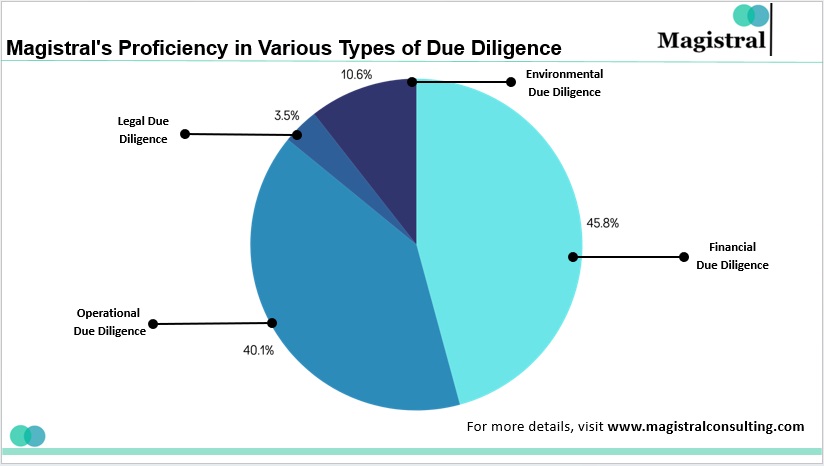
Magistral's Proficiency in Various Types of Due Diligence

Magistral’s Proficiency in Various Types of Due Diligence

Property Management

Owning a lot requires detailed management and the details revealed by the rent roll aid the management process for the investors. With details and facilities like tracking rental payments, management of lease expirations, and monitoring occupancy rates. Along with other details like pricing, tenant retention, lease negotiations, and overall property management. It allows the investors to supervise their holdings.

Analysis of Market and Valuation

Analysts conduct a comprehensive market comparison of other transacted rent rolls by examining the marketing deeply and broadly through the document’s details to obtain a multiplier. They then calculate the management fee using this multiplier and factors like average weekly rent, property-to-landlord ratio, ancillary fees and charges, arrears rate, staff and wages, economic conditions, and legislative compliance. By synthesizing all these elements, they establish a base for applying the required valuation method.

Application of Loan and Financing

Investors need this document to evaluate their decisions based on information such as the property’s rental income, occupancy rate, and lease terms. They use it widely in the commercial property world to analyze future cash flow based on current details, helping them make strategic financial decisions.

Negotiations and Lease Renewals

Property owners and interested managers primarily refer to the document to assess lease expiration dates and occupancy status. They use this information to negotiate lease terms, evaluate tenants’ rental strategies, and adjust rent rates as needed, enabling better comparative analysis for long-term investment decisions.

Critical elements of Rent Rolls: What an investor should look for

Analysis of the rent rolls is a thorough and lengthy process as it traditionally involves a lot of paperwork. The document is prone to regular updation which requires constant evaluation. Although it contains a lot of information that may overwhelm the investor while evaluating, the investor can analyze the following key elements to gain a wholesome viewpoint:

Critical Elements of Rent Rolls

Critical Elements of Rent Rolls

Unit ID

A Unit ID is a unique identity of the property. It is a combination of a unit name and a property name which will always be unique in nature for different properties. This ID allows a handy organization of properties by investors.

Tenant’s Information

It reveals how “seasoned” tenants are. The long-term stay of tenants builds a sense of reliability and assurance in the minds of investors and increases the creditability of the property in the market.

Lease Dates

Knowing the start and end dates enables investors to plan the timing, duration, and amount of their investments. Scheduling the expiration of leases investors take bulk in or out investment decisions.

Lease Deeds

A formally constructed contract between the lessor and the lessee that provides legal protection to the concerned parties by defining their roles, responsibilities, and obligations.

Rent Amount

From the investor’s aspect the amount of rent is the stable income received against investment. The higher the stability more will be the reliability of the investor. However, properties with low levels of income are comparatively cheaper than the ones with stable income.

Due Date

It helps investors keep their financial ducks in a row and manage the payments accordingly.

Security Cash

The security amount provides a safety net to the investors. It acts as a buffer for investors in case the terms and situation are imbalanced.

Owed Balance

By keeping track of what is yet to be cleared and received, investors analyze the consistency of income flow. Long dues indicate poor strength of the property and a critically unfit situation to remain invested.

Pay History

Perfectly correlated with the owed balance and due date, pay history gives a summarized picture of what twists and turns investors encounter.

Analysts should also cover other critical aspects while reviewing the rent roll, such as guarantor information (if applicable), lease type, renewal and termination options, and any attached lease-related documents like amendments to the lease contract.

Magistral Services for Rent Rolls Analysis

By following an in-depth analysis of the property’s rent roll Magistral acquires all relevant and necessary details.  And then builds a database. It is to manage the data sequentially for a better comparative analysis. Analysts use the data to calculate metrics such as total rental income, occupancy rates, lease expiration schedules, and any delinquencies or vacancies to identify potential risks and opportunities based on the rent rolls. Using the results Magistral generates detailed reports and presentations to serve its clients with the best possible opportunities for investment and management. The major steps Magistral follows to serve its clients are:

Data Collection

Gathers data on the property by analyzing the rent rolls including tenant information, lease deed, lease dates, and lease type and some major factors.

Financial Analysis

By judging the financial health of the property Magistral applies various tools and techniques. It is to frame a constructive picture for the client.

Market Comparison

Experts compare rent rolls from different properties to conduct a detailed comparative analysis.

Risk Assessment

Analysts identify potential risks and opportunities by examining the comparative study.

Reporting

The team prepares and shares a structured, detailed report with the client to support informed decision-making.

About Magistral Consulting

Magistral Consulting has helped multiple funds and companies in outsourcing operations activities. It has service offerings for Private Equity, Venture Capital, Family Offices, Investment Banks, Asset Managers, Hedge Funds, Financial Consultants, Real Estate, REITs, RE funds, Corporates, and Portfolio companies. Its functional expertise is around Deal origination, Deal Execution, Due Diligence, Financial Modelling, Portfolio Management, and Equity Research

For setting up an appointment with a Magistral representative visit www.magistralconsulting.com/contact

About the Author

The article is authored by the Marketing Department of Magistral Consulting. For any business inquiries, you can reach out to prabhash.choudhary@magistralconsulting.com

[sp_easyaccordion id=”2854″]

Introduction

The real estate industry, encompassing property development, transactions, and management, plays a crucial role in the global economy. Real estate firms act as facilitators, ensuring smooth transactions and providing vital services. This article explores the multifaceted world of real estate firms, emphasizing their key functions, challenges, and the solutions they can leverage for success.

Real estate firms serve as intermediaries between buyers and sellers, landlords and tenants, and developers and investors. Their expertise in market analysis, valuation, and legal processes instills trust and confidence in clients. As the industry evolves, these firms must navigate complexities and adopt innovative strategies to stay competitive.

Understanding Real Estate Firms

Real estate firms operate across various sectors, including residential, commercial, industrial, and retail. They play a pivotal role in executing transactions and ensuring the efficient management of properties. Beyond sales, they provide critical services such as market analysis, investment advisory, and property management.

These firms are instrumental in high-value acquisitions, strategic development projects, and optimizing investment portfolios. Their expertise in lease administration, asset enhancement, and risk mitigation adds substantial value to clients’ holdings.

Technology adoption has transformed the industry, streamlining operations and improving client experiences. Digital platforms enable virtual property tours and advanced analytics support informed decision-making. By leveraging automation and data-driven insights, real estate firms enhance efficiency, transparency, and agility.

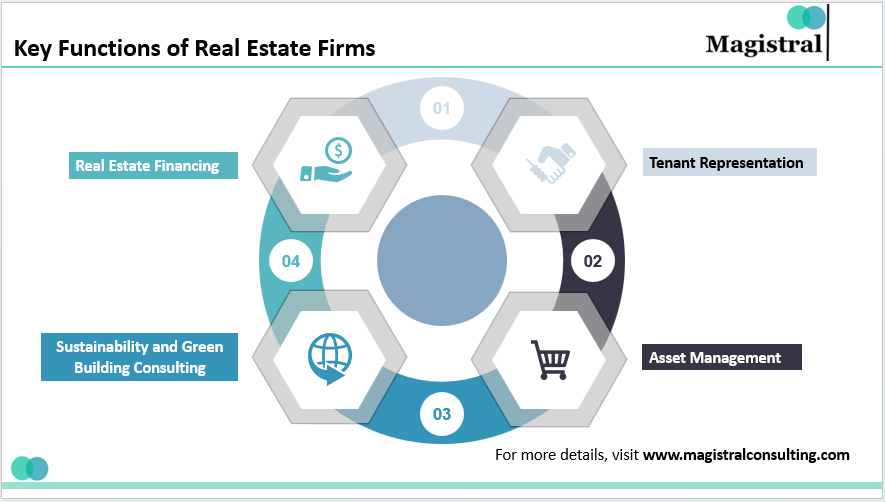
Key Functions of Real Estate Firms

Real estate firms contribute to the efficient operation of the market through various functions:

Key Functions of Real Estate Firms

Key Functions of Real Estate Firms

Tenant Representation

Additionally, real estate firms offer tenant representation services. They assist tenants in finding suitable spaces for lease, negotiate lease terms on their behalf, and advocate for their interests throughout the leasing process.

Asset Management

Apart from property management, real estate firms engage in asset management activities to maximize the value of real estate portfolios. This involves strategic planning, performance analysis, and implementing value-add initiatives to enhance asset performance and investor returns.

Sustainability and Green Building Consulting

Real estate firms offer consulting services in green building practices and sustainability initiatives. They advise clients on incorporating energy-efficient technologies, sustainable materials, and green certifications into their projects to reduce environmental impact and enhance long-term value.

Real Estate Financing

Many firms facilitate real estate financing by connecting clients with lenders and financial institutions, structuring deals, and securing funding for acquisitions, development, and investments.

Challenges Faced by Real Estate Firms

While real estate firms offer numerous benefits, they also face significant challenges:

Market Volatility

The industry is highly sensitive to economic conditions, interest rate fluctuations, and investor sentiment shifts. Economic expansions drive property values up, while downturns lead to decreased demand. Navigating market volatility requires expertise in risk management and a proactive approach to economic trends.

Regulatory Changes

Real estate operates within complex regulatory frameworks, including zoning laws, environmental policies, and tax regulations. Legislative shifts introduce uncertainties that impact property development and investment decisions. Firms must engage with policymakers, maintain compliance, and adapt to evolving regulations.

Competition

The industry is highly competitive, requiring firms to differentiate through specialization, innovation, and technology. Strong client relationships, market expertise, and a commitment to service excellence are essential for long-term success.


Economic Uncertainty

The interconnected nature of the global economy exposes the real estate sector to economic uncertainty stemming from geopolitical events, trade tensions, and economic downturns. Global events such as geopolitical conflicts, natural disasters, or public health crises can trigger market volatility and erode investor confidence, leading to hesitancy in investment decisions and tightening of financing availability. Economic downturns, characterized by recessionary pressures, declining consumer spending, and rising unemployment, exert downward pressure on property prices and demand across various real estate segments. Navigating economic uncertainty requires proactive risk management strategies, diversified investment portfolios, and a focus on liquidity and financial resilience. Moreover, maintaining robust relationships with financial institutions, staying abreast of macroeconomic trends, and leveraging data analytics for informed decision-making are essential for mitigating risks and capitalizing on opportunities amidst economic turbulence.

Magistral Consulting: Tailored Solutions for Real Estate Firms

Magistral Consulting specializes in offering tailored services to real estate firms, addressing their unique challenges and needs.

Magistral's Services on Real Estate Firms

Magistral’s Services on Real Estate Firms

Strategic Fundraising Campaigns

Magistral Consulting specializes in crafting bespoke fundraising campaigns tailored to the specific needs and goals of real estate firms. Leveraging their expertise in market dynamics and investor relations, they develop compelling narratives and engagement strategies designed to attract potential investors. Through meticulous analysis of market conditions and investor preferences, they identify optimal fundraising opportunities and guide clients through every stage of the fundraising process.

Targeted Investor Engagement

Magistral Consulting excels in cultivating meaningful relationships with potential investors who are aligned with the investment objectives and philosophies of their clients. Using tailored outreach efforts and personalized communication strategies, they identify and engage with high-net-worth individuals, institutional investors, family offices, and other relevant stakeholders. By aligning clients’ investment propositions with the interests and preferences of prospective investors, they establish mutually beneficial connections that lay the foundation for successful fundraising campaigns.

Comprehensive Funding Environment Analysis

Magistral Consulting conducts thorough analyses of the funding environment, offering real estate firm’s valuable insights into market trends, investor sentiment, and capital allocation dynamics. Through rigorous research and data-driven analysis, they monitor macroeconomic indicators, regulatory developments, and industry trends that influence the investment landscape.

In-depth Macroeconomic Research

Magistral Consulting stands out in the field of macroeconomic research, providing real estate firms with actionable insights into broader economic trends and their impact on the real estate market. By analyzing key indicators such as GDP growth, interest rates, inflation, and employment figures, they assess the overall economic health and identify potential drivers of real estate demand and investment activity.

About Magistral Consulting

Magistral Consulting has helped multiple funds and companies in outsourcing operations activities. It has service offerings for Private Equity, Venture Capital, Family OfficesInvestment BanksAsset Managers, Hedge Funds, Financial Consultants, Real Estate, REITs, RE fundsCorporates, and Portfolio companies. Its functional expertise is around Deal originationDeal Execution, Due Diligence, Financial ModellingPortfolio Management, and Equity Research

For setting up an appointment with a Magistral representative visit www.magistralconsulting.com/contact

About the Author

The article is Authored by the Marketing Department of Magistral Consulting. For any business inquiries, you could reach out to prabhash.choudhary@magistralconsulting.com

Introduction to Fund Raising Process

Our firm Magistral Consulting has helped in raising funds for more than a hundred companies, start-ups, Private Equity, Venture Capital, and Real Estate funds in the past. We have done it for firms based out of the US, UK, Europe, and Australia. In the process of doing so, we have acquired immense knowledge about the process of fund-raising.

This article will focus on the process that we follow for Start-ups and established companies looking to raise funds primarily through selling equity. Options of debt financing are also explored during the fund-raising negotiations with investors. Although each firm’s situation is unique, here are the common steps that all firms follow in their journey of fund-raising. We undertake this process end-to-end for the firms looking to raise money

Steps to Raise Funds for Startups and Other Firms

Fund Raising for Start-ups and Companies

Fund Raising Process for Start-ups and Other Firms

Step 1: Deal Documentation for Fund Raising

Before the fund-raising process could kick-off, all deal documents need to be prepared. There are three documents that we find an absolute must for a smooth process. Confidential Investment Memo could be made closer to the fundraising process. These documents are:

Teaser Document: It is also known as 1 pager. It’s a brief introduction about the opportunity and usually the first document that is sent across to the investors. For a firm, it will carry an introduction to its products or services, past financial performance, future projections of revenue and profitability, returns that an investor could make in a 3 to 5-year period, and some information on the founding team. It’s ideal to have this information presented in a concise manner with almost overuse of infographics to convey the message. In no case, this document goes over 1 page in length

Pitch Deck: This document is sent after the teaser document if the investor shows interest in the opportunity. This is typically a 5 to 10 pager document carrying all the details about the firm. The details are on similar lines as in the teaser document but more detailed. Major sections include, about the firm, about business, competition, business model, financials, valuations, plans, strategy, team, usage of funds, patents, etc. not necessarily in that order.

Financial Model: Models also vary in terms of details that they capture. A start-up with just an idea can have a very basic valuation model, whereas a firm with multiple lines of established businesses may have a detailed model running into multiple sheets. The purpose of the model is to value the company and show returns to investors which are adjusted for the risk. This is the document usually required in fundraising negotiations.

Investment Memorandum: This is prepared closer to the fund-raising process. While pitch deck maybe a Marketing document, Investment Memo can be seen more as a factual document that highlights the risks clearly in the investment. This may have legal, compliance, and regulatory consequences.

The documents are customized a great deal depending on the nature of the deal like raising a seed round, Series A, Series B, Series C or further growth capital

Once all the documents are in ship-shape and all stakeholders buy into the content in these documents, it is decided to proceed with investors’ reach out.

Step 2: Target and List Generation

This step could take place in parallel with Step 1.  It is about finding the investors who may be interested in the investment opportunity that the firm presents.

Here are the ways to find out the investment firms that may be interested in the opportunity:

Funds required: For smaller fund sizes say lower than $ 5 million, a Venture Capital firm or smaller Private Equity firms will be more suitable. For larger amounts, Private Equity or Family Offices will be more appropriate

Competitive Intelligence: These are the firms that invested in a similar opportunity with the competition. For example, if you are an app that supplies drivers on-demand, which are the investors, that invested in similar apps in the recent past. The way to find that out is either through industry databases or through extensive research in news and events portals

Industry Specialization: These are the firms that specialize in the given space. If the firm is in SaaS space, it makes sense to look for investors who socializes in SaaS and has made investments in the industry

Geographical Specialization: These are the firms that specialize in investing in a specific country or region. There are global investors as well.

ESG and other considerations: Some investors specifically look for sustainable investments like Green technology etc. Other specializations are around companies founded by say women or other minorities and disadvantaged groups. Impact investing is another important category under which a company could fall.

Once the firms are identified, we proceed with the identification of individuals within those firms, who may be in a decision-making capacity to invest in your firm

The information required here is the name of the individual in each firm, their profile, email IDs, phone numbers, and office address.

Step 3: Reach-out and Meetings Set-up

A reach out is performed by mailing to all suitable investors. The email is suitably customized to the needs of each investor and conveys the salient features of the deal. Reach-out over the phone is done for investors, which is very relevant. After the initial communique, a reasonable number of follow-ups are done to make sure there are no stone unturned

On every 100 firms’ reach-out, it is expected to have 5 good quality meetings related to fund-raise. Meetings are coordinated between investors and the entrepreneur.

Step 4: Negotiations

Negotiations go in all sorts of complications on valuations. Here the Financial Model is tested out with all its assumptions. Finally, if everything is fine, a term sheet is issued by the investor. Term sheets need to be studied closely for all sorts of caveats, liabilities, and terms

Why it makes sense to Outsource the Fund-Raising Support?

Running and growing a company in itself is a challenging job. Making all arrangements to raise funds on top of that is cumbersome and takes the focus of the entrepreneur off growing his enterprise. The whole process of fund-raising could be really confusing for a first-timer. It may take a long time for someone to learn the process on his own. It might take anywhere between a couple of months to a year for a company to raise funds depending on its specific situation. This job requires specialization, network, and focus. An outsourcing firm like Magistral provides that and still gives the control back to you at the most crucial stage of fundraising like negotiations.

Our pricing

Our pricing is a mix of upfront retainer fees plus a success-fee that is a percentage of the overall fund raised due to our efforts. This is paid out to us as a consulting or a finder fee. Here Magistral is not a dealer broker and needs no license to operate in international markets. For certain situations where broker-dealer licenses or any other similar licenses are required in any geography, we have pacts with our representatives in the US, UK, and Australia.


There is a huge discussion on the upfront retainer fee for our services with prospective clients. The firms suggest all fees be variable and absolutely no upfront retainer. One discussion I remember where a person suggested that everyone asking for upfront fees for fund-raising is a scam. These are the same people who are paying upfront fees to their lawyers, accountants, and everyone else for their services. If they think it is not a good idea to spend even a few thousand dollars behind their venture to raise funds, why on earth will we spend our efforts behind his fund-raising efforts. It talks to us loud and clear. They are not confident about their venture and may not have resources to even survive for the period that goes into raising funds. As you see, in earlier steps, we spend a considerable effort towards fund-raising, we would not do it for anyone who is just playing around and does not mind giving a higher share of success fees at the expense of the future investors. At some level, this whole exercise needs to be seen as the effort and related pay. That is where an upfront retainer comes into play.

Negotiations are complicated. What if an investor quashes your valuations and proposes something that cuts your valuation to half? Will you take the deal? If not, how is it our fault in facilitating the deal? It’s not fair to expect from us to keep coming up with a pipeline of meetings that are suitable to all your requirements, just because our payments are tied up with the raising funds. That is another case for having some portion of payment tied to the effort and not all of it to the success. If you think your start-up has funds to hire a specialist who will look into fund-raising support full time, drop an inquiry here

Typical Results

Reaching out to 100 investors should yield a small round of financing for a business that has some sort of presence on the ground and has made some money in the past. Things get difficult for mere ideas a bit if they don’t come from someone who has not founded or run any company before. If reaching out to 1000 investors does not yield any meaningful conversations, it is possibly the end of the road for the firm looking to raise money. Growth capital in the form of Series B and beyond see a warmer response than a seed round. One should take into consideration a period of at least a couple of months on the lower side to a year on the higher side for closing the next round. If you are a venture-backed start-up it makes sense to keep working on populating the pipeline all the time for the next round.

Fund-Raising for Private Equity, Venture Capital and Real Estate Funds

Although the process of fund-raising for General Partners follows the same process, the people looking to raise funds here are more sophisticated. Also, larger amounts of fund-raise are involved here. The United States requires a broker-dealer license to arrange funds on a brokerage fee basis. We deal with funds looking to raise money by helping them reach-out to Limited Partners, purely on fixed cost and fixed effort basis. Our ideal client is one who is looking to hire an analyst for reaching out to Limited Partners and not the one who is looking to hire a Private Placement player. If that makes sense to you please drop an inquiry here

If you are in any stage of your fund-raising journey and are looking for some direction, we can get in touch for a free consulting session, drop an inquiry with all details at www.magistralconsulting.com/contact

About Magistral

Magistral is an outsourcing firm that has helped multiple start-ups and companies in raising funds. It has also helped multiple General Partners like Private Equity, Venture Capital, and Real Estate funds in raising money. For more details please visit www.magistralconsulting.com

About the Author

The author, Prabhash Choudhary is the CEO of Magistral Consulting and can be reached at Prabhash.choudhary@magistralconsulting.com for any queries of business inquiries.