Raising capital rarely comes down to having a good idea alone. It comes down to who hears about it, when they hear about it, and how the message is delivered. This is where investor reachout becomes central to a company’s or fund’s ability to close a round. A structured investor reachout helps founders and fund managers connect with limited partners, general partners, family offices, and angel investors who are genuinely suited to a deal. Done poorly, it wastes time and burns relationships before they even start. Done well, it builds a pipeline that keeps working long after the current round closes.
Thank you for reading this post, don't forget to subscribe!This article looks at the strategies that make investor reachout effective, the channels worth using, and how to measure whether the effort is paying off.
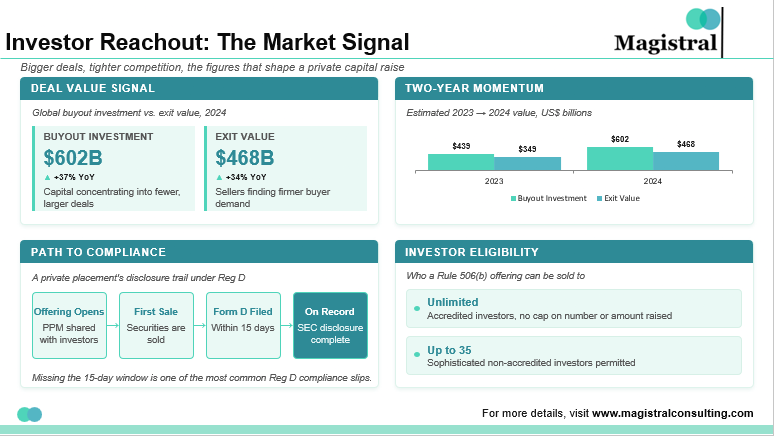
Investor Reachout: The Market Signal
Understanding the Investor Reachout Process for Fundraising Success
Investor reachout starts long before the first message goes out. It depends on knowing which investors genuinely fit the raise, and reaching them at the right moment. Getting this stage right shapes every conversation that follows.
Mapping the Right Investor Universe
A generic contact list rarely moves a raise forward. Effective investor reachout starts with investors whose stage, sector, and cheque size match the round. Magistral Consulting’s investor database, for instance, tracks 5,000+ LPs, 17,000+ GPs, 6,500+ angel investors, and 6,500+ HNIs, which shows how granular this targeting can get.
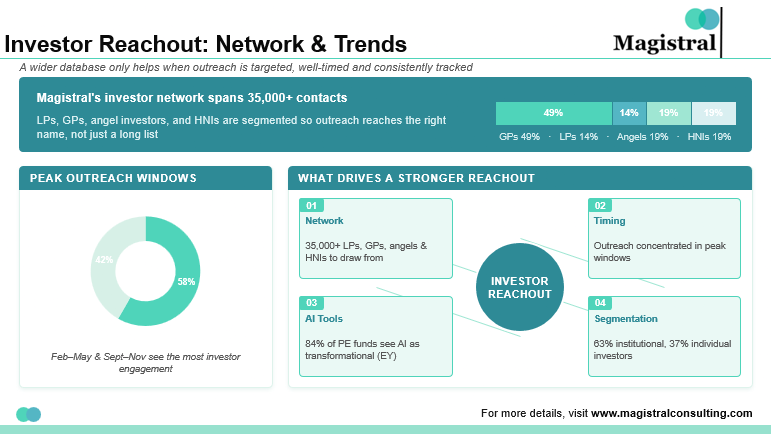
Investor Reachout: Network & Trends
Timing the Investor Reachout
Timing matters as much as the message itself. Data suggests the ideal periods to approach investors are February to May and September to November, since these timeframes coincide with portfolio reviews, reallocation exercises, and opportunity-seeking phases. August and December, by contrast, tend to see far less investor activity.
Segmenting by Investor Type
LPs, GPs, angels, and family offices respond to different signals. A pension fund cares about governance and track record; an angel investor may respond more to founder story and market timing. Segmenting the list before drafting any message keeps the investor reachout targeted rather than generic.
Building a Clean, Verified Contact List
Stale or unverified contacts drag down response rates. A working list should include names, direct emails, LinkedIn profiles, and notes on past investments, so the reachout effort starts from accurate, current data rather than guesswork.
Crafting a Message That Gets an Investor Reachout Noticed
A strong message treats the investor as a specific person, not a line item. It anticipates objections and leads with substance rather than enthusiasm alone. A well-crafted message also respects the reader’s time, since most investors decide within seconds whether a message is worth a second look.
Personalize Every Message
Mass emails read as mass emails, and investors notice quickly. Referencing a fund’s recent investments, thesis, or portfolio overlap signals real research and improves the odds of a reply. Even a single specific line, such as a mention of a portfolio company in a related space, can separate a message from the dozens an investor skims past each week.
Lead With Evidence, Not Just Vision
Claims about market size or traction need support. If a raise cites a growing market, the message should point to the data behind it. Vague optimism rarely survives investor scrutiny; specific numbers do. Founders who anchor their pitch in unit economics, retention, or early revenue tend to earn a faster, more serious response.
Keep the First Email Short
The opening message should answer three questions fast: what the company does, why now, and what is being asked. Long introductions lose attention before the pitch even lands. A clean structure, with the ask stated plainly near the top, makes it easier for a busy investor to decide whether to engage.
Plan the Follow-Up Sequence
Most replies come after a follow-up, not the first note. A short, polite sequence spaced a week or two apart, tied to a small new update each time, keeps the conversation alive without becoming noise. Sharing a fresh milestone, a new hire, or a metric update in each touchpoint gives the investor a genuine reason to respond rather than a repeated nudge.
Choosing the Right Channels for Investor Reachout
No single channel carries a raise on its own. Combining direct outreach, warm introductions, and technology-driven tools tends to produce the strongest response rates. The right mix usually depends on the stage of the raise, the type of investor being approached, and how much of a network already exists to draw on.
Email Investor Reachout
Email remains the backbone of most investor reachout campaigns because it is direct, trackable, and easy to personalize at scale when paired with good data. It also leaves a clear record of who was contacted and when, which makes it easier to manage a large, multi-week campaign without losing track of individual conversations.
LinkedIn and Warm Introductions in Investor Reachout
A warm introduction from a mutual connection consistently outperforms a cold message. LinkedIn is often used to identify that bridge before any direct approach is made. Founders can also use it to research an investor’s recent posts or portfolio moves, which then feeds directly into a more personalized email or message.
Investor Databases and CRM Platforms for Investor Reachout
CRM-led outreach keeps track of who was contacted, when, and how they responded, which prevents duplicate or poorly timed follow-ups across a large investor list. Pairing a verified database with a CRM also makes it possible to segment investors by stage and sector, so each batch of investor reachout goes out with the right framing.
AI-Assisted Investor Reachout
AI tools now help personalize messages, monitor investor sentiment, and flag the right moment to follow up, adding real efficiency to reachout at scale. Used carefully, these tools can also draft the first pass of a message, leaving the founder or team to refine tone and add the details that make it feel genuinely personal.
Events, Conferences and Networking in Investor Reachout
In-person conversations still carry weight. Conferences and investor events often turn a cold prospect into a warm one before an email is ever sent. A short, well-prepared conversation at an event can shortcut weeks of back-and-forth once the formal reachout begins.
Measuring and Improving Investor Reachout Performance
Reachout efforts should be tracked like any other funnel. Open rates, replies, and meetings booked all tell a different part of the story, and treating the process as a funnel rather than a one-off email push makes it much easier to spot where things are going right or wrong.
Tracking Response and Meeting Conversion
Response rate shows message quality; meeting conversion shows targeting quality. Watching both separately helps pinpoint where a campaign is actually breaking down. A high response rate paired with a low meeting conversion, for example, often signals a mismatch between the pitch and the investor’s actual mandate.
Learning From Investor Feedback
Declines are still useful. Patterns in investor feedback, whether about stage, sector fit, or valuation, often point to adjustments worth making before the next batch of investor reachout goes out. Recording this feedback in a shared document, rather than letting it live in individual inboxes, helps a team spot repeated objection faster.
Avoiding Common Mistakes
Sending identical messages to every investor, ignoring timing windows, and skipping follow-ups are among the most common reasons a strong company still struggles with fundraising. Overloading the first message with too much detail, or approaching investors clearly outside the fund’s mandate, tends to waste effort on both sides.
How Magistral Consulting Supports Investor Reachout
Magistral Consulting runs this as a structured, research-driven process rather than a scattershot email push. Its team identifies and segments LPs, GPs, angels, HNIs, and family offices by geography, sector, and stage, then builds the decks, teasers, and CIMs behind the investor reachout. CRM-driven investor reachout campaigns, follow-ups, engagement tracking, and workflow automation keep the process organized end to end, while AI-assisted tools help personalize messages and time follow-ups. For founders and fund managers who want their reachout effort managed with data and discipline instead of guesswork, this kind of support can shorten the path from first contact to closed commitment.
About Magistral Consulting
Magistral Consulting has helped multiple funds and companies in outsourcing operations activities. It has service offerings for Private Equity, Venture Capital, Family Offices, Investment Banks, Asset Managers, Hedge Funds, Financial Consultants, Real Estate, REITs, RE funds, Corporates, and Portfolio companies. Its functional expertise is around Deal origination, Deal Execution, Due Diligence, Financial Modelling, Portfolio Management, and Equity Research
For setting up an appointment with a Magistral representative visit www.magistralconsulting.com/contact
About the Author

Tanya is an investment-research specialist with 6 + years advising venture-capital, private-equity and lending clients worldwide. A Stanford Seed alumnus with an MBA and an Economics (Hons) degree, she heads project teams at Magistral Consulting, delivering financial modelling, due-diligence and deal support on 3,000 + mandates. Her blend of rigorous analytics, sharp project management and clear client communication turns complex data into actionable investment insight.
FAQs
What makes investor reachout different from a regular pitch?
When is the best time to start investor reachout?
How many investors should a reachout campaign target?
Does AI actually improve investor reachout results?
What is the biggest mistake founders make in investor reachout?