Tag Archives: AI-powered Deal Origination

Deal origination has changed. What was once a relationship-driven, highly manual function is now becoming a structured, data-powered discipline. With increasing deal cycles and tightening competition, firms across private equity, investment banking, venture capital, and corporate M&A are increasingly seeking to scale their origination engines through investment banking outsourcing with speed, precision, and sector intelligence.

The market itself is changing fast. Proprietary deal flow has become harder to secure, with analysts now reporting that high-quality opportunities are increasingly concentrated and discovered earlier by firms using data-driven sourcing. At the same time, the cost of maintaining large internal teams has risen markedly. This combination has accelerated the rise of specialist outsourcing partners who operate as an extension of deal teams-helping build broader, deeper, and more actionable pipelines.

Why Data-Driven Deal Origination Is Becoming the Norm

Deal sourcing went through a linear process earlier. The analysts made lists manually, tracked founders in Excel sheets, went through industry reports, and used events or broker feeds. But since there are over 12,000 private companies worldwide that have crossed the $50M+ revenue mark, it is beyond the scale for any human to track. Indeed, the modern deal team needs structured datasets, predictive tools, sector-specific intelligence, and always-on research.

Why Deal Teams Are Shifting to Data-Led Origination

Why Deal Teams Are Shifting to Data-Led Origination

Three major forces are accelerating this shift:

Information Overload and Fragmented Sources

The teams at PE and M&A track companies across databases, filings, news, VC portfolios, industry reports, and social signals. An analyst, on average, toggles between 8–12 data sources to qualify an opportunity. Specialty external teams that focus only on the synthesis of data can do this more effectively for a much lower cost.

The Race for Proprietary Opportunities

Multiple market analyses indicate that proprietary deals generate 15-30% better multiples. However, only 1 in 20 firms today feel they have a truly proprietary engine. Investment banking outsourcing teams help build deeper mapping across subsectors, founder profiles, succession indicators, and buy-and-build plays.

Talent Cost Inflation

In-house sourcing teams have become increasingly expensive. In North America, first-year analyst compensation grew 19% between 2021 and 2024. Specialist outsourcing-most notably, India-based research teams-provides the same quality at a cost 50-70% lower. This allows firms to expand coverage without expanding payroll.

Specialist investment banking outsourcing gives firms continuity and sector stability, thereby allowing them to track these long-term without disruptions. The quality of the talent available in these external pods has also improved. Many analysts now bring sector specialization and prior experience working with global investment teams.

How Outsourced, Data-Driven Models Transform Deal Pipelines

A data-driven outsourcing model brings a level of structure, scale, and discipline that traditional sourcing approaches rarely achieve. Rather than rebuilding company lists with every new investment thesis, firms now have access to continuously updated subsector landscapes, refreshed private-company datasets, and intelligence streams that are closely aligned with their criteria. This serves as a sourcing engine that is always on, not episodic.

A Continuously Updated and Non-Stagnant Pipeline

Its greatest benefit is that deal pipelines are dynamic. Private markets move fast-nearly 21% of mid-market companies undergo a material change every year, from changes in management and ownership to valuation outlook or strategic direction. Outsourced teams track these developments in real time to ensure that companies enter, exit, or re-enter the pipeline based on live triggers such as funding rounds, product launches, key hires, regulatory updates, or changes in industry direction.

Because these updates happen daily, firms avoid the common problem of pipelines going stale. The opportunities stay refreshed, relevant, and connected with market timing, greatly improving qualification rates.

Better Visibility into Whitespace and Under-the-Radar Opportunities

In-house teams are challenged by the inability to track the long tail of private companies. With more than 13,000 private firms now crossing the $50M revenue mark globally, most remain invisible to traditional databases or broker-led channels. Outsourced research teams solve this by monitoring niche markets, microsegments, and emerging subsectors at far greater breadth.

This extended coverage reveals whitespace markets that have low competition but with strong growth indicators, bringing forth targets that internal teams generally miss. Outsourced analysts, as they continuously scan through global datasets and sector signals, can identify firms at an inflection point long before they show up in mainstream pipelines.

Detecting Inflection Points Earlier Than the Competition

Early visibility is where the outsourced models have the most measurable impact. Analysts dedicated to monitoring live news, filings, social signals, new product introductions, and hiring patterns can flag actionable changes faster. Recent industry evaluations show that firms using outsourced research spot strong-fit targets 2-3 quarters earlier compared to peers relying solely on internal sourcing.

This time advantage matters. Earlier outreach increases conversion probability, improves relationship-building, and enhances valuation leverage-especially in competitive subsectors.

Why Investment Banking Outsourcing Is Gaining Global Momentum

Global deal-making has decelerated over recent years. Compared with 2022, global M&A, PE, and VC deals in total decreased by almost 25% in 2023, while the year 2024 saw only a partial recovery, having just over 50,500 deals from around the world. Fewer deals and increased competition force firms to broaden their sourcing funnel, scan wider geographies, and pursue proprietary opportunities more systematically. This is one of the key reasons for the growing traction in the use of investment banking outsourcing worldwide.

2025 Regional Leaders in Investment Banking Outsourcing

2025 Regional Leaders in Investment Banking Outsourcing

Cross-Border Reach and Market Agility

With firms increasingly exploring cross-border and emerging markets, local insights, regulatory knowledge, and on-ground intelligence become important. Investment banking outsourcing teams provide this reach and flexibility, enabling deal teams to monitor multiple regions without expanding in-house resources.

Efficiency in a Competitive Environment

Outsourcing provides a very cost-effective solution with constrained internal bandwidth. It is estimated that the global financial services outsourcing market was around USD 181.6 billion in 2025. This reflects strong demand for specialized, scalable support. By merging continuous sourcing coverage with sector expertise, firms keep a live pipeline while controlling costs.

From Episodic Sourcing to Continuous Origination

With modern investment banking outsourcing, one can move away from ad-hoc, mandate-driven sourcing toward always-on pipelines. Targets are tracked, filtered, and updated continuously based on strategic criteria to make sure firms can act quickly when opportunities emerge, stay ahead of competition, and maintain high-quality deal flow even in slow market conditions.

The future of deal origination is clear: firms that adopt structured, data-driven sourcing models-underpinned by specialist partners-will enjoy a meaningful competitive advantage. Investment banking outsourcing has moved far beyond cost arbitrage; it is now a strategic capability empowering deal teams to scale intelligently, operate efficiently, and unlock opportunities that would otherwise remain undiscovered.

Outsourcing will take center stage in shaping how contemporary investment teams go about discovering, qualifying, and executing opportunities amid compressing deal cycles and evolving markets.

How Magistral Supports Investment Banking Outsourcing

Magistral empowers global deal teams through its comprehensive suite of investment banking outsourcing services, aimed at expanding coverage, deepening intelligence, and maintaining a deal pipeline that is continuously refreshed. Each of the services works as an integrated extension of various PE, VC, IB, and Corporate M&A teams.

Deal Origination & Target Identification

Continuous scanning of companies across sectors and geographies is done by utilizing thesis-aligned filters to surface relevant opportunities early in order to enhance the effectiveness of investment banking outsourcing workflows.

Market & Subsector Mapping

Structured mapping of industries, value chains, and emerging niches, revealing whitespace opportunities and competitive pockets that drive sharper sourcing strategies.

Financial & Business Profiling

Brief overviews of shortlisted targets covering models, financial performance, customer segments, and key metrics to facilitate speedier decision-making.

Competitive & Benchmarking Analysis

Track competitor moves, price developments, funding activity, and strategic shifts to help deal teams identify market inflection points early.

About Magistral Consulting

Magistral Consulting has helped multiple funds and companies in outsourcing operations activities. It has service offerings for Private Equity, Venture Capital, Family Offices, Investment Banks, Asset Managers, Hedge Funds, Financial Consultants, Real Estate, REITs, RE funds, Corporates, and Portfolio companies. Its functional expertise is around Deal origination, Deal Execution, Due Diligence, Financial Modelling, Portfolio Management, and Equity Research

For setting up an appointment with a Magistral representative visit www.magistralconsulting.com/contact

About the Author

Prabhash Choudhary is the CEO of Magistral Consulting. He is a Stanford Seed alumnus and mechanical engineer with 20 + years’ leadership at Fortune 500 firms- Accenture Strategy, Deloitte, News Corp, and S&P Global. At Magistral Consulting, he directs global operations and has delivered over $3.5 billion in client impact across finance, research, analytics, and outsourcing. His expertise spans management consulting, investment and strategic research, and operational excellence for 1,200 + clients worldwide

FAQs

What type of research and analytical services does Magistral provide?

Magistral offers end-to-end research support, including market research, industry analysis, competitive benchmarking, financial modeling, investor materials, and opportunity mapping for PE, VC, IB, and corporate strategy teams.

Does Magistral support deal teams across all sectors?

Yes. Magistral has deep multi-sector expertise across SaaS, manufacturing, healthcare, AI, logistics, energy transition, BFSI, consumer, and more, providing both broad coverage and specialized subsector insights.

How does Magistral improve deal origination through Investment Banking Outsourcing?

Magistral creates continuous, intelligence-backed pipelines by tracking markets, subsectors, competitors, and emerging opportunities, allowing IB teams to identify actionable targets faster.

Why is Investment Banking Outsourcing with Magistral more cost-effective?
Magistral provides scalable analyst capacity at a fraction of in-house costs, enabling IB teams to deepen coverage, accelerate origination, and maintain high-quality deal flow without additional hiring.


AI-powered deal origination has begun transforming how investment banks, private equity firms, and corporate acquirers identify, analyse, and close high-value transactions. While traditional approaches, which are heavily dependent on interlocked personal networks and on manual efforts, have proven rather sluggish in present-day fast-paced markets, AI platforms allow a strategic advantage to those who use them. Using machine learning and NLP methods, the systems scan huge data sets in real-time to uncover actionable opportunities that would otherwise have gone unnoticed. Hence, firms with AI-powered deal origination not only speed the sourcing but also guarantee the deal pipeline of higher quality and relevance and, thus, maintain competitiveness in the environment that is even more data-driven.

AI-Powered Deal Origination: The New Standard in Sourcing

Advanced analytics are at the centre of the optimizations enabled in sourcing. By automating data collection and analysis, AI can recognize acquisitions candidates, benchmark companies, and determine competitive landscapes in a way never conducted-so swiftly and precisely.

Real-Time Market Intelligence

By ingesting, aggregating, and analysing millions of company profiles, transactions, and financial signals, platforms such as Cyndx Finder and Comparables.ai put forth relevant opportunities within seconds. Their proprietary algorithms are meant to predict which private companies are most likely to seek capital. It can also be used to put on the market for acquisition so the dealmakers can initiate pre-emptive negotiations.

Enhanced Target Identification

The machine learning models assess numerous factors such as sector focus, growth parameters, and funding history. It is to match targets to buyers who are best suited to them. This will minimize human subjectivity and restrict pipeline entries to prospects worth pursuing.

Mapping Competitive Landscapes

The AI-enabled systems provide a piecemeal overview of industry dynamics from which perspective firms gain insight into what their competitors are offering in terms of funding and the pores in the market. Such information will allow deal teams to position themselves advantageously ahead of their competitors to take advantage.

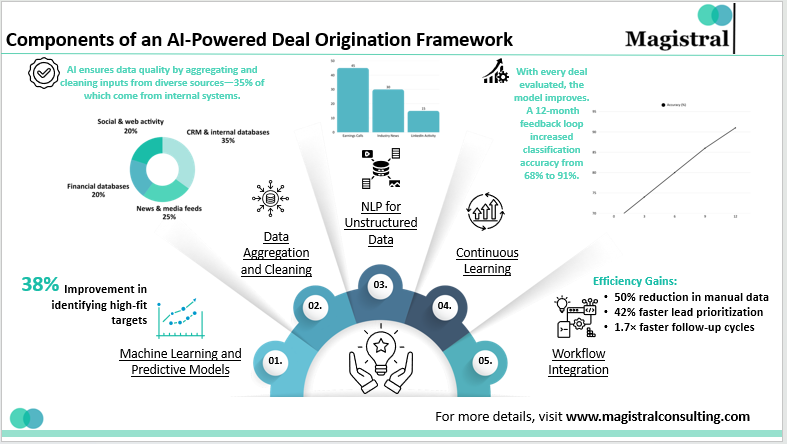
Components of AI-Powered Deal Origination Framework

Different technological layers collaborate to execute a well-designed AI-powered origination process.

Data Aggregation and Cleaning

AI systems need to gather and clean data from multiple sources—including CRM, social media, financial databases and public filings—before they can generate insights.

Machine Learning and Predictive Models

ML algorithms consider the historical performance metrics of investments to identify companies or sectors that may currently be strengthened and would outperform.

NLP for Unstructured Data

Natural Language Processing allow for the analysis of signals of interest from pitch decks, earnings calls, news article reviews, and industry comments.

Workflow Integration

AI tools are linked with internal deal flow systems, CRM technology such as Salesforce or Affinity, as well as calendar and email software to prioritize targets and automatically circulate follow-ups.

Continuous Learning

As the AI is assessed on each new deal or concludes it, the model learns and enriches his predictions for the future that in returns makes the engine smarter.

Components of an AI-Powered Deal Origination Framework

Components of an AI-Powered Deal Origination Framework

Essentially, the smooth functioning of these layers enables a deal origination process powered by AI that is smart and efficient. Through the integration of data aggregation, machine learning, NLP, and workflow automation, deal sourcing becomes more accurate and prioritized by AI.

Proactive Strategies for Superior Outcomes

Today, effective deal origination is moving from reactive, network-driven approaches to proactive, technology-enabled methodologies. Through AI as well as data enriched analytics, firms now can outpace the market (by continuously being on the lookout for similar opportunities).

Predictive Sourcing

AI’s forecasting capabilities enable businesses to predict shifts in the market and identify targets before they are on the public’s radar. This pre-emptive strategy can help engage early and give you better shot at exclusives.

Automated Lead Qualification

With AI, companies can score, and rank leads automatically according to real-time data, industry trends and their own investment preferences. This saves time by concentrating on the best prospects, rather than wasting time on the low-interest ones.

Scalable Outreach and Engagement

With so much of the outreach automated by AI, organisations can now reach out to many people with highly personalised messages much more efficiently. The system also assists in identifying the best time to follow up – making it easier to reach possible sellers.

The present AI technology allows organizations to establish flexible learning capabilities. This enables them to maintain dynamic portfolio alignment. The AI platforms adjust their deal sourcing settings automatically when investment theses transform to maintain pipeline alignment with existing strategic objectives.

AI-Powered Deal Origination: Efficiency, Accuracy, and Competitive Edge

By using deal origination software enabled by AI, you’re not only cutting out inefficiency; you’re also making better investments. Top channels report big increases in research productivity and direct sourcing effectiveness.

Accelerated Research and Screening

The most recent AI tools enable deal teams to perform market and company analysis at a 20 times faster rate than conventional manual approaches. The substantial acceleration in speed enables analysts and decision-makers to shift their focus toward strategic tasks which are more valuable instead of spending time on routine data collection.

Improved Deal Pipeline Quality

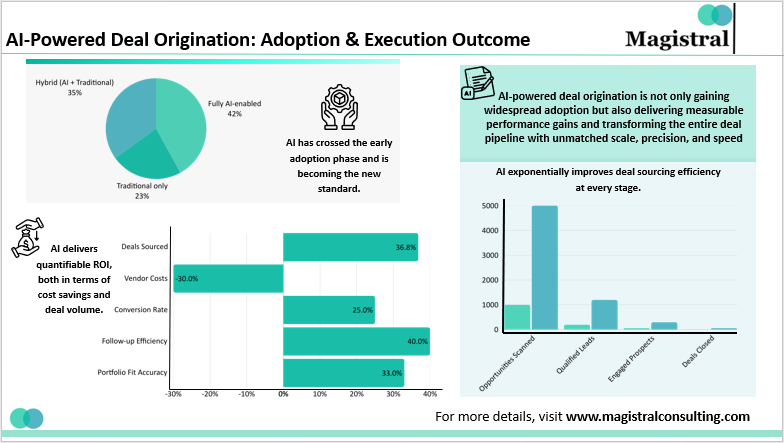
When you tap into richer data and smarter algorithms, companies see a huge boost. About half of their direct sourcing pipelines improve, and they’re sourcing 36% more deals using AI-powered platforms.

Enhanced Decision-Making

Artificial intelligence tools improve investment analysis by offering enhanced visibility for investment opportunities throughout the investment process. The analytics support teams in precise risk evaluation and value discovery which enables better decision-making to enhance deal success rates.  AI analytics give smarter insights during every stage of a deal. This means less risk and a better shot at closing successful deals. Organizations achieve decreased risk levels and improved investment success rates as a result.

AI-Powered Deal Origination: Real-World Applications and Future Trends

The use of AI for deal origination has already produced real-world outcomes for major investment banks alongside private equity firms. The development of this technology will enhance its effect by providing greater self-operating abilities with adaptable personalized deal sourcing capabilities.

Case Studies and Industry Adoption

Leading firms that leverage AI-based platforms have experienced a 51.7% improvement in research productivity. There is also a 30% decrease in vendor management costs which demonstrates the operational advantages of AI integration.

Autonomous Deal Execution

Agentic AI technologies have begun to emerge for financial operations by handling each process from start to deal compliance and execution. All routine tasks now operate without human input which decreases error rates. It also allows professionals to dedicate more time to strategic decision-making. This technology allows firms to boost transaction speed while achieving better accuracy. It also helps in enhancing their control of the deal lifecycle.

Hyper-Personalization and Market Expansion

AI technology delivers hyper-personalized sourcing methods which assist businesses in discovering specific opportunities. It is across market segments that conventional systems would miss. This ability strengthens the deal pipelines of organizations while also guaranteeing that their investment approaches remain in line with market trends.

AI-Powered Deal Origination: Adoption & Execution Outcome

AI-Powered Deal Origination: Adoption & Execution Outcome

AI-powered deal origination will develop through ongoing enhancements that integrate better with markets. The escalating volume of processed data will drive machine learning models to boost their precision. This in turn improves the execution quality of deal origination.  The adoption of these technological advancements will enable organizations to secure valuable business opportunities.

Therefore, the implementation of AI-powered deal origination becomes the primary driver for fundamental changes in the industry. The technology’s proven performance of operational optimization together with its new market discovery capabilities and workflow autonomy leads early adopters to keep their market leadership status among rising competition.


About Magistral Consulting

Magistral Consulting has helped multiple funds and companies in outsourcing operations activities. It has service offerings for Private Equity, Venture Capital, Family Offices, Investment Banks, Asset Managers, Hedge Funds, Financial Consultants, Real Estate, REITs, RE funds, Corporates, and Portfolio companies. Its functional expertise is around Deal origination, Deal Execution, Due Diligence, Financial Modelling, Portfolio Management, and Equity Research

For setting up an appointment with a Magistral representative visit www.magistralconsulting.com/contact

About the Author

The article is authored by the Marketing Department of Magistral Consulting. For any business inquiries, you can reach out to prabhash.choudhary@magistralconsulting.com

AI analyses vast datasets in real time, identifies high-potential targets based on custom criteria, and automates lead qualification and outreach, resulting in faster, more accurate, and scalable deal sourcing.

Key benefits include accelerated research and screening, improved pipeline quality, enhanced decision-making, and the ability to proactively identify off-market opportunities.

While AI can significantly reduce reliance on traditional networking, it is most effective when used to complement human expertise, enabling dealmakers to focus on relationship-building and negotiation.

Leading platforms include Cyndx Finder, Comparables.ai, and Sourcescrub, each offering advanced analytics, predictive sourcing, and real-time market intelligence for investment professionals.