Tag Archives: Capital Raising

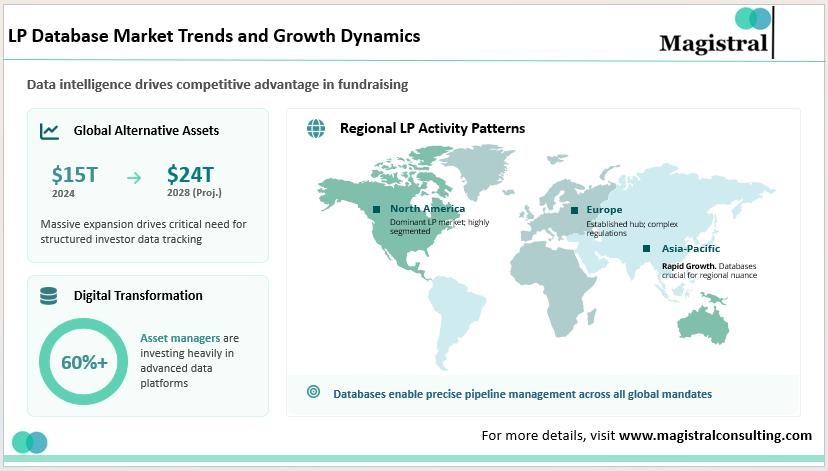
The LP Database has become an essential resource for investment firms that operate in a highly competitive fundraising environment. Structured data has become the primary tool through which firms discover and connect with their investors because capital markets grow and investor preferences shift. According to industry insights from Deloitte and Precedence Research, global alternative assets crossed $15 trillion in 2024, which expanded the investor universe. The Database evolved from a basic contact database into a vital business resource that enables firms to connect with investors based on their specific investment requirements, geographic location, and risk tolerance, which leads to better fundraising results.

LP Database Market Trends and Growth Dynamics

The market expands because alternative investments grow, which increases the requirement for improved investor intelligence capabilities. reference
LP Database Market Trends and Growth Dynamics

LP Database Market Trends and Growth Dynamics

Expansion of Alternative Investments and LP Demand

The expansion of alternative investments leads to increased demand for LP services. The demand for structured investor data increases because private equity and venture capital businesses expand their operations. PwC projects that alternative assets will reach nearly $24 trillion by 2028, which creates essential requirements for the database solutions that track global investor activities.

Digital Transformation in Investor Data Management

The Database transforms into a predictive and strategic tool through the continuous implementation of analytics and AI tools by firms, which Deloitte researchers found to show that 60 percent of asset managers dedicate resources toward data platform development.

Regional Growth Patterns in LP Activity

The LP activity in North America and Europe shows dominance, but Asia Pacific experiences rapid growth, which an LP Database enables companies to use for the successful management of regional investor customs and regulatory requirements.

Integration with Fundraising Strategies

The Database provides firms with tools for capital raising, which lets them track and manage their development process through different stages.

LP Database Role in Investor Targeting and Capital Allocation

It improves investor identification and enables better capital distribution through its organized analytical findings.

Understanding Investor Preferences

The database captures ticket size and sector focus as fundamental variables that enable firms to identify suitable investors and enhance their chances of success.

Enhancing Relationship Management

The system consolidates all investor contact details together with their complete interaction records, which helps organizations develop strong partnerships that last over time.

Data-Driven Capital Allocation Decisions

Fundraising success rates increase when organizations use data to drive their fundraising efforts, according to McKinsey research, which shows that this database provides current investor data for this purpose.

Improving Fundraising Efficiency

The Database uses automation to reduce manual tasks while enabling companies to dedicate their resources to essential activities, such as building connections with investors throughout their fundraising periods.

LP Database Technology and Data Analytics Evolution

Technological advancements have transformed the Database into a dynamic platform powered by analytics and automation.

Adoption of Artificial Intelligence in Databases

The process of using Artificial Intelligence with database systems has become an established practice. AI enables predictive insights by analysing investor behaviour, helping firms prioritize outreach and improve fundraising efficiency.

Automation and Workflow Integration

The process of automation, together with workflow automation, creates efficient business operations that enhance productivity through automated processes.

Data Quality and Accuracy Challenges

Organizations face difficulties in maintaining data quality because they need to keep their information accurate while their data systems require regular updates.

Cybersecurity and Compliance Considerations

Companies guard their investor information through heightened security measures because they need to protect confidential data, which results in 70 percent of financial institutions adopting cybersecurity solutions, according to Deloitte.

LP Database Strategies and Best Practices for Firms

The strategic implementation of a database will deliver maximum advantages through enhanced data quality and improved investor segmentation, which supports the organization’s fundraising objectives.

Building a Comprehensive Database Framework

The use of a structured database system that includes standardized fields will enhance system accessibility while maintaining uniformity in investor data handling across multiple departments.

Leveraging Data for Strategic Insights

Analytics tools help convert data into actionable insights, which enable firms to refine their fundraising strategies while achieving better targeting results.

Aligning Database Use with Fundraising Goals

The organization can improve its operational success through LP Database implementation when business objectives are established.

Continuous Data Maintenance and Updates

The database maintains its accuracy through regular updates, which include data validation processes that ensure current market conditions are properly reflected in the database.

What Emerging Managers Really Need from an LP Database?

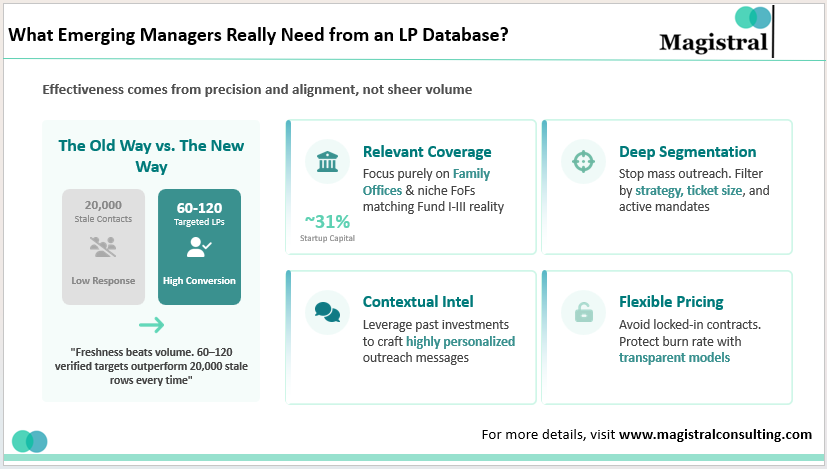
The common belief among emerging fund managers states that their fundraising success will improve when they access larger databases. The industry proves that successful fundraising requires organizations to focus on specific objectives rather than increasing their database size. The research conducted by Altss and PitchBook shows that investor outreach to 60 to 120 qualified investors produces better results than contacting 20,000 unfiltered contacts. The research shows that focused LP Database strategies produce better and quicker fundraising outcomes.
What Emerging Managers Really Need from an LP Database?

What Emerging Managers Really Need from an LP Database?

Coverage That Matches Fund Reality

The Database needs to show actual funding patterns because early funds receive their primary funding from family offices and smaller institutions, which provide 31 percent of their total capital.

Freshness Over Volume of Data

Organizations value current, accurate information more than extensive data collections because outdated contact information leads to lower response rates, while smaller verified datasets deliver better fundraising outcomes.

Segmentation Instead of Mass Outreach

Investor targeting becomes more efficient when organizations filter investors according to their investment strategy, geographic location, and preferred ticket size because targeted lists perform better than unsegmented outreach methods.

Context that Strengthens Investor Communication

The evaluation of historical investments together with current market positioning enables the creation of custom communication methods, which result in better investor interaction than standard outreach methods.

Transparent and Flexible Pricing Models

Emerging managers face strict budget limits, which force them to select tools based on their pricing details because hidden costs, together with inflexible contracts, will restrict their ability to operate freely. Industry guidance highlights that flexible and transparent pricing models help managers control burn while still accessing high-quality Database capabilities.

LP Database Support from Magistral Consulting

Magistral Consulting assists firms in developing and sustaining high-quality LP Databases through its unified approach, which combines data research with verification and analytics to enhance investor targeting and capital raising processes.

About Magistral Consulting

Magistral Consulting has helped multiple funds and companies in outsourcing operations activities. It has service offerings for Private Equity, Venture Capital, Family Offices, Investment Banks, Asset Managers, Hedge Funds, Financial Consultants, Real Estate, REITs, RE funds, Corporates, and Portfolio companies. Its functional expertise is around Deal origination, Deal Execution, Due Diligence, Financial Modelling, Portfolio Management, and Equity Research

For setting up an appointment with a Magistral representative visit www.magistralconsulting.com/contact

About the Author

Tanya is an investment-research specialist with 6 + years advising venture-capital, private-equity and lending clients worldwide. A Stanford Seed alumnus with an MBA and an Economics (Hons) degree, she heads project teams at Magistral Consulting, delivering financial modelling, due-diligence and deal support on 3,000 + mandates. Her blend of rigorous analytics, sharp project management and clear client communication turns complex data into actionable investment insight.

FAQs

Why is an LP Database important?

It improves investor targeting, enhances relationships, and increases fundraising efficiency through data-driven insights.

How does technology impact the LP Database?

Technologies like AI and automation improve data accuracy, predictive capabilities, and workflow efficiency.

What challenges exist in LP Database management?

Challenges include maintaining data accuracy, ensuring cybersecurity, and integrating systems effectively.

How can firms improve LP Database performance?
Firms can improve performance by focusing on data quality, using analytics, and aligning the database with strategic goals.

With evolving market conditions, capital raising firms respond to trends such as digitization, sustainability, and private credit markets. We will explore the capital raising landscape with reference to market dynamics, key metrics, trends, and opportunities shaping the industry in 2025.

Market Overview: Capital Raising in 2025

As businesses continue to scale and seek external funding, the role of capital raising firms is ever more critical. According to the Report of 2025, 2024 has marked a 24% decline in fund-raising for global private equity, making it worth $1.1 trillion, a period that had both challenges and opportunities. The drawdown was due to macroeconomic factors like inflation, uptick in interest rates, and market volatility; however, the appetite for tech and sustainable sectors remain quite robust. Global VC dynamism waned in 2024 with the total amount invested down by 25 percent to an amount presently sitting at $184 billion. Comparatively speaking, it was $245 billion in 2023. However, trends are evident that funding is much more clearly geared toward later-stage companies than early-stage startups.

Types of Capital Raising Firms

Capital raising is organized in sectors. Each sector may in fact approach several capital raising strategies.

Investment Banks

Firms like Goldman Sachs, JP Morgan, and Morgan Stanley have historically dominated the equity capital markets and continue to lead in IPOs, secondary offerings, and M&A.

Private Equity (PE) Firms

PE firms provide “growth capital” and exercise nurturing control to scale businesses. Fundraising dropped to $529 billion in 2024, from $712 billion in 2023, according to a report. However, PE remains one of the most significant fundraising mechanisms, especially in healthcare, technology, and energy transition sectors.

Venture Capital Firms

Venture capital firms are geared toward companies with high-growth, early-stage companies, which further continue to nurture innovation. In 2024, the median size of a seed-stage round had increased by 20% over the prior year, showing investors’ high confidence in high-potential startups.

Boutique Advisory Firms

Smaller firms usually provide highly focused and specialized services for niche industries. It usually deals with complex transactions like debt restructuring and mergers. In 2024, these smaller firms saw together action in the tech and health sectors, with over a third of tech and health deals being advised by a boutique firm.

Capital Raising Process

The capital raising process is multi-faceted, with various stages all driven by specific data metrics:

Preparation and Assessment

Target Capital Amount

How much the company would really like to raise is usually tied to its growth projections.

Valuation

Startups with revenue multiples or market potential as a basis for valuation. Going by multiples of revenue or by total market potential for a valuation. In 2024, the average revenue multiple for early-stage SaaS companies was 10x.

Engagement and Deal Structuring

Investor Engagement

Capital raising firms draw on their investor networks to bring in HNWIs, family offices, and institutional investors.

Terms Negotiation

In 2024, during the capital raising process, venture capital firms would take an average 22% stake, as opposed to the of-the-year 19% stake in 2023.

Marketing and Investor Outreach

Investor Types

Institutional investors such as pension funds and sovereign wealth funds formed around 45% of capital in 2024; meanwhile, high net-worth individuals (HNWIs) and family offices constituted 30% of the total.

Platform Utilization

The capital markets are changing with technology powering the rise in digital platforms for capital raising. Seders, Crowd cube, and Republic passed the $2.8 billion mark in early-stage investments in 2024-a 30% increase relative to 2023-established-shift towards democratized capital raises.

Closing the Deal

Time to Close: On average, 15% increase in the time to close a round of fundraising in the past two years-from about 6.5 months in 2022 to 7.5 months in 2024. This delay can be vintage to increase due diligence and complicated deal structures.

Emerging Trends and Opportunities in Capital Raising

Several trends will spawn new opportunities for capital raising firms in 2025.

Opportunities Across Markets in Capital Raising Firms

Opportunities Across Markets in Capital Raising Firms

Sustainable and ESG Investments

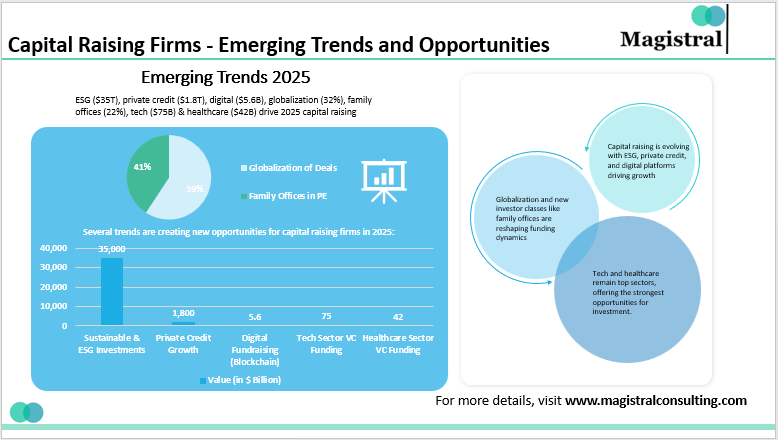
It is data that tells that sustainable investment reached a $35 trillion washing in 2024, up 10% from 2023. Increasingly, the capital raising companies structure their deals from an ESG perspective, with 41% of private-equity firms looking at the ESG impact before an actual investment decision is made.

Private Credit Growth

With banks having tightened their lending standards, private credit is riding the big high of growth. The global private credit market is expected to reach about $1.8 trillion by 2026.

Digital and Alternative Fundraising Platforms

The rise of digital capital-raising platforms is reshaping industry. An insane amount of activity has been observed in tokenized assets.

Globalization of Investment

Cross-border investment is becoming very common with globalization of capital markets. Venture capital deals involving foreign investors reached 32% in 2024 from 25% in 2023, showing a more interconnected financial system has evolved. This offers capital raising firms a chance to extend their services internationally and reach out to global investor networks.

Rise of Family Offices

With time family offices have increasingly taken the capital raising activity away from other players. When one set of data is considered, family offices were found to have participated in almost 22% of private equity deals in 2024. This change hints at growing interest in the custom and flexibility that family offices can allow an investment approach.

Focus on Tech and Healthcare Sectors

Investment in technology and healthcare has always been on the rise. Healthcare companies raised $42 billion, obviously showing much more interest once again from investors in these high-growth sectors. Firms that raise capital and have the expertise in these industries stand to benefit from the better position to grab these opportunities.

Regional Insights: Opportunities Across Markets

Whatever may be said about the global nature of capital raising, regional trends shape the opportunity for capital raising firms.

Opportunities Across Markets in Capital Raising Firms

Opportunities Across Markets in Capital Raising Firms

North America

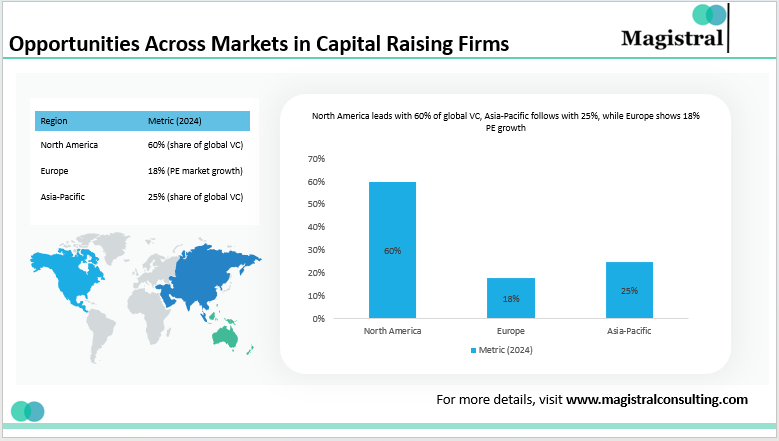
The U.S. remains the biggest market for the venture capital and private equity, covering over 60% of all global VC investment in 2024. Late-stage financing thus would continue to dominate in the San Francisco Bay Area and beyond, as mature startups strive to seek larger funding rounds. Likewise, sustainable investment and private credit also offer huge opportunities.

Europe

European private equity and venture capital are catching increasing interest from institutional investors. The European private equity market grew by 18% in 2024, with a strong presence in healthcare, technology, and energy transition.

Asia-Pacific

Private equity and venture capital investments flourish in the Asia-Pacific region, with China, India, and Southeast Asia being top three destinations. 2024 will see Asia getting 25% of the world’s VC funding, with fintech and clean energy at the zenith of priority targets.

Middle East and Africa

The Middle East, especially the Gulf Cooperation Council (GCC) area, experiences significant growth in private equity and venture capital investments. Sovereign wealth funds (SWFs) of the UAE and Saudi Arabia continue to be very active in financing large, infrastructure projects. Capital raising firms that can bring cross-border perspectives and mastery of regulatory processes will undoubtedly pursue excellent opportunities in this region.

Services offered by Magistral Consulting

Magistral Consulting offers a range of services that help capital-raising firms in flexibility and decision making:

Investor Identification & Profiling

We create detailed target investor lists and profiles, including the investment thesis and key decision-makers.

Investor Communication & Outreach

We design custom outreach campaigns across email, LinkedIn, and events, and prepare pitch decks and teasers.

Fundraising Collateral Preparation

Creates pitch decks, CIMs, teasers, and financial models to support negotiations and attract investors.

Investor Tracking & Reporting

We manage the overall process, help investor outreach and tracks engagement through CRM systems, providing progress reports.

Market Intelligence & Insights

Offers sector-specific reports and insights relevant to the investor’s priorities to ensure fundraising fits investor interests.

End-to-End Fundraising Support

Manages the complete fundraising process from investor identification to deal closure.

AI-Driven Investor Engagement

AI enables personalized outreach as it also analyzes investor sentiments for enhanced investor engagement.


About Magistral Consulting

Magistral Consulting has helped multiple funds and companies in outsourcing operations activities. It has service offerings for Private Equity, Venture Capital, Family Offices, Investment Banks, Asset Managers, Hedge Funds, Financial Consultants, Real Estate, REITs, RE funds, Corporates, and Portfolio companies. Its functional expertise is around Deal origination, Deal Execution, Due Diligence, Financial Modelling, Portfolio Management, and Equity Research

For setting up an appointment with a Magistral representative visit www.magistralconsulting.com/contact

About the Author

Aman is an investment-research specialist with 5+ years of experience across business and investment research, including 2+ years with Big Four firms like KPMG. A Stanford Seed alumnus with an MBA in Finance and a Bachelor of Commerce (Hons) from University of Delhi, he focuses on private equity, venture capital, and renewable energy sectors. He leads project teams at Magistral Consulting, delivering financial research, due diligence, deal sourcing, and M&A support, while driving strong process management and analytics. His blend of attention to detail, strategic thinking, and dynamic execution enables him to turn complex data into actionable investment insights.


FAQs

What challenges do capital raising firms face in 2025?

Firms are dealing with market volatility, declining fundraising, and complex deals due to inflation and interest rate hikes

How have family offices impacted capital raising?

Family offices are increasingly involved in private equity deals, accounting for 22% of transactions in 2024, offering more personalized investment options

What trends are shaping capital raising in 2025?

Trends include growth in ESG investments, private credit, digital platforms, and globalization of investments in sectors like tech and healthcare

How are digital platforms changing capital raising?

Digital platforms like crowdfunding and tokenized securities are democratizing investment, with a 30% increase in raised funds in 2024

What regional opportunities exist for capital raising firms?

Opportunities are growing in North America (VC and PE), Europe (institutional investment), Asia-Pacific (fintech and clean energy), and the Middle East (sovereign wealth funds)