Tag Archives: CIM

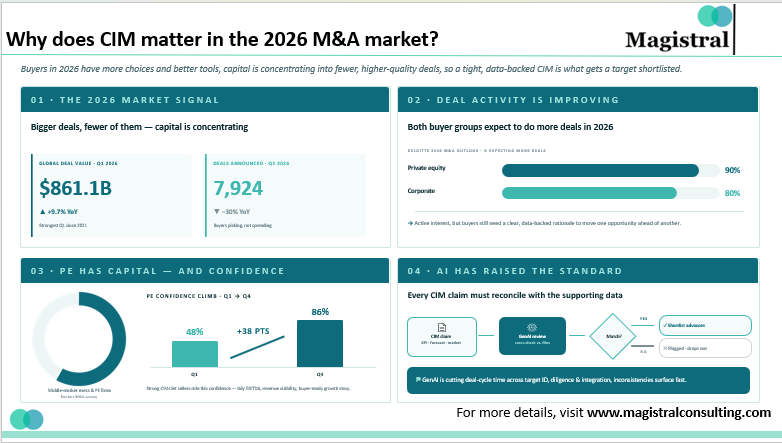
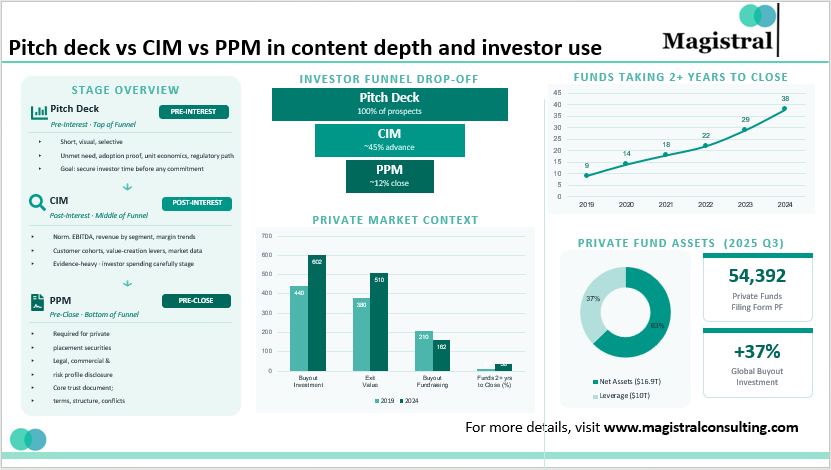
The Confidential Information Memo has come to be recognized as an important tool in deal-making in the context of the increasingly competitive and data-driven deal environment. The global M&A deal environment has consistently maintained deal volumes above $3 trillion in the most recent deal cycles. Private capital fundraising cycles have also been significantly lengthened. Preqin reports that the average fundraising period now exceeds 18-20 months. This contrasts with the nearly 12-14 months seen in the preceding deal environment. The lengthened fundraising period has put additional emphasis on maintaining investor engagement.

At the same time, the investor landscape has seen changes in the way in which investors seek to analytically validate the deal and respond in increasingly rapid manners. Deloitte reports that over 70% of investors now seek more in-depth due diligence materials before proceeding to advanced deal stages. In this context, the Confidential Information Memo is no longer just a tool but rather a process that can be used to improve investor conversion and deal closure.

The Confidential Information Memo and Deal Funnel Efficiency

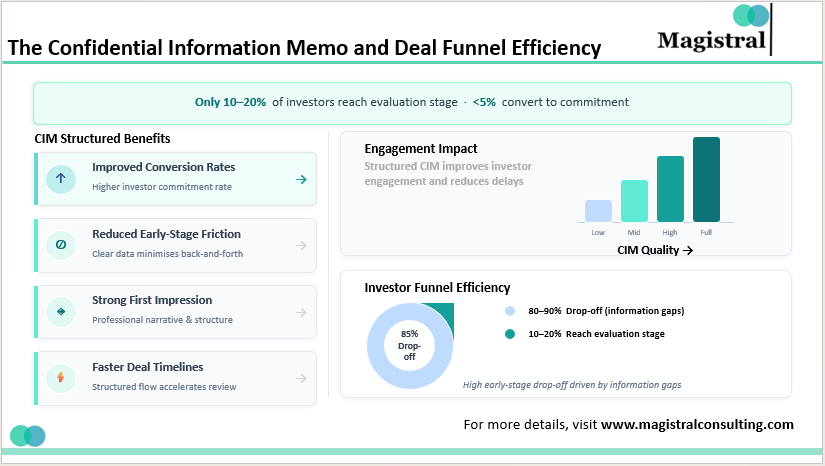
The Confidential Information Memo is central in the context of the efficiency with which deals can move through the investor funnel.

The Confidential Information Memo and Deal Funnel Efficiency

The Confidential Information Memo and Deal Funnel Efficiency

Impact on investor conversion rates

The investor funnel is one that sees high levels of drop-off at the early stages. Industry averages indicate that only 10-20% of the initial investor outreach ultimately make it to the advanced evaluation stages. In turn, fewer than 5% of these investors ultimately make it to the final stage.

Reduction of Inefficiency in Early-Stage Friction

When there are deficiencies or inconsistencies in information, there are always delays as further follow-ups are required. In addition, this may result in a lower number of investors showing interest. A well-prepared Confidential Information Memo helps avoid such inefficiency and results in a better deal flow.

Influence on First-Round Engagement Decisions

Investors make decisions within the first round of reviewing deal materials. A well-structured document that presents business, financial, and growth information helps investors progress to the next step, i.e., management discussions.

Compression of Deal Timelines

Fundraising processes are taking longer than 18 months. Therefore, it becomes imperative to reduce inefficiency. A well-prepared Confidential Information Memo helps investors compress deal evaluation timelines in the early stages.

Confidential Information Memo and Data Depth Requirements

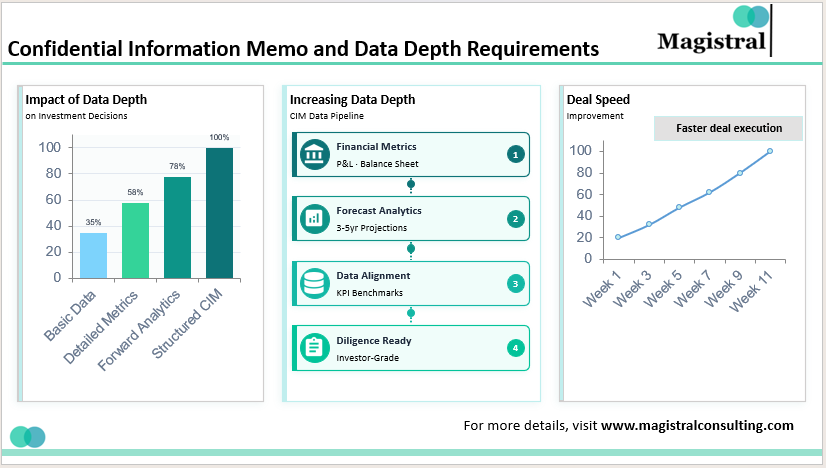
There are significant changes in investor requirements, and they are looking for deeper analytical rigor. Therefore, the quality and structure of the data are becoming important aspects of deal materials.

Confidential Information Memo and Data Depth Requirements

Confidential Information Memo and Data Depth Requirements

Demand for More Detailed Financial Metrics

Today, investors are seeking in-depth information on financial measures. According to McKinsey & Company, organizations that are using data-driven insights can improve the accuracy of their investment decisions by as much as 20-30%.

Shift toward Forward-Looking Analytics

Past performance does not suffice as a criterion for evaluating a deal. Investors are looking for information that helps them understand growth and potential risks. Therefore, sensitivity analysis can be included in the Confidential Information Memo.

Consistency of Financial and Operating Data

There are often inconsistencies in financial and operating data. A well-structured Confidential Information Memo helps investors trust the information presented.

Alignment with due diligence processes

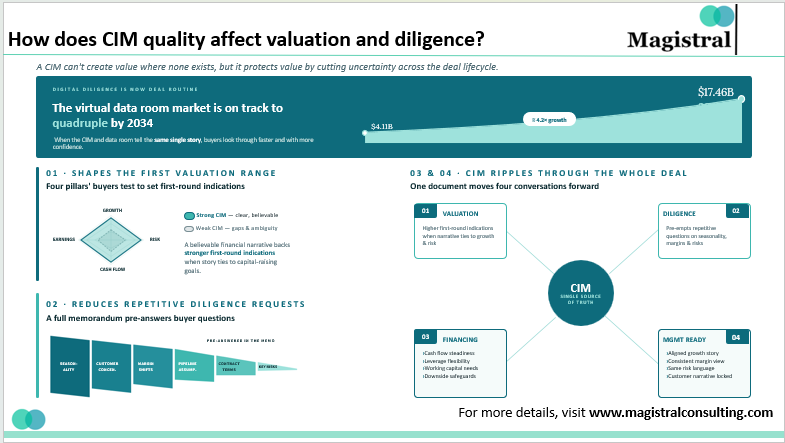
A well-structured and organized Confidential Information Memo can greatly assist in reducing due diligence processes. This can help in moving through due diligence processes faster.

Confidential Information Memo and Competitive Positioning

With capital concentration being limited to fewer deals, differentiation is key in getting attention from potential investors.

Capital concentration trends

The market is witnessing an upward trend in capital concentration in top-performing deals. According to Bain & Company, fewer deals are attracting more capital, resulting in an increase in competition among deals.

Importance of narrative clarity

Having a strong investment narrative with data support can greatly assist in positioning. In addition, investment opportunities are also evaluated based on how clear and concise the narrative is.

Role in shaping investor perception

The Confidential Information Memo is also considered an opportunity for investors to gain in-depth knowledge of the business. Therefore, its structure, clarity, and data support can greatly contribute to shaping investor perception.

Consistency between narrative and data

The Confidential Information Memo can also greatly assist in ensuring consistency in data analysis. Inconsistency in data analysis can greatly contribute to undermining investor confidence.

Confidential Information Memo and Its Impact on Valuation Outcomes

The Confidential Information Memo plays an important role in valuation outcomes. Its quality can greatly contribute to better valuation outcomes.

Improved investor confidence and participation

Having a well-structured and organized Confidential Information Memo can greatly contribute to building confidence among investors. Improved confidence among investors can greatly contribute to creating a competitive environment.

Creation of competitive bidding environments

Having an excellent Confidential Information Memo can greatly contribute to creating competitive environments. A competitive environment can greatly contribute to achieving better valuation outcomes.

Reduction in perceived risk

The availability of financial information and transparent assumptions can significantly reduce the perceived risk, which can, in turn, increase the valuation multiples.

Acceleration towards binding offers

The use of efficient communication can significantly reduce the gap between various stages, thus accelerating the process towards making binding offers.

Confidential Information Memo and Operational Challenges

The significance of the Confidential Information Memo notwithstanding, several operational challenges make it difficult to prepare a quality Confidential Information Memo.

Fragmentation of data sources

Data on financial, operational, and market performance is often scattered in various systems, which can result in inconsistencies in the consolidated financial information.

Time constraints in deal execution

The deal execution process is generally short, which can result in a high probability of errors in validation or incomplete information.

Balancing detail with readability

While excessive detail can make the Confidential Information Memo difficult to read, a lack of detail can undermine the credibility of the information provided.

Coordination of various stakeholders

The preparation of the Confidential Information Memo involves coordination with various teams, including finance, strategy, and investment bankers. Misalignment of various stakeholders can result in inconsistencies.

Confidential Information Memo and Structured Execution Framework

For companies that use a structured approach, the Confidential Information Memo can have a significant impact.

Standardization of templates and formats

The use of standardized templates can significantly reduce the effort in preparing the Confidential Information Memo, making it easier to read.

Centralized data management systems

The use of a single source of truth can significantly improve the accuracy of the information provided in the Confidential Information Memo, thus reducing inconsistencies.

Integration with digital deal tools

The use of digital tools such as data rooms, CRM, and analytics can significantly improve the coordination of various teams, thus enabling better tracking of interactions with various investors.

Iterative refinement based on investor feedback

Continuous improvement through investor queries and feedback helps in improving the quality and engagement of the document over time.

Alignment with overall deal strategy

Confidential Information Memo should be aligned with the overall deal strategy in order to ensure consistency in all channels and mediums of communication.

About Magistral Consulting

Magistral Consulting has helped multiple funds and companies in outsourcing operations activities. It has service offerings for Private Equity, Venture Capital, Family Offices, Investment Banks, Asset Managers, Hedge Funds, Financial Consultants, Real Estate, REITs, RE funds, Corporates, and Portfolio companies. Its functional expertise is around Deal origination, Deal Execution, Due Diligence, Financial Modelling, Portfolio Management, and Equity Research

For setting up an appointment with a Magistral representative visit www.magistralconsulting.com/contact

About the Author

Tanya is an investment-research specialist with 6 + years advising venture-capital, private-equity and lending clients worldwide. A Stanford Seed alumnus with an MBA and an Economics (Hons) degree, she heads project teams at Magistral Consulting, delivering financial modelling, due-diligence and deal support on 3,000 + mandates. Her blend of rigorous analytics, sharp project management and clear client communication turns complex data into actionable investment insight.

FAQs

What is a Confidential Information Memo?

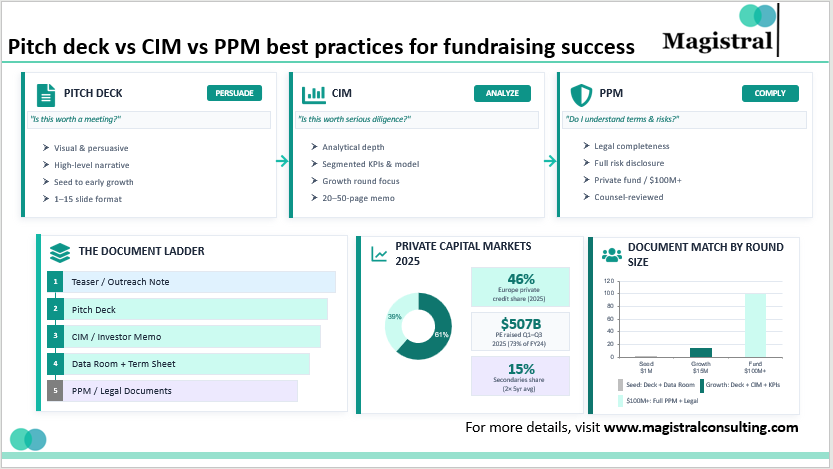
A Confidential Information Memo is an in-depth document that is part of transactional processes and is used to present information about a company’s business, financials, and investment thesis to potential investors.

Why is it important in deal processes?

It is used as a key tool for investor evaluation and plays an important role in terms of engagement and the overall deal process.

How does it impact valuation?

A well-structured document helps in generating greater investor confidence and improves overall valuation for companies.

What data should be included?

It should include financial performance, projections, market information, and operational information.

What are the common challenges in preparation?

Common challenges include data inconsistency, time constraints, and balancing information and clarity.

CIM Outsourcing has evolved from a tactical support role into a strategic function. CIMs remain the foundation for fundraising, M&A, and deal marketing in private equity and venture capital. However, due to the amount of analyst time involved with creating CIMs in-house as well as the amount of time and management attention spent on creating these materials, deal volume levels have jumped back. Activity timelines have shortened for many investment management firms. There has subsequently been a rising trend towards using an external CIM Outsourcing provider to fulfil these functions. It allows the firm’s investment professionals to focus on what they do best. This helps in enabling the firm to use its limited resources better.

According to the 2024 Deloitte Private Markets Outlook report, more than half (58%) of mid-market investment management firms intend to increase their use of third-party providers to create programs to enhance the efficiency and reliability of their respective processes.

CIM Outsourcing in Modern Investment Workflows

It enables investment firms to delegate many aspects of CIM preparation to an outsourced firm. It helps in maintaining ultimate strategic oversight over these projects. Since 2021, the length of the Due Diligence timeline has increased by an average of 22%. Thus creating a need for most firms to outsource their CIM preparation to third-party specialists. CIM preparation is a time and labour-intensive process that falls outside the core competencies of the firm.

CIM Outsourcing in Modern Investment Workflows

CIM Outsourcing in Modern Investment Workflows

What does CIM Outsourcing Cover?

Outsourcing providers handle all aspects of CIM preparation, including financial models, market sizing and positioning, competitive analysis, and risk management. Providers often provide standardised formats for CIM preparation to facilitate consistency across multiple deals. Thereby providing a means of driving consistency across a portfolio of investment deals. Providers can also reduce the internal review cycles of most firms by an average of 30%.

Why Firms Are Reallocating CIM Work?

By outsourcing their firm’s CIM preparation, analysts can spend more time sourcing, placing valuations, and conducting negotiations. This allows firms to reduce analyst burnout, improve their workflow, and align their workflow with the trend of outsourcing. It can be done for all non-core document-intensive operations.

CIM Outsourcing as a Strategic Operating Model

It has evolved from being merely a way to augment capacity for firms into a strategic choice. Firms can make to increase Agility, Consistency, and Excellence in Execution. McKinsey & Company estimates that by the year 2026, more than 60 % of Investment Firms will have outsourced at least one of their Core Deal Support Functions. Outsourcing is at the heart of this transformation, allowing Firms to place their full attention on What Drives their Returns and to communicate clearly and credibly with Investors while providing them with compelling information.

CIM Outsourcing and Its Role in Fundraising Efficiency

CIM’s role as an outsourced service has a significant impact on the success of the fundraising process. Especially when it comes to sourcing capital for current and future projects within a crowded environment and differentiating yourself from other firms.

MSCI’s Capital Markets Outlook, published, when referring to “quality of investment documentation,” over 70% of institutional investor respondents stated that this attribute is one they use to influence their decisions to initially engage with early-stage investment opportunities. As such, leveraging a CIM that is professionally structured will positively impact the initial impression received in relation to your CIM and your firm and reduce the amount of back-and-forth discussion with respect to diligence processes.

Enhancing Investor Communication

Outsourced CIM teams are comprised of specialists who can translate complex operational or financial data. It is done into easily understood and professionally coherent investment narratives. Given the increased need for consistent communication concerning growth strategy development/implementation, scalability, and downside protection throughout the capital-raising process, the function of outsourced CIM teams is important.

In addition, for private equity and other alternative investment firms that are raising capital for multiple funds. They are having consistency in terms of CIM development will assist with your brand credibility. This is especially true when combined with the limited attention spans of the average investor and the large volume of deal flow in the marketplace.

Supporting Capital Raising Timelines

The companies that are actively raising funds usually must function under tight schedules based on market conditions or the need for liquidity from the portfolios. CIM Outsourcing allows for faster iterations and concurrent processing to stay updated on the information despite changes in assumptions.

According to Deloitte, companies that make use of outsourced documentation support can decrease the time taken to prepare for fundraising by as much as 18 to 25 percent.

Operational and Cost Benefits of CIM Outsourcing

CIM Outsourcing isn’t just about speed and quality; it’s also about quantifiable savings & improved efficiencies. Due to the need for senior management oversight and multiple rounds of editing and a high opportunity cost associated with using internal documentation teams. According to a 2024 operational benchmarking report on operations by CBRE, the cost of each transaction operated via an outsourced method has been reduced by 20% to 30% versus fully in-house methods.

Scalability Without Fixed Overhead

When firms use outsourcing, they can increase their documentation capability according to the number of transactions being processed. During times of cyclical growth, the ability to increase or decrease documentation resources will provide more flexibility for internal teams to manage peak work periods.

Accuracy and Risk Mitigation

CIM Outsourcing Companies provide numerous layers of review to ensure that they have reduced the likelihood of human error and inconsistencies. The efforts to produce quality work will help to mitigate risk to the firm’s reputation as well as increase investor confidence in the documents produced during the due diligence process.

How Firms Select the Right CIM Outsourcing Partner

When selecting the right partner for CIM outsourcing, cost is only one part of the equation. As such, leading businesses place a higher value on domain experience, the maturity of processes, and collaborative styles utilized by their outsourcing partners.

How Firms Select the Right CIM Outsourcing Partner

How Firms Select the Right CIM Outsourcing Partner

Domain Knowledge and Financial Fluency

To create an effective CIM that resonates with sophisticated investors, providers must be able to speak the specific metric types, valuation logic, and regulatory expectations of the companies in the sector they’re working with.

Process Transparency and Collaboration

For firms to gain maximum value from their outsourced partner’s experience, providers must operate with a level of transparency. It is through the use of clear workflows, version control and communication protocols. The provider should seamlessly integrate into the firm’s internal teams and existing operational structure.  These integrations provide a more efficient operation of both the outsourcing firm and the provider’s services.

Technology Enablement

Developing advanced solutions and utilizing rapidly developing technologies, including artificial intelligence, data validation, and secure collaboration tools, allows providers to enhance their ability to reduce turnaround time and ensure that your confidential information remains protected.

How Magistral Consulting Adds Value Through CIM Outsourcing

At Magistral Consulting, outsourcing is provided within the context of an overall investment support infrastructure. It is not just as an isolated offering. Magistral Consulting provides investment companies with the expertise and support needed for them to execute an investment with confidence.

There is significant experience in private markets for both teams of Magistral. They support CIM creation in a highly integrated manner with the valuation models, findings, and expectations of the investors.

In carrying out its role as an extension of the client teams, Magistral allows the investment firms to focus on strategy and capital allocation. It is by ensuring that the CIMs are investor-ready, data-driven, and executed at a professional level by being agile. Magistral also ensures that they are credible in a highly competitive deal environment.


About Magistral Consulting

Magistral Consulting has helped multiple funds and companies in outsourcing operations activities. It has service offerings for Private Equity, Venture Capital, Family Offices, Investment Banks, Asset Managers, Hedge Funds, Financial Consultants, Real Estate, REITs, RE funds, Corporates, and Portfolio companies. Its functional expertise is around Deal origination, Deal Execution, Due Diligence, Financial Modelling, Portfolio Management, and Equity Research

For setting up an appointment with a Magistral representative visit www.magistralconsulting.com/contact

About the Author

Akansha is a Stanford Seed alum with an MBA (Finance & Operations) and B.Com (Hons). She delivers business and financial research for PE/VC and investment banking clients. Experience spans fundraising, M&A support, deal sourcing, consolidation accounting, supply chain analysis, and CRM-led outreach. Known for meticulous detail and fast learning, she turns analysis into investor-ready decisions.

FAQs

Which firms benefit most from CIM Outsourcing?

Private equity, venture capital, investment banking, and growth equity firms benefit most, particularly those managing multiple deals or fundraising cycles simultaneously.

Does outsourcing reduce control over deal narratives?

No. Firms retain strategic oversight while outsourcing execution tasks, allowing them to shape messaging without handling operational workload.

How does CIM Outsourcing impact deal timelines?

Industry data suggests that outsourcing can reduce documentation timelines by up to 25 percent, accelerating go-to-market and investor engagement.

Is CIM Outsourcing secure for sensitive information?

Reputable providers operate under strict confidentiality frameworks, secure data environments, and compliance protocols aligned with global standards.


Introduction

An investment memorandum is a legal document that outlines a private placement investment’s goals, risks, and terms. This document includes financial statements, management biographies, a full explanation of the business activities, and other relevant information.

The purpose of an investment memorandum is to inform purchasers about the offering and protect sellers from the risks of selling unregistered securities. It is a document sent to potential investors. It is an essential business plan that skilled investors may use to do due diligence. Most issuers use these documents primarily to satisfy securities authorities’ obligations, as intelligent investors typically conduct substantial due diligence. However, offering memorandums is comparable to prospectuses—private placements rather than public offerings.

An investment banker often prepares an offering memorandum, also known as an investment memorandum, to explain a company’s capital requirements to potential investors. The banker utilizes the memorandum to hold an auction among a select group of investors to find the best deal.

Private equity firms sometimes seek to accelerate their growth without taking on debt or going public. If a manufacturing corporation, for example, wants to grow the number of facilities it owns, it can use an offering memorandum to fund the expansion. When this occurs, the company must first select how much money it wants to raise and at what price per share it will do so. In this case, the firm needs $100 million to fund its expansion for a $60 cost per share.

Importance of Investment Memorandum

An investor memorandum is significant since it explains if the company is a good or terrible investment. The memorandum serves as a business overview or a revised business strategy.

It allows a company to demonstrate its strengths and why it is a good investment.  Its significance extends beyond the fact that it is a required document in the investment process for sellers and investors. The document protocol aids the investor in comprehending the investment’s prospects, potential dangers, prospective returns, activities involved, and overall capital structure.

The offering memorandum protects the investor and the issuers of securities. The issuer must adhere to all SEC requirements to the letter (Securities and Exchange Commission). The Securities and Exchange Commission (SEC) promotes investor fairness by protecting investors in the securities sector from false information and assisting investors in making educated decisions when investing large sums of money.

The offering memorandum also gives the vendor a professional appearance. Investors avoid putting their money into companies that do not demonstrate strong organization or expertise in their field. Memos are a simple approach for stakeholders to generate opinions about a concept. This is especially true when discussing a memo with possible investors, but it also applies when utilizing a memo to make a product or strategy choice. If an investment memorandum is well-designed and complete, it may be an indirect marketing tool.

What is included in the Investment Memorandum?

Investor memorandums usually provide information on the company’s structure, financial risk and health, and other pertinent information. This information aids an investor in determining if the risk is acceptable in exchange for the business’s prospective profits. A typical memorandum has the following items:

Outline of Investment Memorandum

Outline of Investment Memorandum

Introduction

The initial pages of the offering document include a brief description of the firm, its principal operation, and all “legends” needed by federal and state securities regulations.

Summary of the Terms of the Offer

You should include the firm’s capitalization—both before and after the offering—in this section, typically in the form of a term sheet. You may also incorporate liquidation preferences, conversion rights, anti-dilution clauses, voting rights, and other investor protection provisions.

Factors at Risk

A PPM will list any risk factors that the issuer can think of that might affect the investor’s investment, including both generic risks that apply to comparable investments and risks specific to the issuer and its securities Concerns might include, for example, reliance on a strategic relationship, reliance on a limited number of individuals, or competitive risks.

Description of the Company and Management

This part offers the company’s history and discusses its goods and services, the industry, goals, competitors, advertising and marketing strategy, suppliers, intellectual property, client descriptions, and other essential information the investor could find helpful. Biographical information, specific abilities, and additional background information will be included in management information.

Use of Proceeds

A corporation must explain how it intends to use the net funds generated from the offering and the estimated amount anticipated for each purpose. This allows the investor to see how their money, as well as that of others, is being invested is used

Securities Description

The rights, limits, and class of securities being sold are described in this section. It should also indicate the company’s ability to adjust its capitalization through multiple shares and dividend distribution types.

Exhibits

Exhibits allow a business to present additional information and documents that may be relevant to an investor’s choice. You may include copies of investment contracts, financial statements, the issuer’s organizational documents, key agreements, licenses, and other documents as exhibits.

Tips for Writing a Perfect Investment Memorandum

You can prepare an investment memorandum by following key steps: keep it simple, create a clear layout, be transparent about risks, and include the investment terms. These points are discussed further below:

Writing tips for Investment Memorandum

Writing tips for Investment Memorandum

Make it simple to comprehend

Clarity is essential. It’s critical to take your time and speak in a manner investors can comprehend. Their primary objective is to grasp the possibility and develop a business plan. If you use jargon in your investment memoranda, you risk attracting the wrong attention. Keep things simple; don’t throw folks off by making things too complicated.

Optimize the layout

Include a summary of the firm and the market. You should include an overview of your products and services, analyze your competition, define your target audience, and present your financial model. Use graphs and charts to concisely communicate essential information while making your investment memorandum. More aesthetically appealing. This is very beneficial when dealing with financial data. Using a bar chart to share sales growth, for example, emphasizes how quickly you’ve expanded and is simpler to read than a standard table.

Be transparent and upfront about the risk

Nobody enjoys being surprised. As a result, rather than the fund discovering risks during due diligence, set them out in your investment memorandum early on.

Include the investment’s terms

Outlining the financial project’s goals is an intelligent thing to undertake. Determine if the funds will be utilized for expansion, acquisitions, or working capital.

Make sure your financials are in order

This is the most crucial aspect since it is the key to receiving high-level term sheet offers. You must supply a complete financial statement that contains the following information:

-Gross revenue

-Flows of funds

-Revenue

-Profit and Loss Statements

-EBITDA

-Margins

Use statistics from the previous two years and an estimate for the following five. This allows potential investors to run their numbers and see if you’re a reasonable risk. Be as specific as possible.

Why Magistral Consulting?

Magistral consulting prepared a Private Placement Memorandum for a large land parcel amid a mega-global city and successfully analyzed cash flows and returns from all scenarios. It also used to raise over 40 million USD worth of co-investments.

Investment Memorandums

Magistral consulting provides investment memorandum services for Funds, Properties, Farms, Luxury Hotels, Land Banks, Islands, Resorts, etc.

Analysis of Valuation

Using techniques such as comps, precedent transaction research, and leveraged buyout to determine the company’s fair market value.

Primary Research

Exploratory interviews with all stakeholders at Target Company, including management, workers, ex-employees, vendors, and investors, to identify any red signals.

Company Profile Data

We gather all the company-specific data and anticipate potential questions to ensure we complete the memo thoroughly.

Detailed Financial Analysis

We provide a complete financial review utilizing all essential characteristics from balance sheets to income statements.

About Magistral Consulting

Magistral Consulting has helped multiple funds and companies in outsourcing operations activities. It has service offerings for Private Equity, Venture Capital, Family OfficesInvestment BanksAsset Managers, Hedge Funds, Financial Consultants, Real Estate, REITs, RE fundsCorporates and Portfolio companies. Its functional expertise is in Deal originationDeal Execution, Due Diligence, Financial ModelingPortfolio Management and Equity Research.

For setting up an appointment with a Magistral representative visit www.magistralconsulting.com/contact

About the Author

The article is Authored by the Marketing Department of Magistral Consulting. For any business inquiries, you could reach out to prabhash.choudhary@magistralconsulting.com