Tag Archives: PPM

Though fundraising documents may seem alike from afar, the investor uses each of them differently in a fundraising deal. The pitch deck starts the discussion, the CIM builds the business and financial case, and the PPM supports the legal documentation during private offerings. This is why it is essential to distinguish between pitch deck vs CIM vs PPM prior to approaching any angel investor, venture capital fund, family office, or institutional buyer. With an increasing number of investors in any market, it is crucial to use the right fundraising tool; otherwise, negotiations will drag on, confusion will arise, and the level of credibility of the company in question will suffer greatly.

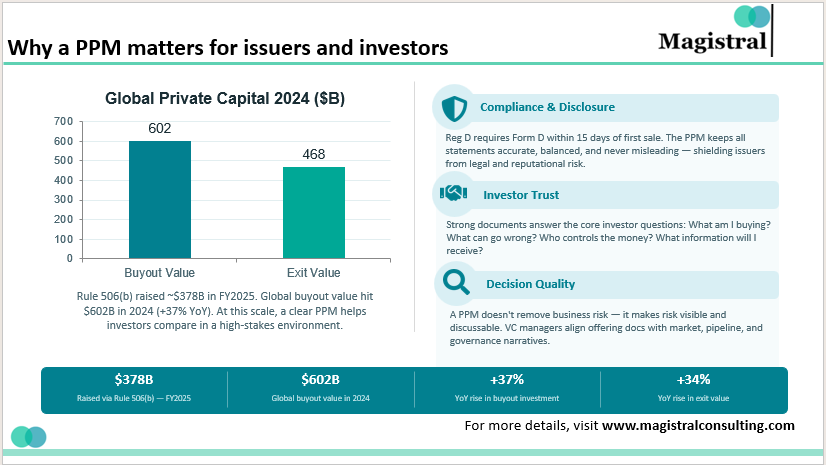
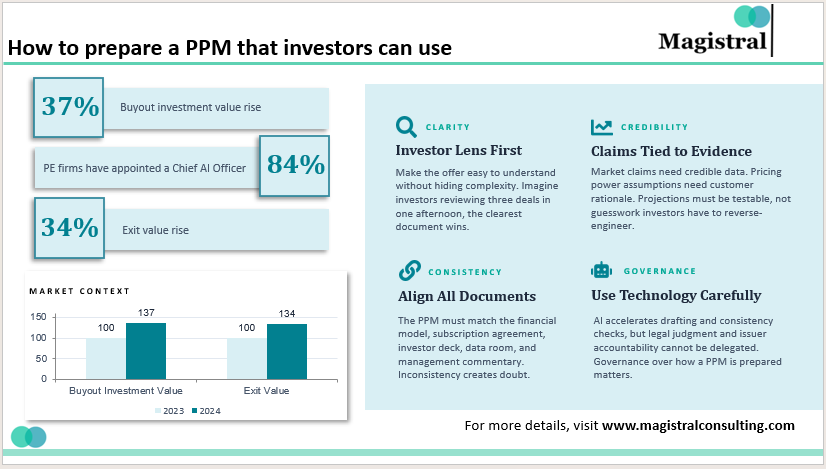
According to recent figures, global buyout investment increased by 37%, while exit value increased by 34% in 2024. Nevertheless, despite positive dynamics, the amount of global buyout fundraising decreased by 23% that year. In turn, startup fundraising on leading private marketplaces reached approximately 120 billion dollars in 2025, growing 17% annually; however, the overall number of rounds dropped to a six-year low. In practical terms, understanding pitch deck vs CIM vs PPM helps founders choose the right document at the right point in the process.

Pitch deck vs CIM vs PPM for fundraising purposes

The key difference lies in the requirements of the investors for the various stages of the financing process. While a pitch deck contains a concise and visual description of a business idea, the company’s progress towards achieving its goals, market potential, traction, business model, and capital requirements, it should attract investors’ attention within several minutes. A CIM, which stands for Confidential Information Memorandum, presents investors with a deeper analysis of the company in terms of its financial standing, sources of income, operations, market situation, concentration of customers, business growth, and rationale behind the sale. Thus, it is located somewhere between the preliminary meeting and the due diligence process.

And lastly, the PPM, or Private Placement Memorandum, is a formal document required for a private placement offering. Unlike a pitch deck and a CIM, the primary purpose of this document is to disclose certain details regarding the conditions, risks, fees, and suitability of the investors. A clear view of pitch deck vs CIM vs PPM makes it easier to match the material to the investor’s expectations.

Pitch deck vs CIM vs PPM in content depth and investor use

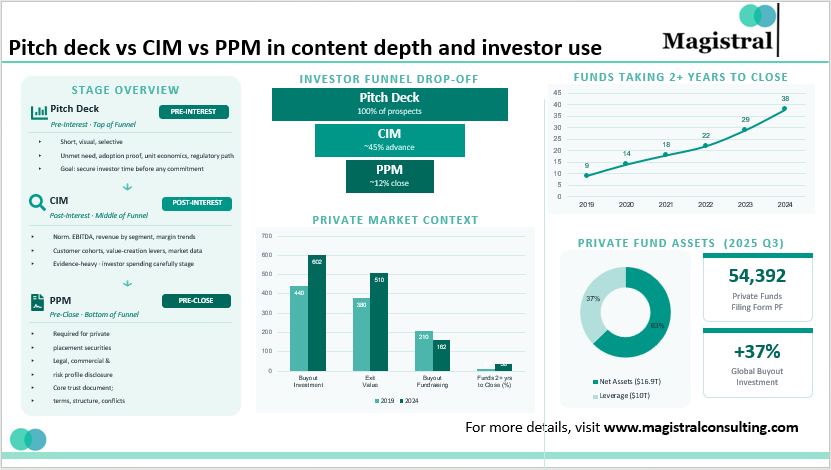
It is important to recognize that the difference between these documents lies not only in their length but also in how investors use them. In other words, documents would become easier to organize when each one of the documents is used for its corresponding stage of the financing funnel.

Pitch deck vs CIM vs PPM in content depth and investor use

Pitch deck vs CIM vs PPM in content depth and investor use

When investors read a pitch deck

Before an investor makes the decision to spend his or her time on further evaluation, he or she looks at the pitch deck. This document should be short, visual, and targeted. The fact that it tries to provide all information in detail is contrary to the purpose of this document.
For example, consider a founder of a health-tech startup raising Series A funds. The investor needs information about the unmet need, adoption proof, unit economics, regulatory pathway, and reasons why the current round helps grow the business fast. He or she doesn’t need the whole paragraph about legal risks. This is one of the clearest examples of pitch deck vs CIM vs PPM in practice.

When investors request a CIM

This kind of CIM should contain EBITDA, revenues per segment, margin evolution, market growth, customer cohorts, advantages, and value creation. This is critical since investors are being prudent with their resources. For instance, in 2024, the amount of investments for buyouts across the world grew by 37% to reach almost 602 billion dollars, while the amount of exit value climbed 34%, but buyout fundraising dropped 23% across the globe. The second observation by Bain & Company was that the number of funds that took two years or even more to be finalized went up to 38% compared to 9% back in 2019.

In simple words, there is an improvement in deals faster than the improvement in fundraising, meaning that managers require better materials. In this stage, documents becomes especially relevant because investors now expect more depth and diligence support. reference

When a PPM becomes necessary

PPM is needed when there is an offer to buy and sell securities through the private placement of such securities. It provides a detailed description to help informed investors evaluate the offer.

The extent of the market of private placements also highlights the importance of good-quality disclosure. According to the statistics for Q3 2025, 54,392 private funds have reported on their investments using Form PF. These private funds hold $16.9 trillion worth of net assets and $26.9 trillion worth of gross assets. At such a magnitude of private placements, the PPM is an important document for evaluating the deal. This is why one should consider a PPM as opposed to pitch decks or CIMs. From a compliance perspective, pitch deck vs CIM vs PPM is not just a messaging choice but also a legal and procedural one.

Pitch deck vs CIM vs PPM for startups, companies, and funds

Startups, established companies, and private funds use different fundraising documents depending on the stage and complexity of the transaction. Early-stage startups usually rely on pitch decks to communicate vision, traction, and growth potential to angel investors and VCs. As companies mature and raise larger rounds, investors often expect additional materials such as financial models, investor memos, data rooms, and sometimes PPM disclosures for private securities offerings. Established companies pursuing growth capital or M&A transactions typically use CIMs to provide detailed information on financial performance, operations, market position, and valuation.

Private funds often require all three: a pitch deck to introduce the strategy, a CIM or investment memorandum to explain track record and portfolio construction, and a PPM to disclose fund terms, risks, fees, and compliance details. With private markets expanding rapidly and investors demanding deeper diligence, the quality and depth of pitch deck vs CIM vs PPM documentation have become increasingly important. For founders and fund managers alike, pitch deck vs CIM vs PPM should be planned as part of a broader fundraising workflow rather than as isolated deliverables.

Pitch deck vs CIM vs PPM best practices for fundraising success

The key to success is having your fundraising materials as a cohesive set. The question you should be asking yourself is not which of these is better but rather when you should use each material and how consistently they should back up the investor’s experience. A smart approach to pitch deck vs CIM vs PPM improves both investor communication and process efficiency.

Pitch deck vs CIM vs PPM

Pitch deck vs CIM vs PPM best practices for fundraising success

Keep the message consistent

When an investor gets conflicting messages from your pitch deck and sees something different in the CIM, then notices new risk factors that weren’t mentioned before in the PPM, the trust will be broken. You need to go deeper into the story but not change its course.
That’s what a professional fundraising consultant can do for you. Strong consistency across pitch deck vs CIM vs PPM helps reinforce credibility with sophisticated investors.

Match the document to the round size and investor type

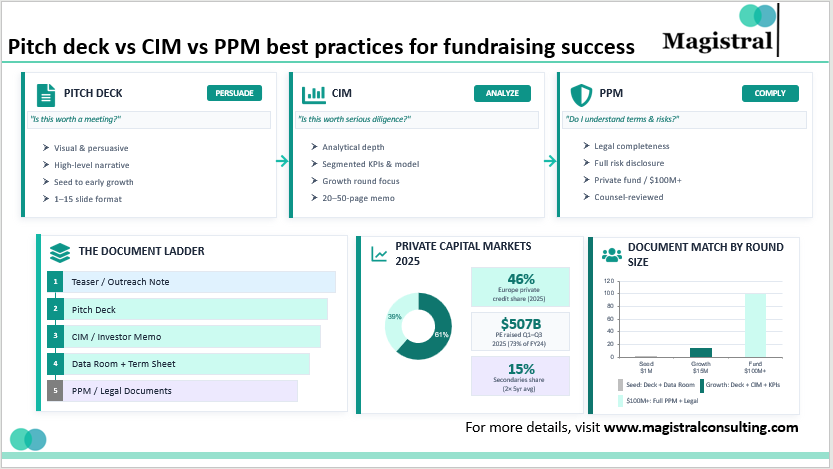
When deciding how to use pitch deck vs CIM vs PPM, the right way is to choose one based on the size and nature of the fundraising process. In the case of raising $1 million for a seed, you may only need an effective deck with the right data room. For 15 million dollars in the growth stage, you might need a more complete investor memo, KPIs, and projections. As for raising 100 million dollars for your private fund or making a private placement, you’ll probably have to prepare a precise PPM together with a subscription package.

A pitch deck can be convincing. A CIM should be analytical. But a PPM has to be very careful and detailed. Mixing up these approaches can cause some issues.

For instance, risk factors are not supposed to play a main role during the initial meetings with investors. Nevertheless, they shouldn’t be forgotten in the end offering. Mature and balanced communication is always highly appreciated by investors.

Use data without overloading the reader

Your fundraising documents will include many facts, including figures, but those figures must be used in an appropriate context. According to Preqin, 46 percent of fundraising for private credit in Q1 to Q3 was allocated to European funds, which represents an increase from the 23 percent seen in 2024, and 61.5 percent of the capital raised went to direct lending.

Also, according to Preqin, the number of dollars raised in Q1 to Q3 of 2025 by private equity reached 507 billion dollars, representing 73 percent of what was seen throughout the year 2024, and secondaries represented 15 percent of fundraising, more than twice the figure over the past five years. These types of figures can be useful for explaining when it’s a good time to raise. Used well, they also strengthen the narrative around pitch deck vs CIM vs PPM without overwhelming the reader.

Create a document ladder, not isolated files

Exceptional fundraising teams very seldom view each of these documents individually. They create a document ladder – from teaser/contact letter, through pitch deck, memo / CIM, data room, term sheet negotiation, and ending with PPM / final documentation if required. Viewing documents in such a light allows entrepreneurs and managers to avoid two pitfalls – putting too much into a pitch deck and underpreparing the final document.
Fundraising documents always aim at a single investor’s question.
Pitch deck – is this even worth a conversation?
CIM – Is this investment worth my time?
PPM – Do I know enough about the terms and risks?
This framework is often the easiest way to understand documents across the full investor journey.

How Magistral supports fundraising documentation

Magistral Consulting provides fundraising documentation, investment due diligence research, financial modeling, market research, and presentation preparation services to start-ups, privately held companies, funds, and investment management firms. On its fundraising page on the website of Magistral Consulting, it is mentioned that standard fundraising documents typically consist of a pitch deck, CIM/PPM, valuation, and a one-pager.

For issuers looking to prepare investor documents, Magistral Consulting will help to align the story, figures, diligence support, and outreach process. Other services provided by the company include due diligence services, deal structuring and execution, financial modeling, valuation, fundraising, deal sourcing, portfolio management, ESG analysis, fund administration, research, marketing, and investor relations.

An efficient process makes the difference between PIM vs CIM vs PPM from just a document decision into a strategic fundraising process where documents come at the appropriate time and with the right content. In advisory work, such documents are often central to deciding what to prepare first and how to sequence investor materials.

About Magistral Consulting

Magistral Consulting has helped multiple funds and companies in outsourcing operations activities. It has service offerings for Private Equity, Venture Capital, Family Offices, Investment Banks, Asset Managers, Hedge Funds, Financial Consultants, Real Estate, REITs, RE funds, Corporates, and Portfolio companies. Its functional expertise is around Deal origination, Deal Execution, Due Diligence, Financial Modelling, Portfolio Management, and Equity Research

For setting up an appointment with a Magistral representative visit www.magistralconsulting.com/contact

About the Author

Tanya is an investment-research specialist with 6 + years advising venture-capital, private-equity and lending clients worldwide. A Stanford Seed alumnus with an MBA and an Economics (Hons) degree, she heads project teams at Magistral Consulting, delivering financial modelling, due-diligence and deal support on 3,000 + mandates. Her blend of rigorous analytics, sharp project management and clear client communication turns complex data into actionable investment insight.

FAQs

What is the main difference between pitch deck vs CIM vs PPM?

A pitch deck creates initial investor interest, a CIM provides detailed business and financial information, and a PPM discloses legal terms and risks for a private securities offering.

Does every fundraiser need all three documents?

No. Early startups may only need a pitch deck at first. Funds, private placements, and larger transactions often need a CIM and PPM as discussions move forward.

Is a CIM legally the same as a PPM?

No. A CIM is usually a detailed commercial and financial document, often used in M&A or growth capital processes. A PPM is a legal disclosure document for private securities offerings.

Can a pitch deck replace a CIM?

Usually not. A pitch deck is too brief for serious diligence. Once investors show strong interest, a CIM or detailed investor memorandum helps them evaluate the opportunity more thoroughly.

Who prepares these fundraising documents?

Founders, CFOs, investment bankers, consultants, lawyers, and fundraising advisors often work together. Legal counsel usually reviews or prepares the PPM because of disclosure and securities law implications.

For certain businesses that want to increase capital by attracting investment from the general public, the issuance of shares is likely to be a very lengthy and complicated exercise. However, there is yet another way in which companies intending to raise funds can do so by means of the issuance of a Private Placement Memorandum, which is PPM.

When it comes to private fundraising, the need for a well-written Private Placement Memorandum (PPM) is indispensable for the issuers and their potential investors. A PPM not only discloses key information but also protects against legal issues, supports marketing efforts, and provides detailed insights into the investment being offered.

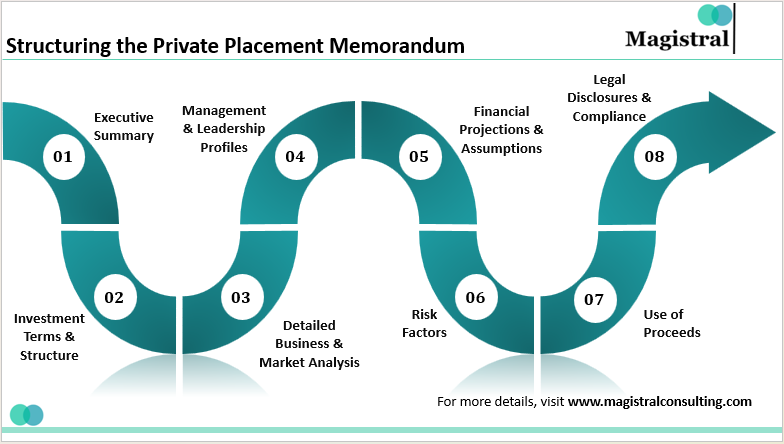
Structuring the Private Placement Memorandum

When drafting the PPM, a great deal of attention goes into ensuring that everything is clear, and to comply with regulations, and make a solid case for investment. Every section and component offer significant information in a constructive manner which offers potential investors a clear picture of the proposition on offer.

Structuring the Private Placement Memorandum

Structuring the Private Placement Memorandum

Executive Summary

Despite being a concise section, the Executive Summary demands attention to detail and clarity. It should briefly explain the intent of the investment, the aims, and the strategic benefits without violating regulations. The private placement memorandum should present the value proposition in a way that captures investors’ attention as early as possible.

Investment Terms and Structure

A clearly phrased terms section describes the technical structure of the investment, including minimum investment thresholds, offered securities and their voting powers, dividends and preferences, lockup periods, and how to exit the investment. It should include clarifications on certain contentious terms such as conversion rights, liquidation preferences, etc. so as to address the features of the investment and provide clarity to the investors.

Detailed Business and Market Analysis

An effective business analysis, in PPM, shows the issuer’s business model, how it operates, and a description of its improvement approaches. It should provide an industry outlook based on facts, trends, and drivers of the market study as well as its competitors and disruptions in the market, market data, and forecasts along with other credible sources indicating the growth prospects.

Management and Leadership Profiles

The level of experience of the management team of the issuer has a great potential to change the beliefs of the investors. This part should include the qualifications, experience, and achievements of the key individuals. It is also interesting to know about the governance – how the board and advisors were formed, which enriches the presentation of the issuer’s ability to implement the plan.

Financial Projections and Assumptions

Private placement memorandums typically present financial forecasts as one of their most important elements. Investors expect management to provide realistic, fact-based forecasts over a 3–5-year horizon, covering revenue, EBITDA, capex, and cash flows.

Risk Factors

Due to the need to comply with and manage investor expectations from the outset, it is important to provide a full disclosure of all risks. The types of risk generally covered include risks posed by market fluctuations, levels of regulatory effectiveness, operational control, and competitive factors. Moreover, identifying industry or regional threats can assist in illustrating possible outcomes that are likely to affect profitability.

Use of Proceeds

Investors must understand how their money will be used. A strong ‘Use of Proceeds’ section clearly explains how the funds will be allocated across areas such as research and development, market expansion, operational growth, and debt repayment.
>This section should also exhibit the relationship between capital requirements and timelines with clear purposes that help the investors understand how the growth of the foreign entity will be in relation to their funding.

Legal Disclosures and Compliance

Regulatory compliance is of utmost importance while preparing the private placement memorandum. The legal disclosure’s part shall explain what type of securities laws (including, among others, those exemptions which are entitled under Reg D, in respect of the U.S.–based offerings of any securities) the private placement memorandum is adherent to. Other important disclosures include such issues as conflicts of interest, patents and other intellectual properties, material agreements, and risk of lawsuits.

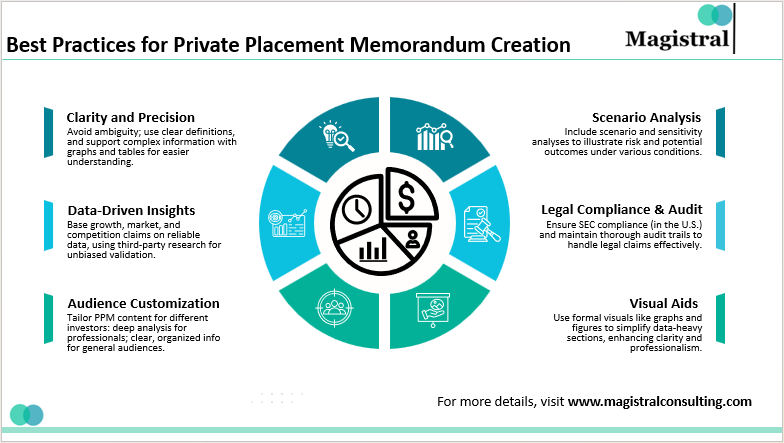
Best Practices for Private Placement Memorandums Creation

An effective PPM should be simple, precise, and able to speak to the intended audience ensuring investors’ confidence and compliance.

Best Practices for Private Placement Memorandum Creation

Best Practices for Private Placement Memorandum Creation

Clarity and Precision

A private placement memorandum should be free from any vagueness and aspire to straightforwardness that will instill the trust of investors. Although technical jargon is sometimes unavoidable, writers must prioritize clarity and clearly define any ambiguous terms.
In other instances, it is advisable to employ graphs and tables that help to convey complex information better.

Data-Driven Insights

Substantiate any assertions on growth, market size, or competition with solid data, including third-party research, market assessments, or industry reports. This gives an impartial basis for forecasts and puts into perspective the issuer’s circumstances.

Customization for Target Audience

Modifying the content structure of the PPM depending on the type of investors will yield better results. Detailed analysis, comprehensive financial information, and emphasis on competitive advantages are imperative for professional and institutional investors. On the other hand, more general public audiences might be better served with straightforward and organized explanations.

Integrate Scenario Analysis

Incorporating sensitivity analyses or more financial scenarios adds a positive twist in approaching risk management. It raises the level of sophistication in decision-making. Scenario analysis aims to enhance the investors’ understanding of the range and variability of potential outcomes. It also judges the stability of such outcomes under changing conditions.

Legal Compliance and Audit Trail

A private placement memorandum is subject to both political and legal consequences and therefore, the issuers should abide by the SEC requirements, if any, within the United States and seek a lawyer well-versed in securities law. Compliance teams manage noncompliance causes and issues through reviews and documented audit trails, which help address any claims from investors.

Graphic and Visual Aid Integration

Employing illustrations, graphs, and figures is useful especially, in parts with extensive data analysis like financial forecasts and comparisons of industries. However, such components must be the formal ones to enhance the image and illustrate the message properly.

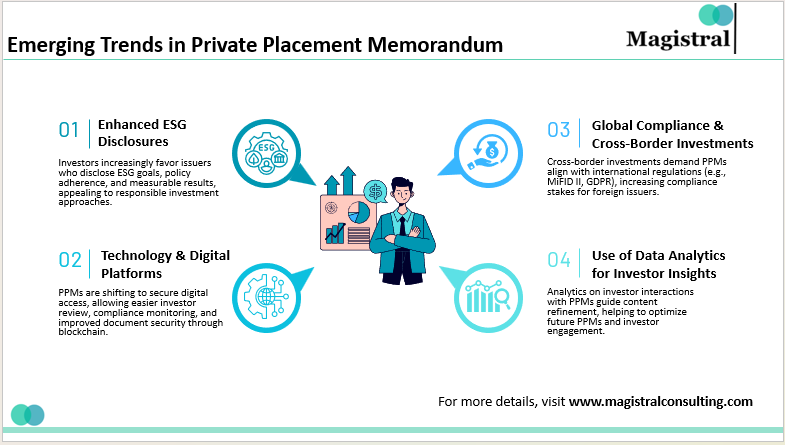
Emerging Trends in Private Placement Memorandums

With the development of PPMs, new trends that benefit investor interests and ease operations have started to be incorporated more into PPMs.

Emerging Trends in Private Placement Memorandum

Emerging Trends in Private Placement Memorandum

Enhanced ESG Disclosures

As Environmental, Social, and Governance (ESG) factors become more prominent. There is a growing preference among investors for issuers to inform them regarding the various ESG initiatives. There is also the debate as to how they create sustainable value over time. ESG-related aims, adherence to policy, and quantifying results can be beneficial in attracting more investors. It is good for especially those who have responsible investment approaches.

Integration of Technology and Digital Platforms

Technology is driving a major transformation in how private placement memorandums are distributed and accessed. Secured private placement memorandum Digital Access is very instrumental in the investor review process and provides means to monitor compliance with ease. As such, organizations are exploring the potential of blockchain technology to improve document security and transparency.

Focus on Global Compliance and Cross-Border Investments

With the growth of cross-border fundraising, there’s a need for PPM to include the issues of compliance with different territories. Regulations such as the EU MiFID II and GDPR directly influence how organizations share information and process data, thereby increasing the stakes for foreign issuers.

Use of Data Analytics for Investor Insights

Organizations on the other hand do not stop at designing the private placement memorandum but rather utilize the analytics to understand the investors’ behaviors. This helps to fine-tune the PPM, enhances the subsequent investor roundups, and most importantly, the contents of the PPM. Analytics identifies the most-read sections, helping teams recompose the private placement memorandum for optimal results.


Magistral Consulting Services for Private Placement Memorandums

Private placements can be very difficult to navigate but having a trusted advisor can make all the difference. Magistral Consulting offers extensive support for Private Placement Memorandums (PPMs). Our services include:

Crafting PPM

Our team develops PPM that is detailed and compliant with the laws. Magistral Consulting works closely with you to understand your business, goals, and regulatory requirements. We craft a PPM with all the required elements.

Compliance with the law

We make sure that your private placement memorandum adheres to all the relevant laws and regulations. We also offer guidance on compliance issues, helping you avoid any legal pitfalls.

Financial Reports

We also draft detailed financial statements that clearly present your company’s financial health. It also ensures your data supports better investment decisions.

Assessing Risks

It is very important to understand and disclose any possible associated risks to build investor trust. Our experts recognize and evaluate the associated risks with your investment offering, offering comprehensive risk disclosures in the PPM.


About Magistral Consulting

Magistral Consulting has helped multiple funds and companies in outsourcing operations activities. It has service offerings for Private Equity, Venture Capital, Family Offices, Investment Banks, Asset Managers, Hedge Funds, Financial Consultants, Real Estate, REITs, RE funds, Corporates, and Portfolio companies. Its functional expertise is around Deal origination, Deal Execution, Due Diligence, Financial Modelling, Portfolio Management, and Equity Research

For setting up an appointment with a Magistral representative visit www.magistralconsulting.com/contact

About the Author

The article is authored by the Marketing Department of Magistral Consulting. For any business inquiries, you can reach out to prabhash.choudhary@magistralconsulting.com

[sp_easyaccordion id=”3137″]

Introduction

An investment memorandum is a legal document that outlines a private placement investment’s goals, risks, and terms. This document includes financial statements, management biographies, a full explanation of the business activities, and other relevant information.

The purpose of an investment memorandum is to inform purchasers about the offering and protect sellers from the risks of selling unregistered securities. It is a document sent to potential investors. It is an essential business plan that skilled investors may use to do due diligence. Most issuers use these documents primarily to satisfy securities authorities’ obligations, as intelligent investors typically conduct substantial due diligence. However, offering memorandums is comparable to prospectuses—private placements rather than public offerings.

An investment banker often prepares an offering memorandum, also known as an investment memorandum, to explain a company’s capital requirements to potential investors. The banker utilizes the memorandum to hold an auction among a select group of investors to find the best deal.

Private equity firms sometimes seek to accelerate their growth without taking on debt or going public. If a manufacturing corporation, for example, wants to grow the number of facilities it owns, it can use an offering memorandum to fund the expansion. When this occurs, the company must first select how much money it wants to raise and at what price per share it will do so. In this case, the firm needs $100 million to fund its expansion for a $60 cost per share.

Importance of Investment Memorandum

An investor memorandum is significant since it explains if the company is a good or terrible investment. The memorandum serves as a business overview or a revised business strategy.

It allows a company to demonstrate its strengths and why it is a good investment.  Its significance extends beyond the fact that it is a required document in the investment process for sellers and investors. The document protocol aids the investor in comprehending the investment’s prospects, potential dangers, prospective returns, activities involved, and overall capital structure.

The offering memorandum protects the investor and the issuers of securities. The issuer must adhere to all SEC requirements to the letter (Securities and Exchange Commission). The Securities and Exchange Commission (SEC) promotes investor fairness by protecting investors in the securities sector from false information and assisting investors in making educated decisions when investing large sums of money.

The offering memorandum also gives the vendor a professional appearance. Investors avoid putting their money into companies that do not demonstrate strong organization or expertise in their field. Memos are a simple approach for stakeholders to generate opinions about a concept. This is especially true when discussing a memo with possible investors, but it also applies when utilizing a memo to make a product or strategy choice. If an investment memorandum is well-designed and complete, it may be an indirect marketing tool.

What is included in the Investment Memorandum?

Investor memorandums usually provide information on the company’s structure, financial risk and health, and other pertinent information. This information aids an investor in determining if the risk is acceptable in exchange for the business’s prospective profits. A typical memorandum has the following items:

Outline of Investment Memorandum

Outline of Investment Memorandum

Introduction

The initial pages of the offering document include a brief description of the firm, its principal operation, and all “legends” needed by federal and state securities regulations.

Summary of the Terms of the Offer

You should include the firm’s capitalization—both before and after the offering—in this section, typically in the form of a term sheet. You may also incorporate liquidation preferences, conversion rights, anti-dilution clauses, voting rights, and other investor protection provisions.

Factors at Risk

A PPM will list any risk factors that the issuer can think of that might affect the investor’s investment, including both generic risks that apply to comparable investments and risks specific to the issuer and its securities Concerns might include, for example, reliance on a strategic relationship, reliance on a limited number of individuals, or competitive risks.

Description of the Company and Management

This part offers the company’s history and discusses its goods and services, the industry, goals, competitors, advertising and marketing strategy, suppliers, intellectual property, client descriptions, and other essential information the investor could find helpful. Biographical information, specific abilities, and additional background information will be included in management information.

Use of Proceeds

A corporation must explain how it intends to use the net funds generated from the offering and the estimated amount anticipated for each purpose. This allows the investor to see how their money, as well as that of others, is being invested is used

Securities Description

The rights, limits, and class of securities being sold are described in this section. It should also indicate the company’s ability to adjust its capitalization through multiple shares and dividend distribution types.

Exhibits

Exhibits allow a business to present additional information and documents that may be relevant to an investor’s choice. You may include copies of investment contracts, financial statements, the issuer’s organizational documents, key agreements, licenses, and other documents as exhibits.

Tips for Writing a Perfect Investment Memorandum

You can prepare an investment memorandum by following key steps: keep it simple, create a clear layout, be transparent about risks, and include the investment terms. These points are discussed further below:

Writing tips for Investment Memorandum

Writing tips for Investment Memorandum

Make it simple to comprehend

Clarity is essential. It’s critical to take your time and speak in a manner investors can comprehend. Their primary objective is to grasp the possibility and develop a business plan. If you use jargon in your investment memoranda, you risk attracting the wrong attention. Keep things simple; don’t throw folks off by making things too complicated.

Optimize the layout

Include a summary of the firm and the market. You should include an overview of your products and services, analyze your competition, define your target audience, and present your financial model. Use graphs and charts to concisely communicate essential information while making your investment memorandum. More aesthetically appealing. This is very beneficial when dealing with financial data. Using a bar chart to share sales growth, for example, emphasizes how quickly you’ve expanded and is simpler to read than a standard table.

Be transparent and upfront about the risk

Nobody enjoys being surprised. As a result, rather than the fund discovering risks during due diligence, set them out in your investment memorandum early on.

Include the investment’s terms

Outlining the financial project’s goals is an intelligent thing to undertake. Determine if the funds will be utilized for expansion, acquisitions, or working capital.

Make sure your financials are in order

This is the most crucial aspect since it is the key to receiving high-level term sheet offers. You must supply a complete financial statement that contains the following information:

-Gross revenue

-Flows of funds

-Revenue

-Profit and Loss Statements

-EBITDA

-Margins

Use statistics from the previous two years and an estimate for the following five. This allows potential investors to run their numbers and see if you’re a reasonable risk. Be as specific as possible.

Why Magistral Consulting?

Magistral consulting prepared a Private Placement Memorandum for a large land parcel amid a mega-global city and successfully analyzed cash flows and returns from all scenarios. It also used to raise over 40 million USD worth of co-investments.

Investment Memorandums

Magistral consulting provides investment memorandum services for Funds, Properties, Farms, Luxury Hotels, Land Banks, Islands, Resorts, etc.

Analysis of Valuation

Using techniques such as comps, precedent transaction research, and leveraged buyout to determine the company’s fair market value.

Primary Research

Exploratory interviews with all stakeholders at Target Company, including management, workers, ex-employees, vendors, and investors, to identify any red signals.

Company Profile Data

We gather all the company-specific data and anticipate potential questions to ensure we complete the memo thoroughly.

Detailed Financial Analysis

We provide a complete financial review utilizing all essential characteristics from balance sheets to income statements.

About Magistral Consulting

Magistral Consulting has helped multiple funds and companies in outsourcing operations activities. It has service offerings for Private Equity, Venture Capital, Family OfficesInvestment BanksAsset Managers, Hedge Funds, Financial Consultants, Real Estate, REITs, RE fundsCorporates and Portfolio companies. Its functional expertise is in Deal originationDeal Execution, Due Diligence, Financial ModelingPortfolio Management and Equity Research.

For setting up an appointment with a Magistral representative visit www.magistralconsulting.com/contact

About the Author

The article is Authored by the Marketing Department of Magistral Consulting. For any business inquiries, you could reach out to prabhash.choudhary@magistralconsulting.com