Tag Archives: confidential memo

A CIM, or Confidential Information Memorandum, is one of those documents that kind of becomes the backbone of a sell-side M&A process. In 2026, it matters even more because buyers are moving faster, using AI-enabled review tools, and they expect clearer financial and market evidence before they even submit bids. With global M&A activity picking up again and dealmakers expecting higher transaction volume, sellers need a piece of writing that clearly lays out the business, supports the valuation narrative, and builds buyer trust with the first read, not after several rounds of questions.

What is a CIM in 2026?

It is a confidential document shared with selected buyers after they sign an NDA. It gives them a structured view of the company, the business model, the financial results, the competitive position, the risks, and the growth outlook, so they can decide whether to stay in the process or step back.

Meaning of a Confidential Information Memorandum

A Confidential Information Memorandum basically presents the company’s story in a professional, buyer-ready format. It covers what the company does, how revenue is generated, where it competes, who runs the operation, and why this opportunity deserves attention, without overcomplicating it.

Why buyers rely on it

Buyers rely on the document because it helps them determine if the opportunity matches their investment criteria. In a busy 2026 M&A market, investors want quick clarity on size, growth, profitability, customer strength, and strategic alignment, before they spend time on deeper diligence.

What the document should not do

The memorandum should not dump every sensitive detail or include unrestricted confidential information. It should also avoid stating a fixed asking price, since sellers often want buyers to build their own valuation through a competitive bidding process, instead of locking everyone into one number too early.

A practical way to think about it

Think of it like a kind of guided tour, before the full inspection. The seller walks the buyer through the company’s overall layout, strengths, performance, and likely growth path, but keeps the more detailed papers for later diligence stages. So, it’s not, like, everything up front. More of a careful preview.

Why does CIM matter in the 2026 M&A market? 

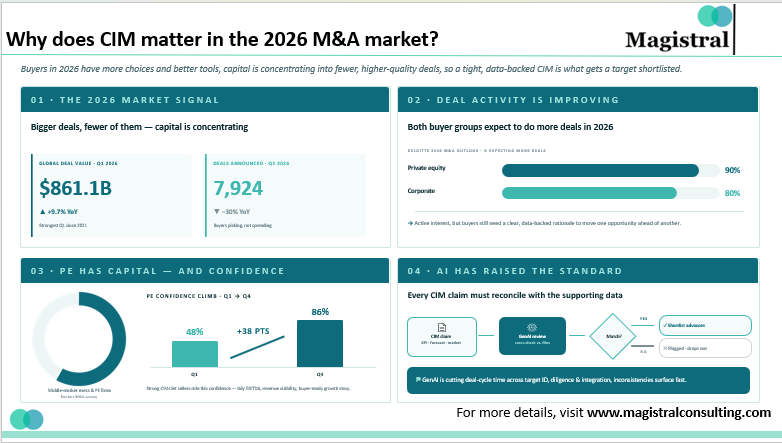
It matters because buyers in 2026 have more choices and, frankly, better tools. S&P Global said global M&A deal value hit $861.1 billion in Q1 2026, up 9.7% from Q1 2025, and it was the strongest first quarter since 2021. Still, only 7,924 deals were announced, down 30% year over year. That mix usually means buyers are concentrating capital into fewer, higher-quality transactions rather than spreading it around.
CIM

Why does CIM matter in the 2026 M&A market?

Deal activity is improving 

Deal activity is getting better in 2026, but the market is still picky. Deloitte reported that 90% of private equity respondents and 80% of corporate respondents expect their organizations to do more deals in 2026. That’s exactly why document quality stays important, because even with active interest, buyers still need a solid data-backed rationale for why one opportunity should jump ahead of another.

Private equity has capital to deploy 

Private equity has real capacity to deploy, but they stay disciplined. Reuters noted that 58% of surveyed middle market executives and private equity firms expect M&A volume to rise in 2026, while private equity confidence climbed to 86% in Q4 from 48% in Q1. Strong CIM preparation helps sellers support that confidence with tidy EBITDA discussion, revenue visibility, and a buyer-ready growth narrative.

AI has raised the standard

AI tools now help buyers review documents faster, compare claims with backup files, and identify inconsistencies. McKinsey’s 2026 M&A research says generative AI is helping deal teams reduce costs and accelerate deal cycles by improving target identification, due diligence, and integration workflows. This means every market claim, KPI, and forecast in the CIM must match the supporting data.

Key Sections Every CIM Should Include

A CIM should be comprehensive but also easy to steer through. The best docs kind of move in a clean path from the company story and market opening to financial performance and transaction readiness.

Executive Summary

Give a short overview of the business, investment highlights, growth potential, and the transaction rationale. Sum up key financial and operational strengths, so a reader gets the core idea fast.

Company Overview

Describe the business model, history, products, services, locations, and customer base. Keep the explanation clear and accessible to all buyers.

Ownership and Corporate Background

Outline the ownership structure, company evolution, and any significant acquisitions, restructurings, or leadership changes.

Market Overview

Cover market size, what’s driving growth, competitive dynamics, industry trends, and regulatory considerations, using data that’s credible and current.

Products and Services

Describe the offerings, how revenue is generated, and the key differentiators. Also, point out the things that support sustained growth and customer pull over time.

Customers and Revenue Quality

Show the strength and stability of revenue through customer diversification, retention rates, contract terms, and recurring business patterns.

Recurring Revenue

Clearly categorize recurring revenue sources such as subscriptions, service contracts, maintenance agreements, and repeat customer purchases.

Financial Performance

Present historical financial results, profitability metrics, cash flow performance, and projections. Link financial performance to valuation potential.

Management Team

Highlight the experience, capabilities, and organizational depth of the leadership team. Demonstrate the company’s ability to operate successfully after a transaction.

Founder Dependency

Address the extent of founder involvement and explain succession plans, leadership depth, and customer relationship transition strategies.

How does CIM quality affect valuation and diligence?

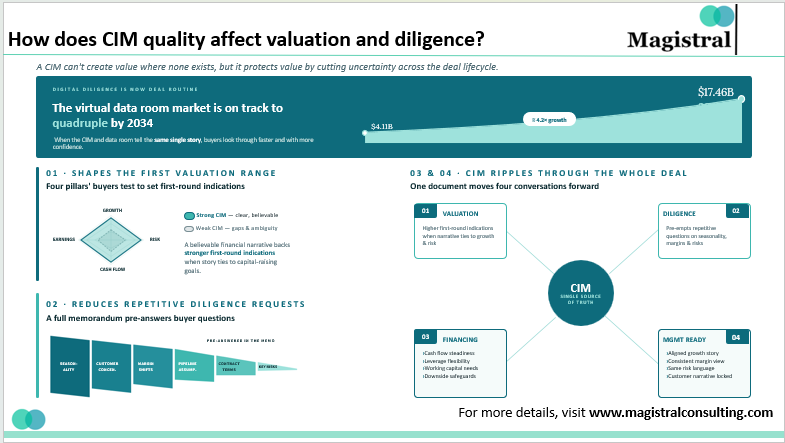
A CIM can’t really create value where none exists, but it can protect value by cutting down uncertainty. Fortune Business Insights estimates the global virtual data room market will grow from $4.11 billion in 2026 to $17.46 billion by 2034, and it kind of underlines how digital diligence has become part of the deal routine. When the CIM plus the data room tell the same, single-story buyers can look through things faster, with more confidence too.
CIM

How does CIM quality affect valuation and diligence?

It shapes the first valuation range

Buyers build early valuation ideas from growth, risk, earnings quality, and cash flow. A clear, believable document can back up stronger first-round indications, mainly when the financial narrative connects well to capital raising goals or specific transaction aims.

It reduces repetitive diligence requests

A full memorandum covers the typical questions before buyers even ask. It spells out seasonality, customer concentration, margin shifts, pipeline assumptions, contract language, and the key risks, and that usually saves time as well as improves buyer assurance.

It supports debt and financing conversations

Quite a few buyers need lenders involved to fund the acquisition, so the document should also reflect cash flow steadiness, leverage flexibility, working capital needs, and downside safeguards. A tight financial storyline makes the financing talk less messy and faster to move forward.

It prepares management for buyer meetings

Putting the memorandum together makes the leadership line up on the business story before any buyer meetings. That makes it easier for the team to answer questions in a consistent manner around growth direction, margins, risks, customers, and operational priorities.

How Magistral supports CIM preparation?

Magistral sort of supports deal teams in a messy but effective way, with market research, competitive analysis, financial modelling, and diligence prep. The group also helps craft buyer-driven CIMs, using things like market sizing, competitor mapping, revenue analysis, adjusted EBITDA schedules, and those “what if” financial scenario models.

On top of that, Magistral takes a hand with data room organization, diligence trackers, KPI reporting, customer write-ups, and management Q&A prep, like making sure people can answer clean. And because they tailor the materials for different investor types, it ends up improving buyer relevance, cutting down errors, reinforcing confidentiality, and getting the whole transaction more ready.

About Magistral Consulting

Magistral Consulting has helped multiple funds and companies in outsourcing operations activities. It has service offerings for Private Equity, Venture Capital, Family Offices, Investment Banks, Asset Managers, Hedge Funds, Financial Consultants, Real Estate, REITs, RE funds, Corporates, and Portfolio companies. Its functional expertise is around Deal origination, Deal Execution, Due Diligence, Financial Modelling, Portfolio Management, and Equity Research

For setting up an appointment with a Magistral representative visit www.magistralconsulting.com/contact

About the Author

Tanya is an investment-research specialist with 6 + years advising venture-capital, private-equity and lending clients worldwide. A Stanford Seed alumnus with an MBA and an Economics (Hons) degree, she heads project teams at Magistral Consulting, delivering financial modelling, due-diligence and deal support on 3,000 + mandates. Her blend of rigorous analytics, sharp project management and clear client communication turns complex data into actionable investment insight.

FAQs

What does CIM mean in M&A?

A Confidential Information Memorandum is a detailed sell side document shared with qualified buyers after they sign an NDA. It explains the company’s business model, financial performance, market position, management team, and growth plan.

Who prepares a Confidential Information Memorandum?

Investment bankers, M&A advisors, consultants, and company management usually prepare it together. Management provides the facts, while advisors shape the story, analysis, and buyer presentation.

How is it different from a teaser?

A teaser is short, anonymous, and shared before an NDA. The full memorandum is longer, confidential, and shared only after a buyer agrees to confidentiality terms.

Does the document include valuation?

Usually, it does not include an asking price. Sellers prefer buyers to submit their own valuation through a competitive process after reviewing the opportunity.

Why does the document matter more in 2026?

It matters more because deal activity is improving, buyers are using AI enabled review tools, and private capital remains available. A clear, data backed document helps sellers stand out and reduces uncertainty during early diligence.

CIM Outsourcing has evolved from a tactical support role into a strategic function. CIMs remain the foundation for fundraising, M&A, and deal marketing in private equity and venture capital. However, due to the amount of analyst time involved with creating CIMs in-house as well as the amount of time and management attention spent on creating these materials, deal volume levels have jumped back. Activity timelines have shortened for many investment management firms. There has subsequently been a rising trend towards using an external CIM Outsourcing provider to fulfil these functions. It allows the firm’s investment professionals to focus on what they do best. This helps in enabling the firm to use its limited resources better.

According to the 2024 Deloitte Private Markets Outlook report, more than half (58%) of mid-market investment management firms intend to increase their use of third-party providers to create programs to enhance the efficiency and reliability of their respective processes.

CIM Outsourcing in Modern Investment Workflows

It enables investment firms to delegate many aspects of CIM preparation to an outsourced firm. It helps in maintaining ultimate strategic oversight over these projects. Since 2021, the length of the Due Diligence timeline has increased by an average of 22%. Thus creating a need for most firms to outsource their CIM preparation to third-party specialists. CIM preparation is a time and labour-intensive process that falls outside the core competencies of the firm.

CIM Outsourcing in Modern Investment Workflows

CIM Outsourcing in Modern Investment Workflows

What does CIM Outsourcing Cover?

Outsourcing providers handle all aspects of CIM preparation, including financial models, market sizing and positioning, competitive analysis, and risk management. Providers often provide standardised formats for CIM preparation to facilitate consistency across multiple deals. Thereby providing a means of driving consistency across a portfolio of investment deals. Providers can also reduce the internal review cycles of most firms by an average of 30%.

Why Firms Are Reallocating CIM Work?

By outsourcing their firm’s CIM preparation, analysts can spend more time sourcing, placing valuations, and conducting negotiations. This allows firms to reduce analyst burnout, improve their workflow, and align their workflow with the trend of outsourcing. It can be done for all non-core document-intensive operations.

CIM Outsourcing as a Strategic Operating Model

It has evolved from being merely a way to augment capacity for firms into a strategic choice. Firms can make to increase Agility, Consistency, and Excellence in Execution. McKinsey & Company estimates that by the year 2026, more than 60 % of Investment Firms will have outsourced at least one of their Core Deal Support Functions. Outsourcing is at the heart of this transformation, allowing Firms to place their full attention on What Drives their Returns and to communicate clearly and credibly with Investors while providing them with compelling information.

CIM Outsourcing and Its Role in Fundraising Efficiency

CIM’s role as an outsourced service has a significant impact on the success of the fundraising process. Especially when it comes to sourcing capital for current and future projects within a crowded environment and differentiating yourself from other firms.

MSCI’s Capital Markets Outlook, published, when referring to “quality of investment documentation,” over 70% of institutional investor respondents stated that this attribute is one they use to influence their decisions to initially engage with early-stage investment opportunities. As such, leveraging a CIM that is professionally structured will positively impact the initial impression received in relation to your CIM and your firm and reduce the amount of back-and-forth discussion with respect to diligence processes.

Enhancing Investor Communication

Outsourced CIM teams are comprised of specialists who can translate complex operational or financial data. It is done into easily understood and professionally coherent investment narratives. Given the increased need for consistent communication concerning growth strategy development/implementation, scalability, and downside protection throughout the capital-raising process, the function of outsourced CIM teams is important.

In addition, for private equity and other alternative investment firms that are raising capital for multiple funds. They are having consistency in terms of CIM development will assist with your brand credibility. This is especially true when combined with the limited attention spans of the average investor and the large volume of deal flow in the marketplace.

Supporting Capital Raising Timelines

The companies that are actively raising funds usually must function under tight schedules based on market conditions or the need for liquidity from the portfolios. CIM Outsourcing allows for faster iterations and concurrent processing to stay updated on the information despite changes in assumptions.

According to Deloitte, companies that make use of outsourced documentation support can decrease the time taken to prepare for fundraising by as much as 18 to 25 percent.

Operational and Cost Benefits of CIM Outsourcing

CIM Outsourcing isn’t just about speed and quality; it’s also about quantifiable savings & improved efficiencies. Due to the need for senior management oversight and multiple rounds of editing and a high opportunity cost associated with using internal documentation teams. According to a 2024 operational benchmarking report on operations by CBRE, the cost of each transaction operated via an outsourced method has been reduced by 20% to 30% versus fully in-house methods.

Scalability Without Fixed Overhead

When firms use outsourcing, they can increase their documentation capability according to the number of transactions being processed. During times of cyclical growth, the ability to increase or decrease documentation resources will provide more flexibility for internal teams to manage peak work periods.

Accuracy and Risk Mitigation

CIM Outsourcing Companies provide numerous layers of review to ensure that they have reduced the likelihood of human error and inconsistencies. The efforts to produce quality work will help to mitigate risk to the firm’s reputation as well as increase investor confidence in the documents produced during the due diligence process.

How Firms Select the Right CIM Outsourcing Partner

When selecting the right partner for CIM outsourcing, cost is only one part of the equation. As such, leading businesses place a higher value on domain experience, the maturity of processes, and collaborative styles utilized by their outsourcing partners.

How Firms Select the Right CIM Outsourcing Partner

How Firms Select the Right CIM Outsourcing Partner

Domain Knowledge and Financial Fluency

To create an effective CIM that resonates with sophisticated investors, providers must be able to speak the specific metric types, valuation logic, and regulatory expectations of the companies in the sector they’re working with.

Process Transparency and Collaboration

For firms to gain maximum value from their outsourced partner’s experience, providers must operate with a level of transparency. It is through the use of clear workflows, version control and communication protocols. The provider should seamlessly integrate into the firm’s internal teams and existing operational structure.  These integrations provide a more efficient operation of both the outsourcing firm and the provider’s services.

Technology Enablement

Developing advanced solutions and utilizing rapidly developing technologies, including artificial intelligence, data validation, and secure collaboration tools, allows providers to enhance their ability to reduce turnaround time and ensure that your confidential information remains protected.

How Magistral Consulting Adds Value Through CIM Outsourcing

At Magistral Consulting, outsourcing is provided within the context of an overall investment support infrastructure. It is not just as an isolated offering. Magistral Consulting provides investment companies with the expertise and support needed for them to execute an investment with confidence.

There is significant experience in private markets for both teams of Magistral. They support CIM creation in a highly integrated manner with the valuation models, findings, and expectations of the investors.

In carrying out its role as an extension of the client teams, Magistral allows the investment firms to focus on strategy and capital allocation. It is by ensuring that the CIMs are investor-ready, data-driven, and executed at a professional level by being agile. Magistral also ensures that they are credible in a highly competitive deal environment.


About Magistral Consulting

Magistral Consulting has helped multiple funds and companies in outsourcing operations activities. It has service offerings for Private Equity, Venture Capital, Family Offices, Investment Banks, Asset Managers, Hedge Funds, Financial Consultants, Real Estate, REITs, RE funds, Corporates, and Portfolio companies. Its functional expertise is around Deal origination, Deal Execution, Due Diligence, Financial Modelling, Portfolio Management, and Equity Research

For setting up an appointment with a Magistral representative visit www.magistralconsulting.com/contact

About the Author

Aman is an investment-research specialist with 5+ years of experience across business and investment research, including 2+ years with Big Four firms like KPMG. A Stanford Seed alumnus with an MBA in Finance and a Bachelor of Commerce (Hons) from University of Delhi, he focuses on private equity, venture capital, and renewable energy sectors. He leads project teams at Magistral Consulting, delivering financial research, due diligence, deal sourcing, and M&A support, while driving strong process management and analytics. His blend of attention to detail, strategic thinking, and dynamic execution enables him to turn complex data into actionable investment insights.

FAQs

Which firms benefit most from CIM Outsourcing?

Private equity, venture capital, investment banking, and growth equity firms benefit most, particularly those managing multiple deals or fundraising cycles simultaneously.

Does outsourcing reduce control over deal narratives?

No. Firms retain strategic oversight while outsourcing execution tasks, allowing them to shape messaging without handling operational workload.

How does CIM Outsourcing impact deal timelines?

Industry data suggests that outsourcing can reduce documentation timelines by up to 25 percent, accelerating go-to-market and investor engagement.

Is CIM Outsourcing secure for sensitive information?

Reputable providers operate under strict confidentiality frameworks, secure data environments, and compliance protocols aligned with global standards.


Introduction

After experiencing a turbulent time, the Merger and Acquisition sector is finally exposed to some light in the market. With the increasing diversification among businesses, investors, strategic acquirers, and alike interest holders they are utilizing more of their consciousness to understand the position of their business in order to strategically analyze and highlight the strengths and weaknesses related to the collaboration aspect of the businesses. A confidential information memo unfolds both the qualitative and quantitative aspects of any potential deal for an investor or potential buyer, the summary structure of the document allows the interested ones to measure the level of excitement for the opportunity. With a non-legally binding feature, the document answers the obvious and gives details about the investment’s growth potential.

Current Scenario of Merger and Acquisition Market

Current Scenario of Merger and Acquisition Market

Essential Components of Confidential Information Memo: Aspects that Prospects Should Evaluate

The document is typically a compilation of various components along with some additional components such as intellectual property rights details, legal regulatory details, industry, and market knowledge, and more. From details like the number of employees to the number of customers along with customer growth rate and customer concentration to financial details like financial statements and projections along with legal details which highlight elements such as ownership structure and leases. A prospective buyer focuses on the following key elements to assess the potential risk and value of the business on offer:

Overview of the company

This portion of the document contains basic information about the history of the company, its place of headquarters its structure, products, and services along with the market size of the company. Apart from this confidential information memos also contain required financial details like revenue, EBITA, and net income of the company as well as customer details and employee details.

Executive Summary

It consists of a detailed summary of the entire document with at least the following information:

Key business offerings of the company

Summarized financial detail

The nature of the transactions the company deals in

Finally an investment rationale explaining why an investment is worthy for an investor.

This snapshot of the business clearly outlines a compelling overview of why the business is a valuable opportunity for a buyer and investor along with the vision, mission, and core values of the business. For small businesses, this section sets the stage for comprehension which makes the businesses an attractive target for acquisition.

Market Analysis

Based on reliable data sources like the World Bank, IDC, and others confidential information memos contain a creditable market analysis. This helps the investor and acquirer understand the strategy of the company to deal with the various elements of the market. The major information in this section is related to the growth trends in the market with the factors driving them. Ranking the targets based on which mapping of the competitors is done. This helps the decision-makers to read, analyze, and interpret the future situation of the company in the market.

Financial Performance

Confidential information memo provides details based on detailed financial statements. This includes, cashflow statements, income statements, and balance sheets typically of 4 to 5 years. It measures the key metrics like amount and number of cash flows, the growth rate of revenue, the overall profitability of the company. This section allows the interest holders to understand the financial health as well as the financial potential (based on its growth prospects). This is done by drawing a trend analysis based on the past data of the company.

Operational Details

This section gives overall details of the operational functioning of the company which broadly includes production processes (if the company has in-house manufacturing), procurement details, procured technologies, supply chain details, logistics details, and other facilities of the company. By highlighting these operational details confidential information memo explains the real operational strengths and potential weaknesses of the company which helps the interest holders to take calculative risks post-acquisition in the market.

Opportunities of Growth

To give insights into the growth opportunities of the company, this section of the confidential information memo outlines the important roadmap of how the company can be scaled and grown in the future. Certainly, this section includes the plans for expanding (can be vertical or horizontal), strategies to capitalize on emerging trends in the industry, and plans for introducing new products or services in the market, this clears the vision of the company to the buyer which helps the buyer to gain confidence on the business and trust it with its investment.

Risk Factors

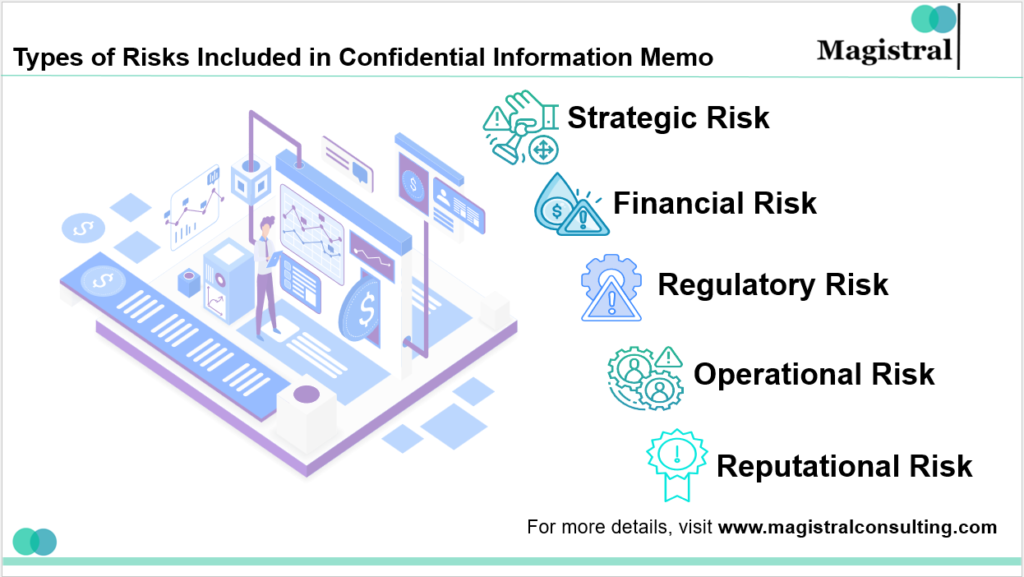
There is no business without risk, which makes it one of the most important aspects for an investor to study. This section of the document provides a clear picture of the existing as well as the potential challenges of the business. Confidential information memo considers both the internal as well as external risks to measure factors like market volatility, legal challenges, operational inefficiencies, and more to inform interested stakeholders about essential possibilities for informed decision-making about acquisition.

Types of Risks Included in Confidential Information Memo

Types of Risks Included in Confidential Information Memo

Legal Information

This legal information section explains the bottlenecks of legalities. This includes intellectual property rights, ongoing and expected litigations, compliance requirements, licenses, and permits related to business. The section holds more importance to small businesses than the large businesses in the market. This is due to more potential constructive legal structure. A study of all the risks in the confidential information memo allows the buyer to understand the crucial aspects of assessing the potential liabilities of the business.

Testimonials of Customers and Case Study

Towards the end, the document contains some relevant case studies and client testimonials as a sign of satisfied customers. Most of the confidential information memo contains this as it is evidence of growth for potential buyers and stakeholders. It also gives insights into the company’s value, effectiveness, and reputation. This is via the reviews shared by the clients themselves, it boosts confidence of the potential buyers in the market.

According to the report shared by PitchBook, Private Equity firms hold more than 27,000 portfolios of companies globally stating a sharp dip compared to the past years. With the evident steadiness in the market, one clear thing is the bounce back of Merger and Acquisition. Globally, corporates are moving towards Mergers and Acquisitions to accelerate growth and to reinvent their businesses to cope with AI. With the high demand for investments, AI is turning the way of the economy’s growth, and Mergers and Acquisitions are no exception. Confidential information memo allows investors to have a deeper look into the opportunities for investments.


Magistral’s services for Merger and Acquisition

With the help of its expertise and specialized resources Magistral measures and covers various aspects of the transaction process. The following are the most important services of Magistral for merger and acquisition:

Valuation Services

The expert analysts of Magistral follow a detailed performance and industry analysis to determine the fair value of the business.

Deal Origination

Magistral helps businesses to identify and secure new investment opportunities and business deals to expand their business by investing meticulously.

Deal Execution

Magistral focuses on comprehensive management of the deal processing and precisely streamlines the operations to ensure a successful deal completion.

Due Diligence

Magistral conducts a detailed analysis of all financial, operational, and legal aspects. Through this we ensure clients about the valuation and potential of the collaboration.

Risk Management

Magistral identifies existing and potential risks related to merger and acquisition which majorly include financial, market, and operational risks.

Regulatory and Compliance

Magistral ensures that the collaboration meets all the necessary regulatory compliances and requirements including antitrust filings and other documentation.


About Magistral Consulting

Magistral Consulting has helped multiple funds and companies in outsourcing operations activities. It has service offerings for Private Equity, Venture Capital, Family Offices, Investment Banks, Asset Managers, Hedge Funds, Financial Consultants, Real Estate, REITs, RE funds, Corporates, and Portfolio companies. Its functional expertise is around Deal origination, Deal Execution, Due Diligence, Financial Modelling, Portfolio Management, and Equity Research

For setting up an appointment with a Magistral representative visit www.magistralconsulting.com/contact

About the Author

The article is authored by the Marketing Department of Magistral Consulting. For any business inquiries, you can reach out to prabhash.choudhary@magistralconsulting.com

[sp_easyaccordion id=”3078″]

Introduction

An investment memorandum is a legal document that outlines a private placement investment’s goals, risks, and terms. This document includes financial statements, management biographies, a full explanation of the business activities, and other relevant information.

The purpose of an investment memorandum is to inform purchasers about the offering and protect sellers from the risks of selling unregistered securities. It is a document sent to potential investors. It is an essential business plan that skilled investors may use to do due diligence. Most issuers use these documents primarily to satisfy securities authorities’ obligations, as intelligent investors typically conduct substantial due diligence. However, offering memorandums is comparable to prospectuses—private placements rather than public offerings.

An investment banker often prepares an offering memorandum, also known as an investment memorandum, to explain a company’s capital requirements to potential investors. The banker utilizes the memorandum to hold an auction among a select group of investors to find the best deal.

Private equity firms sometimes seek to accelerate their growth without taking on debt or going public. If a manufacturing corporation, for example, wants to grow the number of facilities it owns, it can use an offering memorandum to fund the expansion. When this occurs, the company must first select how much money it wants to raise and at what price per share it will do so. In this case, the firm needs $100 million to fund its expansion for a $60 cost per share.

Importance of Investment Memorandum

An investor memorandum is significant since it explains if the company is a good or terrible investment. The memorandum serves as a business overview or a revised business strategy.

It allows a company to demonstrate its strengths and why it is a good investment.  Its significance extends beyond the fact that it is a required document in the investment process for sellers and investors. The document protocol aids the investor in comprehending the investment’s prospects, potential dangers, prospective returns, activities involved, and overall capital structure.

The offering memorandum protects the investor and the issuers of securities. The issuer must adhere to all SEC requirements to the letter (Securities and Exchange Commission). The Securities and Exchange Commission (SEC) promotes investor fairness by protecting investors in the securities sector from false information and assisting investors in making educated decisions when investing large sums of money.

The offering memorandum also gives the vendor a professional appearance. Investors avoid putting their money into companies that do not demonstrate strong organization or expertise in their field. Memos are a simple approach for stakeholders to generate opinions about a concept. This is especially true when discussing a memo with possible investors, but it also applies when utilizing a memo to make a product or strategy choice. If an investment memorandum is well-designed and complete, it may be an indirect marketing tool.

What is included in the Investment Memorandum?

Investor memorandums usually provide information on the company’s structure, financial risk and health, and other pertinent information. This information aids an investor in determining if the risk is acceptable in exchange for the business’s prospective profits. A typical memorandum has the following items:

Outline of Investment Memorandum

Outline of Investment Memorandum

Introduction

The initial pages of the offering document include a brief description of the firm, its principal operation, and all “legends” needed by federal and state securities regulations.

Summary of the Terms of the Offer

You should include the firm’s capitalization—both before and after the offering—in this section, typically in the form of a term sheet. You may also incorporate liquidation preferences, conversion rights, anti-dilution clauses, voting rights, and other investor protection provisions.

Factors at Risk

A PPM will list any risk factors that the issuer can think of that might affect the investor’s investment, including both generic risks that apply to comparable investments and risks specific to the issuer and its securities Concerns might include, for example, reliance on a strategic relationship, reliance on a limited number of individuals, or competitive risks.

Description of the Company and Management

This part offers the company’s history and discusses its goods and services, the industry, goals, competitors, advertising and marketing strategy, suppliers, intellectual property, client descriptions, and other essential information the investor could find helpful. Biographical information, specific abilities, and additional background information will be included in management information.

Use of Proceeds

A corporation must explain how it intends to use the net funds generated from the offering and the estimated amount anticipated for each purpose. This allows the investor to see how their money, as well as that of others, is being invested is used

Securities Description

The rights, limits, and class of securities being sold are described in this section. It should also indicate the company’s ability to adjust its capitalization through multiple shares and dividend distribution types.

Exhibits

Exhibits allow a business to present additional information and documents that may be relevant to an investor’s choice. You may include copies of investment contracts, financial statements, the issuer’s organizational documents, key agreements, licenses, and other documents as exhibits.

Tips for Writing a Perfect Investment Memorandum

You can prepare an investment memorandum by following key steps: keep it simple, create a clear layout, be transparent about risks, and include the investment terms. These points are discussed further below:

Writing tips for Investment Memorandum

Writing tips for Investment Memorandum

Make it simple to comprehend

Clarity is essential. It’s critical to take your time and speak in a manner investors can comprehend. Their primary objective is to grasp the possibility and develop a business plan. If you use jargon in your investment memoranda, you risk attracting the wrong attention. Keep things simple; don’t throw folks off by making things too complicated.

Optimize the layout

Include a summary of the firm and the market. You should include an overview of your products and services, analyze your competition, define your target audience, and present your financial model. Use graphs and charts to concisely communicate essential information while making your investment memorandum. More aesthetically appealing. This is very beneficial when dealing with financial data. Using a bar chart to share sales growth, for example, emphasizes how quickly you’ve expanded and is simpler to read than a standard table.

Be transparent and upfront about the risk

Nobody enjoys being surprised. As a result, rather than the fund discovering risks during due diligence, set them out in your investment memorandum early on.

Include the investment’s terms

Outlining the financial project’s goals is an intelligent thing to undertake. Determine if the funds will be utilized for expansion, acquisitions, or working capital.

Make sure your financials are in order

This is the most crucial aspect since it is the key to receiving high-level term sheet offers. You must supply a complete financial statement that contains the following information:

-Gross revenue

-Flows of funds

-Revenue

-Profit and Loss Statements

-EBITDA

-Margins

Use statistics from the previous two years and an estimate for the following five. This allows potential investors to run their numbers and see if you’re a reasonable risk. Be as specific as possible.

Why Magistral Consulting?

Magistral consulting prepared a Private Placement Memorandum for a large land parcel amid a mega-global city and successfully analyzed cash flows and returns from all scenarios. It also used to raise over 40 million USD worth of co-investments.

Investment Memorandums

Magistral consulting provides investment memorandum services for Funds, Properties, Farms, Luxury Hotels, Land Banks, Islands, Resorts, etc.

Analysis of Valuation

Using techniques such as comps, precedent transaction research, and leveraged buyout to determine the company’s fair market value.

Primary Research

Exploratory interviews with all stakeholders at Target Company, including management, workers, ex-employees, vendors, and investors, to identify any red signals.

Company Profile Data

We gather all the company-specific data and anticipate potential questions to ensure we complete the memo thoroughly.

Detailed Financial Analysis

We provide a complete financial review utilizing all essential characteristics from balance sheets to income statements.

About Magistral Consulting

Magistral Consulting has helped multiple funds and companies in outsourcing operations activities. It has service offerings for Private Equity, Venture Capital, Family OfficesInvestment BanksAsset Managers, Hedge Funds, Financial Consultants, Real Estate, REITs, RE fundsCorporates and Portfolio companies. Its functional expertise is in Deal originationDeal Execution, Due Diligence, Financial ModelingPortfolio Management and Equity Research.

For setting up an appointment with a Magistral representative visit www.magistralconsulting.com/contact

About the Author

The article is Authored by the Marketing Department of Magistral Consulting. For any business inquiries, you could reach out to prabhash.choudhary@magistralconsulting.com