Tag Archives: Confidential Information Memo

The private placement memorandum is one of the key documents of a private capital fundraising. It discloses details about the company and the offering itself. It covers such aspects as company overview, deal terms, risks, uses of proceeds, and the legal structure of the offering. For company management, fund managers, RE sponsors, and private market issuers, it may be viewed as a structured presentation of the investment opportunity. For investors, it may be considered a risk map.

According to the U.S. Securities and Exchange Commission (SEC), private placements offer a limited number of disclosures compared to registered offerings; therefore, investors should examine all the information before making investments. The good PPM cannot guarantee successful funding; however, it can make it easier by providing greater transparency, reducing false statements, and presenting investment opportunities in an organized manner.

What is a PPM in private capital raising?

It is a disclosure document utilized during private offerings. It presents the issuer and provides information necessary for evaluating the opportunity. Practically, it allows bringing together the issuer, management, counsel, and investors’ representatives for due diligence purposes.

Core meaning and purpose

Private placements are not public offerings. They are typically made to a select group of accredited investors. As per SEC rules, private offerings made under Rule 506(b) of Regulation D can offer an unlimited amount of money, must not use any form of general solicitation, may sell to any number of accredited investors, and can have up to 35 sophisticated non-accredited investors under the exemption’s requirements.

A PPM is often the document that combines all the disclosures, risk factors, and mechanics of the offering. This is why it is relevant. This is because it brings together all aspects of the transaction, such as risks involved, assumptions being made, deal structure, and conflict of interest. For instance, in a private equity fundraising process, this document helps Limited Partners understand how the money raised will be used.

Why investors ask for it

Prior to investing their funds, investors prefer transparency by seeking the company’s legal structure, the size of its offer, the minimum amount of investment, the experience of its management, financial projections, an exit strategy, and associated risks. Additionally, the SEC notes that private placements might include insufficient disclosures and restrictive securities, making the document’s accuracy more crucial. As such, an elaborate PPM provides investors with information required to evaluate risk, profit potential, liquidity, and corporate governance.

Where it fits in the fundraising process

The Private Placement Memorandum typically comes after teaser documents, pitch decks, and first interactions with the investors. The document will be used alongside subscription agreements, investor questionnaires, Form D, and other due diligence paperwork.

Why a PPM matters for issuers and investors

It helps minimize uncertainties. It does not eliminate business risks; rather, it exposes the risks, making it easier to communicate about the risks.
Why a PPM matters for issuers and investors

Why a PPM matters for issuers and investors

Compliance and disclosure discipline

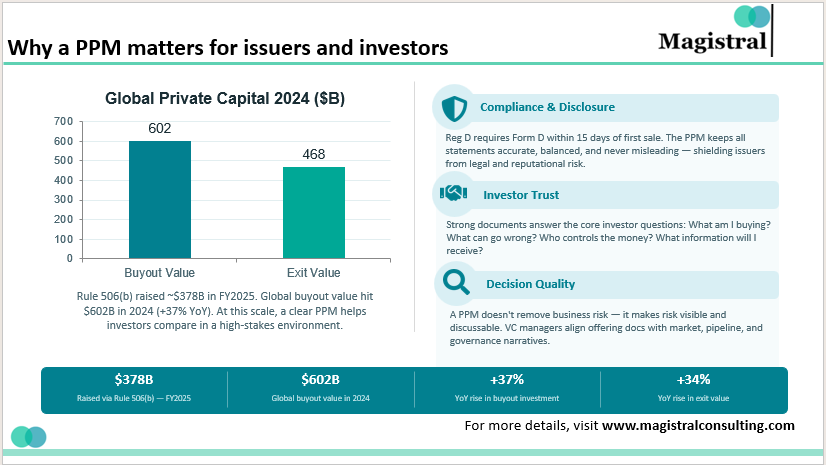
Under Regulation D, the issuance of securities requires the completion of Form D within 15 days of the first sale of securities. It may not be mandatory in some exemptions, yet issuances under this category are still required to observe the anti-fraud rules of business. This means that any information stated on the document should not only be accurate but also complete.

Market scale makes documentation more important

Today, private capital is no longer an anomaly within the capital markets. According to the SEC’s Office of the Advocate for Small Business Capital Formation, during the fiscal year 2025 reporting period, private companies had raised around $378 billion via Rule 506(b) private placements. In addition, Bain has stated that global buyout investment value jumped 37% year over year to $602 billion in 2024, while the exit value was 34% higher at $468 billion. When dealing with a market of such magnitude, having a good PPM is important since people will have to choose between competing offerings.

Investor trust and decision quality

The right documents enable investors to compare offers. Even venture funds, real estate syndications, and credit vehicles might differ greatly, but investors’ concerns remain the same: What do I get? What risks do I face? Who manages the cash flow? What information will be provided to me afterwards? That is one of the reasons why venture capital managers try to coordinate their documents with comprehensive market, pipeline, and governance narratives.

What a PPM usually includes

A PPM is where legal, commercial, financial, and operational matters are packaged together in one document. The format will depend on the issuer, jurisdiction, exempt status, and asset class.

Offering terms

This chapter will describe the kind of security issued, the size of the offering, minimum amount, investor qualifications, closing conditions, transfer restrictions, and subscriptions. It needs to be clear enough for non-lawyers but specific enough for lawyers.

Business and investment strategy

Here, the issuer explains its plan for creating value. In the case of an operating company, this could include product development, hiring, acquiring customers, and increasing margins. In the case of a fund, it could involve sourcing investments, portfolio construction, decision making by the investment committee, and exits.

Risk factors

The risk factors discussion need not read like standard legalese. Rather, the risks should be relevant to the particular business. A fund focused on a specific sector will have different risks than a diversified portfolio. These days, a comprehensive private placement memorandum discusses liquidity risks, valuation approach, cyber vulnerability, key man risks, leverage, concentration caps, and macroeconomic concerns. The stronger the risk disclosure, the clearer it will be to investors what could hurt performance and how management will respond.

Financials and valuation assumptions

A financial discussion may include historical results, financial projections, capital structure, use of funds, and sensitivity analysis. If assumptions are material, sponsors should highlight them. Good valuation documentation will help investors know if revenues, margins, leverage, multiples, or exits drive expected returns.

How to prepare a PPM that investors can use

A PPM should never appear to be a legal text attached to a marketing presentation. Instead, it should anticipate investors’ concerns before those turn into objections.
How to prepare a PPM that investors can use

How to prepare a PPM that investors can use

Start with the investor lens

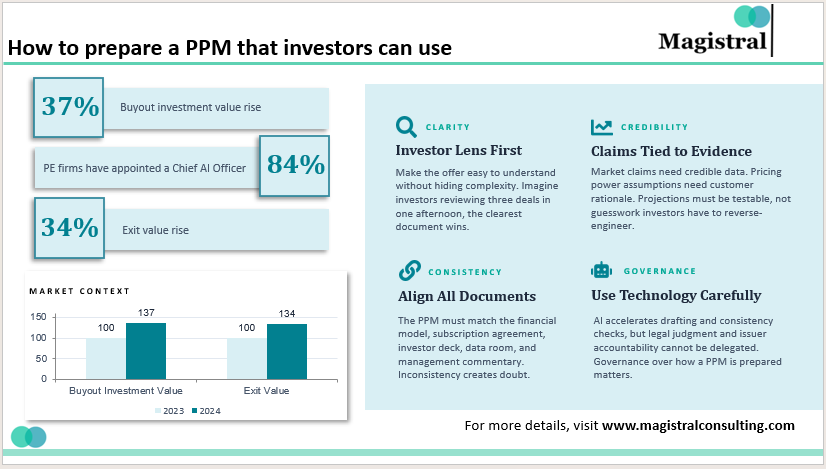
Suppose an investor evaluates three offers within one afternoon. The best way would be to explain the offer comprehensively, while making sure that there is no ambiguity about the story, its economics, risks, and the systems controlling the process.

Keep claims tied to evidence

If you mention a growing market, provide proof. If you claim that your company has an edge in the sourcing process, explain how that works. If financial projections rely on pricing power, describe the reasons why customers will be ready to pay extra money for your products or services. Bain’s 2025 Private Equity Outlook reported that the value of the investments made in the year of 2024 grew by 37%, and the value of the exits grew by 34%. However, the study also noted that fundraising was weak in such unstable markets and advised issuers against making unrealistic assumptions.

Align legal, finance, and operations

The document needs to align with the model, subscription agreement, investor presentations, data room, and management commentary. Discrepancies raise suspicions. Most issuers also link the PPM with the investor reporting process, due diligence, and fund administration prior to launching the product.

Use technology carefully

AI can aid drafting, research, and consistency, but it does not replace human judgment or legal responsibility. As an example, EY found that 84% of private equity funds believed that AI would have a major transformational effect on their business. This is relevant as expectations about how data is managed, processed, and provided for diligence purposes increase significantly.

How Magistral supports PPM preparation and investor readiness

Magistral’s contributions to preparing a successful PPM and making investors ready
It becomes even more valuable when backed up with proper research, clean financials, and an organized investor communication process. Issuers and fundraisers can turn to Magistral Consulting for assistance in conducting research, building financial models, drafting documents, and preparing investor-related materials. All of these services will make it more effective by bringing consistency to its narrative, numbers, and due diligence materials.

Research and market benchmarking

Helping a team create market research, competitor analysis, trends and investor-ready narratives is particularly important when a raise relies on an established thesis about, say, healthcare growth, artificial intelligence infrastructure, fintech development or regional expansion.

Financial model and data room support

An investor never looks only at a document itself. He always requests additional information like models, cap tables, diligence files, and other schedules. Magistral’s investment banking experience helps issuers put all of those pieces together.

Investor communication readiness

Effective documents minimize iterations. Investors need to see enough details to move from the stage of interest to diligence. Effective PPM, backed by accurate data and consistent messaging, may be used by sponsors to secure funding.


About Magistral Consulting

Magistral Consulting has helped multiple funds and companies in outsourcing operations activities. It has service offerings for Private Equity, Venture Capital, Family Offices, Investment Banks, Asset Managers, Hedge Funds, Financial Consultants, Real Estate, REITs, RE funds, Corporates, and Portfolio companies. Its functional expertise is around Deal origination, Deal Execution, Due Diligence, Financial Modelling, Portfolio Management, and Equity Research

For setting up an appointment with a Magistral representative visit www.magistralconsulting.com/contact

About the Author

Tanya is an investment-research specialist with 6 + years advising venture-capital, private-equity and lending clients worldwide. A Stanford Seed alumnus with an MBA and an Economics (Hons) degree, she heads project teams at Magistral Consulting, delivering financial modelling, due-diligence and deal support on 3,000 + mandates. Her blend of rigorous analytics, sharp project management and clear client communication turns complex data into actionable investment insight.


FAQs

What is the main purpose of this document?

It gives private investors structured information about the issuer, the offering terms, financial assumptions, risks, and legal framework.

Is it legally required for every private placement?

Not always, but issuers must still follow securities laws, disclosure duties, anti-fraud rules, and applicable filing requirements.

Who prepares it?

Usually, counsel leads the legal drafting, while management, finance teams, advisors, and consultants support business, market, and financial sections.

How is it different from a pitch deck?

A pitch deck sells the story. This document explains the full investment, including risks, terms, conflicts, restrictions, and disclosures.

Can investors rely only on it?

No. Investors should also review financial models, legal documents, diligence materials, management responses, and independent professional advice.


A CIM, or Confidential Information Memorandum, is one of those documents that kind of becomes the backbone of a sell-side M&A process. In 2026, it matters even more because buyers are moving faster, using AI-enabled review tools, and they expect clearer financial and market evidence before they even submit bids. With global M&A activity picking up again and dealmakers expecting higher transaction volume, sellers need a piece of writing that clearly lays out the business, supports the valuation narrative, and builds buyer trust with the first read, not after several rounds of questions.

What is a CIM in 2026?

It is a confidential document shared with selected buyers after they sign an NDA. It gives them a structured view of the company, the business model, the financial results, the competitive position, the risks, and the growth outlook, so they can decide whether to stay in the process or step back.

Meaning of a Confidential Information Memorandum

A Confidential Information Memorandum basically presents the company’s story in a professional, buyer-ready format. It covers what the company does, how revenue is generated, where it competes, who runs the operation, and why this opportunity deserves attention, without overcomplicating it.

Why buyers rely on it

Buyers rely on the document because it helps them determine if the opportunity matches their investment criteria. In a busy 2026 M&A market, investors want quick clarity on size, growth, profitability, customer strength, and strategic alignment, before they spend time on deeper diligence.

What the document should not do

The memorandum should not dump every sensitive detail or include unrestricted confidential information. It should also avoid stating a fixed asking price, since sellers often want buyers to build their own valuation through a competitive bidding process, instead of locking everyone into one number too early.

A practical way to think about it

Think of it like a kind of guided tour, before the full inspection. The seller walks the buyer through the company’s overall layout, strengths, performance, and likely growth path, but keeps the more detailed papers for later diligence stages. So, it’s not, like, everything up front. More of a careful preview.

Why does CIM matter in the 2026 M&A market? 

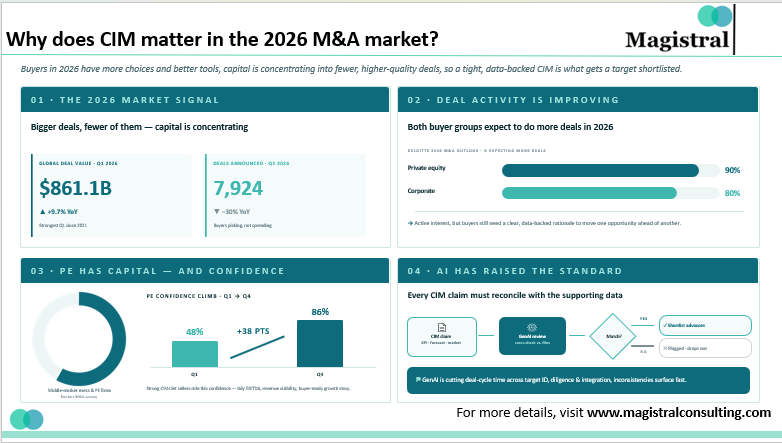
It matters because buyers in 2026 have more choices and, frankly, better tools. S&P Global said global M&A deal value hit $861.1 billion in Q1 2026, up 9.7% from Q1 2025, and it was the strongest first quarter since 2021. Still, only 7,924 deals were announced, down 30% year over year. That mix usually means buyers are concentrating capital into fewer, higher-quality transactions rather than spreading it around.

CIM

Why does CIM matter in the 2026 M&A market?

Deal activity is improving 

Deal activity is getting better in 2026, but the market is still picky. Deloitte reported that 90% of private equity respondents and 80% of corporate respondents expect their organizations to do more deals in 2026. That’s exactly why document quality stays important, because even with active interest, buyers still need a solid data-backed rationale for why one opportunity should jump ahead of another.

Private equity has capital to deploy 

Private equity has real capacity to deploy, but they stay disciplined. Reuters noted that 58% of surveyed middle market executives and private equity firms expect M&A volume to rise in 2026, while private equity confidence climbed to 86% in Q4 from 48% in Q1. Strong CIM preparation helps sellers support that confidence with tidy EBITDA discussion, revenue visibility, and a buyer-ready growth narrative.

AI has raised the standard

AI tools now help buyers review documents faster, compare claims with backup files, and identify inconsistencies. McKinsey’s 2026 M&A research says generative AI is helping deal teams reduce costs and accelerate deal cycles by improving target identification, due diligence, and integration workflows. This means every market claim, KPI, and forecast in the CIM must match the supporting data.

Key Sections Every CIM Should Include

A CIM should be comprehensive but also easy to steer through. The best docs kind of move in a clean path from the company story and market opening to financial performance and transaction readiness.

Executive Summary

Give a short overview of the business, investment highlights, growth potential, and the transaction rationale. Sum up key financial and operational strengths, so a reader gets the core idea fast.

Company Overview

Describe the business model, history, products, services, locations, and customer base. Keep the explanation clear and accessible to all buyers.

Ownership and Corporate Background

Outline the ownership structure, company evolution, and any significant acquisitions, restructurings, or leadership changes.

Market Overview

Cover market size, what’s driving growth, competitive dynamics, industry trends, and regulatory considerations, using data that’s credible and current.

Products and Services

Describe the offerings, how revenue is generated, and the key differentiators. Also, point out the things that support sustained growth and customer pull over time.

Customers and Revenue Quality

Show the strength and stability of revenue through customer diversification, retention rates, contract terms, and recurring business patterns.

Recurring Revenue

Clearly categorize recurring revenue sources such as subscriptions, service contracts, maintenance agreements, and repeat customer purchases.

Financial Performance

Present historical financial results, profitability metrics, cash flow performance, and projections. Link financial performance to valuation potential.

Management Team

Highlight the experience, capabilities, and organizational depth of the leadership team. Demonstrate the company’s ability to operate successfully after a transaction.

Founder Dependency

Address the extent of founder involvement and explain succession plans, leadership depth, and customer relationship transition strategies.

How does CIM quality affect valuation and diligence?

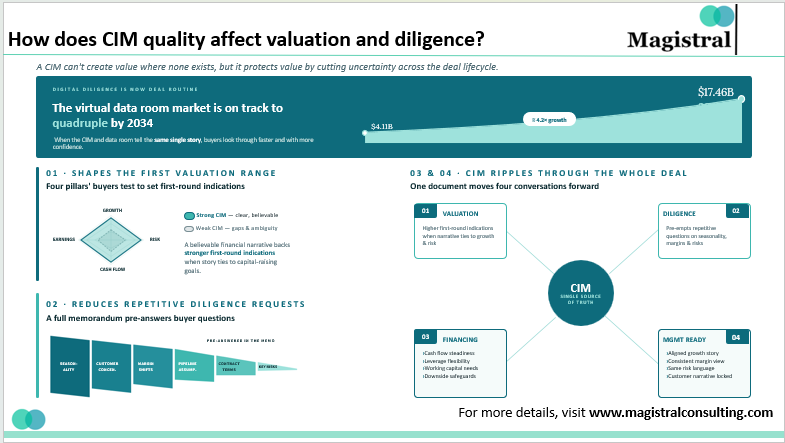
A CIM can’t really create value where none exists, but it can protect value by cutting down uncertainty. Fortune Business Insights estimates the global virtual data room market will grow from $4.11 billion in 2026 to $17.46 billion by 2034, and it kind of underlines how digital diligence has become part of the deal routine. When the CIM plus the data room tell the same, single-story buyers can look through things faster, with more confidence too.

CIM

How does CIM quality affect valuation and diligence?

It shapes the first valuation range

Buyers build early valuation ideas from growth, risk, earnings quality, and cash flow. A clear, believable document can back up stronger first-round indications, mainly when the financial narrative connects well to capital raising goals or specific transaction aims.

It reduces repetitive diligence requests

A full memorandum covers the typical questions before buyers even ask. It spells out seasonality, customer concentration, margin shifts, pipeline assumptions, contract language, and the key risks, and that usually saves time as well as improves buyer assurance.

It supports debt and financing conversations

Quite a few buyers need lenders involved to fund the acquisition, so the document should also reflect cash flow steadiness, leverage flexibility, working capital needs, and downside safeguards. A tight financial storyline makes the financing talk less messy and faster to move forward.

It prepares management for buyer meetings

Putting the memorandum together makes the leadership line up on the business story before any buyer meetings. That makes it easier for the team to answer questions in a consistent manner around growth direction, margins, risks, customers, and operational priorities.

How Magistral supports CIM preparation?

Magistral sort of supports deal teams in a messy but effective way, with market research, competitive analysis, financial modelling, and diligence prep. The group also helps craft buyer-driven CIMs, using things like market sizing, competitor mapping, revenue analysis, adjusted EBITDA schedules, and those “what if” financial scenario models.

On top of that, Magistral takes a hand with data room organization, diligence trackers, KPI reporting, customer write-ups, and management Q&A prep, like making sure people can answer clean. And because they tailor the materials for different investor types, it ends up improving buyer relevance, cutting down errors, reinforcing confidentiality, and getting the whole transaction more ready.

About Magistral Consulting

Magistral Consulting has helped multiple funds and companies in outsourcing operations activities. It has service offerings for Private Equity, Venture Capital, Family Offices, Investment Banks, Asset Managers, Hedge Funds, Financial Consultants, Real Estate, REITs, RE funds, Corporates, and Portfolio companies. Its functional expertise is around Deal origination, Deal Execution, Due Diligence, Financial Modelling, Portfolio Management, and Equity Research

For setting up an appointment with a Magistral representative visit www.magistralconsulting.com/contact

About the Author

Tanya is an investment-research specialist with 6 + years advising venture-capital, private-equity and lending clients worldwide. A Stanford Seed alumnus with an MBA and an Economics (Hons) degree, she heads project teams at Magistral Consulting, delivering financial modelling, due-diligence and deal support on 3,000 + mandates. Her blend of rigorous analytics, sharp project management and clear client communication turns complex data into actionable investment insight.

FAQs

What does CIM mean in M&A?

A Confidential Information Memorandum is a detailed sell side document shared with qualified buyers after they sign an NDA. It explains the company’s business model, financial performance, market position, management team, and growth plan.

Who prepares a Confidential Information Memorandum?

Investment bankers, M&A advisors, consultants, and company management usually prepare it together. Management provides the facts, while advisors shape the story, analysis, and buyer presentation.

How is it different from a teaser?

A teaser is short, anonymous, and shared before an NDA. The full memorandum is longer, confidential, and shared only after a buyer agrees to confidentiality terms.

Does the document include valuation?

Usually, it does not include an asking price. Sellers prefer buyers to submit their own valuation through a competitive process after reviewing the opportunity.

Why does the document matter more in 2026?

It matters more because deal activity is improving, buyers are using AI enabled review tools, and private capital remains available. A clear, data backed document helps sellers stand out and reduces uncertainty during early diligence.

The Confidential Information Memo has come to be recognized as an important tool in deal-making in the context of the increasingly competitive and data-driven deal environment. The global M&A deal environment has consistently maintained deal volumes above $3 trillion in the most recent deal cycles. Private capital fundraising cycles have also been significantly lengthened. Preqin reports that the average fundraising period now exceeds 18-20 months. This contrasts with the nearly 12-14 months seen in the preceding deal environment. The lengthened fundraising period has put additional emphasis on maintaining investor engagement.

At the same time, the investor landscape has seen changes in the way in which investors seek to analytically validate the deal and respond in increasingly rapid manners. Deloitte reports that over 70% of investors now seek more in-depth due diligence materials before proceeding to advanced deal stages. In this context, the Confidential Information Memo is no longer just a tool but rather a process that can be used to improve investor conversion and deal closure.

The Confidential Information Memo and Deal Funnel Efficiency

The Confidential Information Memo is central in the context of the efficiency with which deals can move through the investor funnel.

The Confidential Information Memo and Deal Funnel Efficiency

The Confidential Information Memo and Deal Funnel Efficiency

Impact on investor conversion rates

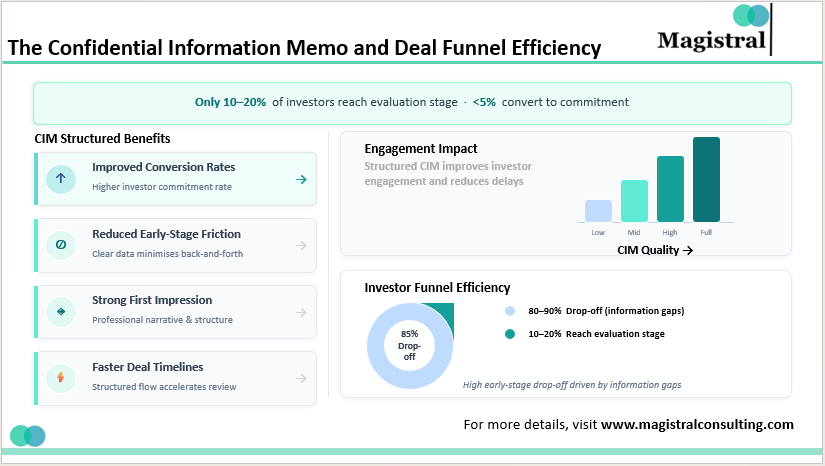
The investor funnel is one that sees high levels of drop-off at the early stages. Industry averages indicate that only 10-20% of the initial investor outreach ultimately make it to the advanced evaluation stages. In turn, fewer than 5% of these investors ultimately make it to the final stage.

Reduction of Inefficiency in Early-Stage Friction

When there are deficiencies or inconsistencies in information, there are always delays as further follow-ups are required. In addition, this may result in a lower number of investors showing interest. A well-prepared Confidential Information Memo helps avoid such inefficiency and results in a better deal flow.

Influence on First-Round Engagement Decisions

Investors make decisions within the first round of reviewing deal materials. A well-structured document that presents business, financial, and growth information helps investors progress to the next step, i.e., management discussions.

Compression of Deal Timelines

Fundraising processes are taking longer than 18 months. Therefore, it becomes imperative to reduce inefficiency. A well-prepared Confidential Information Memo helps investors compress deal evaluation timelines in the early stages.

Confidential Information Memo and Data Depth Requirements

There are significant changes in investor requirements, and they are looking for deeper analytical rigor. Therefore, the quality and structure of the data are becoming important aspects of deal materials.

Confidential Information Memo and Data Depth Requirements

Confidential Information Memo and Data Depth Requirements

Demand for More Detailed Financial Metrics

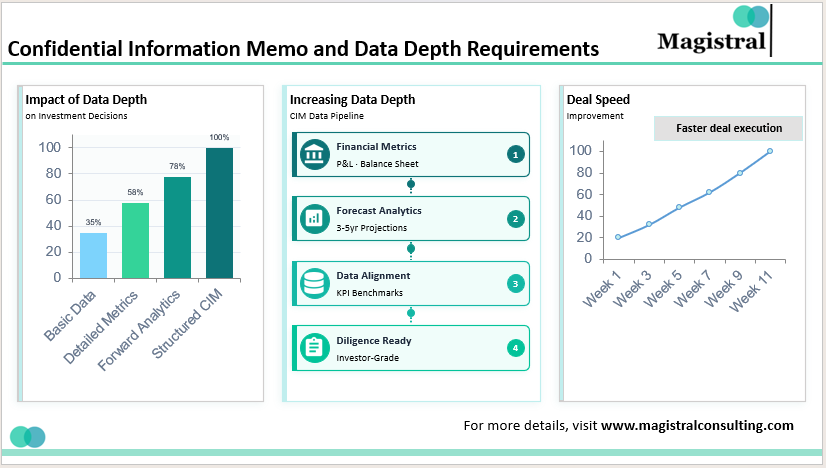
Today, investors are seeking in-depth information on financial measures. According to McKinsey & Company, organizations that are using data-driven insights can improve the accuracy of their investment decisions by as much as 20-30%.

Shift toward Forward-Looking Analytics

Past performance does not suffice as a criterion for evaluating a deal. Investors are looking for information that helps them understand growth and potential risks. Therefore, sensitivity analysis can be included in the Confidential Information Memo.

Consistency of Financial and Operating Data

There are often inconsistencies in financial and operating data. A well-structured Confidential Information Memo helps investors trust the information presented.

Alignment with due diligence processes

A well-structured and organized Confidential Information Memo can greatly assist in reducing due diligence processes. This can help in moving through due diligence processes faster.

Confidential Information Memo and Competitive Positioning

With capital concentration being limited to fewer deals, differentiation is key in getting attention from potential investors.

Capital concentration trends

The market is witnessing an upward trend in capital concentration in top-performing deals. According to Bain & Company, fewer deals are attracting more capital, resulting in an increase in competition among deals.

Importance of narrative clarity

Having a strong investment narrative with data support can greatly assist in positioning. In addition, investment opportunities are also evaluated based on how clear and concise the narrative is.

Role in shaping investor perception

The Confidential Information Memo is also considered an opportunity for investors to gain in-depth knowledge of the business. Therefore, its structure, clarity, and data support can greatly contribute to shaping investor perception.

Consistency between narrative and data

The Confidential Information Memo can also greatly assist in ensuring consistency in data analysis. Inconsistency in data analysis can greatly contribute to undermining investor confidence.

Confidential Information Memo and Its Impact on Valuation Outcomes

The Confidential Information Memo plays an important role in valuation outcomes. Its quality can greatly contribute to better valuation outcomes.

Improved investor confidence and participation

Having a well-structured and organized Confidential Information Memo can greatly contribute to building confidence among investors. Improved confidence among investors can greatly contribute to creating a competitive environment.

Creation of competitive bidding environments

Having an excellent Confidential Information Memo can greatly contribute to creating competitive environments. A competitive environment can greatly contribute to achieving better valuation outcomes.

Reduction in perceived risk

The availability of financial information and transparent assumptions can significantly reduce the perceived risk, which can, in turn, increase the valuation multiples.

Acceleration towards binding offers

The use of efficient communication can significantly reduce the gap between various stages, thus accelerating the process towards making binding offers.

Confidential Information Memo and Operational Challenges

The significance of the Confidential Information Memo notwithstanding, several operational challenges make it difficult to prepare a quality Confidential Information Memo.

Fragmentation of data sources

Data on financial, operational, and market performance is often scattered in various systems, which can result in inconsistencies in the consolidated financial information.

Time constraints in deal execution

The deal execution process is generally short, which can result in a high probability of errors in validation or incomplete information.

Balancing detail with readability

While excessive detail can make the Confidential Information Memo difficult to read, a lack of detail can undermine the credibility of the information provided.

Coordination of various stakeholders

The preparation of the Confidential Information Memo involves coordination with various teams, including finance, strategy, and investment bankers. Misalignment of various stakeholders can result in inconsistencies.

Confidential Information Memo and Structured Execution Framework

For companies that use a structured approach, the Confidential Information Memo can have a significant impact.

Standardization of templates and formats

The use of standardized templates can significantly reduce the effort in preparing the Confidential Information Memo, making it easier to read.

Centralized data management systems

The use of a single source of truth can significantly improve the accuracy of the information provided in the Confidential Information Memo, thus reducing inconsistencies.

Integration with digital deal tools

The use of digital tools such as data rooms, CRM, and analytics can significantly improve the coordination of various teams, thus enabling better tracking of interactions with various investors.

Iterative refinement based on investor feedback

Continuous improvement through investor queries and feedback helps in improving the quality and engagement of the document over time.

Alignment with overall deal strategy

Confidential Information Memo should be aligned with the overall deal strategy in order to ensure consistency in all channels and mediums of communication.

About Magistral Consulting

Magistral Consulting has helped multiple funds and companies in outsourcing operations activities. It has service offerings for Private Equity, Venture Capital, Family Offices, Investment Banks, Asset Managers, Hedge Funds, Financial Consultants, Real Estate, REITs, RE funds, Corporates, and Portfolio companies. Its functional expertise is around Deal origination, Deal Execution, Due Diligence, Financial Modelling, Portfolio Management, and Equity Research

For setting up an appointment with a Magistral representative visit www.magistralconsulting.com/contact

About the Author

Tanya is an investment-research specialist with 6 + years advising venture-capital, private-equity and lending clients worldwide. A Stanford Seed alumnus with an MBA and an Economics (Hons) degree, she heads project teams at Magistral Consulting, delivering financial modelling, due-diligence and deal support on 3,000 + mandates. Her blend of rigorous analytics, sharp project management and clear client communication turns complex data into actionable investment insight.

FAQs

What is a Confidential Information Memo?

A Confidential Information Memo is an in-depth document that is part of transactional processes and is used to present information about a company’s business, financials, and investment thesis to potential investors.

Why is it important in deal processes?

It is used as a key tool for investor evaluation and plays an important role in terms of engagement and the overall deal process.

How does it impact valuation?

A well-structured document helps in generating greater investor confidence and improves overall valuation for companies.

What data should be included?

It should include financial performance, projections, market information, and operational information.

What are the common challenges in preparation?

Common challenges include data inconsistency, time constraints, and balancing information and clarity.