Tag Archives: CIM Outsourcing

Though fundraising documents may seem alike from afar, the investor uses each of them differently in a fundraising deal. The pitch deck starts the discussion, the CIM builds the business and financial case, and the PPM supports the legal documentation during private offerings. This is why it is essential to distinguish between pitch deck vs CIM vs PPM prior to approaching any angel investor, venture capital fund, family office, or institutional buyer. With an increasing number of investors in any market, it is crucial to use the right fundraising tool; otherwise, negotiations will drag on, confusion will arise, and the level of credibility of the company in question will suffer greatly.

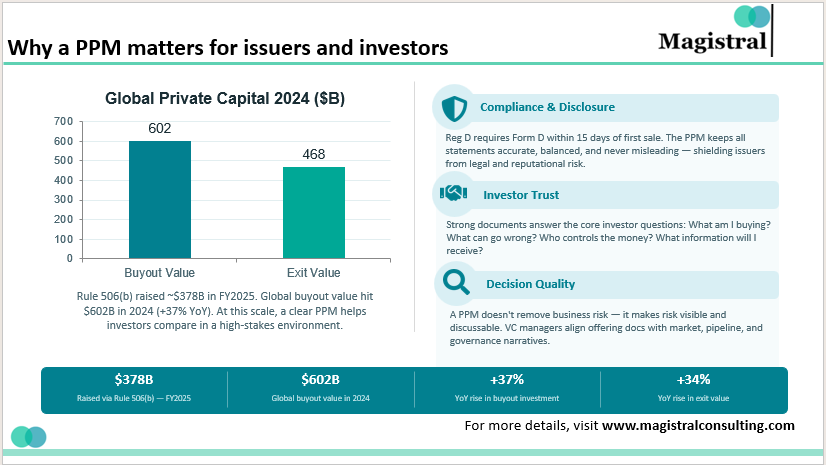
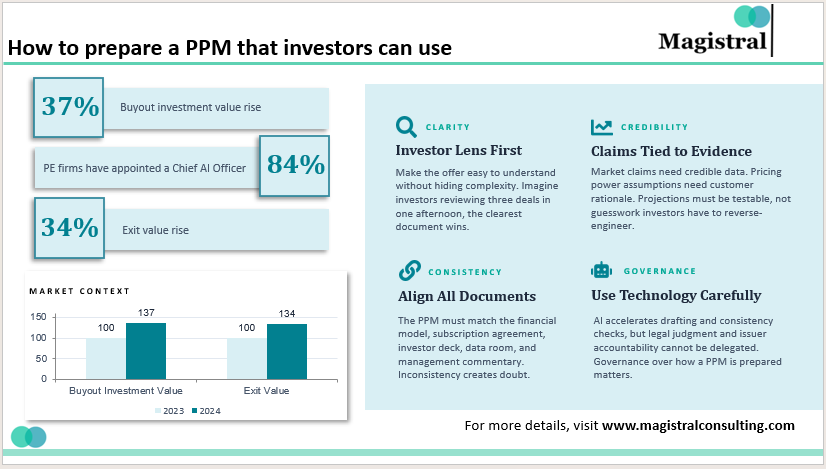
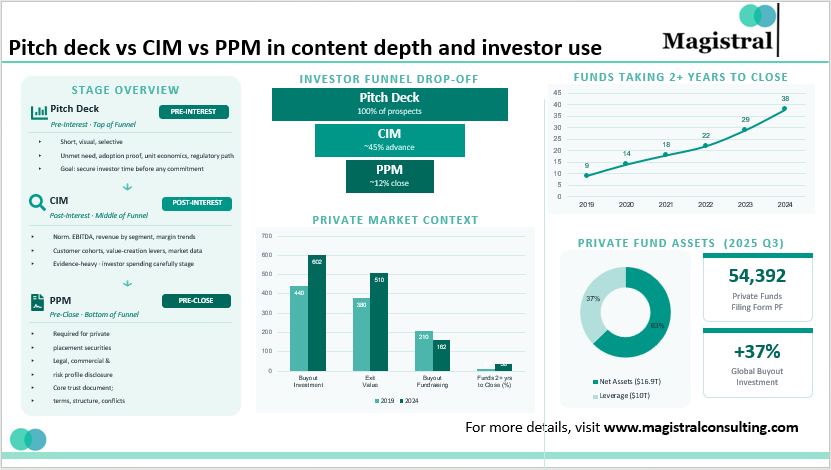
According to recent figures, global buyout investment increased by 37%, while exit value increased by 34% in 2024. Nevertheless, despite positive dynamics, the amount of global buyout fundraising decreased by 23% that year. In turn, startup fundraising on leading private marketplaces reached approximately 120 billion dollars in 2025, growing 17% annually; however, the overall number of rounds dropped to a six-year low. In practical terms, understanding pitch deck vs CIM vs PPM helps founders choose the right document at the right point in the process.

Pitch deck vs CIM vs PPM for fundraising purposes

The key difference lies in the requirements of the investors for the various stages of the financing process. While a pitch deck contains a concise and visual description of a business idea, the company’s progress towards achieving its goals, market potential, traction, business model, and capital requirements, it should attract investors’ attention within several minutes. A CIM, which stands for Confidential Information Memorandum, presents investors with a deeper analysis of the company in terms of its financial standing, sources of income, operations, market situation, concentration of customers, business growth, and rationale behind the sale. Thus, it is located somewhere between the preliminary meeting and the due diligence process.

And lastly, the PPM, or Private Placement Memorandum, is a formal document required for a private placement offering. Unlike a pitch deck and a CIM, the primary purpose of this document is to disclose certain details regarding the conditions, risks, fees, and suitability of the investors. A clear view of pitch deck vs CIM vs PPM makes it easier to match the material to the investor’s expectations.

Pitch deck vs CIM vs PPM in content depth and investor use

It is important to recognize that the difference between these documents lies not only in their length but also in how investors use them. In other words, documents would become easier to organize when each one of the documents is used for its corresponding stage of the financing funnel.

Pitch deck vs CIM vs PPM in content depth and investor use

Pitch deck vs CIM vs PPM in content depth and investor use

When investors read a pitch deck

Before an investor makes the decision to spend his or her time on further evaluation, he or she looks at the pitch deck. This document should be short, visual, and targeted. The fact that it tries to provide all information in detail is contrary to the purpose of this document.
For example, consider a founder of a health-tech startup raising Series A funds. The investor needs information about the unmet need, adoption proof, unit economics, regulatory pathway, and reasons why the current round helps grow the business fast. He or she doesn’t need the whole paragraph about legal risks. This is one of the clearest examples of pitch deck vs CIM vs PPM in practice.

When investors request a CIM

This kind of CIM should contain EBITDA, revenues per segment, margin evolution, market growth, customer cohorts, advantages, and value creation. This is critical since investors are being prudent with their resources. For instance, in 2024, the amount of investments for buyouts across the world grew by 37% to reach almost 602 billion dollars, while the amount of exit value climbed 34%, but buyout fundraising dropped 23% across the globe. The second observation by Bain & Company was that the number of funds that took two years or even more to be finalized went up to 38% compared to 9% back in 2019.

In simple words, there is an improvement in deals faster than the improvement in fundraising, meaning that managers require better materials. In this stage, documents becomes especially relevant because investors now expect more depth and diligence support. reference

When a PPM becomes necessary

PPM is needed when there is an offer to buy and sell securities through the private placement of such securities. It provides a detailed description to help informed investors evaluate the offer.

The extent of the market of private placements also highlights the importance of good-quality disclosure. According to the statistics for Q3 2025, 54,392 private funds have reported on their investments using Form PF. These private funds hold $16.9 trillion worth of net assets and $26.9 trillion worth of gross assets. At such a magnitude of private placements, the PPM is an important document for evaluating the deal. This is why one should consider a PPM as opposed to pitch decks or CIMs. From a compliance perspective, pitch deck vs CIM vs PPM is not just a messaging choice but also a legal and procedural one.

Pitch deck vs CIM vs PPM for startups, companies, and funds

Startups, established companies, and private funds use different fundraising documents depending on the stage and complexity of the transaction. Early-stage startups usually rely on pitch decks to communicate vision, traction, and growth potential to angel investors and VCs. As companies mature and raise larger rounds, investors often expect additional materials such as financial models, investor memos, data rooms, and sometimes PPM disclosures for private securities offerings. Established companies pursuing growth capital or M&A transactions typically use CIMs to provide detailed information on financial performance, operations, market position, and valuation.

Private funds often require all three: a pitch deck to introduce the strategy, a CIM or investment memorandum to explain track record and portfolio construction, and a PPM to disclose fund terms, risks, fees, and compliance details. With private markets expanding rapidly and investors demanding deeper diligence, the quality and depth of pitch deck vs CIM vs PPM documentation have become increasingly important. For founders and fund managers alike, pitch deck vs CIM vs PPM should be planned as part of a broader fundraising workflow rather than as isolated deliverables.

Pitch deck vs CIM vs PPM best practices for fundraising success

The key to success is having your fundraising materials as a cohesive set. The question you should be asking yourself is not which of these is better but rather when you should use each material and how consistently they should back up the investor’s experience. A smart approach to pitch deck vs CIM vs PPM improves both investor communication and process efficiency.

Pitch deck vs CIM vs PPM

Pitch deck vs CIM vs PPM best practices for fundraising success

Keep the message consistent

When an investor gets conflicting messages from your pitch deck and sees something different in the CIM, then notices new risk factors that weren’t mentioned before in the PPM, the trust will be broken. You need to go deeper into the story but not change its course.
That’s what a professional fundraising consultant can do for you. Strong consistency across pitch deck vs CIM vs PPM helps reinforce credibility with sophisticated investors.

Match the document to the round size and investor type

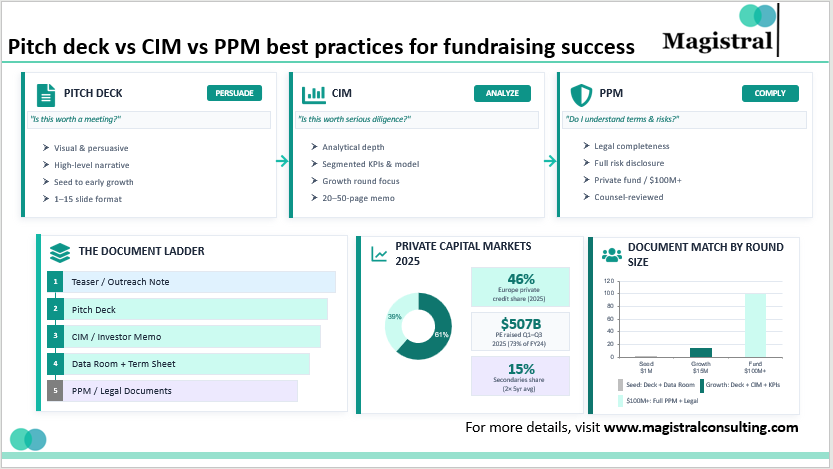
When deciding how to use pitch deck vs CIM vs PPM, the right way is to choose one based on the size and nature of the fundraising process. In the case of raising $1 million for a seed, you may only need an effective deck with the right data room. For 15 million dollars in the growth stage, you might need a more complete investor memo, KPIs, and projections. As for raising 100 million dollars for your private fund or making a private placement, you’ll probably have to prepare a precise PPM together with a subscription package.

A pitch deck can be convincing. A CIM should be analytical. But a PPM has to be very careful and detailed. Mixing up these approaches can cause some issues.

For instance, risk factors are not supposed to play a main role during the initial meetings with investors. Nevertheless, they shouldn’t be forgotten in the end offering. Mature and balanced communication is always highly appreciated by investors.

Use data without overloading the reader

Your fundraising documents will include many facts, including figures, but those figures must be used in an appropriate context. According to Preqin, 46 percent of fundraising for private credit in Q1 to Q3 was allocated to European funds, which represents an increase from the 23 percent seen in 2024, and 61.5 percent of the capital raised went to direct lending.

Also, according to Preqin, the number of dollars raised in Q1 to Q3 of 2025 by private equity reached 507 billion dollars, representing 73 percent of what was seen throughout the year 2024, and secondaries represented 15 percent of fundraising, more than twice the figure over the past five years. These types of figures can be useful for explaining when it’s a good time to raise. Used well, they also strengthen the narrative around pitch deck vs CIM vs PPM without overwhelming the reader.

Create a document ladder, not isolated files

Exceptional fundraising teams very seldom view each of these documents individually. They create a document ladder – from teaser/contact letter, through pitch deck, memo / CIM, data room, term sheet negotiation, and ending with PPM / final documentation if required. Viewing documents in such a light allows entrepreneurs and managers to avoid two pitfalls – putting too much into a pitch deck and underpreparing the final document.
Fundraising documents always aim at a single investor’s question.
Pitch deck – is this even worth a conversation?
CIM – Is this investment worth my time?
PPM – Do I know enough about the terms and risks?
This framework is often the easiest way to understand documents across the full investor journey.

How Magistral supports fundraising documentation

Magistral Consulting provides fundraising documentation, investment due diligence research, financial modeling, market research, and presentation preparation services to start-ups, privately held companies, funds, and investment management firms. On its fundraising page on the website of Magistral Consulting, it is mentioned that standard fundraising documents typically consist of a pitch deck, CIM/PPM, valuation, and a one-pager.

For issuers looking to prepare investor documents, Magistral Consulting will help to align the story, figures, diligence support, and outreach process. Other services provided by the company include due diligence services, deal structuring and execution, financial modeling, valuation, fundraising, deal sourcing, portfolio management, ESG analysis, fund administration, research, marketing, and investor relations.

An efficient process makes the difference between PIM vs CIM vs PPM from just a document decision into a strategic fundraising process where documents come at the appropriate time and with the right content. In advisory work, such documents are often central to deciding what to prepare first and how to sequence investor materials.

About Magistral Consulting

Magistral Consulting has helped multiple funds and companies in outsourcing operations activities. It has service offerings for Private Equity, Venture Capital, Family Offices, Investment Banks, Asset Managers, Hedge Funds, Financial Consultants, Real Estate, REITs, RE funds, Corporates, and Portfolio companies. Its functional expertise is around Deal origination, Deal Execution, Due Diligence, Financial Modelling, Portfolio Management, and Equity Research

For setting up an appointment with a Magistral representative visit www.magistralconsulting.com/contact

About the Author

Tanya is an investment-research specialist with 6 + years advising venture-capital, private-equity and lending clients worldwide. A Stanford Seed alumnus with an MBA and an Economics (Hons) degree, she heads project teams at Magistral Consulting, delivering financial modelling, due-diligence and deal support on 3,000 + mandates. Her blend of rigorous analytics, sharp project management and clear client communication turns complex data into actionable investment insight.

FAQs

What is the main difference between pitch deck vs CIM vs PPM?

A pitch deck creates initial investor interest, a CIM provides detailed business and financial information, and a PPM discloses legal terms and risks for a private securities offering.

Does every fundraiser need all three documents?

No. Early startups may only need a pitch deck at first. Funds, private placements, and larger transactions often need a CIM and PPM as discussions move forward.

Is a CIM legally the same as a PPM?

No. A CIM is usually a detailed commercial and financial document, often used in M&A or growth capital processes. A PPM is a legal disclosure document for private securities offerings.

Can a pitch deck replace a CIM?

Usually not. A pitch deck is too brief for serious diligence. Once investors show strong interest, a CIM or detailed investor memorandum helps them evaluate the opportunity more thoroughly.

Who prepares these fundraising documents?

Founders, CFOs, investment bankers, consultants, lawyers, and fundraising advisors often work together. Legal counsel usually reviews or prepares the PPM because of disclosure and securities law implications.

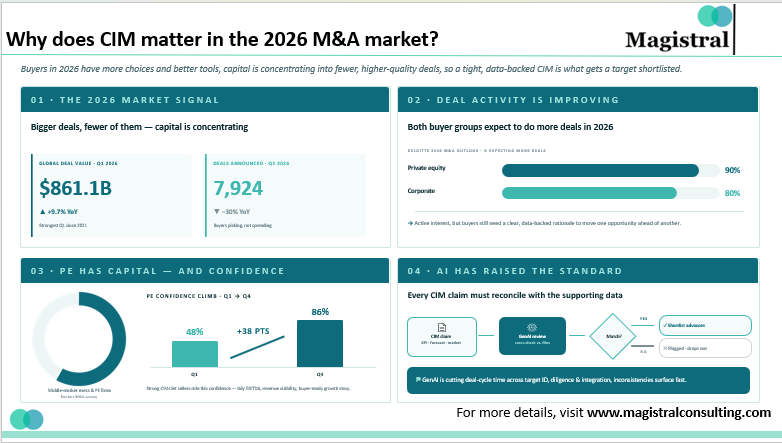
The Confidential Information Memo has come to be recognized as an important tool in deal-making in the context of the increasingly competitive and data-driven deal environment. The global M&A deal environment has consistently maintained deal volumes above $3 trillion in the most recent deal cycles. Private capital fundraising cycles have also been significantly lengthened. Preqin reports that the average fundraising period now exceeds 18-20 months. This contrasts with the nearly 12-14 months seen in the preceding deal environment. The lengthened fundraising period has put additional emphasis on maintaining investor engagement.

At the same time, the investor landscape has seen changes in the way in which investors seek to analytically validate the deal and respond in increasingly rapid manners. Deloitte reports that over 70% of investors now seek more in-depth due diligence materials before proceeding to advanced deal stages. In this context, the Confidential Information Memo is no longer just a tool but rather a process that can be used to improve investor conversion and deal closure.

The Confidential Information Memo and Deal Funnel Efficiency

The Confidential Information Memo is central in the context of the efficiency with which deals can move through the investor funnel.

The Confidential Information Memo and Deal Funnel Efficiency

The Confidential Information Memo and Deal Funnel Efficiency

Impact on investor conversion rates

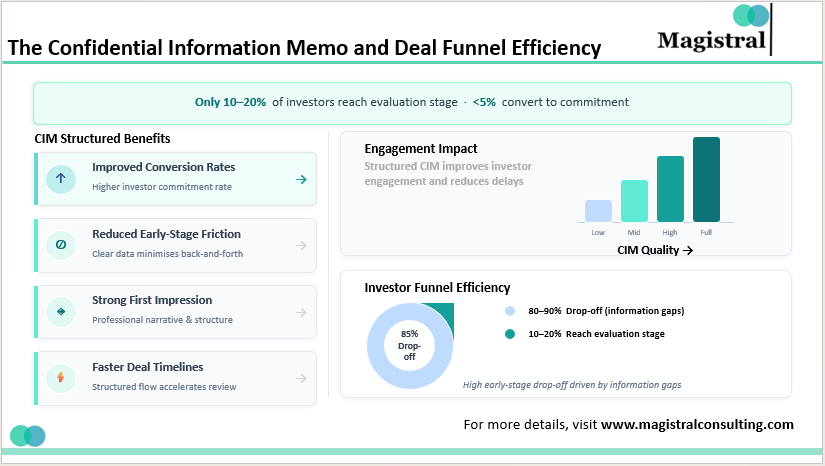
The investor funnel is one that sees high levels of drop-off at the early stages. Industry averages indicate that only 10-20% of the initial investor outreach ultimately make it to the advanced evaluation stages. In turn, fewer than 5% of these investors ultimately make it to the final stage.

Reduction of Inefficiency in Early-Stage Friction

When there are deficiencies or inconsistencies in information, there are always delays as further follow-ups are required. In addition, this may result in a lower number of investors showing interest. A well-prepared Confidential Information Memo helps avoid such inefficiency and results in a better deal flow.

Influence on First-Round Engagement Decisions

Investors make decisions within the first round of reviewing deal materials. A well-structured document that presents business, financial, and growth information helps investors progress to the next step, i.e., management discussions.

Compression of Deal Timelines

Fundraising processes are taking longer than 18 months. Therefore, it becomes imperative to reduce inefficiency. A well-prepared Confidential Information Memo helps investors compress deal evaluation timelines in the early stages.

Confidential Information Memo and Data Depth Requirements

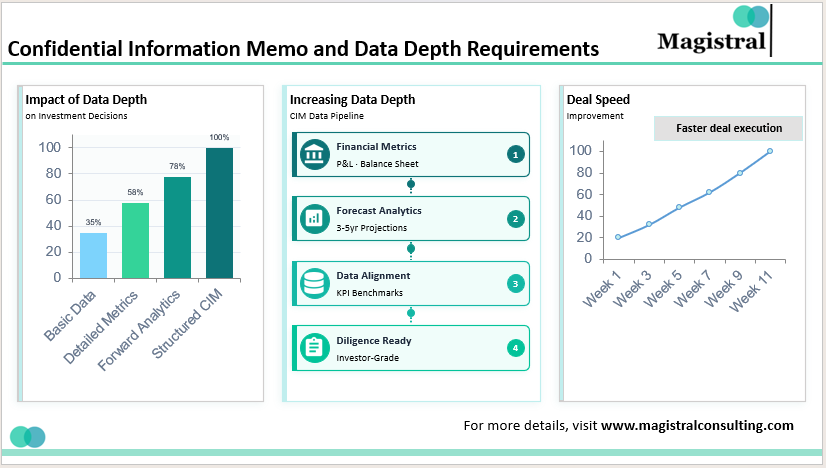
There are significant changes in investor requirements, and they are looking for deeper analytical rigor. Therefore, the quality and structure of the data are becoming important aspects of deal materials.

Confidential Information Memo and Data Depth Requirements

Confidential Information Memo and Data Depth Requirements

Demand for More Detailed Financial Metrics

Today, investors are seeking in-depth information on financial measures. According to McKinsey & Company, organizations that are using data-driven insights can improve the accuracy of their investment decisions by as much as 20-30%.

Shift toward Forward-Looking Analytics

Past performance does not suffice as a criterion for evaluating a deal. Investors are looking for information that helps them understand growth and potential risks. Therefore, sensitivity analysis can be included in the Confidential Information Memo.

Consistency of Financial and Operating Data

There are often inconsistencies in financial and operating data. A well-structured Confidential Information Memo helps investors trust the information presented.

Alignment with due diligence processes

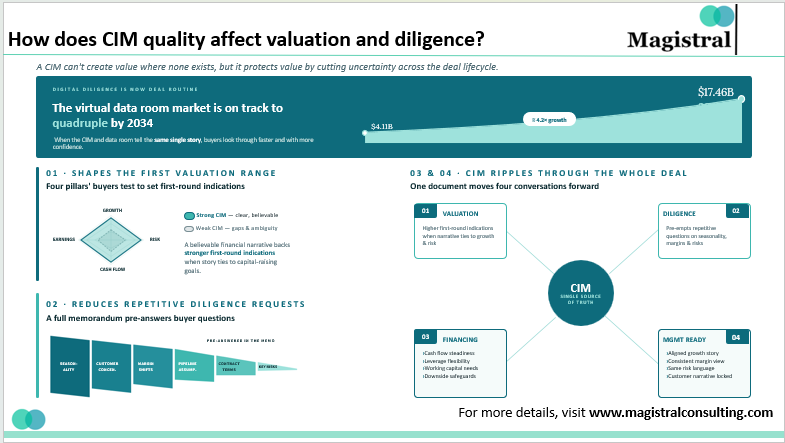
A well-structured and organized Confidential Information Memo can greatly assist in reducing due diligence processes. This can help in moving through due diligence processes faster.

Confidential Information Memo and Competitive Positioning

With capital concentration being limited to fewer deals, differentiation is key in getting attention from potential investors.

Capital concentration trends

The market is witnessing an upward trend in capital concentration in top-performing deals. According to Bain & Company, fewer deals are attracting more capital, resulting in an increase in competition among deals.

Importance of narrative clarity

Having a strong investment narrative with data support can greatly assist in positioning. In addition, investment opportunities are also evaluated based on how clear and concise the narrative is.

Role in shaping investor perception

The Confidential Information Memo is also considered an opportunity for investors to gain in-depth knowledge of the business. Therefore, its structure, clarity, and data support can greatly contribute to shaping investor perception.

Consistency between narrative and data

The Confidential Information Memo can also greatly assist in ensuring consistency in data analysis. Inconsistency in data analysis can greatly contribute to undermining investor confidence.

Confidential Information Memo and Its Impact on Valuation Outcomes

The Confidential Information Memo plays an important role in valuation outcomes. Its quality can greatly contribute to better valuation outcomes.

Improved investor confidence and participation

Having a well-structured and organized Confidential Information Memo can greatly contribute to building confidence among investors. Improved confidence among investors can greatly contribute to creating a competitive environment.

Creation of competitive bidding environments

Having an excellent Confidential Information Memo can greatly contribute to creating competitive environments. A competitive environment can greatly contribute to achieving better valuation outcomes.

Reduction in perceived risk

The availability of financial information and transparent assumptions can significantly reduce the perceived risk, which can, in turn, increase the valuation multiples.

Acceleration towards binding offers

The use of efficient communication can significantly reduce the gap between various stages, thus accelerating the process towards making binding offers.

Confidential Information Memo and Operational Challenges

The significance of the Confidential Information Memo notwithstanding, several operational challenges make it difficult to prepare a quality Confidential Information Memo.

Fragmentation of data sources

Data on financial, operational, and market performance is often scattered in various systems, which can result in inconsistencies in the consolidated financial information.

Time constraints in deal execution

The deal execution process is generally short, which can result in a high probability of errors in validation or incomplete information.

Balancing detail with readability

While excessive detail can make the Confidential Information Memo difficult to read, a lack of detail can undermine the credibility of the information provided.

Coordination of various stakeholders

The preparation of the Confidential Information Memo involves coordination with various teams, including finance, strategy, and investment bankers. Misalignment of various stakeholders can result in inconsistencies.

Confidential Information Memo and Structured Execution Framework

For companies that use a structured approach, the Confidential Information Memo can have a significant impact.

Standardization of templates and formats

The use of standardized templates can significantly reduce the effort in preparing the Confidential Information Memo, making it easier to read.

Centralized data management systems

The use of a single source of truth can significantly improve the accuracy of the information provided in the Confidential Information Memo, thus reducing inconsistencies.

Integration with digital deal tools

The use of digital tools such as data rooms, CRM, and analytics can significantly improve the coordination of various teams, thus enabling better tracking of interactions with various investors.

Iterative refinement based on investor feedback

Continuous improvement through investor queries and feedback helps in improving the quality and engagement of the document over time.

Alignment with overall deal strategy

Confidential Information Memo should be aligned with the overall deal strategy in order to ensure consistency in all channels and mediums of communication.

About Magistral Consulting

Magistral Consulting has helped multiple funds and companies in outsourcing operations activities. It has service offerings for Private Equity, Venture Capital, Family Offices, Investment Banks, Asset Managers, Hedge Funds, Financial Consultants, Real Estate, REITs, RE funds, Corporates, and Portfolio companies. Its functional expertise is around Deal origination, Deal Execution, Due Diligence, Financial Modelling, Portfolio Management, and Equity Research

For setting up an appointment with a Magistral representative visit www.magistralconsulting.com/contact

About the Author

Tanya is an investment-research specialist with 6 + years advising venture-capital, private-equity and lending clients worldwide. A Stanford Seed alumnus with an MBA and an Economics (Hons) degree, she heads project teams at Magistral Consulting, delivering financial modelling, due-diligence and deal support on 3,000 + mandates. Her blend of rigorous analytics, sharp project management and clear client communication turns complex data into actionable investment insight.

FAQs

What is a Confidential Information Memo?

A Confidential Information Memo is an in-depth document that is part of transactional processes and is used to present information about a company’s business, financials, and investment thesis to potential investors.

Why is it important in deal processes?

It is used as a key tool for investor evaluation and plays an important role in terms of engagement and the overall deal process.

How does it impact valuation?

A well-structured document helps in generating greater investor confidence and improves overall valuation for companies.

What data should be included?

It should include financial performance, projections, market information, and operational information.

What are the common challenges in preparation?

Common challenges include data inconsistency, time constraints, and balancing information and clarity.

CIM Outsourcing has evolved from a tactical support role into a strategic function. CIMs remain the foundation for fundraising, M&A, and deal marketing in private equity and venture capital. However, due to the amount of analyst time involved with creating CIMs in-house as well as the amount of time and management attention spent on creating these materials, deal volume levels have jumped back. Activity timelines have shortened for many investment management firms. There has subsequently been a rising trend towards using an external CIM Outsourcing provider to fulfil these functions. It allows the firm’s investment professionals to focus on what they do best. This helps in enabling the firm to use its limited resources better.

According to the 2024 Deloitte Private Markets Outlook report, more than half (58%) of mid-market investment management firms intend to increase their use of third-party providers to create programs to enhance the efficiency and reliability of their respective processes.

CIM Outsourcing in Modern Investment Workflows

It enables investment firms to delegate many aspects of CIM preparation to an outsourced firm. It helps in maintaining ultimate strategic oversight over these projects. Since 2021, the length of the Due Diligence timeline has increased by an average of 22%. Thus creating a need for most firms to outsource their CIM preparation to third-party specialists. CIM preparation is a time and labour-intensive process that falls outside the core competencies of the firm.

CIM Outsourcing in Modern Investment Workflows

CIM Outsourcing in Modern Investment Workflows

What does CIM Outsourcing Cover?

Outsourcing providers handle all aspects of CIM preparation, including financial models, market sizing and positioning, competitive analysis, and risk management. Providers often provide standardised formats for CIM preparation to facilitate consistency across multiple deals. Thereby providing a means of driving consistency across a portfolio of investment deals. Providers can also reduce the internal review cycles of most firms by an average of 30%.

Why Firms Are Reallocating CIM Work?

By outsourcing their firm’s CIM preparation, analysts can spend more time sourcing, placing valuations, and conducting negotiations. This allows firms to reduce analyst burnout, improve their workflow, and align their workflow with the trend of outsourcing. It can be done for all non-core document-intensive operations.

CIM Outsourcing as a Strategic Operating Model

It has evolved from being merely a way to augment capacity for firms into a strategic choice. Firms can make to increase Agility, Consistency, and Excellence in Execution. McKinsey & Company estimates that by the year 2026, more than 60 % of Investment Firms will have outsourced at least one of their Core Deal Support Functions. Outsourcing is at the heart of this transformation, allowing Firms to place their full attention on What Drives their Returns and to communicate clearly and credibly with Investors while providing them with compelling information.

CIM Outsourcing and Its Role in Fundraising Efficiency

CIM’s role as an outsourced service has a significant impact on the success of the fundraising process. Especially when it comes to sourcing capital for current and future projects within a crowded environment and differentiating yourself from other firms.

MSCI’s Capital Markets Outlook, published, when referring to “quality of investment documentation,” over 70% of institutional investor respondents stated that this attribute is one they use to influence their decisions to initially engage with early-stage investment opportunities. As such, leveraging a CIM that is professionally structured will positively impact the initial impression received in relation to your CIM and your firm and reduce the amount of back-and-forth discussion with respect to diligence processes.

Enhancing Investor Communication

Outsourced CIM teams are comprised of specialists who can translate complex operational or financial data. It is done into easily understood and professionally coherent investment narratives. Given the increased need for consistent communication concerning growth strategy development/implementation, scalability, and downside protection throughout the capital-raising process, the function of outsourced CIM teams is important.

In addition, for private equity and other alternative investment firms that are raising capital for multiple funds. They are having consistency in terms of CIM development will assist with your brand credibility. This is especially true when combined with the limited attention spans of the average investor and the large volume of deal flow in the marketplace.

Supporting Capital Raising Timelines

The companies that are actively raising funds usually must function under tight schedules based on market conditions or the need for liquidity from the portfolios. CIM Outsourcing allows for faster iterations and concurrent processing to stay updated on the information despite changes in assumptions.

According to Deloitte, companies that make use of outsourced documentation support can decrease the time taken to prepare for fundraising by as much as 18 to 25 percent.

Operational and Cost Benefits of CIM Outsourcing

CIM Outsourcing isn’t just about speed and quality; it’s also about quantifiable savings & improved efficiencies. Due to the need for senior management oversight and multiple rounds of editing and a high opportunity cost associated with using internal documentation teams. According to a 2024 operational benchmarking report on operations by CBRE, the cost of each transaction operated via an outsourced method has been reduced by 20% to 30% versus fully in-house methods.

Scalability Without Fixed Overhead

When firms use outsourcing, they can increase their documentation capability according to the number of transactions being processed. During times of cyclical growth, the ability to increase or decrease documentation resources will provide more flexibility for internal teams to manage peak work periods.

Accuracy and Risk Mitigation

CIM Outsourcing Companies provide numerous layers of review to ensure that they have reduced the likelihood of human error and inconsistencies. The efforts to produce quality work will help to mitigate risk to the firm’s reputation as well as increase investor confidence in the documents produced during the due diligence process.

How Firms Select the Right CIM Outsourcing Partner

When selecting the right partner for CIM outsourcing, cost is only one part of the equation. As such, leading businesses place a higher value on domain experience, the maturity of processes, and collaborative styles utilized by their outsourcing partners.

How Firms Select the Right CIM Outsourcing Partner

How Firms Select the Right CIM Outsourcing Partner

Domain Knowledge and Financial Fluency

To create an effective CIM that resonates with sophisticated investors, providers must be able to speak the specific metric types, valuation logic, and regulatory expectations of the companies in the sector they’re working with.

Process Transparency and Collaboration

For firms to gain maximum value from their outsourced partner’s experience, providers must operate with a level of transparency. It is through the use of clear workflows, version control and communication protocols. The provider should seamlessly integrate into the firm’s internal teams and existing operational structure.  These integrations provide a more efficient operation of both the outsourcing firm and the provider’s services.

Technology Enablement

Developing advanced solutions and utilizing rapidly developing technologies, including artificial intelligence, data validation, and secure collaboration tools, allows providers to enhance their ability to reduce turnaround time and ensure that your confidential information remains protected.

How Magistral Consulting Adds Value Through CIM Outsourcing

At Magistral Consulting, outsourcing is provided within the context of an overall investment support infrastructure. It is not just as an isolated offering. Magistral Consulting provides investment companies with the expertise and support needed for them to execute an investment with confidence.

There is significant experience in private markets for both teams of Magistral. They support CIM creation in a highly integrated manner with the valuation models, findings, and expectations of the investors.

In carrying out its role as an extension of the client teams, Magistral allows the investment firms to focus on strategy and capital allocation. It is by ensuring that the CIMs are investor-ready, data-driven, and executed at a professional level by being agile. Magistral also ensures that they are credible in a highly competitive deal environment.


About Magistral Consulting

Magistral Consulting has helped multiple funds and companies in outsourcing operations activities. It has service offerings for Private Equity, Venture Capital, Family Offices, Investment Banks, Asset Managers, Hedge Funds, Financial Consultants, Real Estate, REITs, RE funds, Corporates, and Portfolio companies. Its functional expertise is around Deal origination, Deal Execution, Due Diligence, Financial Modelling, Portfolio Management, and Equity Research

For setting up an appointment with a Magistral representative visit www.magistralconsulting.com/contact

About the Author

Aman is an investment-research specialist with 5+ years of experience across business and investment research, including 2+ years with Big Four firms like KPMG. A Stanford Seed alumnus with an MBA in Finance and a Bachelor of Commerce (Hons) from University of Delhi, he focuses on private equity, venture capital, and renewable energy sectors. He leads project teams at Magistral Consulting, delivering financial research, due diligence, deal sourcing, and M&A support, while driving strong process management and analytics. His blend of attention to detail, strategic thinking, and dynamic execution enables him to turn complex data into actionable investment insights.

FAQs

Which firms benefit most from CIM Outsourcing?

Private equity, venture capital, investment banking, and growth equity firms benefit most, particularly those managing multiple deals or fundraising cycles simultaneously.

Does outsourcing reduce control over deal narratives?

No. Firms retain strategic oversight while outsourcing execution tasks, allowing them to shape messaging without handling operational workload.

How does CIM Outsourcing impact deal timelines?

Industry data suggests that outsourcing can reduce documentation timelines by up to 25 percent, accelerating go-to-market and investor engagement.

Is CIM Outsourcing secure for sensitive information?

Reputable providers operate under strict confidentiality frameworks, secure data environments, and compliance protocols aligned with global standards.