Tag Archives: Pitch Deck

Though fundraising documents may seem alike from afar, the investor uses each of them differently in a fundraising deal. The pitch deck starts the discussion, the CIM builds the business and financial case, and the PPM supports the legal documentation during private offerings. This is why it is essential to distinguish between pitch deck vs CIM vs PPM prior to approaching any angel investor, venture capital fund, family office, or institutional buyer. With an increasing number of investors in any market, it is crucial to use the right fundraising tool; otherwise, negotiations will drag on, confusion will arise, and the level of credibility of the company in question will suffer greatly.

According to recent figures, global buyout investment increased by 37%, while exit value increased by 34% in 2024. Nevertheless, despite positive dynamics, the amount of global buyout fundraising decreased by 23% that year. In turn, startup fundraising on leading private marketplaces reached approximately 120 billion dollars in 2025, growing 17% annually; however, the overall number of rounds dropped to a six-year low. In practical terms, understanding pitch deck vs CIM vs PPM helps founders choose the right document at the right point in the process.

Pitch deck vs CIM vs PPM for fundraising purposes

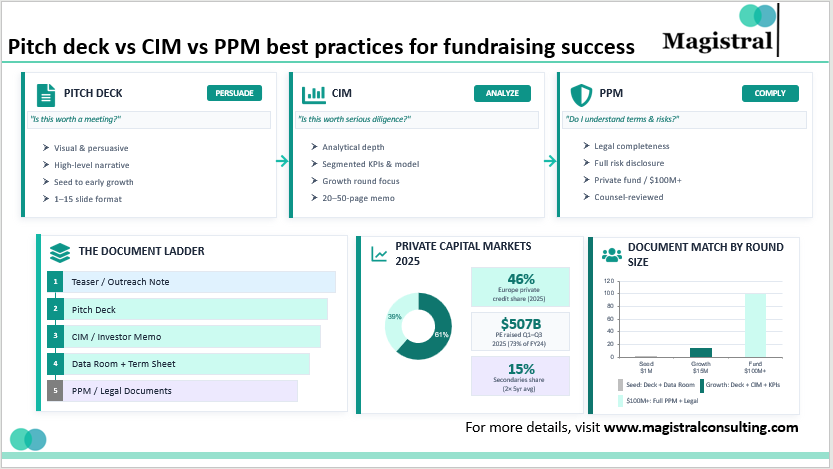
The key difference lies in the requirements of the investors for the various stages of the financing process. While a pitch deck contains a concise and visual description of a business idea, the company’s progress towards achieving its goals, market potential, traction, business model, and capital requirements, it should attract investors’ attention within several minutes. A CIM, which stands for Confidential Information Memorandum, presents investors with a deeper analysis of the company in terms of its financial standing, sources of income, operations, market situation, concentration of customers, business growth, and rationale behind the sale. Thus, it is located somewhere between the preliminary meeting and the due diligence process.

And lastly, the PPM, or Private Placement Memorandum, is a formal document required for a private placement offering. Unlike a pitch deck and a CIM, the primary purpose of this document is to disclose certain details regarding the conditions, risks, fees, and suitability of the investors. A clear view of pitch deck vs CIM vs PPM makes it easier to match the material to the investor’s expectations.

Pitch deck vs CIM vs PPM in content depth and investor use

It is important to recognize that the difference between these documents lies not only in their length but also in how investors use them. In other words, documents would become easier to organize when each one of the documents is used for its corresponding stage of the financing funnel.
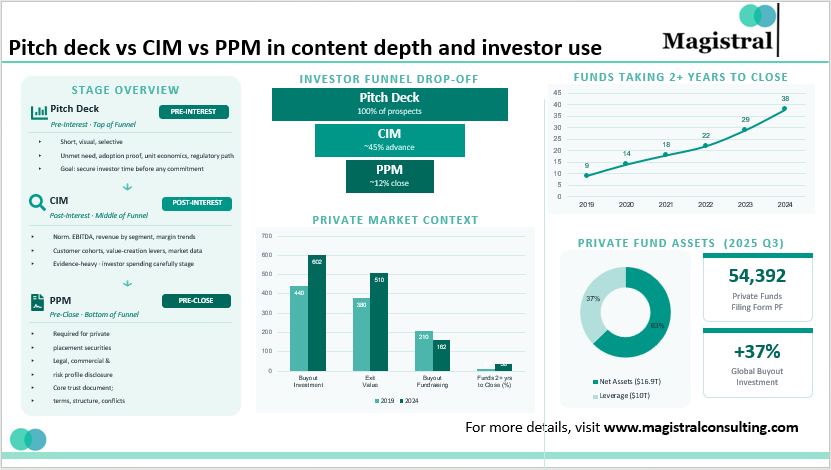
Pitch deck vs CIM vs PPM in content depth and investor use

Pitch deck vs CIM vs PPM in content depth and investor use

When investors read a pitch deck

Before an investor makes the decision to spend his or her time on further evaluation, he or she looks at the pitch deck. This document should be short, visual, and targeted. The fact that it tries to provide all information in detail is contrary to the purpose of this document.
For example, consider a founder of a health-tech startup raising Series A funds. The investor needs information about the unmet need, adoption proof, unit economics, regulatory pathway, and reasons why the current round helps grow the business fast. He or she doesn’t need the whole paragraph about legal risks. This is one of the clearest examples of pitch deck vs CIM vs PPM in practice.

When investors request a CIM

This kind of CIM should contain EBITDA, revenues per segment, margin evolution, market growth, customer cohorts, advantages, and value creation. This is critical since investors are being prudent with their resources. For instance, in 2024, the amount of investments for buyouts across the world grew by 37% to reach almost 602 billion dollars, while the amount of exit value climbed 34%, but buyout fundraising dropped 23% across the globe. The second observation by Bain & Company was that the number of funds that took two years or even more to be finalized went up to 38% compared to 9% back in 2019.

In simple words, there is an improvement in deals faster than the improvement in fundraising, meaning that managers require better materials. In this stage, documents becomes especially relevant because investors now expect more depth and diligence support. reference

When a PPM becomes necessary

PPM is needed when there is an offer to buy and sell securities through the private placement of such securities. It provides a detailed description to help informed investors evaluate the offer.

The extent of the market of private placements also highlights the importance of good-quality disclosure. According to the statistics for Q3 2025, 54,392 private funds have reported on their investments using Form PF. These private funds hold $16.9 trillion worth of net assets and $26.9 trillion worth of gross assets. At such a magnitude of private placements, the PPM is an important document for evaluating the deal. This is why one should consider a PPM as opposed to pitch decks or CIMs. From a compliance perspective, pitch deck vs CIM vs PPM is not just a messaging choice but also a legal and procedural one.

Pitch deck vs CIM vs PPM for startups, companies, and funds

Startups, established companies, and private funds use different fundraising documents depending on the stage and complexity of the transaction. Early-stage startups usually rely on pitch decks to communicate vision, traction, and growth potential to angel investors and VCs. As companies mature and raise larger rounds, investors often expect additional materials such as financial models, investor memos, data rooms, and sometimes PPM disclosures for private securities offerings. Established companies pursuing growth capital or M&A transactions typically use CIMs to provide detailed information on financial performance, operations, market position, and valuation.

Private funds often require all three: a pitch deck to introduce the strategy, a CIM or investment memorandum to explain track record and portfolio construction, and a PPM to disclose fund terms, risks, fees, and compliance details. With private markets expanding rapidly and investors demanding deeper diligence, the quality and depth of pitch deck vs CIM vs PPM documentation have become increasingly important. For founders and fund managers alike, pitch deck vs CIM vs PPM should be planned as part of a broader fundraising workflow rather than as isolated deliverables.

Pitch deck vs CIM vs PPM best practices for fundraising success

The key to success is having your fundraising materials as a cohesive set. The question you should be asking yourself is not which of these is better but rather when you should use each material and how consistently they should back up the investor’s experience. A smart approach to pitch deck vs CIM vs PPM improves both investor communication and process efficiency.
Pitch deck vs CIM vs PPM

Pitch deck vs CIM vs PPM best practices for fundraising success

Keep the message consistent

When an investor gets conflicting messages from your pitch deck and sees something different in the CIM, then notices new risk factors that weren’t mentioned before in the PPM, the trust will be broken. You need to go deeper into the story but not change its course.
That’s what a professional fundraising consultant can do for you. Strong consistency across pitch deck vs CIM vs PPM helps reinforce credibility with sophisticated investors.

Match the document to the round size and investor type

When deciding how to use pitch deck vs CIM vs PPM, the right way is to choose one based on the size and nature of the fundraising process. In the case of raising $1 million for a seed, you may only need an effective deck with the right data room. For 15 million dollars in the growth stage, you might need a more complete investor memo, KPIs, and projections. As for raising 100 million dollars for your private fund or making a private placement, you’ll probably have to prepare a precise PPM together with a subscription package.

A pitch deck can be convincing. A CIM should be analytical. But a PPM has to be very careful and detailed. Mixing up these approaches can cause some issues.

For instance, risk factors are not supposed to play a main role during the initial meetings with investors. Nevertheless, they shouldn’t be forgotten in the end offering. Mature and balanced communication is always highly appreciated by investors.

Use data without overloading the reader

Your fundraising documents will include many facts, including figures, but those figures must be used in an appropriate context. According to Preqin, 46 percent of fundraising for private credit in Q1 to Q3 was allocated to European funds, which represents an increase from the 23 percent seen in 2024, and 61.5 percent of the capital raised went to direct lending.

Also, according to Preqin, the number of dollars raised in Q1 to Q3 of 2025 by private equity reached 507 billion dollars, representing 73 percent of what was seen throughout the year 2024, and secondaries represented 15 percent of fundraising, more than twice the figure over the past five years. These types of figures can be useful for explaining when it’s a good time to raise. Used well, they also strengthen the narrative around pitch deck vs CIM vs PPM without overwhelming the reader.

Create a document ladder, not isolated files

Exceptional fundraising teams very seldom view each of these documents individually. They create a document ladder – from teaser/contact letter, through pitch deck, memo / CIM, data room, term sheet negotiation, and ending with PPM / final documentation if required. Viewing documents in such a light allows entrepreneurs and managers to avoid two pitfalls – putting too much into a pitch deck and underpreparing the final document.
Fundraising documents always aim at a single investor’s question.
Pitch deck – is this even worth a conversation?
CIM – Is this investment worth my time?
PPM – Do I know enough about the terms and risks?
This framework is often the easiest way to understand documents across the full investor journey.

How Magistral supports fundraising documentation

Magistral Consulting provides fundraising documentation, investment due diligence research, financial modeling, market research, and presentation preparation services to start-ups, privately held companies, funds, and investment management firms. On its fundraising page on the website of Magistral Consulting, it is mentioned that standard fundraising documents typically consist of a pitch deck, CIM/PPM, valuation, and a one-pager.

For issuers looking to prepare investor documents, Magistral Consulting will help to align the story, figures, diligence support, and outreach process. Other services provided by the company include due diligence services, deal structuring and execution, financial modeling, valuation, fundraising, deal sourcing, portfolio management, ESG analysis, fund administration, research, marketing, and investor relations.

An efficient process makes the difference between PIM vs CIM vs PPM from just a document decision into a strategic fundraising process where documents come at the appropriate time and with the right content. In advisory work, such documents are often central to deciding what to prepare first and how to sequence investor materials.

About Magistral Consulting

Magistral Consulting has helped multiple funds and companies in outsourcing operations activities. It has service offerings for Private Equity, Venture Capital, Family Offices, Investment Banks, Asset Managers, Hedge Funds, Financial Consultants, Real Estate, REITs, RE funds, Corporates, and Portfolio companies. Its functional expertise is around Deal origination, Deal Execution, Due Diligence, Financial Modelling, Portfolio Management, and Equity Research

For setting up an appointment with a Magistral representative visit www.magistralconsulting.com/contact

About the Author

Tanya is an investment-research specialist with 6 + years advising venture-capital, private-equity and lending clients worldwide. A Stanford Seed alumnus with an MBA and an Economics (Hons) degree, she heads project teams at Magistral Consulting, delivering financial modelling, due-diligence and deal support on 3,000 + mandates. Her blend of rigorous analytics, sharp project management and clear client communication turns complex data into actionable investment insight.

FAQs

What is the main difference between pitch deck vs CIM vs PPM?

A pitch deck creates initial investor interest, a CIM provides detailed business and financial information, and a PPM discloses legal terms and risks for a private securities offering.

Does every fundraiser need all three documents?

No. Early startups may only need a pitch deck at first. Funds, private placements, and larger transactions often need a CIM and PPM as discussions move forward.

Is a CIM legally the same as a PPM?

No. A CIM is usually a detailed commercial and financial document, often used in M&A or growth capital processes. A PPM is a legal disclosure document for private securities offerings.

Can a pitch deck replace a CIM?

Usually not. A pitch deck is too brief for serious diligence. Once investors show strong interest, a CIM or detailed investor memorandum helps them evaluate the opportunity more thoroughly.

Who prepares these fundraising documents?

Founders, CFOs, investment bankers, consultants, lawyers, and fundraising advisors often work together. Legal counsel usually reviews or prepares the PPM because of disclosure and securities law implications.

Crafting a compelling investor narrative is increasingly complex, requiring clear storytelling, credible numbers, and market-backed logic. Pitch deck outsourcing has evolved from a tactical design choice to a strategic decision that impacts fundraising success. In tighter capital markets with limited investor attention, professionally built decks help businesses stand out and save leadership time. Investors spend only a few minutes on pitch decks, making concise storytelling, clear financial logic, and structured narratives essential. This approach is gaining traction across startups, funds, and advisory firms globally.

Pitch Deck Outsourcing and the Growing Demand for Investor-Ready Narratives

The rising complexity of fundraising explains why pitch deck outsourcing has become integral to capital markets communication. Investors no longer review decks casually. They analyze them as condensed business cases supported by data, valuation logic, and growth realism.

Pitch Deck Outsourcing & Growing Demand for Investor-Ready Narratives

Pitch Deck Outsourcing & Growing Demand for Investor-Ready Narratives

Why pitch deck outsourcing aligns with modern investor expectations

Investor conversations today are shorter yet deeper. Investor deal flow has intensified, while time spent evaluating individual opportunities has remained limited. Average time spent per deck has remained near historical lows, increasing pressure on founders and fund managers to communicate clarity early in the process. Outsourcing it ensures that narratives are structured clearly, assumptions are defensible, and visuals guide attention to value drivers rather than distractions. Teams focusing on product or deal sourcing often lack the bandwidth to refine these elements internally.

The link between outsourced decks and faster capital raising

Well-structured decks directly influence capital raising efficiency. When founders or fund teams integrate outsourced pitch decks with broader capital raising strategies, investor meetings progress faster, and follow-up questions decline. This often complements advisory support linked to private equity and venture capital mandates, where clarity and precision influence early screening decisions.

Financial accuracy as a driver of credibility

Outsourced specialists typically combine storytelling with robust modeling inputs such as market sizing, scenario analysis, and valuation logic. This approach mirrors institutional standards used across funds, helping early-stage or mid-market firms present information in formats investors already trust. Standardized and well-structured presentations help investors assess opportunities more efficiently. Investors focus disproportionately on a small number of slides, making consistency, comparability, and narrative flow essential for reducing friction during early screening.

Design is not just aesthetics anymore

Visual consistency supports comprehension. Pitch deck outsourcing integrates design with data flow so that numbers reinforce the story instead of overwhelming it. This is particularly important when decks incorporate insights from real estate financial modeling or sector-specific investment theses, where charts, assumptions, and timelines must align logically.

Pitch Deck Outsourcing as a Cost-Efficient Alternative to In-House Teams

Building an internal pitch team appears attractive until costs and timelines are examined. Pitch deck outsourcing often delivers better economics with higher output quality.

Comparing internal effort versus outsourced expertise

An internal team requires hiring analysts, designers, and strategists, which increases fixed costs. Outsourced models convert these costs into variable engagement based on fundraising cycles. Large consulting firms continue to highlight outsourcing as a flexible operating model that allows organizations to scale specialized capabilities without expanding fixed costs. Deloitte’s global sourcing research shows that a growing share of executives are increasing budgets for managed and outsourced services to improve efficiency and speed during peak demand cycles.

Scalability during peak fundraising cycles

Fundraising rarely follows a linear schedule. Teams experience sudden bursts of activity when investor interest peaks. An outsourcing pitch deck allows firms to scale output quickly without diverting internal resources from core operations such as product development or deal execution.

Supporting funds and investm ent professionals

For investment firms managing multiple funds, outsourced decks bring consistency across strategies and vintages. This is particularly valuable for funds presenting to limited partners who expect standardized disclosures and comparable performance narratives across portfolios.

Reducing opportunity cost for leadership

Time spent refining slides is time not spent meeting investors or closing deals. By outsourcing pitch decks, founders and partners focus on conversations while specialists handle structure and polish. This approach aligns well with advisory models used across investment banking support functions, where execution speed is critical.

Pitch Deck Outsourcing and Its Role in Data-Driven Storytelling

Modern pitch decks are analytical tools disguised as stories. Pitch deck outsourcing strengthens this balance by grounding narratives in credible data.

Integrating market data and benchmarks

According to market forecasts, the global IT and business process outsourcing market is projected to grow at approximately 9% CAGR over the second half of the decade, underscoring continued demand for specialized external capabilities.

Financial modeling and valuation alignment

Investors look for coherence between assumptions and outcomes. Pitch deck outsourcing often works alongside valuation frameworks such as discounted cash flow logic or comparable analysis. When decks align with disciplined valuation thinking, credibility increases, and follow-up diligence becomes smoother.

Customizing decks for different investor profiles

A single pitch rarely fits all audiences. Institutional investors, strategic partners, and family offices focus on different risk metrics. Outsourced teams adapt decks accordingly, adjusting emphasis on growth, cash flow, or downside protection without rebuilding the core narrative from scratch.

Technology and analytics are enhancing presentation quality

AI-driven analytics increasingly support outsourced pitch development by identifying weak assumptions or narrative gaps. Organizations using analytics-driven content development reported higher stakeholder confidence during investment discussions.

Pitch Deck Outsourcing Across Industries and Deal Types

The application of these spans industries, each with unique storytelling demands.

Pitch Deck Outsourcing Across Industries and Deal Types

Pitch Deck Outsourcing Across Industries and Deal Types

Startups and early-stage ventures

For startups, outsourced decks often bridge the credibility gap. They help founders articulate a vision while backing it with structured market logic. This complements broader startup fundraising efforts where clarity often outweighs scale in early discussions.

Private equity and growth investments

In private equity contexts, decks focus on value creation plans, operational improvements, and exit logic. Outsourcing ensures that complex operational narratives remain concise while aligning with investor expectations around governance and returns.

Real estate and asset-backed strategies

Real estate-focused decks rely heavily on cash flow projections, sensitivity analysis, and market comparisons. Outsourced specialists experienced in asset-level modeling help translate granular data into investor-friendly visuals without diluting analytical depth.

Cross-border and emerging market deals

When pitching international opportunities, clarity becomes even more critical. Outsourced decks standardize messaging, reduce ambiguity, and address risk considerations that global investors prioritize, such as currency exposure or regulatory stability.

How Magistral Consulting Supports Pitch Deck Outsourcing Engagements

Effective pitch deck outsourcing requires more than slide creation. It demands financial insight, strategic context, and execution discipline.

Strategic narrative development

Magistral Consulting approaches pitch decks as investment stories rather than presentations. Teams focus on aligning business fundamentals with investor expectations while maintaining logical flow across sections.

Financial rigor and market context

Support extends beyond visuals into underlying analysis. By combining market surveys, financial modeling, and sector benchmarks, decks remain grounded while highlighting upside potential.

Integration with broader advisory services

Pitch deck outsourcing often works best when aligned with complementary services such as deal support and ongoing finance transformation initiatives. This integrated approach ensures consistency across investor communications and operational planning.

Delivering confidence at critical moments

Ultimately, the goal is confidence. When leaders walk into investor meetings knowing their materials reflect best practices, conversations shift from clarification to conviction. It becomes not just a service but a strategic enabler that supports long-term capital strategy and investor relationships.


About Magistral Consulting

Magistral Consulting has helped multiple funds and companies in outsourcing operations activities. It has service offerings for Private Equity, Venture Capital, Family Offices, Investment Banks, Asset Managers, Hedge Funds, Financial Consultants, Real Estate, REITs, RE funds, Corporates, and Portfolio companies. Its functional expertise is around Deal origination, Deal Execution, Due Diligence, Financial Modelling, Portfolio Management, and Equity Research

For setting up an appointment with a Magistral representative visit www.magistralconsulting.com/contact

About the Author

Dhanita is a BD and Marketing professional with 6+ years’ experience in sales strategy, growth execution, and client acquisition; credentials include Stanford Seed (Stanford GSB), an MBA from USMS–GGSIPU, and a B.Com (Hons) from the University of Delhi. Expertise spans market research and opportunity mapping, sales strategy, CRM, brand positioning, integrated campaigns, content development, lead generation, and analytics; currently oversees business development calls and end-to-end marketing operations

FAQs

Who benefits most from pitch deck outsourcing?

Startups, fund managers, real estate sponsors, and growth-stage companies benefit most when internal teams lack time or specialized presentation expertise.

Does outsourcing reduce control over messaging?

Control typically improves because founders and executives focus on core messaging while specialists translate it into structured narratives and visuals.

How does pitch deck outsourcing impact fundraising timelines?

Outsourced decks often shorten fundraising cycles by reducing revisions and improving investor clarity from the first meeting.

Is pitch deck outsourcing suitable for repeat fundraises?

Yes, it ensures consistency across multiple raises while allowing updates based on market conditions and investor feedback.

How do companies measure the ROI of pitch deck outsourcing?

Companies measure the ROI of pitch deck outsourcing by looking at faster fundraising cycles, fewer revision rounds, and stronger investor engagement, such as higher follow-up meeting rates and clearer valuation discussions.


The power of presentation is paramount in the dynamic startup ecosystem, where exceptional concepts are insufficient. Complete Pitch Deck Support has become a critical enabler, assisting founders in the development of compelling, fundable narratives that resonate with investors.   

A Strategic Imperative: Comprehensive Pitch Deck Support 

Negotiating your way through the murky waters of a new startup is no easy feat, and having a well-pitch deck supports Startup Genome, 92% of firms fail to obtain follow-on funding due to a lack of presentation materials. 

In the interim, CB Insights reports that 38% of ventures falter as a result of inadequate funding. Structure, narrative, and clarity are provided by the Complete Pitch Deck support to convert investor interest into tangible capital.

Key Catalysts Behind Rising Demand 

The demand for narratives that are investor-ready has increased. As funding becomes more difficult to secure. Startups must no longer depend on minimal or generic decks; it is imperative to provide comprehensive Pitch Deck in order to differentiate themselves, establish credibility, and expedite fundraising results. A more challenging fundraising environment necessitates more robust decks.

Key Catalysts Behind Rising Demand

Key Catalysts Behind Rising Demand

Rising Investor Scrutiny

The number of available transactions has decreased as a result of the 51% decrease in global VC funding from $582B in 2021 to $285B in 2023 (KPMG Venture Pulse Q4 2023). It is now imperative that entrepreneurs receive comprehensive Deck support in order to ensure that their investor-ready storytelling is in alignment with pertinent metrics, thereby distinguishing them from the crowd.
Perspective: The average duration of time that venture capitalists spend examining a pitch deck has decreased from four minutes in 2022 to three minutes and 44 seconds (DocSend 2023 Pitch Deck Report). 

The Transition to Data-Driven Narratives

Data must be the foundation of contemporary startup storytelling. According to PitchBook, 67% of successful seed-round presentations encompassed explicit financials, market size, and go-to-market plans. The support of a complete pitch deck allows founders to proactively respond to investor inquiries through strategic narrative that is replete with data.

Key Components of an Effective Pitch Deck

It is crucial to comprehend that a successful deck must provide both clarity and persuasion prior to delving into the specifics. The most effective comprehensive Pitch Deck support solutions concentrate on the development of components that are consistent with the psychology of investors and align with business logic.

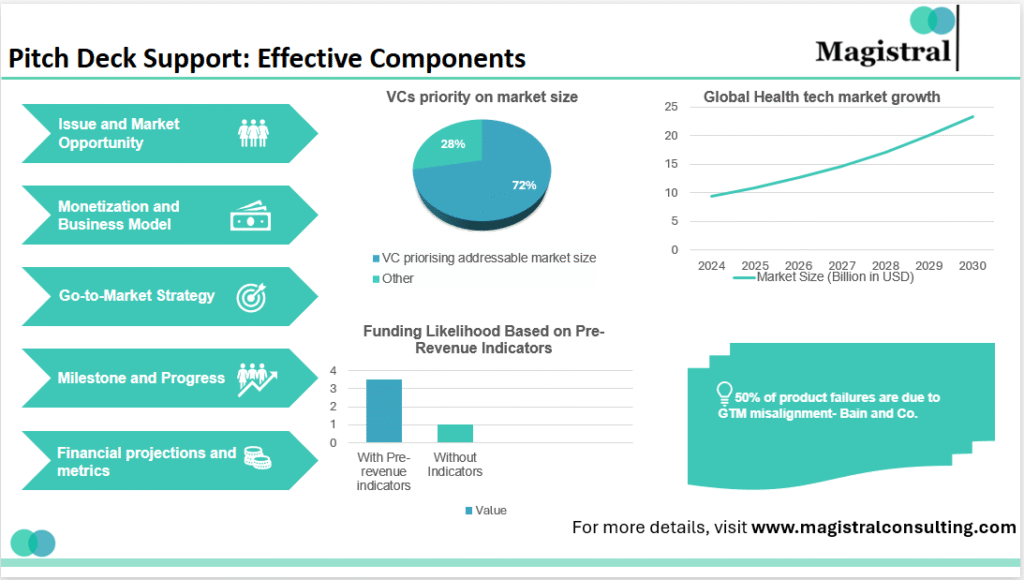
Pitch Deck Support: Effective Components

Pitch Deck Support: Effective Components

Clearly Defined Market Opportunity and Problem Statement

Startups must explicitly specify the issue they address and exhibit market potential. “Addressable market size” is a critical decision factor for 72% of VCs, according to EY-Parthenon. Support for the complete pitch deck guarantees that the pain points are not only articulated but also quantified using the TAM/SAM/SOM frameworks.
Fortune Business Insights anticipates that the global mental health tech market will reach $23.3 billion by 2030, with a compound annual growth rate (CAGR) of 16.5%.

Transparent Business Model and Monetization

According to McKinsey, 59% of early-stage investors decline proposals that lack a transparent revenue model. Founders can confidently and accurately present financial levers such as MRR, CAC, and LTV with the assistance of a Complete Pitch Deck.  

Go-to-Market Strategy with Execution Readiness

A GTM strategy that is ostentatious but lacks realistic execution frequently fails. Bain & Company discovered that 50% of product disasters are the result of GTM misalignment. A proposal document that is well-supported should include a comprehensive GTM plan, which includes personas, sales channels, and cost projections.  

Milestones and Progress Based on Evidence

Startups that demonstrate robust pre-revenue indicators, such as user growth and pilot consumers, are 3.5 times more likely to secure funding (Crunchbase 2024). The strategic highlighting of such proof elements is guaranteed by the Complete Deck support, which is designed to foster trust.  

Grounded Financial Forecasts

Decks that are 60% more likely to secure funding are those that are supported by explicit assumptions and three-year projections, as per PwC. Tailored modeling of revenue, waste rate, and even adverse scenarios is included in the comprehensive Pitch Deck support. 

From Good to Great: The Impact of Expert Pitch Deck Crafting

Design is not the sole aspect of Complete Pitch Deck support. It pertains to the development of a strategic, persuasive experience that motivates investor action. To the process, experts contribute objectivity, profundity, and investor insight.  

Improving Investor Retention and Visual Communication

Professionally designed visuals enhance message retention by 67%, according to research conducted at Stanford University. Expert Pitch Deck support transforms complex data into infographics, timelines, and visuals that maintain investor attention.

Competitive Benchmarking to Demonstrate Distinction

Comparing businesses is an ongoing activity for investors. Experts who provide comprehensive support utilize benchmarking tools such as Statista and PitchBook to emphasize their strategic advantages.
For instance, a SaaS startup has discovered that its CAC is 22% lower and its retention is 18% higher than that of its rivals. These insights provide a competitive advantage in the market.  

Customizing Decks for Investor Archetypes

Different value signals are sought by VCs, entrepreneurs, and family offices. High-quality Pitch Deck support customizes content according to investor persona, industry dynamics, and stage-specific outcomes, such as ecosystem fit or departures.

What is it’s future?

The field of startup fundraising is undergoing a swift transformation. Balancing automation with strategy, data with design, and personalization with scalability is the key to the future of it.  

 AI Is Revolutionizing the Workflow—But It Is Not Replacing Expertise

AI tools such as Beautiful.ai, Tome, and Canva Deck expedite creation. Nevertheless, strategic experts deliver irreplaceable value through comprehensive Pitch Deck support, grounding it in strategic logic and investor insights. While AI facilitates the narrative process, it does not direct it.

The Emergence of Interactive, Data-Driven Presentation Formats

According to the 2024 Digital Investor Trends report by Deloitte, interactive presentations are now preferred by one-third of investors. These decks include live demonstrations, dashboards, and data room access. Such formats are already being integrated. 

VC Dry Powder Indicates Opportunity

Global VC dried powder is valued at $580 billion as of 2024 (Preqin). Startups with investor-grade, comprehensive Pitch Deck support will be distinguished when capital is reactivated. The aperture may be overlooked by individuals who lack clarity or a compelling structure. 

Magistral Consulting’s Services for Pitch Deck Support 

Magistral Consulting offers comprehensive services to assist startups and investment firms in creating compelling pitch decks that effectively communicate their value propositions to potential investors.  

Strategic Narrative Development 

Magistral works with clients to craft a persuasive and coherent narrative that highlights the problem they address, their solution, market opportunities, and unique value proposition.

Visual Design and Branding 

Understanding the importance of visual appeal, Magistral designs pitch decks that are not only informative but also aesthetically engaging. This includes the creation of custom graphics, charts, and layouts that align with the startup’s branding, ensuring consistency and professionalism throughout the presentation.  

Financial Modelling and Projections 

Magistral provides detailed financial modelling services to project revenues, expenses, and cash flows. These models help in demonstrating the startup’s financial viability and growth potential, offering investors a clear picture of expected returns and financial health.  

Market Research and Competitive Analysis 

To substantiate the business case, Magistral conducts thorough market research, including industry trends, market sizing, and competitive analysis. This data-driven approach ensures that the pitch deck presents a well-rounded view of the market landscape and the startup’s positioning within it.  

Investor Outreach and Fundraising Support 

Beyond pitch deck creation, Magistral assists in identifying and reaching out to potential investors. Leveraging a proprietary database of over 25,000 investors, they help startups connect with suitable funding sources, streamlining the fundraising process.  

Supporting Documentation Preparation 

Magistral aids in the preparation of essential supporting documents such as investment memos, teasers, and executive summaries. These materials complement the pitch deck, providing investors with comprehensive information to facilitate decision-making.  

About Magistral Consulting

Magistral Consulting has helped multiple funds and companies in outsourcing operations activities. It has service offerings for Private Equity, Venture Capital, Family Offices, Investment Banks, Asset Managers, Hedge Funds, Financial Consultants, Real Estate, REITs, RE funds, Corporates, and Portfolio companies. Its functional expertise is around Deal origination, Deal Execution, Due Diligence, Financial Modelling, Portfolio Management, and Equity Research

For setting up an appointment with a Magistral representative visit www.magistralconsulting.com/contact

About the Author

The article is authored by the Marketing Department of Magistral Consulting. For any business inquiries, you can reach out to prabhash.choudhary@magistralconsulting.com

[sp_easyaccordion id=”3874″]

An adequately made Startup Pitch Deck remains the perfect tool for funding for startups. Given that more than $445 billion went into startups all over the world in 2023, the competition is very stiff. Investors receive a lot of pitch deck presentations each year, out of which only 1 percent of the startups actually end up getting funded. Therefore, a data-driven and visually attractive pitch deck is crucial for distinguishing yourself.

As per CB Insights, 42% of startups fail due to the lack of market need, while 29% fail due to the inability to raise funds.

This article shows trends, key components, and future opportunities, along with recommended graphs and statistics for better visualization.

The Importance of a Startup Pitch Deck

A pitch deck is a compact presentation that offers investors an overview of the startup, business model, and growth potential.

The investor spends an average of 3 minutes and 44 seconds studying a Startup Pitch Deck.

65% of investors make funding decisions based on the first three slides.

Startups with visually appealing decks are 30% more likely to receive funding.


Trends in Startup Pitch Decks

Some of the trends taking place in Startup Pitch Decks are as follows:

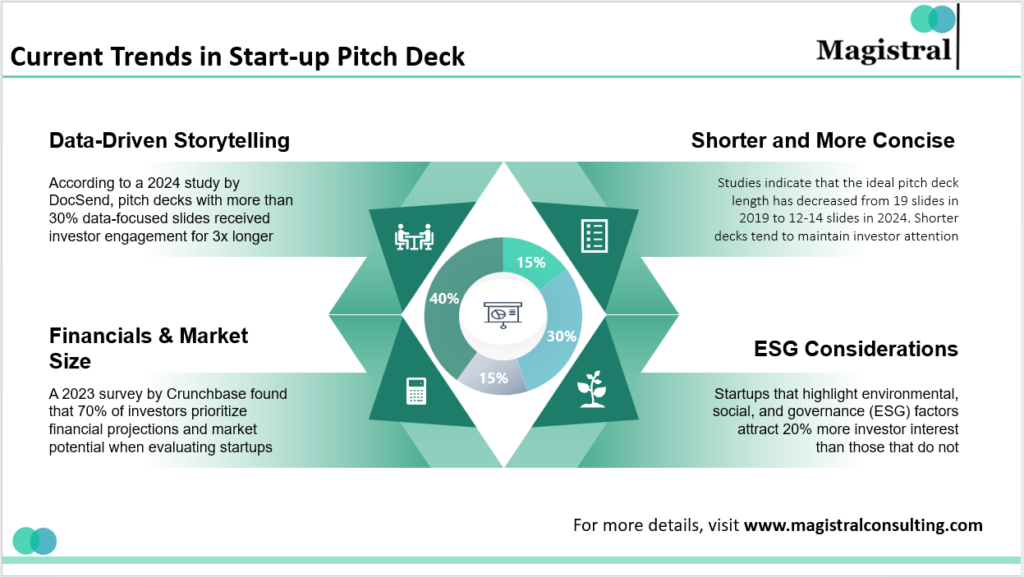
Current Trends in Startup Pitch Deck

Current Trends in Startup Pitch Deck

Data-Driven Storytelling

Investors fully rely on quantitative data. A report shows that pitch decks with 30% or more data-related slides attracted investor engagement 3 times longer than PowerPoint decks with less than the mentioned percentage of data elements.

Shorter and More Concise Startup Pitch Deck

Research indicates that the optimum pitch-deck length has declined from 19 slides in 2019 to 12 to 14 slides in 2024. Shorter decks will maintain an investor’s attention and keep the message sharp.

Financials and Market Size

According to a survey conducted in 2023, funding expectations and market potential attract the most attention from 70% of investors when evaluating startups.

Financials (24% of total viewing time)

Market Opportunity (21%)

Traction and Growth (18%)

Sustainability and ESG Considerations

Startups engaged in environmental, social, and governance issues attract 20% more investor interest than firms ignoring these agendas. Sustainable business models are indeed the new sweet for every VC and impact investor.

Region-Wise Startup Pitch Deck Trends

There are various trends shaping the landscape in the Pitch Deck arena. The regional composition of the emerging trends is as follows:

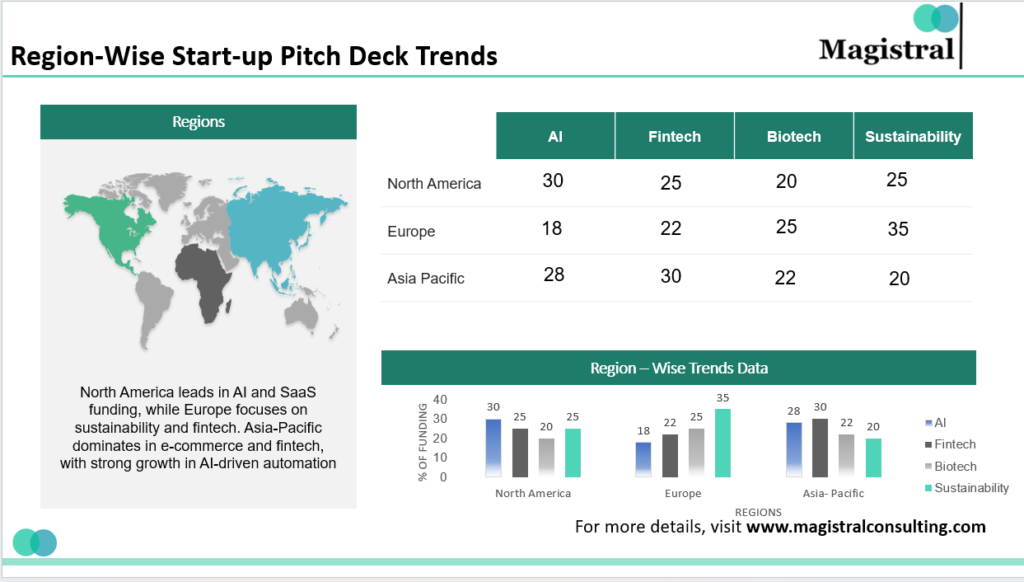
Region-wise Startup Pitch Deck Trends

Region-wise Startup Pitch Deck Trends

North America

60% of investments target AI and SaaS startups.

Much attention from investors tends to be on early funding rounds.

Seed-stage startups secured an average of $2.5 million in 2023.

Europe

45% of funding for startups is directed toward sustainability.

Focus on green technology and fintech.

With a 30% growth rate in 2023, investments are seen in government grants and venture capital.

Asia-Pacific

The sectors containing e-commerce and fintech account for 55% of total investment into startups.

China and India are the leaders in startup funding, having invested more than $80 billion in 2023.

Startups focused on logistics and AI-enabled automation have seen a 40% year-on-year growth.

Essential Components of a Successful Startup Pitch Deck

Statement of the Problem

Indicate precisely what problem is being solved by your startup.

Example: “95% of online shoppers abandon their carts due to lack of real-time support.”

Solution

The idea should show a fresh, creative way of thinking.

A visual showing the state before and after must be provided to reveal the change.

Market Opportunity

The ability to grow is very appealing to anyone looking to invest.

Example: It is expected that the worldwide market for AI will grow to $1.5 trillion by 2030.

Business Model

How to earn money?

For example, subscription, freemium, B2B SaaS, etc.

Data: Subscription-based startups grow 5x faster than straight-sell companies.

Traction & Milestones

Investors prefer startups with proven traction.

Example: We achieved $1 million ARR in 12 months.

The user base grew 300% in 6 months.

Competitive Analysis

Compare your startup with competitors using a SWOT analysis.

Use a comparison matrix to highlight advantages.

Financial Projections

3–5-year revenue forecast.

Break-even analysis.

Example data:  Projected revenue of $50M by Year 5. Expected 40% gross margin.

Funding Requirements & Use of Funds

Clearly define how much funding is needed and how it will be used.

Example: Seeking $5 million in funding for product development (40%), marketing (30%), and team expansion (30%).

Team & Advisors

Highlight key team members’ expertise.

Data: 75% of VC-backed startups attribute success to a strong founding team.

Future Opportunities in Startup Pitch Deck

Interactive & AI-Powered Startup Pitch Deck

65% of investors prefer decks with interactive elements.

AI-powered analytics can track investor engagement.

Personalized Startup Pitch Deck for Different Investors

80% of successful startups tailor pitch decks to specific investors.

Blockchain & Smart Contracts for Fundraising

Token-based fundraising is expected to grow 400 percent by 2027.


Something that presents a momentous proposal in startup culture is almost a guarantee. With a clean and simple design story backing the investment, a deck could lower the startup’s chance of obtaining funding. Financial projections presented in the deck must strive for accuracy to convince the lonesome angel. Leveraging emerging technologies and trends like AI-driven analytics, sustainability, and blockchain fundraising will provide even greater opportunities in the coming years.

With investors spending less than 4 minutes per deck, crafting a clear, engaging, and data-rich presentation is not just a necessity—it’s a game-changer.

Magistral’s Services for Startup Pitch Deck 

Pitch Deck Creation

Offering an irresistible design and strategic format that emphasizes storytelling skill to get your startup some merit by showcasing high-quality data visualization and infographics. Graphics in the pitch deck simplify complex information for your audience to digest and allow investors to gain insights into the most important aspects quickly.

Market Research & Analysis

A well-researched market opportunity strengthens a startup’s investment appeal. Magistral conducts in-depth industry research, competitor analysis, and market sizing, including Total Addressable Market (TAM), Serviceable Available Market (SAM), and Serviceable Obtainable Market (SOM). These insights help startups position themselves effectively and provide investors with a clear understanding of the market potential and competitive landscape.

Financial Modeling & Projections

Investors need a clear picture of a startup’s financial viability, and Magistral helps build robust financial models. Our services pertain to revenue forecasting, cost structure assignment, break-even analysis, and evaluation metrics. By putting in place realistic and data-supported financial projections, startups are also able to establish credibility and support their sustainability in the long run.

Investor Targeting & Strategy

As crucial as a thorough pitch is the identification of the right investors. Magistral helps startups choose potential investors depending on the industry, stage of funding, and investment interests. They also refine messaging to fit the different types of investors so that the startup value proposition resonates with the worthy, increasing the likelihood of getting the funds.

Business Strategy & USP Refinement

Business Strategy & USP Refinement show that this sitting unique startup model and selling proposition stand apart from competition. Thus, assistance comes from Magistral in the business strategy refinement, strengthening value propositions, and optimizing revenue generation streams.


About Magistral Consulting

Magistral Consulting has helped multiple funds and companies in outsourcing operations activities. It has service offerings for Private Equity, Venture Capital, Family Offices, Investment Banks, Asset Managers, Hedge Funds, Financial Consultants, Real Estate, REITs, RE funds, Corporates, and Portfolio companies. Its functional expertise is around Deal origination, Deal Execution, Due Diligence, Financial Modelling, Portfolio Management, and Equity Research

For setting up an appointment with a Magistral representative visit www.magistralconsulting.com/contact

About the Author

The article is authored by the Marketing Department of Magistral Consulting. For any business inquiries, you can reach out to prabhash.choudhary@magistralconsulting.com

[sp_easyaccordion id=”3414″]

Introduction

A start-up pitch deck is a concise summary that provides an overview of your business plan, products, services, and growing success to potential investors or clients. It is often used to convey your vision, value proposition, market opportunity, and essential company characteristics to prospective investors, associates, or stakeholders A start-up pitch deck aims to fascinate and persuade your audience to spark curiosity and support your business idea. A well-designed start-up pitch deck normally comprises several slides covering various elements of your company.

Crafting a compelling startup pitch deck is undeniably one of the most challenging tasks for entrepreneurs. While the overarching objective is to secure funding, the primary aim of the initial presentation is to convince potential investors to extend an invitation for a subsequent meeting. Planning carefully and structuring the components of your start-up pitch deck to convey a compelling story are essential to developing that relationship. Since it’s hard for many firms to stand out in the market due to the enthusiasm and the tough competition for funding, startups need to strengthen their fundraising techniques much more than before.

A start-up pitch deck’s narrative structure is comparable to that of a film trailer in that it sets up the key scenes while maintaining the viewer’s attention and enthusiasm. Start-up pitch decks can be delivered in person or emailed to prospective investors and clients. The most effective technique to make sure a possible partner has gone through all the slides in your start-up pitch deck is often to present it. Additionally, it offers you the chance to respond to any quick queries they may have.

Components of an Effective Start-up Pitch Deck

To effectively convey the value proposition, market opportunity, and development potential of a start-up, a pitch deck typically contains several essential components. Keep your start-up pitch deck brief, focused, and interesting. To hold the attention of your audience and make a lasting impression, each component should be presented simply and persuasively.

Components of an Effective Pitch Deck

Components of an Effective Pitch Deck

The following are crucial components to take into account when designing your start-up pitch deck:

Problem Statement

A pitch deck’s problem statement establishes the context for your company or project by identifying the problem or obstacle that your solution attempts to solve. Clearly state the issue or pain point that your start-up is attempting to solve. Describe the problem’s importance and its effects on your target market.

Solution

Describe the product or service you are offering to solve the issue. Explain how your startup will solve the cited issue and the ways your product or service meets the needs of your target market.

Unique Value Proposition

To stand out from other businesses, emphasize your start-up’s distinctive features, price, or market positioning. Express how you possess a competitive advantage.

Sales and Marketing Strategies

Explain your customer acquisition and marketing techniques. Describe your strategy for attracting and contacting your target market. Discuss your predicted growth trajectory, customer acquisition cost (CAC), and methods of marketing. Discuss probable difficulties and their solutions.

Achievements and Success

Highlight the significant accomplishments, landmarks, and engagement your startup has attained. Display important indicators like user growth, revenue, partnerships, and customer acquisition.

Team Introduction

Include a picture of your squad as a whole to start. As a result, a visual connection is made and your company becomes more personable. Elaborate on your founding group and significant players. Emphasize their background, skills, and experience that are pertinent.

Graphics and Style

Include images, charts, graphs, and other visual components to improve and aesthetically appeal your presentation. Make sure the layout is clear, unified, and simple to read.

Investment Ask

Your start-up pitch deck should end with a compelling call to action. Whatever you desire from your audience – an investment, a collaboration, or additional discussions – express it in clear terms. Include any prospective exits or liquidity events as well as the investment arrangements, such as equity or debt.

Benefits of a Well-Crafted Start-up Pitch Deck

When conveying their business ideas and looking for funding or partnerships, startups, and entrepreneurs can benefit from using pitch decks in several ways. It makes presentations clear and interesting, grabs audience interest, and raises the possibility of winning partnerships or funding.  Here are a few major advantages of a well-designed start-up pitch deck:

Benefits of Well-Crafted Pitch Deck

Benefits of Well-Crafted Pitch Deck

Concise Information:

It makes complicated information easier to understand for your audience by condensing it into simple slides. It offers a clear and short overview of your business endeavor, enabling you to articulate your mission, value proposition, and market potential.

Organized Presentation:

They navigate you through crucial elements like the problem statement, solution, market opportunity, and financial projections to make sure you address every important facet of your enterprise.

Graphical Representation:

You can concentrate on the most important elements of your company or project by using a pitch deck. You can successfully demonstrate your main ideas with the help of visual components like charts, graphs, and photographs in pitch decks.

Drawing Interest:

Potential investors or partners can be attracted by a visually stunning start-up pitch deck with an engaging tale. You can get their attention and leave a lasting impression by using eye-catching pictures, graphics, and clear messaging.

Demonstrating Market Potential:

You may show investors how market research, sales volume, market trends, and target markets can help your company grow and become more appealing.

Feedback and Refinement:

Stakeholder input and insights are obtained when your start-up pitch deck is shared. Your business model, value proposition, and presentation may benefit from this input, which may eventually increase your chances of success.

Magistral’s Start-up Pitch Deck Designing Services

Our team has worked on a variety of pitch decks over the years, some of which have been used to raise money for private equity funds, find co-investors, pitch real estate investments, and exit portfolio companies for incubators.

For a fundraising round to be successful, the entrepreneur’s whole business concept must be presented in the investor pitch. It should include all branding elements, such as colors and logos. Financial projections should include explicit descriptions of revenues, expenses, valuation, and marketing strategies, as well as estimations for client acquisition costs. Only then can the start-up pitch deck appeal to your target market, which is made up of angel investors or VC funds. There are usually some recurring elements in the start-up pitch deck that help it succeed on the roadshow.

Magistral Consulting has supported the fund-raising activities of numerous enterprises, including Private Equity, Venture Capital, Investment Banks, and Asset Management companies.

For our clients’ fundraising endeavors, some of the services that we provide are:

-Create Logos and Websites

-Start-up pitch decks

-Develop Project Plans

-Industry reports

-Financial Modeling

About Magistral Consulting

Magistral Consulting has helped multiple funds and companies in outsourcing operations activities. It has service offerings for Private Equity, Venture Capital, Family OfficesInvestment BanksAsset Managers, Hedge Funds, Financial Consultants, Real Estate, REITs, RE fundsCorporates, and Portfolio companies. Its functional expertise is around Deal originationDeal Execution, Due Diligence, Financial ModellingPortfolio Management, and Equity Research.

For setting up an appointment with a Magistral representative: visit www.magistralconsulting.com/contact

About the Author

The article is authored by the Marketing Department of Magistral Consulting. For any business inquiries, you can reach out to  prabhash.choudhary@magistralconsulting.com

Over the years our team has worked on multiple pitch decks, some raising funds for a Private Equity fund, some looking for co-investors, some pitching a real estate investment while others for incubators trying to exit a portfolio company.

Recently the demand for pitch deck outsourcing has gone up due to more sophisticated demands from angel investors and VC firms for a robust business plan. Also, pitch deck design requirements have also gone up by several notches. A potential investor judges the business potential of a startup from the PowerPoint Presentation or the pitch presentation that details the business, its target audience, clients, its social media presence, marketing collateral, customer acquisition strategy, digital marketing strategy, and several other operational ideas about the upcoming startup. A pitch deck that explains the business idea well gets multiple investors. A pitch deck template with attractive graphic design that also explains the business model well will get the attention of angel investors. A successful pitch deck explains the value proposition, details out the financial model, talks about all the market segments, that the small business is trying to reach out. Investor pitch should be the entrepreneur‘s complete idea of the business for a successful fundraising round. It should have all the branding aspects in terms of colors, logos, etc. Financial projection should clearly spell out revenues, costs, valuation, and marketing plans with calculations around customer acquisition cost and strategy. It’s then only that the pitch deck will resonate with your target audience which is angel investors or VC funds.

Almost, always there are some consistent characteristics of the pitch deck that eventually pulls it off on the road-show. Here are these characteristics of the winning pitch deck:

1. Number of Slides: The number of slides for an investment pitch deck is ideally is 10-12. It can go as high as 20, but anything over that is overkill to raise money. A pitch that we designed only on 5 slides, for real-estate investment, was used to raise as much as 10 Million USD in co-investments

2. The flow of Presentation: Information has to flow like a stream of water. You introduce a subject, just to tease the reader and before an obvious question, your next slide is sitting there, answering it. Slides are as engaging as a story-book. Typical example: Start with a universal problem that everyone acknowledges, detail the current ways of solving the problem, go onto propose how all existing solutions are ineffective, present your solution that is different from everything else out there, give business case for your solution, your funding requirements, what can investors expect and finally closing it with the team profile and their accomplishments. Everything flows one after the other like an engaging storybook

3. Structure within a slide: All tables and structures used consistently follow the MECE principle. MECE stands for Mutually Exclusive and Collectively Exhaustive. A combination of any number of bullet points on a slide has to be MECE. All bullet points combined should exhaustively cover all aspects of a subject and at the same time, no two bullet points should convey anything similar

4. Brand logo and color consistency: Rainbow of colors look good on a book that carries nursery rhymes, but for something that is meant for an Investment Banking crowd, it needs to be soberer. Limited colors on slides which specifically need to be derived from the brand logo, shows the professionalism of the presenter. Loud colors can be used for investment themes related to B2C but for anything B2B, hues need to be tapered down

5. The structure across the slides: If something is repeating again and again on multiple slides, like fund returns of different funds on different slides, the corresponding data needs to be at the exact same place on every slide. It’s like while you quickly move from one slide to another, tables should not dance from its place. The eye of the recipient gets trained to see specific data at a specific place on every slide

6. Less the text, better: For everything that can replace a text is welcome. A picture says a thousand words and one should use info-graphic or a picture to convey rather than writing a thousand words on slides

7. Back-up Material: Although fewer slides are there on a pitch deck, every number that is used on the slide should have a detailed back-up ready to be opened in case of a query. A 5 slides Pitch Deck is usually preceded by 30-40 page business case or a project plan. Another excel carrying P&L, Balance Sheet and Cash Flow projections almost always follow. Financial Modeling is done for more complex investment plans

8. Team Bio: It’s the team that usually gets funding. Their credentials and experience are almost always highlighted in the pitch deck. It needs to be made sure that pictures of all partners are there, preferably in similar professional outlook, clicked at similar zooms, preferably in professional or no background

9. Simplifying the content: We work on multiple concepts that are very “Sciency” and “Academic”, like a core tech, topics that are purely academic, a scientific breakthrough or global epidemic. Material that is available on the topic is good for pursuing a doctorate but the idea is to simplify all these core concepts to the level that is easily understood by investors and in the least amount of time.

There may be several other things that might be important for a pitch deck in a niche area or a specific situation, but almost all the winning pitch decks in our experience have these common characteristics.

Magistral (www.magistralconsultig.com) has worked with multiple firms like Private Equity, Venture Capital, Investment Banks, and Asset Management companies in supporting their fund-raising efforts. We have prepared logos, website and website content, pitch decks, project plans, industry reports and financial modeling that support the fund-raising efforts of our clients.

The author is the CEO of Magistral Consulting and can be reached at Prabhash.choudhary@magistralconsulting.com for any queries or work samples.


Tags/ Keywords: Pitch Deck Outsourcing, Pitch Deck, Outsourced CFO, Investor Pitch Deck, Investor, Business Plan, Pitch Deck Design, Startup, Startup Pitch Deck, Small Business Owners, Potential Investors, Presentation, PowerPoint Presentation, Pitch Presentation, Marketing, Slide Deck, Design, Outsourcing, Elevator Pitch, Social Media, Target Audience, Start-up Founder, Venture Capital, Business, Winning Pitch Deck, Web Design, marketing collateral, customer acquisition, digital marketing, business idea, pitch deck template, graphic design, business model, audience, angel investor, clients, successful pitch deck, funding, value proposition, financial model, market, small business, silicon valley, target market, investor pitch, entrepreneur, fundraising, branding, financial projection, customer acquisition cost