Tag Archives: Deal Origination Outsourcing

Deal execution is now characterized by measurable aspects of deal-making speed and efficiency as well as capital deployment results instead of merely deal completion processes. According to Bain & Company, top-quartile private equity firms achieve deal completion 20-30% faster than median-quartile firms. This means faster access to competitive deal flow. On the other hand, McKinsey & Company found that deal execution frameworks can increase accuracy in decision-making processes by as much as 30%, hence reducing mis-pricing risks in high-multiple deal-making. With private equity dry powder now above $3 trillion globally, as Preqin found out, efficient execution is now a quantifier for deal-making differentiation.

Deal execution now affects deal-making entry prices as well as deal-making certainty. In competitive deal-making processes such as auctions, sellers now prefer deal makers whose execution is as competitive as their prices. Thus, it is no longer merely a deal-making phase but a quantifier for deal-making results as well as risk mitigation and deal efficiency.

Deal Execution and Time-to-Close Metrics

It can now be quantified and measured based on deal-making efficiency as well as deal-making results.
Deal Execution

Deal Execution and Time-to-Close Metrics

Compression of deal timelines

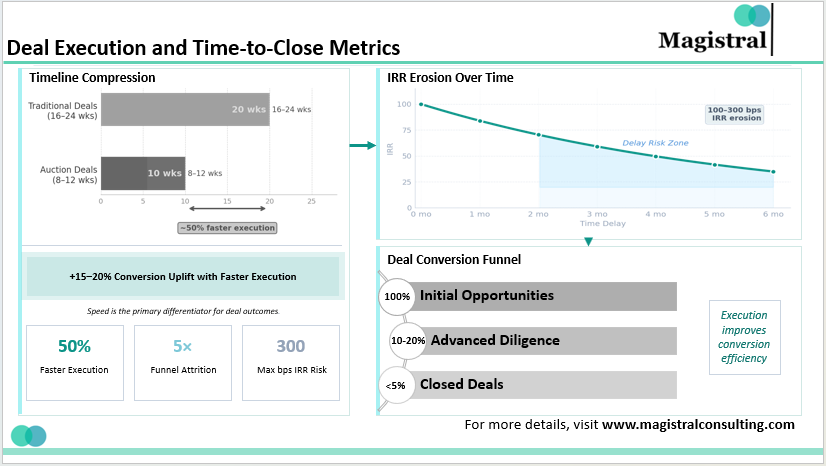
Average deal timelines for private equity deal-making have compressed considerably in competitive deal-making processes. According to Bain & Company, average deal timelines for auction-driven deal-making are now between 8-12 weeks as opposed to 4-6 months in less competitive deal-making processes. Faster deal makers have a significant advantage in acquiring high-quality deal flow, especially in proprietary or semi-competitive deal-making processes.

Impact of Delays on IRR

This has a direct mathematical impact on the returns. A 3–6-month delay in the deployment of capital can cause the returns to drop by 100-300 basis points depending on the assumption used in the calculation of the holding periods.

Parallel execution efficiency gains

Firms employing parallel execution models benefit from a 20-25% reduction in execution cycle. This is because the financial diligence, legal review, and financing processes occur simultaneously.

Conversion rates across the deal funnel

Industry benchmarks show that only 10-20% of the initial opportunities advance to the advanced diligence stage. Only fewer than 5% of the opportunities advance to the deal completion stage. The structured execution model improves the conversion rates.

Deal Execution and Capital Deployment Efficiency

It has a direct impact on the efficiency of the capital deployment and the returns on the investment.
Deal Execution

Deal Execution and Capital Deployment Efficiency

Dry powder pressure and deployment speed

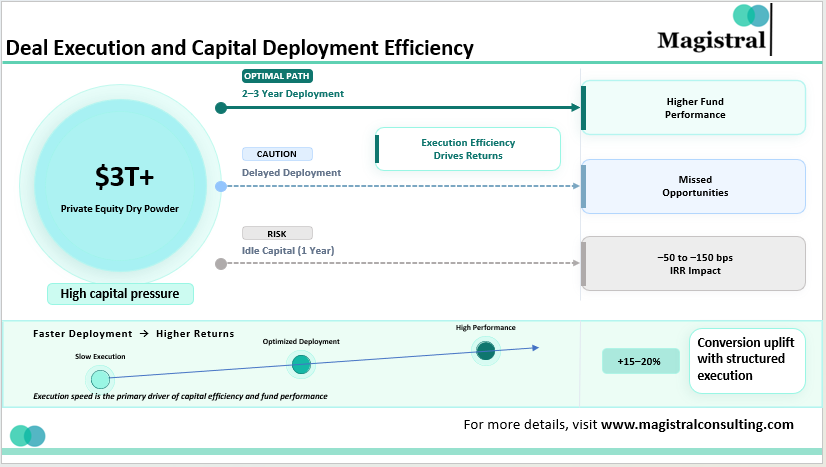
With the dry powder in the private equity industry standing at more than $3 trillion globally, the pressure on the private equity firms to deploy the dry powder efficiently has increased. Firms taking longer times to deploy the dry powder may be missing out on good investment opportunities. The dry powder of the peers may be deployed efficiently.

Deployment speed and fund performance

Funds taking 2-3 years to deploy the dry powder tend to perform better compared to the peers taking longer times. This enables the fund managers to create shareholder value early.

Idle capital impact

One year of idle capital can cause the returns to drop by 50-150 basis points depending on the conditions. This makes the efficiency of the execution critical in the private equity industry.

Pipeline conversion efficiency

Firms with structured execution processes achieve a 15-20% uplift in deal conversion rates due to better prioritization, speed, and coordination.

Deal Execution and Risk Quantification

It is closely related to quantified risk results, especially with high-value and high-contested deals.

Valuation risk and execution accuracy

Valuation multiples are high in various industries. This means that overpaying is a potential risk. McKinsey points out that an incorrect calculation by 1-2 times the EBITDA multiple can have major implications. A structured execution process eliminates this risk by improving validation, cross-checks, and accuracy.

Error reduction through standardization

Standardized execution processes achieve a 20-30% reduction in operational errors, especially with financial modelling, documentation, and compliance. This improves deal quality and enhances investors’ confidence.

Regulatory and compliance risk

Cross-border deals now account for an increasing proportion of all private equity transactions. This means that regulatory complexity is an added risk. A structured execution process eliminates delays due to compliance issues by improving documentation and approvals while adhering to regulatory requirements.

Diligence to execution integration

Firms that directly incorporate diligence results into their execution process achieve over a 20% reduction in post-deal surprises. This aligns investment and execution decisions.

Deal Execution and Technology-Driven Efficiency

Technology is driving improvements to deal execution speed, accuracy, and coordination.

Digital Deal Room Adoption

More than 90% of all private equity firms have now adopted virtual data room technology. This has reduced document processing times and made information sharing easier due to geographical dispersion.

Automation-driven efficiency gains

Automation achieves a 25-40% reduction in manual work effort required to execute deal-related processes, especially with data aggregation, reporting, and documentation.

Real-time execution tracking

Real-time execution tracking helps firms improve execution efficiency by 15-25 percent by reducing execution delays.

Analytics-enabled decision-making

The application of data-driven execution models helps firms improve decision-making efficiency by 20-30 percent.

Deal Execution and Value Creation Linkage

The importance of execution has increased in terms of the rate at which value creation initiatives begin.

Speed to value creation

The ability of firms to execute from deal execution to control within 30-60 days helps in faster realization of value creation initiatives.

Operational value contribution

The contribution of operational value creation has increased in recent private equity transactions, according to PwC.

Early identification of value drivers

The application of execution frameworks helps firms identify value creation early, thus improving returns.

Post-deal performance tracking

The application of performance tracking from the beginning helps firms improve efficiency in tracking performance by more than 25 percent.

Deal Execution and Competitive Performance Gap

The difference in execution efficiency has increased in terms of being a differentiator between high-performing firms and average firms.

Speed advantage of top-quartile firms

The application of execution frameworks by top private equity firms helps in faster execution, which is 20-30 percent faster compared to the rest of the firms.

Consistency in execution outcomes

The application of execution frameworks helps firms improve consistency in execution outcomes.

Investor Perception and Fundraising Impact

Strong execution track records boost LP confidence, thereby having a direct impact on fundraising success and capital raised.

Scalability in Deal Volume

Execution models enable firms to grow deal volume without a corresponding increase in cost, thus enhancing operating leverage and efficiency.

About Magistral Consulting

Magistral Consulting has helped multiple funds and companies in outsourcing operations activities. It has service offerings for Private Equity, Venture Capital, Family Offices, Investment Banks, Asset Managers, Hedge Funds, Financial Consultants, Real Estate, REITs, RE funds, Corporates, and Portfolio companies. Its functional expertise is around Deal origination, Deal Execution, Due Diligence, Financial Modelling, Portfolio Management, and Equity Research

For setting up an appointment with a Magistral representative visit www.magistralconsulting.com/contact

About the Author

Dhanita is a BD and Marketing professional with 6+ years’ experience in sales strategy, growth execution, and client acquisition; credentials include Stanford Seed (Stanford GSB), an MBA from USMS–GGSIPU, and a B.Com (Hons) from the University of Delhi. Expertise spans market research and opportunity mapping, sales strategy, CRM, brand positioning, integrated campaigns, content development, lead generation, and analytics; currently oversees business development calls and end-to-end marketing operations

FAQs

What is deal execution in private equity?

Deal execution in private equity refers to the process of executing deals.

Why is deal execution becoming increasingly data-driven?

It has become increasingly data-driven because firms use quantifiable measures such as speed, conversion rates, and efficiency.

What impact does deal execution have on returns?

Deal execution has a positive impact on returns because the speed of execution enables the deployment of capital, thus enhancing IRR.

What role does technology play in deal execution?

Technology plays a crucial role in it by enhancing speed, accuracy, and efficiency.

What are the different ways in which a PE firm can enhance deal execution performance?

Deal execution performance can be improved by using standardized processes, a centralized data system, and parallel execution.

Finding quality deals and proprietary opportunities has become more challenging, making deal origination outsourcing a mainstream strategy for both funds and corporate investors. By leveraging non-core processes, managers gain access to broader networks and tech-driven solutions without significant cost growth. According to PwC and Deloitte, alternative asset managers increasingly rely on experts for sourcing, screening, and early-stage diligence as deal cycles shorten and investor demands rise. Outsourcing enhances, rather than undermines, institutional judgment.

It is, in essence, expanding your origination platform globally and across industries. It is with direct institutional judgment focused on conviction and decision-making.

Deal Origination Outsourcing: Response to Market Complexity

Investment managers are adopting deal origination outsourcing to handle the growing volume of deal opportunities and internal processing demands. The global middle-office outsourcing market, valued at USD 8.5 billion in 2024, is expected to grow to USD 16.9 billion by 2033, with a CAGR of 7.47%. This growth is driven by stricter reporting, transparency, and increased investment complexity, alongside greater reliance on tech-led compliance management. Deal origination outsourcing helps firms create a systematic, adaptable approach for sourcing deals, with third parties handling market mapping, entity identification, and outreach.

Deal Origination Outsourcing: Response to Market Complexity

Deal Origination Outsourcing: Response to Market Complexity

Expanding coverage without expanding headcount

The key benefit of sourced origination is scalable coverage, allowing teams to monitor hundreds of companies simultaneously. As private equity firms expand into growth equity, buyouts, and special situations, it’s challenging to maintain consistent origination outside their networks. Sourced origination provides market insights without the overhead of physical offices. In North America, 47% of mid-market PE & VC firms have increased reliance on third-party providers, with 44% maintaining usage levels, and only 9% reporting a decrease, signaling a positive and accelerating trend.

Data-driven sourcing in a crowded landscape

Deal origination outsourcing is rapidly integrating the use of human intelligence and the power of data and analytics. This is done by service providers who utilize industry-specific databases and transaction intelligence. It also uses AI-driven screening tools to identify and prioritize target companies earlier than before. According to a study conducted by Deloitte in 2024,  “Funds that adopted a data-driven sourcing approach achieved a shorter time to first meeting compared to a relationship-driven approach.”
>Such capabilities fit with the wider transformation currents in the middle office. The tech used is not only for efficiency but to support investment decision-making and governance.

Reducing opportunity cost for senior investors

Each hour spent by senior partners in list building, data cleaning, or canvassing cold leads is time taken away from valuation, negotiation, or interacting with the LPs. In doing away with repetitive and process-driven sourcing work, deal origination outsourcing helps senior investors in leveraging opportunities in which their know-how possesses compound returns. It is known that venture capital organizations increasingly use outsourced analyst staff. It is for tracking new companies in various ecosystems in preparation for partners to contact only after principal fit is ascertained.

Deal Origination Outsourcing and Its Impact on Investment Efficiency

Outsourcing origination in deals directly impacts how efficiently capital moves from mandate to deployment. Efficiency herein is not merely speed, but quality-adjusted speed.
>According to an analysis of private market transactions, funds that have structured sourcing frameworks appeared to experience fewer instances of late-stage deal dropouts. Outsourcing plays into that role as well, with the process enhancing early filtering and documentation.

Improving deal quality through structured screening

Outsourced teams screen opportunities, using pre-defined investment criteria, before they ever reach the investment committees. This discipline cuts down the noise and keeps them on strategy with the fund. This, in conjunction with internal expertise in valuation and DCF modelling, paints an earlier and clearer picture for the investment teams with minimal rework later in the process.

Supporting thematic and sector-focused strategies

Many funds now pursue themes such as digital infrastructure, healthcare services, or climate-aligned assets. Deal origination outsourcing supports this shift by maintaining continuous sector scans rather than episodic sourcing pushes. For example, infrastructure-focused funds increasingly rely on external partners to monitor regulatory changes and asset pipelines. It is done across regions, feeding insights into capital raising narratives for investors.

Enhancing collaboration across functions

Effective origination requires coordination between sourcing, due diligence, and execution. Sourced teams also tend to integrate with CRM platforms and internal business processes. Its such that analysis results are effectively aggregated to investment banking-style execution teams. The process eliminates friction as well as increases cycle times without sacrificing analysis or due diligence.

Deal Origination Outsourcing: Technology-Led Transformation

Technology is transforming deal origination outsourcing, with firms shifting from spreadsheets and cold calling to AI-powered platforms. The AI in Finance market is set to grow from USD 38.36 billion in 2024 to USD 190.33 billion by 2030, driven by AI-centric models. Over 80% of financial institutions plan to boost spending on explainable AI, model governance, and predictive analytics. In deal origination, outsourced providers are key, with more than 60% of alternative asset managers expected to increase tech spending on sourcing and pipeline management by 2024.

This trend aligns with overall management, with the North America region having contributed to a market share of 35.3% of the AI in Finance market in 2024 due to increased acceptance of analytics and automation in private capital markets.

Deal Origination Outsourcing: Technology-Led Transformation

Deal Origination Outsourcing: Technology-Led Transformation

AI-enabled target identification

Advanced AI tools now analyse large volumes of financial data, growth indicators, transaction patterns, and behavioural signals to identify companies most likely to seek capital, pursue strategic partnerships, or explore exits. Compliance automation platforms are currently the fastest-growing AI product segment at a projected 35.7% growth rate, also play a role by ensuring cleaner datasets and reducing regulatory friction during early screening. When combined with human validation, AI-enabled sourcing improves hit rates, shortens origination cycles, and reduces time spent on misaligned opportunities, reinforcing the trend of technology augmenting rather than replacing investment judgment.

Knowledge continuity and institutional memory

One of the least discussed benefits of deal origination outsourcing is related to structured knowledge retention. This is because external teams can keep track of structured data points like contacts, manager interaction, feedback, and timing cues. This enables structured knowledge retention, which in turn benefits from an overwhelming presence of advanced AI, exceeding 91% in the market in 2024, through intelligent data tagging and search.

Integrating origination with downstream processes

Contemporary outsourcing approaches now integrate origination outputs directly with diligence,, valuation, and investment committee processes. This streamlines processes, prevents redundancy, and provides a clean, auditable trail from first touch through investment decision. In a world where private funds find themselves under greater scrutiny from their limited partners, especially about adherence to processes and governance, this is a big boost to both credibility and efficiency.

Deal Origination Outsourcing with Magistral Consulting

As deal origination outsourcing matures, the focus shifts from volume to relevance. Investment teams need partners who understand strategy, not just sourcing mechanics. Magistral Consulting approaches origination as an extension of the investment office, aligning research, analytics, and outreach with each client’s mandate.

By combining sector-focused analysts, technology-driven screening, and seamless integration with diligence and deal support workflows, Magistral helps funds build resilient pipelines. Whether supporting private equity, venture capital, or corporate investors, the emphasis remains on quality first origination that converts into executable opportunities. In a market where attention is scarce and competition intense, deal origination outsourcing becomes most powerful when it feels less like outsourcing and more like collaboration.


About Magistral Consulting

Magistral Consulting has helped multiple funds and companies in outsourcing operations activities. It has service offerings for Private Equity, Venture Capital, Family Offices, Investment Banks, Asset Managers, Hedge Funds, Financial Consultants, Real Estate, REITs, RE funds, Corporates, and Portfolio companies. Its functional expertise is around Deal origination, Deal Execution, Due Diligence, Financial Modelling, Portfolio Management, and Equity Research

For setting up an appointment with a Magistral representative visit www.magistralconsulting.com/contact

About the Author

Prabhash Choudhary is the CEO of Magistral Consulting. He is a Stanford Seed alumnus and mechanical engineer with 20 + years’ leadership at Fortune 500 firms- Accenture Strategy, Deloitte, News Corp, and S&P Global. At Magistral Consulting, he directs global operations and has delivered over $3.5 billion in client impact across finance, research, analytics, and outsourcing. His expertise spans management consulting, investment and strategic research, and operational excellence for 1,200 + clients worldwide

FAQs

What is Deal Origination Outsourcing

Deal Origination Outsourcing refers to engaging external specialists to support sourcing, screening, and early engagement of investment opportunities while internal teams retain decision-making authority.

How does Deal Origination Outsourcing reduce costs?

It converts fixed headcount expenses into flexible engagement models, allowing firms to scale sourcing activity up or down without long-term commitments.

Is Deal Origination Outsourcing suitable for smaller funds?

Yes, emerging managers often benefit the most as outsourcing provides immediate access to research depth and networks that would otherwise take years to build.

Does outsourcing affect relationship-driven sourcing?

When structured well, it complements relationships by ensuring consistent follow-ups and broader market coverage rather than replacing partner-level interactions.

How long does it take to see results from Deal Origination Outsourcing?

Most firms begin seeing qualified opportunities within a few months, though sustained value compounds over time as pipelines and market intelligence deepen.