Tag Archives: Family Office Service Providers Outsourcing

Family offices are responsible for handling more complex investment portfolios, legal entities, reporting, private investments, taxation issues, and succession plans. However, creating a larger internal workforce for all specializations is often expensive, involves inefficient work processes, and relies heavily on several employees. Outsourced family office services represent another approach where analysts, accountants, researchers, technologists, and administrators serve as the extension of the internal family office.

Outsourced Family Office Services Foundations and Operating Models

The family office is not supposed to hire external providers to cut down staff. Rather, the model of its operations should help separate strategic functions from those that can be performed efficiently by an external provider.

Outsourced Family Office Services

Outsourced Family Office Services: Foundations & Operating Models

Why Family Offices Use External Specialists

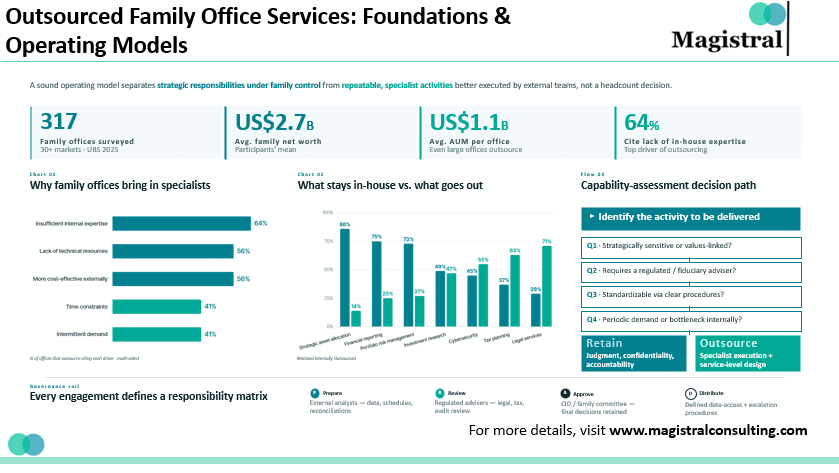
UBS conducted a survey of 317 family offices in 2025 in more than 30 markets. The families that participated had an average net worth of US$2.7 billion, and their family offices managed an average of US$1.1 billion. Of the outsourcing family offices, 64% reported that they lacked internal expertise, 56% did not have the required technical capacity, and 56% found the outsourcing of tasks more cost-efficient. Time constraints and irregular demand were reported by 41% each.

This information proves that outsourcing is not only practiced by small companies. Even large offices with a considerable amount of assets could find it difficult to provide full-time employees dedicated to the tasks of cybersecurity, complex evaluations, tax analysis, manager research, and unique transactions. Thus, the proper mandate for outsourced family office services must start from an assessment of the capabilities. It would be important to list the activities that involve strategic decisions, need regulated advisors, cause bottlenecks in operations, and have standardization procedures.

What Should Remain Under Family Control

It usually happens that the family office stays responsible for the issues connected with the values, investment philosophy, governance, privacy, and relations. Thus, according to the results provided by UBS, 86% of offices made strategic asset allocation internally, and 75% and 73% made their own financial reporting and portfolio risk management. The above-mentioned figures prove the necessity of the presence of judgment and confidentiality in the process of outsourced family office services.

Accountability need not involve doing all the supporting tasks in-house. This is because an outside team can collect portfolio data, reconcile documents, produce analytic schedules, review managers’ reports, and manage dashboards while the chief investment officer or family committee makes the calls.

Functions Commonly Suitable for Outsourcing

The best candidates for outsourcing are those that have both high technicality and episodic need. According to the UBS study, 71% of firms outsourced legal services, 63% outsourced tax planning, and 55% outsourced cybersecurity. Investment research was also about even, with 49% conducting investment research in-house and 47% using external parties, which explains why many firms currently regard outsourced family office services as a specialty overlay function instead of a substitute for in-house capabilities. In practice, outsourced family office services are most effective when the scope is clearly documented and tied to measurable deliverables.

Other possible fields include bookkeeping, entity administration, capital call management, document management, market analysis, performance attribution, company management, and direct investment support. There may be different analytical templates, valuations calendars, and risk indicators for families using private equity, venture capital, real asset, and credit strategies.

Governance and Service-Level Design

All engagements should specify ownership, deadlines, approval rights, data access policies, escalation provisions, and service level targets. Responsibility charts could clarify who is responsible for the preparation, review, approval, and delivery of each deliverable. It is also advisable for families to keep the roles of service providers and advisors separate. External analysts could prepare schedules, analysis, and models, whereas licensed lawyers, accountants, auditors, or investment professionals should be responsible for providing formal advice and approval.

Applications and Use Cases for Outsourced Family Office Services

The value of outsourced family office services varies depending on where a family office finds itself in its family office lifecycle. A startup family office may need help in establishing infrastructure and reporting, while a well-established family office with multiple generations can be in need of specialized investment research and technology integration, among others. The importance of outsourced family office services is increasing with growth in the family office industry.

Outsourced Family Office Services

Outsourced Family Office Services: Applications & Use Cases

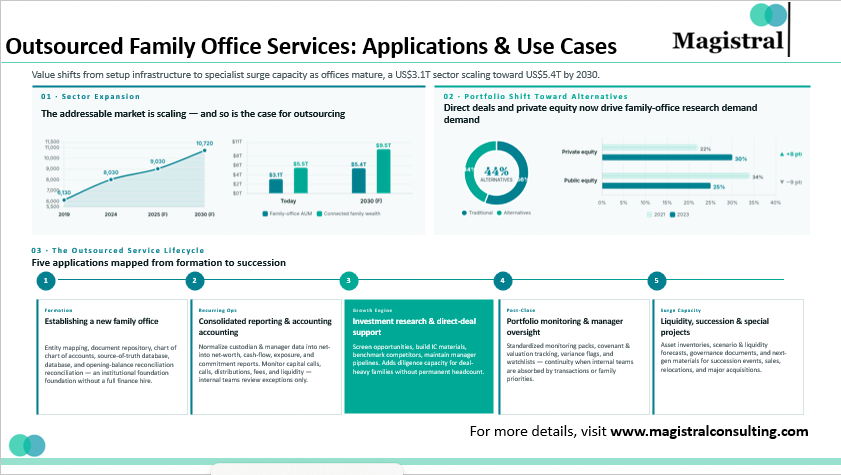
According to Deloitte, the number of single-family offices worldwide is 8,030, compared to 6,130 in 2019, and is expected to increase to 9,030 in 2025 and 10,720 in 2030. Deloitte estimates family office AUM to currently be around US$3.1 trillion and to possibly reach US$5.4 trillion in 2030, while family wealth managed through family offices is US$5.5 trillion and possibly US$9.5 trillion in 2030.

Establishing a New Family Office

The initial set of a new family office often includes assets invested with various banks, holding companies, trusts, partnerships, and even some directly owned investments. The first step before any analysis takes place is to build the entity structure, gather all relevant documentation, establish the reporting schedule, chart of accounts, and source-of-truth database. It can be done through hiring an outside team that will gather the historical documentation, establish the structure, reconcile the opening balances, and develop a management reporting tool.

It provides an institution without having to hire a whole finance and research department in the process of building an office. This approach, which works well for fund managers, can work for family offices with multiple investment vehicles as well, but the workflow should be adjusted accordingly.

Consolidated Reporting and Accounting Support

The information received by families from the custodians, administrators, private-market managers, operating companies, and advisers is usually not in standardized format. External professionals can standardize the information and create consolidated net-worth reports, cash flow reporting, exposure reporting, commitment reporting, and accounts by entities. Moreover, the provider may be monitoring capital calls, distributions, management fees, loans, tax documentation, and liquidity needs. The internal professionals may then look at the exceptions rather than spending time compiling spreadsheets. It is one of the most practical ways of using outsourced family office services, as the task is recurring, control-focused, and measurable.

Investment Research and Direct-Deal Support

Family offices actively engage in private transactions, co-investments, and direct investments into companies. UBS has reported that family offices had 56% of their portfolios allocated to traditional investments and 44% to alternatives in 2024, with equities accounting for 30%, while private equity, direct investments, and real estate dominated the alternative bucket. Private Equity has also been reported to make up 30% of the average portfolio of the survey respondents in 2023, according to Deloitte’s family office research, while public equities dropped from 34% in 2021 to 25%.

An external research team can screen opportunities, prepare company profiles, analyze industries, benchmark competitors, review financial projections, and build investment-committee materials. It may also maintain a pipeline of managers, intermediaries, co-investors, and relevant funds. For deal-heavy families, outsourced family office services can add diligence capacity without permanently increasing headcount.

Portfolio Monitoring and Manager Oversight

External analysts can convert manager reports and portfolio-company updates into standardized monitoring packs. They can flag variances against budgets, summarize board materials, and maintain watchlists. This creates continuity when internal professionals are occupied with transactions or family priorities.

Liquidity, Succession, and Special Projects

Succession events, asset sales, relocations, and major acquisitions can create temporary surges in analytical work. UBS found that only 53% of surveyed families had a formal wealth-succession plan, while just 26% involved the next generation from the outset. Campden Wealth’s 2025 operational-excellence research, based on 146 family offices, also found that 57% of families now live across borders, increasing the need for coordinated tax, estate, investment, and governance support.

External teams can prepare asset inventories, scenario analyses, liquidity forecasts, governance documents, and educational materials as a part of outsourced family office services. They should work alongside the family’s legal and tax advisers rather than replacing them.

How Magistral Consulting Helps in Outsourced Family Office Services

Magistral Consulting assists family offices in terms of being an additional part of the finance, investment, and operations departments through outsourced family office services. Such services are provided as research on investments, financial modeling, monitoring of the portfolio, reporting, assistance in transactions, CRM management, and marketing to investors.

Due to flexible staffing, outsourced family office services make it possible for family offices to expand their staff when they face busy periods without hiring permanent employees. Having a proprietary database consisting of more than 45,000 investors in LPs, GPs, angel investors, HNWIs, and other types of investors, Magistral also offers specific help with fundraising and market research.


About Magistral Consulting

Magistral Consulting has helped multiple funds and companies in outsourcing operations activities. It has service offerings for Private Equity, Venture Capital, Family Offices, Investment Banks, Asset Managers, Hedge Funds, Financial Consultants, Real Estate, REITs, RE funds, Corporates, and Portfolio companies. Its functional expertise is around Deal origination, Deal Execution, Due Diligence, Financial Modelling, Portfolio Management, and Equity Research

For setting up an appointment with a Magistral representative visit www.magistralconsulting.com/contact

About the Author

Aman is an investment-research specialist with 5+ years of experience across business and investment research, including 2+ years with Big Four firms like KPMG. A Stanford Seed alumnus with an MBA in Finance and a Bachelor of Commerce (Hons) from University of Delhi, he focuses on private equity, venture capital, and renewable energy sectors. He leads project teams at Magistral Consulting, delivering financial research, due diligence, deal sourcing, and M&A support, while driving strong process management and analytics. His blend of attention to detail, strategic thinking, and dynamic execution enables him to turn complex data into actionable investment insights.


FAQs

What functions can a family office outsource?

Common functions include accounting support, consolidated reporting, investment research, portfolio monitoring, entity administration, cybersecurity, data management, and project-based analysis.

Which activities should remain in-house?

Families often retain governance, strategic asset allocation, final investment approvals, sensitive relationships, privacy decisions, and oversight of external providers.

Is outsourcing suitable only for smaller family offices?

No. Large offices also use specialist providers to obtain technical expertise, handle temporary workloads, support international activities, and avoid maintaining underutilized roles.

How can a family office protect confidential information?

It should evaluate access controls, encryption, employee screening, data residency, incident-response processes, subcontractors, confidentiality agreements, and business-continuity arrangements.

How should provider performance be measured?

Use agreed service levels covering accuracy, turnaround time, unresolved exceptions, reporting deadlines, response times, documentation standards, and stakeholder satisfaction.


Family offices—private firms that manage the wealth of high-net-worth families—are now a force in world finance. They manage more than $5.5 trillion in assets. By 2030, the doubling of these figures to $9.5 trillion will create families that control and influence investment behavior, asset allocation policies, and wealth-management strategies. In contrast to conventional wealth managers, family offices provide more flexibility, long-term orientation, and direct decision-making authority over investments, enabling them to move quickly in response to market changes.

Global Expansion of Family Offices

The rapid rise in family wealth has fueled significant growth in family offices and family office investment, a trend expected to continue. Increasing wealth concentration, successful generational wealth transfers, strong private equity and M&A markets, and the demand for tailored investment strategies are driving this surge.

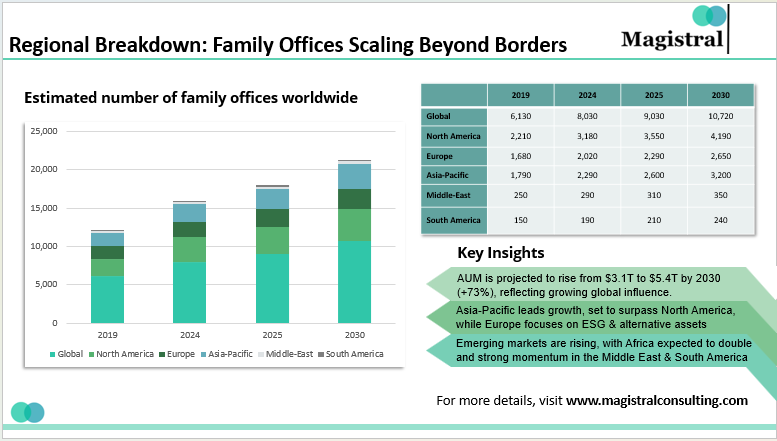
Currently, 8,030 single-family offices exist globally—a 31% increase from 6,130 in 2019. Projections indicate the number will reach 9,030 in 2025, and by 2030, it is expected to grow by 75%, reaching 10,720.

  • Key factors driving this expansion:
    • The transition from conventional wealth managers to in-house teams for tailored family office investment approaches.
    • Increased direct investment and private equity participation, avoiding fund managers.
    • Growing entrepreneurial wealth, especially in technology and emerging markets is impacting family office investment.

Regional Breakdown: Family Offices Scaling Beyond Borders

As family offices expand in size, many are venturing outside of a single location. Currently, 28% of family offices run multiple branches, while another 12% plan to open additional offices. North America and Asia Pacific represent the two main areas for these family offices, with the highest projection of expansion in each region at 34%, followed by Europe at 24%. Family offices increasingly set up branches in Singapore and Dubai, benefiting from tax incentives and global connectivity.

Regional Breakdown: Family Offices Scaling Beyond Borders

Regional Breakdown: Family Offices Scaling Beyond Borders

As family offices expand, they are also increasing total assets under management (AUM). Currently at $3.1 trillion, AUM is projected to rise 73% to $5.4 trillion by 2030, reflecting its growing influence in global wealth management. Here is the regional breakdown:

Asia-Pacific (Fast Growth)

The APAC region has already surpassed Europe with 2,290 offices and will outstrip North America by 2030. Wealth from China, Singapore, and India is driving this growth.

North America (Largest Market)

North America currently has 3,180 family offices. The industry will expand by 90%, growing from 2,210 in 2019 to 4,190 by 2030. Robust private markets and tax-effective estate planning are driving this growth.

Europe (Stable Growth)

Currently, there are 2,020 offices in Europe, growing by 650 to a number expected to reach 2,650 by 2030. There is an emphasis on ESG investing and alternative assets.

Emerging Markets (Middle East, South America, Africa)

In numbers, Africa is at the lowest, but it is expected to double its numbers by 2030 as wealth rises.


Family Office Wealth: Projected to Reach $9.5 Trillion by 2030

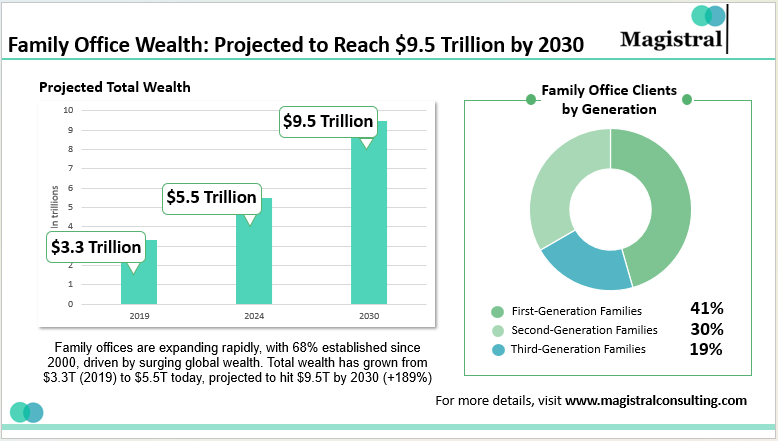
Since the millennium, a sharp increase in global family wealth has driven the establishment of 68% of family offices. Families with family offices have surged their total wealth by 67%, growing from $3.3 trillion in 2019 to $5.5 trillion today. They project this wealth will reach $9.5 trillion by 2030, marking a 189% increase.

Family Office Wealth: Projected to Reach $9.5 Trillion by 2030

Family Office Wealth: Projected to Reach $9.5 Trillion by 2030

The landscape is changing because of this rapid accumulation of wealth, with 41% of family offices catering to first-generation families, 30% to second-generation families, and 19% to third-generation families. Meanwhile, the exploding growth of wealth implies greater demand for structured wealth management, thus driving ever more sophisticated family offices.

Family Office Investment Landscape

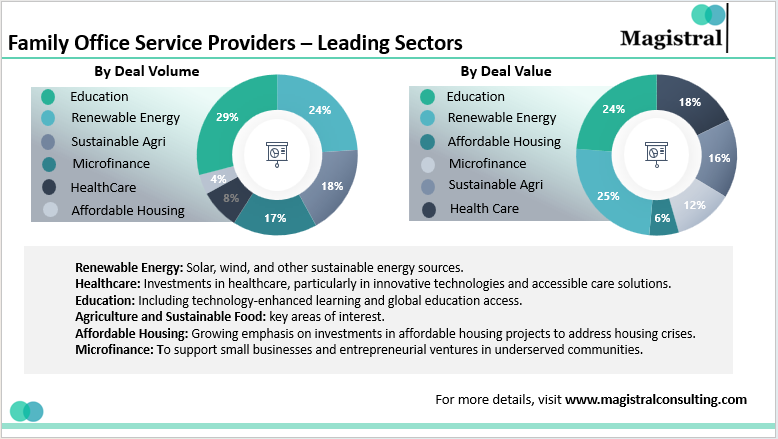
Family offices showed a strong preference for education and renewable energy fields that received the highest volume and value of impact investments last year. High deal flow continued to characterize wind and solar power generation; hence, such deals align with the larger trend of climate tech funding. The share of climate tech investment in energy-related startups rose to nearly 35%, from 30% last year.

There is, however, an underfunding of industrial sector climate tech startups in relation to total sector emissions, while food and agriculture are also feeling the pinch of capital crunch. Also, affordable housing received low-impact investment to some degree owing to recent lower yields in the sector. Family office investment is typically made in impact projects through club deals and collaborative efforts with other investors to drive situations forward instead of by themselves.

Since 2014, at least 66% of all family office impact investment have been similarly arranged as club deals. That peak during 2021-2022 saw four out of five impact investments being co-investments; loyalty to shared investment strategies characterized the landscape.


What’s Next for Family Office Investment in 2025

Key shifts in global markets are reshaping family office investment—here’s what to expect in 2025-

Emerging Global Hubs

While New York and London still occupy the two main positions in the financial center landscape, in the race are Hong Kong, Singapore, and Dubai, which have been welcoming family offices mostly due to their favorable regulation and rising affluence in that particular region.

Impact of Trump’s Re-Election

There will be taxation, regulatory, and, of course, market implications in connection with the family office, with Donald Trump’s re-election in the United States once again. Quite a few things should be expected:

  • Lower corporate and individual taxes for high earners.
  • Extended estate tax exemptions, allowing for larger tax-free wealth transfers.
  • Deregulation in some sectors but concerns about market stability.
  • Increased tariffs, which could impact global family office investment.

Shift to Private Equity

Private equity now accounts for 30% of family office portfolios, up from 22% in 2021, surpassing public equities, which fell from 34% to 25%.

Direct Investments Over PE Funds

More family offices are bypassing traditional PE funds and investing directly in private companies. 50% plan to make direct investments over the next two years, leveraging their entrepreneurial backgrounds.

Strong Interest in Real Estate

With capital constraints limiting institutional investment, family offices now hold 14.4% of AUM in real estate, benefiting from attractive opportunities and lending terms.

Renewed Interest in Cryptocurrency

After previous volatility, 33% of family offices are now investing in cryptocurrencies, up from 16% in 2021. Among them, 41% with assets under $1 billion are increasing exposure.


Magistral Consulting’s Services for Family Office Investment

Magistral Consulting provides tailored family office investment outsourcing solutions to allow them to maximize investment strategies, maximize operational effectiveness, and maintain long-term wealth. Our services extend to include investment research, due diligence, fund administration, and advisory strategy so that family offices can focus on increasing their wealth while staying in control of their assets.

Direct Investments

Magistral supports family office investment in purchasing high-potential investment prospects. It is done with rigorous deal sourcing, prudent due diligence, and professional valuation assistance. By comprehensive financial analysis and market intelligence, we enable clients to maximize risk management and return on direct investment.

GP/Hedge Fund Selection

The choice of an optimal General Partner (GP) or hedge fund is made with intense research and analysis. Magistral undertakes GP profiling, extensive due diligence, and creation of a fund list prior to setting up meetings with the top fund managers. This aids family office investment in matching with the most successful and most reliable funds existing in the marketplace.

GP/Hedge Fund Performance Monitoring & Reporting

Family offices require continuous oversight of their investments. Magistral provides regular performance tracking, risk exposure analysis, and customized reporting. This is done to ensure that GP and hedge fund investments align with expected returns and risk thresholds.

Portfolio Management

Sound portfolio management is necessary to maintain and grow wealth. Magistral assists family office investment in tracking asset allocation, optimizing investment strategies, and maintaining long-term portfolio performance. Our expertise assists in maintaining balance when dealing with risk as well as optimizing new opportunities.

Fund Strategy & Market Research

Family office investment take well-researched decisions on the basis of in-depth market insight. Magistral conducts country studies to understand macroeconomic and regulatory environments, constructs investment theses for opportunities to grow. We also provide comprehensive industry studies to identify trends and movements in markets. These offerings assist family offices in creating researched-based, forward-looking investment strategies.


About Magistral Consulting

Magistral Consulting has helped multiple funds and companies in outsourcing operations activities. It has service offerings for Private Equity, Venture Capital, Family Offices, Investment Banks, Asset Managers, Hedge Funds, Financial Consultants, Real Estate, REITs, RE funds, Corporates, and Portfolio companies. Its functional expertise is around Deal origination, Deal Execution, Due Diligence, Financial Modelling, Portfolio Management, and Equity Research

For setting up an appointment with a Magistral representative visit www.magistralconsulting.com/contact

About the Author

The article is authored by the Marketing Department of Magistral Consulting. For any business inquiries, you can reach out to prabhash.choudhary@magistralconsulting.com

[sp_easyaccordion id=”3525″]

From 2019 to 2024, Family Office Service Providers have grown and changed a lot. They have become advanced organizations focused on managing and safeguarding the wealth of very rich families. This article looks at their fast growth, their investment plans, and which industries and areas have shaped their impact investments during this period.

Overview of Growth of Family Offices: 2019-2024

The count of single-family offices around the world has undergone a sustained increase from about 6,130 in 2019 to an estimated count of 8,030 in 2024, indicating approximately a 31% growth. Such a trajectory probably would go forward by a further 12% increase to 9,030 in 2025 and a rise of 33% to 10,720 in 2030. Such an expansion indicates a 75% growth over the decade.

The most up-to-date picture of family office distribution shows North America at the front, with 3,180 entities, followed by Asia with 2,290, Europe with 2,020, the Middle East with 290, South America with 190, and Africa with 60 family offices in 2024.

Starting at USD 3.3 trillion in 2019, it reached USD 5.5 trillion by 2024-a compound increase of some 67 percent.

It is projected that the figure will be around USD 6.9 trillion by the year 2025 AD, as well as about USD 9.5 trillion by 2030 AD. This would actually make for a stupendous increase of 189 percent between 2019 and 2030.

Investment Strategies and Trends

Among direct investment approaches, Family Office Service Providers have increasingly preferred business services, industrials, and software as the most lucrative sectors. This direct investment shift allows for more control and/or potential higher returns.

Impact investing is hitting the news and has secured the top slot for the Family Office Service Providers in recent times as a large share of their portfolios is being invested in sectors aimed at producing positive social and environmental outcomes. Between June 2022 and June 2024, education and renewable energy dominated the areas of interest, making up 29% and 24% of total impact investments.

More Attention on the Private Equity Sector

Many family offices are allocating larger portions of their portfolios to private equity than before. It is done with both direct investments and typical managed funds. The target allocations of family offices to private equity are expected to be around 25%-30% by 2024, though these qualities might change over time.

The Rise of Co-Investments

Large numbers of family offices are participating in Co-investment opportunities with private equity firms and another institutional investor. It will enable to larger deal flow with lower fees while nurturing partnership and distribution of information between the co-investors.

Philanthropy and ESG

Many Family Office Service Providers blend philanthropic objectives with strategies for impact investing, thereby introducing ESG aspects into their portfolios. By that logic, the mission will thereby be commenting on wider global challenges while achieving a financial return.

Venture Capital Investments

Venture capital has become a popular investment class for Family Office Service Providers, especially in the fields of technology and AI. Startups in such domains have enormous growth potential, while family offices use branded portfolios of flexible capital to facilitate the disruptive innovations they promote.

Leading/Dominating Sectors Global Family Office Impact Investments

In 2023-2024, the sectors dominating global Family Office Service Providers impact investments include:

Family Office Service Providers – Leading Sectors

Family Office Service Providers – Leading Sectors

Impact of family offices in Renewable Energy

Solar, wind, and other sustainable energy sources are some of the energy projects in which family offices started investing.

Family Office Healthcare Impact

Currently, a lot of energy goes into innovation technologies and care solutions within Family Office Service Providers focus on health.

Family Office Impact on Education

It promotes education-related activities, including e-learning programs and utmost access to education.

Food and Agriculture

Producing food sustainably and the AgriTech sector constitute the foremost significance.

Affordable Housing

Increasing investment into schemes of affordable housing is slowly beginning to receive attention, as it can somewhat alleviate housing crises.

Microfinance

Investments in a microfinance curriculum aim to improve small businesses and foster entrepreneurship in poorer communities.

These sectors have gained a foothold because they tend to create substantial positive social and environmental impacts along with financial returns.

Regional Breakdown of Family Office Investments by Deal Volume (2019-2024)

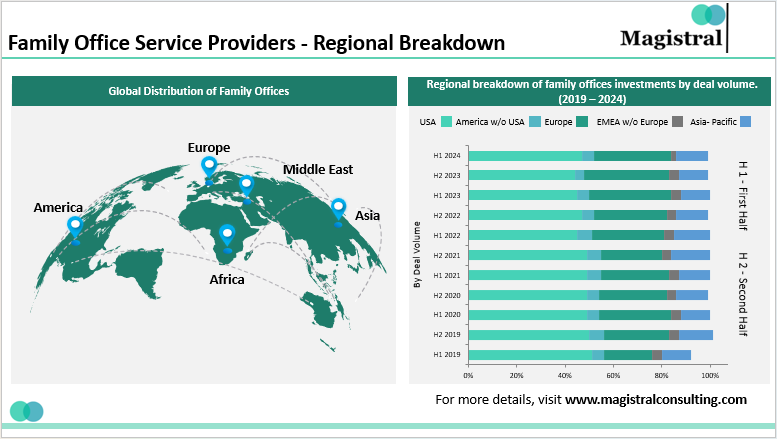
From 2019 until 2024, the regional distribution of family office investments was influenced either favorably or negatively by economic developments, market opportunities, and geopolitical issues.

Family Office Service Providers - Regional Breakdown

Family Office Service Providers – Regional Breakdown

North America

In terms of Family Office Service Providers concentration, the Americas are very active in investment. The steady economic climate and resilient financial market environment in the region act favorably to attract family office investment.

Asia Pacific

The Asia Pacific region has experienced significant growth in family office investments. It is driven by the rapid economic expansion of countries like China and India.

Europe

Europe remains an important area for too many family office investments, particularly in tech, health, and sustainability. The region’s various economies and a strong commitment to innovation open many avenues for family offices working to diversify their portfolios.

Middle East and Africa

Although their share of family office investments is small in global terms, interest continues to grow in Middle East countries and Africa, mainly in real estate, infrastructure, and energy. The wealth created by natural resources in these regions has led to the establishment of new family offices and increased investment activity.


Family Office Investment Opportunities

The opportunities in family office investments are as follows

Advanced Technology

The use of modern technology-driven investment management in recent years has improved the data analysis, risk assessment, and portfolio management knowledge available to family offices.

Sustainable Investments

The increasing focus on environmental, social, and governance (ESG) standards gives family offices the opportunity to invest in projects that coincide with their values and yield competitive returns. Sectors such as renewable energy, sustainable agriculture, and innovative green technologies are catching the attention of family office investors.

Emerging Markets

Due to rapid economic growth and development, emerging markets offer the possibility of great returns. Family Office Service Providers are increasingly on the lookout for opportunities in Southeast Asia, Latin America and Africa for purposes of diversification and to monetize the unique dynamics behind these emerging markets.


Magistral Services for Family Office Service Providers

Services from Magistral aim to improve the efficiency and effectiveness of the service provided

Investment Research and Advisory

Magistral carries out deal sourcing to identify opportunities across asset classes and offers market research, trend analysis, and portfolio performance evaluation, which include private equity, venture capital, and real estate.

Planning and Reporting

Magistral Consulting assists in establishing the budgets, forecasts, and cash flow management and preparation of consolidated financial statements for efficient management.

Real Estate Advisory

Magistral conducts property market analysis, feasibility studies, and valuation reports to help maximize investment returns for family offices.

Support to PE/VC Firms

In all of its operations, such as deal-sourcing, valuation, benchmarking, and portfolio management, Magistral Consulting acts in support of PE/VC firms, ensuring they get the finest information for their investment decisions.

Estate Planning/Documentation

To aid the smooth transition of the estate, Magistral puts together family business succession planning, trust creation, and estate documentation.

Back-Office Support

They perform document processing, manage compliance, handle data, and optimize customer relationship management. All of which enable family offices to pursue their strategic objectives.

Technology and Digital Transformation

Magistral helps automate various work processes in managing family offices while providing family-office-oriented cybersecurity solutions.


About Magistral Consulting

Magistral Consulting has helped multiple funds and companies in outsourcing operations activities. It has service offerings for Private Equity, Venture Capital, Family Offices, Investment Banks, Asset Managers, Hedge Funds, Financial Consultants, Real Estate, REITs, RE funds, Corporates, and Portfolio companies. Its functional expertise is around Deal origination, Deal Execution, Due Diligence, Financial Modelling, Portfolio Management, and Equity Research

For setting up an appointment with a Magistral representative visit www.magistralconsulting.com/contact

About the Author

The article is authored by the Marketing Department of Magistral Consulting. For any business inquiries, you can reach out to prabhash.choudhary@magistralconsulting.com

[sp_easyaccordion id=”3396″]