On paper, outsourcing can appear relatively straightforward: shift an activity to a specialist, cut fixed costs, gain efficiency, and release internal resources for other activities. However, the same decision can have adverse effects, especially when outsourcing failure risks around governance, accountability, cybersecurity, or even communication lags in delivery. This is becoming increasingly critical since outsourcing is no longer confined to traditional departments like payroll processing, call centers, or back-office operations.
Why do outsourcing failure risks emerge before the contract is signed?
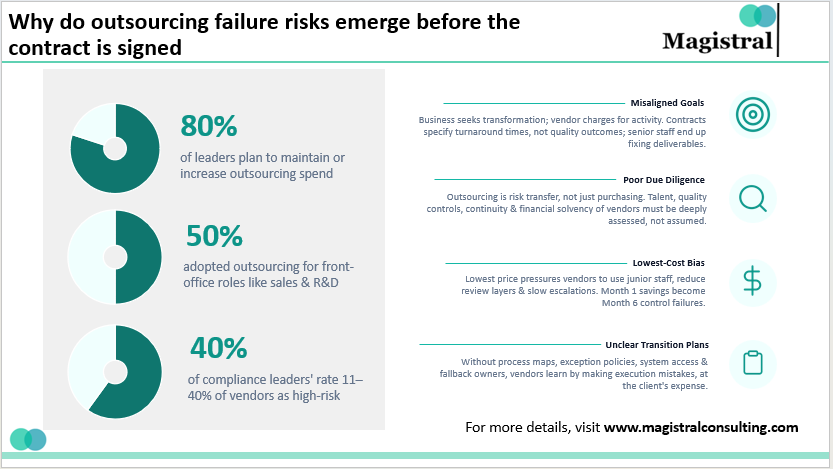
According to Deloitte’s Global Outsourcing Survey 2024, 80% of business leaders intended to keep the same or increase spending on outsourcing arrangements, whereas 50% of respondents had adopted outsourcing for their front-office roles, such as sales, marketing, and research and development. Outsourcing project failures typically start sooner than people realize. In outsourcing failure risks, the red flags usually surface during the vendor selection process, scope definition, price negotiations, and transition plans, long before any service level performance discrepancies become apparent via monthly reports.
Why do outsourcing failure risks emerge before the contract is signed?
Misaligned goals create the first crack
The business might be seeking transformation, while the vendor charges for work completion. The finance department could be looking for insight, while the vendor’s contract terms include only reporting quantity. This situation occurs frequently since customers tend to articulate the activity they would like to outsource rather than the objective they aim to protect.
For instance, if a corporation outsources its investment banking operations, it expects faster screening of potential transactions, enhanced buyer list quality, and better presentation materials. When the contract terms specify just transaction turnaround times, quality becomes increasingly compromised. Although the numbers look good on paper, senior bankers end up burning the midnight oil fixing their deliverables.
Poor due diligence weakens vendor selection
It’s important to remember that outsourcing isn’t a purchasing process alone; it’s a risk transfer activity. To avoid outsourcing failure risks, buyers need to analyze the level of talent, quality controls, information management capabilities, continuity, financial solvency, and scalability of the vendor.
Gartner found that 40% of compliance leaders believe 11-40% of their third-party providers to be high-risk. This fact bears significance because an organization never goes under because of its choice of an external service provider. Instead, it goes under because of the insufficient assessment, challenge, and monitoring of such partners.
The hidden risk of “lowest cost wins.”
The lowest pricing approach can be very useful if the model of operation is clear. If it’s not, the provider will use junior personnel, fewer layers of review, slower escalations, and a strict change-requesting process to maximize their margin. This means savings in the first month and losing control in the sixth, one of the most common outsourcing failure risks.
Transition planning left unclear makes the handover a disaster
In order for the transition period to go smoothly, buyers must develop process maps, exception management policies, system access controls, training sessions, and identify fallback owners. Otherwise, the vendor would learn the process by making mistakes during execution.
Operational outsourcing failure risks in delivery and governance
Execution problems don’t happen suddenly, all at once; instead, they occur through small missteps, a lack of accountability, long delays, and ineffective governance practices.
Service level agreements can measure the wrong things
The SLA may assess speed, volume, and uptime without considering good judgment, contextual awareness, quality, or business impact. An outsourced market research company can deliver its analysis on time, but neglects to reach the right decision-makers. Meanwhile, an outsourced financial services company can reconcile accounts fast but not notice any oddities.
That’s why modern outsourcing delivery models now concentrate on performance. According to Deloitte, outsourcing delivery models are shifting towards value-oriented relationships, where organizations prioritize results, flexibility, competent people, and tangible business value over mere staffing support.
Governance must be active, not ceremonial
Many firms establish a weekly call and label that governance. But that’s insufficient. Good governance involves tracking issues, conducting root cause analyses, assessing risk using heat maps, conducting quality sampling, planning capacity, and establishing executive escalation processes.
In private equity, for example, outsourcing research and portfolio support offers a lot of power. Yet, there is no substitute for clearly defined review protocols since small mistakes with market sizing, customer concentration, or valuation assumptions might alter the business case.
What good governance looks like
Effective governance doesn’t feel like police work. It feels more like shared ownership. Each side understands what constitutes success, decision ownership, escalation criteria, and metrics for improved performance.
Communication gaps compound across time zones
Time zone differences don’t pose a problem. Uncertainty does. Outsourcing failure risks and misunderstandings occur in outsourced relationships when instructions pass via lengthy emails, reviewers alter expectations midway, or offshore vendors can’t quickly address assumptions.
An easy illustration is in order. Let’s assume the portfolio company requests a regional margin bridge. The internal team needs management commentary, but the vendor delivers only spreadsheet variance analysis. There is no negligence involved; yet, the deliverable is off target due to a lack of context.
Cybersecurity and compliance outsourcing failure risks
The biggest outsourcing failure risks today relate to data, technology access, business continuity, and regulatory compliance. The outsourcing buyer can outsource activities, but cannot outsource accountability.
Cybersecurity and compliance outsourcing failure risks
Third-party breaches are rising
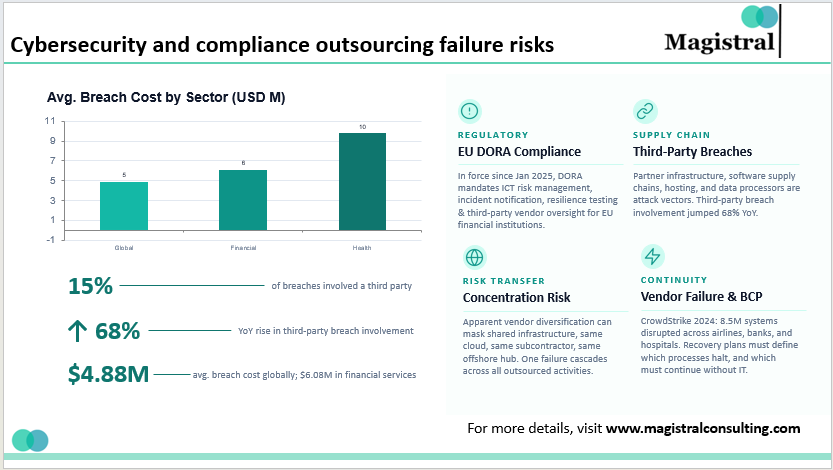
According to a report, 15% of breaches included a third party, up 68% from the previous year. This category includes partner infrastructure, software supply chain vulnerabilities, hosting services, and data processors.
As per IBM’s 2024 Cost of a Data Breach study, the global average cost per breach was USD 4.88 million, with financial services organizations experiencing a cost of USD 6.08 million on average. Such outsourcing failure risks costs elevate third-party cybersecurity from an IT check box to a board-level financial risk.
Regulatory scrutiny is expanding
The EU’s Digital Operational Resilience Act, applicable as of 17 January 2025, mandates standards on ICT risk management, incident notification, resilience testing, and ICT third-party risk management for financial institutions.
This is relevant for the compliance team because vendor oversight is no longer limited to contract reviews alone. Increased due diligence is required regarding the vendor registration process, incident responses, and exit planning.
Concentration risk is often underestimated
Although a firm may think that it has vendor diversification, many vendors may depend on the same cloud computing system, software package, subcontractor, or offshore outsourcing location. If any one of them is down, the whole network of outsourced activities will be blocked.
Business continuity must include vendor failure
In 2024, a major disruption of CrowdStrike’s service impacted 8.5 million Windows systems. The impact was felt in airlines, banks, hospitals, and other essential industries worldwide.
The message here is not about avoiding technology suppliers but about testing your recovery plan. In case of failure of the technology supplier, the client organization should know what processes can be halted and what processes should continue without IT.
How Magistral helps reduce outsourcing failure risks
Magistral helps reduce outsourcing failure risks by offering research, analysis, financing, compliance, deal assistance, and managed delivery. Magistral Consulting does not simply ensure task execution but also helps establish reliable and repeatable workflows for clients.
Structured onboarding improves early control
At first, Magistral understands the workflow of a client, data sources used, preferences, desired standards and quality of work, and necessary escalation procedures. It helps to mitigate the “lost in translation” risk at the initial stage of an outsourced project.
Quality review reduces rework
Each outsourced process involves a certain depth of review to ensure high-quality results. At Magistral Consulting, reviews involve multiple levels, templates of results, feedback from reviewers, and detailed process documentation.
Flexible support helps teams scale responsibly
With increasing pressure to get more done, organizations tend to either hurriedly hire or stress their internal teams. In such cases, outsourcing could be a solution; however, only if scaling is done in an organized manner. Magistral’s service-based approach ensures that the company can effectively scale its research, finance, deal execution, and reporting capabilities without losing ownership, oversight, and confidentiality. When considering an outsourced CFO, a similar approach could be considered as well: outsource the execution, not the strategic decision-making. Outsourcing, managed properly, is more about extending the team than passing on the work over a wall. That is how the failure rate of outsourcing is minimized, yet its benefits are retained.
About Magistral Consulting
Magistral Consulting has helped multiple funds and companies in outsourcing operations activities. It has service offerings for Private Equity, Venture Capital, Family Offices, Investment Banks, Asset Managers, Hedge Funds, Financial Consultants, Real Estate, REITs, RE funds, Corporates, and Portfolio companies. Its functional expertise is around Deal origination, Deal Execution, Due Diligence, Financial Modelling, Portfolio Management, and Equity Research
For setting up an appointment with a Magistral representative visit www.magistralconsulting.com/contact
About the Author

Dhanita is a BD and Marketing professional with 6+ years’ experience in sales strategy, growth execution, and client acquisition; credentials include Stanford Seed (Stanford GSB), an MBA from USMS–GGSIPU, and a B.Com (Hons) from the University of Delhi. Expertise spans market research and opportunity mapping, sales strategy, CRM, brand positioning, integrated campaigns, content development, lead generation, and analytics; currently oversees business development calls and end-to-end marketing operations
FAQs
What are the most common reasons outsourcing fails?
How can companies reduce vendor risk before signing a contract?
Why is governance important in outsourcing?
Can outsourcing be safe for regulated financial work?
When should a company reconsider an outsourcing relationship?