The practice of outsourcing business operations has evolved from merely reducing costs to becoming a key element in the strategy of international companies. Today, businesses need to respond to increasing demands for growth and efficiency and be more flexible amid market uncertainties. They turn to external parties for help with their non-core functions, as indicated by the recent global survey by Deloitte. Almost 70% of businesses now utilize outsourcing for at least one core business process. This is indicative of the new trend towards outsourcing within enterprises. Outsourcing offers a range of benefits, from cost reductions to operational efficiency. Thus, it makes sense to explore the concept of outsourcing business operations.
Operations Outsourcing Market Trends and Industry Growth
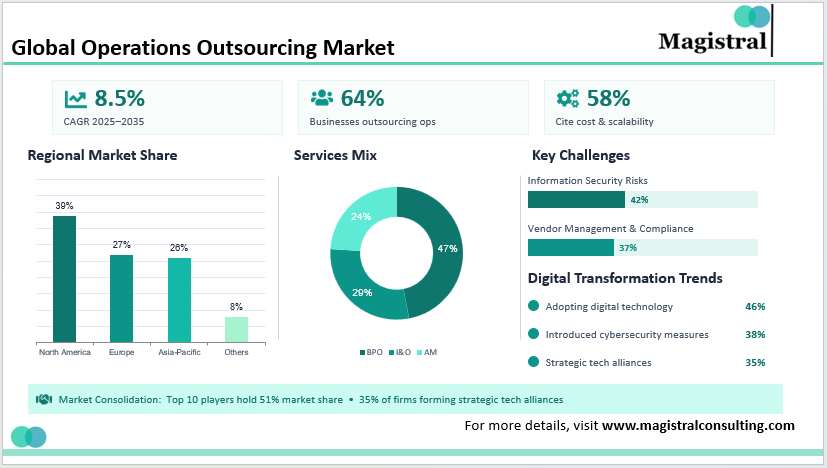
There is a consistent and structural growth being experienced by the global operations outsourcing market that is projected to expand from about $729.9 billion in 2025 to $1.55 trillion by 2035 at a steady CAGR of 8.5%. This is largely because of the increasing number of enterprises that are increasingly adopting outsourced IT and business process solutions, with close to 64% of businesses now leveraging these solutions for operational efficiencies. In many cases, this has been prompted by considerations such as cost savings and scalability, which have been noted to be among the top benefits enjoyed by businesses, with over 58% identifying them as critical factors behind their decision. Reference
However, alongside growth, there has emerged the challenge of issues like information security risks and vendor management and compliance issues which together account for 42% and 37% of the obstacles faced respectively.
Global Operations Outsourcing Market
On a regional basis, North America holds the largest market share with 39%, followed by Europe (27%) and the Asia-Pacific region (26%), which is influenced by both demand concentration and geographical location of delivery centers. There is also a degree of consolidation in the market, as the top 10 players hold 51% of the total market share, while 35% of the firms are making strategic alliances with technology companies. In the case of services offered, BPO is leading with a share of 47%, followed by I&O (29%) and AM (24%).
Moreover, recent trends in the industry confirm that there has been a shift towards the outsourcing of different processes within an organization, and this can be seen from the fact that 46% of the firms are adopting digital technology, while 38% have introduced cybersecurity measures.
Global Operations Outsourcing Trends (2025–2026)
In the coming year of 2025-2026, outsourcing operations in businesses is going through an important shift from the classic outsourcing concept based on cost savings towards technology outsourcing and value-based relationships due to accelerated digitalization. The biggest trend in the field concerns the use of artificial intelligence and automation. The trend implies not only the outsourcing of business operations but also the outsourcing of advanced technologies that include customer services and data analysis among others.
The related trend is connected with the adoption of cloud-based and digitalized approaches by outsourcing companies as part of the services they offer. With the use of cloud services, the entire operation becomes more scalable and flexible. Moreover, it transforms from a rigid business process into a service model for which payments are made on demand. Another related outsourcing trend is that more than 70% of organizations outsource technology-related activities.
Another important trend is the move from labor arbitrage to value-based outsourcing. Instead of choosing outsourcing companies based purely on the bottom line, firms now seek out companies that can provide them with knowledge of their domain, expertise in analytics and other areas, and specialization. Outsourcing companies are increasingly supposed to offer measurable value in terms of faster deals, better experience for customers, and improved decision-making.
The growth in GCCs and offshore facilities is yet another significant trend. Firms now build global operations centers, especially in countries like India, not only as sources of savings but also as innovative centers and centers of analysis and business operations. The growth in offshore centers is indicative of the trend towards viewing such centers as strategic extensions of the enterprise rather than mere back offices.
Data security and compliance are now some of the most crucial concerns of today’s enterprises. With growing regulatory pressures and cross-border movement of data, firms need their outsourcing partners to provide them with sound security measures, certifications, and compliance with data handling regulations. Such certifications include ISO and SOC standards.
Outsourcing strategies are increasingly adopting hybrid and flexible approaches, blending internal staff, offshore service providers, and technological tools into coherent operational ecosystems. With this model, organizations can easily adapt to changing business dynamics by scaling up or down and reducing costs without losing control over their core processes. Thus, in 2025–2026, outsourcing will become a central element of organizational strategy and competitiveness rather than an auxiliary one.
Benefits of operations outsourcing
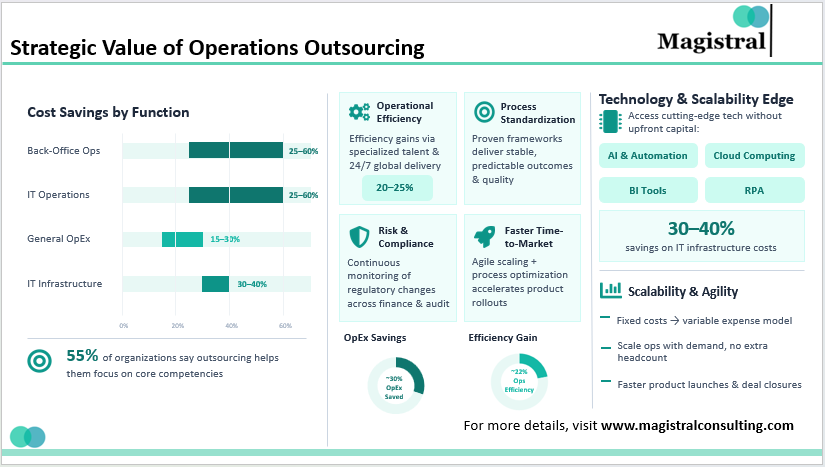
Operations outsourcing offers both tangible cost savings and operational efficiencies, which makes it more of a strategic tool than a tactical one. Firms generally realize a saving of 15-30 percent in their operating expenses, with some back-office and IT operations providing savings between 25-60 percent through labor arbitrage, process standardization, and lower infrastructure costs. In addition to cost savings, outsourcing also boosts the performance of the firm, as it enables firms to attain 20-25 percent operational efficiency and fast turnarounds, as they have access to specialized talent and proven processes and operate on a round-the-clock, worldwide basis.
The main advantage of outsourcing is that it helps organizations concentrate on their core competencies. Organizations can free up their valuable internal resources by outsourcing repetitive and time-consuming activities and use these resources to engage in innovative activities and better decision-making. Over 55 percent of organizations feel that outsourcing helps them to focus on their core operations.
Strategic Value of Operations Outsourcing
Furthermore, operations outsourcing contributes to better process efficiency by employing standardized processes and practices. The external service provider has the expertise and experience needed for the implementation of the standard procedures and techniques that provide more stable and predictable results. At the same time, the process control and optimization ensure process improvements that contribute to better performance in terms of speed and quality.
Risk management and compliance represent another area where outsourced providers can be very useful since they can help in managing operational risks, ensuring proper quality control, and providing timely updates regarding the changes in compliance regulations that apply to the area of financial reporting, auditing, due diligence, etc.
Finally, another great benefit associated with the process of operations outsourcing is the opportunity to leverage state-of-the-art technology and expertise without substantial upfront investments. Outsourcing companies invest in new technologies like automation software, business intelligence tools, artificial intelligence, cloud computing, and others that allow customers to use them immediately. This factor, along with the benefits mentioned above, helps in saving up to 30–40% of expenses on IT infrastructures.
Moreover, operations outsourcing contributes to scalability and agility, transforming fixed expenses to variable ones and allowing organizations to scale their operations depending on the volume of transactions or market trends without having to recruit additional staff. With this level of agility, along with process optimization, the organization can reduce its time to market, meaning that it can roll out new products or make deals at a much faster pace.
All these advantages, taken together, lead to an improvement in ROI in the range of 25-35% in specific areas like research, financial analysis, and operational support.
Key Functions of Operations Outsourcing in Modern Businesses
The area of operations outsourcing covers an increasingly broad spectrum of functions within organizations and goes far beyond the realm of merely offering basic back-office services. For example, in the case of finance and accounting, there could be a situation wherein a firm may outsource its bookkeeping and reporting services along with other financial responsibilities in order to ensure precision while keeping costs down, as well as reducing the number of employees it needs internally. There is also a possibility of successfully outsourcing HR and payroll services, which can help with easy recruitment, effective integration of employees into the company, and flawless payment of salaries due to automated software.
It is also possible to outsource customer services in order to ensure round-the-clock services via telephone, email, and chat in order to maximize customer satisfaction.
Operations Outsourcing Strategies and Best Practices
Perhaps the best means of making use of operations outsourcing would be through the adoption of a process involving a number of important factors. The first and possibly most important of these concerns is selecting an appropriate operations outsourcing partner. It requires evaluating several factors related to the skills and capabilities of a partner, as well as ensuring that it is the right cultural match. Objectives should be clearly formulated as well, including the scope of work and relevant KPIs. Technology should be used efficiently for better collaboration and performance tracking. Finally, regular progress monitoring is crucial for obtaining the necessary outcomes and remaining consistent with the corporate strategy.
How Magistral Supports Operations Outsourcing
Magistral Consulting offers operations outsourcing solutions in the fields of finance, analysis, and research assistance. Its professionals offer unique services and achieve great success due to their expertise and technical awareness. The company is aware of the latest developments in this field, such as capital formation, and, therefore, can develop appropriate solutions quickly. Magistral Consulting helps clients to become more efficient in terms of both operations and costs.
About Magistral Consulting
Magistral Consulting has helped multiple funds and companies in outsourcing operations activities. It has service offerings for Private Equity, Venture Capital, Family Offices, Investment Banks, Asset Managers, Hedge Funds, Financial Consultants, Real Estate, REITs, RE funds, Corporates, and Portfolio companies. Its functional expertise is around Deal origination, Deal Execution, Due Diligence, Financial Modelling, Portfolio Management, and Equity Research
For setting up an appointment with a Magistral representative visit www.magistralconsulting.com/contact
About the Author

Prabhash Choudhary is the CEO of Magistral Consulting. He is a Stanford Seed alumnus and mechanical engineer with 20 + years’ leadership at Fortune 500 firms- Accenture Strategy, Deloitte, News Corp, and S&P Global. At Magistral Consulting, he directs global operations and has delivered over $3.5 billion in client impact across finance, research, analytics, and outsourcing. His expertise spans management consulting, investment and strategic research, and operational excellence for 1,200 + clients worldwide
FAQs
What is operations outsourcing?
Why do companies adopt operations outsourcing?
Which industries benefit the most from operations outsourcing?
How does technology impact operations outsourcing?
What are the risks of operations outsourcing?