Tag Archives: venture capital fundraising support

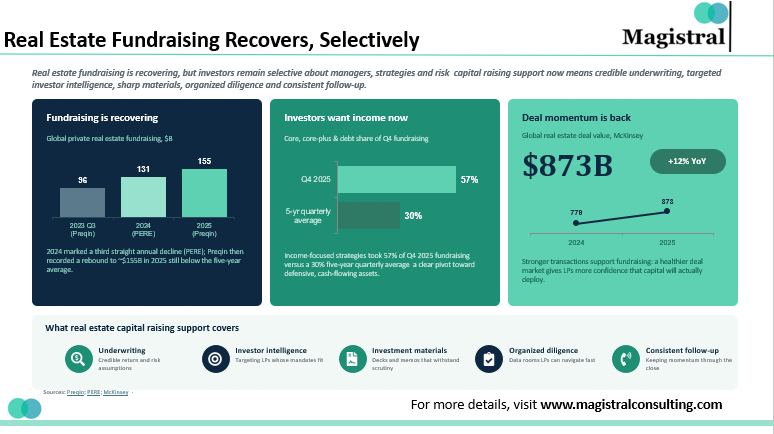
Fundraising for real estate investments is on the rebound, yet investors are still selective when it comes to the fund managers, strategy and risk profile. According to Preqin, fundraising for global real estate investments has grown to approximately $155 billion in 2025 compared to 2024 and is still below the average of the past five years. According to McKinsey, transaction momentum is also on the rise with the value of global real estate transactions growing to approximately $873 billion in 2025, an increase of about 12% year over year.

In this context, real estate capital raising services require much more than just maintaining a list of potential investors. They require credible underwriting, investor research, investment materials and follow-up to turn a good idea into a good investment.

Real Estate Capital Raising Support in a Selective Market

Fundraising conditions improved in 2025, though capital flow was unevenly distributed among fund managers and investment strategies. There is an increased preference for differentiated deals, solid platforms, and management with the ability to show how returns will be created.
Real Estate Capital Raising Support

Real Estate Fundraising Recovers, Selectively

Fundraising Is Recovering

Private real estate investment fundraising faced hard times after the last market peak. PERE reported that fundraising dropped to $131.1 billion in 2024, which became the third annual decrease. Preqin noted separately that $96 billion had already been raised until the third quarter of 2024. Fundraising conditions improved in 2025. Preqin noted approximately $155 billion of global real estate fundraising in 2025. Income-based strategies, such as core, core plus and real estate debt accounted for 57% of fourth quarter fundraising as opposed to 30% average five-year quarterly numbers. The data indicate that investors are back, yet with new priorities.

Hence, the managers must have real estate capital raising support services to link their strategy with current investors’ needs, not just rely on general market improvement. Financial credibility is extremely significant. Real estate financial modeling is quite detailed and helps managers prove how leverage, occupancy, rental increases, operating expenses and exit assumptions influence profitability.

Transaction Activity Is Improving

The field of real estate capital raising support is also aided through reclaiming transaction markets. According to McKinsey, there were $873 billion of global real estate deal values in 2025, which was an increase of approximately 12 percent compared to 2024. Nonetheless, there were significant disparities depending on the property type. Specialized real estate constituted approximately 14 percent of global deal volumes. There was an increase in deal activity in data centers by approximately 37 percent, and office deals increased by approximately 17 percent.

In the United States, there was an increase in deal activity for Class A offices by approximately 34 percent. This becomes significant while making a presentation for an investment opportunity as well as real estate capital raising support.

Capital Is Becoming More Concentrated

Fundraising recovery is not equal across all managers. McKinsey found that the top 20 managers were able to generate 51% of the trailing five years closed-end real estate fundraising as of 2025. In addition, approximately 17% of institutions indicated they would be reducing their number of managers. This represents a tougher landscape for emerging and mid-sized managers without the prestige of the largest platforms; these managers have to have a differentiator, transparency, strong underwriting process and proof of execution to separate themselves. Capital raising skills can assist these managers to turn those attributes into an investment product.

Real Estate Capital Raising Support Across the Investor Journey

Real estate capital raising support does not involve just one pitch or discussion. It is a process that entails identifying, qualifying, engaging, due diligence, investment committee decision-making and commitment of investors.

Investor Mapping Improves Outreach

A long list of investors is not always an indication of good fundraising. Managers must stratify potential investors according to geography, type of asset, risk tolerance, level of commitment, previous investments, and allocation strategies. An organized structure for investors will help the management team focus on those potential investors who are more aligned with the strategy. For instance, an investor seeking stable assets needs a different approach than an investor seeking opportunistic assets. This is critical particularly in cases where institutional investors consolidate their GP relationships in the case of real estate capital raising support.

Pitch Materials Must Demonstrate the Investment Case

However, a powerful investment presentation will go beyond simply describing attributes and returns. Investors are interested in how these returns are created. How would the business perform if the cost of capital is higher? If rental growth rates fall? What is the sensitivity of the predicted IRR to the cap rate at the exit point? How much of the value creation is based on appreciation and how much on performance? Financial models, pitch decks, market analysis, and investment memoranda must give the same answers to these questions. McKinsey stated that cap rate compression and appreciation are now riskier return drivers compared to the last cycle.

Prepare for Due Diligence Early

Institutional investors may review track records, attribution, portfolio construction, valuation approach, corporate structure, governance, service providers, reporting system, ESG policy, and cybersecurity. Managers should have all this information ready prior to commencing the actual due diligence process. Good due diligence information allows a quicker answer and prevents discrepancies among the financial model, presentation, and documentation. Effective real estate capital raising support is not just about marketing. It enables setting up the analytical foundation that will help to make an investor interested in investing.

Real Estate Capital Raising Support Strategies for Better Conversion

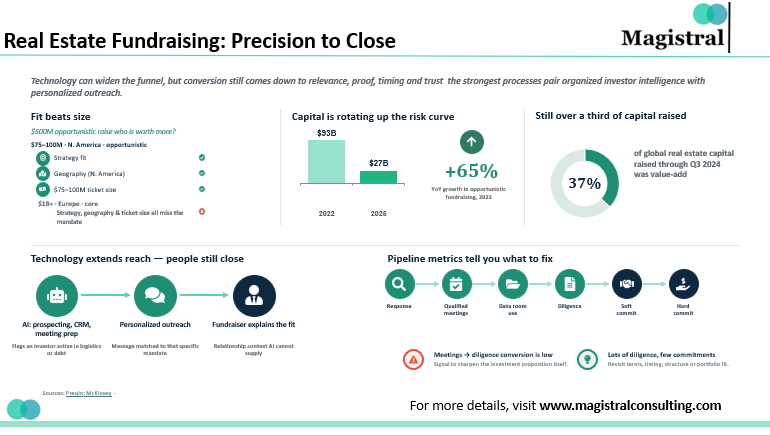
Although technology has the potential to increase fundraising capability, conversion requires relevance, proof, timing, and trust for real estate capital raising support. The most effective processes utilize organized investor information with personalized communication.
Real Estate Capital Raising Support

Real Estate Capital Raising Support: Precision to Close

Target Investors According to Fit

Managers can rank investors based on their property preference, geographic mandate, investment time horizon, experience of investing, return expectations, and usual ticket size. For example, when managers try to raise $500 million in an opportunistic fund, an investor who consistently invests between $75 and $100 million into North American opportunistic funds could be worth more than a large investor whose focus is European core investments. There are changes in market preferences too.

According to Preqin, value add strategies made up about 37% of total real estate capital raised through the third quarter of 2024. However, according to McKinsey, in 2025 the fundraising volume of opportunistic investments was increased by approximately 65% year over year. At the same time, fundraising volume of value add investments fell from $93 billion in 2022 to approximately $27 billion.

Use Technology With Personalization

Automated prospecting, CRM, classification of investors, preparation of meetings, and personalization of communication can be achieved via AI. Nevertheless, automation should complement relationships, not replace them. The system will be able to recognize the investor who has been investing more in logistics or real estate debt. However, the fundraising expert still needs to explain why this approach would suit that mandate. Pipeline statistics also serve as a strength.

It will help track response rate, number of qualified meetings, data room utilization, diligence process, soft commitment level, hard commitment level, and average hard commitment size. Low conversion from meetings to diligence process indicates the need for adjustments of the investment proposition. Investors who conduct extensive diligence but make few commitments suggest that fund terms, timing, structure, or portfolio need to be considered. Thus, it becomes an operationally driven process of real estate capital raising support.

How Magistral Provides Real Estate Capital Raising Support

Managers often have investment expertise but limited capacity to simultaneously conduct investor research, maintain databases, update models, prepare materials, organize data rooms, and manage outreach. External support can expand execution capacity while senior professionals concentrate on investor relationships.

Investor Research and Real Estate Capital Raising Support

Magistral Consulting’s real estate services include LP and GP outreach, HNI outreach, meeting setup, fundraising assistance, pitch deck preparation, competitive intelligence, and investment memorandum support.

Its investor database offering states coverage of more than 35,000 LP and GP leads across the United States, Europe, the United Kingdom, Middle East, India, and China. Large databases alone do not guarantee successful fundraising. Their value comes from filtering prospects according to strategy, geography, investor type, and probable fit.

Combining investor intelligence with real estate capital raising support can help managers build smaller but better qualified pipelines.

Financial Modeling and Investment Materials

Institutional investors expect the financial model, pitch deck, investment memorandum, and supporting market research to communicate the same assumptions.

Magistral’s financial modeling services cover areas such as valuation, DCF analysis, sensitivity analysis, debt analysis, comparable company analysis, and real estate financing models.

These capabilities can help managers explain return drivers and downside scenarios more clearly. They also reduce inconsistencies that may create unnecessary questions during investor diligence.

Building a Repeatable Fundraising Process

Fundraising should not restart from zero each time a manager launches a new vehicle. Investor records, market intelligence, models, reporting templates, diligence materials, and communication history can form a reusable fundraising infrastructure.

INREV reported that at least €117 billion was raised for non-listed real estate globally during 2025. Pension funds accounted for approximately 39% of capital sources, compared with 32% in 2024. Moreover, 87% of surveyed managers expected real estate capital raising support activity to increase over the following two years.

Opportunity is therefore returning, but competition remains intense. Managers can use private equity style analytical and execution support to scale research, modeling, documentation, and investor targeting without unnecessarily expanding internal teams.

Ultimately, real estate capital raising support is most effective when fundraising becomes a repeatable institutional capability. Clear strategy, defensible underwriting, targeted investor intelligence, organized diligence, and disciplined engagement allow managers to adapt as investor preferences and property markets change.


About Magistral Consulting

Magistral Consulting has helped multiple funds and companies in outsourcing operations activities. It has service offerings for Private Equity, Venture Capital, Family Offices, Investment Banks, Asset Managers, Hedge Funds, Financial Consultants, Real Estate, REITs, RE funds, Corporates, and Portfolio companies. Its functional expertise is around Deal origination, Deal Execution, Due Diligence, Financial Modelling, Portfolio Management, and Equity Research

For setting up an appointment with a Magistral representative visit www.magistralconsulting.com/contact

About the Author

Aman is an investment-research specialist with 5+ years of experience across business and investment research, including 2+ years with Big Four firms like KPMG. A Stanford Seed alumnus with an MBA in Finance and a Bachelor of Commerce (Hons) from University of Delhi, he focuses on private equity, venture capital, and renewable energy sectors. He leads project teams at Magistral Consulting, delivering financial research, due diligence, deal sourcing, and M&A support, while driving strong process management and analytics. His blend of attention to detail, strategic thinking, and dynamic execution enables him to turn complex data into actionable investment insights.


FAQs

What does real estate capital raising support include?

It can include investor identification, LP profiling, market research, financial modeling, pitch deck preparation, investment memorandums, data room organization, outreach support, CRM management, and fundraising pipeline monitoring.

Why has raising real estate capital become more challenging?

Higher financing costs, slower distributions, valuation uncertainty, and greater investor selectivity have made fundraising more competitive. Capital has also become increasingly concentrated among larger managers.

Which investors typically allocate capital to real estate funds?

Common investors include pension funds, sovereign wealth funds, insurance companies, family offices, endowments, foundations, asset managers, funds of funds, and high net worth investors.

How can consulting improve real estate capital raising support?

Consultants can test market assumptions, analyze competitors, review operating risks, normalize financial information, model scenarios, and identify questions that materially affect valuation or the post-acquisition plan.

What Is Magistral Consulting?

Magistral Consulting is a financial-services outsourcing and research firm that supports investment banks, private equity and venture capital firms, asset managers, family offices, and corporate finance teams with analytical and operational execution.


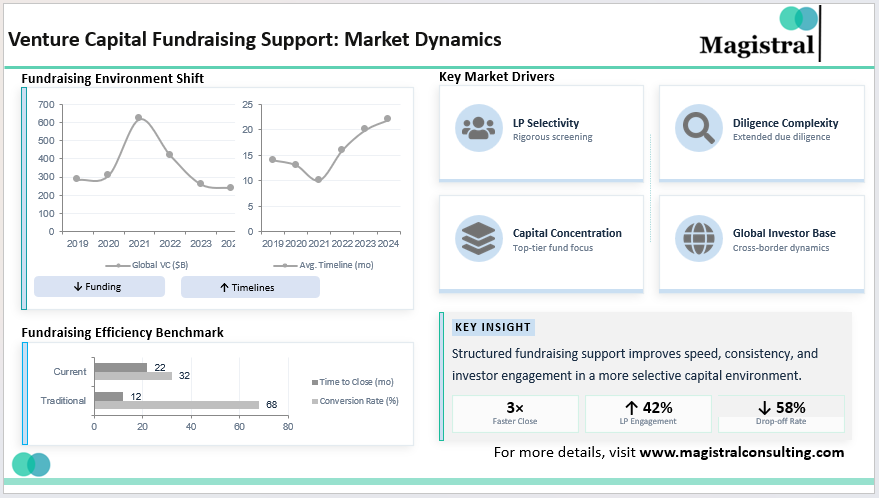
Venture capital fundraising support is becoming essential as fundraising efficiency declines across global markets. Bain & Company reports that global venture funding dropped by over 35% from peak 2021 levels, while Preqin data shows that the average time to close a fund has extended beyond 18–20 months. In addition, fewer funds are successfully reaching final close, indicating increasing competition for limited capital. At the same time, LPs are becoming more selective, with top-performing funds capturing a larger share of commitments. This creates a dual challenge: lower capital availability and higher execution expectations. Venture capital fundraising support addresses this gap by improving response times, structuring investor outreach, and ensuring consistency across materials. As fundraising becomes more process-driven, firms that operate with structured support systems are better positioned to maintain momentum, reduce delays, and improve close rates in competitive environments.

Venture capital fundraising support and market dynamics

The demand for venture capital fundraising support is directly linked to measurable shifts in fundraising performance, investor behaviour, and capital concentration. These changes are not temporary but reflect structural transformation in capital allocation dynamics.

Venture Capital Fundraising Support: Market Dynamics

Venture Capital Fundraising Support: Market Dynamics

Declining fundraising volumes and extended timelines

Global venture funding declined significantly after 2021, with Bain estimating a drop of more than one-third in total capital deployed. At the same time, Preqin highlights that average fundraising timelines have increased from nearly 12–14 months to over 18 months, with some funds taking even longer. This elongation increases operational workload, as firms must sustain engagement across multiple investor touchpoints. Venture capital fundraising support helps manage these extended cycles by ensuring structured follow-ups, timely updates, and continuous pipeline tracking. As a result, firms reduce drop-offs and maintain investor interest over longer periods.

Increased LP selectivity and diligence requirements

Institutional investors are now more selective and analytical in their allocation decisions. Deloitte indicates that LPs evaluate funds based on a broader set of criteria, including governance frameworks, ESG alignment, and performance attribution. Furthermore, due diligence questionnaires have become more detailed, often requiring granular portfolio-level data. This significantly increases documentation workload and slows response cycles. Venture capital fundraising support improves efficiency by standardizing materials, maintaining centralized data, and enabling faster turnaround on investor queries, which directly enhances engagement levels.

Capital concentration among top-performing funds

Capital allocation is becoming increasingly concentrated among top-tier funds. Bain highlights that a smaller number of funds capture a disproportionately large share of total commitments, leaving emerging managers with limited access to capital. This concentration increases competitive pressure and requires stronger differentiation strategies. Venture capital fundraising support helps firms improve positioning by ensuring consistent messaging, structured communication, and clear articulation of investment strategy and track record across all investor interactions.

Globalization of investor base

Fundraising has become global in nature, with LPs allocating capital across geographies and asset classes. This shift requires firms to manage multiple time zones, communication cycles, and regional investor preferences. Venture capital fundraising support enables structured outreach across geographies by maintaining centralized investor pipelines and ensuring consistent follow-ups. This improves engagement across global investor bases and enhances targeting efficiency.

Venture capital fundraising support, operating model, and execution structure

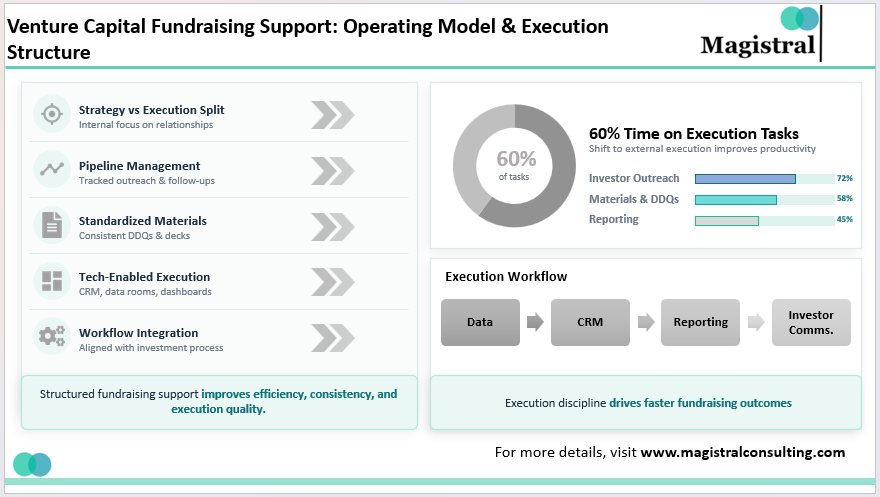
Venture capital fundraising support creates measurable value when implemented as a structured execution system rather than an ad hoc function. A well-defined operating model improves efficiency and ensures consistent outcomes.

Venture Capital Fundraising Support: Operating Model & Execution Structure

Venture Capital Fundraising Support: Operating Model & Execution Structure

Separation of relationship and execution effort

Internal teams focus on investor relationships, negotiations, and closing activities, while execution tasks are handled externally. Industry estimates suggest that investment professionals spend nearly 60% of their time on documentation, coordination, and follow-ups. By shifting these tasks, venture capital fundraising support enables internal teams to focus on high-value activities such as relationship-building and strategic positioning, thereby improving overall productivity.

Structured pipeline management and tracking

A well-managed investor pipeline significantly improves conversion rates. Venture capital fundraising support ensures that all interactions are tracked, follow-ups are scheduled, and next steps are clearly defined. This structured approach reduces inefficiencies, minimizes missed opportunities, and improves overall pipeline visibility. Firms that maintain disciplined pipeline tracking are better positioned to prioritize high-potential investors and allocate resources effectively.

Consistency across fundraising materials

Inconsistent messaging can reduce investor confidence and delay decision-making. Standardized pitch decks, DDQs, and performance summaries ensure alignment across all communications. Venture capital fundraising support enforces version control and consistency, reducing errors and ensuring that all materials reflect the latest data and narrative.

Technology-enabled execution

Modern fundraising relies heavily on digital tools such as CRM systems, virtual data rooms, and analytics dashboards. McKinsey highlights that firms leveraging digital tools can improve operational efficiency by up to 25–30%. Venture capital fundraising support integrates these tools into daily workflows, improving response times, enhancing tracking capabilities, and ensuring better coordination across teams.

Integration with investment workflows

Fundraising increasingly aligns with broader investment functions such as private equity and portfolio monitoring. This ensures that investor communication reflects real-time portfolio insights and performance metrics. Integration across workflows improves consistency and strengthens the overall investment narrative presented to LPs.

Venture capital fundraising support impact on fundraising outcomes

The impact of venture capital fundraising support can be measured across key performance indicators such as speed, conversion rates, and investor engagement.

Improved response time and engagement

Preqin indicates that faster response times significantly improve investor engagement and increase the likelihood of conversion. Delays in communication often result in reduced interest or missed opportunities. Venture capital fundraising support ensures timely responses, maintaining momentum and strengthening investor relationships.

Reduction in fundraising cycle duration

Although market conditions influence timelines, structured execution reduces inefficiencies. Firms with disciplined workflows often close funds faster compared to those with fragmented processes. By streamlining communication and reducing bottlenecks, venture capital fundraising support contributes to shorter fundraising cycles.

Higher conversion rates across the pipeline

A structured pipeline improves visibility into investor interest levels and allows firms to focus on high probability leads. This targeted approach improves conversion rates and ensures efficient use of resources. Venture capital fundraising support plays a key role in maintaining pipeline discipline and tracking investor engagement.

Improved consistency and credibility

Consistency in communication builds trust with LPs and enhances credibility. Venture capital fundraising support ensures that all materials, responses, and updates align with the fund’s positioning and strategy. This consistency reduces confusion and improves investor confidence.

Better targeting and investor fit

Firms that adopt structured targeting strategies achieve higher success rates. Venture capital fundraising support enables better segmentation of investors based on mandate fit, geography, and investment preferences. This improves outreach effectiveness and increases the likelihood of successful fundraising.

Venture capital fundraising supports governance and process control

As fundraising becomes more structured, governance plays a critical role in maintaining control, consistency, and compliance.

Centralized data and version control

A single source of truth ensures that all stakeholders have access to the latest information. This reduces inconsistencies and prevents errors in investor communication, particularly when multiple versions of documents are involved.

Compliance and regulatory alignment

Fundraising materials must comply with regulatory requirements across jurisdictions. Structured workflows ensure that all materials are reviewed and approved before being shared with investors, reducing compliance risks.

Quality control mechanisms

Review processes ensure accuracy in performance data, track records, and financial metrics. Venture capital fundraising support enforces these controls systematically, improving data reliability and consistency.

Process discipline and cadence

Regular updates, pipeline reviews, and structured tracking mechanisms prevent process drift. Maintaining a consistent cadence ensures that all fundraising activities remain aligned with overall objectives.

Long-term capability building

Over time, venture capital fundraising support evolves into a repeatable system that enhances efficiency, scalability, and investor engagement. Firms that embed structured support into their operating model develop stronger fundraising capabilities and achieve more consistent outcomes across cycles.

About Magistral Consulting

Magistral Consulting has helped multiple funds and companies in outsourcing operations activities. It has service offerings for Private Equity, Venture Capital, Family Offices, Investment Banks, Asset Managers, Hedge Funds, Financial Consultants, Real Estate, REITs, RE funds, Corporates, and Portfolio companies. Its functional expertise is around Deal origination, Deal Execution, Due Diligence, Financial Modelling, Portfolio Management, and Equity Research

For setting up an appointment with a Magistral representative visit www.magistralconsulting.com/contact

About the Author

Tanya is an investment-research specialist with 6 + years advising venture-capital, private-equity and lending clients worldwide. A Stanford Seed alumnus with an MBA and an Economics (Hons) degree, she heads project teams at Magistral Consulting, delivering financial modelling, due-diligence and deal support on 3,000 + mandates. Her blend of rigorous analytics, sharp project management and clear client communication turns complex data into actionable investment insight.

FAQs

What is venture capital fundraising support?

It is a structured support model that helps manage investor outreach, documentation, and fundraising workflows.

How does fundraising support improve efficiency?

It reduces operational workload and ensures faster, more consistent execution.

Why is fundraising becoming more complex?

Increased LP selectivity, longer cycles, and higher diligence requirements have made fundraising more demanding.

What tasks are typically supported?

Investor research, CRM updates, DDQ preparation, and follow-up management.

What is the biggest benefit of venture capital fundraising support?

The biggest benefit is improved fundraising outcomes through better process execution and scalability.