Tag Archives: Companies Portfolio Management

Global financial systems now use automated investment portfolio management as an essential element of their operations, which started out as a basic instrument for users. Investors today deal with three major challenges, which include unpredictable market conditions, increasing inflation rates, and swift changes in capital among different asset categories. According to PwC’s Global Asset and Wealth Management Outlook, global assets under management are projected to approach 147 trillion dollars by the end of the decade, increasing the demand for scalable digital solutions. Deloitte found that more than 60 percent of asset managers now speed up their AI technology implementation for investment management tasks.

Automated management systems enable organizations to achieve operational efficiency while minimizing costs and maintaining ongoing performance evaluation through their ability to process data.

The Growing Importance of Automated Investment Portfolio Management

The practice of automated investment portfolio management has become essential for both retail investors and institutional investors when they develop their investment strategies. The global market for robo advisory services will grow at more than 30 percent annual compound growth, according to market research conducted by Precedence Research. The fast development of this technology shows that investors trust algorithmic systems, which use allocation models to handle their investments.

The Growing Importance of Automated Investment Portfolio Management

The Growing Importance of Automated Investment Portfolio Management

Expansion of Digital Advisory Assets

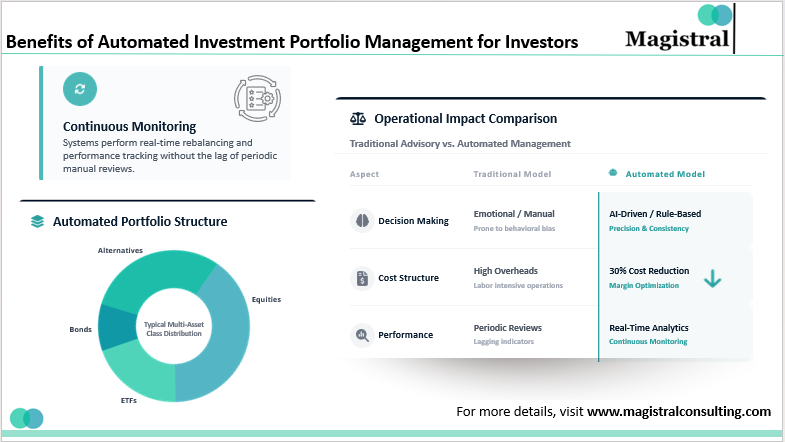
Digital advisory platforms now manage trillions in client assets worldwide. PwC shows that digitally powered wealth platforms attract major market share because millennials and first-time investors use these platforms. Investors use automated investment portfolio management to achieve a multiple asset class distribution, which includes equities, bonds, and exchange-traded funds, while keeping their expenses low.

Institutional AI Adoption

Large asset managers increasingly embed AI into portfolio construction. MSCI research shows that AI risk analytics tools help investors better forecast drawdown risks during periods of market uncertainty. Hedge funds now use algorithmic systems to enhance their alpha strategies, which mirrors the changes described in AI in hedge funds, where data science improves their ability to make instant choices.

Cost Efficiency and Margin Optimization

The process of automation produces major savings in advisory service costs. Digital portfolio platforms enable organizations to decrease their operational expenses by as much as 30 percent when compared to traditional advisory models, according to Deloitte research. Companies that maintain lower overhead costs can accommodate more customers while retaining control over investment management. This enables businesses to expand their operations while safeguarding their profit margins.

Data Driven Discipline

Emotional investing often leads to suboptimal timing decisions. Automated systems eliminate bias by following rule-based allocation strategies. This aligns with the broader evolution outlined in AI in portfolio management, where machine intelligence supports precision and transparency in asset allocation.

Core Technologies Powering Automated Investment Portfolio Management

The core structure of automated investment portfolio management depends on technological systems. Artificial intelligence and machine learning, together with cloud infrastructure, provide organizations with advanced abilities to run their analytics and modify their investment portfolios at quicker speeds.

Machine Learning in Asset Allocation

The researchers use machine learning models to analyze both past relationships between different factors and present economic conditions. McKinsey’s digital asset management insights indicate that AI-driven allocation can enhance risk-adjusted returns by improving forecasting consistency. The platforms for automated investment portfolio management execute constant portfolio adjustments in response to changing market volatility.

Predictive Risk Modeling

Predictive analytics simulate multiple market scenarios that include both inflation spikes and rate hikes. The approach helps organizations minimize their losses during unpredictable market conditions.

Behavioral Data Insights

The advanced algorithms use investor behavior data together with their past trading records to create customized portfolio management solutions. The process of customizing investment experience for investors leads to better investor satisfaction results, while investors still need to follow their necessary diversification rules.

Cloud-Based Infrastructure

Cloud technology provides organizations with the ability to observe their investment portfolios throughout every moment of the day. Asset managers process large datasets efficiently without heavy infrastructure investments. The same digital transformation trends that affect the investment banking industry also transform its outsourcing processes through analytics and automation technologies that enhance operational efficiency.

Integration with Alternative Investments

Contemporary platforms provide users with access to investment opportunities that extend beyond traditional stock and bond markets. Institutions worldwide adopt alternative investment options, which include private markets and structured products. Fund managers who operate in institutional settings have started using automated screening systems to achieve better risk management results and improved portfolio diversity outcomes.

Benefits of Automated Investment Portfolio Management for Investors

Automated investment portfolio management delivers many advantages across cost, performance tracking, and risk management. As global markets grow more interconnected, investors demand solutions that combine speed with analytical depth.
Benefits of Automated Investment Portfolio Management for Investors

Benefits of Automated Investment Portfolio Management for Investors

Enhanced Portfolio Diversification

Algorithms allocate capital across asset classes based on predefined risk thresholds. According to MSCI, diversified portfolios supported by quantitative models show improved resilience during downturns compared to concentrated allocations.

Continuous Rebalancing

Most manual portfolio rebalancing activities take place either every three months or every twelve months. The automated systems track asset distributions throughout the day and make corrections whenever they detect changes beyond set limits. This approach to management keeps operations in sync with established long-term business targets.

Transparency and Reporting

Digital dashboards display performance metrics through immediate, real-time monitoring. Investors receive immediate access to changes in their allocations, together with information about sector distribution and risk assessment scores. The system provides complete visibility, which enhances both trust and accountability in the organization.

Lower Entry Barriers

Retail investors can now enter the market because investment firms have reduced their minimum capital requirements. This system enables all investors to use advanced investment techniques that used to be exclusive to wealthy individuals.

How Magistral Supports Automated Investment Portfolio Management

The process of managing automated investment portfolios requires organizations to establish both technological systems and operational structures. Magistral Consulting helps asset managers, family offices, and institutional investors create scalable portfolio management systems.

Data Analytics and Model Support

The teams at Magistral provide analytical expertise that improves both algorithm development and reporting precision

Integration with Capital Strategies

The capital raising advisory process shows that structured investor communication works better with digital portfolio reporting than with other methods.

Operational Optimization

Automatic systems need to operate within the boundaries of compliance regulations and reporting requirements. Magistral helps organizations create operational processes that enhance their governance capabilities and improve their reporting practices to show how their portfolios meet regulatory requirements.

Long Term Strategic Alignment

The global financial system demands that organizations find partners who possess knowledge about both technological advancements and market dynamics. The practice of automated investment portfolio management reaches its highest efficiency when organizations use both strategic advisory services and operational excellence. Organizations can handle market fluctuations by using analytical tools and systems that can grow and enhance their professional knowledge of their industry.

About Magistral Consulting

Magistral Consulting has helped multiple funds and companies in outsourcing operations activities. It has service offerings for Private Equity, Venture Capital, Family Offices, Investment Banks, Asset Managers, Hedge Funds, Financial Consultants, Real Estate, REITs, RE funds, Corporates, and Portfolio companies. Its functional expertise is around Deal origination, Deal Execution, Due Diligence, Financial Modelling, Portfolio Management, and Equity Research

For setting up an appointment with a Magistral representative visit www.magistralconsulting.com/contact

About the Author

Prabhash Choudhary is the CEO of Magistral Consulting. He is a Stanford Seed alumnus and mechanical engineer with 20 + years’ leadership at Fortune 500 firms- Accenture Strategy, Deloitte, News Corp, and S&P Global. At Magistral Consulting, he directs global operations and has delivered over $3.5 billion in client impact across finance, research, analytics, and outsourcing. His expertise spans management consulting, investment and strategic research, and operational excellence for 1,200 + clients worldwide

FAQs

How secure is automated investment portfolio management?

Leading platforms use encrypted cloud infrastructure and regulatory compliant frameworks to protect investor data and transaction integrity.

Can automated systems outperform human advisors?

While results vary, automated systems improve consistency and reduce emotional bias, which can enhance long term risk adjusted performance.

Is automated investment portfolio management suitable for institutions?

Yes, many institutional investors use algorithm driven allocation and AI based analytics to strengthen diversification and risk forecasting.

How does automation reduce costs?
Automation reduces manual advisory effort and operational overhead, allowing firms to scale services efficiently while lowering client fees.

Portfolio management teams now face pressure not only to create alpha but also to navigate tighter margins, increased regulatory focus, complex data requirements, and demands for institutional-quality reporting. As a result, portfolio management outsourcing has shifted from a cost-saving tactic to a strategic organizational model. Asset managers, alternative investment firms, family offices, and hedge funds increasingly rely on experts for portfolio analytics, reporting, and risk monitoring, allowing them to focus on investment decisions. This trend has accelerated as more complex capital flows into their management in 2024-2025.

Why Portfolio Management Outsourcing Is Accelerating in 2024–2025

The renewed momentum behind portfolio management outsourcing is best understood by looking at the broader industry context rather than isolated cost pressures.

Why Portfolio Management Outsourcing Is Accelerating in 2024–2025?

Why Portfolio Management Outsourcing Is Accelerating in 2024–2025?

The total global assets under management passed the $135 trillion mark in 2024, and there was a resurgence in organic growth compared to the previous year, 2023. With an ever-increasing asset base, the number of moving parts increases as well. There are several factors involved. For many firms, scaling internal teams at the same pace simply isn’t economical or operationally efficient.

Secondly, the modern financial landscape is also propelling the trend. The reality is that nonbank financial institutions currently represent slightly more than half of worldwide financial assets. This increases the challenge of proper risk management. Investors not only judge managers based on return performance. They also judge them based on the quality of the portfolios they deliver. The outsourcing of managers is no longer considered “back-office delegation.” It is the institutionalization of portfolio management.

On the human capital side, skilled portfolio analysis professionals, risk experts, and reporting professionals with performance expertise continue to be in short supply and cost-prohibitively in major financial hubs.

Core Functions Covered Under Portfolio Management Outsourcing

Although the scope varies by firm, portfolio management outsourcing would typically support several core areas that sit close to the investment decision-making process.

Portfolio Analytics and Performance Measurement

The foundation of portfolio oversight is accurate, timely performance analytics. Outsourced teams perform tasks such as return attribution, benchmark comparisons, factor analysis, and multi-period performance reviews. That way, portfolio managers know immediately what is driving the results, without needing to spend hours reconciling data across systems.

For alternative strategies such as private credit, real assets, or structured products, analytics often rely on bespoke models. Specialist providers bring experience from a host of fund structures and asset classes, reducing the risk of misinterpretation or inconsistent methodologies.

Risk Monitoring and Exposure Management

Today’s investors have higher expectations of risk oversight than just information on volatility. They expect to receive detailed, easy-to-understand descriptions of concentration risk; liquidity profiles; potential drawdown scenarios; and answers to their stress testing. The portfolio management outsourcing partner has implemented a risk framework or tool that will continuously detect any type of exposure and notify the firm of problems prior to their becoming a serious concern.

This function is important for any firm that is operating in both private equity and public markets because both have varying degrees of liquidity. Creating these views internally for the firm requires a significant number of resources. The external specialist, however, has created the views for both sectors of the business to accommodate that intersection.

Operational and Strategic Benefits Beyond Cost Savings

While cost savings are still a motivator for many firms, the true benefit of employing outsourced support for portfolio management is its strategic effect.

Improved Focus for Investment Teams

By eliminating the need to perform operational tasks and prepare data for reporting and reconciliation. Portfolio managers now dedicate their time and energy to assisting with research, asset allocation, and assessing risk-to-reward ratios. Thus, portfolio managers have greater clarity when making strategic decisions and ultimately make better decisions. Especially during the high-stress, volatile times of the markets when the ability to react quickly is critical.

Scalability Without Disruption

When a firm has a growing fund or is preparing to launch a new product, the outsourced model makes scaling seamless. Firms launch new portfolios or mandates and investor reporting requirements evolve. So the outsourced model absorbs these new demands without extensive hiring or major system changes

Risk and Compliance Alignment

With the growing expectations from regulators worldwide, the portfolio oversight function has become heavily scrutinized. The right portfolio management outsourcing partners will provide you with experience. It deals with how to implement controls, maintain documentation standards, and develop processes that are ready for audit. This will reduce operational risk and aid in achieving compliance.

Market Trends Shaping Portfolio Management Outsourcing

The 2024-2025 years saw a noticeable shift in trends, prompting companies to rethink their strategies for portfolio management outsourcing.

Market Trends Shaping Portfolio Management Outsourcing

Market Trends Shaping Portfolio Management Outsourcing

Integration With Middle-Office and Data Functions

Firms are now integrating portfolio tasks instead of outsourcing them one at a time. The market expects the global main-office outsourcing sector, valued at around $8 billion in 2024, to more than double over the next decade, reflecting sustained demand for end-to-end solutions.

Performance-Linked Outsourcing Outcomes

Recent surveys conducted in the industry indicate that over 80% of the firms taking advantage of outsourced trading and analytics functions report being able to make better investments. This brings an end to the myth that outsourcing merely affects productivity; it rather stresses that having better data and quicker insights can lead to returns.

Customization Over Standardization

Firms are no longer relying on the same outsourcing contracts for all roles. They opt for a tailor-made service that best suits their specific strategy, asset class, or investor profile. This is a notable trend observed in the case of alternative managers managing complex portfolios that span both public and private markets.

Technology-Enabled Oversight

The use of automation, dashboards, and real-time reporting tools is becoming a standard procedure. Among portfolio management outsourcing partners, those who combine human skills with cutting-edge technology are gaining popularity, as they provide the expected level of transparency without giving up control.

How Magistral Adds Value to Portfolio Management Outsourcing

Magistral considers portfolio management outsourcing to be a partnership model, not a task-oriented service. Magistral leverages its deep financial industry knowledge with its offshore execution capabilities, and it caters to its asset management clients. It is in terms of analytics, risk management, reporting, and operational management, without sacrificing control. Instead, its personnel are considered an extension of its clients’ investment management. They operate alongside adaptive processes that are aligned with each firm’s strategy, assets, and client necessities. Multi-asset portfolios, alternative platforms, or any other form of engagement in public, private, or equity markets. Its primary goal remains to help portfolio managers concentrate on what is most imperative to them: informed decision-making.


About Magistral Consulting

Magistral Consulting has helped multiple funds and companies in outsourcing operations activities. It has service offerings for Private Equity, Venture Capital, Family Offices, Investment Banks, Asset Managers, Hedge Funds, Financial Consultants, Real Estate, REITs, RE funds, Corporates, and Portfolio companies. Its functional expertise is around Deal origination, Deal Execution, Due Diligence, Financial Modelling, Portfolio Management, and Equity Research

For setting up an appointment with a Magistral representative visit www.magistralconsulting.com/contact

About the Author

Nitin is a Partner and Co-Founder at Magistral Consulting. He is a Stanford Seed MBA (Marketing) and electronics engineer with 19 + years at S&P Global and Evalueserve, leading research, analytics, and inside‑sales teams. An investment‑ and financial‑research specialist, he has delivered due‑diligence, fund‑administration, and market‑entry projects for clients worldwide. He now shapes Magistral Consulting’s strategic direction, oversees global operations, and drives business‑development support.

FAQs

Is portfolio management outsourcing suitable for small funds?

Yes. Smaller managers often benefit the most, as outsourcing provides access to experienced talent and advanced infrastructure without fixed overheads.

Does outsourcing reduce control over portfolios?

When structured correctly, it enhances control by improving data quality, transparency, and oversight, while decision-making authority remains with the manager.

How does outsourcing support investor reporting?

Outsourced teams produce standardized, accurate, and timely reports aligned with LP expectations, helping managers build credibility and trust.

Can outsourcing adapt as portfolios grow or strategies change?

Scalability is one of its main advantages. Services can expand or adjust as assets, strategies, or regulatory requirements evolve.


Introduction

Portfolio and fund management play a crucial role in financial success for individuals and institutions. Whether you’re an investor looking to grow wealth or a fund manager handling client assets, understanding key principles and strategies is essential. This guide covers portfolio and fund management fundamentals, including strategies and best practices to optimize investments.

Understanding Portfolio Management

Portfolio management involves allocating assets strategically to meet investment objectives while minimizing risk. Portfolios include stocks, bonds, real estate, commodities, and alternative investments. The primary goals are capital preservation, appreciation, and risk mitigation.

Diversification is key, spreading investments across asset classes, sectors, and regions to reduce risk. Asset allocation involves determining the right mix of assets based on risk tolerance, investment horizon, and financial goals.

Portfolio Management Strategies

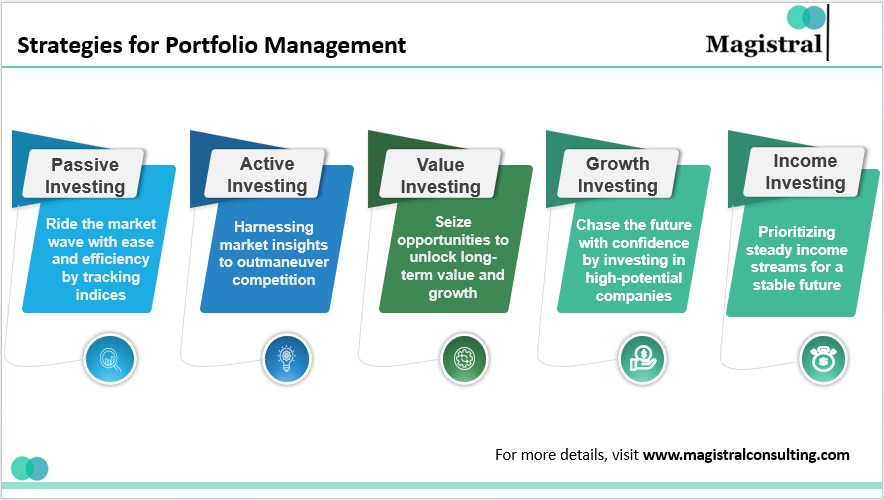
Several strategies can be employed in portfolio management to achieve specific objectives:

Strategies for Portfolio Management

Strategies for Portfolio Management

Passive Investing

Passive investing tracks market indices using low-cost index funds or ETFs to mirror overall market performance. The objective is to mirror the performance of the overall market while keeping fees and transaction costs minimal.

Active Investing

Active investing involves buying and selling securities to outperform the market, requiring research and analysis. This requires thorough research, market analysis, and continuous monitoring of portfolio holdings.

Value Investing

Value investing focuses on identifying undervalued stocks trading below intrinsic value for long-term gains. Investors following this strategy seek to capitalize on market inefficiencies and generate long-term returns.

Growth Investing

Growth investing targets companies with strong earnings growth potential, often carrying higher risk. While this involves higher levels of risk, it can lead to significant capital appreciation over time.

Income Investing

Income investing prioritizes investments that generate steady income, such as dividends or interest payments. This strategy is commonly favored by retirees or investors seeking reliable cash flow.

Risk Management

Risk management is a vital component of portfolio management, playing a central role in protecting against potential losses and safeguarding capital. Below are some common risk management techniques:

Asset Allocation

Asset allocation spreads investments across different asset classes to reduce reliance on a single market. This diversification strategy plays a crucial role in mitigating the impact of underperformance in one asset class on the overall portfolio, thereby enhancing its stability and resilience.

Portfolio Rebalancing

Regularly assessing and adjusting a portfolio is vital to ensure it stays aligned with the investor’s risk tolerance and investment objectives. Market shifts and fluctuations in asset performance may lead to deviations from the desired asset allocation over time. Portfolio rebalancing adjusts asset allocations periodically to maintain risk levels and investment objectives.

Stop-loss Orders

Utilizing stop-loss orders set predefined prices for selling securities to limit potential losses. By employing stop-loss orders, investors safeguard their investments from substantial declines in value, thus lessening the impact of unfavorable market shifts on the portfolio.

Hedging Strategies

Hedging strategies use derivatives like options or futures to protect against adverse market movements. These strategies are aimed at protecting against adverse price movements in specific securities or asset classes. For example, investors might use options to hedge against downside risk in their equity holdings or utilize futures contracts to hedge against fluctuations in commodity prices.

Fund Management: Overview and Strategies

Fund management involves overseeing pooled investments such as mutual funds, hedge funds, ETFs, and pension funds. Fund managers make investment decisions, execute trades, and ensure compliance with fund objectives.

Types of Funds

Mutual Funds

They are pooled investments managed by professionals across various securities.

Hedge Funds

Hedge funds use diverse strategies like long-short equity and global macro to maximize returns.

Exchange-Traded Funds (ETFs)

ETFs are traded on exchanges, tracking market indices or specific asset classes.

Pension Funds

These are employer-sponsored retirement funds investing in diversified assets.


Fund Management Strategies

Fund management strategies encompass a range of approaches used by fund managers to achieve specific investment objectives while mitigating risk. Here are some common fund management strategies:

Fund Management Strategies

Fund Management Strategies

Benchmarking

This measures fund performance against relevant indices.

Active vs. Passive Management

It requires fund managers to decide between hands-on investment strategies or index tracking.

Risk Management

Risk Management implements diversification, hedging, and portfolio optimization to protect investor capital.

Performance Evaluation

Performance Evaluation analyzes metrics like risk-adjusted returns, alpha, and Sharpe ratio to assess fund success.

Regulatory Environment and Compliance

Fund managers operate under strict regulations enforced by authorities such as the SEC in the USA and FCA in the UK. Adhering to regulatory requirements ensures investor confidence and legal compliance.

Magistral Consulting’s Services in Portfolio and Fund Management

Magistral Consulting offers a comprehensive suite of services tailored to investors and businesses in portfolio and fund management.

Portfolio Management

Portfolio management involves allocating assets strategically to meet investment objectives while minimizing risk. Magistral provides customized investment strategies using market analysis, risk assessment, and strategic asset allocation.

ESG Compliance Monitoring

Environmental, social, and governance (ESG) aspects play a major role in influencing investment decisions in the contemporary socially conscious world. Magistral Consulting helps clients integrate environmental, social, and governance factors into investment decisions.

Outsourced CFO and Financial Reporting

We provide outsourced CFO services to companies looking for strategic financial assistance without the overhead of a full-time CFO. Magistral also offers financial planning, budgeting, forecasting, and financial statement reporting.

Business Development Support for Portfolio and Fund Management

Magistral goes beyond traditional financial services, offering business development support to help clients identify growth opportunities and expand their market presence.

assists with market expansion, procurement support, fund administration, and operational streamlining.

About Magistral Consulting

Magistral Consulting has helped multiple funds and companies in outsourcing operations activities. It has service offerings for Private Equity, Venture Capital, Family Offices, Investment Banks, Asset Managers, Hedge Funds, Financial Consultants, Real Estate, REITs, RE funds, Corporates, and Portfolio companies. Its functional expertise is around Deal origination, Deal Execution, Due Diligence, Financial Modelling, Portfolio Management, and Equity Research

For setting up an appointment with a Magistral representative visit www.magistralconsulting.com/contact

About the Author

The article is authored by the Marketing Department of Magistral Consulting. For any business inquiries, you can reach out to prabhash.choudhary@magistralconsulting.com

Introduction

Portfolio Management for Private Equity and Venture Capital firms refers to the way in which the critical performance metrics are collected, measured, monitored, and tracked across the portfolio companies, and/or the active funds. Furthermore, such measures ensure that the capital is not subjected to excessive market risk. The capacity to make informed decisions underpins the entire process. Generally, Private Equity firms seek out underperforming or undervalued companies. By working with these companies, managers unlock significant value by:

– Improving business strategy

– Injecting managerial expertise

– Advance product technology

– Expanding distribution

Portfolio Management for Private Equity involves acquiring investment company ideas from a variety of sources and evaluating these to make an analytical decision. It is critical to rethink the portfolio regularly and practice the continual development of Portfolio Management methods.

Effective Portfolio Management for Private Equity leads to better IRRs for LP Investors

A PE or a VC firm invests in a company typically with 5+ years of the horizon. In early-stage investing, active management of companies to grow the valuation is imperative.

Even for late-stage investing, a well-balanced portfolio is critical in today’s world, as the perfect set of companies in a portfolio of private equity helps to grow. A good portfolio is a well-balanced combination of various companies, with funds allocated according to the firm’s tastes and risk tolerance. Building a portfolio is only the beginning of the task. In terms of returns and risk reduction, active management outperforms passive management.

Portfolio management is crucial because it reduces risk by diversifying and redistributing cash across different companies in the portfolio based on their performance. It also aids in the preparation of tax requirements. It also aids in the organization of money in times of need.

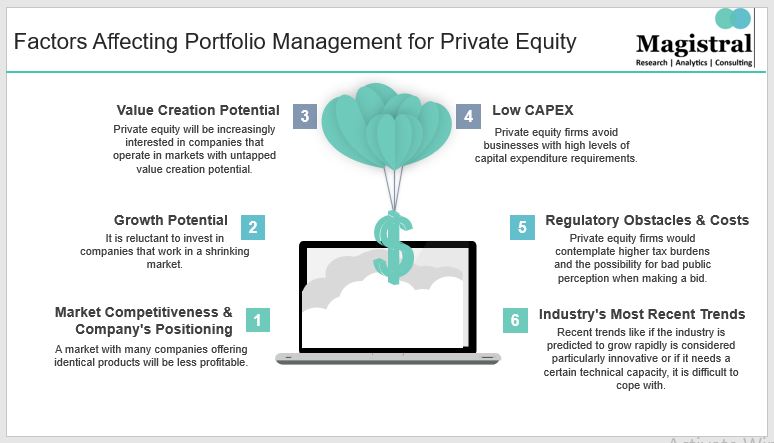
Factors affecting Portfolio Management for Private Equity

Private equity is undoubtedly a very competitive industry. It has been traditionally known for cutthroat business focused on cost-cutting and profit generation. This trend has slowly shifted in recent years. Now, Private equity looks for such companies in their portfolio which generate value over the long term.

Factors that impact PE Portfolio Performance

Crucial Factors leading to the success of a PE portfolio

Some of the factors which are taken into consideration in Private Equity portfolio management are:

Market Competitiveness and a Company’s Positioning 

The market’s competitiveness will significantly impact an individual company’s ability to achieve long-term success. A market with much competition offering identical items is likely to be less profitable.

Growth Potential 

Private equity firms are increasingly talking about companies where they would infuse both financial and organizational capabilities and industries that can accomplish growth in numerous ways.

Value Creation Potential 

The companies that operate in markets with untapped value creation potential are more attractive. Private equity firms prize the ability to minimize costs and increase existing capabilities for new revenue streams.

Low CAPEX 

If a company operates in a sector that will necessitate a significant amount of initial funding, a private equity firm will view this as an obstacle and will want to spend less for the company. In contrast, if a company already has the capital it needs to perform business and expand, a private equity firm would be willing to pay a higher price for the acquisition.

Regulatory Obstacles and Costs 

Regulatory barriers and costs could significantly impact the price of a company that operates in a particular sector. When making a bid to add a company to a portfolio, private equity firms recognize higher tax burdens.

Industry’s Most Recent Trends

The latest industry trends and possibilities for expansion have a significant impact on a company’s valuation. Companies that compete in the market can be more desired from private equity firms’ standpoint if the industry is predicted to proliferate, is considered particularly innovative, or needs a specific technological capacity that is hard to acquire.

Improving Private Equity Portfolio Performance

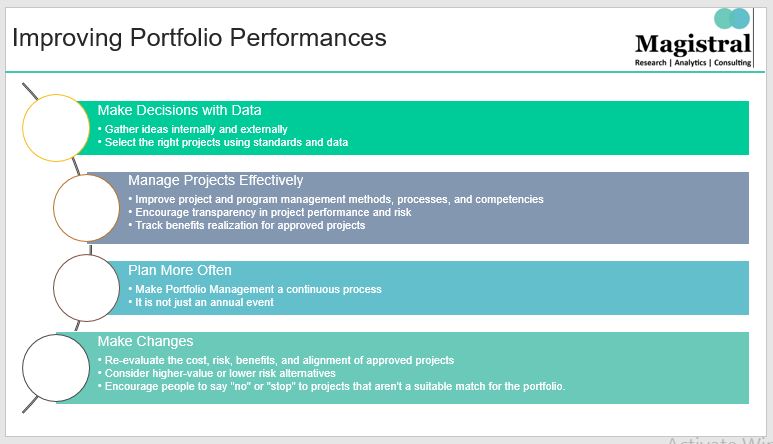
Effective project delivery and the ability to make modifications are key to improving portfolio success. It cannot be expected that projects that have been approved will produce the intended outcomes. Their worth, risk, and cost must all be assessed regularly. Projects should be discontinued or replaced if underperforming and have better alternatives.

Data analysis should be considered when making decisions. It is critical to collect ideas both internally and externally and choose the correct initiatives based on standards and statistics. Projects must be effectively managed. Methods, processes, and competencies for the project and program management must be improved, while clarity in project performance and risk need to be encouraged.

Improving PE Portfolio Performance

Improving PE Portfolio Performance

Portfolio Management is a continual activity, not simply an annual event, so planning should be done more frequently. The cost, risk, benefits, and coherence of authorized projects should all be reevaluated, with higher-value or lower-risk alternatives being considered

Technology’s Role in Enhancing Portfolio Performance

Better technology ensures that data from other processes, such as project, resource, and economic management, is timely and accurate. It also allows for the detection of underperforming projects and reduces effort and time spent on portfolio management tasks, allowing for continuous planning. It enables speedier re-planning when budgets alter, or new projects are made mandatory by providing analytic support in considering numerous ideas and projects simultaneously. It also gives process participants, stakeholders, and constituents access to reporting and transparency.

Role of Outsourcing

Outsourcing is the practice of hiring a third-party organization to carry out services that were initially performed in-house. The shift towards a customer-oriented business model resulted in outsourcing and therefore it became an important part of business economics in the 1990s. In only a few decades businesses realized in order to stay relevant in the industry, they need to focus on increasing the customer value of their services or products. Since then, businesses turned more towards the concept of outsourcing.

Outsourcing is even more critical for PE acquired businesses as they need to create value and savings quickly due to their investors’ pressure.

Here are a few fundamental benefits of outsourcing:

– Reduced costs are one of the primary advantages of outsourcing. These costs only arise when the process is ongoing, when these processes are not required, no bills are generated.

– Outsourcing partners are experts in their domain; therefore, they are quick and efficient in the organization’s process.

– Their expertise leads to increase quality and better results. They deal with the specific task with a matter of routine and precision.

Experienced outsourcing vendors provide cost savings with expertise, therefore it’s a better return on the company’s investment.

Magistral Service Offerings for Portfolio Management for Private Equity and Venture Capital

Magistral has helped multiple Private Equity and Venture Capital firms in managing their portfolio in the cycle of acquisition, value creation, and securing a profitable exit. Expertise when combined with Outsourcing brings quality and cost-effectiveness to the strategic decisions made at the portfolio companies.

Magistral's Portfolio Management Service Offerings for Private Equity and Venture Capital

Magistral’s Service Offerings for Portfolio Management for Private Equity and Venture Capital

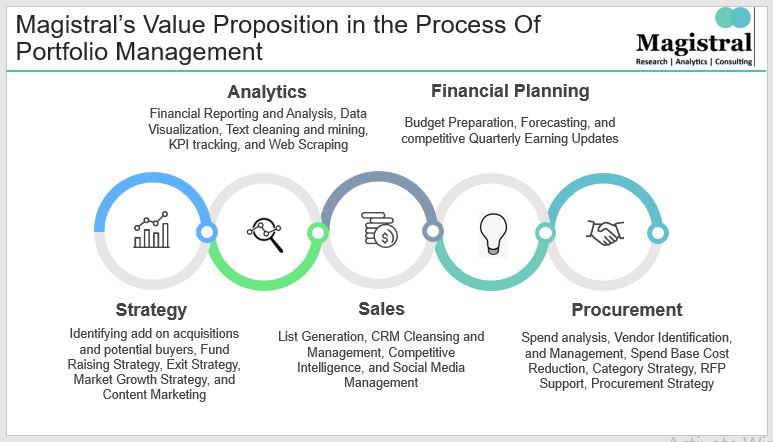
So here is how Magistral helps:

Strategy

This is the most important part of the planning, which comprises the following:

– Identifying Add-On Acquisitions and Potential Buyers: Finding relevant M&A opportunities help in lowering the cost by merging the staff members with similar expertise, expanding into new regions, consolidating management and finances, and boosting the buying power.

– Planning Fund Raising Strategies: Here, a basic setup is made for fundraising such as LP research, LP reach out through calls & e-mails, preparing content, partner profiles, etc.

– Exit Strategy: Various exit strategies are made including a trade sale, which is the sale of a company to another PE firm, or a secondary buy-out for a medium or large portfolio company.

– Market Growth Strategy: Profitability, Growth, and Performance are the major objectives for Portfolio Management for Private Equity. Various strategies are formed to keep the portfolio growing.

– Content Marketing: This step helps in marketing the content for the acquisition of add-ons or potential buyers for private equity.

Analytics

The second major step involves analytics of portfolio management for Private Equity and Venture Capital. Analytics include the followings:

– Financial Reporting and Analysis: It is the process of documenting and communicating financial activities and performances over specific time periods. It depicts the financial health of the companies. This can be further done by performing trend analysis, common-size financial analysis, financial ratio analysis, and benchmark (industry) analysis.

– Preparing Dashboards: Various dashboards are prepared by cleaning the data, selecting the right chart, and building the perspective using predefined templates which helps in making a clear and better decision.

– Data Visualization: Information or data is then represented by visual elements like charts, graphs, and maps. It’s the most accessible way to see and understand trends, outliners, and patterns.

– Text Cleaning and Mining: Text cleaning and mining refer to artificial intelligence technology that uses natural language processing to transform the free text in documents and data into normalized structure data suitable for analysis.

– Predictive Modeling: It is a statistical technique using machine learning and data mining to predict and forecast likely future outcomes with the aid of historical and existing data. It works by analyzing current and historical data and projecting what it learns on a model generated to forecast likely outcomes.

– KPI Tracking: Key Performance Indicator (KPI) helps in monitoring performance metrics.

– Web Scraping: It’s the process of using bots to extract content and data from a website.

Sales

After analytics, the sale is taken care of by performing the following activities:

– List Generation: Final list is generated on the basis of various factors.

– CRM Cleansing and Management: It is performed to improve the overall quality of our data so that it increases the overall productivity of the portfolio.

– Competitive Intelligence: Competitive Intelligence research is the data gathered to know and analyze competitors. It helps in making better strategic decisions.

– Social Media Management: It helps in promoting the sales of a particular portfolio by the means of social media.

Financial Planning

Financial Planning while portfolio management for private equity is an important step as it helps in developing overall goals and creates a plan of action to achieve them. This step majorly includes the following:

– Budget Preparation: It’s a process of preparing an outline of planned future activities by making available funds, expenses, and future incomes into account.

– Forecasting: Historical data are used as inputs to make informed estimates that are predictive in determining the direction of future trends

– Competitive Quarterly Earning Updates: Final step is to make competitive earning updates.

Procurement

Its purpose is to develop a fully comprehensive picture of procurement. Following are the steps performed:

– Spend Analysis: In this, we analyze the past and projected procurement expenditure or spending for services or work

– Vendor Identification: In this, business requirements are identified and analyzed, and then developed to finally evaluate the vendors

– Spend Base Cost Reduction: This is performed to systematically boost productivity

– Category Strategy: It is an excellent tool that should be the procurement team’s work. It maximizes the value and efficiency

– RFP Support: RFP stands for Request for Proposal, it’s a business document that announces a project, describes it, and solicits bids from qualified investors

 Typical Outcomes of our Portfolio Management Services

– 30-50% reduction in cost operations

– Up to 20% improvement in sales for companies operating in B2B segments

– Up to 20% reduction in Procurement spend base

– Up to 10% improvements in gross margins due to advanced analytics

– 30-40% improvement in plan compliance

About Magistral consulting

Magistral Consulting has helped multiple funds and companies in outsourcing operations activities. It has service offerings for Private Equity, Venture Capital, Family OfficesInvestment BanksAsset Managers, Hedge Funds, Financial Consultants, Real Estate, REITs, RE fundsCorporates and Portfolio companies. Its functional expertise is around Deal originationDeal Execution, Due Diligence, Financial ModelingPortfolio Management and Equity Research.

For setting up an appointment with a Magistral representative visit www.magistralconsulting.com/contact

About the Author

The article is Authored by the Marketing Department of Magistral Consulting. For any business inquiries, you could reach out to prabhash.choudhary@magistralconsulting.com