Tag Archives: due diligence for Real estate

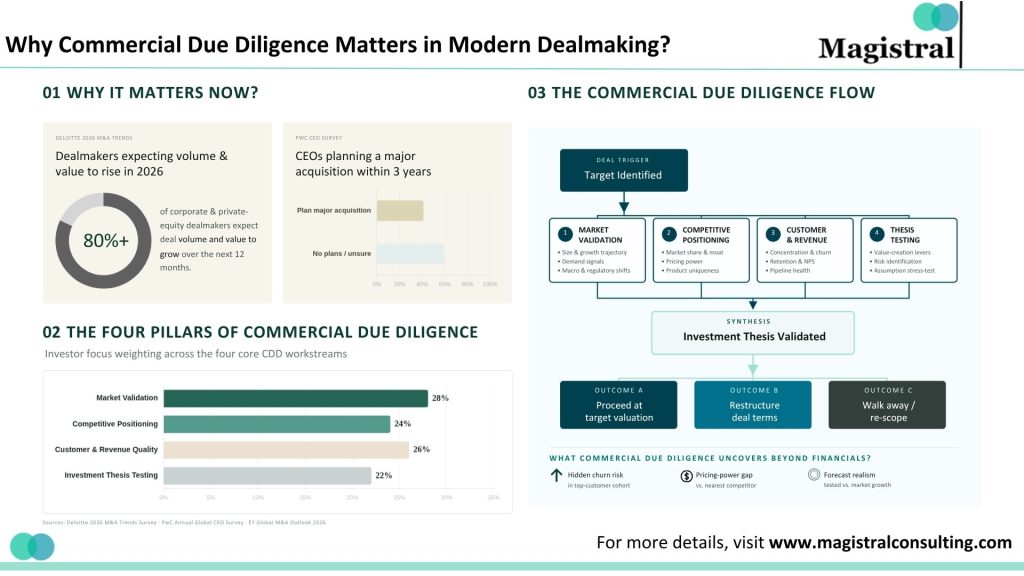
Commercial due diligence is a market-focused assessment that helps investors determine whether a deal is realistic, investable, and sustainable. It evaluates market size, customer demand, competition, pricing power, and growth potential beyond reported financial performance. Its importance has increased in 2026 as deal activity accelerates. According to Deloitte’s 2026 M&A Trends Survey, over 80% of corporate and private equity dealmakers expect deal volume and value to increase over the next year, while 41% of CEOs surveyed by PwC plan to pursue a major acquisition within the next three years. As a result, market validation, customer insights, and competitive analysis have become critical to investment decisions.

Why Commercial Due Diligence Matters in Modern Dealmaking?

Commercial due diligence validates whether a target company’s growth plans are supported by real market conditions. It helps investors assess if customer demand, competition, regulatory factors, and industry trends can realistically support the company’s projections.

Commercial Due Diligence

Why Commercial Due Diligence Matters in Modern Dealmaking?

Market Validation

Commercial due diligence verifies whether a target’s growth projections are supported by actual market demand. Although EY estimates the global M&A value could reach US$3.8 trillion in 2026, strong deal activity alone does not guarantee a target’s success. Investors assess customer demand, market growth, and competitive dynamics to determine whether forecasts are achievable.

Competitive Positioning

A bigger market does not automatically mean winning. Investors look at market share, customer stickiness, pricing power, product uniqueness, and other strategic advantages. The goal is to see whether the company can hold its ground, or even strengthen it, inside the market.

Customer and Revenue Quality

Buyers evaluate how durable revenue is by looking at customer concentration, retention performance, churn patterns, satisfaction signals, and the pipeline’s health. This surfaces risks that may stay hidden when you only read financial statements, and it often changes valuation views, plus how the deal is structured.

Investment Thesis Testing

Each acquisition rests on beliefs about what comes next and how value will be created. Commercial due diligence tests those beliefs, helping investors confirm the opportunity, spot weak spots, and refine deal assumptions. It’s basically where an idea gets put under a sharper lens, before the transaction moves forward.

Key components of commercial due diligence

It combines market research, customer analysis, competitor benchmarking, business plan review, and scenario modeling to support valuation, negotiation, and value creation decisions.

Market attractiveness

Market attractiveness reviews market size, growth outlook, regulation, cyclicality, and profit pools. PwC’s 2026 M&A outlook reported that global deal values rose 36% in 2025, showing why buyers need sharper market screening before paying premium valuations.

Business plan assessment

Business plan assessment tests whether management forecasts are realistic. Buyers review revenue growth, pricing assumptions, customer acquisition costs, margin targets, and capital needs, then connect those findings with DCF modeling and downside scenarios.

Competitive benchmarking

Competitive benchmarking compares the target against direct and indirect competitors across pricing, product quality, brand strength, technology, and customer service. Bain’s 2026 M&A report highlights shifting profit pools, making competitor positioning a key diligence priority.

Risk identification

Risk identification covers customer concentration, pricing pressure, regulation, execution risk, and market volatility. Reuters reported that private equity firms held about US$1 trillion in unsold assets in 2025, which shows why buyers must avoid overpaying for growth that may not materialize.

How commercial due diligence helps both investors and companies

Commercial due diligence helps a lot, sort of before and after the deal, it strengthens decision-making by giving buyers a more solid picture of market risk, upside chances, and what matters most for growth.

For private equity investors

Private equity investors lean on it to choose, like, proceed, renegotiate, or step away, based on market scale, pricing leverage, and what value can realistically be created.

For strategic acquirers

Strategic acquirers use it to check the synergy story they are assuming, also customer pull, channel compatibility, brand overlap, and even integration risks, before they lock in capital.

For growth companies

Growth companies rely on it to uncover the hidden issues in pricing, audience segmentation, competitive behavior, and expansion plans, before they raise funds or before they enter a transaction.

For lenders and credit teams

Lenders apply it to judge demand steadiness, how concentrated the customer base is, how strong the competitive pressure really is, and which downside cases could hurt repayment capacity.

Commercial Due Diligence Best Practices for Stronger Outcomes

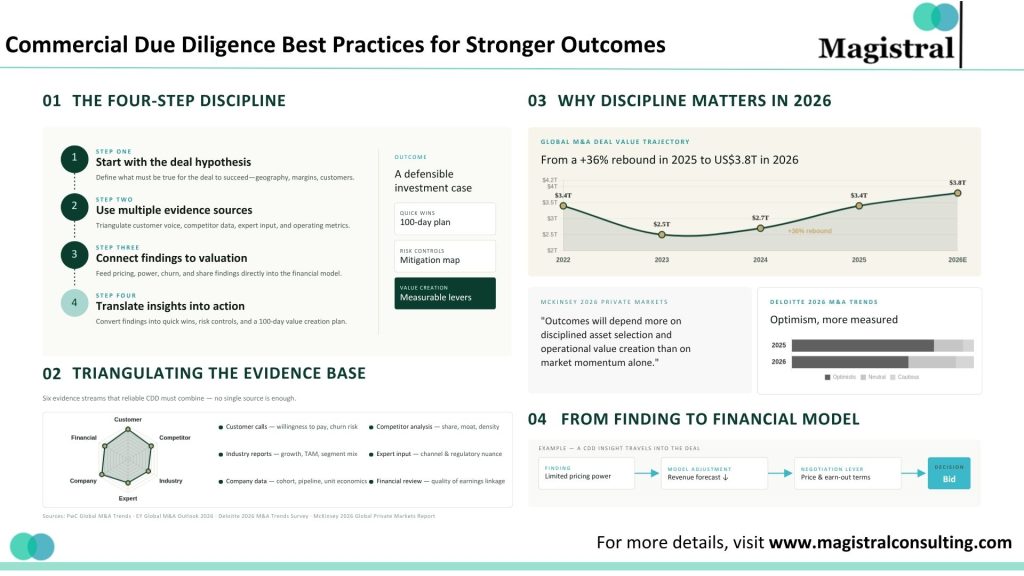
Commercial due diligence works best when teams begin with a clear deal hypothesis, then test it through customer evidence, competitor research, market reports, operating data, and valuation scenarios. In 2026, this discipline is especially important because PwC reported that global deal values rose 36% in 2025, driven by roughly 600 transactions above US$1 billion, while EY expects global M&A value to reach about US$3.8 trillion by the end of 2026. Deloitte’s 2026 M&A Trends Survey also shows that dealmakers remain optimistic, although expectations are more measured than in the previous year. Strong teams, therefore, focus less on broad market excitement and more on whether the target can win customers, protect pricing, grow profitably, and support the valuation case.

Commercial due diligence

Commercial due diligence best practices for stronger outcomes

Start with the deal hypothesis

A focused process starts by defining what must be true for the deal to succeed. If the thesis depends on geographic expansion, the team should test local demand, competitor density, channel readiness, and pricing norms. If the thesis depends on margin improvement, it should test customer willingness to accept price increases, churn risk, and sales productivity.

Use multiple evidence sources

Reliable diligence should combine industry reports, customer calls, competitor analysis, expert input, company data, and financial review. McKinsey’s 2026 Global Private Markets Report states that outcomes will depend more on disciplined asset selection, operational value creation, AI adoption, liquidity, and risk management than on market momentum alone. That makes evidence-led diligence essential for avoiding weak assumptions.

Connect findings to valuation

Diligence findings should flow directly into the financial model. If customer research shows limited pricing power, the revenue forecast should be adjusted. If competitor analysis confirms a defensible niche, the valuation may support a stronger case. This link helps investment banking teams prepare better transaction materials, buyer responses, and negotiation arguments.

Translate insights into action

The final output should define what the buyer should do next. EY expects 2026 deal activity to remain supported by corporate growth strategies and private equity exit needs, so investors need reports that convert market findings into quick wins, risk controls, post-deal priorities, and measurable value creation plans.

How Magistral supports commercial due diligence

Magistral supports due diligence by merging market research, competitor mapping, customer intel, business plan validation, and financial analysis into one kind of workable decision framework, not too rigid. Our team helps investors size up the market, examine growth drivers, understand customer segments, review pricing trends, track regulatory developments, and gauge competitive intensity. It ties all that back to valuation through revenue bridge analysis, market share scenarios, sensitivity testing, downside case building, and deal-ready reporting. So, decision makers can translate what they found during diligence into investment committee materials, management questions, and post-deal priorities, with a more grounded sense of whether the target is a durable opportunity or just an attractive narrative.


About Magistral Consulting

Magistral Consulting has helped multiple funds and companies in outsourcing operations activities. It has service offerings for Private Equity, Venture Capital, Family Offices, Investment Banks, Asset Managers, Hedge Funds, Financial Consultants, Real Estate, REITs, RE funds, Corporates, and Portfolio companies. Its functional expertise is around Deal origination, Deal Execution, Due Diligence, Financial Modelling, Portfolio Management, and Equity Research

For setting up an appointment with a Magistral representative visit www.magistralconsulting.com/contact

About the Author

Aman is an investment-research specialist with 5+ years of experience across business and investment research, including 2+ years with Big Four firms like KPMG. A Stanford Seed alumnus with an MBA in Finance and a Bachelor of Commerce (Hons) from University of Delhi, he focuses on private equity, venture capital, and renewable energy sectors. He leads project teams at Magistral Consulting, delivering financial research, due diligence, deal sourcing, and M&A support, while driving strong process management and analytics. His blend of attention to detail, strategic thinking, and dynamic execution enables him to turn complex data into actionable investment insights.


FAQs

What is the main purpose of commercial due diligence?

The main purpose is to test whether a target company’s market, customers, competition, and growth assumptions support the proposed investment case.

How is it different from financial due diligence?

Financial due diligence reviews historical numbers, accounting quality, earnings, working capital, and liabilities. Commercial due diligence reviews the external market factors that influence future performance.

Who uses this process?

Private equity firms, strategic acquirers, lenders, venture investors, and corporate development teams use it before making investment or acquisition decisions.

When should it be conducted?

It usually takes place after initial screening and before final investment approval, signing, or exclusivity decisions.

What should a good report include?

A good report should include market assessment, customer insights, competitor analysis, business plan validation, key risks, valuation implications, and practical post deal priorities.


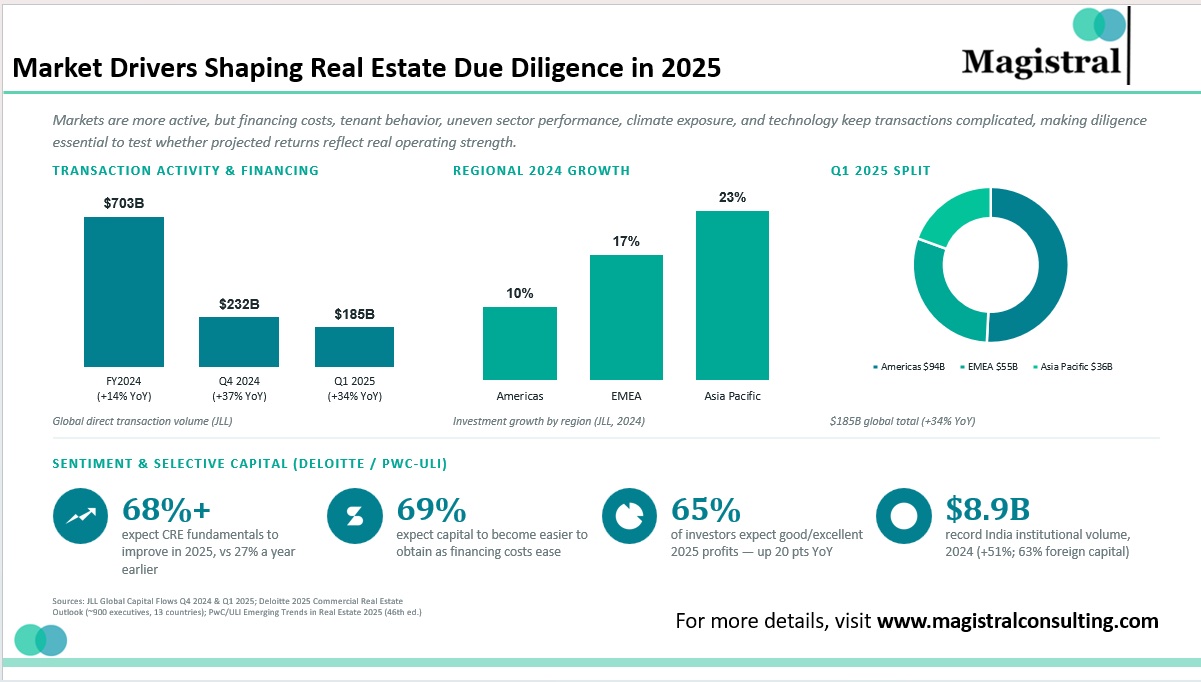
Real estate remains a preferred asset class for investors seeking stable income, diversification, and inflation hedging. Global transaction volumes are recovering, with direct deals in early 2025 reaching nearly $185 billion. It is representing a year-over-year increase of more than 30%. Yet activity is still below historic highs, making valuation accuracy, financing risks, and market liquidity key concerns. In this climate, due diligence in real estate is no longer a compliance formality but a critical safeguard. It covers financial validation of rent rolls and expenses, compliance with valuation standards, and environmental checks. They include Phase I assessments and new resilience frameworks.

Sustainability pressures are also reshaping investment outcomes. Poor energy performance increasingly leads to “brown discounts,” pushing some assets toward stranded risk without retrofit plans. At the same time, technology is transforming diligence. AI speeds document reviews, IoT enables real-time monitoring, and digital twins allow predictive modeling of building performance. Looking ahead, due diligence will expand to cover climate resilience, embodied carbon, and long-term obsolescence. While automation compresses review timelines. For investors, rigorous and tech-enabled diligence will define competitive advantage in the next phase of real estate markets.

Why Due Diligence in Real Estate Is Essential in 2025

The global real estate market was valued at $4.2 trillion in 2024 and is projected to grow at 5.8% annually through 2030. This expansion is being fueled by urbanization, large-scale infrastructure projects, and growing institutional participation. However, it also brings heightened complexity. Rising interest rates, stricter ESG mandates, and increasing cross-border transactions mean property deals. They now carry greater regulatory, financial, and reputational risks.

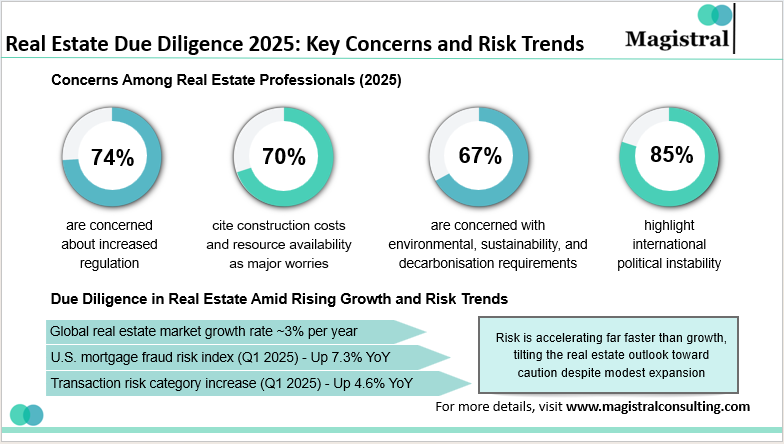
Real Estate Due Diligence 2025: Key Concerns and Risk Trends

Real Estate Due Diligence 2025: Key Concerns and Risk Trends

According to Deloitte, 25% of real estate deals collapse post-closing due to inadequate due diligence. It often results in financial loss or litigation. In contrast, transactions supported by rigorous diligence report 40% higher investor confidence and up to 20% stronger returns. It serves as underscoring its role as a strategic differentiator.

In 2025, due diligence in real estate must evolve from a reactive checklist to a forward-looking framework. Investors who integrate robust financial scrutiny, regulatory compliance, and ESG evaluation will not only minimize hidden liabilities but also position themselves for sustained outperformance. Technology is further reshaping the process, with AI and blockchain reducing verification timelines and improving accuracy. Meanwhile, scenario-based risk modeling helps investors navigate volatility in interest rates and climate risks. Ultimately, due diligence is no longer just about protecting capital, it is about securing competitive advantage. It is also about building resilient portfolios, and driving alpha in a rapidly changing market.

Cross-Border Deals: Multiplying Complexity

Global real estate markets are being reshaped by policy shifts and regulatory reforms, making location-specific due diligence in real estate more critical than ever. In the U.S., the 2025 “One Big Beautiful Bill” extends tax benefits for pass-throughs and Opportunity Zones, directly influencing yield calculations. The U.K. is debating a new national property levy to replace stamp duty and council tax, injecting uncertainty into high-value transactions.

In Europe, Germany’s stringent tenant protections keep rental yields tight, while loopholes in furnished short-lets distort market dynamics. Australia has imposed a foreign-buyer ban on existing homes from April 2025. It is alongside AI-driven approvals and modular construction incentives to boost housing supply. In the UAE, freehold ownership rules, municipal fees, and repatriation frameworks remain central to investor strategies. These evolving shifts highlight why a one-size-fits-all approach to real estate due diligence in real estate no longer suffices.

The challenge for global funds is not only to identify these differences but to integrate them into valuation models and exit plans. A surface-level check of financials and titles rarely suffices when returns depend on regulatory agility and market-specific knowledge. Cross-border due diligence in real estate demands a layered approach, combining local expertise with global investor expectations.

Distressed and Special Situations: Where Diligence Creates Alpha

In today’s market, due diligence in real estate is no longer a procedural step—it is both a risk shield and a value driver. On the compliance front, mounting regulatory scrutiny and ESG expectations are reshaping investment standards. Real estate disputes rose 27% globally in 2024, while 68% of investors now demand end-to-end diligence covering legal, financial, and climate exposure. Robust assessments help prevent costly errors such as unpaid taxes, zoning violations, or overvaluation, missteps that can erode annual IRRs by 2–4%. Deals supported by comprehensive diligence also experience 33% fewer post-closing disputes. This makes it a clear competitive edge in safeguarding capital and reputation.

At the same time, diligence has emerged as a source of alpha, particularly in distressed and special situations. With global distressed real estate projected to surpass $200 billion by 2026, the opportunity set is expanding rapidly. But these are precisely the assets most vulnerable to hidden liabilities- ranging from litigation to environmental non-compliance. In this context, diligence becomes a negotiation lever. In 2024, U.S. buyers of defaulted loans achieved 30–35% discounts once ESG and technical deficiencies were uncovered. By systematically surfacing such risks, investors can reprice transactions, and also secure deeper discounts. They ultimately transform compliance discipline into return generation.

ESG and PropTech: Redefining Due Diligence in Real Estate

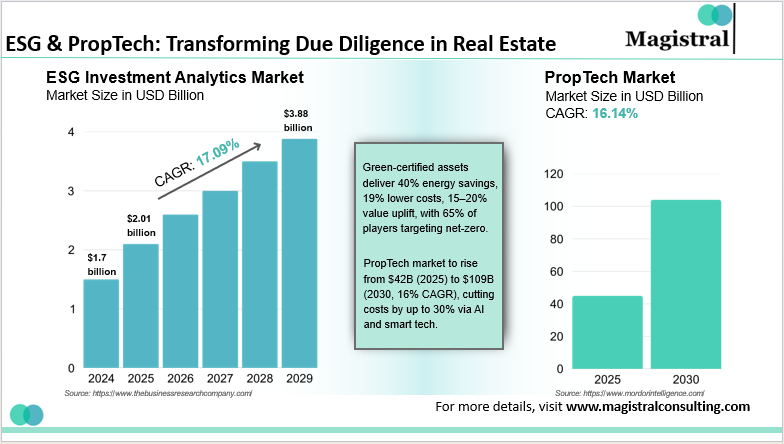
Another structural shift is that diligence is no longer confined to financials, legalities, and engineering reports. Sustainability and technology are now integral. JLL reports that green-certified buildings command a 10–15% rental premium in developed markets. Conversely, assets that fail environmental compliance tests face declining liquidity. Climate risk assessments, from flood modeling for coastal assets to energy efficiency audits for commercial towers, are becoming part of standard diligence packages.

ESG & PropTech: Transforming Due Diligence in Real Estate

ESG & PropTech: Transforming Due Diligence in Real Estate

At the same time, PropTech tools are revolutionizing how due diligence in real estate is performed. AI-driven platforms can now analyse tenant sentiment, energy usage, and even construction quality data drawn from digital blueprints. These insights help investors move beyond static documents to dynamic, real-time assessments of asset quality and tenant health. Ignoring these tools risks holding stranded assets in a market increasingly tilted toward transparency and sustainability.

The Global Market Outlook for Due Diligence Services

With global real estate expected to surpass USD 5 trillion by 2030, the importance of due diligence in real estate has never been greater. What was once a procedural step is now a strategic requirement. It is critical for accurate pricing, regulatory compliance, and ESG alignment. Investors who integrate rigorous diligence into their decision-making not only avoid costly pitfalls but also strengthen resilience and reputation in an increasingly regulated market.

The due diligence services market itself is projected to grow at an 8% CAGR through 2030. It is driven by digitalization and shifting investor priorities. AI and blockchain are streamlining verification processes, while ESG factors now influence nearly 90% of institutional asset allocation. At the same time, advanced risk-adjusted valuation models are becoming mainstream. This helps investors navigate volatility in rates, climate risks, and macroeconomic shocks. Deloitte reports that portfolios applying these techniques outperformed peers by 18% in IRR over five years. It is proof that future-ready diligence is not just about compliance, but about capturing alpha in a complex global market.

Real Estate Due Diligence Services by Magistral Consulting

Magistral Consulting offers end-to-end due diligence in real estate solutions designed to support smarter, risk-mitigated investment decisions. Their services include legal and title verification, financial modeling, valuation benchmarking, and thorough ESG and environmental audits. They also conduct market feasibility studies using predictive analytics and provide deal structuring support through secure virtual data rooms. Magistral’s tech-enabled approach ensures faster turnaround, enhanced data accuracy, and compliance with evolving global standards. With a strong focus on risk-adjusted returns and sustainability, Magistral empowers institutional investors, developers, and private equity firms to make confident, data-backed real estate investment decisions across markets.

About Magistral Consulting

Magistral Consulting has helped multiple funds and companies in outsourcing operations activities. It has service offerings for Private Equity, Venture Capital, Family Offices, Investment Banks, Asset Managers, Hedge Funds, Financial Consultants, Real Estate, REITs, RE funds, Corporates, and Portfolio companies. Its functional expertise is around Deal origination, Deal Execution, Due Diligence, Financial Modelling, Portfolio Management, and Equity Research

For setting up an appointment with a Magistral representative visit www.magistralconsulting.com/contact

About the Author

Aman is an investment-research specialist with 5+ years of experience across business and investment research, including 2+ years with Big Four firms like KPMG. A Stanford Seed alumnus with an MBA in Finance and a Bachelor of Commerce (Hons) from University of Delhi, he focuses on private equity, venture capital, and renewable energy sectors. He leads project teams at Magistral Consulting, delivering financial research, due diligence, deal sourcing, and M&A support, while driving strong process management and analytics. His blend of attention to detail, strategic thinking, and dynamic execution enables him to turn complex data into actionable investment insights.

FAQs

Why is real estate due diligence more important in 2025 than before?

Due diligence has become essential due to rising cross-border investments, regulatory complexities, and ESG compliance. A Deloitte study found that 25% of deals fail post-closing due to inadequate checks, while robust due diligence boosts investor confidence by 40% and enhances returns by 20%

What are the most critical components of real estate due diligence?

The core areas include legal/title verification, financial and tax analysis, technical inspections, and environmental/ESG compliance. Each area plays a key role in identifying risks such as overpayment, hidden liabilities, or sustainability gaps

How is technology improving real estate due diligence?

AI speeds up document reviews by 50%, blockchain reduces ownership disputes by 80%, and geospatial mapping identifies climate risks within minutes. Virtual data rooms also cut deal closure time by up to 30% by centralizing document access

How do ESG factors influence property investment decisions?

By 2025, 70% of institutional investors require ESG scoring. Properties without green certifications or sustainability metrics often face regulatory penalties or lower market interest, making ESG due diligence crucial for long-term value creation