Tag Archives: Commercial Due Diligence

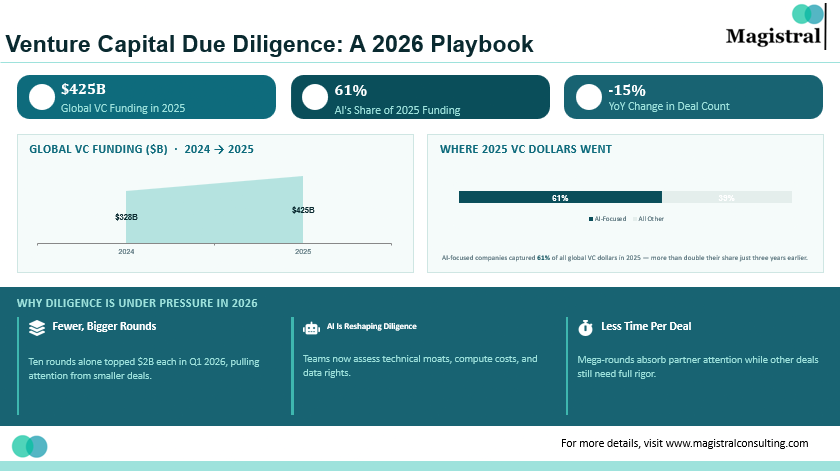
Global venture funding climbed to $425 billion in 2025, roughly 30 percent higher than 2024 and the third-largest year on record, even as the number of completed deals fell by close to 15 percent. Capital is concentrating in fewer, larger, faster-moving rounds, and AI-focused companies alone captured well over half of that total. Ten funding rounds attracted more than $2 billion each in just the first quarter of 2026. For a due diligence team, that combination is uncomfortable: less time per deal, bigger checks at stake, and a wave of fast-scaling companies that don’t fit the diligence playbooks built for slower-moving markets.
Venture Capital Due Diligence

Venture Capital Due Diligence: A 2026 Playbook

Founders raising in this environment expect answers on a compressed timeline too, which puts additional pressure on funds that still rely entirely on partner bandwidth. Venture capital due diligence was never a simple checklist exercise, but the current pace makes it harder to do well with a lean in-house team alone. This article looks at what venture capital due diligence actually covers, how it differs from private equity or lending diligence, and how funds are adjusting their process, and their team, to keep up.

The Case for Rethinking Venture Capital Due Diligence in 2026

Capital Is Concentrating in Fewer, Bigger Rounds

Global VC deal count dropped roughly 15 percent year over year in 2025 even as invested capital rose sharply, meaning the average round got substantially larger while the number of live mandates per partner didn’t shrink to match. When a handful of mega-rounds absorb so much partner attention, thinner-staffed early and growth-stage deals still need the same rigor applied to them, just with less time available to give it.

AI Is Reshaping What Diligence Teams Need to Understand

AI-focused companies captured 61 percent of global VC investment in 2025, more than double their share from just three years earlier. That shift means diligence teams increasingly need to assess technical moats, compute costs, and data rights alongside the usual market and founder questions, a skill set most generalist in-house teams weren’t built to cover at scale, particularly across multiple portfolio sectors at once. Funds that built their diligence process around traditional SaaS metrics are now having to relearn how to evaluate infrastructure-heavy, capital-intensive AI businesses instead.

What Venture Capital Due Diligence Actually Involves

Venture capital due diligence goes beyond reviewing headline growth metrics. It combines market validation, founder assessment, financial and legal review, and independent reference checks to determine whether the opportunity can support venture-scale returns and withstand deeper investor scrutiny.
Venture Capital Due Diligence

What VC Due Diligence Covers, and How to Choose a Partner

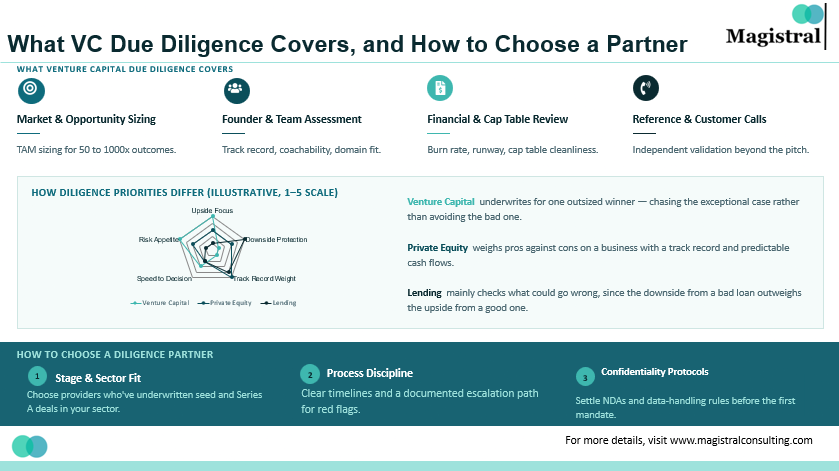
Market and Opportunity Sizing

The first question in any VC deal is whether the addressable market is large enough, and the timing right enough, to support a 50 to 1000x outcome over a five-to-ten-year horizon, not just a profitable niche business.

Founder and Team Assessment

Because early-stage companies are often pre-revenue or pre-product, the founding team’s track record, coachability, and domain expertise routinely outweigh the financials in the diligence memo.

Financial, Cap Table, and Legal Review

Even at the seed stage, diligence needs to confirm burn rate, runway, cap table cleanliness, and outstanding liabilities, since a messy cap table or an undisclosed obligation can quietly derail a later round.

Reference Calls and Customer Validation

Independent conversations with customers, former colleagues, and other investors in the space test whether the pitch holds up outside the founder’s own narrative.

How Venture Capital Due Diligence Differs from Private Equity or Lending Diligence

A VC fund is underwriting for one outsized winner to cover the losses of several failed bets, so it is actively looking for the one differentiator that could make a company a runaway success rather than a merely profitable one. A private equity investor weighs pros against cons and typically invests when the pros outweigh the cons on a business that already has a track record and predictable cash flows. A lender, by contrast, is mainly checking what could go wrong, since its downside from a bad loan is far larger than its upside from a good one.

That difference in orientation, chasing the exceptional case rather than simply avoiding the bad one, shapes everything from how a diligence memo is structured to how much weight it gives a single missing data point. Funds weighing whether to bring in outside help on this kind of due diligence work should weigh those same trade-offs before treating outsourced support as a generic research task.


Why Funds Are Turning to Outside Support for Venture Capital Due Diligence

Speed Without Adding Permanent Headcount

This is where diligence outsourcing earns its keep: a dedicated external team can deliver a first-pass due diligence report in as little as 72 hours, rather than the weeks a stretched in-house analyst pool might need, without the fund committing to another full-time hire.

Confidentiality When Sourcing Sensitive Deals

Outsourced analysts can reach out to a target’s customers or competitors without revealing which fund is behind the inquiry, which matters most in competitive, still-unannounced rounds. That distance can be the difference between a clean read on a company’s real trajectory and a conversation shaped by who’s asking.

Specialist Coverage Beyond the Core Team

Complex mandates, technical audits, competitive mapping, or deal support across an entire pipeline are easier to staff through a partner who already has sector specialists on the bench than by hiring for every niche in-house, especially for sectors a fund only touches occasionally.


How to Choose a Venture Capital Due Diligence Partner

Stage and Sector Fit Over Generalist Breadth

A provider that has actually underwritten seed and Series A companies in your sector will ask sharper questions than a generalist research outsourcing team still learning the space.

Process Discipline and Turnaround Commitments

Clear timelines, defined deliverables, and a documented escalation path for red flags matter more once a partner is handling live, time-sensitive deals rather than back-office research. Funds that skip this diligence on their own diligence partner tend to find out the hard way, mid-deal, when a report arrives late or a red flag gets buried instead of flagged. A partner willing to put those commitments in writing signals they’ve handled this pressure before, not just claimed they can.

Confidentiality and Data-Handling Protocols

References, NDAs, and clear rules on what information moves between the fund and the outsourced team should be settled before the first mandate, not after a leak.


Building the Relationship Across Multiple Deals

Start with One Deal or One Sector

Piloting venture capital due diligence on a single mandate gives the fund a clean read on quality and turnaround before handing over a full pipeline.

Keep the Investment Decision In-House

Outsourced diligence should sharpen the partner’s judgment call, not replace it; the final decision to invest, and the conviction behind it, has to stay with the fund. That boundary is what keeps an outsourcing relationship additive rather than a substitute for the fund’s own conviction.

How Magistral Consulting Supports Venture Capital Due Diligence

Magistral Consulting supports venture capital funds as an extended research and execution team, contributing to the diligence effort during active deal periods but leaving the final decision to the fund. Engagement terms may be project-based, through retainers, or via dedicated resources, and may fit within the client’s current diligence and Investment Committee process.

Market, Company, and Commercial Research

Magistral provides help with market sizing, industry mapping, competitor benchmarking, business-model analysis, customer research, and validation of the commercial assumptions of the investment thesis.

Financial and Cap Table Analysis

Historical performance, burn rate, runway, unit economics, forecasting, cap tables, fundraising and dilution projections, and financial modeling/valuation work, where applicable.

Due Diligence and Data Room Support

Magistral helps keep track of the diligence requirements and reviews financial and operational information, management information, tracks open items, and documents findings for the investment team, with the legal and tax opinions left to appropriate advisers.

Investment Committee and Decision-Support Materials

Findings from the diligence process are presented in the form of company profiles, diligence reports, Investment Committee memos, industry slides, sensitivity analysis, and decision-ready presentations.


About Magistral Consulting

Magistral Consulting has helped multiple funds and companies in outsourcing operations activities. It has service offerings for Private Equity, Venture Capital, Family Offices, Investment Banks, Asset Managers, Hedge Funds, Financial Consultants, Real Estate, REITs, RE funds, Corporates, and Portfolio companies. Its functional expertise is around Deal origination, Deal Execution, Due Diligence, Financial Modelling, Portfolio Management, and Equity Research

For setting up an appointment with a Magistral representative visit www.magistralconsulting.com/contact

About the Author

Aman is an investment-research specialist with 5+ years of experience across business and investment research, including 2+ years with Big Four firms like KPMG. A Stanford Seed alumnus with an MBA in Finance and a Bachelor of Commerce (Hons) from University of Delhi, he focuses on private equity, venture capital, and renewable energy sectors. He leads project teams at Magistral Consulting, delivering financial research, due diligence, deal sourcing, and M&A support, while driving strong process management and analytics. His blend of attention to detail, strategic thinking, and dynamic execution enables him to turn complex data into actionable investment insights.


FAQs

What does venture capital due diligence cover?

Market sizing, founder and team assessment, financial and cap table review, legal checks, and independent reference calls with customers and industry contacts.

How is VC due diligence different from private equity due diligence?

VC due diligence looks for the one factor that could make a company an outsized winner, while PE due diligence weighs pros and cons on a business with an established track record.

Is outsourced due diligence reliable for early-stage deals?

Yes, when the provider has genuine experience underwriting startups in that sector. Most funds treat outsourced output as an input, with the final call staying in-house.

How long does venture capital due diligence typically take?

It varies with deal complexity and data availability, but outsourced teams can often deliver an initial report within days, compared with weeks for a stretched in-house team.

How should a fund choose a due diligence partner?
Look for sector- and stage-specific experience, clear turnaround commitments, and documented confidentiality protocols, rather than choosing on price alone.


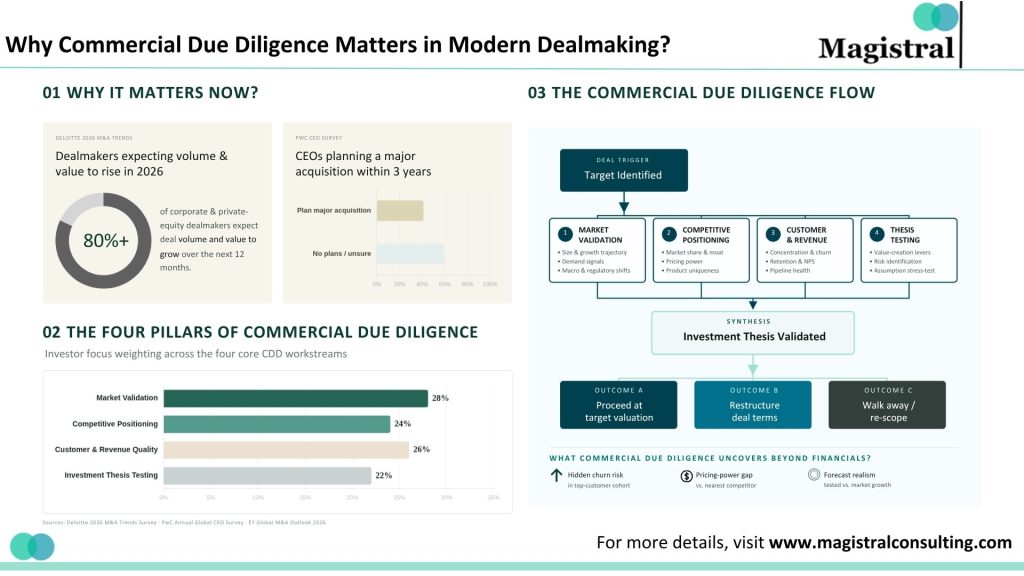
Commercial due diligence is a market-focused assessment that helps investors determine whether a deal is realistic, investable, and sustainable. It evaluates market size, customer demand, competition, pricing power, and growth potential beyond reported financial performance. Its importance has increased in 2026 as deal activity accelerates. According to Deloitte’s 2026 M&A Trends Survey, over 80% of corporate and private equity dealmakers expect deal volume and value to increase over the next year, while 41% of CEOs surveyed by PwC plan to pursue a major acquisition within the next three years. As a result, market validation, customer insights, and competitive analysis have become critical to investment decisions.

Why Commercial Due Diligence Matters in Modern Dealmaking?

Commercial due diligence validates whether a target company’s growth plans are supported by real market conditions. It helps investors assess if customer demand, competition, regulatory factors, and industry trends can realistically support the company’s projections.

Commercial Due Diligence

Why Commercial Due Diligence Matters in Modern Dealmaking?

Market Validation

Commercial due diligence verifies whether a target’s growth projections are supported by actual market demand. Although EY estimates the global M&A value could reach US$3.8 trillion in 2026, strong deal activity alone does not guarantee a target’s success. Investors assess customer demand, market growth, and competitive dynamics to determine whether forecasts are achievable.

Competitive Positioning

A bigger market does not automatically mean winning. Investors look at market share, customer stickiness, pricing power, product uniqueness, and other strategic advantages. The goal is to see whether the company can hold its ground, or even strengthen it, inside the market.

Customer and Revenue Quality

Buyers evaluate how durable revenue is by looking at customer concentration, retention performance, churn patterns, satisfaction signals, and the pipeline’s health. This surfaces risks that may stay hidden when you only read financial statements, and it often changes valuation views, plus how the deal is structured.

Investment Thesis Testing

Each acquisition rests on beliefs about what comes next and how value will be created. Commercial due diligence tests those beliefs, helping investors confirm the opportunity, spot weak spots, and refine deal assumptions. It’s basically where an idea gets put under a sharper lens, before the transaction moves forward.

Key components of commercial due diligence

It combines market research, customer analysis, competitor benchmarking, business plan review, and scenario modeling to support valuation, negotiation, and value creation decisions.

Market attractiveness

Market attractiveness reviews market size, growth outlook, regulation, cyclicality, and profit pools. PwC’s 2026 M&A outlook reported that global deal values rose 36% in 2025, showing why buyers need sharper market screening before paying premium valuations.

Business plan assessment

Business plan assessment tests whether management forecasts are realistic. Buyers review revenue growth, pricing assumptions, customer acquisition costs, margin targets, and capital needs, then connect those findings with DCF modeling and downside scenarios.

Competitive benchmarking

Competitive benchmarking compares the target against direct and indirect competitors across pricing, product quality, brand strength, technology, and customer service. Bain’s 2026 M&A report highlights shifting profit pools, making competitor positioning a key diligence priority.

Risk identification

Risk identification covers customer concentration, pricing pressure, regulation, execution risk, and market volatility. Reuters reported that private equity firms held about US$1 trillion in unsold assets in 2025, which shows why buyers must avoid overpaying for growth that may not materialize.

How commercial due diligence helps both investors and companies

Commercial due diligence helps a lot, sort of before and after the deal, it strengthens decision-making by giving buyers a more solid picture of market risk, upside chances, and what matters most for growth.

For private equity investors

Private equity investors lean on it to choose, like, proceed, renegotiate, or step away, based on market scale, pricing leverage, and what value can realistically be created.

For strategic acquirers

Strategic acquirers use it to check the synergy story they are assuming, also customer pull, channel compatibility, brand overlap, and even integration risks, before they lock in capital.

For growth companies

Growth companies rely on it to uncover the hidden issues in pricing, audience segmentation, competitive behavior, and expansion plans, before they raise funds or before they enter a transaction.

For lenders and credit teams

Lenders apply it to judge demand steadiness, how concentrated the customer base is, how strong the competitive pressure really is, and which downside cases could hurt repayment capacity.

Commercial Due Diligence Best Practices for Stronger Outcomes

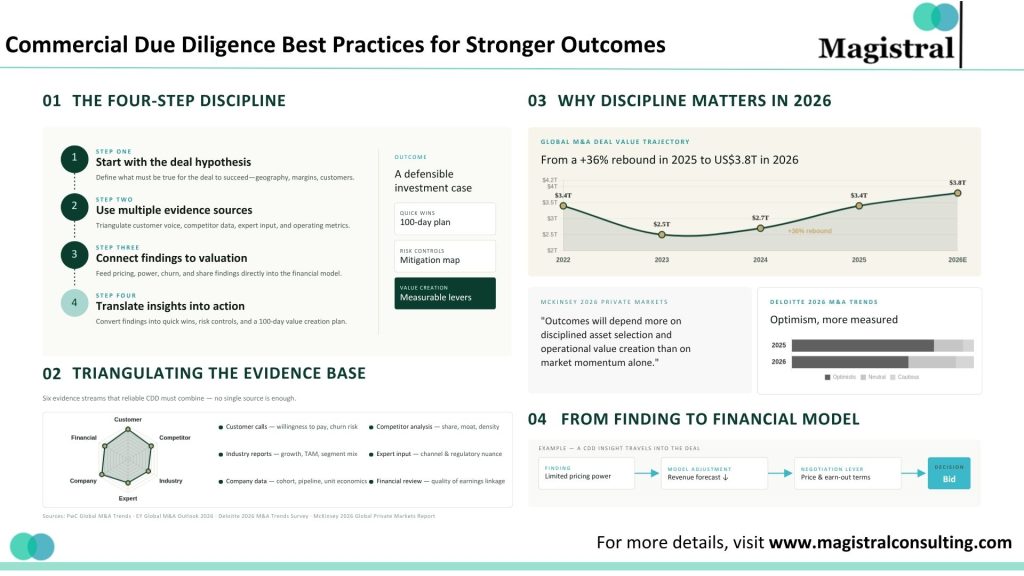
Commercial due diligence works best when teams begin with a clear deal hypothesis, then test it through customer evidence, competitor research, market reports, operating data, and valuation scenarios. In 2026, this discipline is especially important because PwC reported that global deal values rose 36% in 2025, driven by roughly 600 transactions above US$1 billion, while EY expects global M&A value to reach about US$3.8 trillion by the end of 2026. Deloitte’s 2026 M&A Trends Survey also shows that dealmakers remain optimistic, although expectations are more measured than in the previous year. Strong teams, therefore, focus less on broad market excitement and more on whether the target can win customers, protect pricing, grow profitably, and support the valuation case.

Commercial due diligence

Commercial due diligence best practices for stronger outcomes

Start with the deal hypothesis

A focused process starts by defining what must be true for the deal to succeed. If the thesis depends on geographic expansion, the team should test local demand, competitor density, channel readiness, and pricing norms. If the thesis depends on margin improvement, it should test customer willingness to accept price increases, churn risk, and sales productivity.

Use multiple evidence sources

Reliable diligence should combine industry reports, customer calls, competitor analysis, expert input, company data, and financial review. McKinsey’s 2026 Global Private Markets Report states that outcomes will depend more on disciplined asset selection, operational value creation, AI adoption, liquidity, and risk management than on market momentum alone. That makes evidence-led diligence essential for avoiding weak assumptions.

Connect findings to valuation

Diligence findings should flow directly into the financial model. If customer research shows limited pricing power, the revenue forecast should be adjusted. If competitor analysis confirms a defensible niche, the valuation may support a stronger case. This link helps investment banking teams prepare better transaction materials, buyer responses, and negotiation arguments.

Translate insights into action

The final output should define what the buyer should do next. EY expects 2026 deal activity to remain supported by corporate growth strategies and private equity exit needs, so investors need reports that convert market findings into quick wins, risk controls, post-deal priorities, and measurable value creation plans.

How Magistral supports commercial due diligence

Magistral supports due diligence by merging market research, competitor mapping, customer intel, business plan validation, and financial analysis into one kind of workable decision framework, not too rigid. Our team helps investors size up the market, examine growth drivers, understand customer segments, review pricing trends, track regulatory developments, and gauge competitive intensity. It ties all that back to valuation through revenue bridge analysis, market share scenarios, sensitivity testing, downside case building, and deal-ready reporting. So, decision makers can translate what they found during diligence into investment committee materials, management questions, and post-deal priorities, with a more grounded sense of whether the target is a durable opportunity or just an attractive narrative.


About Magistral Consulting

Magistral Consulting has helped multiple funds and companies in outsourcing operations activities. It has service offerings for Private Equity, Venture Capital, Family Offices, Investment Banks, Asset Managers, Hedge Funds, Financial Consultants, Real Estate, REITs, RE funds, Corporates, and Portfolio companies. Its functional expertise is around Deal origination, Deal Execution, Due Diligence, Financial Modelling, Portfolio Management, and Equity Research

For setting up an appointment with a Magistral representative visit www.magistralconsulting.com/contact

About the Author

Aman is an investment-research specialist with 5+ years of experience across business and investment research, including 2+ years with Big Four firms like KPMG. A Stanford Seed alumnus with an MBA in Finance and a Bachelor of Commerce (Hons) from University of Delhi, he focuses on private equity, venture capital, and renewable energy sectors. He leads project teams at Magistral Consulting, delivering financial research, due diligence, deal sourcing, and M&A support, while driving strong process management and analytics. His blend of attention to detail, strategic thinking, and dynamic execution enables him to turn complex data into actionable investment insights.


FAQs

What is the main purpose of commercial due diligence?

The main purpose is to test whether a target company’s market, customers, competition, and growth assumptions support the proposed investment case.

How is it different from financial due diligence?

Financial due diligence reviews historical numbers, accounting quality, earnings, working capital, and liabilities. Commercial due diligence reviews the external market factors that influence future performance.

Who uses this process?

Private equity firms, strategic acquirers, lenders, venture investors, and corporate development teams use it before making investment or acquisition decisions.

When should it be conducted?

It usually takes place after initial screening and before final investment approval, signing, or exclusivity decisions.

What should a good report include?

A good report should include market assessment, customer insights, competitor analysis, business plan validation, key risks, valuation implications, and practical post deal priorities.