Tag Archives: Venture Capital Due Diligence

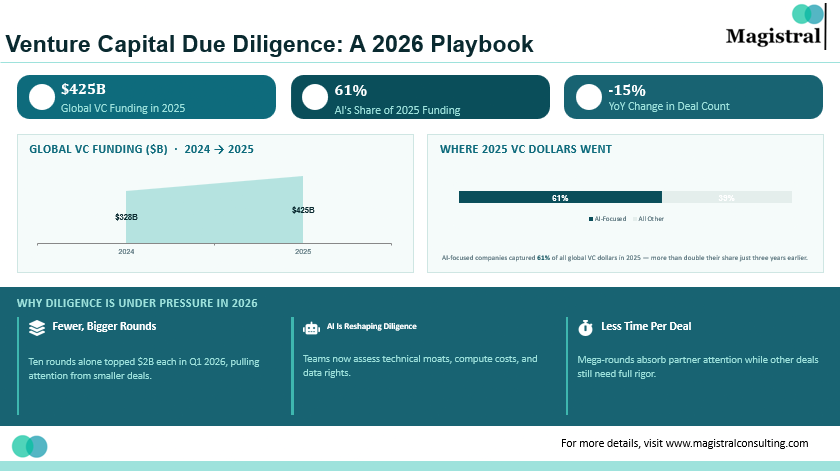
Global venture funding climbed to $425 billion in 2025, roughly 30 percent higher than 2024 and the third-largest year on record, even as the number of completed deals fell by close to 15 percent. Capital is concentrating in fewer, larger, faster-moving rounds, and AI-focused companies alone captured well over half of that total. Ten funding rounds attracted more than $2 billion each in just the first quarter of 2026. For a due diligence team, that combination is uncomfortable: less time per deal, bigger checks at stake, and a wave of fast-scaling companies that don’t fit the diligence playbooks built for slower-moving markets.
Venture Capital Due Diligence

Venture Capital Due Diligence: A 2026 Playbook

Founders raising in this environment expect answers on a compressed timeline too, which puts additional pressure on funds that still rely entirely on partner bandwidth. Venture capital due diligence was never a simple checklist exercise, but the current pace makes it harder to do well with a lean in-house team alone. This article looks at what venture capital due diligence actually covers, how it differs from private equity or lending diligence, and how funds are adjusting their process, and their team, to keep up.

The Case for Rethinking Venture Capital Due Diligence in 2026

Capital Is Concentrating in Fewer, Bigger Rounds

Global VC deal count dropped roughly 15 percent year over year in 2025 even as invested capital rose sharply, meaning the average round got substantially larger while the number of live mandates per partner didn’t shrink to match. When a handful of mega-rounds absorb so much partner attention, thinner-staffed early and growth-stage deals still need the same rigor applied to them, just with less time available to give it.

AI Is Reshaping What Diligence Teams Need to Understand

AI-focused companies captured 61 percent of global VC investment in 2025, more than double their share from just three years earlier. That shift means diligence teams increasingly need to assess technical moats, compute costs, and data rights alongside the usual market and founder questions, a skill set most generalist in-house teams weren’t built to cover at scale, particularly across multiple portfolio sectors at once. Funds that built their diligence process around traditional SaaS metrics are now having to relearn how to evaluate infrastructure-heavy, capital-intensive AI businesses instead.

What Venture Capital Due Diligence Actually Involves

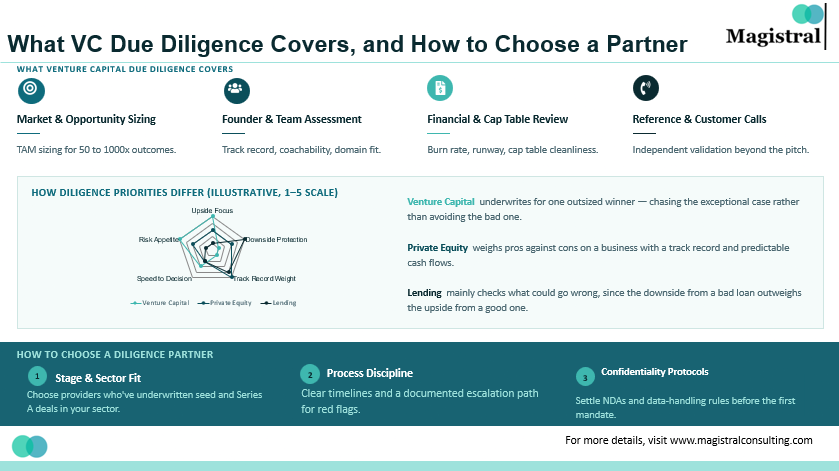
Venture capital due diligence goes beyond reviewing headline growth metrics. It combines market validation, founder assessment, financial and legal review, and independent reference checks to determine whether the opportunity can support venture-scale returns and withstand deeper investor scrutiny.
Venture Capital Due Diligence

What VC Due Diligence Covers, and How to Choose a Partner

Market and Opportunity Sizing

The first question in any VC deal is whether the addressable market is large enough, and the timing right enough, to support a 50 to 1000x outcome over a five-to-ten-year horizon, not just a profitable niche business.

Founder and Team Assessment

Because early-stage companies are often pre-revenue or pre-product, the founding team’s track record, coachability, and domain expertise routinely outweigh the financials in the diligence memo.

Financial, Cap Table, and Legal Review

Even at the seed stage, diligence needs to confirm burn rate, runway, cap table cleanliness, and outstanding liabilities, since a messy cap table or an undisclosed obligation can quietly derail a later round.

Reference Calls and Customer Validation

Independent conversations with customers, former colleagues, and other investors in the space test whether the pitch holds up outside the founder’s own narrative.

How Venture Capital Due Diligence Differs from Private Equity or Lending Diligence

A VC fund is underwriting for one outsized winner to cover the losses of several failed bets, so it is actively looking for the one differentiator that could make a company a runaway success rather than a merely profitable one. A private equity investor weighs pros against cons and typically invests when the pros outweigh the cons on a business that already has a track record and predictable cash flows. A lender, by contrast, is mainly checking what could go wrong, since its downside from a bad loan is far larger than its upside from a good one.

That difference in orientation, chasing the exceptional case rather than simply avoiding the bad one, shapes everything from how a diligence memo is structured to how much weight it gives a single missing data point. Funds weighing whether to bring in outside help on this kind of due diligence work should weigh those same trade-offs before treating outsourced support as a generic research task.


Why Funds Are Turning to Outside Support for Venture Capital Due Diligence

Speed Without Adding Permanent Headcount

This is where diligence outsourcing earns its keep: a dedicated external team can deliver a first-pass due diligence report in as little as 72 hours, rather than the weeks a stretched in-house analyst pool might need, without the fund committing to another full-time hire.

Confidentiality When Sourcing Sensitive Deals

Outsourced analysts can reach out to a target’s customers or competitors without revealing which fund is behind the inquiry, which matters most in competitive, still-unannounced rounds. That distance can be the difference between a clean read on a company’s real trajectory and a conversation shaped by who’s asking.

Specialist Coverage Beyond the Core Team

Complex mandates, technical audits, competitive mapping, or deal support across an entire pipeline are easier to staff through a partner who already has sector specialists on the bench than by hiring for every niche in-house, especially for sectors a fund only touches occasionally.


How to Choose a Venture Capital Due Diligence Partner

Stage and Sector Fit Over Generalist Breadth

A provider that has actually underwritten seed and Series A companies in your sector will ask sharper questions than a generalist research outsourcing team still learning the space.

Process Discipline and Turnaround Commitments

Clear timelines, defined deliverables, and a documented escalation path for red flags matter more once a partner is handling live, time-sensitive deals rather than back-office research. Funds that skip this diligence on their own diligence partner tend to find out the hard way, mid-deal, when a report arrives late or a red flag gets buried instead of flagged. A partner willing to put those commitments in writing signals they’ve handled this pressure before, not just claimed they can.

Confidentiality and Data-Handling Protocols

References, NDAs, and clear rules on what information moves between the fund and the outsourced team should be settled before the first mandate, not after a leak.


Building the Relationship Across Multiple Deals

Start with One Deal or One Sector

Piloting venture capital due diligence on a single mandate gives the fund a clean read on quality and turnaround before handing over a full pipeline.

Keep the Investment Decision In-House

Outsourced diligence should sharpen the partner’s judgment call, not replace it; the final decision to invest, and the conviction behind it, has to stay with the fund. That boundary is what keeps an outsourcing relationship additive rather than a substitute for the fund’s own conviction.

How Magistral Consulting Supports Venture Capital Due Diligence

Magistral Consulting supports venture capital funds as an extended research and execution team, contributing to the diligence effort during active deal periods but leaving the final decision to the fund. Engagement terms may be project-based, through retainers, or via dedicated resources, and may fit within the client’s current diligence and Investment Committee process.

Market, Company, and Commercial Research

Magistral provides help with market sizing, industry mapping, competitor benchmarking, business-model analysis, customer research, and validation of the commercial assumptions of the investment thesis.

Financial and Cap Table Analysis

Historical performance, burn rate, runway, unit economics, forecasting, cap tables, fundraising and dilution projections, and financial modeling/valuation work, where applicable.

Due Diligence and Data Room Support

Magistral helps keep track of the diligence requirements and reviews financial and operational information, management information, tracks open items, and documents findings for the investment team, with the legal and tax opinions left to appropriate advisers.

Investment Committee and Decision-Support Materials

Findings from the diligence process are presented in the form of company profiles, diligence reports, Investment Committee memos, industry slides, sensitivity analysis, and decision-ready presentations.


About Magistral Consulting

Magistral Consulting has helped multiple funds and companies in outsourcing operations activities. It has service offerings for Private Equity, Venture Capital, Family Offices, Investment Banks, Asset Managers, Hedge Funds, Financial Consultants, Real Estate, REITs, RE funds, Corporates, and Portfolio companies. Its functional expertise is around Deal origination, Deal Execution, Due Diligence, Financial Modelling, Portfolio Management, and Equity Research

For setting up an appointment with a Magistral representative visit www.magistralconsulting.com/contact

About the Author

Aman is an investment-research specialist with 5+ years of experience across business and investment research, including 2+ years with Big Four firms like KPMG. A Stanford Seed alumnus with an MBA in Finance and a Bachelor of Commerce (Hons) from University of Delhi, he focuses on private equity, venture capital, and renewable energy sectors. He leads project teams at Magistral Consulting, delivering financial research, due diligence, deal sourcing, and M&A support, while driving strong process management and analytics. His blend of attention to detail, strategic thinking, and dynamic execution enables him to turn complex data into actionable investment insights.


FAQs

What does venture capital due diligence cover?

Market sizing, founder and team assessment, financial and cap table review, legal checks, and independent reference calls with customers and industry contacts.

How is VC due diligence different from private equity due diligence?

VC due diligence looks for the one factor that could make a company an outsized winner, while PE due diligence weighs pros and cons on a business with an established track record.

Is outsourced due diligence reliable for early-stage deals?

Yes, when the provider has genuine experience underwriting startups in that sector. Most funds treat outsourced output as an input, with the final call staying in-house.

How long does venture capital due diligence typically take?

It varies with deal complexity and data availability, but outsourced teams can often deliver an initial report within days, compared with weeks for a stretched in-house team.

How should a fund choose a due diligence partner?

Look for sector- and stage-specific experience, clear turnaround commitments, and documented confidentiality protocols, rather than choosing on price alone.


Venture Capital Outsourcing has turned out to be a sensible solution to the rapid changes in the venture ecosystem. Today, venture capital companies assess a larger number of deals, control extensive portfolios, and undertake operations in different regions. All this is done while dealing with the pressure of shorter capital cycles and higher expectations of limited partners (LPs). Meanwhile, the establishment of large internal teams is not only expensive but also lacks flexibility most of the time. According to the 2024 report of PwC and Deloitte, a considerable proportion of venture capital funds are reforming their operational models with the aim of keeping the same size and not losing analytical depth. Venture Capital Outsourcing gives firms the opportunity to use specialized research, financial expertise, and operational support whenever they need them. Instead of stretching small internal teams too thin, Venture Capital outsourcing enables partners to concentrate on sourcing, deciding, and building relationships with founders. In an environment where timing and judgment are the two factors that determine the amount of profit made. This change has become a strategic necessity rather than an option.

Venture Capital Outsourcing and the Changing VC Operating Model

It is altering the way in which venture firms are planning the structure of their teams as well as their workflows. It is not the case that funds will be enlarging their permanent headcount. They are going to be using the flexible operating models that will be scalable according to deal activity.

Venture Capital Outsourcing and the Changing VC Operating Model

Venture Capital Outsourcing and the Changing VC Operating Model

Growing Complexity in Venture Capital Operations

The modern venture portfolios are more complex than ever before. Funds are investing in a variety of sectors, at different stages, and in different geographical areas. The 2024 data of Deloitte Private Markets shows that mid-sized venture firms now have a much larger number of portfolio companies than they did ten years ago. Venture Capital Outsourcing is one of the means through which this complexity is manage. As it provides additional analytic and operational capacity without the need of hiring more internally.

Cost Flexibility Without Strategic Dilution

The addition of analysts and operational personnel to the workforce constitutes a fixed cost that tends to persist during times of recession. Conversely, Outsourcing turns these costs into variable ones. This enable the firms to adjust their support for the operation according to their needs. This method is like the operating models of private equity, where cost control and flexibility are very important.

Speed as a Competitive Advantage

With enhanced speed, VCs can support more startups earlier in the lifetime of the business and provide the founders with quicker feedback that builds confidence in their relationship with the venture capital firm. The combination of this fast turnaround time and good internal decision-making provides a strong credibility and trust factor with the startup community It enhances the benefits even further. Enhanced speed is therefore more than just an operational benefit. It can be leveraged as a key competitive advantage. This results in improved access to high-quality opportunities, superior deals, and the highest win percentage, even in oversubscribed investment situations.

Using an outsourced team allows you to greatly accelerate the critical components required to complete those processes, including conducting Deal Screening, Market Studies, and Comparable Benchmarking, to name a few. The ability to streamline these functions and utilize standardized approaches, advanced tools, and dedicated analysts enables your firm to more effectively evaluate deals, reducing time to market and increasing confidence.

Venture Capital Outsourcing in Research, Due Diligence, and Deal Support

By providing immediate access to the investment lifecycle, vendor-researched funds provide immediate value through in-depth research and consistent delivery of results.

Market Research and Sector Mapping

Research teams are responsible for evaluating multiple industries, keeping track of technological advancements, market adoption by consumers, and competition. Thematic investing is becoming a leading performance driver for venture investment portfolios. Market data on thematic investing is being published by CBRE and MSCI for the year 2024. While VC firms lack the resources to continuously monitor market trends internally. Venture Capital outsourcing enables VC firms to perform ongoing market due diligence through comprehensive evaluations of reports from independent firms.

Financial and Commercial Due Diligence

As the valuation landscape normalizes, VC firms are now giving greater importance to fundamentals when reviewing transactions. External analyst professionals are assisting VC firms with revenue modeling, evaluating unit economics, and creating downside scenarios. These processes utilize an investment banking discipline, yet provide the flexibility required to manage the high degree of uncertainty associated with early-stage investments.

Financial Modeling and Investment Materials

There is a difference between venture models and cash flow frameworks; however, the need for structured analysis remains. Outsourcing takes care of runway analysis, milestone-based valuation logic, and sensitivity testing. All of which are of the same rigor as real estate financial modeling geared for startup dynamics. The teams working off-site also aid in the preparation of investment memos and materials for the committee. This in turn lightens the internal workload.

Venture Capital Outsourcing for Portfolio Management and Fund Operations

In addition to deal execution, Venture Capital Outsourcing is becoming more of a part of the process of investment monitoring and fund operations. As venture portfolios grow and become more complex, internal teams often struggle to maintain consistent oversight without additional support.

Venture Capital Outsourcing for Portfolio Management and Fund Operations

Venture Capital Outsourcing for Portfolio Management and Fund Operations

Portfolio Monitoring and Performance Analysis

McKinsey’s 2025 Global Private Markets Review claims that firms that monitor their portfolios via analytics-driven monitoring frameworks can achieve almost 25% greater follow-on capital allocation efficiency compared to firms that typically rely on periodic manual reviews of their portfolios. Furthermore, the study indicates that by having the ability to monitor the performance of their portfolio in real-time. Investors can quickly identify underperforming assets before they have an opportunity to erode the value of their portfolios.

Investor Reporting and Transparency

According to a PwC Private Capital survey in 2024, over 70% of limited partners consider the quality and transparency of reports to be the main reason for their reinvestment. On the contrary, venture funds using outsourced reporting and analytics support are able to fulfill LP timelines and reporting standards. This is especially true when the complexity of the portfolio increases.

Compliance and Operational Support

Deloitte’s 2024 alternative investment operations study revealed that funds that availed themselves of outsourced compliance and fund operations support were able to report regulatory less delays of up to 30%. In addition, they were also able to maintain good terms with the regulators in different jurisdictions. The study also demonstrates that control outsourcing not only eliminates the burden on internal resources but also draws the line where governance is concerned.

How Magistral Consulting Increases Value through Venture Capital Outsourcing?

Magistral Consulting increases the value of Venture Capital Outsourcing. By making its research, analysis, and operational support match the ways in which the venture firms make their investment decisions. By positioning itself so closely to the internal procedures, Magistral can be sure that insights are not only timely and relevant but also directly connected to the execution of the deal.

The support is given in the areas of research, diligence, portfolio monitoring, and investor reporting. These are all adjusted according to the fund’s strategy and stage. Such an approach permits the venture teams to take on more work without adding staff, develop the process of decision making and the communication with the limited partners to be one of an ongoing nature. Thus transforming the Venture Capital Outsourcing into a competitive advantage is sustained over time rather than just a temporary solution.

About Magistral Consulting

Magistral Consulting has helped multiple funds and companies in outsourcing operations activities. It has service offerings for Private Equity, Venture Capital, Family Offices, Investment Banks, Asset Managers, Hedge Funds, Financial Consultants, Real Estate, REITs, RE funds, Corporates, and Portfolio companies. Its functional expertise is around Deal origination, Deal Execution, Due Diligence, Financial Modelling, Portfolio Management, and Equity Research

For setting up an appointment with a Magistral representative visit www.magistralconsulting.com/contact

About the Author

Prabhash Choudhary is the CEO of Magistral Consulting. He is a Stanford Seed alumnus and mechanical engineer with 20 + years’ leadership at Fortune 500 firms- Accenture Strategy, Deloitte, News Corp, and S&P Global. At Magistral Consulting, he directs global operations and has delivered over $3.5 billion in client impact across finance, research, analytics, and outsourcing. His expertise spans management consulting, investment and strategic research, and operational excellence for 1,200 + clients worldwide

FAQs

What activities are typically included in Venture Capital Outsourcing?

Firms commonly outsource research, financial analysis, due diligence support, portfolio tracking, and investor reporting while retaining final decision authority.

Is Venture Capital Outsourcing suitable for smaller venture funds?

Yes. Smaller funds benefit by accessing experienced talent without building large permanent teams.

Does Venture Capital Outsourcing reduce control over investments?

No. Partners maintain decision-making control while outsourced teams provide analytical and execution support.

How does Outsourcing support limited partner expectations?

It improves reporting accuracy, transparency, and responsiveness, aligning communication with institutional LP standards.


Introduction

The business of Venture Capital funds depends on the targets it invests in. The more the chances of its portfolio companies hitting a moonshot, the more successful the fund is in general. Venture Capital firms conduct due diligence to lock in the right targets at the seed stage and aim for 50–1000X returns over a 5 to 10-year horizon.

The way a VC fund looks at a target is fundamentally different from how a Private Equity or a lender would look at it. A VC fund looks for that one silver lining that can make a portfolio company a roaring success. PE firms mostly weigh pros and cons and generally invest if the Pros outweigh the cons. A lender analyzes if anything could go wrong with the company and may jeopardize its investments. Different objectives of investment require different lenses for analysis.

Challenges impacting Venture Capital Due Diligence

Venture Capital invests in small firms, primarily start-ups, often only at the idea stage. The biggest challenge for due diligence, in this case, is the availability of data. When the idea has not shown any traction, the research needs to be more outside-in. That is finding out the market information and if any customers may be willing to pay for such services of the potential portfolio company. If there is any traction, then the analysis needs to be both outside-in and inside-out. An inside-out investigation is more towards getting into the details related to operations and finance of the company along with the opportunity that the market offers.

Another challenge is to keep the deal pipeline active for multiple due diligence exercises to happen. Due diligence can throw numerous red flags. If there are various deals in the pipeline, a VC fund can walk away from the opportunity till they get into the company that justifies investment in terms of money and time. Many VC funds park small amounts with the companies they know or are from their circle of friends and family. That biased approach would result in sub-optimal results in the long run

Venture Capital Due Diligence- What to look for?

Venture capital due diligence involves looking specifically around the following aspects of a potential portfolio company before committing to investing:

VC Due Diligence

Questions that the VC Due Diligence answers

The Opportunity Size

Assessing the opportunity size carefully gives an idea of whether there is a possibility of a moonshot with the investment. If the total addressable market (TAM) runs into billions and the company solves an acute pain or saves cost or saves time, or makes the process easier, then there is a massive chance that the company will scale up faster. Sometimes the addressable market is at the conjunction of two or more big markets, and there the TAM needs to be arrived at, with careful triangulation and estimates.

The opportunity size almost always coincides with the Go to Market (GTM) strategy. This is where lots of VCs add value with their network and connections along with the domain experience. The company suggests a GTM, which experts in the due diligence phase verify. A well-presented GTM has level 2 and level 3 steps, along with the timelines and business outcomes. There is also the requirement of funds laid out clearly for every stage.

The size of the opportunity and how the company plans to seize that opportunity is almost a make or break part of the due diligence process.

Competition

Competition can be both reassuring and concerning during venture capital due diligence. Competitive intelligence reveals whether the market is viable and worth entering. If the product or service is truly unique, it may be difficult to find direct competitors. In such cases, the focus shifts to whether the market itself makes sense—whether there’s real demand or willingness to pay. In more common business models, competition is expected and even helpful. If existing players are growing, it signals industry potential. However, if competitors are shutting down, struggling to raise funds, or facing profitability issues, it may point to deeper market challenges. Analyzing the competition helps VCs assess the startup’s chances of success and identify red flags early.

In any scenario, a careful evaluation of the competition throws a guiding light and is an essential step in the due diligence process

ESG

This has picked up in the recent past and for a reason. ESG stands for Environmental, Social, and Governance aspects of an investment that indicates sustainable investing. Though it’s far more critical towards the later stage funding rounds, planning definitely yields rewards in the earlier rounds. It is estimated that the majority of the deals in the future will be the impact or sustainable investments, which will fulfill the criteria of ESG maturity. Some studies show almost all investments would be impact investments a few decades down the line. A VC not only plans for an exit from the portfolio but to raise following funding rounds too. Chances of raising rounds at higher valuation increases if the company is primed to be an ESG investment right from the seed or early-stage rounds.

Financials

If the company has been around for a few years and has seen some traction, financial analysis becomes crucial as any other factor in the due diligence process. Financials feed into the valuation of the company. Financials are also essential to forecast future revenues, profitability, and cash flows. During the due diligence process, analysts make reasonable estimates to project the company’s financial statements for the next five years. These projections drive the company’s valuation for fundraising. Analysts also thoroughly test the assumptions used in preparing financial models. If any assumption fails to withstand scrutiny, they flag it for further review. If there is a massive impact of an erroneous assumption, this exercise alone could save millions of dollars for the VC investor.

The team

The founding team in a smaller company is the driving force. Suppose the team is experienced, has relevant skills, produced returns for investors in the past, and is motivated to make a difference. In that case, it can be the difference between an investment that reaches out for a moonshot and another one that proves to be a dud. Checking the team’s credentials, experience, qualifications, and connections is an essential aspect of due diligence.

Red Flags

Apart from significant aspects discussed earlier, the due diligence team also looks for red flags in the documents submitted by the company seeking investment. It could either be a legal hurdle, financial irregularities, or any other problems with the documentation. Discussing these red flags with the company may well turn out to be fruitful.

Magistral’s proprietary process for Venture Capital Due Diligence

Magistral works with multiple VC firms, some one-man companies, and others running a portfolio of hundreds of companies or start-ups. After performing hundreds of due diligence exercises across industries like SaaS, healthcare, Tech, Industrials, Services, Real Estate, and others, Magistral has developed a proprietary due diligence service delivery method.

Magistral's Due Diligence Process

Magistral’s Due Diligence Process

As a first step, Magistral’s financial analysts take control of the data room. The VC or the company populates all the documents in the data room. We comb through the records with an eagle eye to spot opportunities or red flags. We have developed a standardized checklist to evaluate all types of documents. All our observations and questions are collected by the VC and discussed with the company. We also prepare a detailed report on the business. The information on the company comes from secondary research, discussions with the industry experts, and our in-house expertise in the area. Finally, Investment Memo or pitch deck crystallizes all the insights. These pitch decks are designed consistently with the global marketing standards of the financial industry.

About Magistral

Magistral Consulting has helped multiple funds and companies in outsourcing operations activities. It has service offerings for Private Equity, Venture Capital, Family OfficesInvestment BanksAsset Managers, Hedge Funds, Financial Consultants, Real Estate, REITs, RE fundsCorporates and Portfolio companies. Its functional expertise is around Deal originationDeal Execution, Due Diligence, Financial ModelingPortfolio Management and Equity Research

For setting up an appointment with a Magistral representative visit www.magistralconsulting.com/contact

About the Author

The Author, Prabhash Choudhary is the CEO of Magistral Consulting and can be reached at Prabhash.choudhary@magistralconsutling.com for any queries or business inquiries.