Tag Archives: financial modeling and valuations support

For investment firms, private equity houses, and corporate finance teams, financial modelling outsourcing has shifted from a basic cost-saving measure to a strategic advantage. The global financial modelling service market was valued at USD 2.5 billion in 2023 and is projected to reach USD 5.8 billion by 2032, with a CAGR of 9.7%. As deal complexity increases and internal resources become constrained, more companies are partnering with specialists to outsource model development rather than overextending in-house teams.

The Real Deal About Financial Modelling Outsourcing

Financial modelling outsourcing is broader than most firms initially expect. It encompasses the full spectrum of models that support investment decisions and strategic planning activities.

Three Statement and Cash Flow Models

The most fundamental deliverable in financial modelling outsourcing is the three-statement model. This model integrates the income statement, balance sheet, and cash flow statement into one cohesive framework. These models are typically developed and maintained by outsourced teams.

Valuation Models and Discounted Cash Flow

DCF modelling really needs technical precision mixed with some commercial judgement, not just one or the other. Discount rate assumptions, how the terminal value is handled, and the sensitivity tables are areas where financial modelling outsourcing teams typically lean on, so the valuations come out more accurate for the investment.

LBO and M&A Modelling

As financial modelling outsourcing becomes more complex, leveraged buyout and merger models are becoming more complex as well. They include the purchase price stuff, the capital stack, what equity is actually put in, the IRR-based analysis, and cash-on-cash multipliers, sort of everything that helps quantify potential returns and risks for both investors and sponsors in a deal.

Integration and Scenario Models

The modelling of consolidation eliminates the elimination of intercompany transactions for multi-entity companies. As such, the modelling provides one overall view of the financial results of a business. Additionally, scenario modelling is used together with consolidation modelling to stress test assumptions using bull, base and bear conditions, giving decision-makers a structured way to see their risk before committing capital.

FP&A & Forecasting Support

Outsourcing is a growing trend for FP&A – this was discovered in the FP&A Trends Survey 2024. Geography plays an important role in how FP&A maturity is allocated throughout the world. Right now, most of the structured FP&A maturity is sitting in North America 39% and in Europe, 34%, so yeah, not like everywhere else is keeping up, it kind of feels concentrated there.

Why Companies Prefer Financial Modelling Outsourcing over In-House Build

When companies turn to financial modelling outsourcing, they rarely do it just because it’s cheaper, more like there’s a bigger, less obvious perspective that factors in speed, quality, available capacity, and overall strategic attention.
Why Companies Prefer Financial Modelling Outsourcing over In-House Build?

Why Companies Prefer Financial Modelling Outsourcing over In-House?

Talent constraints and access to specialists

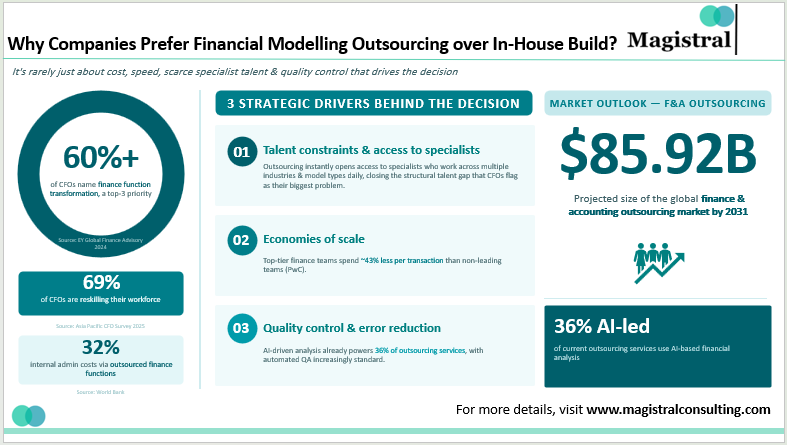
The time and money needed to build a solid modelling team in-house can be quite heavy; yet, financial modelling outsourcing quickly gives clients access to specialists who work with different kinds of models across the various industries they touch, almost daily. The 2024 Global Financial Accounting Advisory Services report by EY found that more than 60% of CFO’s have named transforming the finance function as one of their top three priorities. However, they also point to a talent gap as their biggest problem.

Plus, the Asia Pacific CFO Survey 2025 reports that 69% of CFOs are focusing on reskilling their workforce to keep up with new technologies, so a more structural lack of people can be eased, or at least handled better, through outsourcing.

Economies of Scale

The World Bank says multinational companies can lower their internal admin costs by about 32% through outsourcing, especially when they use an outsourced financial management function. PwC’s Finance Benchmarking note that top-tier finance teams could spend about 43% less per transaction compared with non-leading finance teams; so outsourcing ends up being a really solid method for shutting those gaps down. The cost reasoning still holds even if the firm is small or big, or if they are anywhere location-wise, demonstrating how financial modelling outsourcing drives the global finance and accounting outsourcing market, expected to hit $85.92 billion by 2031.

Quality Control and Error Reduction

Outsourced financial modelling teams follow various pretty rigorous QA procedures, like logic checks, consistency checks and formula audits, to make sure that model errors don’t end up hurting valuations, or cause really bad investment decisions. AI-based financial analysis makes up 36% of current outsourcing services, and at the same time, automated QA layers are showing up more and more, as part of the usual delivery model.

How Technology Shaped Financial Modelling Outsourcing in 2025

Advances in technology have also really shifted the range and general quality of what financial modelling outsourcing teams can put on the table. Things like AI automation and cloud computing are changing how those teams actually package and deliver their work, kind of quietly, but at the same time in a big way.
Financial Modelling Outsourcing

How Technology Shaped Financial Modelling Outsourcing in 2025

AI-Enabled Model Generation

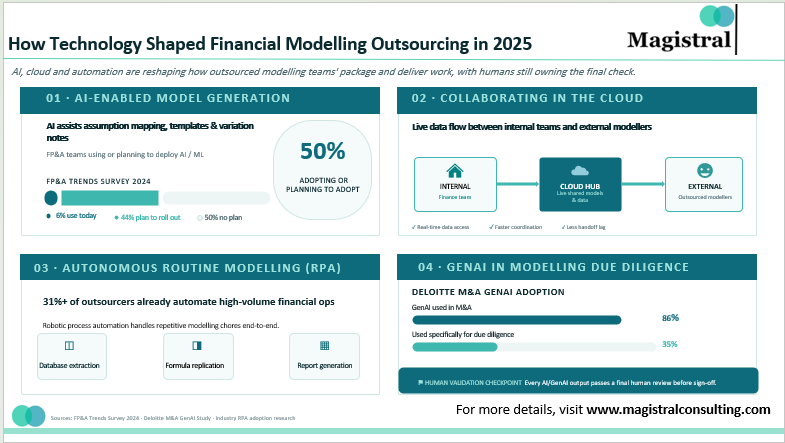
AI tools are now helping with the early steps of financial modelling outsourcing services, for instance, assumption mapping, template filling, variation note drafting, and similar tasks. Per the FP&A Trends Survey 2024, 6% of FP&A teams currently use AI and machine learning, and 44% say they plan to roll out these technologies later on.

Collaborating in the Cloud

Using cloud-based software kind of lets outside outsourcing employees access live data coming from internal systems. The result is a smoother, faster kind of coordination, and it also removes some of the typical waiting time tied to more traditional outsourcing setups.

Autonomous Routine Modelling Tasks

Companies can further lean on robotic process automation, or RPA, to take on repetitive modelling chores. Think pulling information from databases, repeating formulas across a bunch of cells, and producing financial reports. According to research, more than 31% of outsourcing companies have already used RPA to automate high-volume financial operations.

GenAI in Modelling Due Diligence

As reported in Deloitte’s survey, 86% of corporate and private equity managers whose companies or organisations have already used AI in their M&A process say they are also already using GenAI for M&A related activities. From that group, 35% have stated that they used Gen AI during a specific slice of the deal process, namely due diligence. Of course, these workflows still rely on human validation as a final check, as the last layer of review before anything is considered settled.

How Magistral Consulting Helps with Financial Modelling Outsourcing

Magistral Consulting works alongside investment banks, corporate development groups, private equity investors and their advisors for financial modelling outsourcing across the entire transaction and planning life cycle, more or less.

They build and keep transactional models used for M&A deals, Leveraged Buyouts (LBOs), capital raising transactions, and asset purchase transactions. Depending on the client’s deal type, they also develop three statement models: Discounted Cash Flow (DCF) models, LBO, and Consolidation, tied to the client’s deal structure and investment strategy.

In their approach to financial modelling outsourcing services, Magistral pairs a structured delivery framework with real analytical deliverables. The target of the partnership is not just to deliver a model and stop there, but to make sure every outcome actually connects to a choice, a negotiation, or a strategy.

About Magistral Consulting

Magistral Consulting has helped multiple funds and companies in outsourcing operations activities. It has service offerings for Private Equity, Venture Capital, Family Offices, Investment Banks, Asset Managers, Hedge Funds, Financial Consultants, Real Estate, REITs, RE funds, Corporates, and Portfolio companies. Its functional expertise is around Deal origination, Deal Execution, Due Diligence, Financial Modelling, Portfolio Management, and Equity Research

For setting up an appointment with a Magistral representative visit www.magistralconsulting.com/contact

About the Author

Prabhash Choudhary is the CEO of Magistral Consulting. He is a Stanford Seed alumnus and mechanical engineer with 20 + years’ leadership at Fortune 500 firms- Accenture Strategy, Deloitte, News Corp, and S&P Global. At Magistral Consulting, he directs global operations and has delivered over $3.5 billion in client impact across finance, research, analytics, and outsourcing. His expertise spans management consulting, investment and strategic research, and operational excellence for 1,200 + clients worldwide

FAQs

What types of models are usually included in financial modelling outsourcing?

Financial modelling outsourcing is made up of a mix of models, like three statement models, DCF valuation models, LBO and M&A model suites, consolidation frameworks, plus FP&A forecasting setups.

What is the difference between financial modelling outsourcing and hiring an analyst full-time?

When you use a dedicated team, a business can get the specific know-how quickly. So, you end up paying for modelling support you actually need, rather than funding a role that may be underused.

does a business ensure the quality of the outsourced financial models?

Quality control really starts when the client sets the requirements early, through a solid brief and a clear final output format. That way, the provider doesn’t have to guess.

Does financial modelling outsourcing work for new and smaller fund managers?

Emerging fund managers can often benefit a lot from outsourced financial modelling, because they can reach institutional-level modelling, deal by deal, without having to build an internal modelling function right away.

What is the impact of Artificial Intelligence on the quality of outsourced financial models?

AI can help a lot with speed, especially in assumption mapping, template population and the variance commentary parts of the process.

In the last ten years, the position of financial models has experienced a paradigm shift. From being static spreadsheets designed to provide answers to very specific valuation or forecasting queries, types of financial model have transformed into decision engines, dynamically connected to strategy, risk management, execution, and optimization. With this paradigm shift, the concept of financial models itself has to be broadened. In addition to its mathematical formulation, the nature of different types of financial model is also determined by their integration with business processes.

Notably, this transition from individual calculating aids to integrated decision-making tools is a result of the changing nature and needs of the markets in view. The evolving markets for financial services involve a condition characterised by a sense of increased uncertainty and competition in meeting the need for automation and complex regulatory challenges.

The Traditional Role of Different Types of Financial Model

Historical models employed in finance were standalone models created for particular purposes or uses. Valuation models included different types of financial model such as DCFs, comparable analyses, and precedent transactions, which aided in pricing and transaction decisions. Forecasting models aided in decisions related to budgets and internal plans, and models used in risk estimation included VaR and scenario-based models. The models were mainly used and archived after they were validated for particular uses without attention to their efficiency in dynamic decision-making processes.

Such a path also generated limitations in terms of structures. As decision-making speed increased, it became apparent that there was a need to move beyond traditional calculations for finance, from a living model to a calculator: its results reused beyond its purpose or assumption, its assumptions changing constantly to make its results less relevant, or even its results themselves based on dated data.

The New Landscape: Models as Decision Engines

The modern-day financial institutions are increasingly moving the categories and styles of the fiscal models from being static tools towards the strategic drivers by integrating them with the broader data environments and decision-making. This is fueled by four trends:

Financial Modeling Services Market Overview

Financial Modeling Services Market Overview

Real-Time Data Integration

Modern models are attached to real-time data streams, market prices, macro indicators, operational KPIs, and customer behavior metrics. This ensures forecasting, risk, and scenario models are constantly refreshed to deliver insights reflecting reality today, not assumptions from days past.

Example: A treasury risk model linked to real-time FX and interest rate feeds produces refreshed liquidity projections on an hourly basis, allowing proactive hedging decisions to be made rather than simply reacting to change.

Cross-Functional Connectivity

As opposed to being deployed in traditional teams, models can now enable functional workflows. For example, finance teams, risk teams, operations teams, and strategy teams can all leverage a common analytical foundation.

Example: The ability to budget and feed that into an operational risk dashboard will allow both finance and risk groups to understand the potential impact on return on risk-adjusted capital.

Scenario Modeling as a Strategic Routine

Rather than relying on ad hoc forms of stress test approaches, scenario modeling has now become a standard strategic input.

Different types of financial model work in concert to analyse future paths.

Example: During times of high volatility, investment firms run integrated models, which analyze the combined impact on the valuations, risks, and allocation due to interest rate shocks, allowing investors to take informed actions.

Automation and Scalability

Now, bench teams handle repetitive work, which removes the need to compute insights manually, helping to deliver them at speed. As such, data cleansing, assumption updates, and the distribution of outputs are achieved.

Example: AI-augmented workflows that dynamically update the underlying input assumptions of multiple types of financial model can enable the analyst to spend more time interpreting delta movements and writing the narratives that feed the investment committees.

Why This Shift Matters

The shift from static spreadsheets to decision engines changes not just how models are built, but how they influence organisational outcomes.

From Outputs to Outcomes

Typically, models have been used as a mechanism to derive outputs, e.g., valuations, projections, risk calculations, etc. However, in the new format, models are core to decision ecosystems where insights are used to derive outputs, i.e.:

Strategic allocation of capital

Dynamic risk budgeting

Scenario-based stress planning

Portfolio optimisation

This translates into a stronger connection between analytics and enterprise strategy, which forms an important underpinning of robust performance, especially under uncertain markets.

Better Governance and Traceability

As models become integrated, governance improves. For example, inputs, assumptions, version history, and changes can be auditable. This can be particularly important if model risk has implications that extend into a compliant requirement.

Governance models that facilitate these integrative drives help organizations meet regulatory needs in a way that also promises improved decision support.

Re-purposing Types of Financial Model in Practice

As such, the process of re-purposing certain forms of models relating to the category of finance can often be defined as integrating pre-existing models into an automated process of decision-making. The process of forecasting, valuations, and risk models can often be linked, especially those depending on time-sensitive models, in a continuous process of planning out decisions relating to governance. What this does is make it possible for pre-existing models of finance to be dynamic in their understanding of certain assumptions.

Integrated Forecasting and Enterprise Planning

Traditional models for finance department forecasting are now included in enterprise planning solutions. These different types of financial model incorporate data from operations, sales pipelines, and market signals to generate forecasts for various departments within an organization.

These models are being incorporated within:

Portfolio performance dashboards

Capital allocation strategies

Operational planning cycles

This circumvents the issue of delay in the receipt of insights and the response to planning.

Risk Models as Early-Warning Engines

Where once periodic assessment models existed, continuous monitoring platforms can hold the risk model with key indicators updating in real time and triggering pre-set thresholds with automated responses. This transformation allows a proactive risk culture where model insights keep exercising an impact on daily decisions rather than being confined to quarterly reviews.

Example: Credit risk models today lead to real-time credit decisions directly, and liquidity risk engines upgrade transactionally to prompt timely capital or funding adjustments.

Valuation Engines with Scenario Sensitivity

When such valuation models are incorporated into a portfolio management platform, they are referred to as valuation engines. The valuation engines are useful in facilitating the process of re-valuation under multiple scenarios on a real-time basis, hence generating timely investment insights on valuation.

For private equity or asset management industries, it implies that the process of valuation will no longer be retrospective in nature but will rather be predictive.

Strategic Stress Testing

Once again, stress testing models have become an integral part of a corporate planning calendar rather than ad-hoc stress testing exercises. Indeed, firms publish results from quarterly stress tests, supported by robust stress testing scenarios.

Such an approach puts stress testing above a mere regulatory requirement and turns it into a strategy of survivability/competitiveness.

Looking Ahead: The Future of Decision Engines in Financial Services

With the financial services sector facing increasing levels of market volatility, regulatory pressures, and competitiveness, the need to apply different types of financial model at the correct time has become a crucial factor. Scenario libraries are increasingly being seen as the norm, allowing financial institutions to assess hundreds of possible market scenarios with speed and consistency. At the same time, more extensive algorithmic integration is making it possible for different types of financial model to adapt in a dynamic fashion based on the emergence of new data patterns, as opposed to being based on fixed assumptions. In the future, model-execution connections, whereby analytical results are directly used to trigger operational or investment decisions, are poised to become the norm in the financial services sector. In this scenario, financial models are no longer static; instead, the types of financial model currently in use are at the heart of decision engines that dynamically influence financial outcomes.

AI-Driven Financial Modeling: Adoption and Impact Snapshot

AI-Driven Financial Modeling: Adoption and Impact Snapshot

Services Offered by Magistral Consulting for Financial Modeling & Valuation

Magistral Consulting provides end-to-end financial modeling and valuation assistance, which is intended to guide investors, companies, and financial organizations in making informed, data-based decisions.

Debt Analysis

Magistral supports clients by monitoring debt covenants and credit facilities, assessing lender compliance, and evaluating the suitability of existing debt structures for refinancing or additional funding.

Modeling & Valuation

The company creates and analyzes a wide array of valuation approaches, utilizing different types of financial model – DCF, LBO, merger and acquisition models, precedent transaction and comparable company analyses, SOTP analyses, equity research models, and sensitivity analyses.

Real Estate Models

Magistral builds real estate models covering rent-versus-buy and rent-versus-sell analyses, rent roll assessments, property price trend evaluation, and construct-and-sell scenarios, enabling clients to pursue profitable and risk-balanced real estate strategies.

Strategic & AI Benefits

By combining traditional financial modeling with AI-driven insights, Magistral helps clients achieve faster forecasting, more objective valuations, improved cost efficiency, and enhanced negotiating leverage.

About Magistral Consulting

Magistral Consulting has helped multiple funds and companies in outsourcing operations activities. It has service offerings for Private Equity, Venture Capital, Family Offices, Investment Banks, Asset Managers, Hedge Funds, Financial Consultants, Real Estate, REITs, RE funds, Corporates, and Portfolio companies. Its functional expertise is around Deal origination, Deal Execution, Due Diligence, Financial Modelling, Portfolio Management, and Equity Research

For setting up an appointment with a Magistral representative visit www.magistralconsulting.com/contact

About the Author

Himank is an investment and financial analysis specialist with experience across private equity, investment banking, and research-driven engagements. An MBA (Tech) in Finance and BTech in Computer Science graduate from Narsee Monjee Institute of Management Studies, he focuses on financial modeling, valuation, and investment research. He supports project teams at Magistral Consulting, delivering LBO and DCF models, due diligence, investment memorandums, and deal origination support. His blend of analytical thinking, problem-solving ability, and structured approach enables him to translate complex financial data into actionable insights.

FAQs

What does Magistral Consulting specialize in?

Magistral Consulting provides operations outsourcing and analytical support to financial services firms, investment managers, and corporates, helping them scale decision-making, execution, and insight delivery without building large in-house teams.

Can Magistral support scenario analysis and stress testing?

Yes, Magistral designs and maintains scenario libraries and stress-testing frameworks that allow clients to evaluate performance across multiple market conditions and use insights proactively in decision-making.

How does Magistral ensure quality and consistency across engagements?

Magistral follows structured delivery frameworks, strong governance, and senior oversight, ensuring outputs are consistent, auditable, and aligned with client decision processes.

Does Magistral build models from scratch or enhance existing ones?

Magistral does both, building models from the ground up where required, while also re-engineering existing models to improve structure, transparency, scalability, and decision relevance.


As global deal volumes fluctuate and regulatory demands intensify, investment banks are increasingly reevaluating their operating methods. The traditional in-house model—once essential for maintaining control and confidentiality—is giving way to more agile, cost-efficient, and technology-enabled frameworks. Investment banking outsourcing has emerged as a strategic lever, not merely for back-office functions but across the investment banking value chain—from research and pitchbook creation to financial modeling and compliance support.
Guided by a worldwide shortage of skilled resources, increasing operational costs, and the need for 24/7 delivery, Investment banking outsourcing is helping optimize delivery while still preserving high-quality delivery. Changing expectations in outsourcing within finance and accounting are also supported by the trends of automation, outcome-based contracting, and ESG compliance.

Why Investment Banks Outsourcing

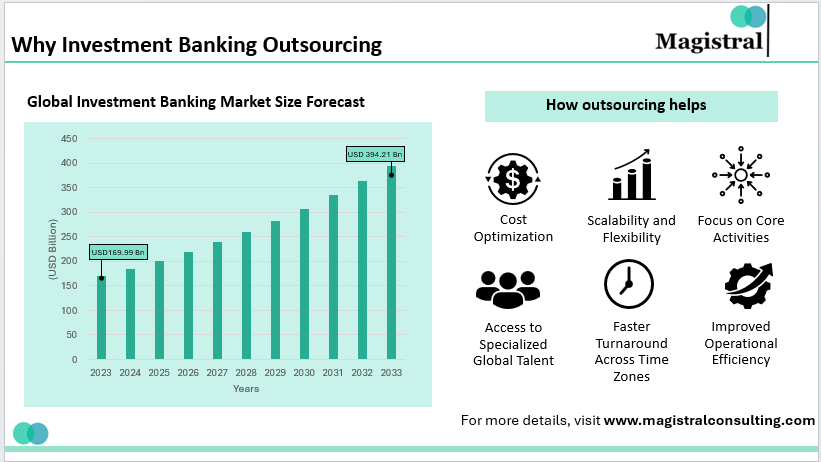
The Global Investment Banking Market Size is anticipated to expand from USD 169.99 billion in 2023 to USD 394.21 billion by 2033, at a CAGR of 8.78% from 2023 to 2033.

Why Investment Banking Outsourcing

Why Investment Banking Outsourcing

Cost Optimization Without Compromising Quality

Investment banking outsourcing provides banks with the potential to lower operating expenses substantially by using experienced and skilled personnel in countries with lower-cost structures, such as India or Eastern Europe. Additionally, the quality of the service is not compromised by the lower cost, as many outsourcing firms deliver high-quality services and deep domain knowledge.

Scalability and Flexibility

Under an investment banking outsourcing arrangement, banks externalize the staffing function with an elastic outsourcing workforce that they can ramp up and ramp down based on demand. Whether it is during the lobbying and M&A surge or IPO season, banks can swiftly ramp additional resources without a long-term commitment, including onboarding time and costs, which means a faster turnaround on their projects and a greater deal volume throughput.

Focus on Core, High-Value Activities

Senior bankers and their effect teams should focus on core, high-value activities. Shifting activities to the outsourced team will allow the bank’s in-house teams to re-establish time for thinking about making strategic decisions and still have consistency across their engagements.

Access to Specialized Global Talent

One of the most valuable attributes an outsourcing partner brings is access to financial analysts and world-class domain specialists who specialize in particular sectors (like real estate, healthcare, fintech, and energy), overlapping professional skills, and regional knowledge. These professionals will have similar experience involving very advanced valuation techniques such as DCF, LBO, or merger models, thereby providing the bank with a competitive advantage.

Faster Turnaround Across Time Zones

With outsourcing teams in varied time zones, investment banks can efficiently run 24 hours a day. A task sent at the end of the U.S. business day can be completed by an offshore team overnight and have deliverables ready in the morning. This ongoing availability speeds up workflows and reduces deal cycles, which is important for fast-moving transactions.

Improved Operational Efficiency

Outsourcing improves efficiency levels because support functions in investment banks, such as market research, updating the CRM, collecting data, and completing compliance documentation, are needed but not core functions. By displacing these functions, banks increase productivity in-house, meaning they can take on more clients without a linear increase in headcount.

Investment Banking Outsourcing: Market Trends

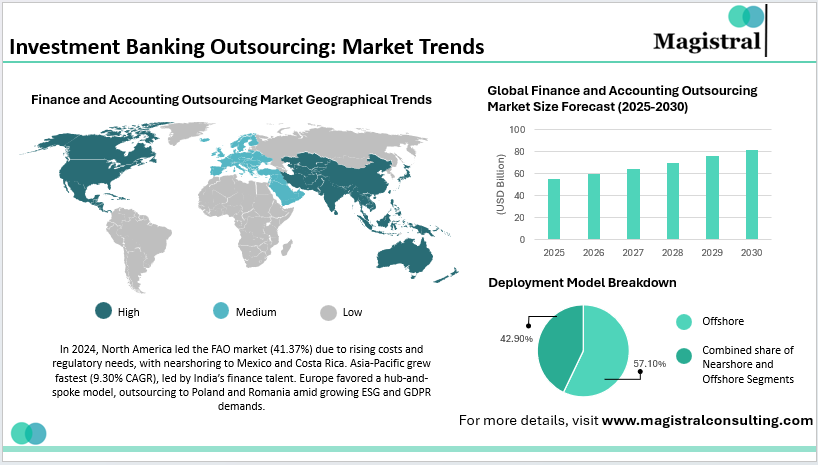
The global finance and accounting outsourcing market reached USD 54.79 billion in 2025 and is forecasted to grow to USD 81.25 billion by 2030, at a compound annual growth rate (CAGR) of 8.21%. The momentum of operational efficiency is changing the way investment banks view operational efficiency. Some key contributors to the change in investment banks are automating the financial organization’s inefficiencies, transitioning from time-based contracts to outcome-based contracts, and increasing pressures to comply with ESG compliance and reforms to international tax.
Investment banking outsourcing is being looked at as a value proposition rather than just a cost-saving opportunity. Investment banking outsourcing is still seen as a cost-saving solution, but now investment banks look for real-time insights into their operations through outsourcing to service providers that give them scalability, using a mix of artificial intelligence and predictive analytics with financial domain specialists to give banks strategic value, no longer using the labor arbitrage sourcing model.

Investment Banking Outsourcing: Market Trends

Investment Banking Outsourcing: Market Trends

Shifts in Delivery Models

While offshore service delivery locations (i.e., India and the Philippines) make up over 57% of service delivery in 2024 and are growing, near-shore service delivery (i.e., North & South America) is starting to gain traction as it is expected to grow at 10.20% CAGR to 2030. For investment banks, because of the nature of their work, near-shoring, specifically to Latin American locations (i.e., Mexico and Colombia) is attractive because they allow investment banks to turn virtual and meet in person with a client during the same day with compatible time zones and at a small ratio of cultural alignment.
This transition is further driven by a combination of data-localization directives and a market preference for high-touch, client-facing services with minimal language or cultural friction. Providers have started implementing bilingual teams and making investments in client experience training comparable to onshore services. Offshore service providers are responding through “follow-the-sun” support models by pairing night-shift teams in India with day-shift teams in the U.S.–to ensure that their responsiveness doesn’t stop overnight. This model works well for finance and accounting firms, particularly investment banking outsourcing, given the opportunities to operate simultaneously across global time zones and meet their procedures for near-continuous deal execution.

Geographic Insights

North America led the outsourcing market in 2024 with a 41.37% share. U.S. and Canadian investment banks face rising labor costs and talent shortages, driving demand for automated, outsourced solutions. Captive centers in Mexico and Costa Rica address data-sovereignty concerns and offer bilingual support. Regulatory requirements like Sarbanes-Oxley and SEC scrutiny fuel third-party validation needs.

Asia-Pacific, led by India and the Philippines, is the fastest-growing region (9.30% CAGR). India offers deep talent in treasury, FP&A, and analytics, while Vietnam and Malaysia serve as niche hubs for Japanese and Australian firms. Government incentives and data-security standards attract global banks for investment banking outsourcing.

In Europe, banks use a hub-and-spoke model, retaining core finance functions centrally and outsourcing volume tasks to Poland and Romania. Demand for ESG reporting and GDPR compliance is rising, and UK firms are increasingly moving to Ireland post-Brexit.

Investment Banking Outsourcing: Future Outlook

The model for investment banking outsourcing will quickly change as investment banking firms face increasing deal complexity, regulatory scrutiny, and efficiency pressures. With investment banking projected to grow to USD 394.21 billion by 2033, banks will turn to outsourcing for more than just cost reduction, as firms will leverage outsourcing as a strategic and effective option for scale, speed, and specialization. The investment banking outsourcing model will keep pushing further into front- and middle-office operations built on advanced analytics, artificial-intelligence-enabled research, and automation on accounts payable and receivable compliance. Near-shore and hybrid models will keep evolving using time-zone alignment, and various data-localization compliance and ‘follow-the-sun’ support will keep advancing as full 24/7 execution. Environmental, social, and governance (ESG) and sustainability reporting will be considerable outsourcing categories, while regulatory items, like the EU’s Corporate Sustainability Reporting Directive (CSRD) and SEC oversight, will demand even greater disclosures, and reporting will increasingly rely on third-party validation.

Magistral’s Services for Investment Banking Outsourcing

Deal Sourcing

Magistral Consulting helps investment banks find and assess early-stage deal opportunities through extensive industry and market research. We can also help with identifying acquisition or investment targets using a custom screening model. Furthermore, Magistral provides sector newsletters to clients that provide them with ongoing updates on market movements, competitor activity, and the latest sector trends to keep clients informed during times of heightened deal activity.

Valuations

Magistral provides comprehensive valuation support through sophisticated LBO and DCF modeling, allowing investment banks to evaluate viability and value transaction structure. The firm provides total financial modeling services tailored to different transaction types, and its valuation services include precedent transaction analysis and comparable company approach to valuation, giving its clients a holistic view of a company’s value based on historical data and market standards.

Deal Execution

For investment banking outsourcing, Magistral is involved in deal execution, where our activities include the creation of high-quality marketing materials (such as teasers and detailed investment memoranda) to clarify how to approach potential investors or buyers. We will assist in the identification and profiling of proper counterparties (investors, acquirers, etc.), through a combination of structured outreach and data-driven targeting methods to fast-track the transaction process to increase quality and efficiency.

Marketing Support

Magistral enhances an investment bank’s marketing and thought leadership initiatives by creating premium-quality white papers, case studies, and thought pieces to highlight sector depth. We would also create impact analysis reports and sustainable investing content that respond to the increasing demand for ESG-aligned investment strategies. Points of View (PoVs) that are genuine insights and perspectives on a sector’s trends are designed to catalyze investment banks’ brand strength and deepen client engagement.

About Magistral Consulting

Magistral Consulting has helped multiple funds and companies in outsourcing operations activities. It has service offerings for Private Equity, Venture Capital, Family Offices, Investment Banks, Asset Managers, Hedge Funds, Financial Consultants, Real Estate, REITs, RE funds, Corporates, and Portfolio companies. Its functional expertise is around Deal origination, Deal Execution, Due Diligence, Financial Modelling, Portfolio Management, and Equity Research

For setting up an appointment with a Magistral representative visit www.magistralconsulting.com/contact

About the Author

Prabhash Choudhary is the CEO of Magistral Consulting. He is a Stanford Seed alumnus and mechanical engineer with 20 + years’ leadership at Fortune 500 firms- Accenture Strategy, Deloitte, News Corp, and S&P Global. At Magistral Consulting, he directs global operations and has delivered over $3.5 billion in client impact across finance, research, analytics, and outsourcing. His expertise spans management consulting, investment and strategic research, and operational excellence for 1,200 + clients worldwide


FAQs

Why are investment banks increasingly outsourcing their operations?

Investment banks are outsourcing to reduce operational costs, access global talent, improve efficiency, and manage fluctuating workloads. Outsourcing also enables faster execution and round-the-clock coverage, especially during high-demand periods like M&A surges or IPO seasons.


Which functions within investment banking are commonly outsourced?

Functions frequently outsourced include financial modeling (DCF, LBO, precedent transactions), pitchbook creation, industry and market research, company profiling, CRM updates, and compliance documentation. Increasingly, banks are also outsourcing ESG reporting and analytics.


Is quality compromised when investment banks outsource high-value tasks?

No. Leading outsourcing firms offer deep domain expertise and maintain high-quality standards. They employ experienced financial analysts trained in global best practices and valuation methods, ensuring deliverables meet investment banking benchmarks.


What are the advantages of using offshore and near-shore delivery models?

Offshore models (e.g., India, the Philippines) offer significant cost savings and access to large talent pools, while near-shore models (e.g., Mexico, Colombia, Ireland) provide time-zone alignment, data-localization compliance, and cultural proximity for more collaborative work.