Tag Archives: Financial Modeling Outsourcing Services

For investment firms, private equity houses, and corporate finance teams, financial modelling outsourcing has shifted from a basic cost-saving measure to a strategic advantage. The global financial modelling service market was valued at USD 2.5 billion in 2023 and is projected to reach USD 5.8 billion by 2032, with a CAGR of 9.7%. As deal complexity increases and internal resources become constrained, more companies are partnering with specialists to outsource model development rather than overextending in-house teams.

The Real Deal About Financial Modelling Outsourcing

Financial modelling outsourcing is broader than most firms initially expect. It encompasses the full spectrum of models that support investment decisions and strategic planning activities.

Three Statement and Cash Flow Models

The most fundamental deliverable in financial modelling outsourcing is the three-statement model. This model integrates the income statement, balance sheet, and cash flow statement into one cohesive framework. These models are typically developed and maintained by outsourced teams.

Valuation Models and Discounted Cash Flow

DCF modelling really needs technical precision mixed with some commercial judgement, not just one or the other. Discount rate assumptions, how the terminal value is handled, and the sensitivity tables are areas where financial modelling outsourcing teams typically lean on, so the valuations come out more accurate for the investment.

LBO and M&A Modelling

As financial modelling outsourcing becomes more complex, leveraged buyout and merger models are becoming more complex as well. They include the purchase price stuff, the capital stack, what equity is actually put in, the IRR-based analysis, and cash-on-cash multipliers, sort of everything that helps quantify potential returns and risks for both investors and sponsors in a deal.

Integration and Scenario Models

The modelling of consolidation eliminates the elimination of intercompany transactions for multi-entity companies. As such, the modelling provides one overall view of the financial results of a business. Additionally, scenario modelling is used together with consolidation modelling to stress test assumptions using bull, base and bear conditions, giving decision-makers a structured way to see their risk before committing capital.

FP&A & Forecasting Support

Outsourcing is a growing trend for FP&A – this was discovered in the FP&A Trends Survey 2024. Geography plays an important role in how FP&A maturity is allocated throughout the world. Right now, most of the structured FP&A maturity is sitting in North America 39% and in Europe, 34%, so yeah, not like everywhere else is keeping up, it kind of feels concentrated there.

Why Companies Prefer Financial Modelling Outsourcing over In-House Build

When companies turn to financial modelling outsourcing, they rarely do it just because it’s cheaper, more like there’s a bigger, less obvious perspective that factors in speed, quality, available capacity, and overall strategic attention.
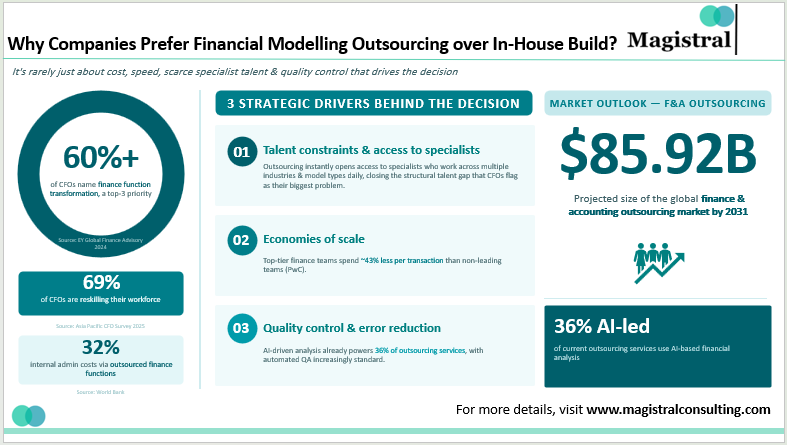
Why Companies Prefer Financial Modelling Outsourcing over In-House Build?

Why Companies Prefer Financial Modelling Outsourcing over In-House?

Talent constraints and access to specialists

The time and money needed to build a solid modelling team in-house can be quite heavy; yet, financial modelling outsourcing quickly gives clients access to specialists who work with different kinds of models across the various industries they touch, almost daily. The 2024 Global Financial Accounting Advisory Services report by EY found that more than 60% of CFO’s have named transforming the finance function as one of their top three priorities. However, they also point to a talent gap as their biggest problem.

Plus, the Asia Pacific CFO Survey 2025 reports that 69% of CFOs are focusing on reskilling their workforce to keep up with new technologies, so a more structural lack of people can be eased, or at least handled better, through outsourcing.

Economies of Scale

The World Bank says multinational companies can lower their internal admin costs by about 32% through outsourcing, especially when they use an outsourced financial management function. PwC’s Finance Benchmarking note that top-tier finance teams could spend about 43% less per transaction compared with non-leading finance teams; so outsourcing ends up being a really solid method for shutting those gaps down. The cost reasoning still holds even if the firm is small or big, or if they are anywhere location-wise, demonstrating how financial modelling outsourcing drives the global finance and accounting outsourcing market, expected to hit $85.92 billion by 2031.

Quality Control and Error Reduction

Outsourced financial modelling teams follow various pretty rigorous QA procedures, like logic checks, consistency checks and formula audits, to make sure that model errors don’t end up hurting valuations, or cause really bad investment decisions. AI-based financial analysis makes up 36% of current outsourcing services, and at the same time, automated QA layers are showing up more and more, as part of the usual delivery model.

How Technology Shaped Financial Modelling Outsourcing in 2025

Advances in technology have also really shifted the range and general quality of what financial modelling outsourcing teams can put on the table. Things like AI automation and cloud computing are changing how those teams actually package and deliver their work, kind of quietly, but at the same time in a big way.
Financial Modelling Outsourcing

How Technology Shaped Financial Modelling Outsourcing in 2025

AI-Enabled Model Generation

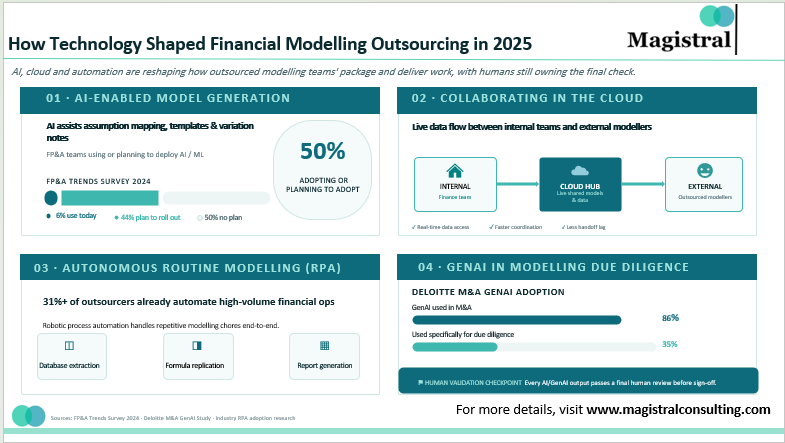
AI tools are now helping with the early steps of financial modelling outsourcing services, for instance, assumption mapping, template filling, variation note drafting, and similar tasks. Per the FP&A Trends Survey 2024, 6% of FP&A teams currently use AI and machine learning, and 44% say they plan to roll out these technologies later on.

Collaborating in the Cloud

Using cloud-based software kind of lets outside outsourcing employees access live data coming from internal systems. The result is a smoother, faster kind of coordination, and it also removes some of the typical waiting time tied to more traditional outsourcing setups.

Autonomous Routine Modelling Tasks

Companies can further lean on robotic process automation, or RPA, to take on repetitive modelling chores. Think pulling information from databases, repeating formulas across a bunch of cells, and producing financial reports. According to research, more than 31% of outsourcing companies have already used RPA to automate high-volume financial operations.

GenAI in Modelling Due Diligence

As reported in Deloitte’s survey, 86% of corporate and private equity managers whose companies or organisations have already used AI in their M&A process say they are also already using GenAI for M&A related activities. From that group, 35% have stated that they used Gen AI during a specific slice of the deal process, namely due diligence. Of course, these workflows still rely on human validation as a final check, as the last layer of review before anything is considered settled.

How Magistral Consulting Helps with Financial Modelling Outsourcing

Magistral Consulting works alongside investment banks, corporate development groups, private equity investors and their advisors for financial modelling outsourcing across the entire transaction and planning life cycle, more or less.

They build and keep transactional models used for M&A deals, Leveraged Buyouts (LBOs), capital raising transactions, and asset purchase transactions. Depending on the client’s deal type, they also develop three statement models: Discounted Cash Flow (DCF) models, LBO, and Consolidation, tied to the client’s deal structure and investment strategy.

In their approach to financial modelling outsourcing services, Magistral pairs a structured delivery framework with real analytical deliverables. The target of the partnership is not just to deliver a model and stop there, but to make sure every outcome actually connects to a choice, a negotiation, or a strategy.

About Magistral Consulting

Magistral Consulting has helped multiple funds and companies in outsourcing operations activities. It has service offerings for Private Equity, Venture Capital, Family Offices, Investment Banks, Asset Managers, Hedge Funds, Financial Consultants, Real Estate, REITs, RE funds, Corporates, and Portfolio companies. Its functional expertise is around Deal origination, Deal Execution, Due Diligence, Financial Modelling, Portfolio Management, and Equity Research

For setting up an appointment with a Magistral representative visit www.magistralconsulting.com/contact

About the Author

Prabhash Choudhary is the CEO of Magistral Consulting. He is a Stanford Seed alumnus and mechanical engineer with 20 + years’ leadership at Fortune 500 firms- Accenture Strategy, Deloitte, News Corp, and S&P Global. At Magistral Consulting, he directs global operations and has delivered over $3.5 billion in client impact across finance, research, analytics, and outsourcing. His expertise spans management consulting, investment and strategic research, and operational excellence for 1,200 + clients worldwide

FAQs

What types of models are usually included in financial modelling outsourcing?

Financial modelling outsourcing is made up of a mix of models, like three statement models, DCF valuation models, LBO and M&A model suites, consolidation frameworks, plus FP&A forecasting setups.

What is the difference between financial modelling outsourcing and hiring an analyst full-time?

When you use a dedicated team, a business can get the specific know-how quickly. So, you end up paying for modelling support you actually need, rather than funding a role that may be underused.

does a business ensure the quality of the outsourced financial models?

Quality control really starts when the client sets the requirements early, through a solid brief and a clear final output format. That way, the provider doesn’t have to guess.

Does financial modelling outsourcing work for new and smaller fund managers?

Emerging fund managers can often benefit a lot from outsourced financial modelling, because they can reach institutional-level modelling, deal by deal, without having to build an internal modelling function right away.

What is the impact of Artificial Intelligence on the quality of outsourced financial models?
AI can help a lot with speed, especially in assumption mapping, template population and the variance commentary parts of the process.

With the growing trends, organizations look forward to improving efficiency, decreasing costs, and optimizing strengths. A good approach is the financial modeling outsourcing tasks to third-party service providers. This approach gives the companies an opportunity to leverage the services of experts who can analyze and interpret data for them with limited capital investment.

Financial Modeling Outsourcing: A Master Weapon

Financial Modeling Outsourcing: A Master Weapon


Financial Modeling is essential in the formulation of strategies, investment decisions, and assessing the performance of an organization which is costly and time-consuming and depends on the expertise and resources available. Thus, the application of outsourcing allows obtaining high-quality models and professional services, while the models and other service-providing personnel adhere to modern methodologies and requirements.


Types of Financial Models

Financial modeling is one of the crucial parts of research for valuing and analyzing the business. Outsourcing helps the internal team of buy-side and sell-side firms to build and update the financial models that will save their time, effort, and cost. Different financial models serve various purposes, but the following types are especially popular in financial modeling outsourcing:

Discounted Cashflow Model (DCF)

Professionals commonly use the DCF model to value businesses, particularly in real estate or industries where they can reliably predict future cash flows. Its versatility makes it a preferred choice for a wide range of valuation scenarios. The major requirements to build a DCF model are:

Unlevered free cash flow

Also known as free cash flows to the firm, brings consistency in the model’s result as it does not depend on the capital structure of the company. Different companies require different modifications while calculating these cash flows, in some cases working capital is not a major value driver but for some, this can be a critical factor.

Discounting rate

After the projection a percentage is required to discount these flows to bring the present worth of the cash flows. The percentage represents the weighted average cost of capital which will carry the weightage of all capital sources like equity, debt, and more.

Terminal value

The value is an outcome of the first cash flow of the company and its cash flow growth rate and discount rate in the terminal period.

Leverage Buyout (LBO) Model

These models are among the most complex financial structures used to evaluate potential LBO deals. They extensively analyze various financial components, especially:

Acquisition Structure

This section analyzes key elements such as the amount of debt raised, the acquisition’s purchase price, and the equity contribution from the investor group or acquiring company.

Key Financial Metrics

Apart from IRR the financial model outsourcing also reveals and studies various other financial metrics such as debt service coverage ratio and cash-on-cash multiple to determine the viability of the transaction for the acquisition.

Sensitivity Analysis

To identify and analyze the potential risks associated with the investment.

Exit Strategy

Different strategies like initial public offering or sale out to another buyer and more are considered in the model.

Consolidation Model

The combination of the parent company’s financial statements with its subsidiary companies gives a 360-degree view of the financial soundness of the business. Two major parts of the process are:

Eliminating intercompany transactions

Based on double-entry logic the process of consolidation eliminates the possible risk of one-sided entries. Intercompany debt, Intercompany revenue and expenses, and Intercompany stock ownership are three intercompany eliminations that are used to reverse the entry to zero effect.

Consolidating financial statements

By integrating and combining all the financial statements of parent and subsidiaries to draft a set of standardized financial statements.

Option Pricing Model

The mathematical structure of this model reveals the theoretical price of the options. Financial teams majorly use this model to value the employee stock options and to manage risk related to currency fluctuations, prices of the commodities, and interest rates. There are three main types of option pricing models:

The Black-Scholes model

The model is used for European options by assuming volatility and risk-free rate constant.

Monte Carlo Simulation

The model is based on random sampling and is used for pricing options that are exotic or complex in nature.

The Binomial model

This model uses a tree-like structure to evaluate and analyze the options.


Market Growth and Trends in Financial Modeling Outsourcing

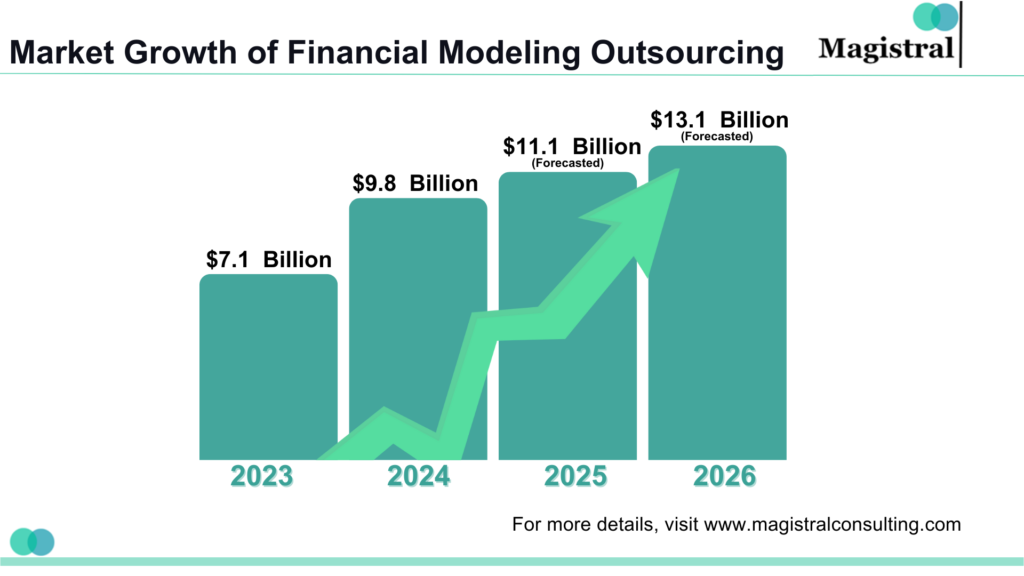
Organizations of all sizes increasingly outsource financial modeling because it effectively presents budget forecasts, identifies funding needs, and supports strategic planning.

Market Growth of Financial Modeling Outsourcing

Market Growth of Financial Modeling Outsourcing

Technological Integration

The adoption of AI, ML, and big data analytics is enhancing accuracy and efficiency in financial models. According to the statistics, about 80% of financial organizations are using or planning to use RPA for the automation of routine work in financial fields so that finance specialists can concentrate on value-added work.

Client Satisfaction

According to a 2024 Financial Recovery Technologies survey, 96% of clients are satisfied with outsourced financial modeling services. This satisfaction has led to more business with firms renewing or increasing their contracts.

Market Growth

It is forecasted that the financial modeling outsourcing market will touch $512.4 billion, at the global level by 2030. The IT outsourcing segment is concerned to increase from $460.1 billion in 2023 to $777.7 billion by 2028. The factors that will continue to ‘fuel’ this type of sector include the demand for cheap services and the development of technology.

Widespread Adoption

Various industries such as financial services, healthcare, technology, and real estate are now outsourcing the financial modeling task to capitalize on the expertise and technical tools.

Geographical Diversification

India, Philippines and Eastern Europe outsourcing destinations offer qualified workforce at cheaper rates, which makes this area ideal for financial modeling outsourcing.


Magistral’s Services on Financial Modeling Outsourcing

 Magistral Consulting is the top Outsourcing Financial Modeling Company that specializes in providing different services for different clients.

Unparalleled Expertise

Magistral’s competent workforce has adequate knowledge of the current standards, regulations, and trends in financial modeling.

Tailored Solutions

Magistral expert analysts develop the revenue forecast, cost structures, investment and profitability appraisals, and sensitivity analysis based on the client’s strategic objectives.

Cost-Effectiveness and Scalability

It is important to note that organizations that outsource their financial modeling from Magistral recoup much more than if they were to employ and maintain a team of financial modelers, and all this with scalable solutions.

Confidentiality and Data Security

Magistral protects client data by strictly following data protection rules and maintaining confidentiality at every stage.

Quality Control and Assurance

Magistral ensures high quality through rigorous validation checks and alignment with market trends to deliver realistic and credible financial models.

Magistral Consulting offers a cost-efficient yet highly elaborated outsourcing option for financial modeling. We engage our clients in the development of solutions, guarantee data protection and adhere to the highest quality standards. Therefore, our approach gives strategic advantage to business organizations that we deal with.


About Magistral Consulting

Magistral Consulting has helped multiple funds and companies in outsourcing operations activities. It has service offerings for Private Equity, Venture Capital, Family Offices, Investment Banks, Asset Managers, Hedge Funds, Financial Consultants, Real Estate, REITs, RE funds, Corporates, and Portfolio companies. Its functional expertise is around Deal origination, Deal Execution, Due Diligence, Financial Modelling, Portfolio Management, and Equity Research

For setting up an appointment with a Magistral representative visit www.magistralconsulting.com/contact

About the Author

The article is authored by the Marketing Department of Magistral Consulting. For any business inquiries, you can reach out to prabhash.choudhary@magistralconsulting.com

[sp_easyaccordion id=”3118″]

Introduction

Financial Modeling Outsourcing refers to the practice of enlisting external service providers or specialized firms to handle the creation and maintenance of financial models. This involves assigning the tasks of designing, building and updating these models to professionals who possess the necessary expertise and resources.

Financial modeling plays a crucial role in the realms of business and finance, as it entails constructing mathematical representations of real-world financial situations. These models predict and evaluate various aspects of a company’s financial performance, such as revenue forecasts, cost analyses, investment valuations, cash flow projections, and scenario assessments. By providing insights into potential outcomes and associated risks, financial models facilitate decision-making processes.

Advantages of Financial Modeling Outsourcing

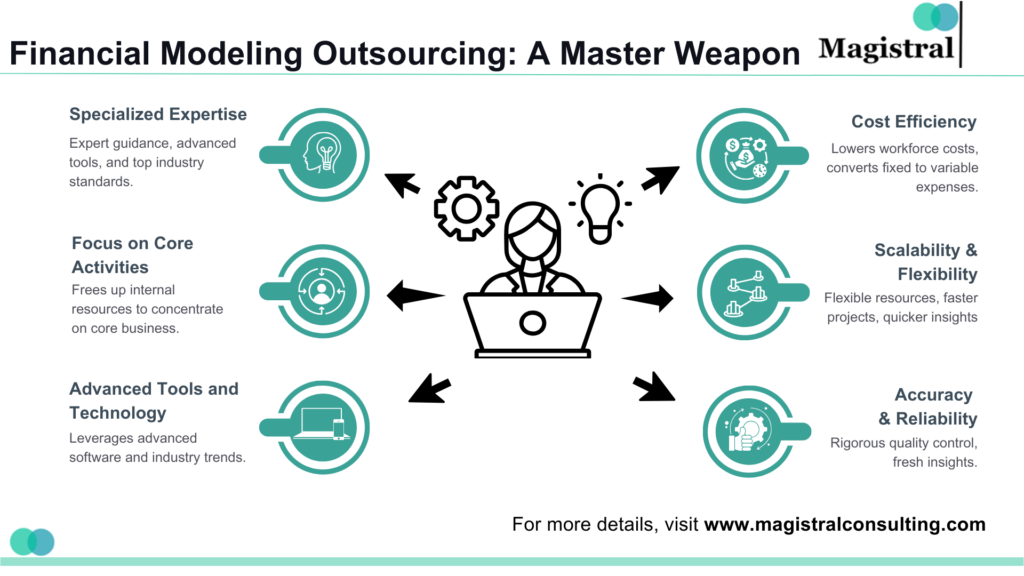
Financial modeling outsourcing offers several key advantages that organizations can leverage to enhance their financial planning and decision-making processes. Some common benefits include:

Advantages of Financial Modeling Outsourcing

Advantages of Financial Modeling Outsourcing

Cost savings and scalability:

Financial modeling outsourcing presents a significant cost-saving opportunity compared to maintaining an in-house team. By outsourcing to external providers, organizations can avoid expenses related to hiring and training specialized staff, investing in technology infrastructure, and ongoing maintenance. This flexible approach allows businesses to scale their demand-based modeling needs, ensuring cost efficiency and resource optimization.

Access to specialized expertise:

Outsourcing financial modeling tasks grants organizations access to professionals who possess specialized knowledge and expertise in the field. These experts have a deep understanding of best practices, industry standards, and regulatory requirements. By partnering with these skilled professionals, organizations can ensure the accuracy, reliability, and compliance of their financial models, benefiting from their extensive experience and insights.

Enhanced efficiency and productivity:

Delegating financial modeling tasks to external experts allows internal teams to focus on core competencies and strategic initiatives. By entrusting time-consuming and specialized tasks to external providers, organizations can streamline their operations, improve overall productivity, and allocate resources more effectively. This enables internal teams to concentrate on high-value activities such as data analysis, decision-making, and strategy formulation, ultimately driving organizational growth.

Improved accuracy and reliability:

External companies that offer financial modelling carry out strict quality checks. They use advanced modelling approaches, follow industry best practices, and do thorough validations. Organizations may make sure that their financial models are accurate and reliable by utilizing their knowledge and experience. As a result, financial estimates and analyses become more accurate and reliable, facilitating the making of well-informed decisions.

Risk Mitigation:

Financial modeling outsourcing helps organizations mitigate risks by leveraging external expertise. External providers have extensive experience across various industries and markets, enabling them to offer valuable insights and identify potential risks or limitations in financial models. They can also provide independent validation and verification of models, reducing the chance of errors or biases. By tapping into their knowledge, organizations can make more informed decisions and reduce exposure to financial risks.

In essence, financial modeling outsourcing offers numerous advantages, including cost savings, access to specialized expertise, enhanced efficiency and productivity, improved accuracy and reliability, and risk mitigation. By leveraging these benefits, organizations can optimize their financial planning and decision-making processes, gain a competitive edge, and achieve better financial performance.

Challenges of Financial Modeling Outsourcing

While financial modeling outsourcing offers numerous benefits, it is crucial for organizations to be aware of the challenges and risks associated with this practice. By understanding these potential pitfalls, businesses can take proactive measures to address them effectively. Here are some of the significant challenges and risks in financial modeling outsourcing:

Data security and confidentiality concerns:

Organizations must divulge sensitive financial data to outside sources when outsourcing financial modelling tasks. To guard against unauthorized access, security breaches, and abuse of sensitive data, it is crucial to make sure that effective data security measures are in place. Throughout the outsourcing process, it is crucial to protect intellectual property and uphold confidentiality agreements.

Communication and coordination challenges:

Effective communication plays a vital role in successful financial modeling outsourcing. Geographical and cultural differences, language barriers, and time zone disparities can hinder seamless collaboration between organizations and external providers. It is crucial to establish clear channels of communication, define expectations, and maintain regular updates to ensure effective coordination throughout the outsourcing engagement.

Quality control and standardization:

Maintaining consistency and quality across outsourced financial models can be challenging. Organizations should establish robust processes and standards to ensure that the models meet their specific requirements and adhere to industry best practices. Regular monitoring and quality control checks should be implemented to maintain the desired level of accuracy and reliability.

Dependency on external providers:

Outsourcing financial modeling tasks means relying on external providers to deliver accurate and timely results. Organizations must carefully select reputable and reliable providers with a proven track record. Building strong relationships, maintaining open lines of communication, and conducting periodic performance evaluations are essential. Ensuring that the outsourcing partner consistently meets expectations.

Regulatory and compliance considerations:

Financial models must adhere to rules and laws particular to their business. To avoid any compliance difficulties, organizations need to make sure that external providers are knowledgeable of these rules. During the outsourcing process, regulatory compliance with regulations like the Sarbanes-Oxley Act (SOX) or International Financial Reporting Standards (IFRS) should be thoroughly assessed and addressed.

By proactively addressing these challenges and risks, organizations can mitigate potential pitfalls associated with financial modeling outsourcing. Implementing robust data security measures, fostering effective communication, establishing quality control processes, selecting reliable providers, and ensuring regulatory compliance are key steps toward successful outsourcing engagements.

Magistral’s Services on Financial Modeling Outsourcing

Magistral Consulting is recognized as a leading provider of specialized financial modeling outsourcing services and solutions. With a proven track record of delivering outstanding results, we offer a comprehensive range of services tailored to meet the diverse needs of organizations across industries.

Magistral's Services on Financial Modeling Outsourcing

Magistral’s Services on Financial Modeling Outsourcing

Unparalleled Expertise and Specialization:

We take pride in our team of highly skilled professionals who possess extensive expertise in financial modeling. Our experts are well-versed in industry best practices, regulatory requirements, and the latest advancements in financial modeling techniques.

Tailored and Customized Solutions:

Whether it involves developing financial models for revenue forecasting, cost analysis, investment valuation, or scenario analysis, we work closely with clients to thoroughly understand their needs and deliver solutions that align with their strategic goals.

Cost-Effectiveness and Scalability:

Recognizing the importance of cost savings and scalability in today’s competitive business environment, we offer a cost-effective outsourcing solution. By entrusting financial modeling tasks to us, organizations can significantly reduce costs compared to maintaining an in-house team.

Confidentiality and Data Security:

Safeguarding the confidentiality and security of our clients’ data is of utmost importance to Magistral Consulting. We adhere to strict data protection protocols to ensure that sensitive financial information remains secure throughout the outsourcing process.

Quality Control and Assurance:

At Magistral Consulting, delivering accurate and reliable financial models is our top priority. We have established rigorous quality control processes to maintain consistency and adhere to industry best practices. Our team conducts thorough validations and employs advanced modeling techniques to ensure the accuracy and reliability of the models we create.

As a trusted partner in financial modeling outsourcing, Magistral Consulting empowers organizations to optimize their financial planning and decision-making processes. Our specialized expertise, customized approach, cost-effective solutions, focus on confidentiality and data security. Rigorous quality control processes, and collaborative approach enable businesses to gain a competitive edge and unlock the full potential of financial modeling in driving their success.

About Magistral Consulting

Magistral Consulting has helped multiple funds and companies in outsourcing operations activities. It has service offerings for Private Equity, Venture Capital, Family OfficesInvestment BanksAsset Managers, Hedge Funds, Financial Consultants, Real Estate, REITs, RE fundsCorporates, and Portfolio companies. Its functional expertise is around Deal originationDeal Execution, Due Diligence, Financial ModellingPortfolio Management, and Equity Research.

For setting up an appointment with a Magistral representative:

visit www.magistralconsulting.com/contact

About the Author

The article is authored by the Marketing Department of Magistral Consulting. For any business inquiries, you can reach out to  prabhash.choudhary@magistralconsulting.com

Financial Modeling Outsourcing is fast catching up, this article focuses on the steps required to prepare a Financial Model that will attract the attention of investors. It also argues as to why it is all the more important to outsource financial modeling to bring in an expert’s point of view.

Financial Modeling Definition

Financial Modeling is an inseparable part of Investment Analysis. A financial model prepared on an excel sheet is used to analyze almost all investment decisions.

Financial Modeling is considered to be a quantitative exercise plainly dealing with numbers and formulas. Sometimes on excel and sometimes on software like R, VB, Python, etc. However, regular practitioners understand that this is more of an art than science. It doesn’t only need to be correct in terms of formulas and assumptions, it needs to sell as well to the client.

In the article we will also talk about Financial Modeling Outsourcing, that is fast catching up as a trend to ensure the quality of the Financial Model

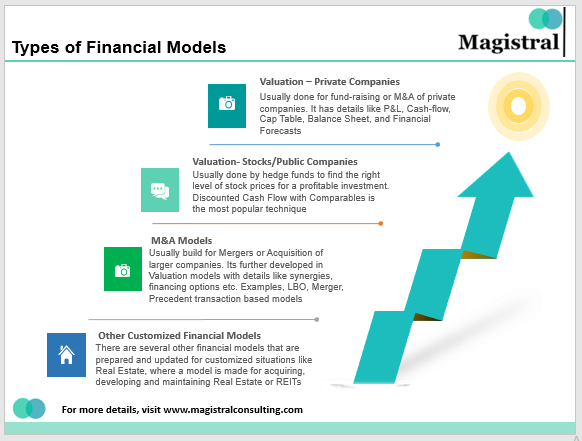
Types of Financial Models

The investment community uses multiple types of Financial Models. Following are the broad types of Financial Model:

Financial Model for Private Companies: Private Equity, Venture Capital, and Investment Banking firms use this to find out the valuation of an asset. Financial Modeling and Valuations go hand-in-hand. Investment Banks also do it day in and day out for their clients. It’s for situations where a private company, a start-up, or otherwise is looking to raise funds from debt or equity or is looking for the opportunities of Mergers and Acquisition. This type of financial model has all the sections that are important for investing like P&L, Balance Sheet, Cash-flows, Working Capital, Cap Table, RoI calculations, exchange rates, Resource utilization metrics, and other relevant details.

The way assumptions are made for the future forecast of revenue is the heart of the financial model. All other numbers just follow these broad numbers. If assumptions on revenue and cost are wrong, a financial model can either give undervalued or lofty valuations, both of which have the potential to kill the deal, either from the buy or sell side.

Financial Model for Stocks: Investors in equity stocks, usually Hedge Funds or Investment Banks use these models for themselves or their clients. They arrive at buy, sell, or hold recommendations based on these financial models. A Discounted Cash Flow Model of the publicly listed stocks is at the heart of each recommendation. It has future financial projections built-in and is updated continuously based on the developments related to that company or industry. Formulas on the model are the same and still, different brokerages come to different recommendations for the same stock. Ever wondered why? It is all in the assumptions and assessment of development. A development or news can be seen as highly negative by a brokerage and hence a huge negative impact on future projections, whereas the same news could be assessed neutral by another broking house.

The key to a great financial model in this situation is to understand the culture of your client/investor. Are they conservative or high-risk takers? Depending on the culture, you can make appropriate assumptions and hence the recommendations that suit your clients. Comparables and peer analysis is also used along with the DCF modeling

M&A Models: Most M&A models build further on financial models for start-ups and companies. It carries specific sections around financing and payback, synergies, Leveraged Buyout details to assess if the proposed M&A is going to create value for everyone involved. The most commonly used models here are Merger Modeling and Precedent Transaction Analysis.  Again assumptions are more important than the Formulas, as that can make or break the deal.

Other Models: A financial model is present usually before any sort of investment or fund-raising decision regarding any form of asset, whether we are talking about Real Estate, REITs, or a portfolio of crypto assets. Financial Model for Real Estate is in principle same as a Private Equity investment in a company but takes into account situations related to the concerning Real Estate.

Real Estate can be acquired and used differently, leading to different financial outcomes. A Real Estate financial model objectively analyses these scenarios and their financial outcomes. Say a land bank bought in the city center of a megacity could be kept vacant for capital appreciation. It could also be developed as an old-age hostel or a hotel. The second scenario will lead to rental income but at the same time will also require capital investments.

All this needs to be evaluated objectively to conclude if the proposed investment makes sense for the investors. Similar models are made to track the performance of REITs, or rent rolls coming from multiple commercial properties. There are multiple ways a Real Estate could give returns and all this leads to a hugely customized financial model specific to the situation. Real Estate Financial Modeling Outsourcing is catching up in a big way.

Steps to prepare a Financial Model- Financial Modeling Best Practices

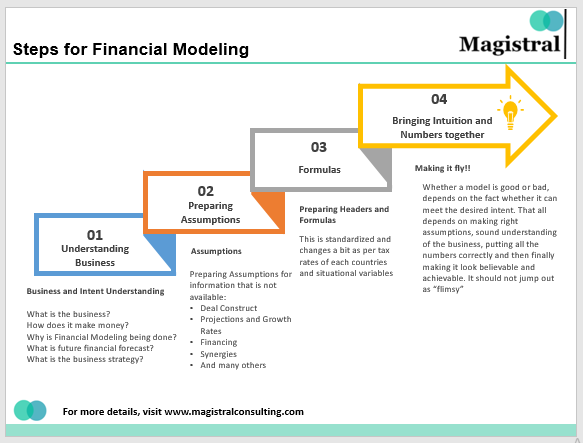
The steps would change as per the financial model under preparation. Following are the generalized steps that are valid for usually all types of Financial Models:

Understanding the business and business situation:  This is the very first step before putting in a single number in Excel, R, Python, VB, or any other software that you plan to use for Financial Modeling. More thorough is your understanding of the business, more reasonable are the assumptions and more chances of it flying with the client or investors.

Usually, a pitch deck is prepared before the financial model so that all stakeholders are clear about the business strategy. This is all the more important in the case of start-ups that are raising Series A with no previous revenue track record. An experienced practitioner asks lots of questions in this stage about the strategy, finance, human resources, market, geographies, products, patents, industry, people, and everything else related to the business.

A robust financial model demands an eye for details. If it is related to specific investing situations, questions should be asked around returns, risks, similar business models around, management team, etc. The financial modeling technique to be used in this specific business situation should also be finalized.

Preparing Assumptions: This is one of the most critical steps while preparing financial models. If Assumptions made does not make sense, it renders the whole financial model useless. Other than making reasonable and well-researched assumptions, the experienced practitioners also make sure assumptions could be changed in the model. Multiple stakeholders play around the model to finalize the contours of the deal. The standard aspect of deal-making is changing assumptions in the model. A well-made model is flexible in changing assumptions.

Preparing the model: Preparing financial models on Excel is most common however, models can also be created on R, VB, Macros, Python, etc. There are many off the shelf financial modeling tools that are available. Financial Model Templates are usually available at this stage. Standardization is the major part of the model in this stage. For example, any private company valuation model would comprise, P&L, Balance Sheet, Cash Flow, etc. These statements will have standardized headers and formulas too. The parts dependent on the nature of business are customized. A SaaS business for example will be very different from Steel business in terms of how they acquire customers and project revenue.

Bringing intuition and data together: This is the task of the most experienced operator in the field of financial modeling. It not only requires the knowledge of the formulas in the financial model but also a thorough understanding of business, its competition, and the industry as a whole. When that experienced operator looks at the valuation that the model throws, he instinctively knows if that is correct or not. The assumptions are played around with if the valuation is not in the expected ballpark. A valuation level that makes sense to both Buy-Side and Sell-Side is achieved by this exercise.


In the end, we see Financial Modeling is more of an art than the exact science.

The rationale behind outsourcing financial modeling

An expert at Financial Modeling has worked with multiple start-ups, Investment Banks, Private Equity, Venture Capital, and other Financial advisors multiple times before.  They have templates available readily with them and know the right questions to ask. All this leads to a Financial Model that is in tune with what the investor ecosystem demands. If you are looking for Financial Modeling Outsourcing, Magistral Consulting (www.magistralconsulting.com) can help in multiple ways.


Magistral Consulting (www.magistralconsulting.com) is a leading player in the Financial Modeling Outsourcing space. It provides Financial Modeling Services. Magistral has specialization in preparing Financial Models for Private Equity, Financial Models for venture Capital, Financial Models for Real Estate, Financial Model for Investments Banks, Financial Models for Hedge Funds, Start-up Financial Modeling, apart from several other highly customized Financial Models. It has delivered Financial Modeling Projects globally to clients in the US, UK, Europe, and South-East Asia. For a business inquiry, you can drop a line at https://magistralconsulting.com/contact/


The Author, Prabhash Choudhary is the CEO of Magistral Consulting and can be reached at Prabhash.choudhary@magistralconsulting.com, in case of queries.