Tag Archives: general partner profiling

General partner profiling has emerged as a critical component of investment decision-making because institutional investors face challenges in selecting the right managers, managing risk, and achieving consistent returns on investment. General partner profiling is not simply a matter of reviewing performance metrics. Limited partners (LPs) must understand a manager’s investment discipline, leadership capabilities, operational expertise, and ability to deliver returns across different business environments. The McKinsey Global Private Markets Report 2026 states that total capital raised by closed-end private equity funds worldwide declined by 17% to $616 billion in 2025, whereas deal value increased by 19% to $2.6 trillion. With liquidity declining and holding periods lengthening, investors are being prompted to scrutinize fund managers more closely.

General Partner Profiling: Market Trends and Growing Importance

Competition in private capital markets has been growing, making general partner profiling increasingly important to institutional investors. Changing fundraising dynamics, limited liquidity, longer holding periods, and evolving LP expectations require investors to assess fund managers on past performance alone.
General Partner Profiling

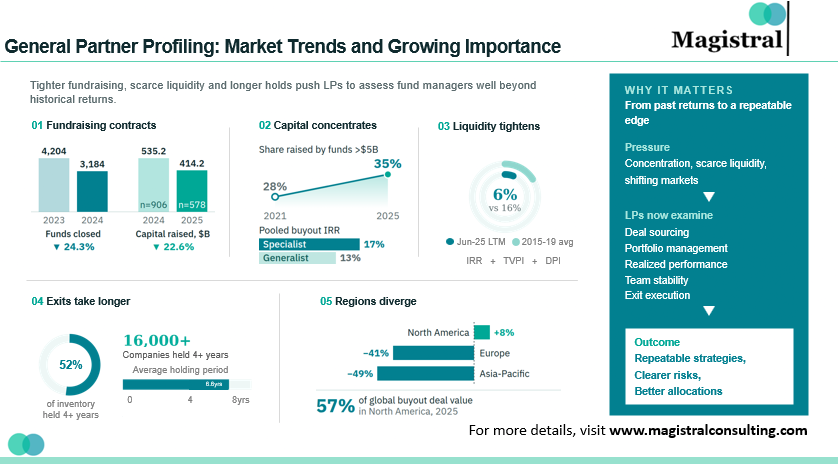
General Partner Profiling: Market Trends and Growing Importance

Changing Fundraising Dynamics

The fundraising environment has deteriorated because of higher financing costs and slower distributions of proceeds. According to Preqin, 3,184 funds closed in 2024, compared with 4,204 in 2023, representing a decline of 24.3%. In 2025, PitchBook data showed that 578 funds raised $414.2 billion, compared with $535.2 billion raised by 906 funds in 2024. Regional dynamics also differed: according to McKinsey research, fundraising activity grew by 8% in North America in 2025 but declined by 41% in Europe and 49% in Asia-Pacific.

Increasing Fundraising Concentration

More capital is flowing to managers with established track records. McKinsey reports that funds over $5 billion raised 35% of all fundraising in 2025 versus 28% in 2021. Smaller specialist managers differentiate themselves through focused expertise: McKinsey found that specialist buyout funds achieved an aggregated IRR of 17% versus 13% of generalists. LPs therefore need to assess whether a manager’s size, sector focus, or specialization provides a sustainable competitive advantage.

Greater Focus on Liquidity and Performance Metrics

LPs are placing greater emphasis on exits and capital returns rather than on valuations alone. McKinsey estimates that DPI as a proportion of AUM was just 6% during the year to June 2025 versus the average 16% during the 2015-19 period. This indicates that LPs should consider IRR, TVPI, and DPI when assessing both investment performance and the return of capital.

Longer Holding Periods and Exit Challenges

Another important factor in assessing fund managers is the extended time before an exit. As per McKinsey, there have been 16,000 portfolio companies worldwide that have had an investment tenure greater than four years, which constitutes 52% of the inventory that has been funded through buyouts. The average holding period reached 6.6 years in the year 2025. LPs must therefore analyze how GPs manage portfolio companies during extended holding periods and how they address exit planning, valuations, and conflicts of interest.

Regional Differences and Investment Opportunities

A manager’s geographic exposure should be assessed. North America accounted for 57% of the global deal value of buyouts in 2025. Europe offers opportunities in industrial consolidation, infrastructure, and the energy transition, while APAC offers opportunities linked to consumption growth and technological innovation. Investors should determine whether a GP has the regional capabilities required to execute its strategy.

Why These Trends Matter for Investors

Fundraising concentration, liquidity concerns, and shifts in the business environment have complicated fund manager selection. Past returns remain important, but investors increasingly evaluate deal-sourcing capabilities, portfolio management, historical performance, personnel stability, and exit processes. A structured general partner profiling approach can help limited partners identify managers with repeatable strategies, recognize possible risks, and make better allocation decisions.

General Partner Profiling: Core Evaluation Framework

Proper general partner profiling involves not only the financial performance of the fund but also the evaluation of its leadership, investment approach, governance, and operational capabilities. This comprehensive analysis enables investors to identify the strengths and possible risks associated with the manager.

Investment Track Record and Performance Attribution

A fund manager’s past performance is a useful starting point, although it never tells the whole story. LPs should evaluate performance on a deal-by-deal basis and consider metrics such as valuation at entry, leverage, value creation, holding periods, multiples of exit, and performance realized. Losses, write-offs, and performance relative to comparable funds also help distinguish skill from luck.

Sources of Value Creation

Understanding how a manager creates value is essential. LPs should evaluate the historical roles of leverage, multiple expansion, and operational improvements in a fund’s performance. Sources of return that worked well in the past may become less effective as market conditions change, increasing the importance of operational capabilities.

Leadership Experience and Team Stability

The experience and stability of the investment team affect fund performance. LPs should investigate the backgrounds of the senior leaders, the responsibility of the investment committee, employee turnover, succession plans, and whether they depend too much on certain individuals. LPs should also check whether the people who made the investments in the past work at the firm now.

Investment Strategy and Portfolio Construction

Investors need to determine whether a fund’s stated investment philosophy is consistent with its historical investments and demonstrated capabilities. Key considerations include target sectors and geographies, transaction size, sourcing capabilities, use of leverage, and portfolio concentration. Any change in investment philosophy should be supported by relevant experience and the capability to execute the revised strategy.

Governance and Alignment of Interests

Good governance contributes significantly to accountability and the alignment of interests between GPs and LPs. The evaluation process should consider management fees, carried interest, GPs’ contribution towards capital, conflicts of interest, valuations, and investment committees, among other factors. Investors should also assess co-investments and reporting procedures when evaluating alignment of interests.

Operational and Regulatory Oversight

A manager’s operational capabilities should form part of the assessment. These capabilities include fund administration, financial reporting, cybersecurity and information protection, compliance and valuations, and risk management.

Reputation and Stakeholder Relationships

References from current investors, portfolio company management, former staff members, lenders, and advisory firms can provide insights beyond past financial performance. Well-structured reference checks allow LPs to evaluate a manager’s communication, decision-making, integrity, and handling of difficult situations throughout the investment process.

A comprehensive general partner profiling process enables investors to look beyond past financial performance by assessing a manager’s investment approach, leadership, governance, operational capabilities, reputation, and stakeholder relationships.

General Partner Profiling: Technology and Analytical Strategies

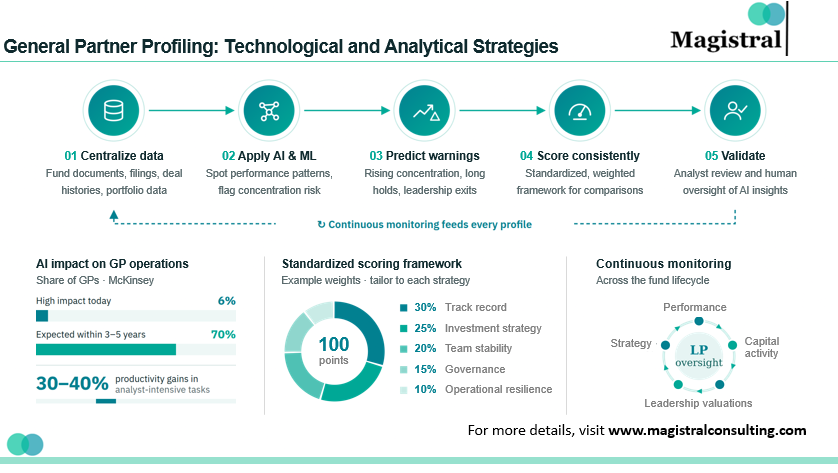
Tools and technologies such as AI, machine learning, and centralized investment databases can make general partner profiling faster, easier, and more efficient. Investment databases allow LPs to combine fund documentation, regulatory disclosures, transaction history, and other portfolio-related information when conducting thorough manager evaluations.
General Partner Profiling

General Partner Profiling: Technological and Analytical Strategies

Artificial intelligence can identify patterns in investment results, detect concentration risks, and generate insights from large volumes of investment data. According to McKinsey, only 6% of general partners consider the use of artificial intelligence to have a high impact on their business processes at the moment, but 70% of GPs expect high impact within the next 3-5 years, and a 30%-40% increase in productivity is reported in analyst work.

Predictive analytics can help identify warning signs such as portfolio concentration growth, holding period growth, and leadership transitions. Standardized scoring models based on criteria including track record (30%), investment philosophy (25%), team stability (20%), governance (15%), and operational flexibility (10%) can help LPs compare managers effectively, although different investment strategies may require different weightings. Analysts should always oversee and validate AI-supported analysis.

How Magistral Consulting Supports General Partner Profiling

Successful general partner profiling requires well-structured research, financial analysis, and continuous monitoring. Magistral Consulting supports investment teams through manager mapping, investment strategy research, performance record analysis, portfolio and financial performance comparisons, and due diligence assistance. Its analytical services also include organizing manager data, assessing risks, identifying information gaps, and creating performance dashboards and monitoring reports.


About Magistral Consulting

Magistral Consulting has helped multiple funds and companies in outsourcing operations activities. It has service offerings for Private Equity, Venture Capital, Family Offices, Investment Banks, Asset Managers, Hedge Funds, Financial Consultants, Real Estate, REITs, RE funds, Corporates, and Portfolio companies. Its functional expertise is around Deal origination, Deal Execution, Due Diligence, Financial Modelling, Portfolio Management, and Equity Research

For setting up an appointment with a Magistral representative visit www.magistralconsulting.com/contact

About the Author

Tanya is an investment-research specialist with 6 + years advising venture-capital, private-equity and lending clients worldwide. A Stanford Seed alumnus with an MBA and an Economics (Hons) degree, she heads project teams at Magistral Consulting, delivering financial modelling, due-diligence and deal support on 3,000 + mandates. Her blend of rigorous analytics, sharp project management and clear client communication turns complex data into actionable investment insight.


FAQs

What is General Partner Profiling in private equity?

It is the systematic assessment of a fund manager's performance, investment strategy, leadership, governance, operational capabilities, and risk characteristics. LPs use the findings to support manager selection, investment commitments, and ongoing oversight.

Why do limited partners evaluate general partners?

Limited partners evaluate managers to identify investment expertise, assess potential risks, understand alignment of interests, and determine whether a manager's strategy matches their portfolio objectives.

Which metrics are most important when evaluating a fund manager?

Common measures include internal rate of return, total value to paid-in capital, distributions to paid-in capital, investment multiples, realized losses, and performance relative to comparable funds. In McKinsey's January 2026 LP survey, IRR remained the leading metric, with DPI and MOIC tied for second. Qualitative factors such as leadership stability and governance are equally important.

How can artificial intelligence improve manager evaluation?

AI can help organize large investment datasets, analyze documents, identify performance patterns, and highlight potential risk indicators. Human analysts still need to verify the information and interpret findings within the relevant investment context.

How often should investors review existing fund managers?
Investors typically review quarterly fund reports and conduct more detailed assessments periodically or when significant developments occur. Leadership departures, strategy changes, deteriorating performance, or governance concerns may warrant additional reviews.


General Partner (GP) profiling is no longer just a background check for limited partners (LPs). In 2025, it has come out as a sophisticated, data-driven process that validates better fund allocation, mitigates risk, and improves portfolio results. LPs today appreciates that who manages the money is as important as where the money is kept. 

Rather than asking, “What’s the fund strategy?” LPs are now asking, “Who is implementing it, and do they have a remarkable track record?” General Partner profiling turns a people-centric perception into an anticipating performance lever, sharpening investment theses and enhancing fund selection.


Adaptive Role of General Partner Profiling: From Due Diligence to Strategic Intelligence

Traditionally, A component of fund due diligence primarily reputational and operational in nature considered as GP profiling. With behavioural insights included Today, it’s a cornerstone of fund evaluation, blending quantitative performance metrics. 

Modern GP profiling incorporates: 

Historical disaggregation of track record 

Models of decision-making and dynamics of team 

Interest analysis to be aligned with 

Psychometric tools are used for behavioural assessment. 

Deal ecosystem stakeholders for sentiment analytics 

GP’s style, resilience, and consistency, allowing LPs to better match capital with conviction uses an integrated approach to uncover deeper truths. 

General Partner Profiling in conception: A Private Equity Case

Evaluating three mid-market private equity funds are considered as an institutional investor. Fund A had the highest IRR in the surface. But a deeper General Partner profile revealed: 

One superstar partner aid excessively to fund A’s returns 

Between deal and ops teams there are internal tensions 

High GP turnover in past funds 

Conversely, Fund B showed stable, with moderate consistent exits across cycles and team-based performance. Over single-period outperformance that valuing sustainability where the fund B backed by LP. 

With succession issues and strategy drift within three years of time, Fund B exceeded expectation, while Fund A struggled. 

Post-Commitment Monitoring: Keeping GPs Accountable

Just as ESG audits track post-investment value, LPs now use GP profiling to monitor fund behaviour during the investment period. 

One pension fund instituted quarterly “GP Health Checks” using a proprietary dashboard that tracked: 

Key personnel retention 

Adherence to stated investment themes 

Co-investment behaviour 

Responsiveness to LP requests 

Over a 5-year horizon, this approach helped the LP renegotiate terms mid-fund with two GPs and exit early from one underperforming relationship, protecting downside while securing alpha elsewhere. This led to a better understanding of funds, towards selection and for a better investment strategy. 

Product Strategy Rooted in General Partner Profiling Insights

Asset allocators are now designing fund-of-fund products based on behavioural clustering of GPs. 

For instance, a sovereign wealth fund grouped GPs not by asset class but by: 

Risk-taking temperament 

Deal origination style (proprietary vs. competitive auctions) 

Post-acquisition value creation models 

The result? A balanced portfolio with reduced correlation risk and improved overall Sharpe ratio achieved not by changing asset classes, but by understanding the people behind the capital. The analysis of better fund selection characterises this capital leads for high amount of concentration to get the required ROI from it. 

The General Partner Profiling Premium: What Investors are Paying For

In today’s fundraising environment, General Partners with transparent governance, strong succession plans, and aligned economics command better terms and quicker closes. Understanding and evaluating the GPs with the appropriate plan for a better investment will lead to a high ROI from it. 

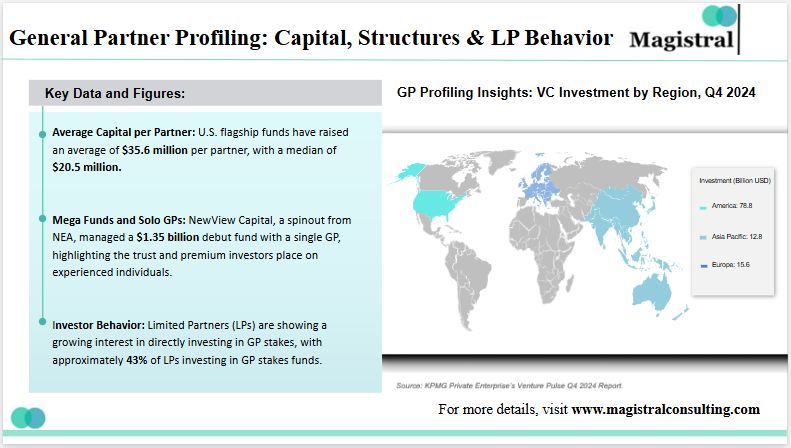
General Partner Profiling: Capital, Structures & LP Behavior​

General Partner Profiling: Capital, Structures & LP Behavior​

According to a 2024 Previn survey, GPs rated in the top quartile of “LP Trust Indices” closed funds 3 months faster and at 1.3x their target size. 

Moreover, those GPs often attracted strategic co-investors willing to waive management fees in exchange for insight access, demonstrating that trust capital is fast becoming as critical as financial capital. 

Four Transformational Trends in General Partner Profiling

The four transformational trends in General Partner Profiling are-

AI-Augmented Track Record Analytics-H3

Platforms now dissect historical deals not just by IRR, but by GP involvement levels, sourcing methods, and timing efficiency. AI identifies patterns even across restructured or recycled portfolios.

AI-Augmented Track Record Analytics-H3

LPs monitor how GPs are perceived by intermediaries, CEOs, and co-investors using NLP-powered tools scraping public data, earnings calls, and proprietary surveys.

AI-Augmented Track Record Analytics-H3

Through assessments and interviews, LPs evaluate decision-making under pressure, openness to dissent, and learning agility—key traits in dynamic markets.

GP-Platform Ecosystem Fit

Rather than assessing a GP in isolation, profiling now maps their fit into the LP’s broader strategy—alignment with long-term goals, values, and existing fund exposures.

Operational Excellence Through GP Alignment

A family office partnered with a niche GP targeting industrial tech roll-ups. Rather than focus solely on financials, they evaluated: 

The GP’s operating cadence 

Their value creation playbook 

Past treatment of LPs in tough cycles 

The office then offered tailored operational support shared HR resources, ESG guidance, and bolt-on scouting assistance. The synergy led to two accretive add-ons within 18 months and tripled the platform’s EBITDA. 

From Profiles to Profits: The ROI of General Partner Intelligence

According to Cambridge Associates, LPs who adopt structured General Partnering profiling frameworks outperform peers by 220 basis points annually over a 10-year horizon. The alpha isn’t just in fund selection it’s in avoiding value-destructive partnerships. 

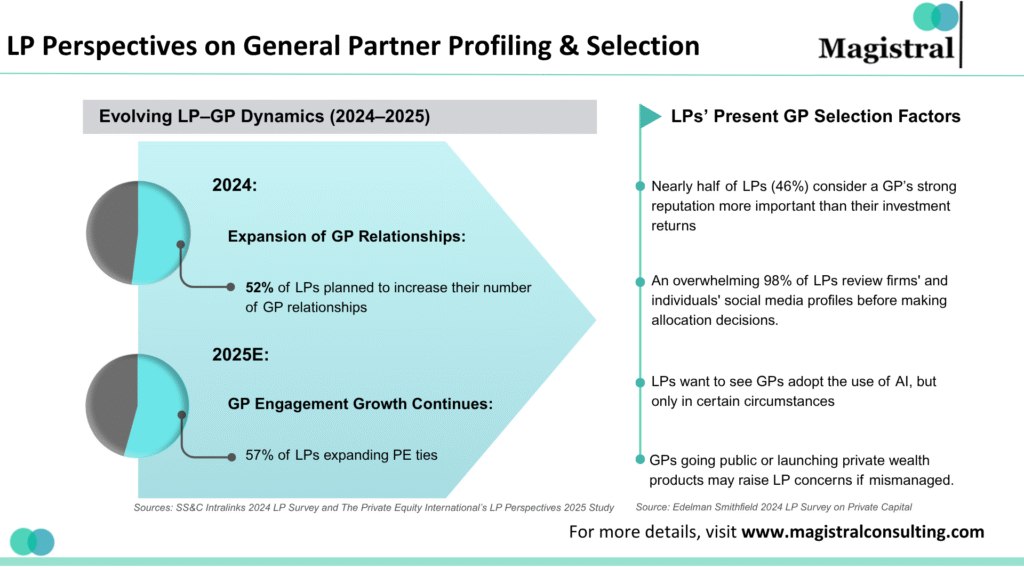
LP Perspective on General Partner Profiling & Selection

LP Perspective on General Partner Profiling & Selection

General Partnering profiling adds value through: 

Enhanced manager selection 

Early warning signals during fund life 

Better alignment in co-investments and strategic guidance 

It transforms relationship management from reactive to strategic, deepening trust and improving long-term fund performance. 

Case Study: Avoiding a GP Misfire

An endowment considered backing a first-time fund from an ex-bulge bracket team. While pedigree and early traction looked promising, profiling revealed: 

A rigid, top-down culture unsuited for agile mid-market deals 

Inflated team bios with overstated track records 

Limited operational empathy 

The endowment passed, instead supporting a less flashy but more grounded team. Three years on, the first fund collapsed due to founder disputes. The alternate team is now raising Fund II with a 2.5x MOIC. 

GP profiling didn’t just save capital—it preserved reputational bandwidth. 

Building an LP Brand Around General Partner Profiling Understanding

Leading allocators now build their brand around being “GP-friendly but disciplined.” They publish their manager selection criteria, host onboarding bootcamps, and reward transparency with better terms. 

One endowment launched a “GP Playbook” outlining: 

Preferred governance structures 

Team dynamics they support 

LP-GP communication cadences 

This transparency made them a preferred LP for emerging managers, granting early access and better fee arrangements. 

Internal Cohesion: General Partnering Profiling as a Cross-Functional Tool

Just like ESG, GP profiling fosters internal alignment. Investment committees, operational due diligence (ODD), legal, and even comms teams now rally around a shared GP dashboard. 

This promotes: 

Faster decision-making 

Shared risk vocabulary 

Unified LP positioning 

Some firms even tie GP profiling scores to internal compensation models, aligning fund selection with institutional values. 

General Partner Profiling: The Strategic Imperative

In 2025, backing a fund without understanding its GPs is like buying a startup without meeting the founder. 

Whether selecting a new venture manager, considering re-ups, or optimising portfolio diversification, LPs must embed GP profiling into their core strategy. It’s not just about risk, it’s about pattern recognition, trust, and long-term alignment. 

In a market of increasing volatility and choice, human capital intelligence is the new edge. The difference between alpha and regret often lies in understanding not just the numbers, but the people behind them. 

Magistral services for General Partners  

Magistral serves General Partners across the investment lifecycle. Right from spanning fundraising, due diligence, portfolio management, to deal sourcing. The specification of each of these areas consists of:

Fundraising Support

Targeted Investor Identification 

Investor Reach out 

Document Support (Pitch Decks, CIMs, and PPMs) 

Real-time Reporting Dashboard Support 

Deal Sourcing 

Deal Sourcing 

Target Profiling 

Investment decision support

Due Diligence

Commercial Due Diligence 

Financial Due Diligence 

Operational Due Diligence

Portfolio Management

KPI Tracking and Reporting 

Data Room Management 

On-Demand Research 

About Magistral Consulting

Magistral Consulting has helped multiple funds and companies in outsourcing operations activities. It has service offerings for Private Equity, Venture Capital, Family Offices, Investment Banks, Asset Managers, Hedge Funds, Financial Consultants, Real Estate, REITs, RE funds, Corporates, and Portfolio companies. Its functional expertise is around Deal origination, Deal Execution, Due Diligence, Financial Modelling, Portfolio Management, and Equity Research

For setting up an appointment with a Magistral representative visit www.magistralconsulting.com/contact

About the Author

The article is authored by the Marketing Department of Magistral Consulting. For any business inquiries, you can reach out to prabhash.choudhary@magistralconsulting.com