Tag Archives: Private Equity Offshoring

Private equity has grown into one of the most demanding corners of finance, and firms can no longer rely on instinct alone to win deals. Deal cycles have lengthened, competition for quality assets has intensified, and limited partners now expect sharper reporting and faster decisions. This is where Private Equity Consulting steps in. It brings structured research, financial rigor, and operational discipline to every stage of the investment lifecycle. From sourcing to exit, consultants help general partners test assumptions, validate deals, and manage portfolios more efficiently. As markets swing between recovery and caution, Private Equity Consulting has moved from being a discretionary add-on to a strategic necessity for firms that want consistent, defensible returns.

The Growing Role of Private Equity Consulting in Deal-Making

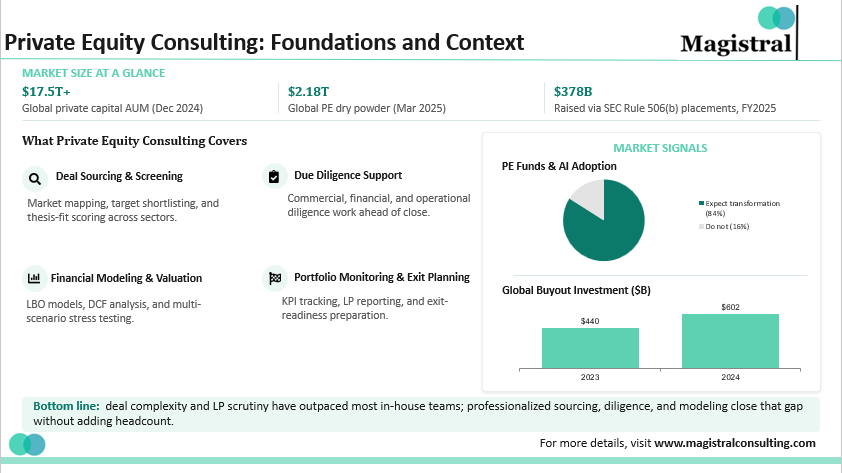
Deal-making today involves more data, more scrutiny, and less room for error. Private Equity Consulting helps firms manage this pressure by supporting every phase of the transaction, not just the final decision. Private capital assets under management more than doubled between December 2018 and December 2024, crossing $17.5 trillion globally, according to S&P Global Market Intelligence’s analysis of Preqin data. A market of that size leaves little room for guesswork at any single stage of a deal.
Private Equity Consulting

Private Equity Consulting: Foundations and Context

Sourcing and Screening Support

Finding the right target has become harder as competition for assets rises. Consultants build screening frameworks, map industries, and shortlist companies that fit an investor’s thesis, saving deal teams weeks of manual research. Global private equity dry powder stood at $2.184 trillion as of March 2025, down 5.2% from its December 2023 peak, which means firms are sitting on capital but still need sharper sourcing to put it to work.

Due Diligence Depth

Commercial, financial, and operational due diligence often determine whether a deal proceeds. External specialists add bandwidth and sector knowledge, freeing internal teams to focus on negotiation. The stakes are real: the SEC reported that private companies raised roughly $378 billion through Rule 506(b) placements in fiscal year 2025 alone, often with far fewer mandated disclosures than public offerings.

Deal Structuring Guidance

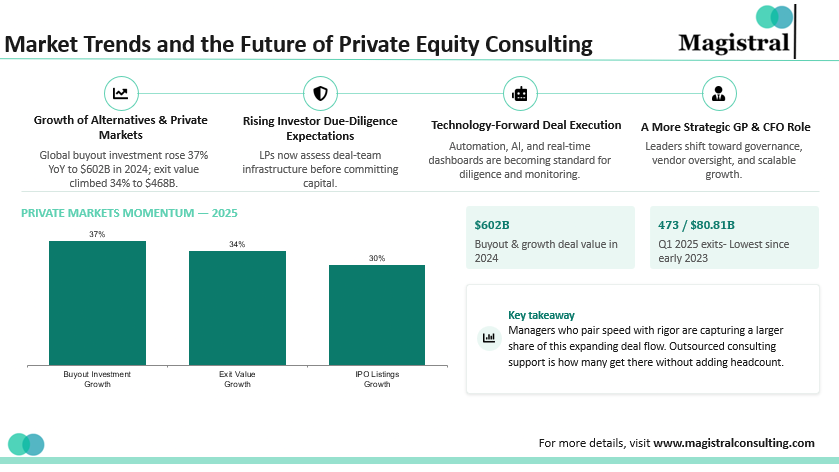
Structuring a transaction involves balancing risk, leverage, and investor expectations. Consultants bring comparable deal data and modelling support that sharpens negotiation positions. Bain & Company’s 2025 Global Private Equity report found that global buyout investment value climbed 37% year over year to $602 billion in 2024, a pace that rewards teams who can structure and close quickly.

Post-Deal Value Creation

Once a deal closes, the work is far from over. Advisors help portfolio companies improve margins, streamline operations, and prepare for the next stage of growth. Exit activity, however, has cooled: PE firms recorded just 473 exits worth $80.81 billion in Q1 2025, the lowest quarterly total since early 2023, making value creation during the hold period more important than ever.

Core Services Under Private Equity Consulting

Private Equity Consulting is not a single service; it is a bundle of capabilities that support investors across the deal and hold periods. Secondaries funds alone called around $83.4 billion from investors in 2024, the highest annual total on record, underlining how much support the broader private capital ecosystem now demands.
Private Equity Consulting

Market Trends and the Future of Private Equity Consulting

Market and Commercial Research

Consultants build market sizing models, competitive landscapes, and demand studies that ground investment theses in evidence. With deals over $250 million now commanding multiples of 11x or higher due to intense competition, a well-supported thesis often separates a winning bid from an overpriced one.

Financial Modelling and Valuation

LBO models, DCF analyses, and sensitivity testing form the backbone of investment decisions. Skilled consultants build these models quickly and stress-test them against multiple scenarios. Bain’s 2025 report also noted that global exit value rose 34% to $468 billion in 2024, a swing sharp enough that outdated valuation assumptions can quietly erode returns if models are not refreshed regularly.

Portfolio Monitoring

Ongoing tracking of KPIs, covenant compliance, and cash flow helps general partners catch problems early rather than reacting after performance slips. With dry powder declining and fundraising conditions tighter through 2025, limited partners are scrutinizing portfolio performance more closely than in prior cycles, raising the bar for consistent monitoring.

Reporting to Limited Partners

Clear, consistent reporting builds LP confidence and reduces the back-and-forth that often slows fundraising for the next vehicle. As institutional allocators weigh private equity against private credit and infrastructure, timely and accurate reporting has become a differentiator rather than a formality.

Exit Strategy Planning

Timing and preparation drive exit outcomes. Consultants help identify buyer pools, prepare data rooms, and position the company’s growth story ahead of a sale or IPO. IPO listings were up roughly 30% year over year by mid-2025, according to industry tracking of exchange data, signalling that public listings are re-emerging as a viable exit path for well-prepared companies.

Why Firms Are Increasing Investment in Private Equity Consulting

Spending on external advisory support has grown steadily, and the reasons go beyond convenience. Firms are responding to structural shifts in how private capital markets operate, and the scale of undeployed capital, now measured in the trillions globally, only adds to the pressure to execute well.

Rising Deal Complexity

Cross-border transactions, regulatory scrutiny, and ESG requirements have made deals harder to execute internally without specialized support. As deal value concentrates in fewer, larger transactions, the operational complexity per deal has risen.

Cost and Talent Pressures

Hiring full in-house teams for every function is expensive and slow. Engaging external experts on a flexible basis lets firms scale capacity as deal flow changes. This matters more in a market where US private equity dry powder fell roughly 32%, from about $1.3 trillion in December 2024 to near $880 billion by September 2025, forcing leaner teams to work faster with what remains.

Data-Driven Decision Making

Investors increasingly expect decisions backed by evidence rather than intuition. Bain’s 2025 Global Private Equity Report noted that global buyout deal value rose sharply in 2024, alongside a comparable jump in exit value, signalling that disciplined, data-led execution is once again rewarding firms that get it right.

AI’s Expanding Influence

A recent EY survey found that 84% of private equity funds expect artificial intelligence to have a major transformational effect on their business, pushing firms to pair consulting support with better technology adoption rather than treating AI as a side experiment.

Choosing the Right Private Equity Consulting Partner

Not every advisory firm delivers the same value, so selecting a partner deserves the same rigor applied to picking a portfolio asset. With private capital AUM more than doubling in six years, the pool of consulting providers has also grown crowded.

Sector Expertise

A consultant familiar with healthcare, technology, or industrials will spot risks and opportunities that a generalist might miss. Sector depth matters most in the largest deals, where 11x-plus multiples leave little margin for a mispriced assumption.

Technology and Process Rigor

Firms with structured research methods and modelling templates deliver faster, more consistent output across deals. Since most PE funds already expect AI to reshape core workflows, partners who have embedded technology into their processes tend to move faster than those still working manually.

Flexibility of Engagement Models

Some firms need project-based support, while others prefer dedicated, ongoing teams. A good partner adapts to both, which matters when dry powder levels and deal flow can shift by double-digit percentages within a single year.

Track Record and References

Past client outcomes, retention rates, and case studies offer a realistic picture of what a consulting relationship will deliver. Firms that can point to measurable outcomes across full market cycles, not just a single strong year, tend to be the safer long-term partners.

How Magistral Consulting Supports Private Equity Consulting Needs

Magistral Consulting, works with private equity, venture capital, and family office clients across deal origination, due diligence, financial modelling, and portfolio management. Its teams have supported due diligence assignments that safeguard deal quality and built dedicated research and equity research desks that combine sector depth with scalable delivery. For firms exploring outsourced support, Magistral also runs global private equity outsourcing engagements that blend in-house and offshore talent to reduce costs while maintaining deal-execution speed. Firms looking to strengthen their Private Equity Consulting capacity without expanding fixed headcount can reach Magistral through its website to discuss a tailored engagement.


About Magistral Consulting

Magistral Consulting has helped multiple funds and companies in outsourcing operations activities. It has service offerings for Private Equity, Venture Capital, Family Offices, Investment Banks, Asset Managers, Hedge Funds, Financial Consultants, Real Estate, REITs, RE funds, Corporates, and Portfolio companies. Its functional expertise is around Deal origination, Deal Execution, Due Diligence, Financial Modelling, Portfolio Management, and Equity Research

For setting up an appointment with a Magistral representative visit www.magistralconsulting.com/contact

About the Author

Aman is an investment-research specialist with 5+ years of experience across business and investment research, including 2+ years with Big Four firms like KPMG. A Stanford Seed alumnus with an MBA in Finance and a Bachelor of Commerce (Hons) from University of Delhi, he focuses on private equity, venture capital, and renewable energy sectors. He leads project teams at Magistral Consulting, delivering financial research, due diligence, deal sourcing, and M&A support, while driving strong process management and analytics. His blend of attention to detail, strategic thinking, and dynamic execution enables him to turn complex data into actionable investment insights.


FAQs

What does Private Equity Consulting typically include?

It usually covers deal sourcing, due diligence, financial modelling, portfolio monitoring, and exit planning, along with market and commercial research that supports each stage.

Why are private equity firms outsourcing more consulting work?

Rising deal complexity, tighter fundraising conditions, and the cost of building large in-house teams are pushing firms toward flexible, specialized external support.

How does Private Equity Consulting differ from investment banking advisory?

Investment banks mainly focus on transaction execution and capital raising, while consulting support spans the full investment lifecycle, including post-deal operational improvement.

Can smaller private equity firms benefit from consulting support?

Yes. Smaller firms often gain the most, since consulting partners provide research and modelling capacity that would otherwise require significant internal hiring.

What role does data play in modern private equity consulting?

Data-backed research and financial modelling now shape most investment decisions, and firms that rely on evidence-based analysis tend to make more consistent, defensible calls on deals and exits.


Introduction

Private Equity (PE) consulting has been around for a while. Many consulting firms have practices offering private equity consulting services. It is interesting to note that even global consulting firms rely on offshoring to a great extent to deliver value to private equity clients on their most pressing issues. Offshoring reduces costs of consulting firms and some of it must be passed onto the clients (we hope!!). But what if all the advantages of offshoring could be passed onto the clients directly?

Read further to know more!!

Private Equity Consulting and Offshoring: Why it’s a match made in heaven?

Management Consulting as an industry has been around for more than 100 years on the back of its solid value proposition for clients. It brings in expertise, experience, political leverage, data sources, network, and usually signs business outcome-based projects with the clients. Usually, benefits outweigh the costs by 3X to 10X.

Private Equity Consulting and Offshoring

Private Equity Consulting and Offshoring brought together

Offshoring also picked up with the advent of the internet. As the work was possible with the help of the internet and advanced communication options, offshoring started to make sense for low-end jobs like call centers and data entry. It was followed by IT and now it is the turn of high-end research, analytics, and consulting jobs. The value proposition of offshoring is cost efficiency and scale. In most cases, offshoring also results in improvements in terms of quality and delivery apart from cost-cutting.

When we combine the forces, we have the impact of consulting with the cost advantages of offshoring, making it an unbeatable value proposition for clients in their marketplace. Remote working and service delivery reduce management consulting overheads like weekly consultant flights, high-end hotel stays, and expensive consultant fees—all typically paid by clients. Simultaneously, offshoring tasks to an expert industry group allows smaller clients to benefit from greater scale.

Business Outcomes for Private Equity Industry and the Services Offered

Major work streams at all private equity companies, big or small, comprise of following workstreams:

Fundraising and marketing or investor relations

Deal origination

Deal execution along with due diligence; and 

Portfolio management to get into the operational details of portfolio companies to make it more valuable

Private Equity Consulting Business Outcomes

Private Equity Consulting Business Outcomes

Magistral's Service Offerings for Private Equity

Magistral’s service offerings for Private Equity

Here is how Private Equity consulting helps in these workstreams

Fund Raising and Marketing/ Investor Relations

A fund is established when it has a healthy pipeline of potential investors apart from the existing ones. This is the area where most emerging managers struggle. The game does not even start if the firm is not able to raise the angel fund. However, like everything else in life, robust results need time and consistent efforts. PE consulting helps reach out to the investors and maintain a continuous touch-point to drive home the value proposition of the fund and thus enable successful fundraising rounds.


The services that help in fundraising are

Fundraising documentation

Fundraising requires a lot of documentation. Sometimes it could be enormous for an emerging manager. At the same time, it needs to be streamlined for established managers. Magistral helps prepare documents like Private Placement Memorandums (PPMs)/ Confidential Information Memorandums (CIMs), pitch decks, financial models and projections, teasers, and strategy and marketing documentation.

Investor profiling and reach-out

Funds specializing in different areas have different ideal profiles for investors or limited partners. Magistral helps in profiling and reach out to these investors. Magistral also has an in-house database that carries leads of more than 15000+ Limited Partners (LPs) and General Partners (GPs). It can also access databases of other players if the task needs it.

Design and Data Support

Magistral has an in-house design team that streamlines the PowerPoint designs and makes them consistent with the global marketing standards. We often receive content in raw form—scribbles from a notepad or whiteboard—and transform it into well-designed PowerPoint decks ready for investors. Similarly, we enhance the visual impact of pitch decks and PPMs, and streamline investor-related data or CRM systems to ensure clarity and consistency.

Newsletters

Multiple touch-points with investors mark content like Newsletters, PoV documents, Industry reports, and market research. Magistral has experience working with hundreds of clients working on these assignments. It has access to resources like secondary sources, interviews with the panel of experts, and triangulations to come up with market sizes, etc. Worthy content establishes the authority of the Private Equity fund in the eyes of accredited investors.

Sustainable Investment and Impact Assessment

We have a specific service offering around ESG analysis, sustainable investments, and impact assessments of the current or potential assets acquired by the Private Equity firms.

Deal Origination

Deal origination services make sure that the focus of the GP is on the suitable targets and populate the deal pipeline with more appropriate deals, to be taken up as and when required. Picking up the right deals is the lifeblood of PE operations. It’s by picking up the right deals that a GP can offer superlative returns to its LP investors. Magistral helps with Deal Flow support and Inbound deal flow analysis.

The deal origination related services offered are:

Industry tracking and landscaping

A Private Equity firm needs to scan the environment for investing continually. It needs to track its key markets, geographies, and industry regularly to take advantage of emerging trends. Magistral has helped multiple clients in tracking industries like healthcare, SaaS, blockchain, cybersecurity, heavy engineering, and many others.

Potential target identification

A list of suitable potential targets is generated using secondary and primary sources. As per the investment thesis, the targets satisfy a host of customizable criteria like revenue, profits, employees, industry, geography, and being open for investments. Secondary sources include databases, whereas primary sources are industry associations, accelerators, angel investor groups, etc.

Target company profiling

After generating the list of potential targets, we shortlist the companies of interest and conduct a deeper dive. We profile each target company by analyzing its business details, strategy, latest developments, management, SWOT, Porter’s Five Forces, and other customized information. Understanding the openness of the company for an investor on the board is also studied at this stage.

Target pipeline management

For deals to be continuously happening, the pipeline needs to be populated continuously. There should be deals in all stages of deal-making. That is ensured by filling the targets in the funnel on an ongoing basis.

ESG Analysis

ESG or impact analysis is more critical than it was ever before. It’s imperative then that Private Equity firms evaluate the deals for ESG fitments. A company that performs better on ESG frameworks is a more sustainable investment and makes a far-reaching impact on the society and communities it serves.

Inbound deal flow management

If a firm receives lots of inbound inquiries, there needs to be an agency to sort out the worthy opportunities from the non-serious ones. Magistral matches the opportunities with the GPs investment thesis and brings forward the best deals.

Summarizing and preparing IMs:

If start-ups send IMs, the same need to be summarized for discussion with the investment committee. Magistral summarizes the Investment memos into investcomms decks for quick and effective decision making.

Deal Viability Analysis: This involves getting into the nitty-gritty of a deal, identifying red flags both inside out and outside in, to make sure the deal produces the impact, which is the aim of the investment to start with. This is achieved from the exhaustive and comprehensive market and company research.

Deal Execution and Due Diligence

Deal execution and due diligence ensure the right investment decisions to produce significant returns, identifying risks for better planning post-investment or M&A.

Here the services are about providing all the foresight and intelligence to make the right decisions. The primary service offerings here are:

Target company due diligence

Here, Magistral takes access to the data rooms and analyses the information to produce highly relevant deliverables and insights. Due diligence includes financial, operational, and ESG related aspects of a firm. Magistral works with both Private Equity firms and Investee companies. It prepares Due Diligence Questionnaires (DDQs) and collects information from the investee companies, either directly or indirectly.

Industry Research

Here, industry research is more specific and has to do with the target company’s operations. We capture details like trends, SWOT, Porter’s Five Forces, key competitors, pricing trends, and news to provide a holistic view of the target company’s industry.

Detailed company profiling and competitive intelligence

At this stage of the company profile, we capture details from multiple sources such as ex-employees, management, current staff, vendors, competitors, investors, and industry stakeholders. We also gather information on competitors and their strategies using both primary and secondary sources.

Investment Memorandums

If the investment involves co-investors, the team prepares standard documentation such as the Investment Memorandum, Confidential Information Memorandum, Pitch Deck, and Financial Models.

Modeling and Valuations

This exercise ensures that deal is made at the right prices so that there is a significant upside for the investment returns. Magistral has prepared 100+ financial models for valuations in industries like SaaS, tech, healthcare, IT, manufacturing, B2C retail, fashion, chemicals, and e-commerce. Magistral captures the information and assumptions for financial models through detailed discussions with the client. We specialize in building 3-part financial models, LBO analysis, DCF modeling, real estate modeling, precedent transaction analysis, comparable analysis, and impact analysis.

Portfolio Management and Fund Management

Portfolio Management aims at maximizing the value of the investment in a company by a Private Equity firm. This is achieved by supporting various tasks of the acquired company to reach more customers, hence improving revenue or reducing operations’ costs. Fund Management is about streamlining the functions of the fund itself to focus on the core tasks of investing and fundraising.

Here the services are:

ESG Compliance Monitoring

Magistral assesses the ESG maturity of an investee company, suggests a set of metrics for ongoing monitoring, collects data on these metrics, and reports the findings to the board, management, and investors every quarter.

Outsourced CFO

Outsourced CFO services are relevant for both funds and the portfolio companies, specifically in the cases where the PE firm invests in start-ups or smaller firms. These companies may not be in a position to invest in a full-time CFO and thus may go for an outsourced CFO that is fractional and provides the operational and cost flexibility. Sometimes Financial Process and Accounting could be outsourced, while CFO could be kept in-house. These tasks include accounting, bookkeeping, administration, procurement, and preparation of financial statements

Outsourced Fund Administration

This service is specifically for funds and takes care of all the administrative aspects of the fund like fund accounting, expense monitoring, trade reconciliation, distribution waterfalls, taxes, fees, incentives, expenses, etc.

Strategy and Business Development support

After the investments, most PE firms focus on growing the revenues of the portfolio companies. This is done through a slew of interventions on strategy and marketing. Magistral supports these activities by providing services like consumer and market studies, new product or market development, lead generation, which is critical in the B2B space, and finding follow-on acquisition or buyer for the investee companies.

And this is how Private Equity consulting joins forces with offshoring to provide an unbeatable competitive advantage for our clients.

About Magistral

Magistral Consulting has helped multiple funds and companies in outsourcing operations activities. It has service offerings for Private Equity, Venture Capital, Family Offices, Investment Banks, Asset Managers, Hedge Funds, Financial Consultants, Real Estate, REITs, RE funds, Corporates and Portfolio companies. Its functional expertise is around Deal origination, Deal Execution, Due Diligence, Financial Modeling, Portfolio Management and Equity Research

For setting up an appointment with a Magistral representative visit www.magistralconsulting.com/contact

About the Author

The Author, Prabhash Choudhary is the CEO of Magistral Consulting and can be reached at Prabhash.choudhary@magistralconsutling.com for any queries or business inquiries.