Tag Archives: Deal Sourcing for Private Equity

Private equity research outsourcing has quickly changed its character from a measure to cut down on expenses to a function that is among the most important ones for investment firms worldwide. The competition gets tougher, which means that the firms need to assess more and more deals, come up with sharper insights, and manage their portfolios more precisely. Deal teams are now spending almost 40% more time on their due diligence work than during pre-2020 periods. The main reason for this is that macro volatility and regulatory scrutiny require deeper and more thorough analyses, as is the case with high-quality private equity research outsourcing, which becomes transformational. Think of it, the valuation of a buyout from different countries in just two weeks. Outsourced analysts use their experience, databases, and modeling tools to instantly expand a firm’s analytical capacity when internal teams cannot keep up. Besides, outsourcing makes available professionals for specialized tasks like sector benchmarking, operational analysis, and competitive mapping. As a consequence, the screening of deals is faster, the investment memos are stronger, and the decisions made are more informed.

The Rising Need for Private Equity Research Outsourcing

The growing reliance on private equity research outsourcing is closely tied to sustained deal activity over the past cycle. In the Americas alone, annual private equity deal value surged from $713.9 billion in 2020 to a peak of $1.44 trillion in 2021, before normalizing at still-elevated levels exceeding $1.0 trillion in 2024. Globally, quarterly deal values consistently ranged between $370 billion and $700 billion from 2021 through 2025. It reflects both post-pandemic acceleration and subsequent macro-driven recalibration. This volume and volatility significantly increased the analytical burden per transaction, requiring repeated valuation resets, deeper sector work, and faster diligence turnarounds. As deal teams navigate high activity levels amid compressed timelines and fluctuating assumptions, many firms have turned to specialized private equity research outsourcing partners to scale analytical capacity without expanding permanent headcount. Many firms engaging in funds management are already partnering with knowledge support teams. This is to accelerate pre-deal evaluations, especially when working across geographies.

The Rising Need for Private Equity Research Outsourcing

The Rising Need for Private Equity Research Outsourcing

Macroeconomic Volatility Intensifying Research Workloads

Sensitivity scenarios required before a deal can progress have been multiplied due to changing interest rates and moving valuation baselines. MSCI’s Private Markets 2024 report shows that cash-flow projections vary significantly across sectors, prompting analysts to recalibrate their models more frequently than ever. Teams hired as support from outside the company provide the necessary capability to deal with the demands of these iterations.

Regulatory Pressures Requiring Deeper Due Diligence

The global private equity market is at its most regulated point ever. Let us explore the regulatory environment manifested through increased disclosures, ESG scoring, and third-party verification. This in turn, demand and necessitate professional document reviews and compliance to a larger degree. A significant number of firms engage outside analysts for the tasks of operational evaluations, benchmark comparisons, and ESG scoring. This is quite similar to how private equity teams enhance operations via private equity research outsourcing.

Portfolio Diversification Driving Specialized Research Needs

Firms investing in non-traditional industries, for instance, renewable energy or logistics such investments require very specific and deep market intelligence to be considered wise. Private equity research outsourcing partners usually have dedicated teams for each sector with the corresponding databases and deep industry insights. Such a cross-functional team enables the PE deal teams to confidently make decisions without the need to invest in a full-time specialized talent.

Time Compression in Deal Cycles Increasing Analytical Demand

Competition for deals frequently compresses the timelines from months to weeks. Outsourcing provides immediate scalability, something internal teams cannot achieve during peak deal activity. As a result, this helps to reduce bottlenecks and allows partners to quickly respond to new opportunities.

How Private Equity Research Outsourcing Strengthens the Deal Lifecycle

Private equity research outsourcing is a process that brings appreciable value to the entire deal cycle. It includes sourcing, due diligence, investment committee preparation, execution, and portfolio management. All of the steps depend on top-notch data and quick analytical responses. Deal teams, at times during due diligence phases, will want in-depth operational insights. A group of outsourced analysts will be of great assistance in scrutinizing vendors’ arrangements, risks along the supply chain, gaps in leadership, and even regulatory noncompliance. This is the exact functional role that operational evaluations play in the context of due diligence best practices.

Pre-Deal Screening and Prioritization

There is a lot of deal flow, yet time is scarce. Valuation of transactions with high potential is done quickly through outsourcing. Analysts perform rapid screens on market size, competition, and financials to get rid of misaligned opportunities at the very beginning. This reduces the workload for internal teams and increases the speed at which they complete deals.

Investment Committee Support

Memos of superior quality require structured evidence. Teams of external individuals put together comprehensive exhibits, tables containing benchmarks, summaries of finances, and documented references. They help partners develop coherent deal rationales through their painstaking approach.

Execution and Negotiation Assistance

During the last stages of the process, outsourced analysts will take care of updating valuations, negotiating prices, modeling debt, and performing sensitivity testing. With their help, partners are assured of entering negotiations with correct figures and a proper understanding of the associated risks.

Technology’s Transformative Role in Private Equity Research Outsourcing

Technology is, in a very substantial way, radically transforming the whole sphere of private equity research outsourcing. Companies that are already on the AI-driven analysis and automation paths, as well as having integrated access to market databases, are certainly those that will get the insights faster and improve the accuracy of their decisions. 67% of private equity firms are actively investing in AI technologies. 82% of private equity and venture capital firms reported using AI in some capacity, up from 47% the previous year, according to industry research.

Technology’s Role in Private Equity Research Outsourcing

Technology’s Role in Private Equity Research Outsourcing

Modern tools use automation and AI to improve data accuracy. These advances resemble the innovations discussed in AI-driven investor intelligence, which help streamline research and outreach.

AI-Enhanced Market Research

AI platforms can interpret vast amounts of data that include financial statements, conference call transcripts, and even industry reports, just to mention a few, in order to detect the patterns that the classical methods might miss. These algorithms pinpoint the threats from the competition, positive or negative public opinion, and the changes in the legal environment for which the company will be affected and thus allowing for a more extensive understanding of the situation.

Automation in Financial Modeling

Automation accelerates tedious tasks like data cleaning, error checking, and formula auditing. PE teams benefit from faster model updates, higher accuracy, and more time for strategic thinking. This also reduces operational risk by minimizing spreadsheet errors. Surveys show 69% of private equity firms use AI for functions. These functions includes automated reporting and analytics dashboards, and 55% use AI-powered research and market intelligence.

Predictive Analytics for Deal Sourcing

Predictive models point out the firms that are early signs of growth or distress. The pipelines become smarter, and the chances are discovered before they are widely seen through these signals.

Workflow Integration and Dashboarding

Top-notch dashboards pool together data from portfolios, financial KPIs, pricing changes, customer defections, and operational measurements. The dashboards that are integrated provide a performance overview that is up to the minute.

How Magistral Consulting Supports Private Equity Research Outsourcing

Magistral Consulting delivers highly specialized private equity research outsourcing designed to strengthen investment workflows from sourcing to exit.

End-to-End Deal Support

For private equity research outsourcing, Magistral is there to help you throughout all the events. This includes deal sourcing, filtering, in-depth analysis, preparation of the investment committee, setting up of the data room, and closing activities. Teams act as a part of the internal deal teams, providing valuable and quick insights.

Specialized Financial Modeling Expertise

Magistral’s analysts create comprehensive financial models, run various what-if analyses, and develop the valuation frameworks. Their financial modeling is in line with the global standards, and it assists the firms to weigh the opportunities in the areas of the valuation ranges, types of financing used, and categories.

Sector-Specific Research and Benchmarking

Magistral’s experts provide valuable information about different sectors such as manufacturing, retail, energy, logistics, and IT. The companies are satisfied with the application of structured models, comparative evaluations, and the use of multiple data sources in triangulation.

Portfolio Monitoring and Value Creation Support

Magistral delivers KPI dashboards, financial trackers, variance analyses, and peer comparisons. This information helps partners to spot the potential value-creating actions early and to take quick action when the performance goes down.

A Natural Wrap-Up

In an environment of rapid changes and growing competitive pressure, the outsourced private equity research gives the strategic depth firms need to keep pace with the competition. The global capabilities of Magistral, the experience in different sectors, and the commitment to analytical excellence will allow private equity investors to make quicker, more intelligent decisions at a larger scale.

About Magistral Consulting

Magistral Consulting has helped multiple funds and companies in outsourcing operations activities. It has service offerings for Private Equity, Venture Capital, Family Offices, Investment Banks, Asset Managers, Hedge Funds, Financial Consultants, Real Estate, REITs, RE funds, Corporates, and Portfolio companies. Its functional expertise is around Deal origination, Deal Execution, Due Diligence, Financial Modelling, Portfolio Management, and Equity Research

For setting up an appointment with a Magistral representative visit www.magistralconsulting.com/contact

About the Author

Utkarsh is a finance professional with expertise in investment research, M&A, and financial modeling. He has built and applied models including DCF, LBO, and comparable analysis, supporting investment banks, private equity, and venture capital firms across diverse sectors. Utkarsh holds an MBA in International Business & Finance from Symbiosis International University, a B.Com (Hons) from Delhi University, and has completed the Stanford Seed program at Stanford Graduate School of Business.

FAQs

What services are included in private equity research outsourcing?

It typically includes deal sourcing, market research, financial modeling, competitive analysis, portfolio monitoring, and due diligence support.

Why do private equity firms outsource research tasks?

Outsourcing expands analytical capacity, accelerates deal timelines, provides specialized expertise, and reduces operating costs while maintaining high-quality insights.

How does outsourcing improve deal evaluation?

It enables deeper market research, standardized modeling, faster benchmarking, and better structured investment memos that support confident decision-making.

Is private equity research outsourcing secure?

Reputable providers implement strict confidentiality protocols, NDAs, encrypted systems, and controlled access to ensure complete data security.

Can outsourcing support post-acquisition value creation?

Yes, outsourced analysts help with KPI tracking, operational benchmarking, margin analysis, and strategic research essential for scaling portfolio companies.


Private Equity Trends: A Driving Force in Global Finance

Private equity is a powerful force shaping investment strategies, fostering innovation, and influencing economic landscapes. As we move into Q1 2024, it is essential to analyze current trends, challenges, and opportunities in the private equity space.

The Resilience of Private Equity Trends Amidst Global Uncertainty

Private equity continues to demonstrate remarkable resilience despite economic and geopolitical uncertainties. This strength stems from key strategies that help firms navigate market volatility and sustain growth.

Diversification Strategies

Private equity firms are actively pursuing diversification strategies to spread investment risks. By expanding across industries and regions, they mitigate sector-specific downturns and geographic vulnerabilities.

For instance, while hospitality and retail may face economic challenges, healthcare, technology, and renewable energy offer stability and long-term growth. Additionally, geographical diversification enables firms to tap into emerging markets while hedging against risks in established economies. Expanding into Asia, Latin America, and Africa offsets slow growth in mature markets.

Flexibility in Deal Structures

To navigate market uncertainties, private equity investors are embracing flexible deal structures. They are shifting away from traditional approaches and adopting innovative investment models.

Minority investments allow firms to acquire strategic stakes in companies without full control. This provides flexibility in resource allocation and exit planning. Convertible securities, such as preferred stock and bonds, offer downside protection while allowing participation in potential upside gains. Structured exits, including recapitalizations, secondary buyouts, and IPOs, optimize investor returns under favorable conditions.

Focus on Operational Value Creation

Operational excellence is becoming a top priority for private equity firms. By working closely with management teams, investors aim to improve efficiency, reduce costs, and accelerate revenue growth.

Operational value creation initiatives encompass a wide range of strategies, including:

Streamlining Operations

Private equity firms collaborate with portfolio companies to identify inefficiencies, streamline business processes, and eliminate redundant costs, enhancing operational agility and responsiveness.

Implementing Growth Strategies

Private equity investors work closely with management teams to develop and execute growth strategies, including market expansion, product diversification, and strategic acquisitions, to capitalize on emerging opportunities and drive top-line growth.

Enhancing Organizational Capabilities

Private equity firms invest in talent development, leadership training, and organizational restructuring to strengthen management teams, foster innovation, and build sustainable competitive advantages within portfolio companies.

Technology and Innovation: Catalysts for Private Equity Growth

Technological advancements are reshaping private equity investment strategies. Investors are increasingly focusing on innovative ventures, particularly in fintech, AI, and cybersecurity.

Technology and Innovation in Private Equity

Technology and Innovation in Private Equity

Emphasis on Digital Transformation

Private equity firms are actively seeking companies that drive digital transformation. Investments in cloud computing, cybersecurity, and e-commerce are growing rapidly. The demand for digital solutions that enhance customer experience, optimize workflows, and improve operational efficiency is rising.

Firms are also investing in cybersecurity startups to combat rising cyber threats. These companies provide advanced threat detection, data protection, and risk mitigation solutions for businesses.

Investment in Industry-specific Solutions

Private equity investors are not only diversifying their portfolios across industries but also targeting companies offering industry-specific solutions to capitalize on niche market opportunities. In Private Equity Trends, healthcare technology emerges as a prominent investment area, with private equity firms investing in companies that develop innovative medical devices, healthcare IT solutions, telemedicine platforms, and digital health services. The convergence of healthcare and technology presents lucrative opportunities for private equity investors to drive innovation, improve patient outcomes, and optimize healthcare delivery systems.

Renewable energy also garners significant attention from private equity investors, with firms targeting companies involved in solar energy, wind power, hydroelectricity, and other renewable energy sources. Private equity trend for investment in renewable energy projects and sustainable infrastructure initiatives reflects a broader commitment towards addressing climate change, reducing carbon emissions, and promoting environmental sustainability.

Strategic Partnerships and Acquisitions

To stay competitive, private equity firms are forming alliances with technology companies, research institutions, and industry experts. These collaborations facilitate knowledge sharing and accelerate innovation.

ESG Integration: A Paradigm Shift in Private Equity

Environmental, Social, and Governance (ESG) considerations have emerged as pivotal factors shaping investment strategies across industries. In Private equity trends for Q1 2024, firms are actively integrating ESG principles into their decision-making processes, aligning investments with sustainability goals. This paradigm shift underscores a broader commitment towards responsible investing, resonating with stakeholders and driving long-term value creation.

Key initiatives driving ESG integration in private equity include:

ESG Integration in Private Equity

ESG Integration in Private Equity

ESG Due Diligence

Private equity firms are conducting comprehensive ESG due diligence to assess environmental risks, social impact, and governance practices within target companies. Private equity trends entail evaluating factors such as carbon footprint, resource usage, labor practices, diversity and inclusion policies, and board governance structures. Through rigorous ESG due diligence, private equity investors can identify potential risks and opportunities, inform investment decisions, and enhance value creation initiatives.

Impact Investing

Private equity investors are increasingly allocating capital towards impact investing opportunities that generate positive social and environmental outcomes alongside financial returns. The impact investments may focus on areas such as renewable energy, affordable housing, healthcare access, education, and community development. By aligning investment strategies with the United Nations Sustainable Development Goals (SDGs) and other global sustainability frameworks, private equity firms contribute to addressing pressing societal and environmental challenges while generating competitive financial returns.

Stakeholder Engagement

Private equity firms are engaging with stakeholders, including investors, portfolio companies, employees, customers, regulators, and local communities, to promote transparency, accountability, and sustainable business practices. For private equity trends, stakeholder engagement initiatives may include regular ESG reporting, dialogue sessions, sustainability workshops, and collaborative projects. By fostering open communication and collaboration, private equity investors can build trust, mitigate risks, and unlock new opportunities for value creation in alignment with ESG principles.

Long-term Value Creation

ESG integration in private equity extends beyond compliance and risk management to drive long-term value creation for investors and society at large. Private equity firms are implementing ESG-focused value creation initiatives within their portfolio companies, such as energy efficiency improvements, supply chain optimizations, product innovation for sustainability, and responsible corporate governance practices. By embedding ESG considerations into business strategies and operations, private equity investors enhance resilience, reputation, and competitive positioning, ultimately driving sustainable growth and financial performance over the long term.

Geopolitical Dynamics: Navigating Challenges in Private Equity

The geopolitical landscape casts a shadow of uncertainty over private equity markets, influencing investment sentiments and risk perceptions. Private equity trends have been characterized by geopolitical tensions, trade disputes, and regulatory changes pose significant challenges for private equity firms operating on a global scale. The ability to navigate through geopolitical complexities while seizing lucrative opportunities remains a defining factor for success in the private equity arena.

Key considerations for navigating geopolitical challenges in private equity include:

Regulatory Compliance

Private equity firms must stay abreast of evolving regulatory frameworks and geopolitical developments to ensure compliance with local laws and regulations governing cross-border investments.

Risk Management Strategies

Private equity investors are implementing robust risk management strategies, including scenario planning, hedging techniques, and portfolio diversification, to mitigate geopolitical risks and safeguard investment portfolios.

Strategic Partnerships and Alliances

Private equity firms are forming strategic partnerships and alliances with local investors, industry experts, and government agencies to navigate geopolitical uncertainties and capitalize on emerging market opportunities.

The Rise of Emerging Markets: Exploring New Frontiers in Private Equity

As traditional markets reach saturation points, private equity investors are increasingly turning towards emerging economies in search of high-growth opportunities. Private equity trends witness a surge in private equity activity across regions like Southeast Asia, Latin America, and Africa, fueled by demographic shifts, urbanization, and burgeoning middle-class populations. The allure of untapped markets coupled with favorable regulatory environments positions emerging economies as key drivers of private equity growth.

Key trends driving private equity investments in emerging markets include:

Sector-specific Opportunities

Private equity investors are targeting emerging market sectors poised for rapid growth, including consumer goods, healthcare, infrastructure, and technology, leveraging demographic trends and consumer preferences to drive value creation.

Strategic Partnerships and Local Expertise

Private equity firms are partnering with local investors, entrepreneurs, and industry experts to navigate cultural nuances, regulatory challenges, and market dynamics unique to emerging economies, facilitating deal sourcing, execution, and value realization.

Sustainable Development Goals

Private equity investors are aligning their investment strategies with sustainable development goals (SDGs), focusing on investments that promote economic growth, social inclusion, and environmental sustainability in emerging markets, thereby contributing to positive socio-economic impact and long-term value creation.

About Magistral Consulting

Magistral Consulting has helped multiple funds and companies in outsourcing operations activities. It has service offerings for Private Equity, Venture Capital, Family Offices, Investment Banks, Asset Managers, Hedge Funds, Financial Consultants, Real Estate, REITs, RE funds, Corporates, and Portfolio companies. Its functional expertise is around Deal origination, Deal Execution, Due Diligence, Financial Modelling, Portfolio Management, and Equity Research

For setting up an appointment with a Magistral representative visit www.magistralconsulting.com/contact

About the Author

The article is authored by the Marketing Department of Magistral Consulting. For any business inquiries, you can reach out to prabhash.choudhary@magistralconsulting.com

Introduction

Deal origination for Private Equity or Deal sourcing is the process by which investment firms identify opportunities. Larger volume deals are sourced to maintain a viable deal flow. Building a deal flow is the most important step because making good investment decisions is reliant on seeing many deals and selecting the best among them to pursue.

The effectiveness of the deal origination process ensures a healthy portfolio of investments that further ensures healthy returns to the Limited Partner investors. Hence its business-critical for a Private Equity firm to make sure the deal origination process works, and works well to meet the investment objectives.

Some venture capitalists, private equity investors, and investment bankers use various methods to source deals whereas some firms reach out to a team of specialists to help with the process of deal origination via outsourcing.

Deal Origination Process for Private Equity

There are multiple approaches to Deal Origination for Private Equity Firms. Some of them are

Traditional Outbound Approach

Here, the deal origination and sourcing largely depend on a wide area of personal networks, contacts, and the good reputation of the firm. Having knowledge of specific industries and the idea of similar deals taking place in the market is an added advantage for placing bids. This approach becomes successful only on the firm’s broad network of contacts, referrals, and a good reputation among founders. Firms compete against each other in process of bidding and their success depends on gaining specific industry knowledge. This typically leads to overvalued assets as all VCs and PEs are looking at the same deals.

Pros of outbound deals:

  • No matter how much things have changed but still the fundamentals of sales remain the same as they are based on human nature. And that makes outbound deals still very successful
  • It’s predictable and gives immediate results on the outbound process as it involves getting instant feedback from the prospective targets

Inbound deals

Inbound deal sourcing refers to all incoming leads, whether they come from existing relationships or unknown founders seeking investment. This is when a founder approaches the firm due to networking, good reputation, or word of mouth about the firm.

Pros of inbound deals:

  • Owners and operators are more likely to meet when they share a connection with you already
  • A shared network gives more knowledge which helps in creating more personalized interactions, giving a competitive edge
  • These deals move comparatively faster as introductions are warm and made only when seeking investments

Outsourced Approach

Traditional methods are nowadays giving way to modern online dealing platforms. Several financial technology companies help in deal origination for private equity firms and enable them to go beyond their network of contacts and source deals by reaching a broad audience on the basis of various criteria. Firms outsource certain parts of the investing value chain to reduce operational costs while maintaining quality and effectiveness.

Pros of Outsourced Approach:

  • Cost-effective
  • It casts a wider net of reaching out to target companies, that ensures exclusive deals that may help a Private Equity firm in delivering outsized IRRs for its Limited Partner investors
  • The deal pipeline continues to be populated in spite of multiple demands like new deals from the top management of the firm
  • The SOP ensures standardized elimination of targets not suitable to PE’s investment philosophy
  • Netting in the assets that are fairly valued

Magistral’s Process of Deal Origination for Private Equity Firms

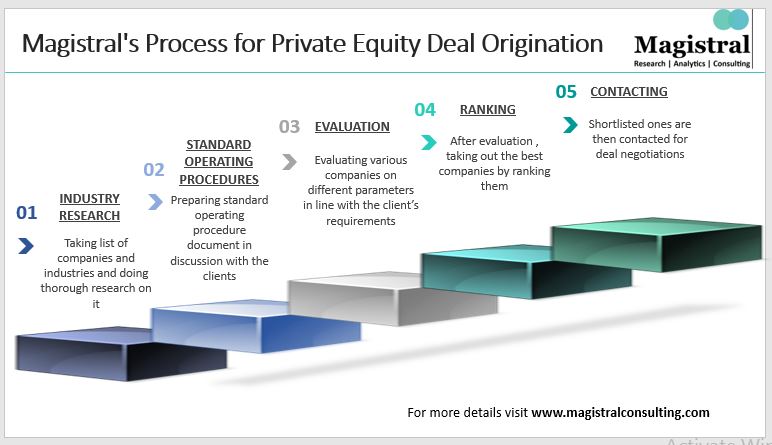
There are various steps involved in the deal origination of private equity firms. These steps include Industry Research, Making SOPs, Evaluating, Ranking, and Contacting the shortlisted companies.

Magistral's Private Equity Deal Origination Process

Deal Origination Process for Private Equity

Industry Research 

This step focuses on taking out a list of companies that looks fit in terms of market position, competitive advantages, multiple avenues of growth, stable and recurring cash flows, low capital requirements, strong management team, favorable industry trends, etc. The inputs from research feed into the next step of SOPs

SOPs

This step is considered majorly after discussion with the clients, standard operating procedures (SOPs) are prepared in order to take care of the requirement of Private Equity clients while performing deal origination and deal sourcing process. A formal signoff is taken from the client once all the steps in detail are identified. Magistral performs this step for its clients without any cost to them

Evaluation

Various criteria are looked into while evaluating a target. Some of these are related to investors such as the investor’s ability to fund, if multiple investments can be made, if the investor has an interest in lead investing, his level of portfolio diversification, etc. The major part of the evaluation of the target is to ensure it meets the investment philosophy of the investor and is in a position to generate value over the investment horizon. The factors like industry, sub-industry, niche, management, team, past fundraising, strategy, marketing, finances, etc are evaluated for targets.

Ranking

On the basis of the above research, the analysts rank the various targets which best align with the investment philosophy of the Private Equity firm. The targets are ranked as per the suitability

Contact

 The final shortlisted investors are then contacted via mail or calls in order to close the best possible deal for a private equity firm. All the support required during the negotiations is provided as well.

Magistral’s Private Equity Deal Origination/ Deal Sourcing Case Study

The client and the business situation

A leading private equity company, investing in a broad range of markets such as energy, retail, and technology. The client wanted to deploy the capital to meet up its investment strategies and therefore wanted Magistral to find the best deals for the company at good valuations.

Magistral's Private Equity Case Study

Magistral’s PE Deal Origination/ Deal Sourcing Case Study

Magistral’s solution 

  • Magistral appointed a dedicated manager for taking the existing list of potential target companies, populate it further, and review them carefully
  • The team created Standard Operating Procedures at no cost to the client, detailing the process thoroughly along with research and ranking methodology.
  • A team of analysts started evaluating and ranking targets on different parameters already set out in the SOP
  • The team contacted shortlisted companies via call or mail and then proceeded with the agreement, documentation, and deal negotiations.

Outcomes

  • Within 6 months, the firm was introduced to more than 30 opportunities.
  • The effort resulted in detailed due diligence with two transactions that were quickly closed

Typical Outcomes of Magistral’s Deal Origination Services for Private Equity

According to a recent survey, 88% of private equity investors indicate their most important 2021 objective is deploying capital- a nearly 10-point increase from last year.

While working with Magistral, IRR is improved due to an exhaustive scan of the investible universe. There is approximately a 30-50% reduction in operational costs for target screening. Database costs are justified through rationalized services.

Over the years, Magistral has delivered multiple analyses that go into supporting and facilitating million-dollar global transactions. The team has so far worked with 200+ clients and facilitated transactions worth billions of dollars.

About Magistral consulting

Magistral Consulting has helped multiple funds and companies in outsourcing operations activities. It has service offerings for Private Equity, Venture Capital, Family OfficesInvestment BanksAsset Managers, Hedge Funds, Financial Consultants, Real Estate, REITs, RE fundsCorporates and Portfolio companies. Its functional expertise is around Deal originationDeal Execution, Due Diligence, Financial ModelingPortfolio Management and Equity Research.

For setting up an appointment with a Magistral representative visit www.magistralconsulting.com/contact

About the Author

The article is authored by the Marketing Department of Magistral Consulting. For any business inquiries, you could reach out to  prabhash.choudhary@magistralconsulting.com