Tag Archives: Deal Origination Services

M&A deal origination is having a moment. After a record 2025, dealmakers are entering 2026 with sharper focus on how opportunities reach the table before a formal auction begins. Every dollar of deal value traces back to an origination decision made months, sometimes years, earlier. As megadeals concentrate value and competition for quality mid-market targets intensifies, firms winning the best assets are rethinking pipeline-building: fewer cold blasts, more thesis-driven research, and increasingly, artificial intelligence layered over relationship data. This article covers where origination stands today, the channels driving deal flow, and how technology is reshaping the deal funnel’s earliest stage.

The Shifting Landscape of M&A Deal Origination in 2026

Global deal activity rebounded sharply through 2025 and into 2026, but the recovery is uneven. Understanding where value and volume are concentrating is essential, since it determines which sectors and deal sizes deserve attention.
M&A Deal Origination

The Shifting Landscape of M&A Deal Origination in 2026

Market Momentum and Megadeal Concentration

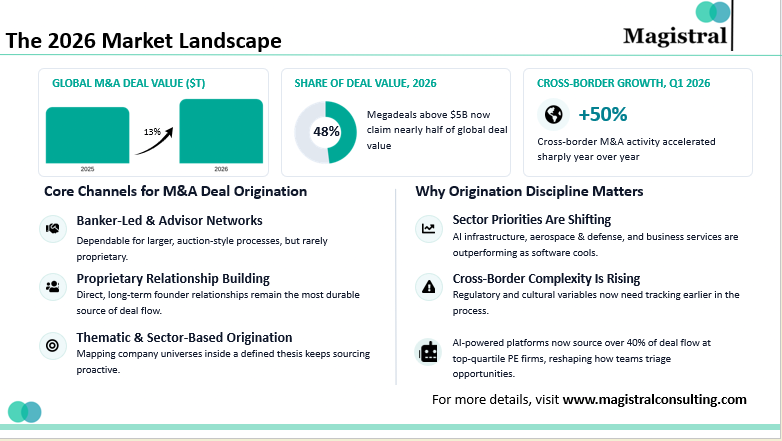
Global M&A deal origination value is on pace to reach roughly four trillion dollars in 2026, a thirteen percent rise from 2025, according to PwC’s mid-year deals outlook. However, transactions above five billion dollars now make up nearly half of that total value, up from under a third two years ago. Strip out megadeals, and underlying value actually declined slightly, meaning teams chasing average-sized deals face a narrower opportunity set than headline numbers suggest.

Sector Hotspots Reshaping Origination Priorities

AI infrastructure, power, and data-centre adjacent assets have become the clearest magnets for origination activity, while software has cooled as buyers reassess disruption risk. Advisors surveyed by Capstone Partners and IMAP expect aerospace, defence, and business services to outperform in 2026, reinforcing that priorities are shifting toward recession-resilient and AI-enabled sectors simultaneously.

Cross-Border Origination Gains Ground

Cross-border M&A deal origination rose sharply in early 2026, with deal value up nearly fifty percent year over year according to LSEG data. European buyers are moving into the United States, and American acquirers are pursuing global consolidation in scale-driven sectors, adding jurisdictional complexity that teams must track earlier in the process.

Middle-Market Origination Under Pressure

Lower middle-market transaction activity softened in 2025, according to Within Intelligence, tightening the pipeline that historically fed larger buyout funds. As a result, firms are building relationships with target companies well before they formally come to market, treating deal origination as a continuous, relationship-first discipline rather than a reactive response to banker outreach.

Core Channels for M&A Deal Origination

No single channel delivers complete deal flow. Effective origination programs blend several sourcing channels, each with different strengths, costs, and levels of exclusivity.

Banker-Led and Advisor Networks

Investment banks and boutique advisors remain a dependable channel for larger, auction-style processes, though teasers reaching many buyers simultaneously rarely produce proprietary access.

Proprietary Relationship Building

Direct, long-term relationships with founders and management teams remain the most durable source of differentiated deal flow. Firms that invest in simplifying and strengthening their deal origination process, reaching out with genuine industry insight rather than generic interest, tend to earn a seat at the table before a company formally explores a sale.

Thematic and Sector-Based Origination

Rather than waiting for opportunities to appear, leading teams define a focused M&A deal origination strategy inside long-term trends such as AI adoption or energy transition, then map the company universe and engage selectively over time. This keeps origination proactive, and compounds as more data feeds back into each thesis.

Marketplaces and Off-Market Platforms

Transaction marketplaces connect buyers with boutique advisors representing smaller, typically lower middle-market sellers. Because listings are visible to many subscribers at once, these platforms function more as shared market access than a proprietary edge.

Corporate Development and Direct Outreach

Strategic acquirers increasingly run their own outreach programs targeting a specific capability gap, a channel that works best with disciplined tracking, since informal outreach easily gets lost.

How AI Is Transforming M&A Deal Origination

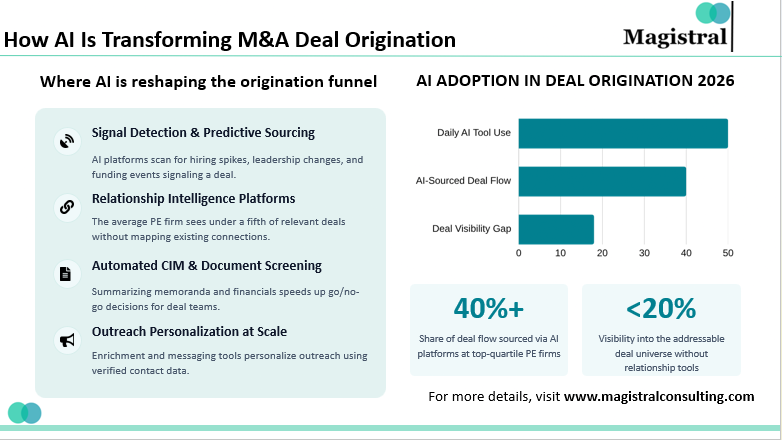
Artificial intelligence is now central to how competitive firms approach AI-powered M&A deal origination. Top-quartile private equity firms reportedly source over forty percent of their deal flow through AI-powered platforms, and nearly half of dealmakers use AI tools daily.
M&A Deal Origination

How AI Is Transforming M&A Deal Origination

Signal Detection and Predictive Sourcing

AI platforms continuously scan company universes for early signals, such as hiring spikes, leadership changes, or funding events, suggesting a company may be preparing for a transaction. Moreover, this shifts origination from periodic list-building toward an always-on monitoring process.

Choosing Proprietary vs. Shared-Access Tools

Not every data platform creates a competitive edge. Broad databases used by hundreds of thousands of subscribers deliver the same list to every firm, while AI-driven discovery tools focused on off-market signals are more likely to surface opportunities competitors have not yet found.

Relationship Intelligence Platforms

The average private equity firm reportedly sees under a fifth of the relevant deals in its addressable universe. Relationship intelligence tools address this gap by mapping the strength and recency of a firm’s existing connections across email, calendars, and meeting history, turning dormant relationships into active leads.

Automated CIM and Document Screening

AI tools that synthesize CIM, financials, and news into concise summaries are part of a broader shift in AI in private equity, helping deal teams reach a go or no-go decision faster and freeing analysts from hours of manual document review during origination.

Outreach Personalization at Scale

Once a target list is built, AI-driven enrichment and messaging tools help teams personalize outreach based on current company news and verified contact data, improving response rates over generic, templated outreach.

Building a Repeatable M&A Deal Origination Strategy

Technology alone does not fix a weak origination process. Therefore, firms that consistently win the best assets treat origination as a system with clear inputs, owners, and metrics, not a collection of ad-hoc habits.

Define a Clear Investment Thesis

A tightly defined thesis, covering target sectors, size ranges, and value-creation levers, gives origination teams a filter for triaging the flood of inbound and AI-surfaced opportunities. Teams without clear criteria tend to close whichever deals are easiest, not the ones that best fit their strategy.

Institutionalize Thematic Research

Investment themes often live only in partner notebooks and old offsite slides. Moving those themes into a shared, continuously updated data model ensures new signals connect back to the firm’s stated priorities instead of depending on any one person’s memory.

Track Origination Metrics That Matter

Measuring opportunities surfaced per week, time-to-triage, and the eventual close rate of AI-sourced leads as they move into deal execution gives leadership a clear, evidence-based view of which channels and themes, including deal origination outsourcing, actually produce results, rather than relying on anecdote.

Balance Technology with Human Judgment

Even the most sophisticated platforms still depend on experienced judgment to interpret signals, structure due diligence, and navigate sensitive conversations with founders. Firms that pair strong data infrastructure with disciplined relationship-building are best positioned to keep winning proprietary deals as competition intensifies, making disciplined origination one of the clearest sources of competitive advantage today.

About Magistral Consulting

Magistral Consulting has helped multiple funds and companies in outsourcing operations activities. It has service offerings for Private Equity, Venture Capital, Family Offices, Investment Banks, Asset Managers, Hedge Funds, Financial Consultants, Real Estate, REITs, RE funds, Corporates, and Portfolio companies. Its functional expertise is around Deal origination, Deal Execution, Due Diligence, Financial Modelling, Portfolio Management, and Equity Research

For setting up an appointment with a Magistral representative visit www.magistralconsulting.com/contact

About the Author

Dhanita is a BD and Marketing professional with 6+ years’ experience in sales strategy, growth execution, and client acquisition; credentials include Stanford Seed (Stanford GSB), an MBA from USMS–GGSIPU, and a B.Com (Hons) from the University of Delhi. Expertise spans market research and opportunity mapping, sales strategy, CRM, brand positioning, integrated campaigns, content development, lead generation, and analytics; currently oversees business development calls and end-to-end marketing operations

FAQs

What is M&A deal origination?

M&A deal origination is the process of identifying, qualifying, and building relationships with potential acquisition or merger targets before a transaction reaches a formal sale process. It covers everything from banker outreach to proprietary, thesis-driven sourcing.

How is AI changing M&A deal origination?

AI helps teams monitor thousands of companies for early transaction signals, map existing relationship networks, summarize deal documents, and personalize outreach at scale, shifting origination from periodic manual research to an always-on process.

What is the difference between proprietary and shared-access deal sourcing?

Shared-access platforms distribute the same company lists or deal teasers to a broad subscriber base, so every firm sees the same opportunities. Proprietary sourcing uses relationship data and off-market signals to surface companies competitors have not yet identified.

Why is middle-market M&A deal origination getting harder?

Lower middle-market deal volume softened in 2025, shrinking the pipeline of smaller companies that larger funds typically rely on. This has pushed firms to build direct relationships with target companies earlier, well before they come to market.

What metrics measure deal origination success?
Common metrics include the number of qualified opportunities surfaced per week, time-to-triage for new opportunities, and the eventual close rate of deals traced back to specific sourcing channels or themes.

M&A, fundraising activities, and investment deals are becoming much more information-heavy than in previous years. The business world currently finds itself facing the demand for rapid decision-making, thorough evaluation, and higher compliance standards. Consequently, the internal teams find it difficult to coordinate each step of the deal process without experiencing organizational stress. This is where external deal support can help. The validity of such claims is confirmed by market trends, according to which 79% of corporate executives and 87% of private equity executives surveyed in Deloitte’s 2025 M&A Trends Survey expect the volume of deals to rise within the next twelve months, and nearly three-quarters see increases in deal value.

Operational Bottlenecks Signal the Need for External Deal Support

With increasing deal size and sophistication, internal teams often find themselves under operational strain. The simultaneous handling of investor relations, compliance analysis, valuations, and financial reporting results in decreasing efficiency. It may be time to consider external deal support if there is a pattern of delays or inefficiencies within the company.

Overloaded Internal Teams Reduce Deal Efficiency

Finance and strategy internal teams are usually responsible for forecasting and other operational tasks. With the added burden of transaction work, there tend to be issues related to execution. There are usually delays in the preparation of documents, diligence responses, and updates provided to investors involved in current deals.
The above issue is quite prevalent among expanding companies backed by private equity investments, whose reporting requirements expand considerably following expansion. External parties can handle the additional work load of analytics and administrative tasks, leaving the management teams free to negotiate and make strategic decisions.

Financial Modeling Delays Affect Investor Confidence

Precise models are important when doing acquisitions, raising capital, and restructurings. Yet, it is common for firms to lack the expertise and manpower that would be able to undertake sophisticated sensitivity analyses, scenario planning, and adjustments to valuation.
Businesses which utilize DCF modeling in their valuation process frequently have to make changes during negotiations. These changes will affect investor confidence if the firm lacks capacity to complete this task. Outside experts are able to provide the capacity required for precise modeling.

Increased Demand for Real-Time Analytics

Current transactions place emphasis on forecasting and scenario modeling. It is now more common for buyers and potential investors to demand customized operating scenarios, downside sensitivity models, and liquidity modeling before negotiations continue.
This capacity enables organizations to respond rapidly with their reporting. This may become an advantage in bidding scenarios.

Compliance and Documentation Become Difficult to Manage

The regulatory environment remains increasingly stringent within the global financial landscape. Organizations undertaking acquisitions or raising capital through institutions usually handle many legal documents, investor disclosures, and compliance requirements at once. Regulatory and documentation pressures significantly impact implementation. In recent 2024 market analysis, it is evident that significant deals require extended closing periods due to increased regulatory complexities and thorough deal reviews, emphasizing the importance of effective coordination, documentation, and approval management. This situation underscores the rationale behind why organizations often rely on outside professionals to control their diligence processes, stakeholder communications, and transaction timelines.

Stakeholder Communication Starts Breaking Down

Communication issues may arise when various advisors, investors, lenders, and executives are engaged in the same transaction process. Failure to keep all parties up-to-date could undermine stakeholder trust.
Entities involved in capital-raising activities would especially find investor communication assistance invaluable. Transaction teams from outside organizations guarantee consistent communication, financial information updates, and diligent responses throughout the negotiation process.

Increasing Transaction Complexity Requires External Deal Support

Contemporary transactions entail greater analysis than transactions did even just ten years ago. Before sealing any deal, businesses consider such aspects as the synergy of operations, cybersecurity challenges, environmental, social, and governance (ESG) issues, and international compliance. Firms finding themselves unable to align all these factors in their transaction process could consider using external deal help in order to maintain transaction momentum.

Cross-Border Transactions Introduce Additional Risks

A cross-border deal entails such factors as taxation, regulations, different accounting practices, and foreign exchange risk. The increase in cross-border transactions makes it necessary for firms to seek external help in ensuring effective and efficient execution. According to McKinsey, an increasing level of integration complexity caused by growing cross-border transactions is one of the reasons why large acquisitions are being postponed. Additionally, Deloitte’s 2025 M&A Trends Survey indicates that 88% of corporate executives and 81% of private equity respondents have seen changes in their target selection strategies in the past two years.

Due Diligence Has Become More Extensive

Today’s transactions assess things like resilience, technology platform strength, ESG issues, and labor stability besides finances. External deal support will help with data room management, validation, and due diligence work.

Data Room Management Requires Dedicated Resources

Virtual data rooms have thousands of financial, legal, and operational documents. The external deal support team will assist with organizing these documents, handling access, and responding to questions by investors.

Technology Deals Require Specialized Expertise

In technology acquisitions, the focus is on assessing IP, doing cybersecurity checks, and analyzing software scalability capabilities. External experts offer special technological skills that are lacking in finance departments.

Rapid Expansion Creates Integration Challenges

Organizations growing quickly through acquisitions may run into problems with post-acquisition integration. The external deal support team helps manage integration to ensure maximum deal value preservation.

Investor Expectations Highlight the Importance of External Deal Support

Investors’ expectations include the requirement for higher transparency and speed in the reporting process as well as more comprehensive analyses during the transaction process. Failure to satisfy those expectations could be detrimental to business valuation and lead to loss of investor confidence.

External Deal Support

Investor Expectations Highlight the Importance of External Deal Support

Investors Expect Faster Reporting Cycles

Lenders, private investors, and other partners often require real-time reporting during dealmaking. Failure to produce reports could cause investors to worry about internal readiness.
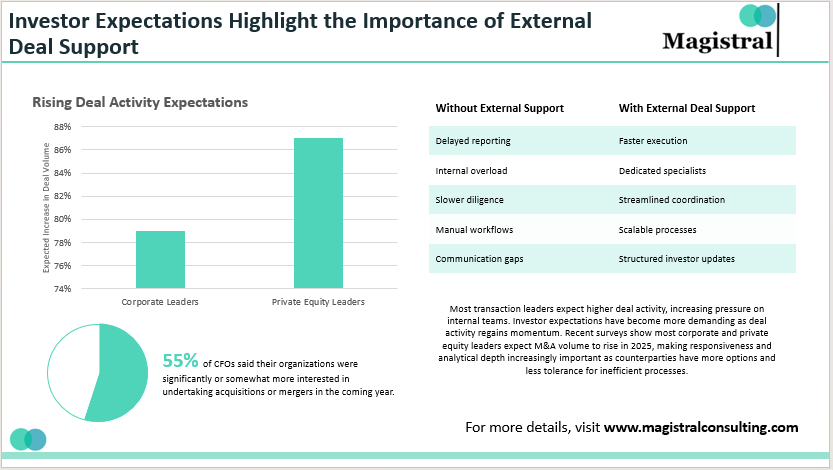
Investor expectations have been becoming more strict in light of the growing interest in deal making. According to Deloitte, 55% of CFOs stated in its 4Q 2024 CFO Signals survey, released in January 2025, that they were either much more or somewhat more interested in acquiring or merging within the next year. In Deloitte’s 2025 M&A Trends Survey, 79% of corporate executives and 87% of private equity executives also predicted higher deal volumes. As the interest in deals grows, quick response becomes more necessary since alternative sources can be considered by the counterparties.

Fundraising Processes Require Specialized Coordination

Fundraising processes include fundraising efforts, investor outreach, presentation planning, value determination, and due diligence coordination. In-house staff handling all these operations simultaneously can find themselves overloaded, and so external deal support can help them out.
Firms working in the venture capital environment usually have their external support teams involved in handling investor pipelines and workflow reporting to enable founders and top management teams to concentrate on positioning rather than coordination.

Investor Materials Need Greater Precision

Investor communication today includes market analysis, competitor benchmarking, and financial forecasts. Stock generic materials can no longer satisfy institutional investors.
External deal support experts usually boost the quality of the investor communication process by adding industry benchmarks, operational key performance indicators, and market insights into presentation documents.

Valuation Discussions Become More Analytical

Valuations in fundraising transactions today are becoming more analytical and less historical. Potential buyers test how firms would survive different economic scenarios before investing money.
Companies seeking external advice usually bolster their negotiation power by improving their forecasts and analyses.

Market Volatility Increases Transaction Pressure

Issues like economic uncertainty, inflation fears, and geopolitical disruption are impacting transaction markets around the world. In a period of market volatility, the ability to react quickly is paramount.
External deal support firms can provide organizations with an opportunity to adjust to changing market situations in an accelerated manner by improving reporting speed and preserving analysis through the process of negotiating the transaction.

Technology Gaps Often Indicate the Need for External Deal Support

In recent decades, technology has revolutionized transaction execution in such areas as fundraising, mergers & acquisitions, and financial reporting. Companies that do not use advanced software solutions might have difficulties executing transactions properly.

External Deal Support

Technology Gaps Often Indicate the Need for External Deal Support

Legacy Systems Slow Transaction Workflows

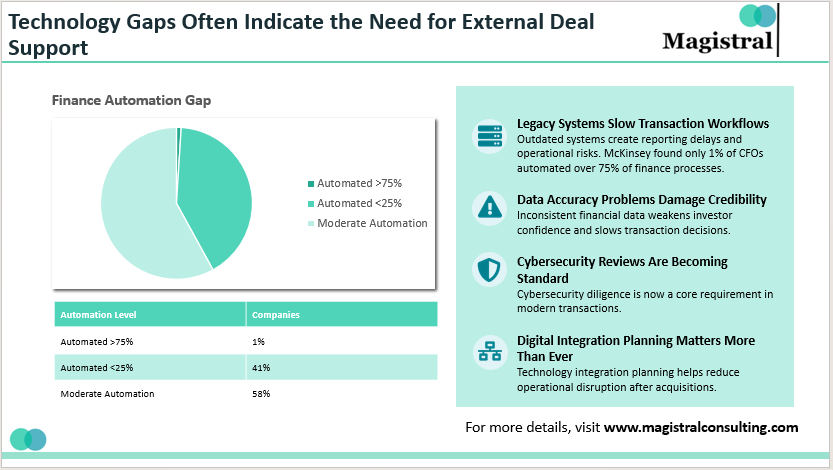
Companies operating legacy systems and utilizing fragmented reporting might experience various transaction execution issues. The use of manual processes poses additional risks to operations. According to McKinsey’s 2024 CFO Pulse research, just 1% of CFOs were able to automate more than three-quarters of their finance processes. Meanwhile, 41% of CFOs had automated up to a quarter of the functions. This technological discrepancy partially explains why many companies have difficulty producing accurate transaction data in a timely manner.

Data Accuracy Problems Damage Credibility

Discrepancies within financial data pose substantial credibility issues in the context of investor negotiations. The investors demand reliable and auditable information, backed up by effective business operations.
Firms that operate via many branches or globally must seek external deal support during deal negotiation to ensure financial data is accurately reported for analysis.

Cybersecurity Reviews Are Becoming Standard

Cybersecurity assessments have become an essential part of contemporary deals. Investors increasingly analyze cybersecurity protocols before making investment decisions.
Companies that lack internal cybersecurity capabilities may need external deal support during deal negotiations to coordinate cyber assessments and meet investors’ expectations.

Digital Integration Planning Matters More Than Ever

Modern digital integration is crucial for deal completion. Investors analyze software integrations, business scalability, and automation before concluding any business transaction.
Outside support agencies assist firms in assessing digital integration challenges and developing an implementation plan before concluding deals.

Magistral’s Services for External Deal Support

Magistral offers comprehensive external deal support services to private equity companies, investment banks, and asset management firms throughout the entire life cycle of deals. These services encompass target screening, industry/company analysis, financial modeling and valuation, due diligence help, investment memorandums drafting, competitive benchmarking, and deal flow management. Leveraging expert analysts’ support and customized engagement models, Magistral assists its clients in enhancing their efficiency, accelerating turnaround time, and managing their transaction workload effectively.


About Magistral Consulting

Magistral Consulting has helped multiple funds and companies in outsourcing operations activities. It has service offerings for Private Equity, Venture Capital, Family Offices, Investment Banks, Asset Managers, Hedge Funds, Financial Consultants, Real Estate, REITs, RE funds, Corporates, and Portfolio companies. Its functional expertise is around Deal origination, Deal Execution, Due Diligence, Financial Modelling, Portfolio Management, and Equity Research

For setting up an appointment with a Magistral representative visit www.magistralconsulting.com/contact

About the Author

Nitin is a Partner and Co-Founder at Magistral Consulting. He is a Stanford Seed MBA (Marketing) and electronics engineer with 19 + years at S&P Global and Evalueserve, leading research, analytics, and inside‑sales teams. An investment‑ and financial‑research specialist, he has delivered due‑diligence, fund‑administration, and market‑entry projects for clients worldwide. He now shapes Magistral Consulting’s strategic direction, oversees global operations, and drives business‑development support.


FAQs

What is external deal support?

External deal support refers to outsourced transaction assistance provided during mergers, acquisitions, fundraising, due diligence, valuation analysis, and investor communication processes.

When should a company consider external deal support?

Companies should consider external support when internal teams experience operational overload, reporting delays, compliance challenges, or resource shortages during transactions.

How does external deal support improve transaction efficiency?

External specialists provide dedicated expertise, faster reporting, streamlined diligence management, and stronger analytical capabilities, helping companies execute deals more efficiently.

Is external deal support useful for mid-sized companies?

Yes. Mid-sized businesses often benefit significantly because they may not maintain large in-house transaction teams, yet still face sophisticated investor expectations.

Can external deal support help during fundraising?

Absolutely. External support providers assist with financial modeling, investor reporting, diligence preparation, pitch materials, and communication management during fundraising activities.


Introduction to Deal Origination Services

Making a deal is imperative for a Venture Capital or a Private Equity firm. That is the business they are in. However, behind every successful deal that attracts investment, there is a pipeline of multiple other deals that are curated over time. Deal origination services deal in populating and updating that deal pipeline.

Every fund has an investment philosophy or mandate to make deals that are relevant for its purpose of delivering outsized returns. Some specialize in early-stage investments like Seed or Series A while others prime for late-stage investments like M&A or Series D and beyond. Whatever is the fund mandate, it’s imperative for every private equity or venture capital fund to populate the deal pipeline, so that the deals that fit every criterion could be fructified as and when required. For Hedge funds and Fund of Funds, deal origination concerns about stocks and funds respectively. Deal Origination for Investment Banking also works on similar lines.

Scope of Deal Origination Services

Private Equity Deal origination or Venture Capital Deal Origination services understand in detail the fund philosophy or the mandate. It is then broken down into actionable categories for the selection of targets. For a typical early-stage VC fund, for example, would be interested in SaaS product companies, where the product development has been done and the company is looking for commercialization in the space where the fund may have connections to bring in the early clients. This breaks down into requirements in terms of the industry of the target, industry where target’s clients are, revenues, geographical presence, employees, team, and their background, and suitability to deal terms like management ready to give majority stake, etc.

Once the profile of an ideal deal is finalized, the search begins for the potential targets, where the deal could be fetched.

Population and Update of Deal Pipeline

The deal pipeline is continually updated for the right deals. Every new deal that is originated finds a place in the deal pipeline. This also works for M&A deal Origination. As not all the details about the private companies are available in the public domain, primary research along with secondary research is employed. Details of the deal origination process are explained below

Deal Origination Services

How A Deal Pipeline is Populated?

Here are the most common ways of populating the deals pipeline:

Secondary Research

Secondary Research is the backbone of finding suitable deals. The analyst looks for the private and sometimes public companies satisfying a given set of criteria like revenue, stage, team, geographical presence, etc. Information on all relevant parameters is collected to shortlist the right target

Primary Research

Once the target is shortlisted the analyst gets in touch with the company to collect other information and understand the intent of the company to raise funds. All the information collected is duly captured in the pipeline sheet or Deal Origination platform

Accelerators

Accelerators, Incubators, and other similar Associations provide a current set of targets that are looking to raise funds and have been primed to do so. Getting in touch with such organizations provides important inputs to the deals pipeline. Sometimes these organizations distribute information through regular newsletters which need to be studied to populate the pipeline for the appropriate targets

Platforms and Events

Some multiple platforms and events help startups in raising funds. These platforms are continually looking for investors to fund their member startups. The analyst usually takes the membership of these platforms to receive periodic information

Deal Databases

There are multiple deal databases along with private company financials. Each geography has a specialized database. Sometimes databases also specialize in a given industry. Deal terms on databases help in arriving at the company valuation which is useful in the deal execution stage

Introduction to Deal Execution Services

Once the pipeline is populated and the opportunity is shortlisted for deal-making, deal execution services come into play. Deal execution services help in preparing documents that go into deal-making and negotiations involved therein.

Activities in deal execution are Financial Modeling, Valuation, Due Diligence, Strategy, Business Development Support, and Deal Documentation

Deal Execution Services

All that forms Deal Execution Services

Financial Modeling

Financial modeling serves as a host of purposes. It analyzes if the proposed acquisition, buy-out, M&A, or investments makes sense financially. It also helps in fine-tuning the financial future of the proposed asset. Revenue, profitability, and costs are forecasted to finally arrive at a proposed valuation. The financial model also takes into account the cost of capital and analyzes various exit opportunities for investors. The financial model also suggests if the investment is viable and is going to provide the expected returns to the fund. The financial model analyzes various investment scenarios too, and how key investment parameters change in all those scenarios. Financial Models have been traditionally prepared on the excel sheets but increasingly there have been multiple software products to aid the modeling and reduce the analyst errors.

Valuation

Valuation is one of the key metrics for the investment decision. It is calculated differently for different types of companies and their maturity. For public companies, the DCF Model along with comps from similar companies gives a comprehensive view. For private companies, it’s usually based on multiples prevailing in the industry. Valuations change in various business scenarios of optimistic, pessimistic, and realistic business outcomes.

Due Diligence

Due Diligence makes sure that investment is right and will meet its objective in terms of expected returns from the asset. Due Diligence checks thoroughly the financials of the company. All the assumptions made to forecast the financial future are double-checked. Due diligence also checks for the track record of the team as professionals. All aspects of Corporate Governance are verified in detail. Legal battles, statutory or government actions on the company are looked at. Due diligence gets into details of finances, strategy, assumptions, marketing, people, team, and everything else that is important. For smaller assets, it could be done in a few weeks, whereas for strategic investment it can go on for months. A data room is set to comb through the huge amount of data and information.

Strategy Formulation for Portfolio Companies

In terms of Deal Execution either the strategy is prepared or already prepared strategy document is vetted. A strategy document is put to attract co-investors and set the expectations from the management. Strategy or plan for the next 5 to 10 years is prepared. The input from the strategy document goes into financial modeling and revenue forecasts. If Strategy is already in place, assumptions are rechecked to make sure the document is robust and achievable. Annual budgets are also derived from the strategy documents.

Business Development Support for Portfolio Companies

Immediately after the deal goes through, major thrust from investors is towards the business development of the invested company. Almost always there is an imminent need of finding out and reaching out to the customers. It is usually achieved through lead generation and meetings’ set up in B2B set-up and effective digital marketing in B2C set up. Business Development support services ensure the revenue and growth forecasts are met

Deal Documentation

There are a host of documents that are prepared for fund-raising. Requirements are even more in the case of public companies. Following are the documents that are usually prepared for fund-raising

PPM/CIM: Private Placement Memorandum or Confidential Information Memorandum is a detailed document covering all aspects of the proposed investment

-1 Pager: It’s a teaser document that is sent out for information of other investors

-Financial Model: As discussed earlier in the document, it analyzes the investment in all scenarios and the respective outcomes.

-Pitch Deck: A short version of CIM which is more of a marketing document

Several other forms are filled and prepared depending on the geography of the investor and investee.

Magistral Consulting has helped multiple investors like Private Equity, Venture Capital, and Family Offices in making the right investments through all the services mentioned above. To drop an inquiry please visit www.magistralconsulting.com/contact

About Magistral

Magistral Consulting has helped multiple funds and companies in outsourcing CIO related activities. It has service offerings for Private Equity, Venture Capital, Family OfficesInvestment BanksAsset Managers, Hedge Funds, Financial Consultants, Real Estate, REITs, RE fundsCorporates and Portfolio companies. Its functional expertise is around Deal originationDeal Execution, Due Diligence, Financial ModelingPortfolio Management and Equity Research

For setting up an appointment with a Magistral representative visit www.magistralconsulting.com/contact

About the Author

The Author, Prabhash Choudhary is the CEO of Magistral Consulting and can be reached at Prabhash.choudhary@magistralconsutling.com for any queries or business inquiries.